steering wheel DODGE STRATUS 2004 2.G User Guide
[x] Cancel search | Manufacturer: DODGE, Model Year: 2004, Model line: STRATUS, Model: DODGE STRATUS 2004 2.GPages: 273
Page 117 of 273

REMOTE SOUND SYSTEM CONTROLS Ð IF
EQUIPPED
The remote sound system controls are located on the rear
surface of the steering wheel. Reach behind the wheel to
access the switches.
The right hand control is a rocker type switch with a
push-button in the center and controls the volume and
mode of the sound system. Pressing the top of the rocker
switch will increase the volume and pressing the bottom
of the rocker switch will decrease the volume.Pressing the center button will make the radio switch
between the various modes available (AM/FM/TAPE/
CD, Etc.).
The left hand control is a rocker type switch with a
push-button in the center. The function of the left hand
control is different depending on which mode you are in.
The following describes the left hand control operation in
each mode.
Radio Operation
Pressing the top of the switch will ªSeekº up for the next
listenable station and pressing the bottom of the switch
will ªSeekº down for the next listenable station.
The button located in the center of the left hand control
will tune to the next preset station that you have pro-
grammed in the radio preset push-button.
Tape Player
Pressing the top of the switch once will go to the next
selection on the cassette. Pressing the bottom of the
switch once will go to the beginning of the current
selection or to the beginning of the previous selection if it
is within the first 5 seconds of the current selection.
UNDERSTANDING YOUR INSTRUMENT PANEL 117
4
Page 141 of 273

Anti-Lock Brake System (ABS) Ð If Equipped
The ABS gives increased vehicle stability and brake
performance under most braking conditions. The system
automatically ªpumpsº the brakes during severe braking
conditions to prevent wheel lock-up.
All vehicle wheels and tires must be the same size and
tires must be properly inflated to produce accurate
signals for the ABS computer. However, the system will
compensate when the compact spare is in use.
During stops where ABS is activated, a vibration of the
brake pedal may be felt and associated system noises
may be heard.
WARNING!
Pumping of the brake pedal will diminish the effec-
tiveness of Anti-lock brakes and may lead to an
accident. Pumping makes the stopping distance
longer. Just press firmly on your brake pedal when
you need to slow down or stop.
WARNING!
²Anti-lock system (ABS) cannot prevent the natu-
ral laws of physics from acting on the vehicle, nor
can it increase braking or steering efficiency be-
yond that afforded by the condition of the vehicle
brakes and tires or the traction afforded.
²The ABS cannot prevent accidents, including
those resulting from excessive speed in turns,
following another vehicle too closely, or hydro-
planing. Only a safe, attentive, and skillful driver
can prevent accidents.
²The capabilities of an ABS equipped vehicle must
never be exploited in a reckless or dangerous
manner which could jeopardize the user's safety
or the safety of others.
STARTING AND OPERATING 141
5
Page 142 of 273

POWER STEERING
The power assisted steering system of your vehicle
provides mechanical steering capability in the event
power assist is lost.
If for some reason the hydraulic pressure is interrupted,
it will still be possible to steer your vehicle. Under these
conditions you will observe a substantial increase in
steering effort.
TRACTION CONTROL Ð IF EQUIPPED
The Traction Control System reduces wheel
slip and maintains traction at the driving
(front) wheels. The system reduces wheel slip
by engaging the brake on the wheel that is
losing traction while spinning. The traction system oper-
ates at speeds below 35 mph (56 km/h).
The system is always in the ªstand byº mode unless:
²The Traction Control switch has been used to turn the
system off;
²There is an Anti-Lock Brake or Traction System mal-
function;
²The system has been deactivated to prevent damage to
the brake system due to overheated brake tempera-
tures.
NOTE:Extended heavy use of Traction Control may
cause the system to deactivate and turn on the Traction
Control indicator located in the instrument cluster.
This is to prevent overheating of the brake system and is
a normal condition. After cooling, the system will auto-
matically reactivate and turn off the Traction Control
Light.
142 STARTING AND OPERATING
Page 156 of 273
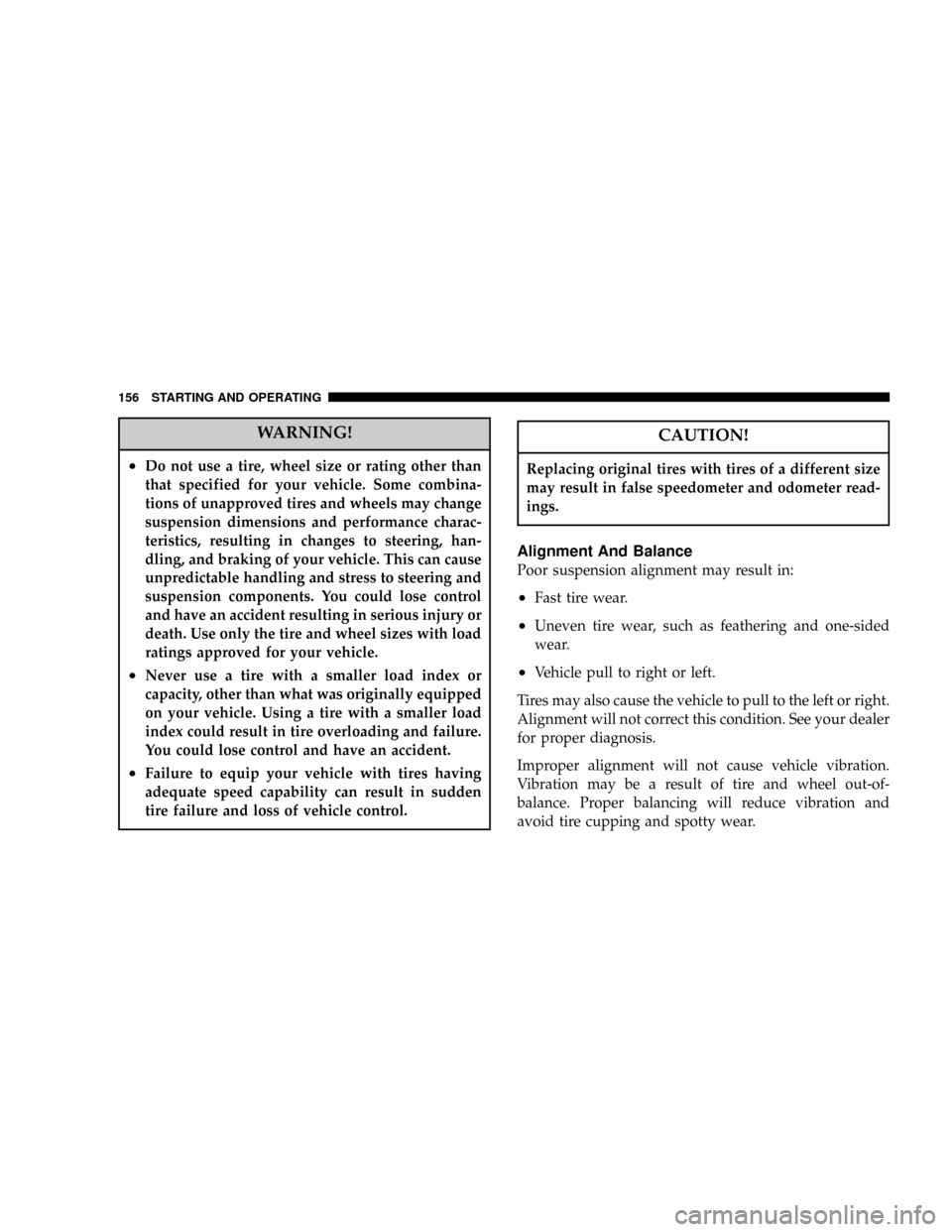
WARNING!
²Do not use a tire, wheel size or rating other than
that specified for your vehicle. Some combina-
tions of unapproved tires and wheels may change
suspension dimensions and performance charac-
teristics, resulting in changes to steering, han-
dling, and braking of your vehicle. This can cause
unpredictable handling and stress to steering and
suspension components. You could lose control
and have an accident resulting in serious injury or
death. Use only the tire and wheel sizes with load
ratings approved for your vehicle.
²Never use a tire with a smaller load index or
capacity, other than what was originally equipped
on your vehicle. Using a tire with a smaller load
index could result in tire overloading and failure.
You could lose control and have an accident.
²Failure to equip your vehicle with tires having
adequate speed capability can result in sudden
tire failure and loss of vehicle control.
CAUTION!
Replacing original tires with tires of a different size
may result in false speedometer and odometer read-
ings.
Alignment And Balance
Poor suspension alignment may result in:
²Fast tire wear.
²Uneven tire wear, such as feathering and one-sided
wear.
²Vehicle pull to right or left.
Tires may also cause the vehicle to pull to the left or right.
Alignment will not correct this condition. See your dealer
for proper diagnosis.
Improper alignment will not cause vehicle vibration.
Vibration may be a result of tire and wheel out-of-
balance. Proper balancing will reduce vibration and
avoid tire cupping and spotty wear.
156 STARTING AND OPERATING
Page 172 of 273

HAZARD WARNING FLASHER
The flasher switch is on top of the steering column,
just behind the steering wheel. Depress the switch
and both cluster indicators and all front and rear direc-
tional signals will flash. Depress the switch again to turn
Hazard Warning Flashers off.
Do not use this emergency warning system when the
vehicle is in motion. Use it when your vehicle is disabled
and is creating a safety hazard for other motorists.If it is necessary to leave the vehicle to go for service, the
flasher system will continue to operate with the ignition
key removed and the vehicle locked.
NOTE:With extended use, the flasher may wear down
your battery.
IF YOUR ENGINE OVERHEATS
In any of the following situations, you can reduce the
potential for overheating by taking the appropriate ac-
tion.
²On the highways Ð Slow down.
²In city traffic Ð While stopped, put transaxle in
neutral, but do not increase engine idle speed.
NOTE:There are steps that you can take to slow down
an impending overheat condition. If your air conditioner
is on, turn it off. The air conditioning system adds heat to
the engine cooling system and turning off the A/C
removes this heat. You can also turn the Temperature
control to maximum heat, the Mode control to floor, and
172 WHAT TO DO IN EMERGENCIES
Page 183 of 273

FREEING A STUCK VEHICLE
If your vehicle is equipped with Traction Control, turn
the system off before attempting to ªrockº the vehicle.
If your vehicle becomes stuck in mud, sand or snow, it
can often be moved by a rocking motion. Turn your
steering wheel right and left to clear the area around the
front wheels. Then shift back and forth between Reverse
and First gear. Usually the least accelerator pedal pres-
sure to maintain the rocking motion without spinning the
wheels is most effective.
CAUTION!
Racing the engine or spinning the wheels too fast
may lead to transaxle overheating and failure. It can
also damage the tires. Do not spin the wheels above
30 mph (48 km/h).
TOWING A DISABLED VEHICLE
Flat bed towing is the preferred towing method. If a flat
bed towing vehicle is not available, a wheel lift towing
vehicle may be used.
Rear towing is not recommended with the front wheels
on the ground, as transaxle damage can result. If rear
towing is the only alternative, a front end dolly must be
used.
CAUTION!
Do not use sling type towing equipment. Damage to
the fascia and air dam may result.
WHAT TO DO IN EMERGENCIES 183
6
Page 184 of 273

TOWING THIS VEHICLE BEHIND ANOTHER
VEHICLE (Flat towing with all four wheels on the
ground)
Automatic Transaxle
Your vehicle may be towed under the following condi-
tions: The gear selector must be in NEUTRAL, the
distance to be towed must not exceed 15 miles (25 km),
and the towing speed must not exceed 25 mph (40
km/h). If the transaxle is not operative, or if the vehicle
is to be towed more than 15 miles (25 km), the vehicle
must be towed with the front wheels off the ground.
Manual Transaxle
If your vehicle is equipped with a manual transaxle, it
may be towed at any legal highway speed, for any
distance, if the transaxle is in neutral.
All Transaxles
CAUTION!
If the vehicle being towed requires steering, the
ignition switch must be in the OFF position, not in
the LOCK or ACCESSORY positions.
If it is necessary to use the accessories while being towed
(wipers, defrosters, etc.), the key must be in the ON
position, not the ACCESSORY position. Make certain the
transaxle remains in NEUTRAL.
184 WHAT TO DO IN EMERGENCIES
Page 198 of 273

²Do not idle the engine with any spark plug wires
disconnected for prolonged period.
Engine Timing Belt
Replace the engine timing belt (2.4L Only) at the intervals
described in the appropriate maintenance schedule.
Crankcase Emission Control System
Proper operation of this system depends on freedom
from sticking or plugging due to deposits. As vehicle
mileage builds up, the Positive Crankshaft Ventilation
(PCV) valve and passages may accumulate deposits. If a
valve is not working properly, replace it with a new
valve. DO NOT ATTEMPT TO CLEAN THE OLD PCV
VALVE!
Check ventilation hose for indication of damage or
plugging deposits. Replace if necessary.
Maintenance-Free Battery
The top of the MAINTENANCE-FREE battery is perma-
nently sealed. You will never have to add water, nor is
periodic maintenance required.
NOTE:The battery is stored in a compartment behind
the left front fender and is accessible without removing
the tire and wheel. Remote battery terminals are located
in the engine compartment for jump starting.
To access the battery, turn the steering wheel fully to the
right and remove the inner fender shield.
198 MAINTAINING YOUR VEHICLE
Page 229 of 273
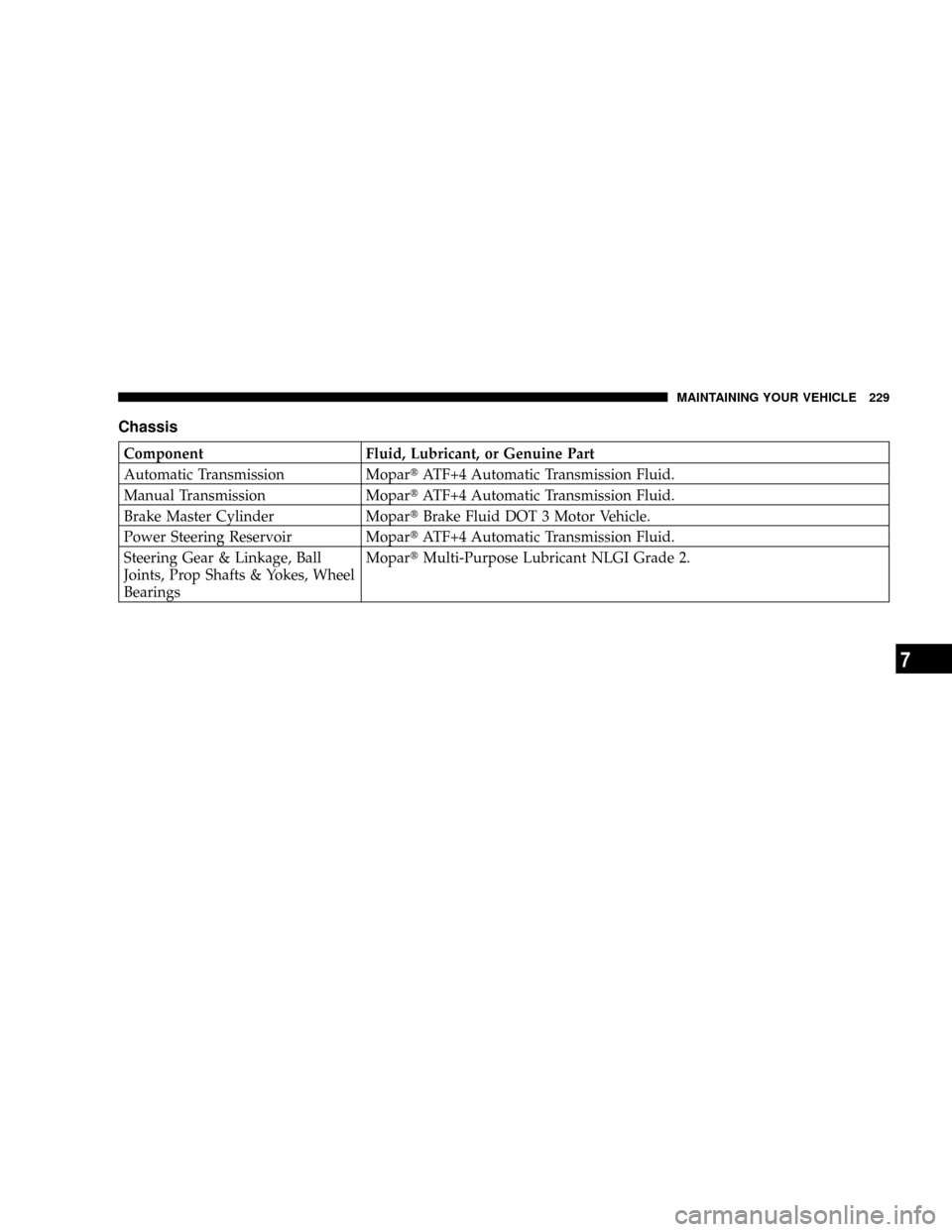
Chassis
Component Fluid, Lubricant, or Genuine Part
Automatic Transmission MopartATF+4 Automatic Transmission Fluid.
Manual Transmission MopartATF+4 Automatic Transmission Fluid.
Brake Master Cylinder MopartBrake Fluid DOT 3 Motor Vehicle.
Power Steering Reservoir MopartATF+4 Automatic Transmission Fluid.
Steering Gear & Linkage, Ball
Joints, Prop Shafts & Yokes, Wheel
BearingsMopartMulti-Purpose Lubricant NLGI Grade 2.
MAINTAINING YOUR VEHICLE 229
7
Page 271 of 273

Speedometer........................... 86
Starting.............................. 130
Cold Weather........................ 131
Engine Fails to Start................... 132
Steering
Power...........................142,200
Tilt Column.......................... 66
Steering Wheel Mounted Sound System
Controls............................ 117
Stuck, Freeing......................... 183
Sun Roof.............................. 75
Supplemental Restraint System - Airbag....... 33
Synthetic Engine Oil..................... 195
Tachometer............................ 86
Tape Player........................... 117
Temperature Gauge, Engine Coolant.......87,173
Theft Alarm............................ 22
Theft System........................... 22
Tilt Steering Column..................... 66
Tire and Loading Information Placard....... 147
Tire Identification Number (TIN)........... 146
Tire Markings......................... 143Tire Safety Information................... 143
Tires ...........................50,150,258
Air Pressure......................... 150
Alignment.......................... 156
Chains............................. 157
Changing........................... 174
Compact Spare....................... 153
Flat Changing........................ 174
General Information................... 150
High Speed......................... 152
Inflation Pressures.................... 151
Load Capacity....................... 147
Quality Grading...................... 258
Radial............................. 153
Replacement......................... 155
Rotation............................ 157
Safety...........................143,150
Sizes............................... 144
Snow Tires.......................... 157
Spinning............................ 154
Tread Wear Indicators.................. 155
Towing...........................183,184
Disabled Vehicle...................... 183
INDEX 271
10