warning DODGE STRATUS COUPE 2004 2.G Owners Manual
[x] Cancel search | Manufacturer: DODGE, Model Year: 2004, Model line: STRATUS COUPE, Model: DODGE STRATUS COUPE 2004 2.GPages: 388, PDF Size: 2.28 MB
Page 214 of 388
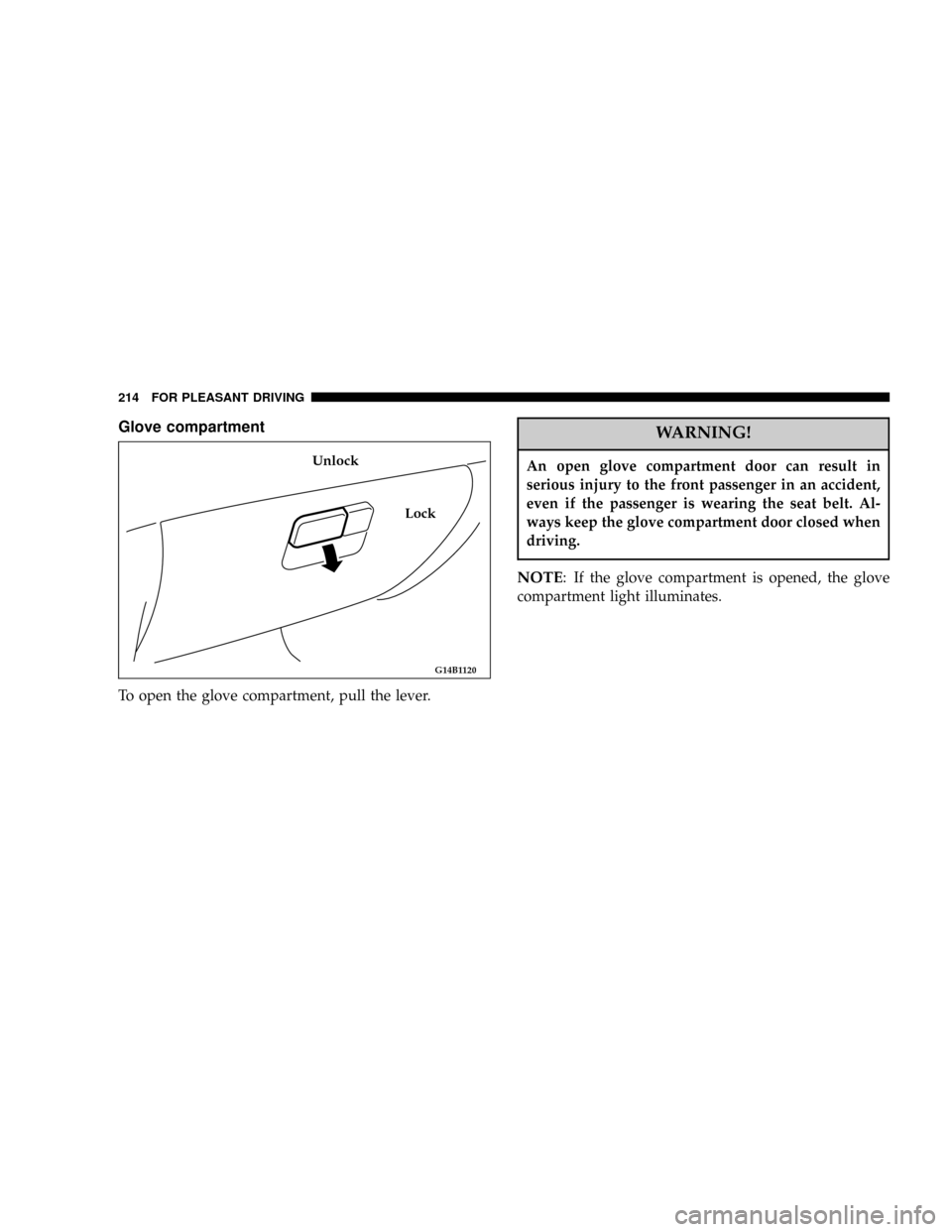
Glove compartment
To open the glove compartment, pull the lever.
WARNING!
An open glove compartment door can result in
serious injury to the front passenger in an accident,
even if the passenger is wearing the seat belt. Al-
ways keep the glove compartment door closed when
driving.
NOTE: If the glove compartment is opened, the glove
compartment light illuminates.
G14B1120
Lock Unlock
214 FOR PLEASANT DRIVING
Page 234 of 388

Do not wipe in a circle. Never use any chemicals such
as benzine, paint thinner, a disc spray cleaner, or an
anti-static agent on the disc.
(8) Do not use a ball point pen, felt pen, pencil, etc. to
write on the label surface of the disc.
(9) Do not put additional labels (A) or stickers (B) on
compact discs. Also, do not use any compact disc on
which a label or sticker has started to peel off or anycompact disc that has stickiness or other contamina-
tion left by a peeled-off label or sticker. If you use
such a compact disc, the CD player may stop working
properly and you may not be able to eject the
compact disc.
CD player laser warning
WARNING!
Operating the CD player in a manner other than
specifically instructed herein may result in hazard-
ous radiation exposure.
Do not remove the cover and attempt to repair the
CD player by yourself. There are no user serviceable
parts inside. In case of malfunction, contact an
authorized dealer.
RADIO OPERATION AND CELLULAR PHONES
Under certain conditions, the operation of a cellular
phone in your vehicle can cause erratic or noisy perfor-
mance from your radio. This condition may be lessened
or eliminated by relocating the cellular phone antenna.
H12F0160
234 FOR PLEASANT DRIVING
Page 249 of 388

WARNING!
If you use a cellular phone while driving, keep your
attention on your driving, in order to reduce risk of
accidents.
FOR PLEASANT DRIVING 249
6
Page 263 of 388

IF THE VEHICLE BREAKS DOWN
If the vehicle breaks down on the road, move to the
shoulder and activate the hazard warning flashers. If
there is no shoulder, or the shoulder is not safe, drive in
the right lane, slowly, with the hazard flashers activated,
until you reach a safe place to stop. Keep the flashers
activated.
If the engine quits
If the engine stops, power will be lost to the steering and
brakes, making steering and braking difficult.
1. The brake booster becomes inoperative and the brake
pedal will be harder to push than usual.
2. Since power steering system is not operative, the
steering wheel will be stiff when turning. Turn the wheel
with more effort than usual.
OPERATION UNDER ADVERSE DRIVING
CONDITIONS
If your vehicle becomes stuck in sand, mud or
snow
If the vehicle becomes stuck in snow, sand, or mud, it can
often be moved by a rocking motion. Turn your steering
wheel right and left to clear the area around the wheels.
Move the gearshift lever or selector lever rhythmically
between the 1st and REVERSE position (with manual
transaxle), ``L'' (Low) and ``R'' (REVERSE) position (with
automatic transaxle), Autostick and ``R'' (REVERSE posi-
tion (with automatic transaxle autostick), while applying
slight pressure to the accelerator pedal.
Avoid racing the engine or spinning the wheels. Pro-
longed efforts to free a stuck vehicle may result in
overheating and transaxle failure.
Allow the engine to idle for a few minutes to let the
transaxle cool between rocking attempts.
If the vehicle remains stuck after several rocking at-
tempts, seek other assistance.
EMERGENCIES 263
8
Page 264 of 388

WARNING!
When attempting to rock your vehicle out of a stuck
position, be sure that the area around the vehicle is
clear of people. The rocking motion may cause the
vehicle to suddenly lurch forward or backward,
causing injury to by-standers.
On a wet road
CAUTION!
²Avoid flooded roads. Water depth can be decep-
tive, and you could be seriously hurt by driving
into flood water.
²When driving in rain, on water-covered roads, or
through a vehicle wash, water could enter the
brake drum linings or discs, resulting in tempo-
rarily ineffective brakes. In such cases, lightly
depress the brake pedal to see if the brakes
operate properly. If they do not, lightly depress
the pedal several times while driving in order to
dry the brake pads or linings, then check them
again.
264 EMERGENCIES
Page 270 of 388

Before installing the wheel cover to the wheel, make sure
that the opening with the symbol mark is correctly
aligned with the air valve.
JACKING AND TIRE CHANGING
If a tire must be changed, do so only after making sure
the vehicle is stopped in a safe, flat location.
Jacking up the vehicle
1. Park the vehicle on level and stable ground.
2. Switch on the hazard warning flashers, set up a
warning triangle, flashing signal light, etc., at an ad-
equate distance from the vehicle, and have all passengers
leave the vehicle. Turn the ignition key to the ªLOCKº
position.
3. Set the parking brake firmly, and move the gearshift
lever (manual transaxle) to the ªNº (Neutral) position or
move the selector lever (automatic transaxle) to the ªPº
(PARK) position.4. Apply a chock or block (A) at the tire diagonally
opposite the tire (B) to be changed.
NOTE: The chock shown is not supplied with the ve-
hicle. It is recommended that you keep one in the vehicle
for use if required.
N24A0100
A
B
270 EMERGENCIES
Page 271 of 388
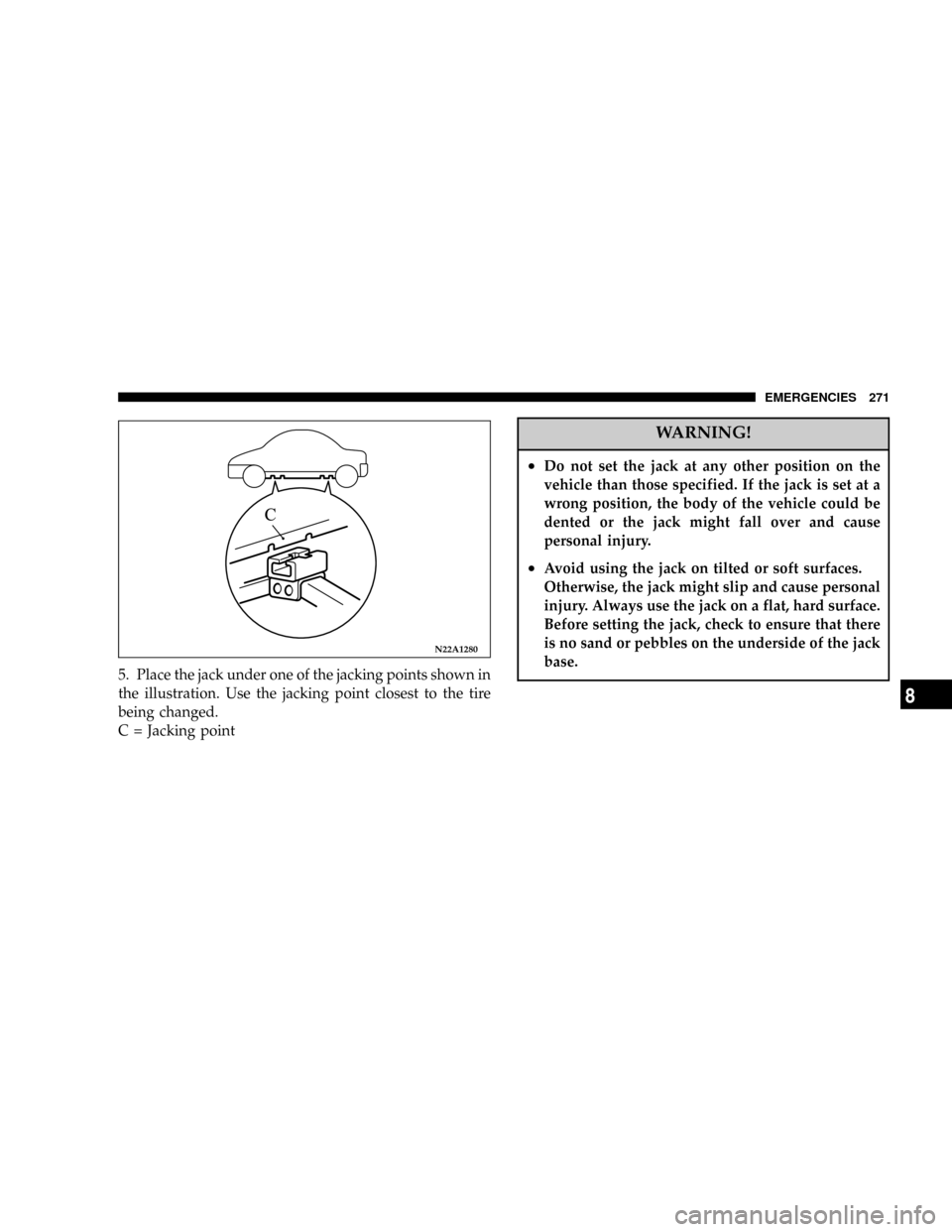
5. Place the jack under one of the jacking points shown in
the illustration. Use the jacking point closest to the tire
being changed.
C = Jacking point
WARNING!
²Do not set the jack at any other position on the
vehicle than those specified. If the jack is set at a
wrong position, the body of the vehicle could be
dented or the jack might fall over and cause
personal injury.
²Avoid using the jack on tilted or soft surfaces.
Otherwise, the jack might slip and cause personal
injury. Always use the jack on a flat, hard surface.
Before setting the jack, check to ensure that there
is no sand or pebbles on the underside of the jack
base.
N22A1280
EMERGENCIES 271
8
Page 274 of 388

WARNING!
²Before using the jack, chock or block the wheel
that is tire diagonally opposite the jacking point.
²Stop jacking up the vehicle when the tire is raised
off the ground. It is dangerous to raise the vehicle
any higher.
²Do not get under the vehicle while using the jack.
²Avoid jarring the raised vehicle or leaving it
supported on the jack for extended periods. Both
are very dangerous.
²Do not use a jack other than the one provided
with your vehicle.
²The jack should not be used for any purpose other
than changing a tire.
²No one should stay in the vehicle while the jack is
used.
²Do not start or run the engine while the vehicle is
on the jack.
NOTE: Place the spare wheel under the vehicle body
near the jack; this helps to minimize danger should the
jack slip out of position.
N24A1500
274 EMERGENCIES
Page 279 of 388

CAUTION!
Driving with a hot cooling system could damage
your vehicle. If temperature gauge reads ªHº, pull
over and stop the vehicle. Idle the vehicle with the
air conditioner turned off until the pointer drops
back into the normal range. If the pointer remains on
the ªHº, turn the engine off immediately, and call for
service.
WARNING!
A hot engine cooling system is dangerous. You or
others could be badly burned by steam or boiling
coolant. You may want to call a service center if your
vehicle overheats. If you decide to look under the
hood yourself, see Maintenance Section of this
manual. Follow the warnings under the Cooling
System Pressure Cap paragraph.
WARNING!
²When working near the radiator cooling fan, dis-
connect the fan motor lead or turn the ignition key
to the OFF position. The fan is temperature con-
trolled and can start at any time the ignition key is
in the ON position.
²You or others can be badly burned by hot coolant
or steam from your radiator. If you see or hear
steam coming from under the hood, don't open
the hood until the radiator has had time to cool.
Never try to open a cooling system pressure cap
when the radiator is hot.
JUMP-STARTING THE ENGINE
If the engine cannot be started because the battery is
weak or dead, the battery from another vehicle can be
used with booster cables to start the engine.
EMERGENCIES 279
8
Page 280 of 388

WARNING!
When using jumper cables to start a vehicle, follow
procedures exactly and exercise extreme caution.
CAUTION!
Do not try to start your vehicle by pushing or towing.
Vehicles equipped with an automatic transaxle can-
not be started this way. Pushing or towing a vehicle
equipped with a manual transaxle may overheat and
damage the catalytic converter. Also, there is a
greater risk of an accident when a vehicle is being
pushed or towed.
1. Remove any metal jewelry such as watch bands or
bracelets that might make an inadvertent electrical con-
tact.
2. Position the vehicles close enough together so the
booster cables can reach, but be sure the vehicles aren't
touching each other. If they are, it could cause a groundconnection. You wouldn't be able to start your vehicle,
and the bad ground could damage the electrical systems.
CAUTION!
Check the other vehicle. It must have a 12-volt
battery. If the other system isn't 12-volts, both sys-
tems can be damaged.
3. You could be injured if the vehicles move. Set the
parking brake firmly on each vehicle. Put an automatic
transaxle in ªPº (PARK) or a manual transaxle in ªNº
(Neutral). Turn the ignition key to the ªLOCKº position.
WARNING!
Turn the ignition key to the ªLOCKº position on
both vehicles.
Use care to make sure that the cables or your clothes
are never caught by the fan or drive belt. Personal
injury could result.
280 EMERGENCIES