fuel DODGE STRATUS COUPE 2004 2.G Owner's Manual
[x] Cancel search | Manufacturer: DODGE, Model Year: 2004, Model line: STRATUS COUPE, Model: DODGE STRATUS COUPE 2004 2.GPages: 388, PDF Size: 2.28 MB
Page 151 of 388

THEFT PROTECTION
CAUTION!
Always remove the key from the ignition switch and
lock all doors when leaving the vehicle unattended.
Always try to park your vehicle in a well lighted
area.
The ignition key can only be removed in the ªLOCKº
position. If the key is left in the lock cylinder, a warning
chime sounds when the driver's door is opened.
NOTE: If your vehicle is equipped with a Theft-alarm
system, refer to ªTheft-alarm systemº.
STEERING LOCK
Withdraw the key and the steering wheel will be locked.
Turn the steering wheel to confirm that it is locked.
CAUTION!
If your vehicle needs to be towed, turn the key to the
(ACC(position to unlock the steering wheel.
STARTING
Tips for starting
1. Do not operate the starter motor continuously for
longer than 15 seconds at a time; doing so could run
down the battery. If the engine does not start, turn the
ignition switch back to ªLOCKº, wait a few seconds, and
then try again.
2. If the engine will not start because the battery is weak
or dead, refer to ªJump-starting the engineº section (page
277) for instructions on starting the engine.
3. The engine is well warmed up if the pointer of the
coolant temperature gauge starts to move. Extended
warm up operation will result in excessive fuel consump-
tion.
STARTING AND DRIVING 151
5
Page 152 of 388
WARNING!
Never run the engine in a closed or poorly ventilated
area any longer than is needed to move your vehicle
in or out of the area. Carbon monoxide gas, which is
odorless, colorless and extremely poisonous, could
build up, and cause serious injury or death.
CAUTION!
²Do not start the vehicle by pushing or pulling.
²Do not run the engine at high rpm or drive the
vehicle at high speed until the engine has had a
chance to warm up.
²Release the ignition key as soon as the engine
starts to avoid damaging the starter motor.
This vehicle is equipped with an electronically controlled
fuel injection system that automatically controls fuel
quantity. When starting the engine, there is normally no
need to depress the accelerator pedal.
Normal conditions
The starting procedure is as follows:
1. Insert the ignition key and make sure all occupants are
properly seated with seat belts fastened.
2. Depress and hold the brake pedal down with your
right foot.
3. Set the gearshift selector lever (manual transaxle) in
the ªNº (NEUTRAL) position, or the selector lever (au-
tomatic transaxle) in the ªPº (PARK) position.
4. Fully depress the clutch pedal (manual transaxle).
NOTE: For models equipped with a manual trans-
axle, the starter will not operate unless the clutch
pedal is fully depressed (Clutch interlock).
5. After turning the ignition key to the ªONº position,
make certain that all warning lights are functioning
properly before starting the engine.
6. Turn the ignition key to the ªSTARTº position without
depressing the accelerator pedal, and release the key
when the engine starts.
152 STARTING AND DRIVING
Page 167 of 388

To start
Depress the clutch pedal fully and shift into 1st. Then
gradually release the clutch pedal while depressing the
accelerator pedal.
CAUTION!
²Do not move the gearshift lever into the ªRº
(REVERSE) while the vehicle is moving forward;
doing so will damage the transaxle.
²Do not rest your foot on the clutch pedal as this
will cause premature clutch wear or damage.
²Do not coast in the ªNº (NEUTRAL) position
(illegal in many states).
²Do not use the gearshift lever as a hand rest. This
can result in premature wear of the transaxle shift
forks.
NOTE
1. If it is hard to shift into 1st, depress the clutch pedal
again; the shift will then be easier to make.2. To shift into reverse from 5th gear, move the gearshift
lever to the ªNº (NEUTRAL) position, and then shift into
reverse. Never shift into the ªRº position when the
vehicle is moving.
Proper shift points
Always use care to change gears with the vehicle speed
matching the engine speed. Proper shifting will improve
fuel economy and prolong engine life.
CAUTION!
Avoid downshifting that may cause the tachometer
pointer to enter the red zone.
This puts the engine at risk of being damaged.
Upshifting
In order to efficiently utilize your manual transaxle for
both fuel economy and performance, it should be shifted
as listed below.
STARTING AND DRIVING 167
5
Page 168 of 388

At low altitude locations, shift at the vehicle speeds listed
for acceleration. Earlier upshifts during cruise conditions
(relatively steady speeds) will result in increased fuel
economy.
2.4 liter engine
Condition Upshift speeds
mph (km/h)
Acceleration Cruise
1st to 2nd 15 (25) 13 (20)
2nd to 3rd 23 (35) 18 (30)
3rd to 4th 34 (55) 33 (53)
4th to 5th 43 (70) 40 (65)
3.0 liter engine
Condition Upshift speeds
mph (km/h)
Acceleration Cruise
1st to 2nd 15 (25) 13 (20)
2nd to 3rd 23 (35) 21 (34)
3rd to 4th 34 (55) 33 (53)
4th to 5th 43 (70) 37 (60)
In high altitude locations, it should be upshifted as listed
below.
Condition Upshift speeds mph (km/h)
1st to 2nd 15 (25)
2nd to 3rd 25 (40)
3rd to 4th 40 (65)
4th to 5th 45 (70)
Downshifting
It is recommended that you downshift to a lower gear
according to the table as necessary to maintain desired
speeds.
Avoid downshifting at too high a speed; the engine may
suffer damage.
To maintain a safe speed and prolong brake life, shift
down to 2nd or 1st when descending a steep grade.
Downshifting is also important to avoid ªluggingº the
engine at too low a speed, such as when turning a corner
or when driving up a steep grade.
168 STARTING AND DRIVING
Page 197 of 388
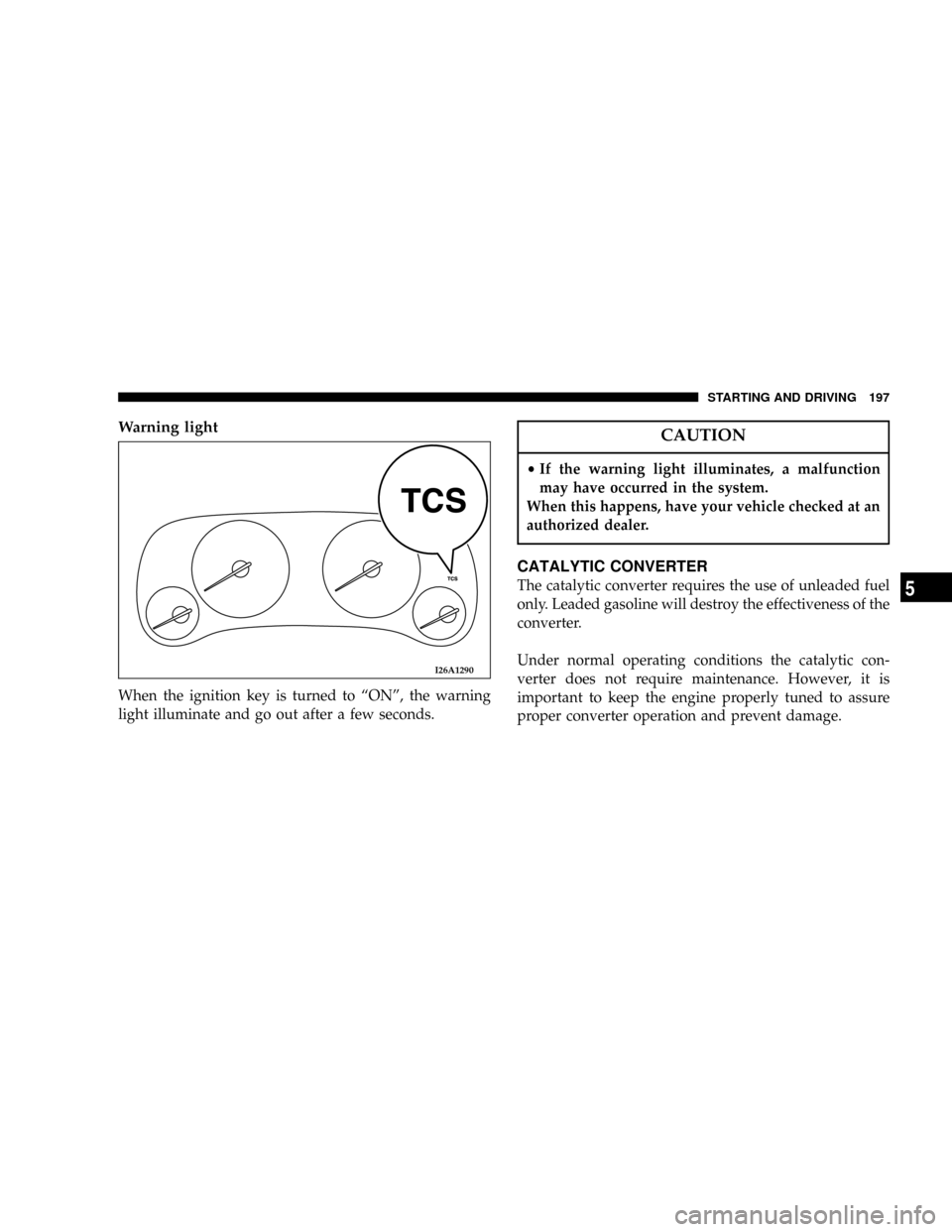
Warning light
When the ignition key is turned to ªONº, the warning
light illuminate and go out after a few seconds.
CAUTION
²If the warning light illuminates, a malfunction
may have occurred in the system.
When this happens, have your vehicle checked at an
authorized dealer.
CATALYTIC CONVERTER
The catalytic converter requires the use of unleaded fuel
only. Leaded gasoline will destroy the effectiveness of the
converter.
Under normal operating conditions the catalytic con-
verter does not require maintenance. However, it is
important to keep the engine properly tuned to assure
proper converter operation and prevent damage.
I26A1290
STARTING AND DRIVING 197
5
Page 198 of 388

CAUTION!
Damage to the catalytic converter can result if your
vehicle is not kept in proper operating condition. In
the event of an engine malfunction, particularly one
involving engine misfire or other apparent loss of
performance, have your vehicle serviced promptly.
Prolonged operation of your vehicle while it is
overheated may result in damage to the converter
and vehicle.
WARNING!
²Do not park or operate this vehicle in areas where
combustible materials such as dry grass or leaves
can come in contact with a hot exhaust, since a fire
could occur.
²Undercoating should not be applied to the cata-
lytic converter.
To minimize the possibility of catalytic converter dam-
age:
1. Use UNLEADED GASOLINE ONLY of the type rec-
ommended in ªFuel selectionº.
2. Do not drive with an extremely low fuel level; running
out of fuel could damage the catalytic converter.
3. Do not shut off the engine or interrupt the ignition
when the transaxle is in gear and the vehicle is in motion.
4. Do not try to start the engine by pushing or towing the
vehicle. If the battery is weak or discharged, use jumper
cables to properly start the engine.
5. Do not idle the engine with any spark plug wires
disconnected or removed, such as when performing
diagnostic tests.
6. Do not idle the engine for prolonged periods if it is
idling roughly or otherwise obviously malfunctioning.
7. To prevent the catalytic converter from being dam-
aged due to unburned gas, do not race the engine when
turning off the ignition switch.
198 STARTING AND DRIVING
Page 200 of 388

Check wheel nuts for tightness and tires (including spare
tire) for proper pressure. Maintain specified tire inflation
pressures. Replace tires before they are excessively worn.
Lights
Have someone observe the operation of all exterior lights
while you activate the controls. Check the turn signals
and highbeam indicators on the instrument panel.
Fluid leaks
Check the area under the vehicle after overnight parking
for fuel, water, oil, or other fluid leaks. Make sure all fluid
levels are at the proper levels. Also, if fuel leaks are
detected, the cause should be located and corrected
immediately.
Driver
Do not drive if you are tired or sleepy. Do not drive if you
have been drinking or taking drugs. Unless you are alert
and able to concentrate on your driving, you could have
an accident, resulting in serious or fatal injury to yourself
and others.
SAFE DRIVING TECHNIQUES
Even this vehicle's safety equipment, and your safest
driving, cannot guarantee that you can avoid accident or
injury. However, we recommend that you give extra
attention to the following, to help maximize the safety of
you and your passengers:
1. Drive defensively. Be aware of traffic, road and
weather conditions. Leave adequate stopping distance
for your vehicle.
2. Before changing lanes, check your mirrors and flash
the proper turn-signal light.
3. While driving, watch the behavior of other drivers,
bicyclists and pedestrians.
4. During an emergency stop, switch on the hazard
warning flasher.
5. When leaving the vehicle, set the parking brake and
place the gearshift lever into low gear.
In vehicles with an automatic transaxle, place the selector
lever in the ªPº (PARK) position. Remove the key.
200 STARTING AND DRIVING
Page 202 of 388

over curbs or parking stop blocks. Always use caution
when traveling up or down sharp inclines as your
bumper may contact the road surface.
2. Maintain specified tire inflation pressures. Replace
tires before they are excessively worn.
3. If you plan to drive in another country, comply with
the vehicle registration laws and confirm the availability
of the correct fuel.
OPERATION DURING COLD WEATHER
1. Check the battery, including terminals and cables.
During extremely cold weather, the battery capacity will
decrease. Also, the battery power level may drop because
more power is needed for cold starting and operation.
Before driving the vehicle, check to see if the engine runs
at the proper speed and if the headlights are at their usual
intensity. Charge or replace the battery if necessary.
During cold weather, it is possible that a discharged
battery could freeze.
WARNING!
The battery gives off explosive hydrogen gas. Any
spark or flame can cause the battery to explode,
which could seriously injury or kill you.
Always wear protective clothes and a face shield
when doing battery maintenance, or let a skilled
technician do it.
2. Manual transaxles may be more difficult to shift
during cold weather operation. This is normal and shift
effort will become easier as the transaxle reaches a
normal operating temperature.
Maintain low-speed operation at first to allow the trans-
axle oil to be distributed to all lubrication points.
3. Check the engine antifreeze.
If there is a shortage of coolant due to leakage or engine
overheating, add high-quality ethylene glycol antifreeze
and water. The recommended ratio is about 50% water
and 50% anti-freeze. This ratio provides adequate corro-
sion, boiling, and freeze protection.
202 STARTING AND DRIVING
Page 290 of 388
No. Symbol Electrical system Capacity
1
Fuse (+B) 60A
2
Radiator fan motor 50A
3
Anti-lock braking system 60A
4
Ignition switch 40A
5
Electric window controls 30A
6
Fog lights 15A
7Ð Ð Ð
8
Horn 15A
9
Engine control 20A
10
Air conditioning 10A
11
Stop lights 15A
12
ÐÐ
13
Alternator 7.5A
14
Hazard warning flasher 10A
15
Automatic transaxle 20A
16
Headlights high beam (right) 10A
17
Headlights high beam (left) 10A
18
Headlights low beam (right) 10A
19
Headlights low beam (left) 10A
20
Position lights (right) 7.5A
21
Position lights (left) 7.5A
No. Symbol Electrical system Capacity
22
Dome lights 10A
23
Audio 10A
24
Fuel pump 15A
25
Defroster 40A
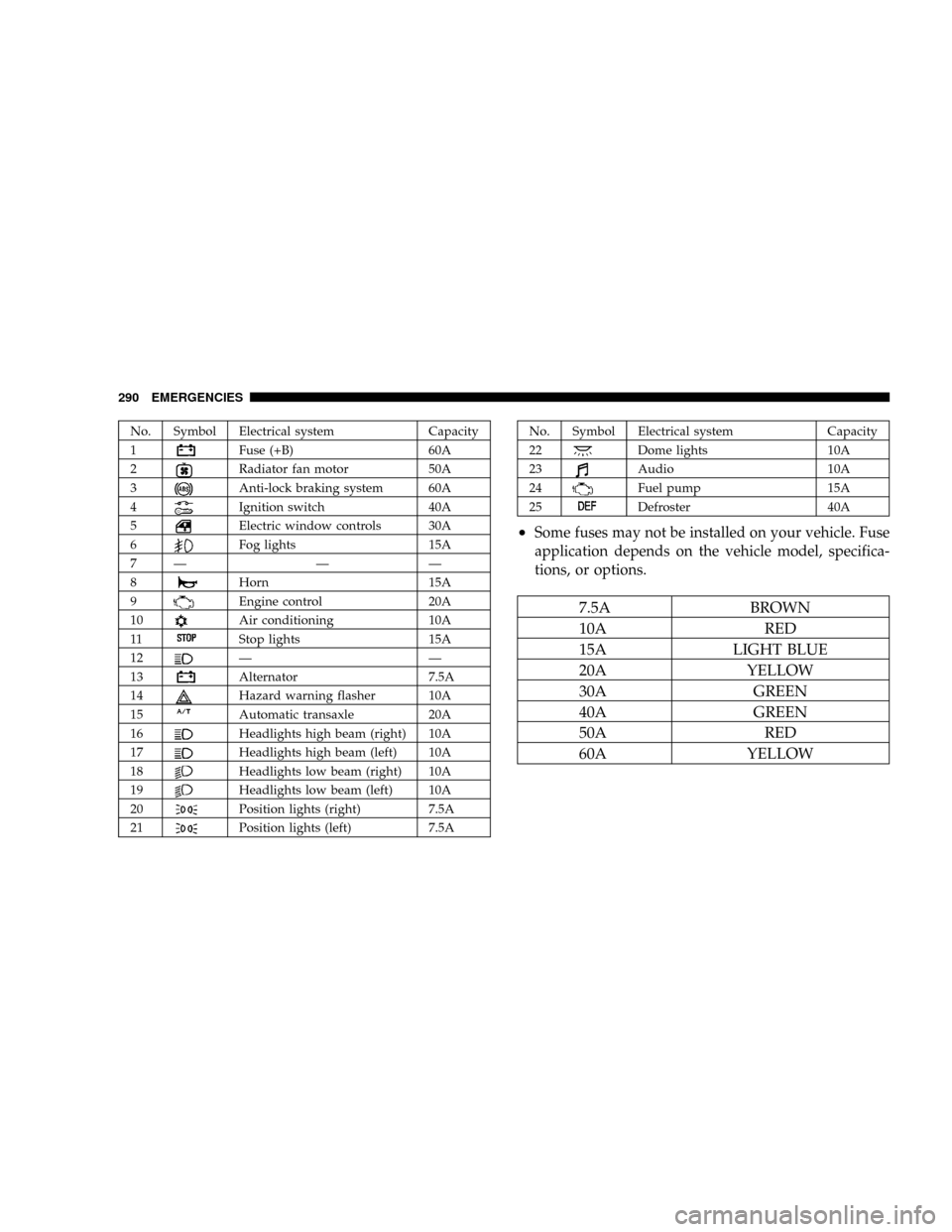
²Some fuses may not be installed on your vehicle. Fuse
application depends on the vehicle model, specifica-
tions, or options.
7.5A BROWN
10A RED
15A LIGHT BLUE
20A YELLOW
30A GREEN
40A GREEN
50A RED
60A YELLOW
290 EMERGENCIES
Page 309 of 388

MAINTENANCE
CONTENTS
mView of engine compartment..............311
mService precautions.....................312
mEmission-control system maintenance.......313
mEmissions Testing......................314
mOnboard Diagnostic System (OBD II)........314
mReplacement Parts......................315
NFuel system (tank, filler tube, connections,
and fuel tank filler cap).................315
NFuel hoses...........................315
NAir cleaner filter......................316
NEvaporative emission control system
(except evaporative emission canister).......316
NSpark plugs..........................317
NIgnition cables........................317NDistributor cap and rotor................317
mGeneral maintenance....................318
NEngine oil and oil filter..................318
mEngine coolant.........................322
NTo check the coolant level................322
NTo add coolant........................322
mBrake fluid...........................323
mClutch fluid (manual transaxle)............324
NTo check the clutch fluid.................324
NTo replace the fluid....................324
mBattery..............................325
NDuring cold weather...................325
9