lock DODGE STRATUS COUPE 2005 2.G Owners Manual
[x] Cancel search | Manufacturer: DODGE, Model Year: 2005, Model line: STRATUS COUPE, Model: DODGE STRATUS COUPE 2005 2.GPages: 396
Page 300 of 396
CAUTION!
²Never hold the halogen light bulb with a bare
hand, dirty glove, etc. The oil from your hand
could cause the bulb to break the next time the fog
lights are operated.
If the glass surface is dirty, it should be cleaned
with alcohol and installed after drying thor-
oughly.
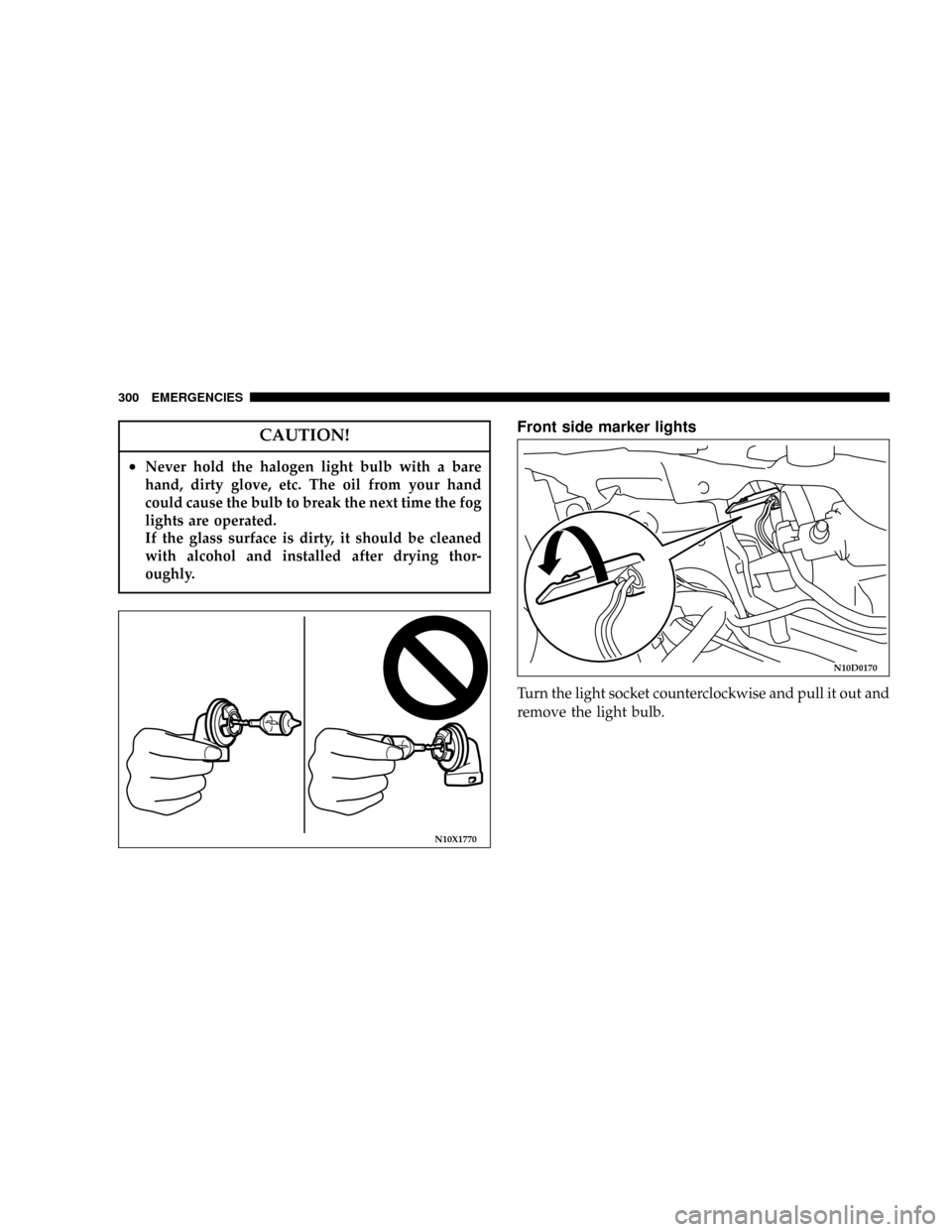
Front side marker lights
Turn the light socket counterclockwise and pull it out and
remove the light bulb.
N10X1770
N10D0170
300 EMERGENCIES
Page 301 of 396
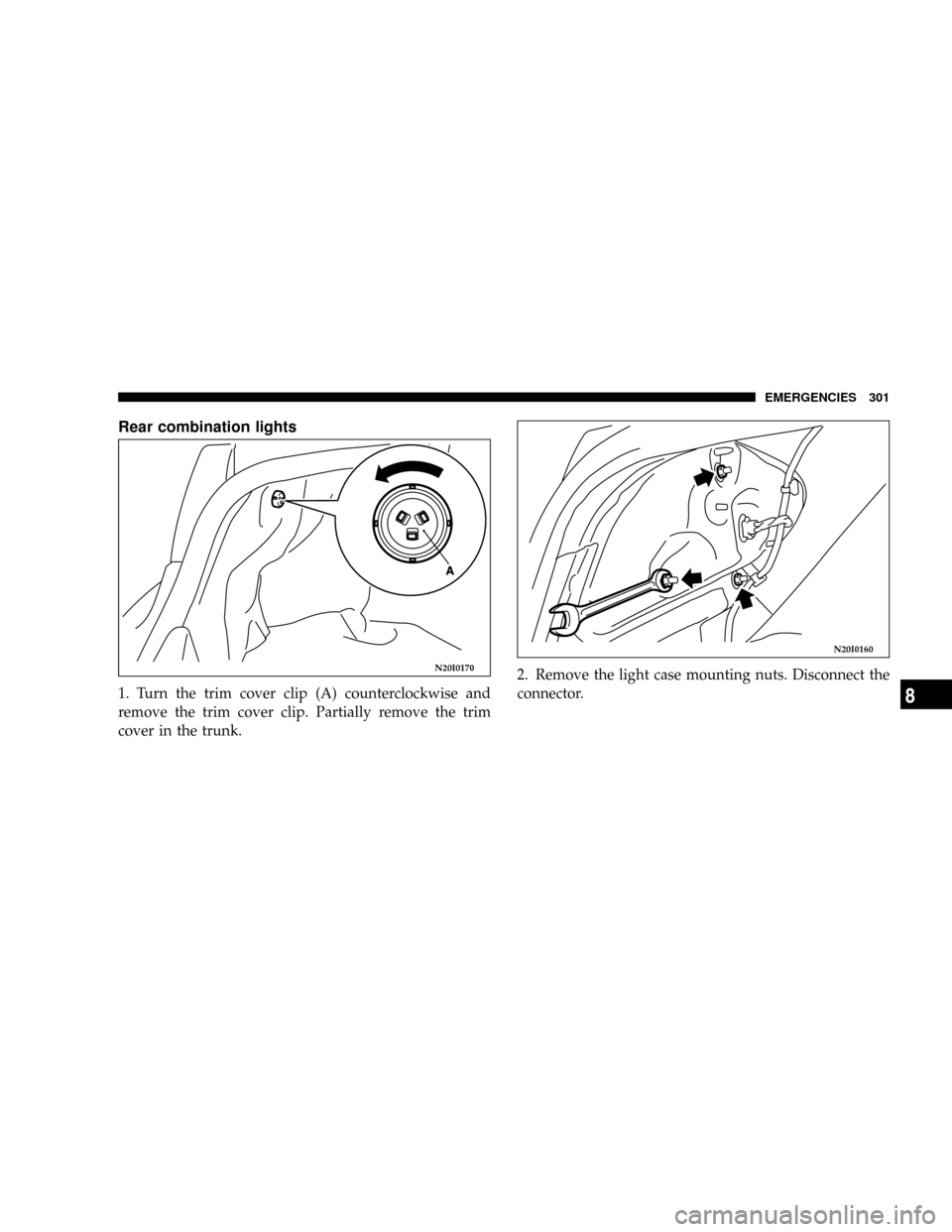
Rear combination lights
1. Turn the trim cover clip (A) counterclockwise and
remove the trim cover clip. Partially remove the trim
cover in the trunk.2. Remove the light case mounting nuts. Disconnect the
connector.
N20I0170
N20I0160
EMERGENCIES 301
8
Page 302 of 396
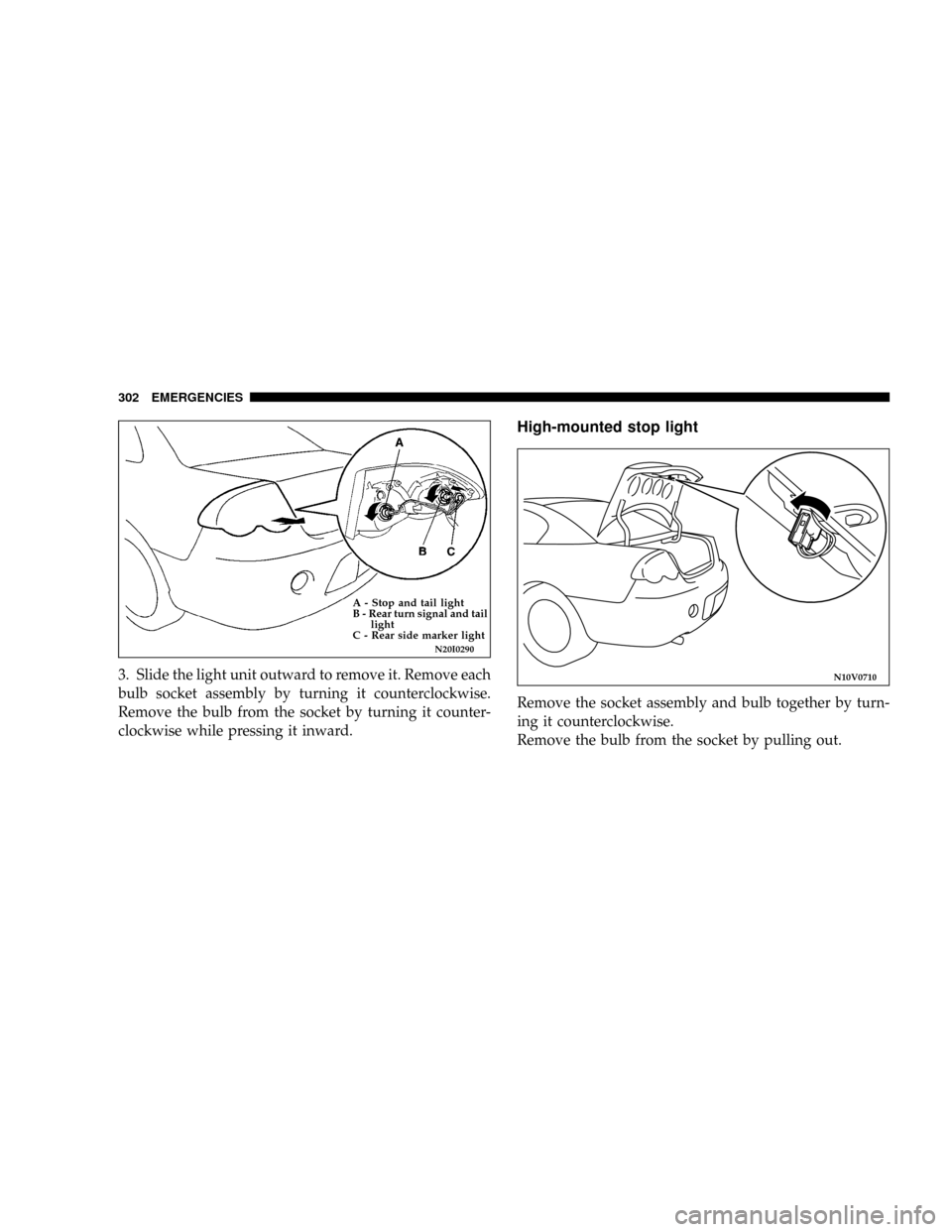
3. Slide the light unit outward to remove it. Remove each
bulb socket assembly by turning it counterclockwise.
Remove the bulb from the socket by turning it counter-
clockwise while pressing it inward.
High-mounted stop light
Remove the socket assembly and bulb together by turn-
ing it counterclockwise.
Remove the bulb from the socket by pulling out.
N20I0290
A - Stop and tail light
B - Rear turn signal and tail
light
C - Rear side marker light
N10V0710
302 EMERGENCIES
Page 303 of 396
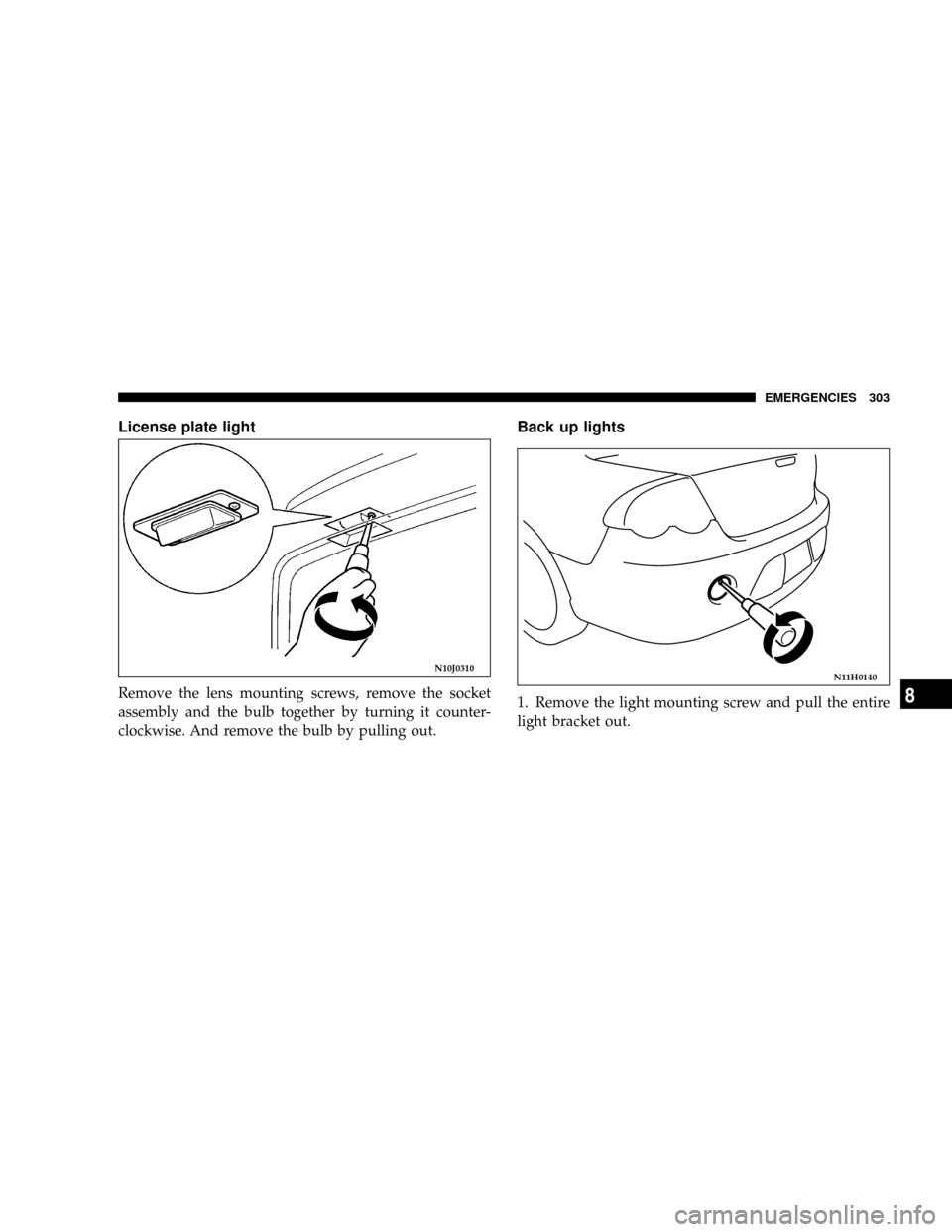
License plate light
Remove the lens mounting screws, remove the socket
assembly and the bulb together by turning it counter-
clockwise. And remove the bulb by pulling out.
Back up lights
1. Remove the light mounting screw and pull the entire
light bracket out.
N10J0310N11H0140
EMERGENCIES 303
8
Page 304 of 396
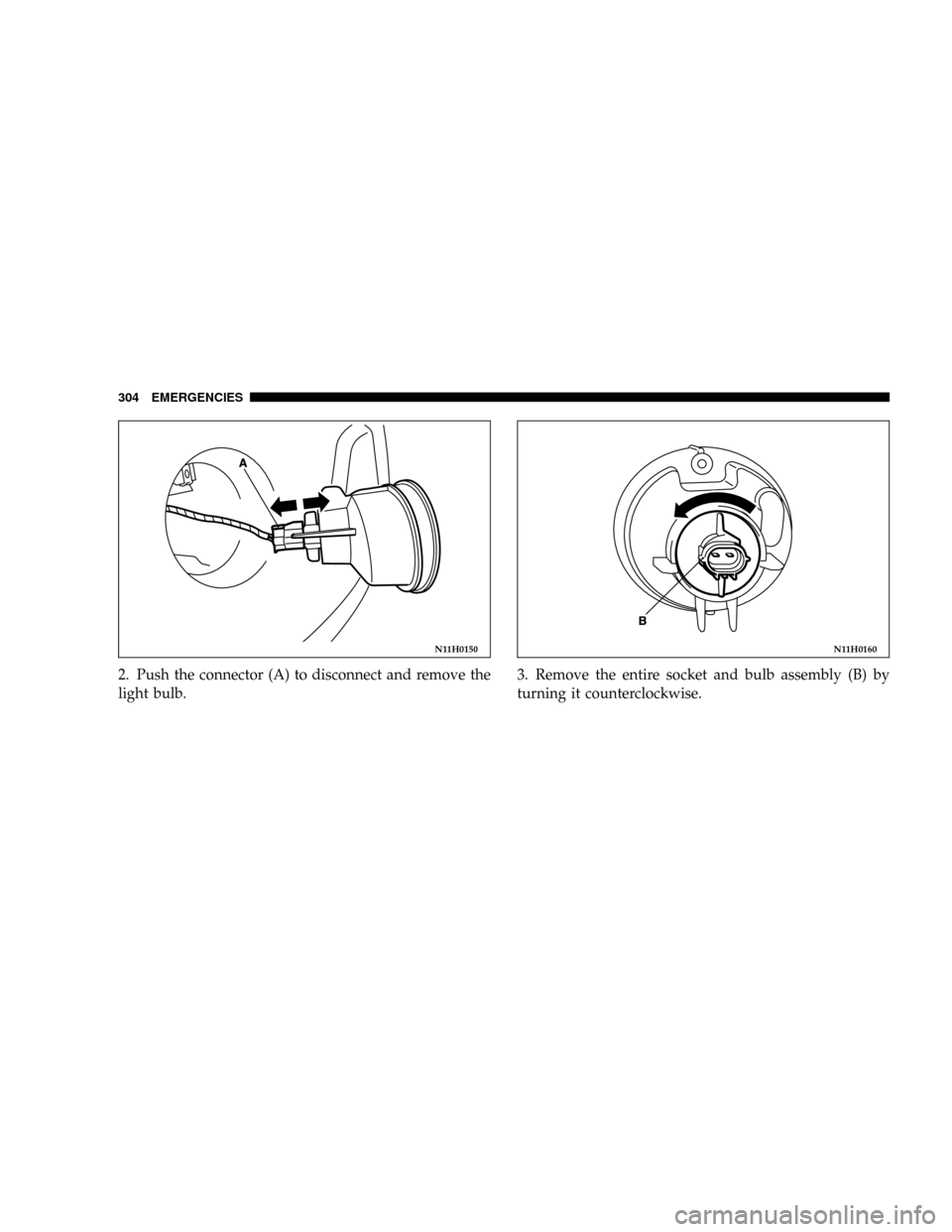
2. Push the connector (A) to disconnect and remove the
light bulb.3. Remove the entire socket and bulb assembly (B) by
turning it counterclockwise.
N11H0150N11H0160
304 EMERGENCIES
Page 310 of 396

NDisconnection and connection.............327
mAutomatic transaxle.....................329
NTo check the fluid level..................330
NProcedure for checking the fluid level.......330
mManual transaxle.......................331
mDisc brake pads, rear drum brake linings
and rear wheel cylinders.................331
mBrake hoses...........................331
mBall joint, steering linkage seal and drive
shaft boots...........................331
mSupplemental Restraint System (SRS)........331
mHood lock release mechanism and
safety catch
...........................332
mExhaust system........................332
mWindshield wiper blades.................333
NWindshield washers....................333
mParking brake.........................334
mDrive belt (for generator, water pump, power
steering pump)
........................335
mTiming belt...........................336
mTi re s................................336
NTire inflation pressures..................340
NRadial ply tires.......................341
N
Tire pressure for sustained high-speed driving...342
NReplacing tire and wheels................342
NTire maintenance......................342
NCargo loads..........................346
NTread wear indicators...................346
NTire rotation.........................347
NTire chains...........................348
NSnow tires...........................348
mRegular Maintenance Schedule.............349
mSevere Maintenance Schedule..............357
310 MAINTENANCE
Page 313 of 396
WARNING!
²The fan may turn on automatically even if the
engine is not running; turn the ignition key to the
ªLOCKº position and remove the key to ensure
safety while you work in the engine compartment.
²Do not smoke, or allow open flames around fuel
or the battery. The fumes are flammable.
²Be extremely cautious when working around the
battery. It contains poisonous and corrosive sulfu-
ric acid.
²Do not get under your vehicle with just the car's
jack supporting it.
Always use properly rated automotive jack
stands.
²Improper handling of components and materials
used in the vehicle can endanger your personal
safety. Consult an authorized dealer if you have
questions.
EMISSION-CONTROL SYSTEM MAINTENANCE
Your vehicle is equipped with an emission-control sys-
tem which satisfies all requirements of the U.S. Environ-
mental Protection Agency. The emission-control system
consists of:
(1) a positive crankcase ventilation system
(2) an evaporative emission-control system
(3) an exhaust emission- control system.
The9Scheduled9maintenance services listed must be
performed at the times or mileages specified to assure the
continued proper functioning of the emission-control
system. These, and all other ªGeneralº maintenance
services included in this manual, should be performed to
provide the best vehicle performance and reliability.
More frequent maintenance may be needed for vehicles
driven under severe operating conditions such as dusty
areas and frequent start and stop driving.
In order to assure the proper function of the emission-
control system, it is recommended that you have your
vehicle inspected and maintained by an authorized
dealer in accordance with the schedule in this manual.
Inspection and service should also be performed any
time a malfunction is suspected.
MAINTENANCE 313
9
Page 322 of 396

ENGINE COOLANT
To check the coolant level
The coolant reserve system provides a quick visual
method for determining the coolant level. When the
engine is cold, the level of the coolant in the reserve tank
should be between the FULL and LOW marks. The
radiator normally remains completely full so there is no
need to remove the radiator cap except for checking the
coolant freeze point or replacing the antifreeze coolant.
To add coolant
Use DaimlerChrysler Genuine Coolant or an equivalent.
Genuine Coolant provides excellent protection against
corrosion and rust formation of all metals, including
aluminum, and prevents clogs in the radiator, heater,
cylinder head, engine block, etc.
If frequent coolant additions are required, or if the level
in the reserve tank does not drop when the engine cools,
the system should be pressure-tested for leaks. Take your
vehicle to an authorized dealer for inspection of the
cooling system.
CAUTION!
²Do not use alcohol or methanol anti-freeze or any
engine coolants mixed with alcohol or methanol
anti-freeze. The use of an improper anti-freeze can
cause corrosion of aluminum components.
²When additional coolant is needed to maintain
the proper level, a minimum of 50% concentration
of ethylene-glycol antifreeze in water should be
added to the reserve tank. Do not overfill. A
higher concentration (not to exceed 60%) should
be used if a lower freezing point is required. The
concentration level can be checked using instru-
ments available at automotive supply stores, or
can be done by your authorized dealer or service
station. Use only high quality ethylene-glycol
antifreeze coolant formulated to prevent corrosion
of all cooling system metals.
²Do not top off with water only. Water by itself
reduces the rust-protective and anti-freeze quali-
ties of the coolant and has a lower boiling point. It
can also cause damage to the cooling system if it
should freeze. Do not use tap water, as it may
cause corrosion and rust formation.
322 MAINTENANCE
Page 332 of 396
HOOD LOCK RELEASE MECHANISM AND
SAFETY CATCH
The door hinges, trunk hinges, hood lock release mecha-
nism and hood safety catch should be inspected, cleaned,
and lubricated as required to maintain ease of operation
and to provide protection against rust and wear. Apply
Multipurpose Grease NLGI Grade 2 sparingly to all
sliding contact areas of the hood latch and release lever.
Work lubricant into the hood lock mechanism until all
frictional surfaces are covered.
Also, apply a film of the same lubricant to the pivot
contact areas of the safety catch.
EXHAUST SYSTEM
WARNING!
Carbon monoxide gas found in the vehicle's exhaust
is poisonous. Inhalation of exhaust fumes can cause
unconsciousness or death.
The best protection against carbon monoxide entry into
the vehicle interior is a properly maintained engineexhaust system.
Whenever a change is noticed in the sound of the exhaust
system; when exhaust fumes can be detected inside the
vehicle; or when the underside or rear of the vehicle is
damaged, have a competent technician inspect the com-
plete exhaust system and adjacent body areas for broken,
damaged, deteriorated, or mispositioned parts.
In addition inspect the exhaust system each time the
vehicle is raised for lubrication or oil change. Replace as
required.
Open seams or loose connections could permit danger-
ous exhaust fumes to seep into the trunk and passenger
compartments.
Do this service when performing underbody service.
Check for any of the following conditions:
1. Check for holes or exhaust gas leakage caused by
corrosion or damage.
2. Check the joints and connections for looseness or
exhaust gas leakage.
3. Check the rubber hangers and brackets for damage.
332 MAINTENANCE
Page 373 of 396
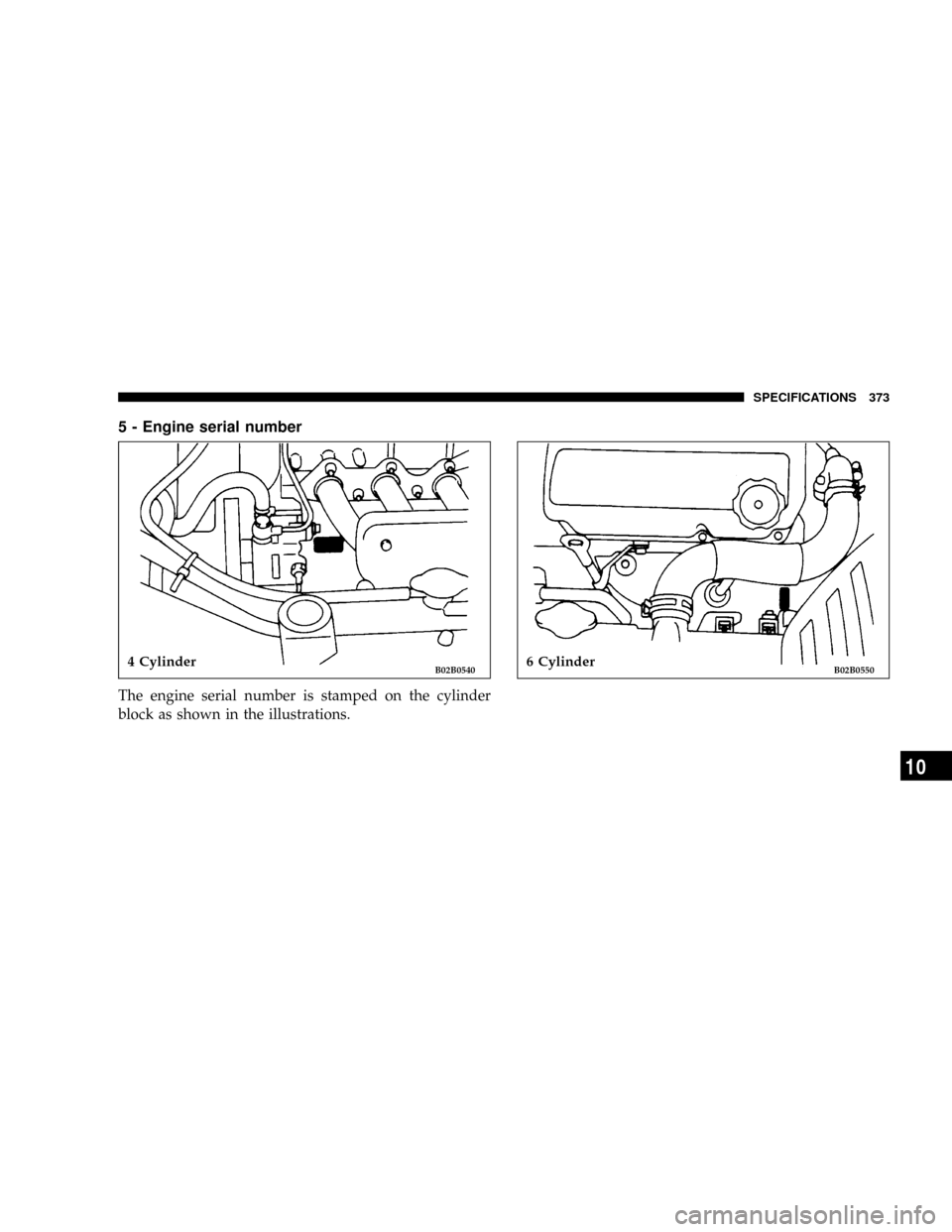
5 - Engine serial number
The engine serial number is stamped on the cylinder
block as shown in the illustrations.
B02B05404 CylinderB02B05506 Cylinder
SPECIFICATIONS 373
10