light DODGE STRATUS COUPE 2005 2.G Owner's Manual
[x] Cancel search | Manufacturer: DODGE, Model Year: 2005, Model line: STRATUS COUPE, Model: DODGE STRATUS COUPE 2005 2.GPages: 396
Page 51 of 396

7. The driver should not arm the system until first
confirming that all passengers have left the vehicle. If the
driver arms the system while a passenger(s) in the
vehicle, the alarm may be activated when the passen-
ger(s) leave the vehicle.
Alarm stage
The alarm will be activated if any of the following occur
while the vehicle is parked and the system is armed.
1. The driver's or passenger 's door is opened without
using the key or the remote keyless transmitter (if
equipped).
2. The trunk lid is opened without the remote keyless
transmitter (if equipped).
TYPE OF ALARM
When the alarm is activated:1. The headlights blink on and off for 3 minutes. After 3
minutes the headlights automatically shut off.
2. The horn will sound intermittently for 3 minutes.
NOTE: The alarm will continue to operate for 3 minutes.
At the end of that period, the alarm will automatically
shut off to save battery power. The system will then be
rearmed until the proper disarming step is taken.
F30A0020
Horn sounds!
Headlights blink on and off!
LOCKING AND UNLOCKING 51
2
Page 53 of 396

3. If the UNLOCK button is pressed when all doors are
closed and no door is opened within approximately 30
seconds, re-arming will automatically occur.
NOTE: Once the system has been disarmed, it cannot be
rearmed except by repeating the arming procedure.
Testing the theft-alarm system
Use the following procedure to test the system:
1. Lower the driver's window.
2. Arm the system as explained in ªArmed stageº.
3. Make sure that the theft-alarm indicator illuminates
and goes off in approximately 20 seconds.
4. Wait a few seconds and then unlock the driver's side
door by using the inside door lock knob and opening the
door.
5. Check to be sure that the horn sounds intermittently
and the headlights blink on and off when the door is
opened.6. Disarm the system by unlocking the front driver's
door, passenger's door or the trunk lid by using the key
or the remote keyless transmitter (if so equipped).
NOTE: To make sure the alarm sounds when the trunk
lid is opened, open the trunk lid by using the trunk lid
release lever.
LOCKING AND UNLOCKING 53
2
Page 60 of 396

Push the switch to adjust the seat forward or backward to
the desired position. Release the switch, and the seat will
lock at that position.
CAUTION!
Operate the power seat with care not to have the
hand or foot caught by the seat.
To recline the seatback
In order to recline the seatback, first lean your body
forward slightly and pull the seatback lock lever up, and
then lean backward to the desired position and release
the lever. The seatback will lock in that position.
G21C0700
60 SEATS, SEAT BELTS, CHILD RESTRAINTS AND AIR BAGS
Page 73 of 396

5. The shoulder belt portion will allow regular move-
ment under normal conditions. The belt will lock in the
event of an abrupt change in vehicle motion.
6. To release the belt, push the button on the buckle. The
belt retracts automatically, so hold the tongue when the
belt is released and while it retracts. Should the belt not
fully return to its stowed position, pull the shoulder belt
down slightly and release quickly.
Adjustable seat belt shoulder anchor (front seats)
The seat belt shoulder anchor height can be adjusted for
greater comfort.
To move the anchor down, depress the lock knob (A). To
move the anchor up, simply slide the anchor up to the
desired position (there is no need to depress the lock
knob).
G28A0260
G08C0070
SEATS, SEAT BELTS, CHILD RESTRAINTS AND AIR BAGS 73
3
Page 74 of 396

WARNING!
To reduce risk of serious injury in a collision, adjust
the anchor at a position so that the belt passes over
your shoulder, but does not touch your neck.
Always adjust the anchor when vehicle is not in
motion.
Make sure the anchor is securely latched after ad-
justment.
Enhanced Driver Seat Belt Use Reminder System
(BeltAlertŸ)
If the driver 's seat belt has not been buckled within 60
seconds of starting the vehicle and if the vehicle speed is
greater than 5 mph (8 km/h), the Enhanced Warning
System (BeltAlertŸ) will alert the driver to buckle their
seat belt. The driver should also instruct all other occu-
pants to buckle their seat belts. Once the warning is
triggered, the Enhanced Warning System (BeltAlertŸ)
will continue to chime and flash the Seat Belt Warning
Light for 96 seconds or until the driver 's seat belt is
buckled.The Enhanced Warning System (BeltAlertŸ) will be
reactivated if the driver 's seat belt is unbuckled for more
than 10 seconds and the vehicle speed is greater than 5
mph (8 km/h).
The Enhanced Warning System (BeltAlertŸ) can be en-
abled or disabled by your authorized dealer or by
following these steps:
NOTE:
The following steps must occur within the first 60
seconds of the ignition switch being turned to the ON
or START position. The manufacturer does not recom-
mend deactivating the Enhanced Warning System
(BeltAlertŸ).
·Turn the ignition switch to the OFF position, and
buckle the driver 's seat belt.
·Turn the ignition key to the ACCESSORY/RUN
position (engine does not need to be running), and
wait for the Seat Belt Warning Light to turn off.
·Within 60 seconds of starting the vehicle, unbuckle
and then re-buckle the driver 's seat belt at least three
times within 10 seconds, ending with the seat belt
buckled.
74 SEATS, SEAT BELTS, CHILD RESTRAINTS AND AIR BAGS
Page 75 of 396

·Turn the ignition key to the OFF position. A single
chime will sound to signify that you have successfully
completed the programming.
The Enhanced Warning System (BeltAlertŸ) can be reac-
tivated by repeating this procedure.
NOTE: Although the Enhanced Warning System
(BeltAlertŸ) has been deactivated, the Seat Belt Warning
Light will continue to illuminate while the driver 's seat
belt remains unfastened.
Seat belt extender
If the seat belt is too short, even when fully extended, a
seat belt extender is available from your dealer. The
extender may be used for either front seating positions.
G28A0160
SEATS, SEAT BELTS, CHILD RESTRAINTS AND AIR BAGS 75
3
Page 88 of 396

MAINTENANCE AND INSPECTION OF SEAT
BELTS
The seat belt webbing may be cleaned with mild soap or
detergent solution. Allow the belts to dry in the shade.
Do not allow them to retract until completely dry. Do not
attempt to bleach or re-dye belts. The color may rub off
and webbing strength could be affected.
Regularly check seat belt buckles and release mecha-
nisms for positive action and the retractors when in the
automatic locking retractor mode for positive engage-
ment. Refer to ªInstalling a child restraint system to a
UNIBELTº on page 82.
Check that the anchor mounting bolts are tight. If the seat
belt webbing shows obvious cuts, tears, protruding bro-
ken fibers that cause a local increase in webbing thick-
ness, or severe fading which indicates weakening by
exposure to sunlight, the entire seat belt assembly should
be replaced.The lap belt portion of the front UNIBELT has a sleeve
inside which the belt is folded back over itself in a loop.
This allows the belt to help absorb the energy of a
collision through a controlled release of the loop. In the
event that the loop inside the sleeve has come loose,
replace the entire seat belt assembly.
G28A0420
Good
No GoodSleeve
Sleeve
88 SEATS, SEAT BELTS, CHILD RESTRAINTS AND AIR BAGS
Page 94 of 396
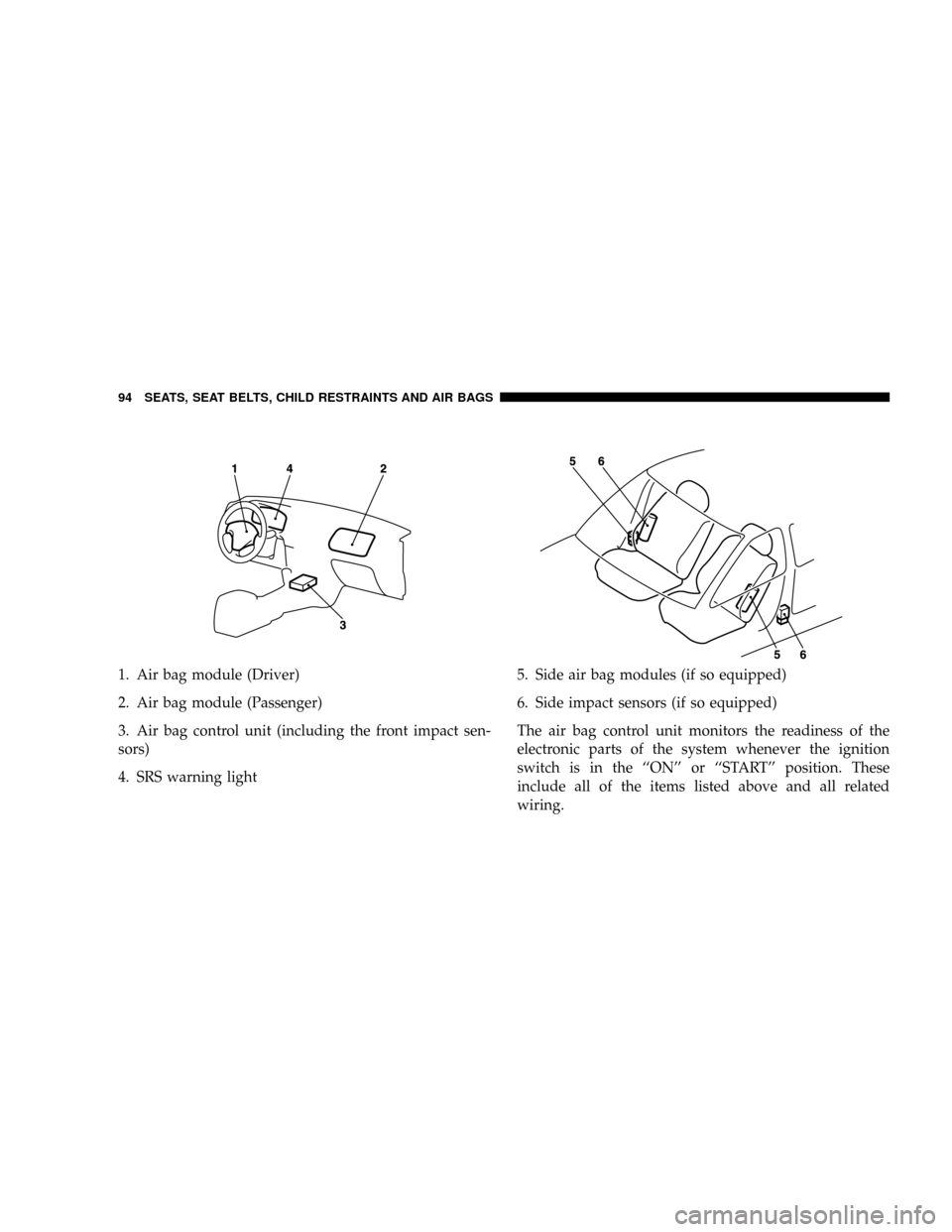
1. Air bag module (Driver)
2. Air bag module (Passenger)
3. Air bag control unit (including the front impact sen-
sors)
4. SRS warning light5. Side air bag modules (if so equipped)
6. Side impact sensors (if so equipped)
The air bag control unit monitors the readiness of the
electronic parts of the system whenever the ignition
switch is in the ``ON'' or ``START'' position. These
include all of the items listed above and all related
wiring.
94 SEATS, SEAT BELTS, CHILD RESTRAINTS AND AIR BAGS
Page 95 of 396

The air bags will operate only when the ignition switch is
in the ``ON'' or ``START'' position.
When an impact sensor detects a front or side impact of
sufficient force, it automatically ignities materials in the
module inflator which generate gas and inflates the
appropriate air bags.
NOTE:A collision that is not severe enough to need
airbag protection will not activate the system. This does
not mean something is wrong with the air bag system.
Deployment of the air bags produces a sudden, loud
noise and releases some smoke and powder. This is not
dangerous and does not indicate a fire in the vehicle.
People with breathing problems may feel some tempo-
rary irritation from chemicals used to inflate the bags. If
irritation continues see your doctor. You may open the
windows after air bags inflates, if it is safe to do so.
After deployment, the air bags deflate very rapidly, so
there is little danger of not being able to see. The time
between the sensors first detecting an impact and the air
bags deflating after deployment is shorter than a blink of
an eye.
WARNING!
²Air bags inflate very quickly and with great force.
In certain situations, contact with an inflating air
bag may cause small cuts, abrasions, and bruises.
Event Data Recording
Your vehicle is equipped with an9EDR9- Event Data
Recorder which is capable of collecting and storing data
in the event of an air bag deployment.
The EDR may record the following information;
± Condition of Specific vehicle systems;
± Whether the driver and front passenger seat belts were
buckled;
± Condition of SRS warning light;
± Diagnostic code(s);
SEATS, SEAT BELTS, CHILD RESTRAINTS AND AIR BAGS 95
3
Page 100 of 396
WARNING!
²Never install a rear-facing child restraint in the front
passenger seat. Rear-facing child restraints MUST
ONLY be used in the rear seat. Forward-facing child
restraints should also be used in the rear seat. If a
forward-facing child restraint must be used in the front
passenger seat, move the seat as far back as possible,
and make sure that the child stays in the child restraint
and away from the door.
Do not allow the child to lean against or close to the
passenger door even if the child is seated in a child
restraint system. The child's head should also not lean
against or be close to the section of the seatback where
the side air bag is located. It is dangerous if the side air
bag inflates. Failure to follow all of these instructions
could lead to serious or fatal injury to the child.
²Work done around and on the side air bag system
components should only be done by an authorized
dealer. Improper work methods could cause an acci-
dental side air bag deployment, or could make a side
air bag inoperable. Either of these situations could
result in serious injury. Be sure to tell anyone who
works on your vehicle that it has air bags.
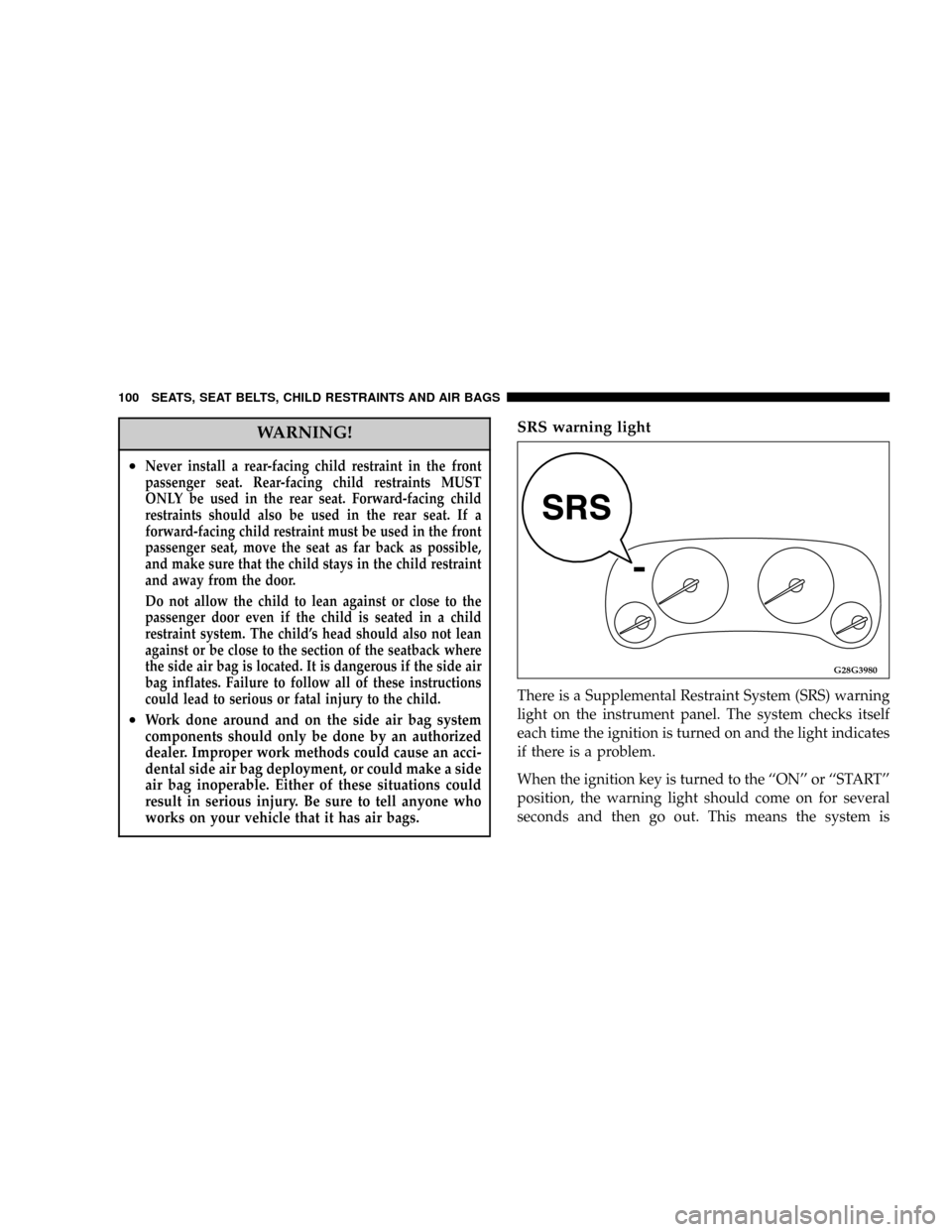
SRS warning light
There is a Supplemental Restraint System (SRS) warning
light on the instrument panel. The system checks itself
each time the ignition is turned on and the light indicates
if there is a problem.
When the ignition key is turned to the ``ON'' or ``START''
position, the warning light should come on for several
seconds and then go out. This means the system is
G28G3980
100 SEATS, SEAT BELTS, CHILD RESTRAINTS AND AIR BAGS