lights DODGE STRATUS COUPE 2005 2.G Owner's Manual
[x] Cancel search | Manufacturer: DODGE, Model Year: 2005, Model line: STRATUS COUPE, Model: DODGE STRATUS COUPE 2005 2.GPages: 396
Page 133 of 396
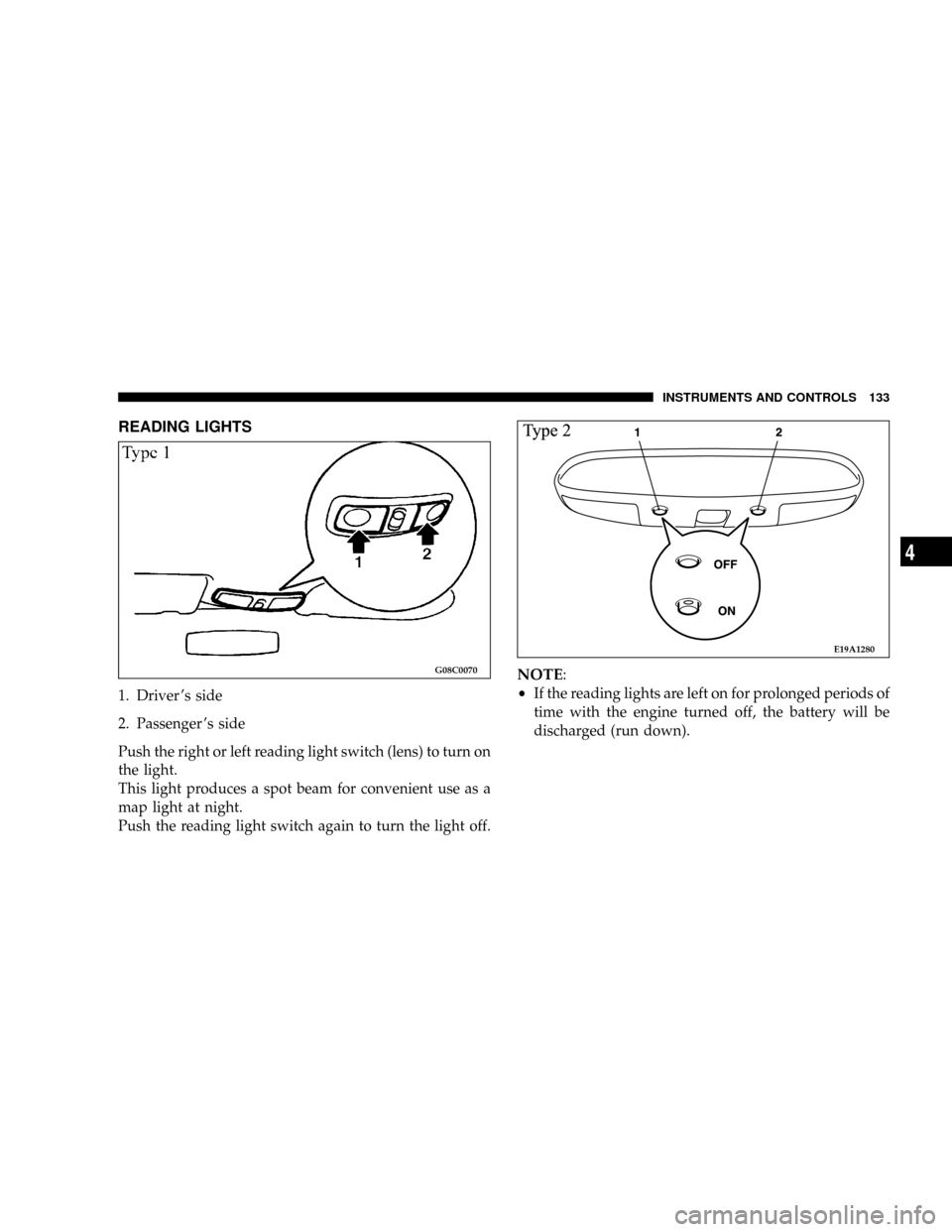
READING LIGHTS
1. Driver 's side
2. Passenger 's side
Push the right or left reading light switch (lens) to turn on
the light.
This light produces a spot beam for convenient use as a
map light at night.
Push the reading light switch again to turn the light off.
NOTE:
²If the reading lights are left on for prolonged periods of
time with the engine turned off, the battery will be
discharged (run down).G08C0070
E19A1280
INSTRUMENTS AND CONTROLS 133
4
Page 134 of 396

REAR PERSONAL LIGHTS
ON - The light illuminates
OFF - The light illuminates when a door is opened and
goes out when it is closed.
HORN SWITCH
Pressing on or around themark on the steering wheel,
causes the horn to honk.
GARAGE DOOR OPENER (IF SO EQUIPPED)
The HomeLinkyUniversal Transceiver replaces up to
three remote controls that operate devices such as garage
door openers, motorized gates, or home lighting. It
triggers these devices at the push of a button, located on
your Electrochromic inside rearview mirror (if so
E19A1270E23A0020T
134 INSTRUMENTS AND CONTROLS
Page 140 of 396
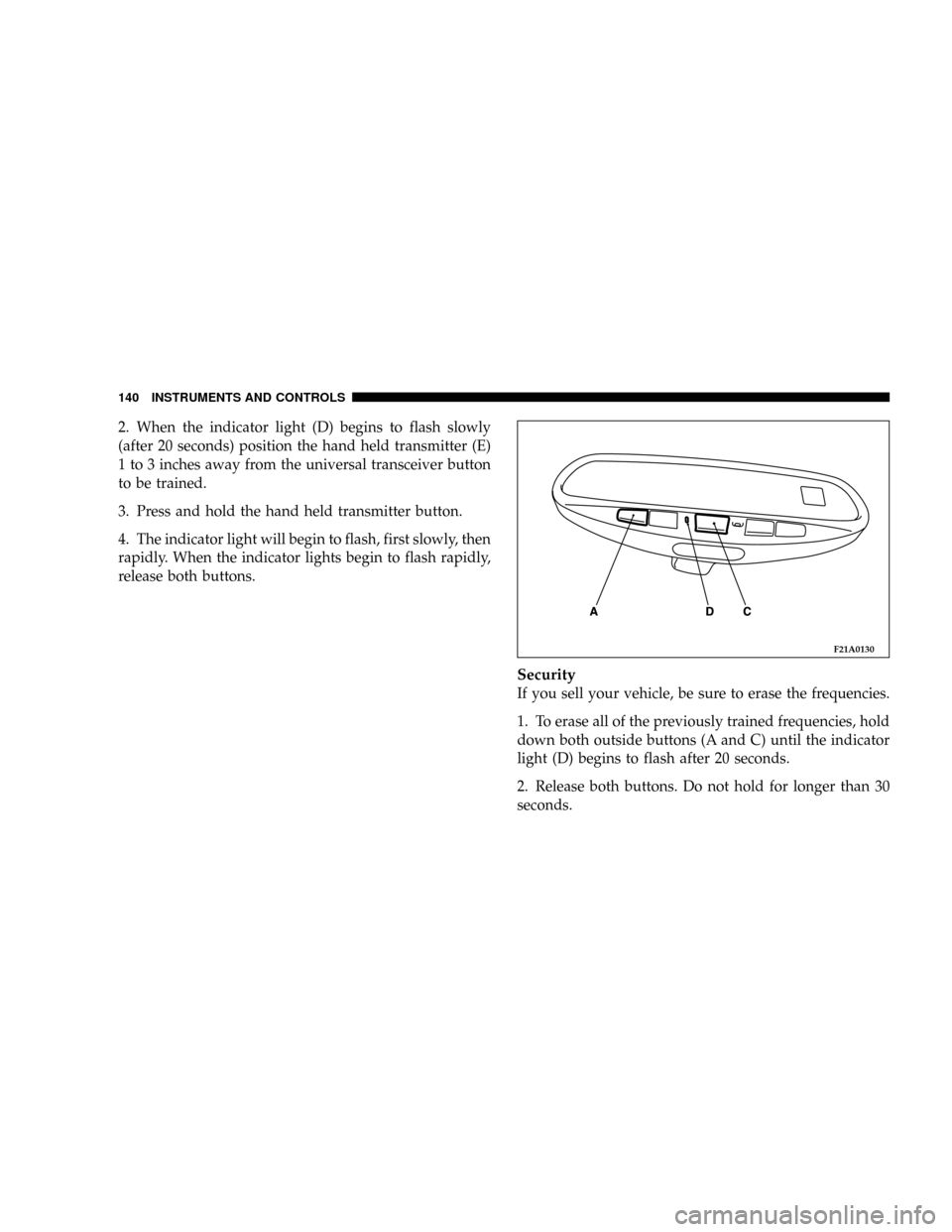
2. When the indicator light (D) begins to flash slowly
(after 20 seconds) position the hand held transmitter (E)
1 to 3 inches away from the universal transceiver button
to be trained.
3. Press and hold the hand held transmitter button.
4. The indicator light will begin to flash, first slowly, then
rapidly. When the indicator lights begin to flash rapidly,
release both buttons.
Security
If you sell your vehicle, be sure to erase the frequencies.
1. To erase all of the previously trained frequencies, hold
down both outside buttons (A and C) until the indicator
light (D) begins to flash after 20 seconds.
2. Release both buttons. Do not hold for longer than 30
seconds.
F21A0130
140 INSTRUMENTS AND CONTROLS
Page 144 of 396

NGear positions........................158
NDriving speed
(Vehicles with automatic transaxle).........159
NHolding on an upgrade.................159
NTransaxle reset mode...................160
mAutomatic transaxle Autostick
(if so equipped)
........................160
NSelector lever operation.................161
NIndicator lights.......................163
NSelector positions (Main gate).............164
NSelector positions Manual gate Autostick.....165
NHolding on an upgrade.................167
NTransaxle reset mode...................168
mManual transaxle (if so equipped)..........168
NTo start.............................169
NProper shift points.....................169NRecommended downshifting speed.........171
NDriving precautions....................171
mParking brake.........................171
mBrake pedal...........................173
mPower brakes.........................174
mBrake pad wear alarm...................174
mAnti-lock braking (ABS) system
(if so equipped)
........................175
NGeneral driving hints
(standard/anti-lock brakes)...............175
mSteering wheel tilt lock lever..............177
mPower steering........................178
mInside Day/Night rearview mirrors.........179
NElectrochromic inside rearview mirror
(if so equipped.......................180
NElectrochromic mirror operation
(if so equipped).......................181
144 STARTING AND DRIVING
Page 145 of 396

mCruise/speed control....................191
NTo activate...........................192
NTo deactivate.........................196
NTo resume the set speed.................197
mTraction control (if so equipped)...........198
mCatalytic converter.....................199
mVehicle preparation before driving..........201
NSeat belts and seats....................201
NDefrosters...........................201
NTires...............................201NLights..............................202
NFluid leaks..........................202
NDriver..............................202
mSafe driving techniques..................202
mDriving, alcohol and drugs...............203
mTips for driving in various conditions........203
mOperation during cold weather............204
mTrailer Towing.........................205
NWarranty Requirements.................205
STARTING AND DRIVING 145
5
Page 151 of 396

FUEL ECONOMY
Fuel economy is dependent on many factors. Your per-
sonal driving habits can have a significant effect on your
fuel economy. Several recommendations for achieving
maximum fuel economy are listed below.
1. When pulling away from traffic lights or stop signs,
accelerate slowly and smoothly.
2. When parked for even a short period, do not idle the
engine. Shut it off.
3. Plan your trips to avoid unnecessary stops.
4. Keep your tires inflated to the recommended pres-
sures.
5. For freeway driving, maintain a constant speed within
the posted limits when traffic, roadway and weather
conditions safely permit, for the best fuel economy.
6. Keep your air filter clean and your vehicle lubricated
according to the recommendations in this manual.
7. Keep your vehicle ªtuned-upº.
An out-of-tune engine wastes fuel and costs money.
8. Reduce excess vehicle load.
IGNITION SWITCH
LOCK
For vehicles with a manual transaxle, when removing the
key, push the key in at the ªACCº position and keep it
depressed until it is turned to the ªLOCKº position, and
remove the key.
For vehicles with an automatic transaxle: When remov-
ing the key, first set the gear selector lever to the ªPº
(PARK) position, and then turn the key to ªLOCKº and
remove it.
I21A0230
STARTING AND DRIVING 151
5
Page 154 of 396
WARNING!
Never run the engine in a closed or poorly ventilated
area any longer than is needed to move your vehicle
in or out of the area. Carbon monoxide gas, which is
odorless, colorless and extremely poisonous, could
build up, and cause serious injury or death.
CAUTION!
²Do not start the vehicle by pushing or pulling.
²Do not run the engine at high rpm or drive the
vehicle at high speed until the engine has had a
chance to warm up.
²Release the ignition key as soon as the engine
starts to avoid damaging the starter motor.
This vehicle is equipped with an electronically controlled
fuel injection system that automatically controls fuel
quantity. When starting the engine, there is normally no
need to depress the accelerator pedal.
Normal conditions
The starting procedure is as follows:
1. Insert the ignition key and make sure all occupants are
properly seated with seat belts fastened.
2. Depress and hold the brake pedal down with your
right foot.
3. Set the gearshift selector lever (manual transaxle) in
the ªNº (NEUTRAL) position, or the selector lever (au-
tomatic transaxle) in the ªPº (PARK) position.
4. Fully depress the clutch pedal (manual transaxle).
NOTE: For models equipped with a manual trans-
axle, the starter will not operate unless the clutch
pedal is fully depressed (Clutch interlock).
5. After turning the ignition key to the ªONº position,
make certain that all warning lights are functioning
properly before starting the engine.
6. Turn the ignition key to the ªSTARTº position without
depressing the accelerator pedal, and release the key
when the engine starts.
154 STARTING AND DRIVING
Page 163 of 396
WARNING!
Always depress the brake pedal when shifting the
selector lever into a gear from the ªNº (NEUTRAL)
position. When beginning to drive, do not shift the
selector lever from the ªNº (NEUTRAL) position
while depressing the accelerator pedal; doing so may
cause the vehicle to ªjumpº forward or backward.
CAUTION!
If the button is always depressed to operate the
selector lever, the lever may be accidentally shifted
into the ªPº, ªRº position. Be sure not to depress the
button when performing the operations indicated by
in the illustration.
NOTE:
If the brake pedal is not depressed and held, the
shift-lock device activates to prevent the selector lever
from being moved from the ªPº (PARK) position.Indicator lights
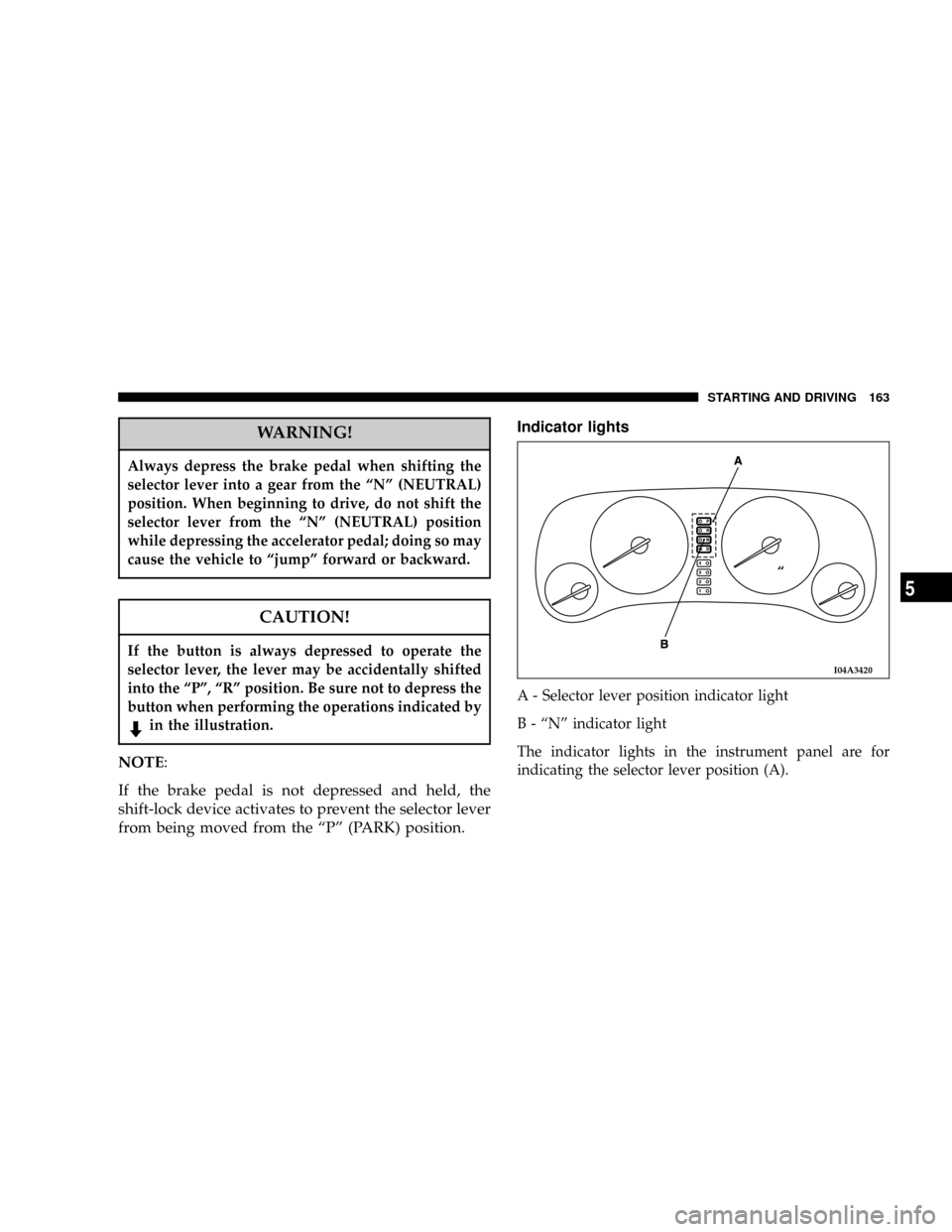
A - Selector lever position indicator light
B - ªNº indicator light
The indicator lights in the instrument panel are for
indicating the selector lever position (A).
I04A3420
ª
STARTING AND DRIVING 163
5
Page 167 of 396
3. In Autostick, downward shifts are made automatically
when the vehicle slows down. When the vehicle stops,
1st gear is automatically selected.
4. When starting out on slippery roads, push the selector
lever forward into the + (UP) position. This puts the
transmission into 2nd gear and is better for starting out
on slippery roads. Push the selector lever to the ±
(DOWN) side to shift back to 1st gear.
5. Move the selector lever gently between the manual
and main gates and between positions in the manual
gate. Undue force could damage the selector lever.Indication lights
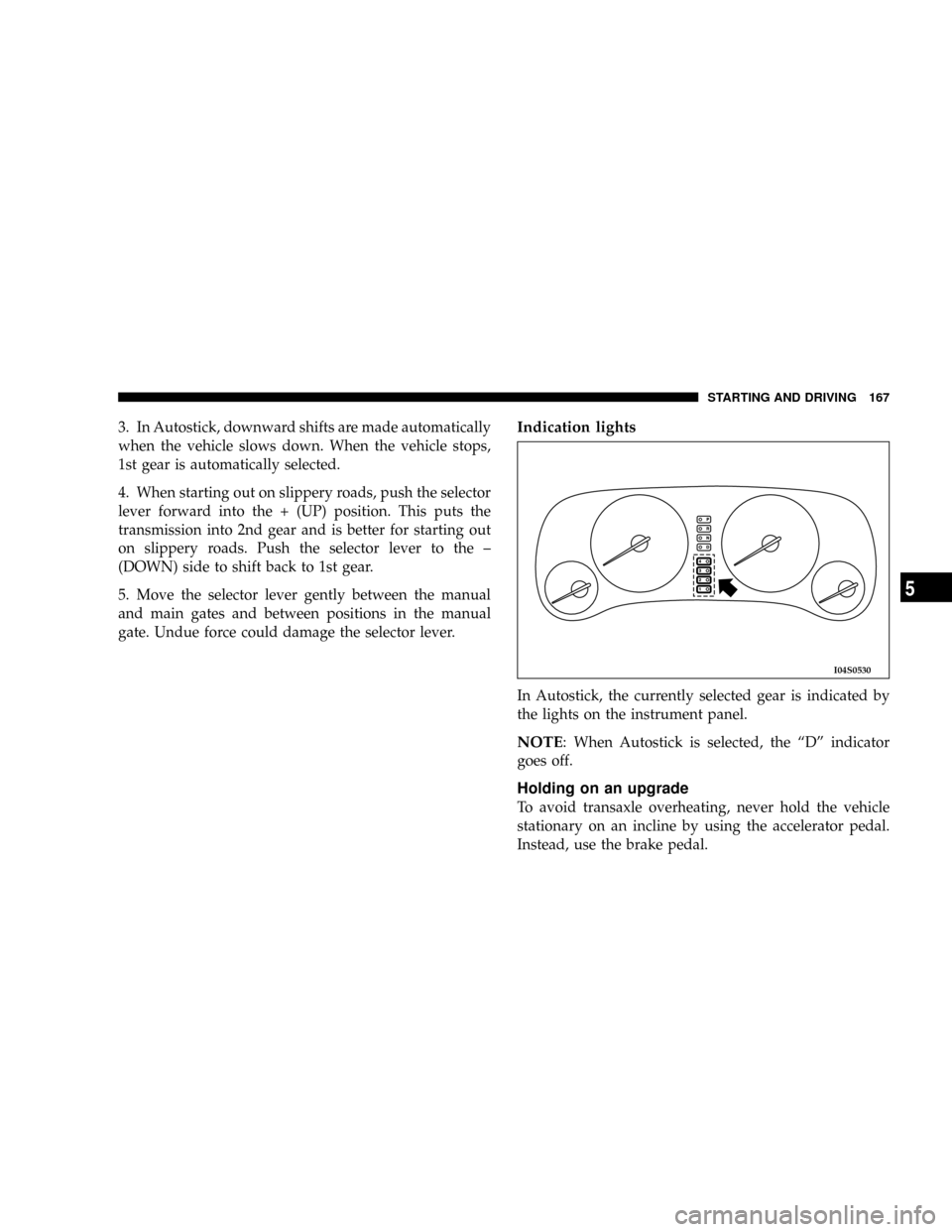
In Autostick, the currently selected gear is indicated by
the lights on the instrument panel.
NOTE: When Autostick is selected, the ªDº indicator
goes off.
Holding on an upgrade
To avoid transaxle overheating, never hold the vehicle
stationary on an incline by using the accelerator pedal.
Instead, use the brake pedal.
I04S0530
STARTING AND DRIVING 167
5
Page 179 of 396
INSIDE DAY/NIGHT REARVIEW MIRRORS
WARNING!
²Do not attempt to adjust the rearview mirrors
while driving. This can be dangerous.
²Your passenger's side mirror is convex. The ob-
jects you see in the mirror will look smaller and
farther away than they actually are. Do not use
this mirror to estimate the distance of following
vehicles when changing lanes.
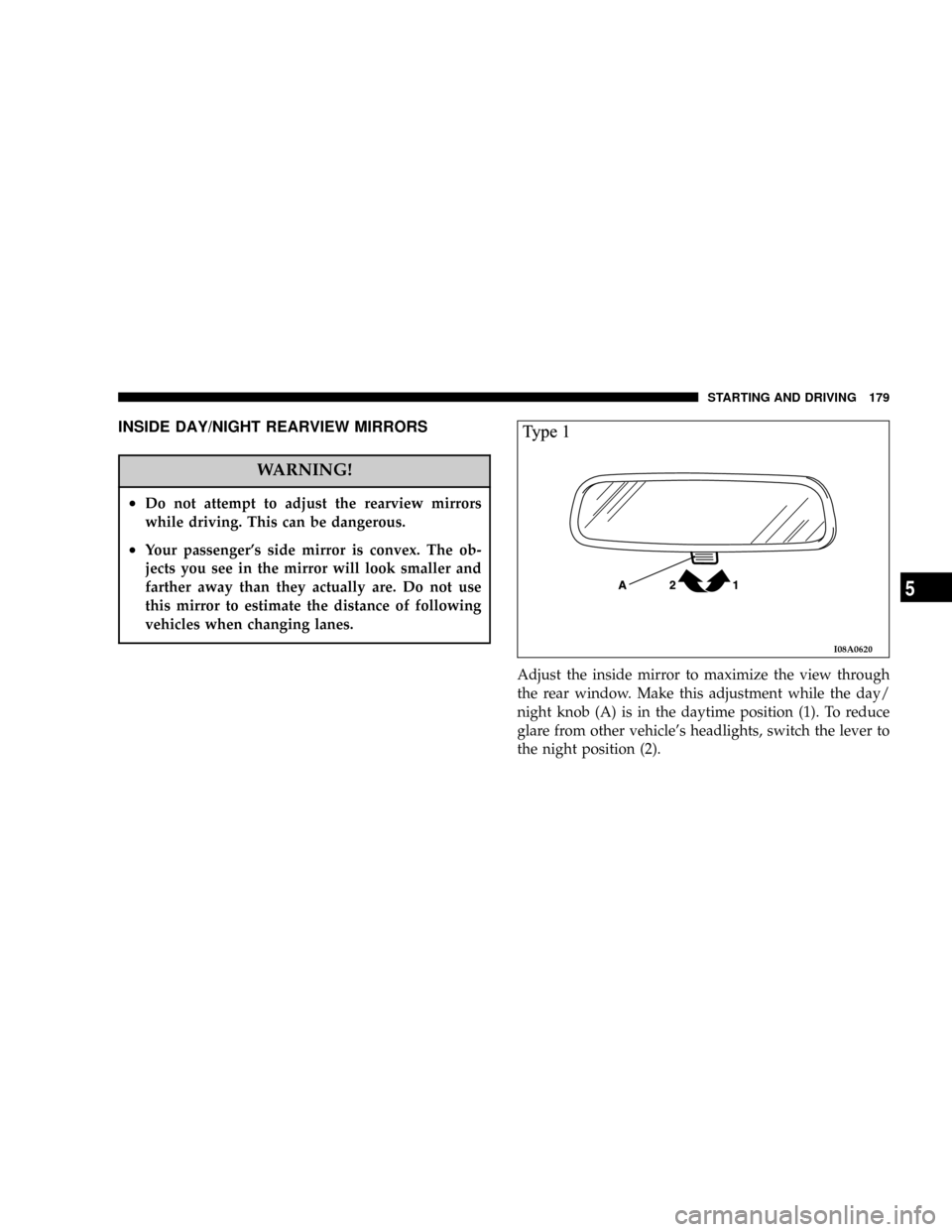
Adjust the inside mirror to maximize the view through
the rear window. Make this adjustment while the day/
night knob (A) is in the daytime position (1). To reduce
glare from other vehicle's headlights, switch the lever to
the night position (2).
I08A0620
STARTING AND DRIVING 179
5