tow DODGE STRATUS SEDAN 2004 Owner's Manual
[x] Cancel search | Manufacturer: DODGE, Model Year: 2004, Model line: STRATUS SEDAN, Model: DODGE STRATUS SEDAN 2004Pages: 273, PDF Size: 4.79 MB
Page 165 of 273
²The ªDº range can be selected when towing. However,
if frquent shifting occurs while in this range, the ª3º
range must be selected.
NOTE:Using the ª3º range while operating the vehicle
under heavy operating conditions will improve perfor-
mance and extend tranaxle life by reducing excessive
shifting and heat build up.
WARNING!
Connecting trailer brakes to your vehicle's hydraulic
brake lines can overload your brake system and
cause it to fail. You might not have brakes when you
need them and could have an accident.
²Do not attempt to tow a trailer while using a compact
spare tire.
²Whenever you pull a trailer, regardless of the trailer
size, stop lights and turn signals on the trailer are
recommended for motoring safety.
²The automatic transaxle fluid and filter should be
changed if you REGULARLY tow a trailer for more
than 45 minutes of continuous operation. See Schedule
ªBº in section 8 of this manual for transaxle fluid
change intervals.
NOTE:Check the automatic transaxle fluid level before
towing. Fluid discoloration, or a burnt odor, shows the
need for a transmission fluid and filter change.
NOTE:For vehicles equipped with Autostick. By using
the Autostick modes, and slecting a specific gear range,
frequent shifting can be avoided. The highest gear range
should be selected that allows for adequate performance.
For example, choose ª4º if the desired speed can be
maintaned. Choose ª3º or ª2º if needed to maintain the
desired speed.
NOTE:Extended driving at high RPM should be
avoided to prevent excess heat generation. A reduction in
vehicle speed may be required to avoid extended driving
at high RPM. Return to a higher gear range or vehicle
speed when road conditions and RPM level allows.
STARTING AND OPERATING 165
5
Page 171 of 273
WHAT TO DO IN EMERGENCIES
CONTENTS
mHazard Warning Flasher.................172
mIf Your Engine Overheats................172
mJacking And Tire Changing...............174
NPreparations For Jacking................174
mJump-Starting The Battery...............179
mDriving On Slippery Surfaces.............182
NAcceleration.........................182
NTraction............................182
mFreeing A Stuck Vehicle.................183
mTowing A Disabled Vehicle...............183
mTowing This Vehicle Behind Another Vehicle
(Flat Towing With All Four Wheels On The
Ground)
.............................184
NAutomatic Transaxle...................184
NManual Transaxle.....................184
NAll Transaxles........................1846
Page 174 of 273
JACKING AND TIRE CHANGING
WARNING!
²Getting under a jacked-up vehicle is dangerous.
The vehicle could slip off the jack and fall on you.
You could be crushed. Never get any part of your
body under a vehicle that is on a jack. Never start
or run the engine while the vehicle is on a jack. If
you need to get under a raised vehicle, take it to a
service center where it can be raised on a lift.
²Do not attempt to change a tire on the side of the
vehicle close to moving traffic. Pull far enough off
the road to avoid the danger of being hit when
operating the jack or changing the wheel.
²The jack is designed to use as a tool for changing
tires only. The jack should not be used to lift the
vehicle for service purposes. The vehicle should
be jacked on a firm level surface only. Avoid ice or
slippery areas.
Preparations for Jacking
Park the vehicle on a firm level surface, avoid ice or
slippery areas, and set the parking brake. Place the gear
selector in PARK.
²Turn on the Hazard Warning Flasher, park vehicle on
firm, level surface.
²Put gear shift in park (automatic transmission) or
reverse (manual transmission).
²Set parking brake and turn off engine.
²Passengers should not remain in the vehicle while the
vehicle is being jacked.
Changing a Tire
The spare wheel, scissors jack, and lug wrench are
stowed under the spare tire cover in the rear cargo area.
Do not attempt to raise this vehicle using a bumper jack.
174 WHAT TO DO IN EMERGENCIES
Page 175 of 273
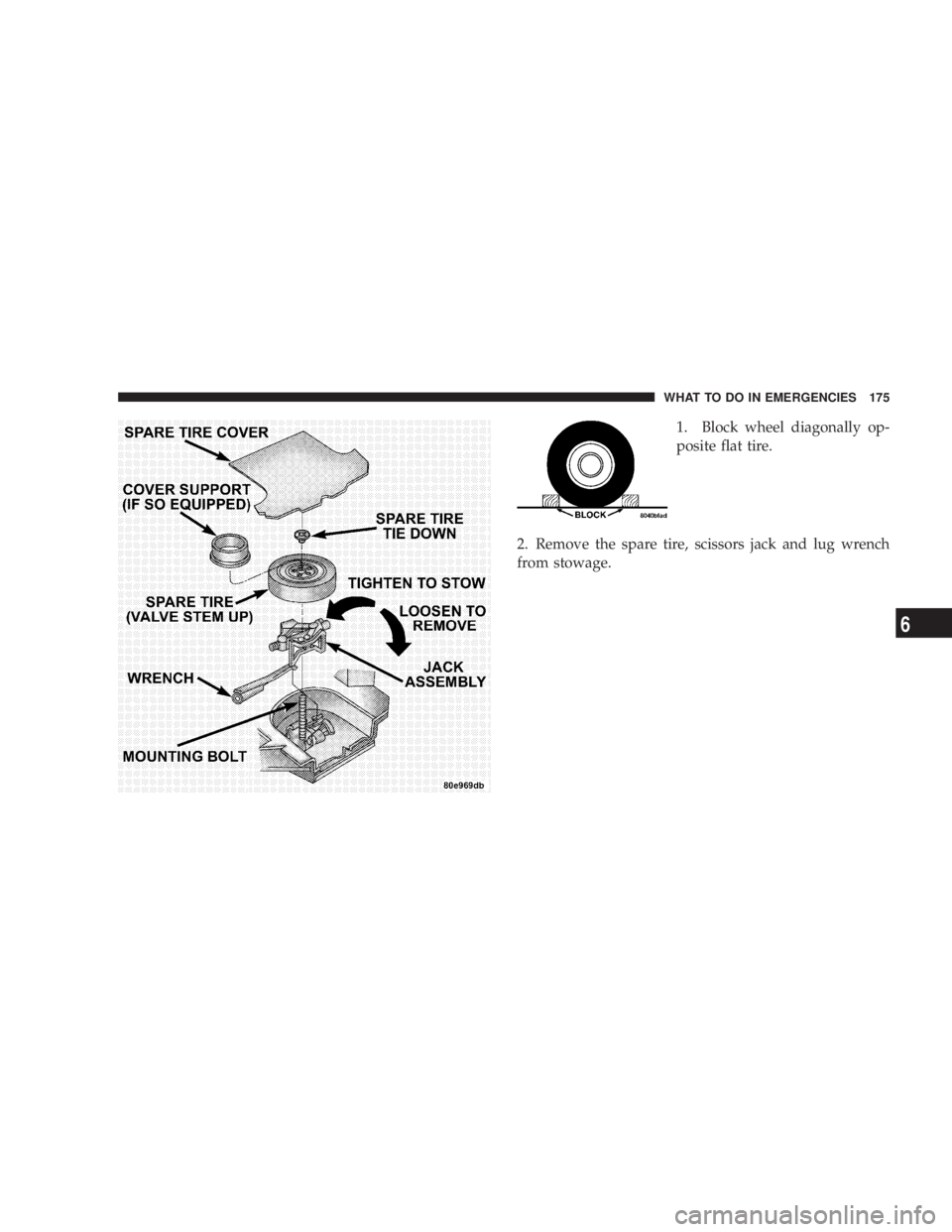
1. Block wheel diagonally op-
posite flat tire.
2. Remove the spare tire, scissors jack and lug wrench
from stowage.
WHAT TO DO IN EMERGENCIES 175
6
Page 178 of 273
WARNING!
Raising the vehicle higher than necessary can make
the vehicle less stable. It could slip off the jack and
hurt someone near it. Raise the vehicle only enough
to remove the tire.
6. Remove lug nuts and tire.
7. Mount spare tire.
8. Tighten all lug nuts on mounting studs.
9. Lower the vehicle to the ground by turning the jack
handle counterclockwise.
10. Fully tighten the lug nuts. Torque wheel lug nuts to
135 N´m (100 ft. lbs.).
11. Store the flat tire, jack, and tools.
WARNING!
A loose tire or jack thrown forward in a collision or
hard stop could endanger the occupants of the ve-
hicle. Always stow the jack parts and the spare tire in
the places provided.
12. Wheel cover installation (if required). Do not attempt
to install a wheel cover on a compact spare. Align valve
notch in wheel cover with valve stem on wheel. Snap
cover into place.
NOTE:When reinstalling the center cap it is necessary
to align the center cap notch with the first spoke, just
right of the valve stem.
13. Adjust the tire pressure as soon as possible. Correct
pressure is on the label located on the driver's door.
178 WHAT TO DO IN EMERGENCIES
Page 179 of 273
JUMP-STARTING THE BATTERY
WARNING!
²Do not attempt to push or tow your vehicle to get
it started. Vehicles equipped with an automatic
transaxle cannot be started this way. Unburned
fuel could enter the catalytic converter and once
the engine has started, ignite and damage the
converter and vehicle. If the vehicle has a dis-
charged battery, booster cables may be used to
obtain a start from another vehicle. This type of
start can be dangerous if done improperly, so
follow this procedure carefully.
²Take care to avoid the radiator cooling fan when-
ever the hood is raised. It can start anytime the
ignition switch is on. You can be hurt by the fan.
NOTE:The battery is stored in a compartment behind
the left front fender and is accessible without removing
the tire and wheel. Remote battery terminals are located
in the engine compartment for jump starting.
1. Wear eye protection and remove any metal jewelry
such as watch bands or bracelets that might make an
inadvertent electrical contact.
2. When boosting from a battery in another vehicle, park
that vehicle within booster cable reach but without
letting the vehicles touch. Set parking brake, place auto-
matic transaxle in PARK and turn ignition to OFF for
both vehicles.
3. Turn off the heater, radio and all unnecessary electrical
loads.
4. Connect one end of a jumper cable to the positive
terminal of the booster battery. Connect the other end to
the positive jump start attachment of the discharged
battery.
WHAT TO DO IN EMERGENCIES 179
6
Page 183 of 273
FREEING A STUCK VEHICLE
If your vehicle is equipped with Traction Control, turn
the system off before attempting to ªrockº the vehicle.
If your vehicle becomes stuck in mud, sand or snow, it
can often be moved by a rocking motion. Turn your
steering wheel right and left to clear the area around the
front wheels. Then shift back and forth between Reverse
and First gear. Usually the least accelerator pedal pres-
sure to maintain the rocking motion without spinning the
wheels is most effective.
CAUTION!
Racing the engine or spinning the wheels too fast
may lead to transaxle overheating and failure. It can
also damage the tires. Do not spin the wheels above
30 mph (48 km/h).
TOWING A DISABLED VEHICLE
Flat bed towing is the preferred towing method. If a flat
bed towing vehicle is not available, a wheel lift towing
vehicle may be used.
Rear towing is not recommended with the front wheels
on the ground, as transaxle damage can result. If rear
towing is the only alternative, a front end dolly must be
used.
CAUTION!
Do not use sling type towing equipment. Damage to
the fascia and air dam may result.
WHAT TO DO IN EMERGENCIES 183
6
Page 184 of 273
TOWING THIS VEHICLE BEHIND ANOTHER
VEHICLE (Flat towing with all four wheels on the
ground)
Automatic Transaxle
Your vehicle may be towed under the following condi-
tions: The gear selector must be in NEUTRAL, the
distance to be towed must not exceed 15 miles (25 km),
and the towing speed must not exceed 25 mph (40
km/h). If the transaxle is not operative, or if the vehicle
is to be towed more than 15 miles (25 km), the vehicle
must be towed with the front wheels off the ground.
Manual Transaxle
If your vehicle is equipped with a manual transaxle, it
may be towed at any legal highway speed, for any
distance, if the transaxle is in neutral.
All Transaxles
CAUTION!
If the vehicle being towed requires steering, the
ignition switch must be in the OFF position, not in
the LOCK or ACCESSORY positions.
If it is necessary to use the accessories while being towed
(wipers, defrosters, etc.), the key must be in the ON
position, not the ACCESSORY position. Make certain the
transaxle remains in NEUTRAL.
184 WHAT TO DO IN EMERGENCIES
Page 189 of 273
ONBOARD DIAGNOSTIC SYSTEM Ð OBD II
Your vehicle is equipped with a sophisticated onboard
diagnostic system called OBD II. This system monitors
the performance of the emissions, engine, and automatic
transmission control systems. When these systems are
operating properly, your vehicle will provide excellent
performance and fuel economy, as well as engine emis-
sions well within current government regulations.
If any of these systems require service, the OBD II system
will turn on the ªMalfunction Indicator Light.º It will
also store diagnostic codes and other information to
assist your service technician in making repairs. Al-
though your vehicle will usually be drivable and not
need towing, see your dealer for service as soon as
possible.CAUTION!
²Prolonged driving with the ªMalfunction Indica-
tor Lightº on could cause further damage to the
emission control system. It could also affect fuel
economy and driveability. The vehicle must be
serviced before any emissions tests can be per-
formed.
²If the ªMalfunction Indicator Lightº is flashing
while the engine is running, severe catalytic con-
verter damage and power loss will soon occur.
Immediate service is required.
MAINTAINING YOUR VEHICLE 189
7
Page 193 of 273
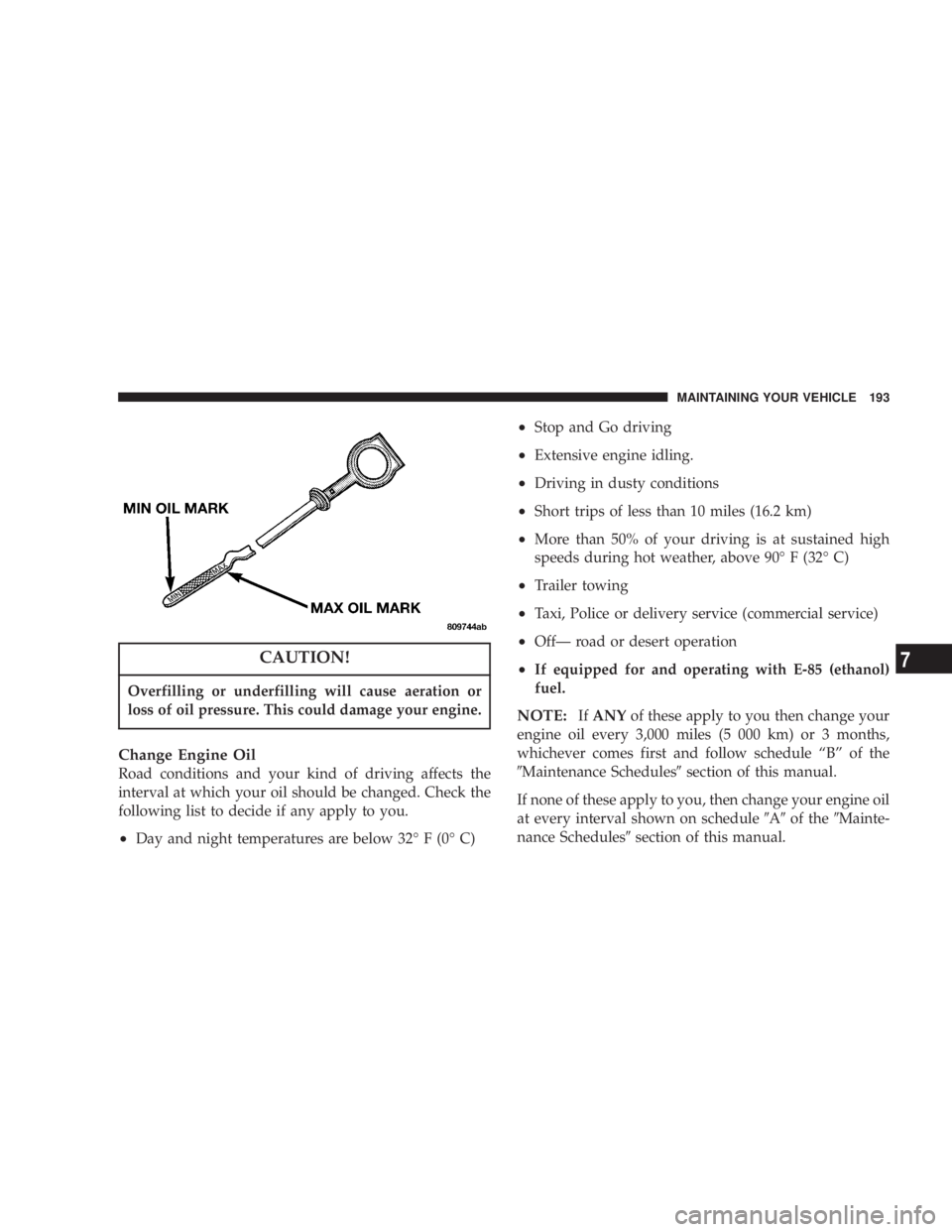
CAUTION!
Overfilling or underfilling will cause aeration or
loss of oil pressure. This could damage your engine.
Change Engine Oil
Road conditions and your kind of driving affects the
interval at which your oil should be changed. Check the
following list to decide if any apply to you.
²Day and night temperatures are below 32É F (0É C)
²Stop and Go driving
²Extensive engine idling.
²Driving in dusty conditions
²Short trips of less than 10 miles (16.2 km)
²More than 50% of your driving is at sustained high
speeds during hot weather, above 90É F (32É C)
²Trailer towing
²Taxi, Police or delivery service (commercial service)
²OffÐ road or desert operation
²If equipped for and operating with E-85 (ethanol)
fuel.
NOTE:IfANYof these apply to you then change your
engine oil every 3,000 miles (5 000 km) or 3 months,
whichever comes first and follow schedule ªBº of the
9Maintenance Schedules9section of this manual.
If none of these apply to you, then change your engine oil
at every interval shown on schedule9A9of the9Mainte-
nance Schedules9section of this manual.
MAINTAINING YOUR VEHICLE 193
7