ignition DODGE STRATUS SEDAN 2005 User Guide
[x] Cancel search | Manufacturer: DODGE, Model Year: 2005, Model line: STRATUS SEDAN, Model: DODGE STRATUS SEDAN 2005Pages: 293, PDF Size: 4.72 MB
Page 21 of 293
2. Continue to hold the Unlock button, wait at least 4
but no longer than 10 seconds, then press the Trunk
button.
3. Release both buttons.
Panic Alarm
The panic mode unlocks the driver’s door, turns on the
interior lights, flashes the headlights, and sounds the
horn for about 3 minutes or until the alarm is turned off.
To use the Panic Alarm:
Press and hold the Panic Button for at least 1 second to
activate the panic alarm. Press and hold the panic button
a second time or unlock the door with the key (if
equipped with central locking) to deactivate the alarm.
The alarm will also shut itself off after 3 minutes, or when
the vehicle speed reaches 15 MPH (24 km/h).
To Program Additional Transmitters:
Up to 4 transmitters can be programmed to your vehicle.
To program a transmitter, perform the following proce-
dure:
1. With the vehicle in Park, turn the ignition switch to the
ON/RUN position.2. Using a currently programmed transmitter, press the
Unlock button on the transmitter. Continue to hold the
Unlock button, wait at least 4 but no longer than 10
seconds, then press and hold the Panic button for at least
one second. Release both buttons simultaneously. You
will hear a chime to signal that you can proceed with
programming the new transmitter.
3. Press and release the Lock and Unlock buttons simul-
taneously, followed by a press and release of ANY button
on each new transmitter to be programmed as well as the
original transmitter. You will hear a chime when a
transmitter has been successfully programmed. You will
have 30 seconds to finish programming all new transmit-
ters. A chime will sound when the 30 seconds is over or
the ignition switch is turned to the LOCK position.
General Information
This transmitter complies with FCC rules part 15 and
with RS-210 of Industry Canada. Operation is subject to
the following two conditions:
1. This device may not cause harmful interference
THINGS TO KNOW BEFORE STARTING YOUR VEHICLE 21
2
Page 23 of 293
VEHICLE THEFT ALARM
The system monitors the doors, trunk, and ignition for
unauthorized operation.
If something triggers the alarm, the system will signal for
up to 18 minutes. For the first three minutes the horn will
sound and the headlights and interior lights will flash.
Then the horn will stop and if the source of the trigger is
still present, the lights will continue to flash for another
15 minutes.
NOTE:The engine will not start until you disarm the
system.
To set the alarm:
1. Remove the keys from the ignition switch and get out
of the vehicle.
2. Lock the door using either the power door lock switch,
the key, or the Keyless Entry Transmitter and close all
doors.
3. The light in the instrument cluster will flash rapidly
for 15 seconds. This shows that the system is arming. If
the light comes on but does not flash, the system is stillarmed, but there is a problem in the trunk circuit. After 15
seconds the light will continue to flash slowly. This
shows that the system is fully armed.
To disarm the system:
Unlock a front door using either the key or the Keyless
Entry Transmitter.
Tamper Alert
If the horn sounds 3 times when you unlock a front door
using either a key or the Keyless Entry Transmitter, the
alarm had been triggered. Check the vehicle for tamper-
ing.
Security System Manual Override
The system will not arm if you lock the doors using the
manual lock control.
THINGS TO KNOW BEFORE STARTING YOUR VEHICLE 23
2
Page 24 of 293
TRUNK LOCK AND RELEASE
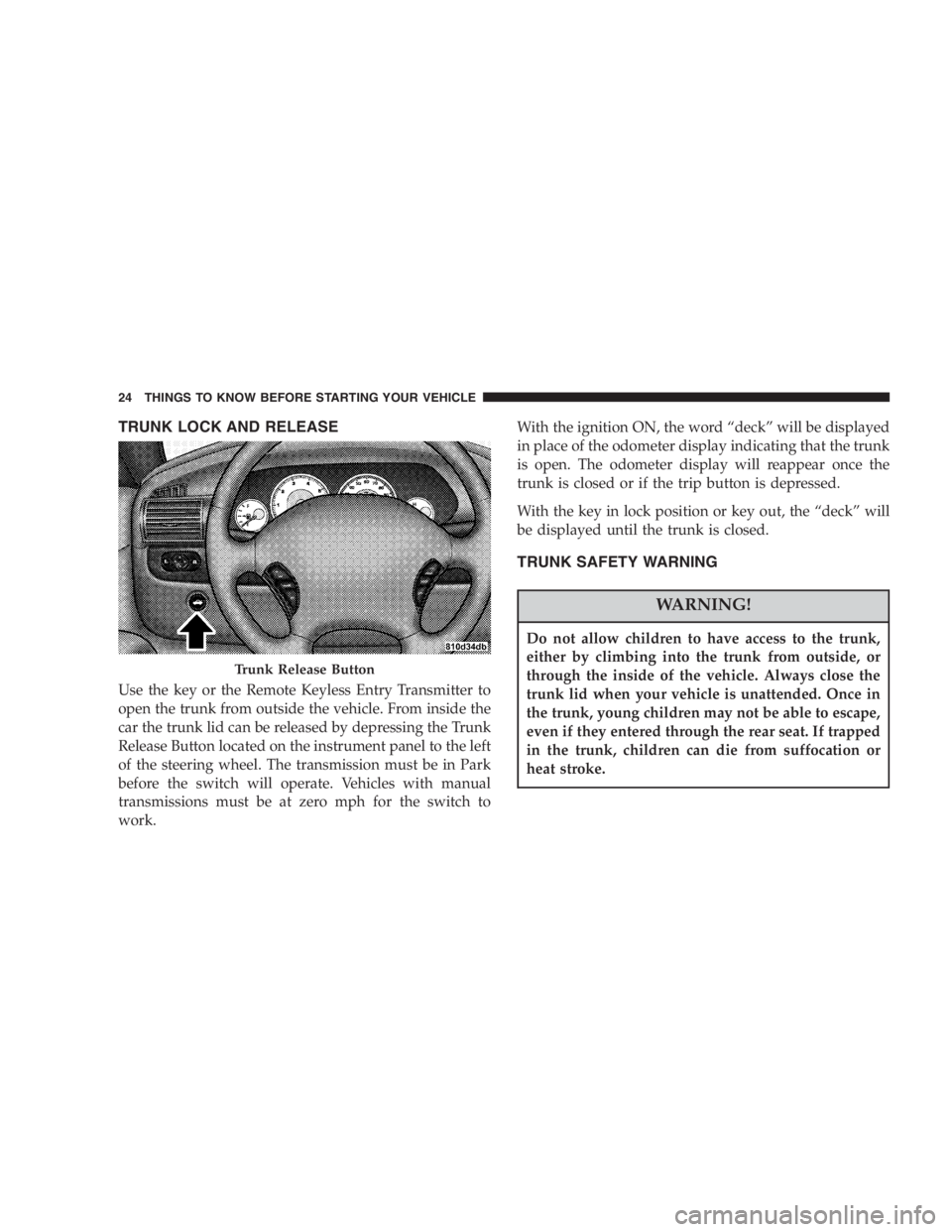
Use the key or the Remote Keyless Entry Transmitter to
open the trunk from outside the vehicle. From inside the
car the trunk lid can be released by depressing the Trunk
Release Button located on the instrument panel to the left
of the steering wheel. The transmission must be in Park
before the switch will operate. Vehicles with manual
transmissions must be at zero mph for the switch to
work.With the ignition ON, the word“deck”will be displayed
in place of the odometer display indicating that the trunk
is open. The odometer display will reappear once the
trunk is closed or if the trip button is depressed.
With the key in lock position or key out, the“deck”will
be displayed until the trunk is closed.
TRUNK SAFETY WARNING
WARNING!
Do not allow children to have access to the trunk,
either by climbing into the trunk from outside, or
through the inside of the vehicle. Always close the
trunk lid when your vehicle is unattended. Once in
the trunk, young children may not be able to escape,
even if they entered through the rear seat. If trapped
in the trunk, children can die from suffocation or
heat stroke.
Trunk Release Button
24 THINGS TO KNOW BEFORE STARTING YOUR VEHICLE
Page 25 of 293
Trunk Internal Emergency Release
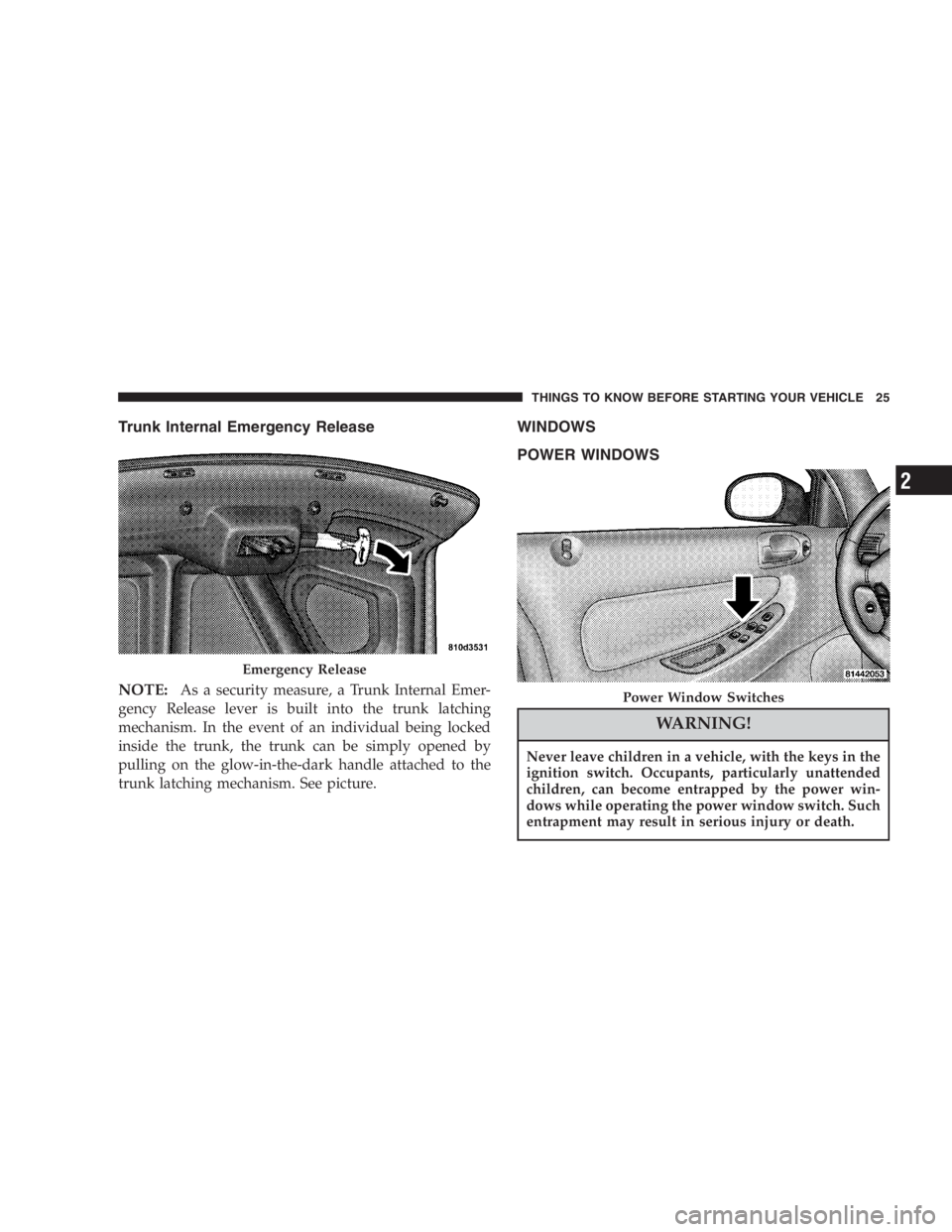
NOTE:
As a security measure, a Trunk Internal Emer-
gency Release lever is built into the trunk latching
mechanism. In the event of an individual being locked
inside the trunk, the trunk can be simply opened by
pulling on the glow-in-the-dark handle attached to the
trunk latching mechanism. See picture.
WINDOWS
POWER WINDOWS
WARNING!
Never leave children in a vehicle, with the keys in the
ignition switch. Occupants, particularly unattended
children, can become entrapped by the power win-
dows while operating the power window switch. Such
entrapment may result in serious injury or death.
Emergency Release
Power Window Switches
THINGS TO KNOW BEFORE STARTING YOUR VEHICLE 25
2
Page 32 of 293
Enhanced Driver Seat Belt Reminder System
(BeltAlert)
If the driver’s seat belt has not been buckled within 60
seconds of starting the vehicle and if the vehicle speed is
greater than 5 mph (8 km/h), the Enhanced Warning
System (BeltAlert) will alert the driver to buckle their seat
belt. The driver should also instruct all other occupants to
buckle their seat belts. Once the warning is triggered, the
Enhanced Warning System (BeltAlert) will continue to
chime and flash the Seat Belt Warning Light for 96
seconds or until the driver’s seat belt is buckled or the
vehicle speed is below 5 mph (8 km/h). The Enhanced
Warning System (BeltAlert) will be reactivated if the
driver’s seat belt is unbuckled for more than 10 seconds
and the vehicle speed is greater than 5 mph (8 km/h).
The Enhanced Warning System (BeltAlert) can be en-
abled or disabled by your authorized dealer or by
following these steps:
NOTE:The following steps must occur within the first
60 seconds of the ignition switch being turned to the ONor START position. DaimlerChrysler does not recom-
mend deactivating the Enhanced Warning System
(BeltAlert).
1. Turn the ignition switch to the OFF position and
buckle the driver’s seat belt.
2. Start the engine and wait for the Seat Belt Warning
Light to turn off.
3. Within 60 seconds of starting the vehicle, unbuckle
and then re-buckle the driver’s seat belt at least three
times within 10 seconds, ending with the seat belt
buckled.
NOTE:Watch for the Seat Belt Warning Light to turn on
while unbuckling and off while re-buckling the seat belt.
It may be necessary to retract the seat belt.
4. Turn off the engine. A single chime will sound to
signify that you have successfully completed the pro-
gramming.
The Enhanced Warning System (BeltAlert) can be reacti-
vated by repeating this procedure.
32 THINGS TO KNOW BEFORE STARTING YOUR VEHICLE
Page 37 of 293
Airbag System Components
The front airbag system consists of the following:
•Airbag Control Module
•AIRBAGReadiness Light
•Driver Airbag
•Passenger Airbag
•Steering Wheel and Column
•Instrument Panel
•Interconnecting Wiring
•Knee Impact Bolsters
•Left and Right Window Bags Above Side Windows—
If Equipped
•Left and Right Side Impact Sensors—If Equipped
•Driver and Front Passenger Seat Belt Pretensioners
How The Airbag System Works
•
The airbag control module determines if a frontal
collision is severe enough to require the airbags to
inflate. The control module receives the level of colli-
sion severity, determines the proper level of airbag to
be deployed. The frontal airbag inflators are designed
to provide three different rates of air bag inflation.
•The airbag control module will not detect rollover or
rear collisions.
•The airbag control module also monitors the readiness
of the electronic parts of the system whenever the
ignition switch is in the START or RUN positions.
These include all of the items listed above except the
knee bolster, the instrument panel, and the steering
wheel and column. If the key is in the“off”position, in
the ACC position, or not in the ignition, the airbags are
not on and will not inflate.
THINGS TO KNOW BEFORE STARTING YOUR VEHICLE 37
2
Page 38 of 293
The airbag control module also turns on the
AIRBAGlight in the instrument panel for 6 to 8
seconds when the ignition is first turned on, then
turns the light off. If it detects a malfunction in any part
of the system, it turns on the light either momentarily or
continuously.
WARNING!
Ignoring the AIRBAG light in your instrument panel
could mean you won’t have the airbags to protect
you in a collision. If the light does not come on, stays
on after you start the vehicle, or if it comes on as you
drive, have the airbag system checked right away.
•When the airbag control module detects a collision
requiring the airbags, it signals the inflator units. A
large quantity of nontoxic gas is generated to inflate
the airbags. Three levels of airbag inflation rates are
possible. These rates are determined by the airbag
control module based on collision severity. The airbag
covers separate and fold out of the way as the airbags
inflate to their full size. The airbags fully inflate inabout 60 milliseconds. This is only about half of the
time it takes you to blink your eyes. The airbags then
quickly deflate while helping to restrain the driver and
front passenger. The driver’s front airbag gas is vented
through a vent hole in the rear of the airbag. The
passenger’s front airbag gas is vented through vent
holes in the sides of the airbag. In this way the airbags
do not interfere with your control of the vehicle.
•The Knee Impact Bolsters help protect the knees and
position you for the best interaction with the front
airbag.
If A Deployment Occurs
The airbag system is designed to deploy when the airbag
control module detects a moderate-to-severe collision, to
help restrain the driver and front passenger, and then to
immediately deflate.
NOTE:A collision that is not severe enough to need
airbag protection will not activate the system. This does
not mean something is wrong with the airbag system.
38 THINGS TO KNOW BEFORE STARTING YOUR VEHICLE
Page 41 of 293
Airbag Light
You will want to have the airbags ready for your protec-
tion in an impact. While the airbag system is designed to
be maintenance free, if any of the following occurs, have
an authorized dealer service the system promptly:
•TheAIRBAGlight does not come on or flickers during
the 6 to 8 seconds when the ignition switch is first
turned on.
•The light remains on or flickers after the 6 to 8 second
interval.
•The light flickers or comes on and remains on while
driving.
Child Restraint
Everyone in your vehicle needs to be buckled up all the
time, babies and children, too. Every state in the United
States and all Canadian provinces require that small
children ride in proper restraint systems. This is the law,
and you can be prosecuted for ignoring it.Children 12 years and under should ride properly buck-
led up in a rear seat, if available. According to crash
statistics, children are safer when properly restrained in
the rear seats rather than in the front.
WARNING!
In a collision, an unrestrained child, even a tiny
baby, can become a missile inside the vehicle. The
force required to hold even an infant on your lap
could become so great that you could not hold the
child, no matter how strong you are. The child and
others could be badly injured. Any child riding in
your vehicle should be in a proper restraint for the
child’s size.
There are different sizes and types of restraints for
children from newborn size to the child almost large
enough for an adult safety belt. Always check the child
seat Owner’s Manual to ensure you have the right seat
for your child. Use the restraint that is correct for your
child:
THINGS TO KNOW BEFORE STARTING YOUR VEHICLE 41
2
Page 49 of 293
SAFETY TIPS
Exhaust Gas
WARNING!
Exhaust gases can injure or kill. They contain carbon
monoxide (CO) which is colorless and odorless.
Breathing it can make you unconscious and can
eventually poison you. To avoid breathing (CO)
follow the safety tips below.
•Do not run the engine in a closed garage or in confined
areas any longer than needed to move your vehicle in
or out of the area.
•If it is necessary to sit in a parked vehicle with the
engine running, adjust your heating or cooling con-
trols to force outside air into the vehicle. Set the blower
at high speed.
•To avoid drawing exhaust gases into the vehicle, close
the trunk while driving. However, if for some reason itmust remain open, close all windows. Adjust the
heating or cooling system to force outside air into the
vehicle. Set the blower at high speed.
Safety Checks You Should Make Inside the
Vehicle
Seat Belts
Inspect the belt system periodically, checking for cuts,
frays and loose parts. Damaged parts must be replaced
immediately. Do not disassemble or modify the system.
Safety belt assemblies must be replaced after a collision if
they have been damaged (bent retractor, torn webbing,
etc.). If there is any question regarding belt or retractor
condition, replace the belt.
Airbag Light
The light should come on and remain on for 6 to
8 seconds as a bulb check when the ignition
switch is first turned ON. If the bulb is not lit
during starting, have it replaced. If the light stays on or
comes on while driving, have the system checked by an
authorized dealer.
THINGS TO KNOW BEFORE STARTING YOUR VEHICLE 49
2
Page 66 of 293
Headlights, Parking Lights, Instrument Panel
Lights
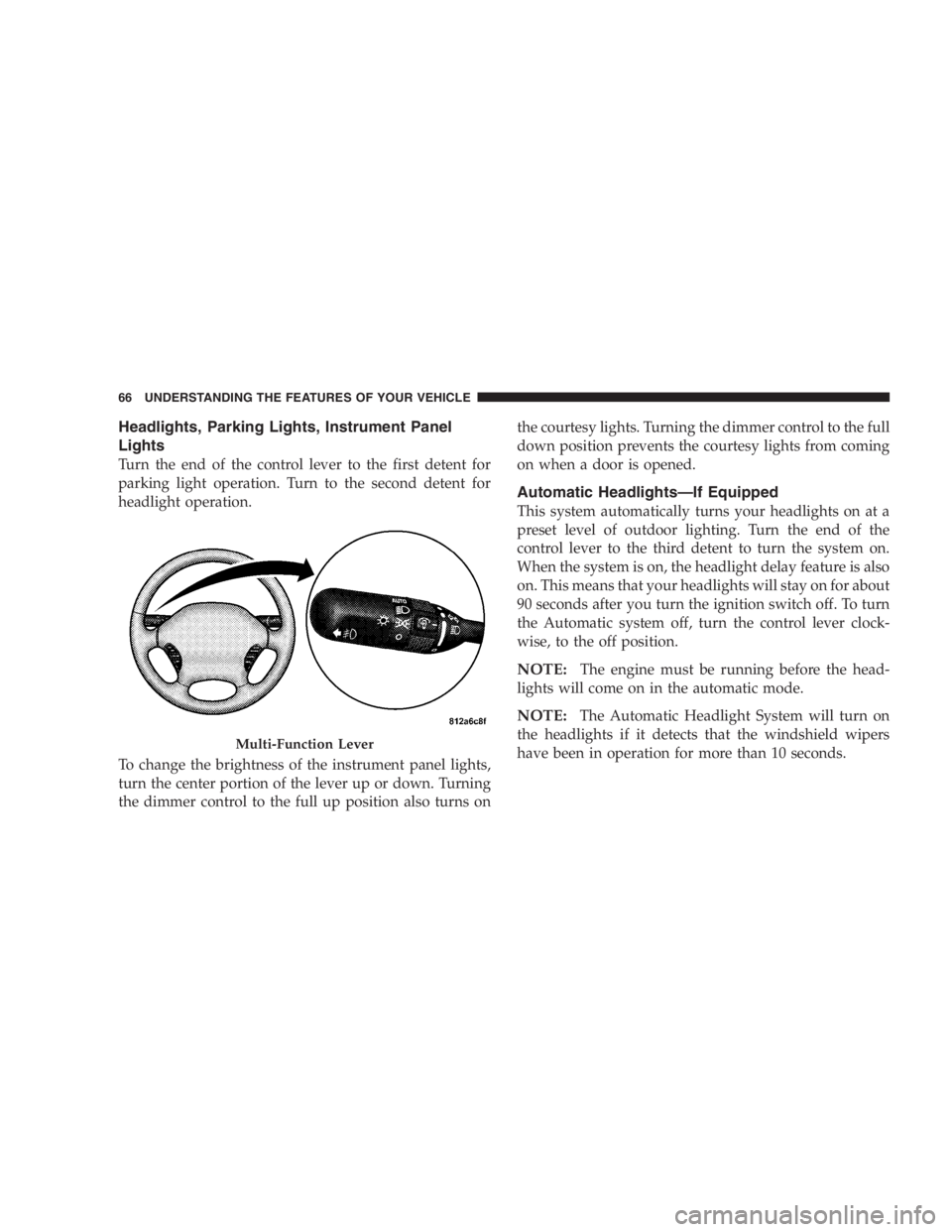
Turn the end of the control lever to the first detent for
parking light operation. Turn to the second detent for
headlight operation.
To change the brightness of the instrument panel lights,
turn the center portion of the lever up or down. Turning
the dimmer control to the full up position also turns onthe courtesy lights. Turning the dimmer control to the full
down position prevents the courtesy lights from coming
on when a door is opened.
Automatic Headlights—If Equipped
This system automatically turns your headlights on at a
preset level of outdoor lighting. Turn the end of the
control lever to the third detent to turn the system on.
When the system is on, the headlight delay feature is also
on. This means that your headlights will stay on for about
90 seconds after you turn the ignition switch off. To turn
the Automatic system off, turn the control lever clock-
wise, to the off position.
NOTE:The engine must be running before the head-
lights will come on in the automatic mode.
NOTE:The Automatic Headlight System will turn on
the headlights if it detects that the windshield wipers
have been in operation for more than 10 seconds.
Multi-Function Lever
66 UNDERSTANDING THE FEATURES OF YOUR VEHICLE