roof DODGE TRUCK 1993 Service User Guide
[x] Cancel search | Manufacturer: DODGE, Model Year: 1993, Model line: TRUCK, Model: DODGE TRUCK 1993Pages: 1502, PDF Size: 80.97 MB
Page 628 of 1502
•
3.9L
ENGINE
9 - 23 (19) Remove the head bolts from each cylinder
head and remove cylinder heads. Discard the cylin der head gasket.
(20) Remove spark plugs.
CLEANING
Clean all surfaces of cylinder block and cylinder
heads.
Clean cylinder block front and rear gasket surfaces
using a suitable solvent.
INSPECTION
Inspect all surfaces with a straightedge if there is
any reason to suspect leakage. If out-of-flatness ex
ceeds 0.00075 mm/mm (0.00075 inch/inch) times the
span length in any direction, either replace head or
lightly machine the head surface.
FOR EXAMPLE:—A 305 mm (12 inch) span is
0.102 mm (0.004 inch) out-of-flat. The allowable out-
of-flat is 305 x 0,00075 (12 x 0.00075) equals 0.23
mm (0.009 inch). This amount of out-of-flat is accept
able.
The cylinder head surface finish should be 1.78-
3.00 microns (70-125 microinches). Inspect push rods. Replace worn or bent rods.
INSTALLATION
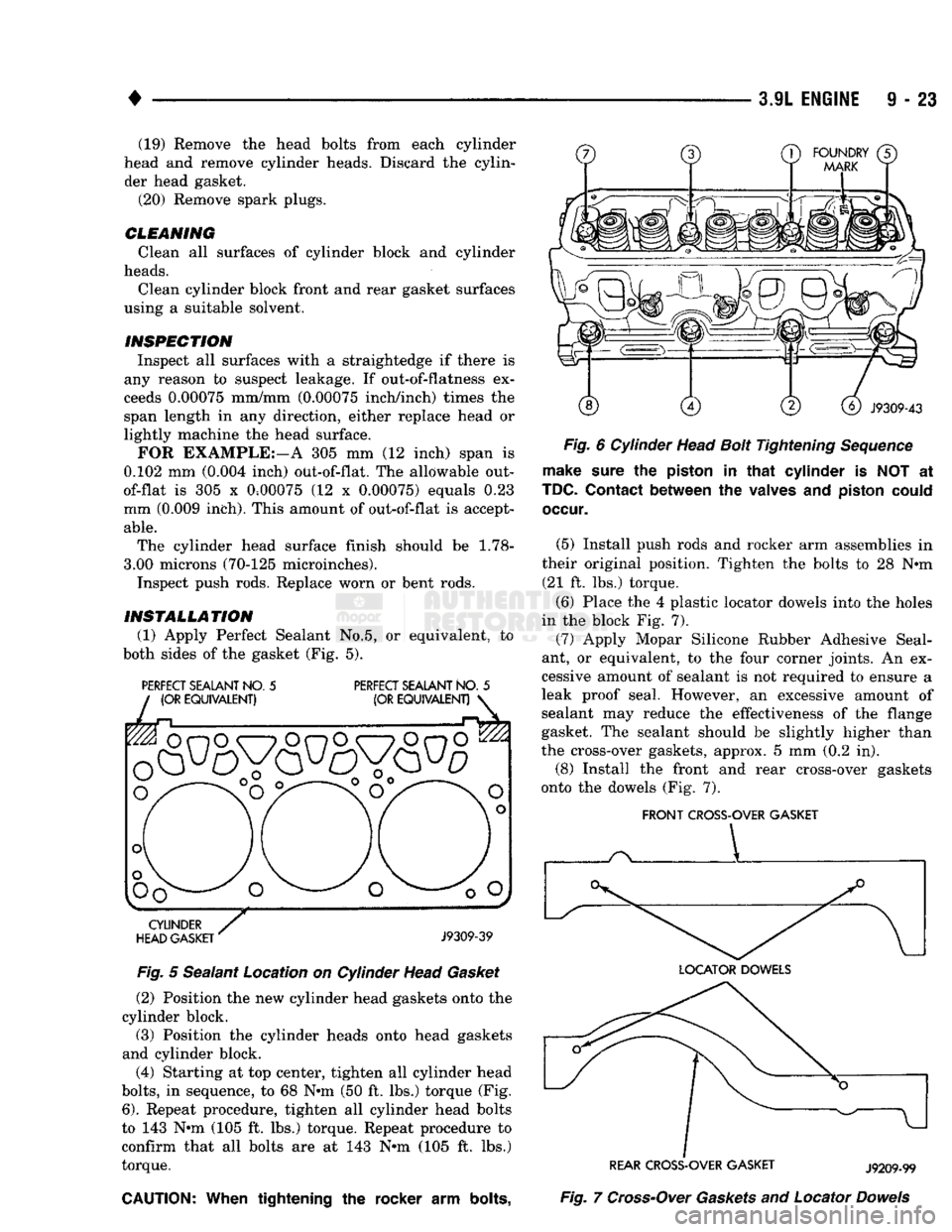
(1) Apply Perfect Sealant No.5, or equivalent, to
both sides of the gasket (Fig. 5).
PERFECT
SEALANT
NO.
5
PERFECT
SEALANT
NO.
5
Fig.
5 Sealant Location on Cylinder Head
Gasket
(2) Position the new cylinder head gaskets onto the
cylinder block.
(3) Position the cylinder heads onto head gaskets
and cylinder block.
(4) Starting at top center, tighten all cylinder head
bolts,
in sequence, to 68 N»m (50 ft. lbs.) torque (Fig.
6).
Repeat procedure, tighten all cylinder head bolts
to 143 N»m (105 ft. lbs.) torque. Repeat procedure to
confirm that all bolts are at 143 N*m (105 ft. lbs.)
torque.
CAUTION:
When
tightening the rocker arm
bolts,
Fig.
6 Cylinder Head
Bolt
Tightening
Sequence
make
sure
the
piston
in
that
cylinder is NOT at
TDC.
Contact
between the
valves
and
piston
could
occur.
(5) Install push rods and rocker arm assemblies in
their original position. Tighten the bolts to 28 Nnn (21 ft. lbs.) torque.
(6) Place the 4 plastic locator dowels into the holes
in the block Fig. 7). (7) Apply Mopar Silicone Rubber Adhesive Seal
ant, or equivalent, to the four corner joints. An ex
cessive amount of sealant is not required to ensure a
leak proof seal. However, an excessive amount of sealant may reduce the effectiveness of the flange
gasket. The sealant should be slightly higher than
the cross-over gaskets, approx. 5 mm (0.2 in).
(8) Install the front and rear cross-over gaskets
onto the dowels (Fig. 7).
FRONT
CROSS-OVER
GASKET
REAR
CROSS-OVER
GASKET
J9209-99
Fig.
7
Cross-Over
Gaskets
and Locator
Dowels
Page 658 of 1502
•
5.2L ENGINE
9 - 53
INSPECTION
Inspect all surfaces with a straightedge if there is
any reason to suspect leakage. If out-of-flatness ex
ceeds 0.00075 mm/mm (0.00075 inch/inch) times the span length in inches in any direction, either replace
head or lightly machine the head surface.
FOR EXAMPLE: A 305 mm (12 inch) span is
0.102 mm (0.004 inch) out-of-flat. The allowable out-
of-flat is 305 x 0.00075 (12 x 0.00075) equals 0.23
mm (0.009 inch). This amount of out-of-flat is accept
able.
The cylinder head surface finish should be 1.78-
3.00 microns (70-125 microinches). Inspect push rods. Replace worn or bent rods.
INSTALLATION
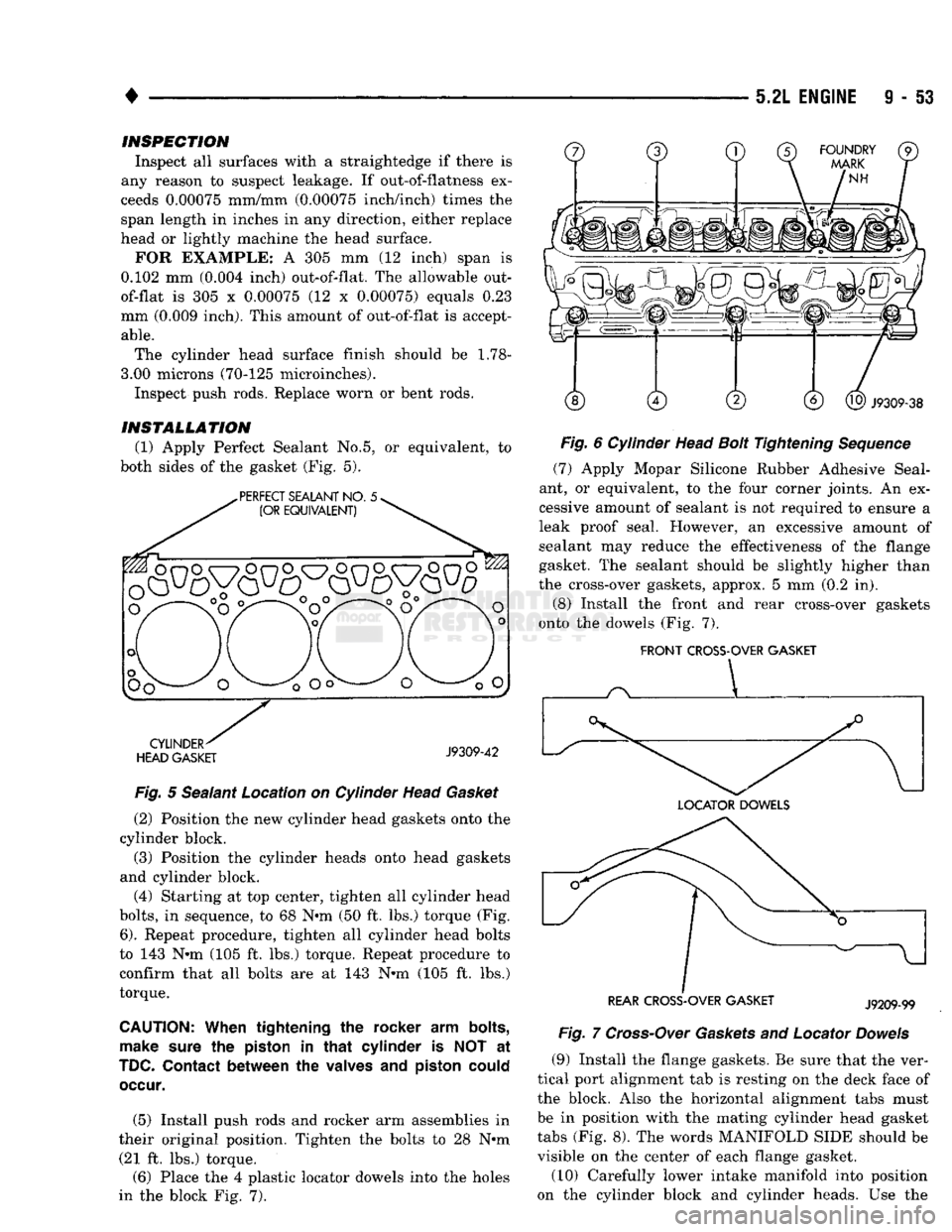
(1) Apply Perfect Sealant No.5, or equivalent, to
both sides of the gasket (Fig. 5).
Fig.
5 Sealant Location on Cylinder Head
Gasket
(2) Position the new cylinder head gaskets onto the
cylinder block. (3) Position the cylinder heads onto head gaskets
and cylinder block. (4) Starting at top center, tighten all cylinder head
bolts,
in sequence, to 68 N»m (50 ft. lbs.) torque (Fig.
6).
Repeat procedure, tighten all cylinder head bolts
to 143 N®m (105 ft. lbs.) torque. Repeat procedure to confirm that all bolts are at 143 N-m (105 ft. lbs.)
torque.
CAUTION:
When
tightening the rocker arm
bolts,
make
sure
the
piston
in
that
cylinder is NOT at
TDC.
Contact
between the
valves
and
piston
could
occur.
(5) Install push rods and rocker arm assemblies in
their original position. Tighten the bolts to 28 N»m (21 ft. lbs.) torque. (6) Place the 4 plastic locator dowels into the holes
in the block Fig. 7).
Fig.
6 Cylinder Head
Bolt
Tightening
Sequence
(7) Apply Mopar Silicone Rubber Adhesive Seal
ant, or equivalent, to the four corner joints. An ex
cessive amount of sealant is not required to ensure a
leak proof seal. However, an excessive amount of sealant may reduce the effectiveness of the flange
gasket. The sealant should be slightly higher than
the cross-over gaskets, approx. 5 mm (0.2 in).
(8) Install the front and rear cross-over gaskets
onto the dowels (Fig. 7).
FRONT
CROSS-OVER GASKET
REAR CROSS-OVER GASKET
J9209-99
Fig.
7
Cross-Over
Gaskets
and Locator
Dowels
(9) Install the flange gaskets. Be sure that the ver
tical port alignment tab is resting on the deck face of
the block. Also the horizontal alignment tabs must
be in position with the mating cylinder head gasket
tabs (Fig. 8). The words MANIFOLD SIDE should be visible on the center of each flange gasket.
(10) Carefully lower intake manifold into position
on the cylinder block and cylinder heads. Use the
Page 688 of 1502
•
IJL ENGINE 9 - 83
INSPECTION
Inspect all surfaces with a straightedge if there is
any reason to suspect leakage. If out-of-flatness ex
ceeds 0.00075 mm/mm (0.00075 inch/inch) times the span length in inches in any direction, either replace
head or lightly machine the head surface.
FOR EXAMPLE: A 305 mm (12 inch) span is
0.102 mm (0.004 inch) out-of-flat. The allowable out-
of-flat is 305 x 0.00075 (12 x 0.00075) equals 0.23
mm (0.009 inch). This amount of out-of-flat is accept
able.
The cylinder head surface finish should be 1.78-
4.57 microns (70-180 microinches). Inspect push rods. Replace worn or bent rods.
INSTALLATION
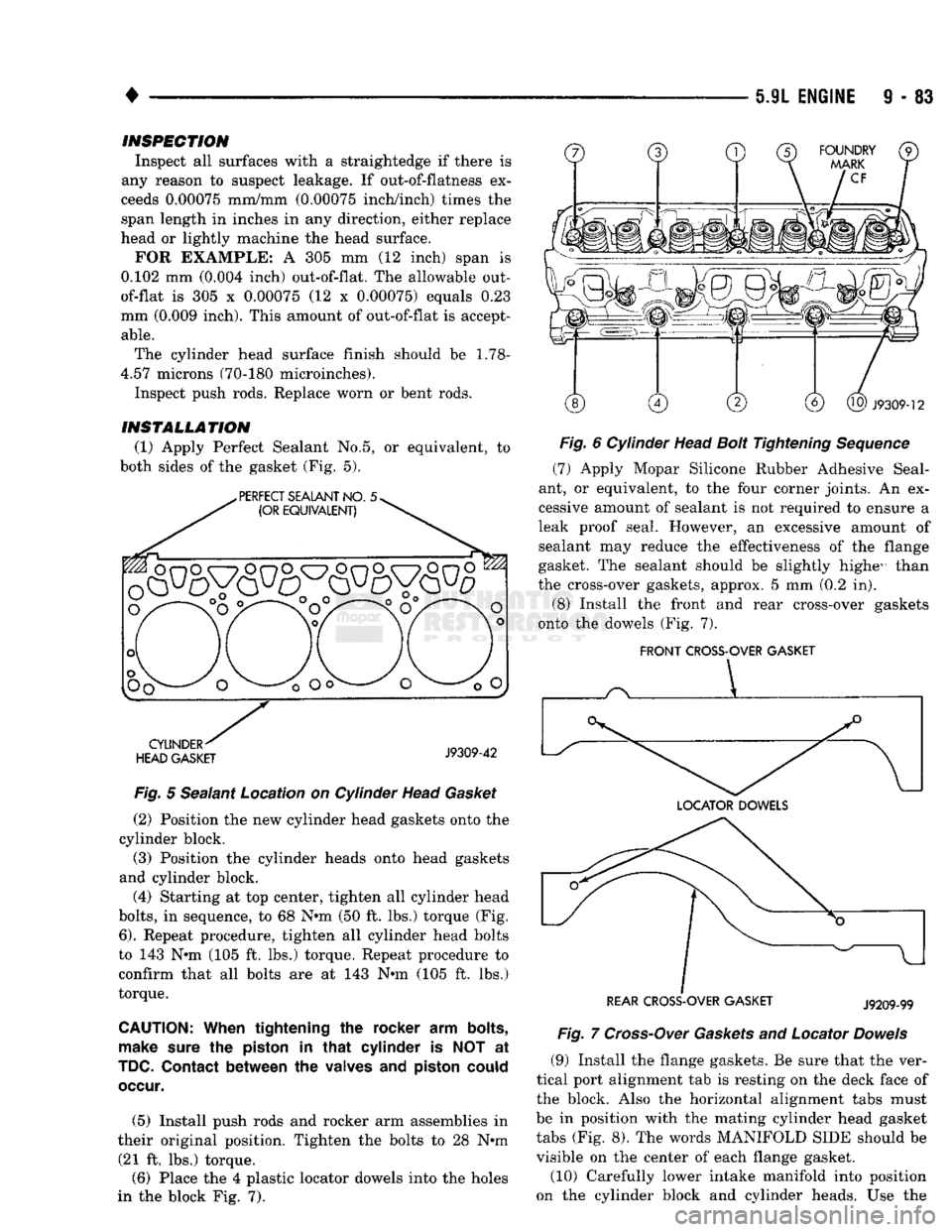
(1) Apply Perfect Sealant No.5, or equivalent, to
both sides of the gasket (Fig. 5).
Fig.
5 Sealant Location on Cylinder Head
Gasket
(2) Position the new cylinder head gaskets onto the
cylinder block.
(3) Position the cylinder heads onto head gaskets
and cylinder block. (4) Starting at top center, tighten all cylinder head
bolts,
in sequence, to 68 N-m (50 ft. lbs.) torque (Fig.
6).
Repeat procedure, tighten all cylinder head bolts
to 143 N-m (105 ft. lbs.) torque. Repeat procedure to confirm that all bolts are at 143 N-m (105 ft. lbs.)
torque.
CAUTION:
When
tightening the rocker arm
bolts,
make
sure
the
piston
in
that
cylinder is NOT at
TDC.
Contact
between the
valves
and
piston
could
occur.
(5) Install push rods and rocker arm assemblies in
their original position. Tighten the bolts to 28 N-m (21 ft. lbs.) torque. (6) Place the 4 plastic locator dowels into the holes
in the block Fig. 7).
Fig.
6 Cylinder Head
Bolt
Tightening
Sequence
(7) Apply Mopar Silicone Rubber Adhesive Seal
ant, or equivalent, to the four corner joints. An ex
cessive amount of sealant is not required to ensure a
leak proof seal. However, an excessive amount of sealant may reduce the effectiveness of the flange
gasket. The sealant should be slightly highe^ than
the cross-over gaskets, approx. 5 mm (0.2 in).
(8) Install the front and rear cross-over gaskets
onto the dowels (Fig. 7).
FRONT
CROSS-OVER GASKET
REAR CROSS-OVER GASKET
J9209-99
Fig.
7
Cross-Over
Gaskets
and Locator
Dowels
(9) Install the flange gaskets. Be sure that the ver
tical port alignment tab is resting on the deck face of
the block. Also the horizontal alignment tabs must
be in position with the mating cylinder head gasket tabs (Fig. 8). The words MANIFOLD SIDE should be
visible on the center of each flange gasket.
(10) Carefully lower intake manifold into position
on the cylinder block and cylinder heads. Use the
Page 735 of 1502
9
- 130 5.9L
(DIESEL) ENGINE
• CAMSHAFT BORE DIAMETER
MAX.
54.133
mm
(2.1312
inch)
J9109-78
Fig.
3 Camshaft
Bores
BORE DIAMETER
MAX. 16.055 mm (0.632 inch)
J9109-79
Fig.
4
Tappet
Bore
Diameter
(3) Cover the lube holes in the top of the block
with waterproof tape.
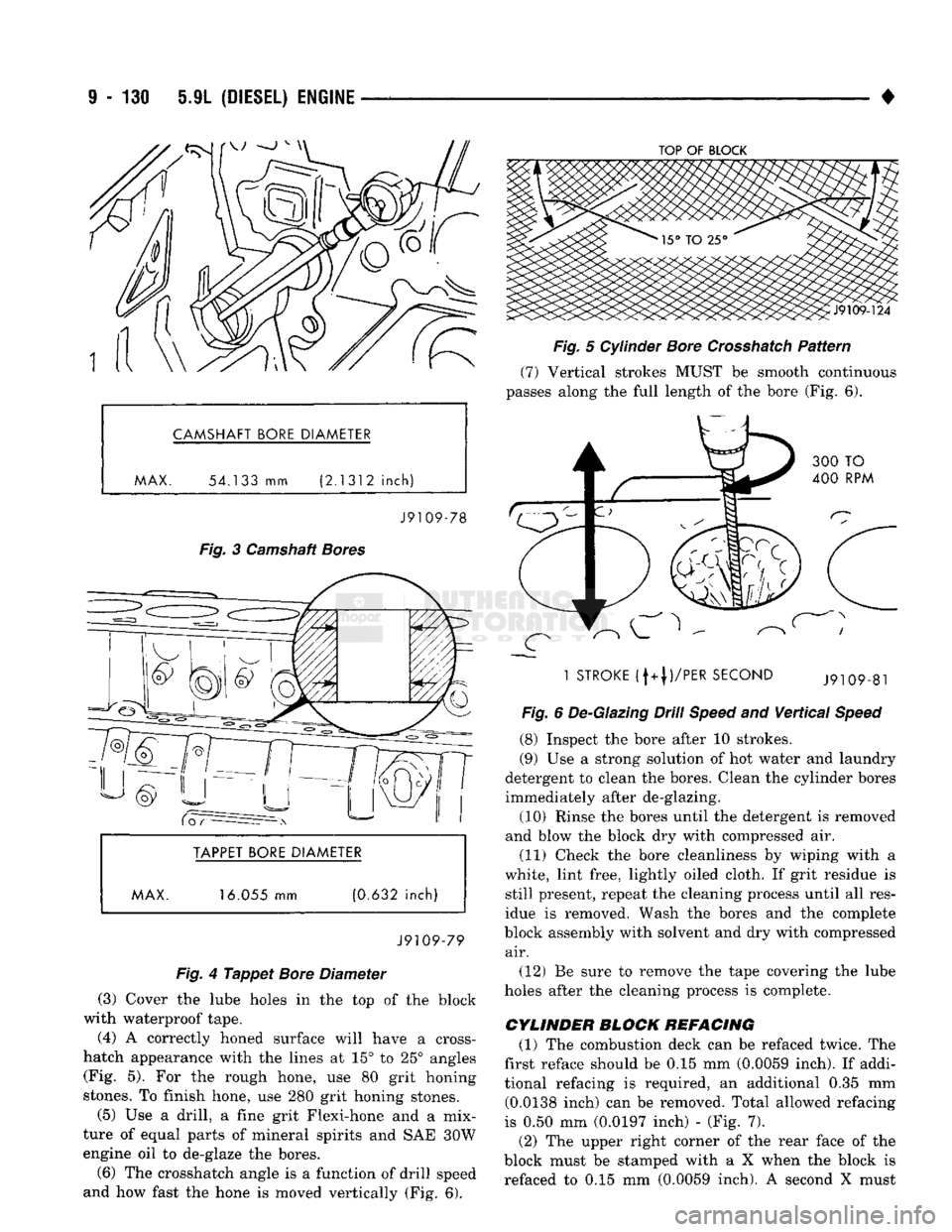
(4) A correctly honed surface will have a cross-
hatch appearance with the lines at 15° to 25° angles (Fig. 5). For the rough hone, use 80 grit honing
stones. To finish hone, use 280 grit honing stones.
(5) Use a drill, a fine grit Flexi-hone and a mix
ture of equal parts of mineral spirits and SAE 30W engine oil to de-glaze the bores.
(6) The Crosshatch angle is a function of drill speed
and how fast the hone is moved vertically (Fig. 6).
TOP
OF
BLOCK
Fig.
5 Cylinder
Bore
Crosshatch
Pattern
(7) Vertical strokes MUST be smooth continuous
passes along the full length of the bore (Fig. 6).
1
STROKE
(f+|)/PER
SECOND
Fig.
6 De-Glazing Drill
Speed
and
Vertical
Speed
(8) Inspect the bore after 10 strokes.
(9) Use a strong solution of hot water and laundry
detergent to clean the bores. Clean the cylinder bores
immediately after de-glazing.
(10) Rinse the bores until the detergent is removed
and blow the block dry with compressed air. (11) Check the bore cleanliness by wiping with a
white, lint free, lightly oiled cloth. If grit residue is still present, repeat the cleaning process until all res
idue is removed. Wash the bores and the complete
block assembly with solvent and dry with compressed air.
(12) Be sure to remove the tape covering the lube
holes after the cleaning process is complete.
CYLINDER BLOCK REFACING
(1) The combustion deck can be refaced twice. The
first reface should be 0.15 mm (0.0059 inch). If addi
tional refacing is required, an additional 0.35 mm (0.0138 inch) can be removed. Total allowed refacing
is 0.50 mm (0.0197 inch) - (Fig. 7).
(2) The upper right corner of the rear face of the
block must be stamped with a X when the block is refaced to 0.15 mm (0.0059 inch). A second X must
Page 773 of 1502
11-14
EXHAUST
SYSTEM
AND
INTAKE
MANIFOLD
• The plenum pan rail must be clean and dry (free of
all foreign material).
INSPECTION
Inspect manifold for cracks.
Inspect mating surfaces of manifold for flatness
with a straightedge.
INSTALLATION
(1) Install the plenum pan, if removed, as follows: (a) Turn the intake manifold upside down. Sup
port the manifold.
(b) Place a new plenum pan gasket onto the seal
rail of the intake manifold. Position the pan over
the gasket. Align all the gasket and pan holes with
the intake manifold. (c) Hand start all bolts.
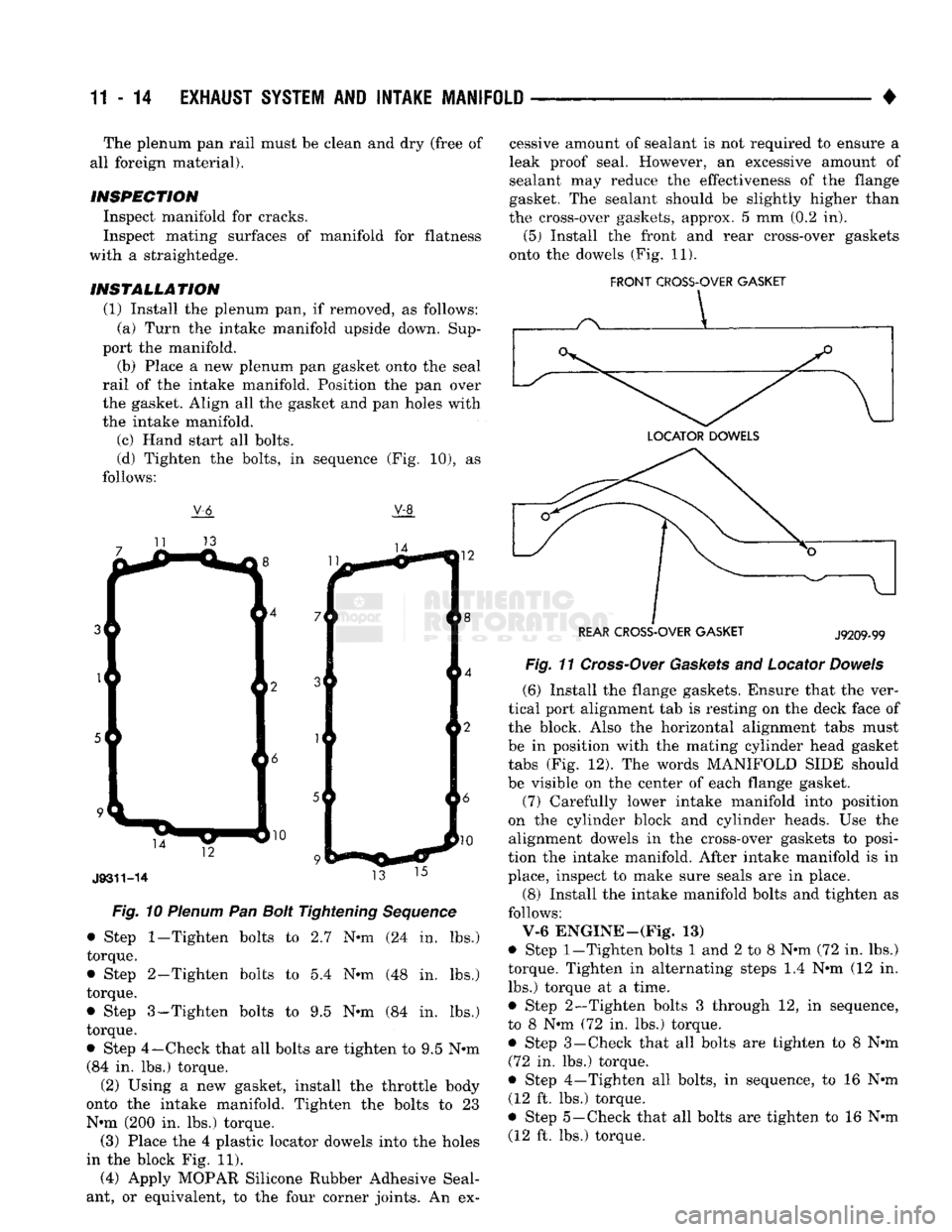
(d) Tighten the bolts, in sequence (Fig. 10), as
follows:
V-6
V-8
Fig.
10
Plenum
Pan
Bolt
Tightening
Sequence
• Step
1-Tighten
bolts to 2.7 N*m (24 in. lbs.)
torque.
• Step 2-Tighten bolts to 5.4 N«m (48 in. lbs.)
torque.
• Step 3-Tighten bolts to 9.5 Nnn (84 in. lbs.)
torque.
• Step 4—Check that all bolts are tighten to 9.5 N®m (84 in. lbs.) torque.
(2) Using a new gasket, install the throttle body
onto the intake manifold. Tighten the bolts to 23
Nun (200 in. lbs.) torque. (3) Place the 4 plastic locator dowels into the holes
in the block Fig. 11).
(4) Apply MOPAR Silicone Rubber Adhesive Seal
ant, or equivalent, to the four corner joints. An ex cessive amount of sealant is not required to ensure a
leak proof seal. However, an excessive amount of
sealant may reduce the effectiveness of the flange
gasket. The sealant should be slightly higher than
the cross-over gaskets, approx. 5 mm (0.2 in).
(5) Install the front and rear cross-over gaskets
onto the dowels (Fig. 11).
FRONT
CROSS-OVER
GASKET
REAR
CROSS-OVER
GASKET
J9209-99
Fig
11
Cross-Over
Gaskets
and Locator
Dowels
(6) Install the flange gaskets. Ensure that the ver
tical port alignment tab is resting on the deck face of
the block. Also the horizontal alignment tabs must
be in position with the mating cylinder head gasket
tabs (Fig. 12). The words MANIFOLD SIDE should
be visible on the center of each flange gasket.
(7) Carefully lower intake manifold into position
on the cylinder block and cylinder heads. Use the alignment dowels in the cross-over gaskets to posi
tion the intake manifold. After intake manifold is in
place, inspect to make sure seals are in place.
(8) Install the intake manifold bolts and tighten as
follows:
V-6 ENGINE—(Fig. 13)
• Step
1-Tighten
bolts 1 and 2 to 8 Nun (72 in. lbs.)
torque. Tighten in alternating steps 1.4 Nun (12 in. lbs.) torque at a time.
• Step 2—Tighten bolts 3 through 12, in sequence,
to 8 Nun (72 in. lbs.) torque.
• Step 3—Check that all bolts are tighten to 8 Nun (72 in. lbs.) torque.
• Step 4—Tighten all bolts, in sequence, to 16 Nun (12 ft. lbs.) torque.
• Step 5—Check that all bolts are tighten to 16 Nun (12 ft. lbs.) torque.
Page 1384 of 1502
•
BODY
COMPONENTS
23 - 1
CONTENTS
page
page
CAB/BODY
INTERIOR COMPONENTS
35
FIXED
GLASS
. 29
DOORS
21
PAINT
CODE
CHART
54
EXTERIOR
COMPONENTS
1
REFINISHING
PROCEDURES
54
EXTERIOR COMPONENTS
INDEX
page
Battery
Tray
7
Blower Motor Housing
Insulation
Panel—Diesel
Engine
Only
7
Body
Mouldings, Nameplates
and
Decals .......
9
Cab
. 14
Cab/Body
and
Cargo
Box
Stripes
11
Cargo
Box
19
Cowl
Grille
7
Front
Fenders
8
Fuel
Filler
Door
and
Nozzle/Tubes
12
Grille
and
Grille
Extension Panel
1
Grille
Extension Panel Support Bracket
(With
Diesel Engine Only)
3
page
Grille
Opening Panel (GOP)
and
Radiator Support Panel
3
Hatchgate
and
Components
16
Hood
5
Hood
Inside Release Cable
5
Hood
Latch
4
Labels/Decals/Plates
1
Outside Mirrors
13
Roof
Vent—Ramcharger
. 20
Splash
Shields—Front Fender
9
Sport
Bar
18
Tailgate
14
LABELS/DECALS/PLATES
GENERAL
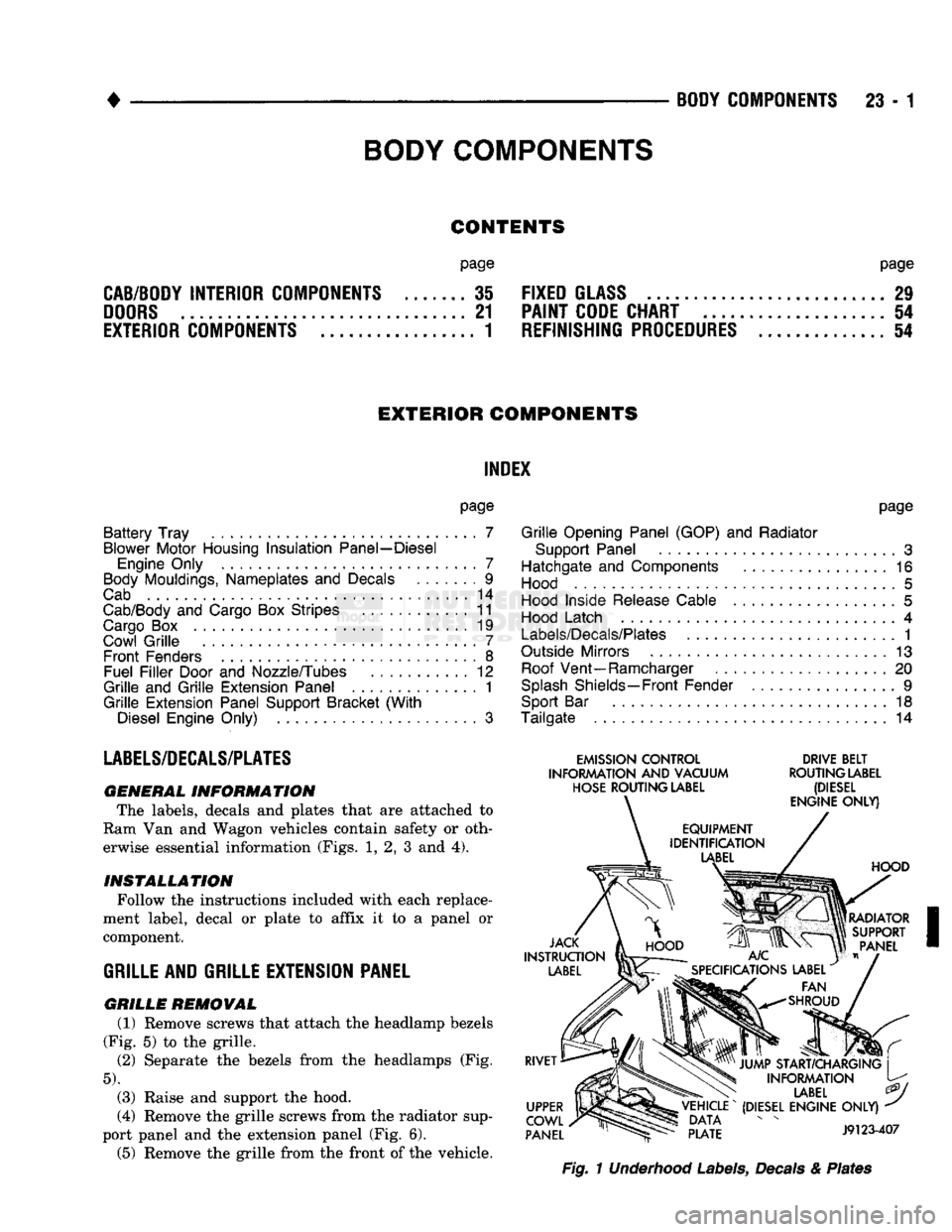
INFORMATION The labels, decals
and
plates that
are
attached
to
Ram Van
and
Wagon vehicles contain safety
or
oth erwise essential information (Figs.
1, 2, 3 and 4).
INSTALLATION
Follow the instructions included with each replace
ment label, decal
or
plate
to
affix
it to a
panel
or
component.
GRILLE
AND GRILLE EXTENSION PANEL
GRILLE
REMOVAL (1) Remove screws that attach the headlamp bezels
(Fig.
5) to the
grille.
(2)
Separate
the
bezels from
the
headlamps
(Fig.
5).
(3) Raise
and
support
the
hood.
(4) Remove the grille screws from the radiator sup
port panel
and the
extension panel (Fig.
6).
(5) Remove
the
grille from the front
of
the vehicle.
EMISSION
CONTROL
DRIVE
BELT
INFORMATION
AND
VACUUM
ROUTING
LABEL
HOSE
ROUTING
LABEL
(DIESEL
Fig.
1 Underhood Labels, Decals & Plates
BODY
COMPONENTS
Page 1394 of 1502
•
BODY COMPONENTS
23 - 11 (3) Apply additional heat to any location where the
decal remains adhered to the panel.
(4) Remove the extra adhesive from the panel with
a cloth saturated with an adhesive remover.
INSTALLATION
(1) Clean the panel surface with a commercial wax
and silicone removal solution. Wipe the surface with
a clean cloth. (2) Remove the backing from the decal. Position it
on the panel.
(3) Verify that the decal is properly aligned.
(4) Press the decal onto the panel with a roller to
ensure complete adhesion.
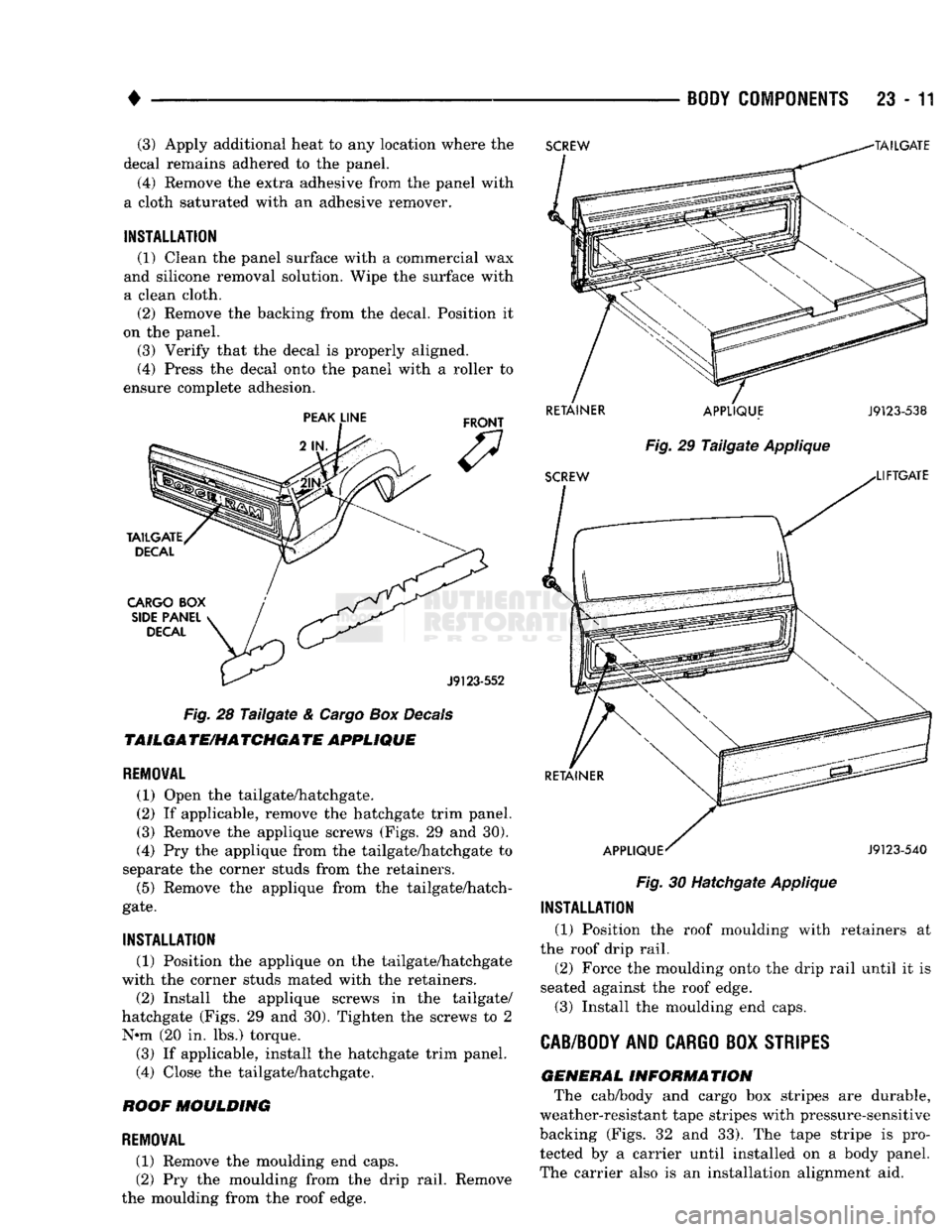
Fig.
28
Tailgate
&
Cargo
Box
Decals
TMILGA
TE/HA
TCHGA
TE
APPLIQUE
REMOVAL
(1) Open the tailgate/hatchgate.
(2) If applicable, remove the hatchgate trim panel.
(3) Remove the applique screws (Figs. 29 and 30).
(4) Pry the applique from the tailgate/hatchgate to
separate the corner studs from the retainers. (5) Remove the applique from the tailgate/hatch
gate.
INSTALLATION
(1) Position the applique on the tailgate/hatchgate
with the corner studs mated with the retainers.
(2) Install the applique screws in the tailgate/
hatchgate (Figs. 29 and 30). Tighten the screws to 2 N-m (20 in. lbs.) torque. (3) If applicable, install the hatchgate trim panel.
(4) Close the tailgate/hatchgate.
ROOF
MOULDING
REMOVAL
(1) Remove the moulding end caps.
(2) Pry the moulding from the drip rail. Remove
the moulding from the roof edge.
RETAINER
APPLIQUE
J9123-538
Fig.
29
Tailgate
Applique
Fig.
30 Hatchgate Applique
INSTALLATION
(1) Position the roof moulding with retainers at
the roof drip rail. (2) Force the moulding onto the drip rail until it is
seated against the roof edge.
(3) Install the moulding end caps.
CAB/BODY
AND
CARGO
BOX
STRIPES
GENERAL
INFORMATION
The cab/body and cargo box stripes are durable,
weather-resistant tape stripes with pressure-sensitive
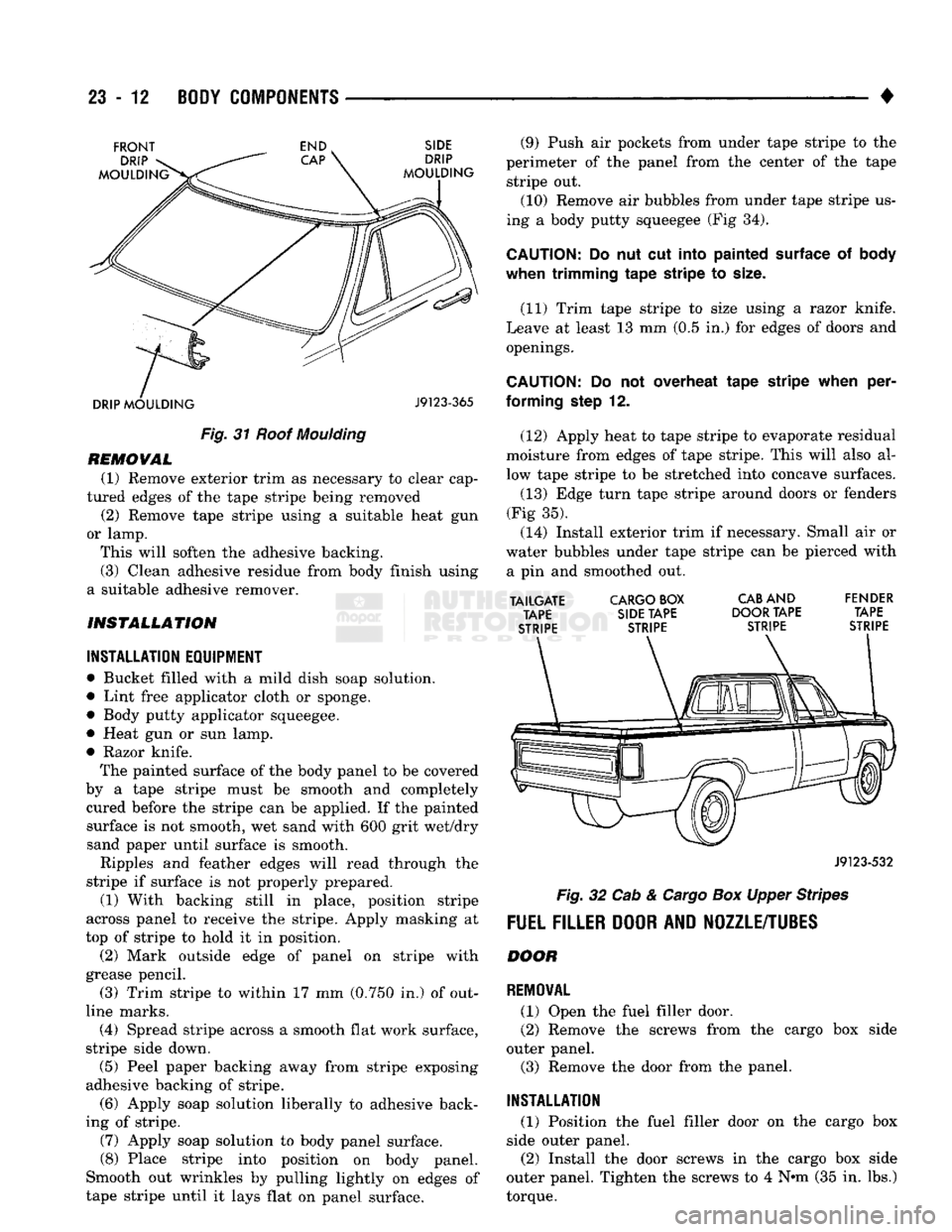
backing (Figs. 32 and 33). The tape stripe is pro tected by a carrier until installed on a body panel.
The carrier also is an installation alignment aid.
Page 1395 of 1502
23
- 12
BODY COMPONENTS
•
Fig.
31
Roof
Moulding
REMOVAL
(1) Remove exterior trim as necessary to clear cap
tured edges of the tape stripe being removed
(2) Remove tape stripe using a suitable heat gun
or lamp. This will soften the adhesive backing.
(3) Clean adhesive residue from body finish using
a suitable adhesive remover.
INSTALLATION
INSTALLATION EQUIPMENT
• Bucket filled with a mild dish soap solution.
• Lint free applicator cloth or sponge. • Body putty applicator squeegee.
• Heat gun or sun lamp.
• Razor knife.
The painted surface of the body panel to be covered
by a tape stripe must be smooth and completely cured before the stripe can be applied. If the painted surface is not smooth, wet sand with 600 grit wet/dry
sand paper until surface is smooth.
Ripples and feather edges will read through the
stripe if surface is not properly prepared. (1) With backing still in place, position stripe
across panel to receive the stripe. Apply masking at
top of stripe to hold it in position. (2) Mark outside edge of panel on stripe with
grease pencil. (3) Trim stripe to within 17 mm (0.750 in.) of out
line marks.
(4) Spread stripe across a smooth flat work surface,
stripe side down. (5) Peel paper backing away from stripe exposing
adhesive backing of stripe.
(6) Apply soap solution liberally to adhesive back
ing of stripe. (7) Apply soap solution to body panel surface.
(8) Place stripe into position on body panel.
Smooth out wrinkles by pulling lightly on edges of
tape stripe until it lays flat on panel surface. (9) Push air pockets from under tape stripe to the
perimeter of the panel from the center of the tape stripe out. (10) Remove air bubbles from under tape stripe us
ing a body putty squeegee (Fig 34).
CAUTION:
Do nut cut
Into
painted surface
of body
when trimming
tape
stripe
to
size.
(11) Trim tape stripe to size using a razor knife.
Leave at least 13 mm (0.5 in.) for edges of doors and openings.
CAUTION;
Do not overheat
tape
stripe
when
per
forming
step
12.
(12) Apply heat to tape stripe to evaporate residual
moisture from edges of tape stripe. This will also al
low tape stripe to be stretched into concave surfaces.
(13) Edge turn tape stripe around doors or fenders
(Fig 35). (14) Install exterior trim if necessary. Small air or
water bubbles under tape stripe can be pierced with a pin and smoothed out.
TAILGATE
CARGO BOX
CAB
AND FENDER TAPE SIDE TAPE DOOR TAPE TAPE
STRIPE STRIPE STRIPE STRIPE
J9123-532
Fig.
32 Cab &
Cargo
Box Upper Stripes
FUEL FILLER DOOR AND NOZZLE/TUBES
DOOR
REMOVAL
(1) Open the fuel filler door.
(2) Remove the screws from the cargo box side
outer panel. (3) Remove the door from the panel.
INSTALLATION
(1) Position the fuel filler door on the cargo box
side outer panel.
(2) Install the door screws in the cargo box side
outer panel. Tighten the screws to 4 Nnn (35 in. lbs.)
torque.
Page 1400 of 1502
•
BODY
COMPONENTS
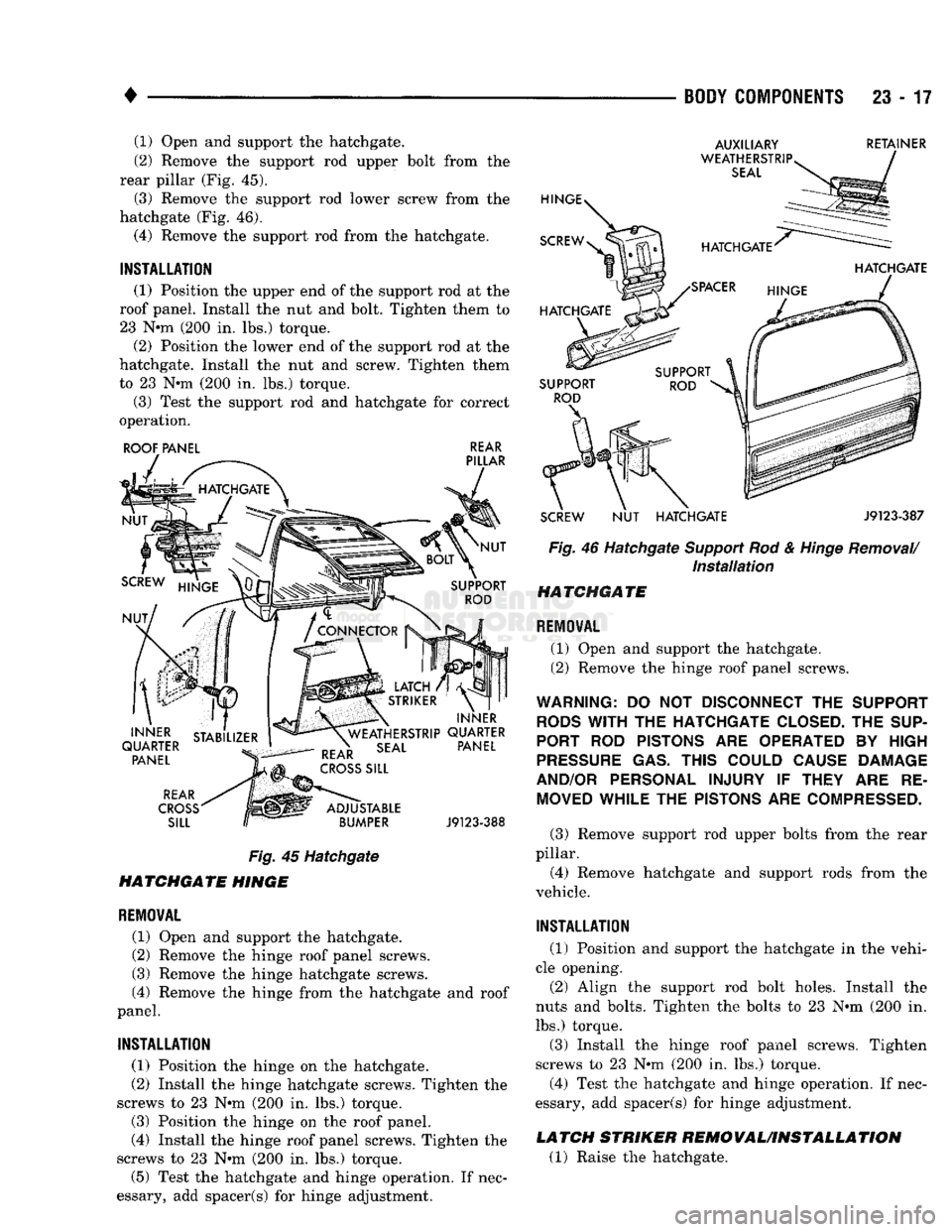
23 - 17 (1) Open and support the hatchgate.
(2) Remove the support rod upper bolt from the
rear pillar (Fig. 45).
(3) Remove the support rod lower screw from the
hatchgate (Fig. 46). (4) Remove the support rod from the hatchgate.
INSTALLATION
(1) Position the upper end of the support rod at the
roof panel. Install the nut and bolt. Tighten them to 23 N'm (200 in. lbs.) torque.
(2) Position the lower end of the support rod at the
hatchgate. Install the nut and screw. Tighten them
to 23 N-m (200 in. lbs.) torque.
(3) Test the support rod and hatchgate for correct
operation.
ROOF PANEL REAR
Fig.
45 Hatchgate
HATCHGATE
HINGE
REMOVAL
(1) Open and support the hatchgate.
(2) Remove the hinge roof panel screws.
(3) Remove the hinge hatchgate screws.
(4) Remove the hinge from the hatchgate and roof
panel.
INSTALLATION
(1) Position the hinge on the hatchgate.
(2) Install the hinge hatchgate screws. Tighten the
screws to 23 N*m (200 in. lbs.) torque.
(3) Position the hinge on the roof panel.
(4) Install the hinge roof panel screws. Tighten the
screws to 23 N»m (200 in. lbs.) torque.
(5) Test the hatchgate and hinge operation. If nec
essary, add spacer(s) for hinge adjustment.
AUXILIARY RETAINER
SCREW
NUT
HATCHGATE
J9123-387
Fig.
46 Hatchgate
Support
Rod &
Hinge
Removal/
Installation
HATCHGATE
REMOVAL
(1) Open and support the hatchgate.
(2) Remove the hinge roof panel screws.
WARNING:
DO NOT
DISCONNECT
THE
SUPPORT
RODS
WITH
THE
HATCHGATE CLOSED.
THE
SUP
PORT
ROD
PISTONS
ARE
OPERATED
BY
HIGH
PRESSURE
GAS.
THIS COULD CAUSE DAMAGE
AND/OR PERSONAL INJURY
IF
THEY
ARE RE
MOVED WHILE
THE
PISTONS
ARE
COMPRESSED.
(3) Remove support rod upper bolts from the rear
pillar.
(4) Remove hatchgate and support rods from the
vehicle.
INSTALLATION
(1) Position and support the hatchgate in the vehi
cle opening. (2) Align the support rod bolt holes. Install the
nuts and bolts. Tighten the bolts to 23 N*m (200 in.
lbs.) torque.
(3) Install the hinge roof panel screws. Tighten
screws to 23 N«m (200 in. lbs.) torque. (4) Test the hatchgate and hinge operation. If nec
essary, add spacer(s) for hinge adjustment.
LATCH
STRIKER
REMOVAL/INSTALLATION
(1) Raise the hatchgate.
Page 1403 of 1502
23
- 20
BODY COMPONENTS
•
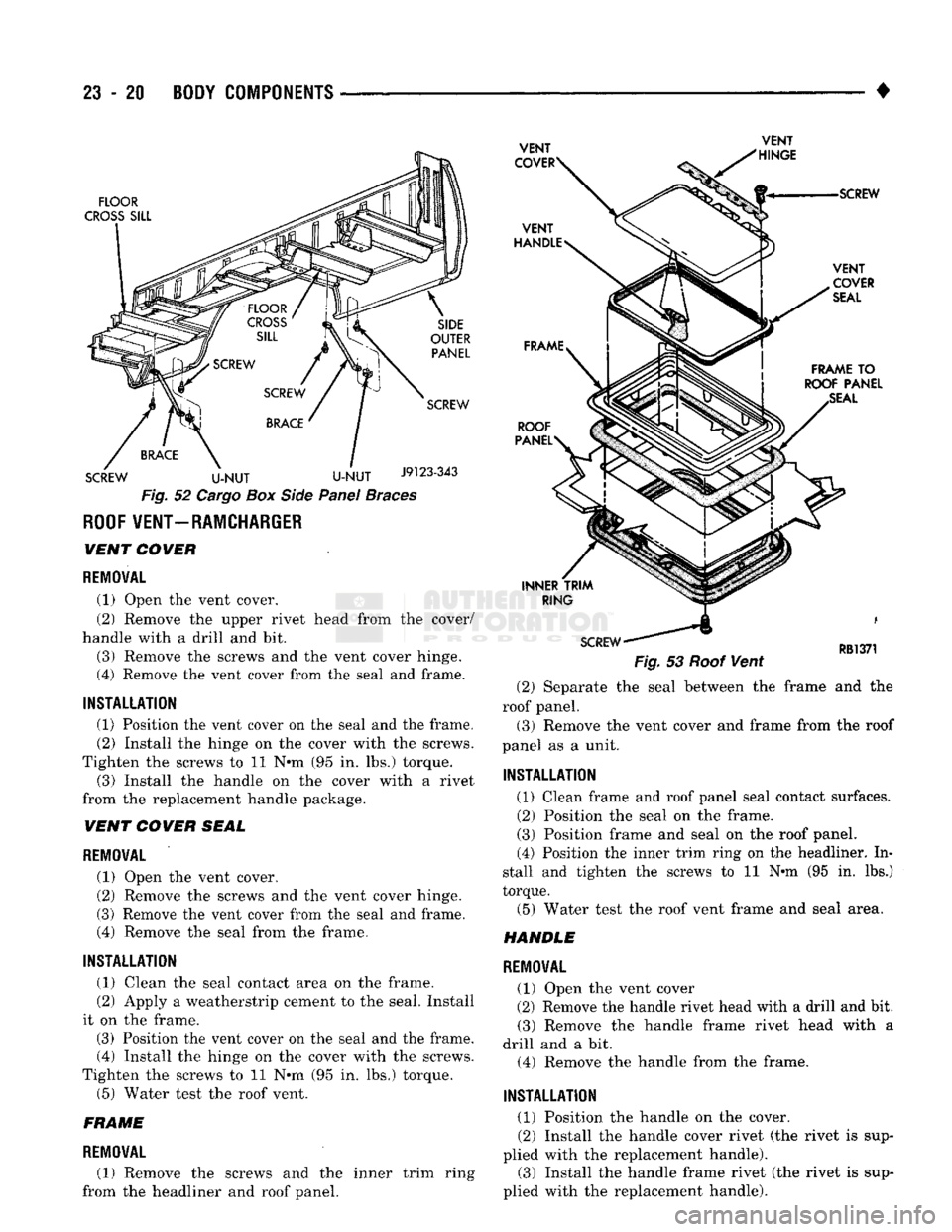
Fig.
52
Cargo
Box
Side
Panel
Braces
ROOF
VENT—RAMCHARGER
WENT
COWER
REMOVAL
(1) Open the vent cover.
(2) Remove the upper rivet head from the cover/
handle with a drill and bit. (3) Remove the screws and the vent cover hinge.
(4) Remove the vent cover from the seal and frame.
INSTALLATION
(1) Position the vent cover on the seal and the frame. (2) Install the hinge on the cover with the screws.
Tighten the screws to 11 N-m (95 in. lbs.) torque.
(3) Install the handle on the cover with a rivet
from the replacement handle package.
WENT
COWER
SEAL
REMOVAL
(1) Open the vent cover.
(2) Remove the screws and the vent cover hinge.
(3) Remove the vent cover from the seal and frame.
(4) Remove the seal from the frame.
INSTALLATION
(1) Clean the seal contact area on the frame.
(2) Apply a weatherstrip cement to the seal. Install
it on the frame. (3) Position the vent cover on the seal and the frame.
(4) Install the hinge on the cover with the screws.
Tighten the screws to 11 N-m (95 in. lbs.) torque. (5) Water test the roof vent.
FRAME
REMOVAL
(1) Remove the screws and the inner trim ring
from the headliner and roof panel.
Fig.
53
Roof
Vent
(2) Separate the seal between the frame and the
roof panel. (3) Remove the vent cover and frame from the roof
panel as a unit.
INSTALLATION
(1) Clean frame and roof panel seal contact surfaces. (2) Position the seal on the frame.
(3) Position frame and seal on the roof panel.
(4) Position the inner trim ring on the headliner. In
stall and tighten the screws to 11 N-m (95 in. lbs.)
torque.
(5) Water test the roof vent frame and seal area.
HANDLE
REMOVAL
(1) Open the vent cover
(2) Remove the handle rivet head with a drill and bit.
(3) Remove the handle frame rivet head with a
drill and a bit. (4) Remove the handle from the frame.
INSTALLATION
(1) Position the handle on the cover. (2) Install the handle cover rivet (the rivet is sup
plied with the replacement handle).
(3) Install the handle frame rivet (the rivet is sup
plied with the replacement handle).