diag code DODGE TRUCK 1993 Service Owner's Guide
[x] Cancel search | Manufacturer: DODGE, Model Year: 1993, Model line: TRUCK, Model: DODGE TRUCK 1993Pages: 1502, PDF Size: 80.97 MB
Page 906 of 1502
•
FUEL
SYSTEM
14 - 87
ENGINE
WARM-UP
• The PCM may start the air intake heater post-heat
cycle depending on intake air temperature. If manifold air temperature was at or below 15°C (59°F) when the
ignition switch was turned on, the cycle is started.
• If intake manifold air temperature is below 32°C
(90°F),
the KSB solenoid will be energized through
the air temperature switch. The solenoid remains en ergized until the air temperature switch opens. The
switch opens when intake manifold air temperature
is above 32°C (90°F).
• If the coolant temperature is below 16°C (60° F),
the transmission will not be allowed to enter over drive (automatic transmission).
• The PCM will turn on the water-in-fuel lamp if a signal is received from the water-in-fuel sensor.
CRUISE
OR
IDLE
• The PCM monitors intake manifold air tempera
ture through the charge temperature sensor input. • If intake manifold air temperature is below 32°C
(90°F),
the KSB solenoid will be energized through
the air temperature switch. The solenoid remains en ergized until the air temperature switch opens. The switch opens when intake manifold air temperature
is above 32°C (90°F).
• The air intake heater post-heat cycle will be com
pleted, if it is not already over.
• The vehicle speed sensor, engine speed sensor and
throttle position sensor inputs are used to control
transmission overdrive operation.
• If the coolant temperature is below 16° C (60° F),
the transmission will not be allowed to enter over drive (automatic transmission).
• If the transmission thermo-switch is open, the
transmission will not be allowed to enter into over
drive (automatic transmission). If the switch opens
when the vehicle is in overdrive, the transmission
will be downshifted. The transmission thermo-switch opens at 134°C (273°F).
• The thermo-switch will close once the transmission
fluid temperature drops to 116°C (240°F). • The PCM will turn on the water-in-fuel lamp if a signal is received from the water-in-fuel sensor.
ACCELERATION
• The vehicle speed sensor, engine speed sensor and
throttle position sensor inputs are used to control
transmission overdrive operation.
• If the coolant temperature is below 16° C (60° F),
the transmission will not be allowed to enter over
drive (automatic transmission).
• If intake manifold air temperature is below 32°C
(90°F),
the KSB solenoid will be energized through
the air temperature switch. The solenoid remains en ergized until the air temperature switch opens. The
switch opens when intake manifold air temperature
is above 32°C (90°F). • If the transmission thermo-switch is open, the
transmission will not be allowed to enter into over
drive (automatic transmission). If the switch opens
when the vehicle is in overdrive, the transmission
will be downshifted. The transmission thermo-switch opens at 134°C (273°F). The thermo-switch will close
once the transmission fluid temperature drops to 116°C (240°F).
• The PCM will turn on the water-in-fuel lamp if a
signal is received from the water-in-fuel sensor.
• If the speed control system resume/accelerate func
tion is being used, the PCM will only allow the vehi
cle to accelerate at a predetermined rate. If a speed
control has been set and the resume/accelerate but
ton is momentarily pushed in, the PCM will increase
vehicle speed by two miles per hour.
• If the brakes are applied, the PCM will disable the
speed control.
DECELERATION
• The vehicle speed sensor, engine speed sensor and
throttle position sensor inputs are used to control
transmission overdrive operation.
• If the coolant temperature is below 16° C (60° F),
the transmission will not be allowed to enter over drive (automatic transmission).
• If the transmission thermo-switch is open, the trans
mission will not be allowed to enter into overdrive (au
tomatic transmission). If the switch opens when the
vehicle is in overdrive, the transmission will be down shifted. The transmission thermo-switch opens at 134°C (273°F). The thermo-switch will close once the transmis
sion fluid temperature drops to 116°C (240°F).
• The PCM will turn on the water-in-fuel lamp if a
signal is received from the water-in-fuel sensor.
• If intake manifold air temperature is below 32°C
(90°F),
the KSB solenoid will be energized through
the air temperature switch. The solenoid remains en ergized until the air temperature switch opens. The
switch opens when intake manifold air temperature
is above 32°C (90°F).
• If the speed control system coast/set function is be
ing used, the PCM will only allow the vehicle to de celerate at a predetermined rate. If the coast/set
switch is pushed while the system is operating, the
PCM will set speed control to the rate the vehicle is
traveling at when the switch is released. • If the brakes are applied, the PCM will disable the speed control.
IGNITION SWITCH
OFF
• When the ignition switch is turned to the off posi
tion, the PCM still receives battery voltage through
the battery input. Battery voltage is needed to keep
PCM memory alive. The PCM memory stores diag nostic trouble code (DTC) messages and the mini
mum TPS value from the previous key-on.
Page 907 of 1502
DIESEL FUEL INJECTION—GENERAL DIAGNOSIS
INDEX
page
Air
in
Fuel System
90
Air Intake Heater
. 90
Diagnostic
Trouble Code (DTC)
. 95
DRB
II
Scan
Tool
95
Engine
Speed
Sensor
91
Fuel Heater
91
Fuel
Injection
Pump
91
Fuel Injectors
92
Fuel Supply Restrictions
92
page
Fuel/Water Separator
Filter 92
High
Pressure Fuel Line Restrictions
93
KSB
Solenoid
. 93
Mechanical
Lift
Pump
93
On-Board
Diagnostics (OBD)
94
System
Schematics—5.9L Diesel Engine
....... 95
Throttle
Position
Sensor
Test
94
Visual
Inspection
88
VISUAL
INSPECTION
A visual inspection for loose, disconnected, or incor
rectly routed wires and hoses should be made before attempting to diagnose or service the fuel injection
system. A visual check will help find these condi
tions.
It also saves unnecessary test and diagnostic
time.
A thorough visual inspection of the fuel injec
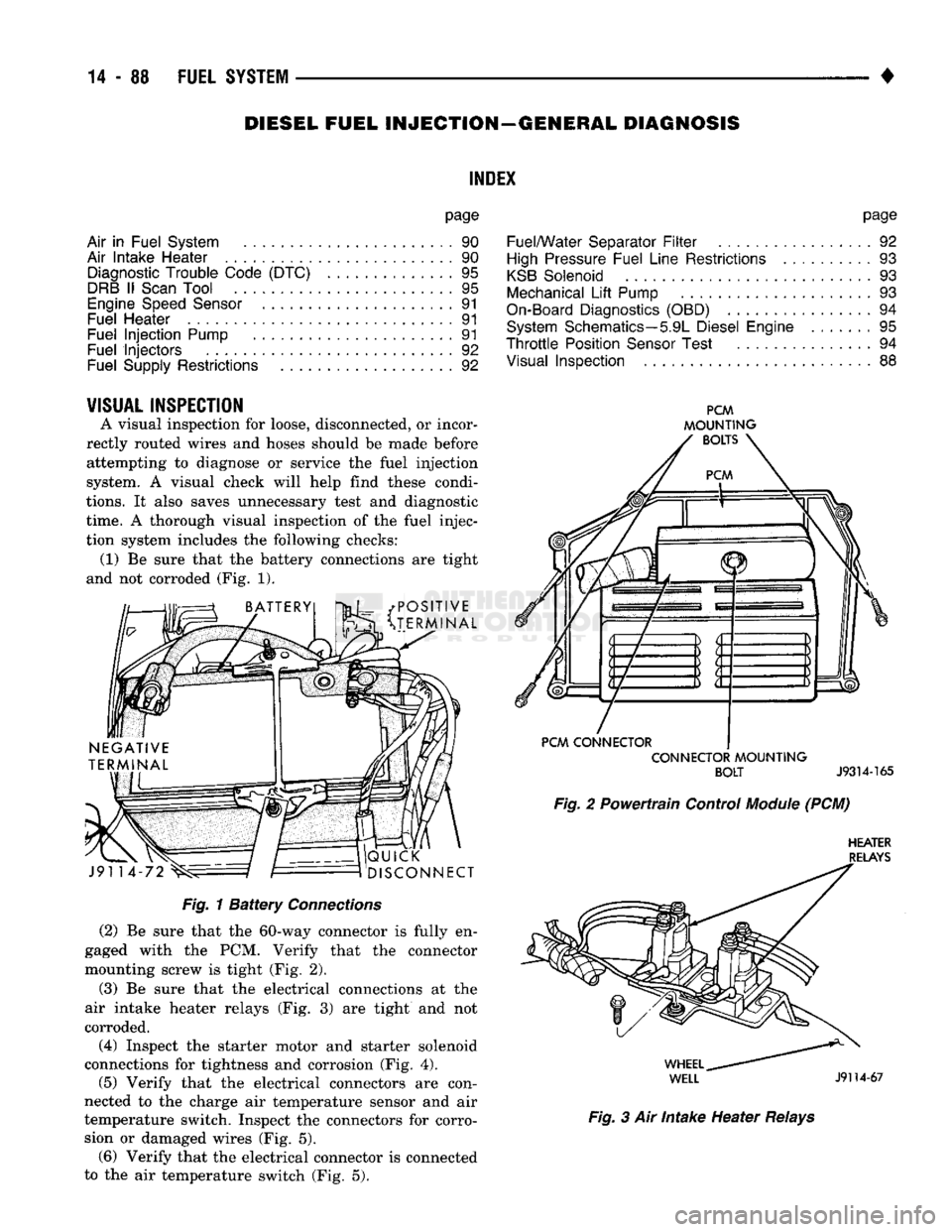
tion system includes the following checks: (1) Be sure that the battery connections are tight
and not corroded (Fig. 1).
• POSITIVE
v^3t
^TERMINAL J91 14
QUICK
DISCONNECT
PCM
MOUNTING
BOLTS
PCM
CONNECTOR CONNECTOR
MOUNTING
BOLT
J9314-165
Fig.
2 Powertrain Control
Module
(PCM)
HEATER
RELAYS
Fig.
1
Battery
Connections
(2)
Be sure that the 60-way connector is fully en
gaged with the PCM. Verify that the connector
mounting screw is tight (Fig. 2).
(3)
Be sure that the electrical connections at the
air intake heater relays (Fig. 3) are tight and not
corroded.
(4)
Inspect the starter motor and starter solenoid
connections for tightness and corrosion (Fig. 4).
(5)
Verify that the electrical connectors are con
nected to the charge air temperature sensor and air
temperature switch. Inspect the connectors for corro sion or damaged wires (Fig. 5). (6) Verify that the electrical connector is connected
to the air temperature switch (Fig. 5).
WHEEL
^
WELL
J9114-67
Fig.
3 Air Intake Heater
Relays
Page 913 of 1502
14
- 94
FUEL
SYSTEM
•
THROTTLE POSITION
SENSOR
TEST
CAUTION;
Before checking
the
TPS,
the
throttle
linkage must
be
checked
for
correct
adjustment.
The
throttle
lever must
contact
the low idle
speed screw.
The
throttle
lever must reach breakover when
the
throttle
is
wide
open. Refer
to the
Accelerator Pedal and
Throttle
Cable section
of
Group
14,
Fuel Systems.
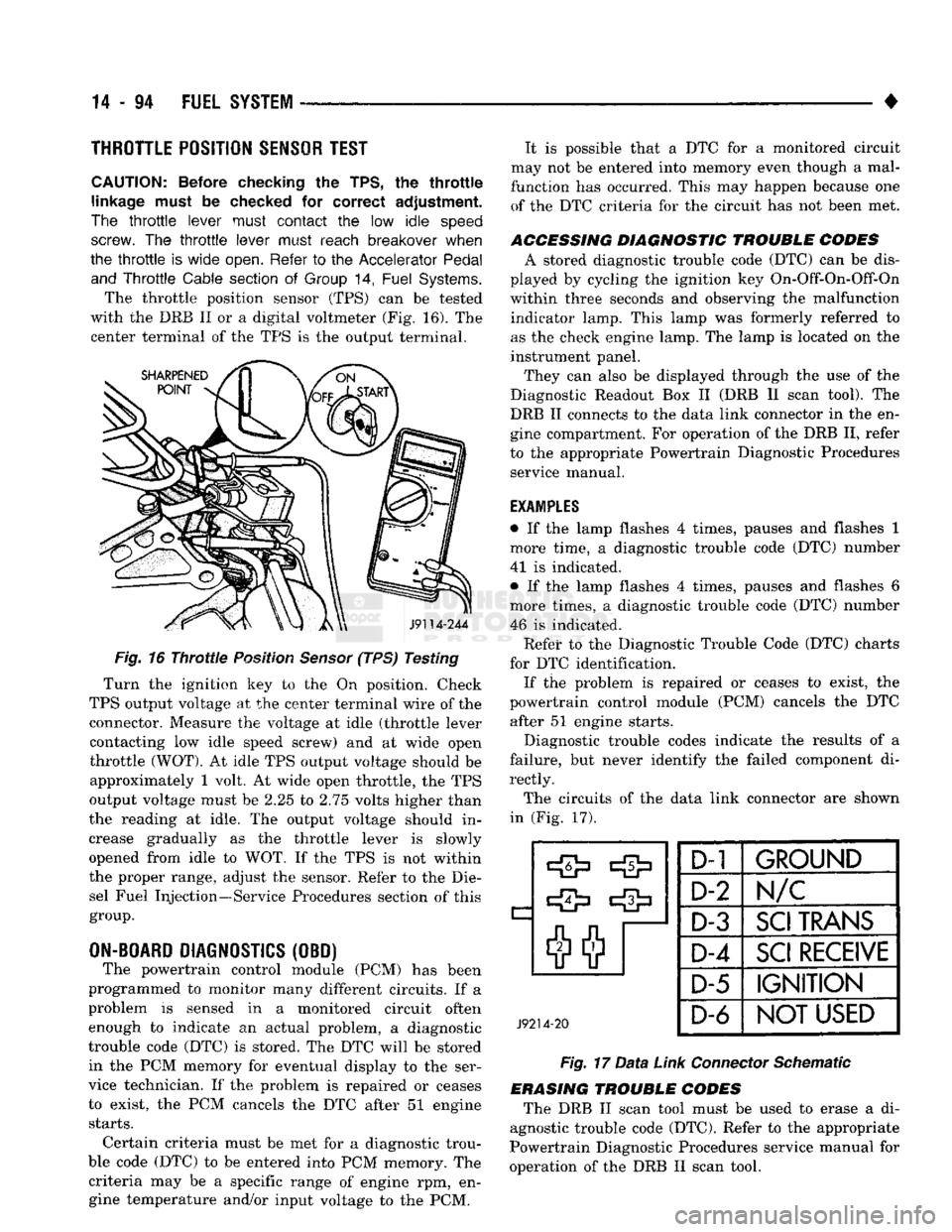
The throttle position sensor (TPS) can be tested
with the DRB II or a digital voltmeter (Fig. 16). The center terminal of the TPS is the output terminal.
J9114-244
Fig.
16
Throttle
Position
Sensor
(TPS) Testing
Turn the ignition key to the On position. Check
TPS output voltage at the center terminal wire of the connector. Measure the voltage at idle (throttle lever contacting low idle speed screw) and at wide open
throttle
(WOT).
At idle TPS output voltage should be approximately 1 volt. At wide open throttle, the TPS
output voltage must be 2.25 to 2.75 volts higher than
the reading at idle. The output voltage should in
crease gradually as the throttle lever is slowly
opened from idle to WOT. If the TPS is not within
the proper range, adjust the sensor. Refer to the Die sel Fuel Injection—Service Procedures section of this
group.
ON-BOARD
DIAGNOSTICS
(OBD) The powertrain control module (PCM) has been
programmed to monitor many different circuits. If a
problem is sensed in a monitored circuit often enough to indicate an actual problem, a diagnostic
trouble code (DTC) is stored. The DTC will be stored in the PCM memory for eventual display to the ser
vice technician. If the problem is repaired or ceases
to exist, the PCM cancels the DTC after 51 engine
starts.
Certain criteria must be met for a diagnostic trou
ble code (DTC) to be entered into PCM memory. The criteria may be a specific range of engine rpm, engine temperature and/or input voltage to the PCM. It is possible that a DTC for a monitored circuit
may not be entered into memory even though a mal
function has occurred. This may happen because one of the DTC criteria for the circuit has not been met.
ACCESSING DIAGNOSTIC TROUBLE CODES A stored diagnostic trouble code (DTC) can be dis
played by cycling the ignition key On-Off-On-Off-On
within three seconds and observing the malfunction indicator lamp. This lamp was formerly referred to
as the check engine lamp. The lamp is located on the
instrument panel.
They can also be displayed through the use of the
Diagnostic Readout Box II (DRB II scan tool). The
DRB II connects to the data link connector in the en
gine compartment. For operation of the DRB II, refer
to the appropriate Powertrain Diagnostic Procedures service manual.
EXAMPLES
• If the lamp flashes 4 times, pauses and flashes 1
more time, a diagnostic trouble code (DTC) number
41 is indicated.
• If the lamp flashes 4 times, pauses and flashes 6
more times, a diagnostic trouble code (DTC) number 46 is indicated. Refet* to the Diagnostic Trouble Code (DTC) charts
for DTC identification. If the problem is repaired or ceases to exist, the
powertrain control module (PCM) cancels the DTC after 51 engine starts.
Diagnostic trouble codes indicate the results of a
failure, but never identify the failed component di
rectly.
The circuits of the data link connector are shown
in (Fig. 17).
J9214-20
D-1
1
GROUND
D-2
N/C
D-3
SCI
TRANS
D-4
SCI
RECEIVE
D-5 IGNITION
D-6
NOT USED
Fig.
17
Data
Link
Connector
Schematic
ERASING TROUBLE CODES The DRB II scan tool must be used to erase a di
agnostic trouble code (DTC). Refer to the appropriate
Powertrain Diagnostic Procedures service manual for
operation of the DRB II scan tool.
Page 914 of 1502
•
FUEL SYSTEM
14 - 95
DRB
II
SCAN
TOOL
For operation
of the DRB II
scan tool, refer
to the
appropriate Powertrain Diagnostic Procedures ser
vice manual.
DIAGNOSTIC TROUBLE CODE (DTC)
On
the
following pages,
a
list
of
diagnostic trouble
codes
is
provided
for the
diesel engine.
A DTC
indi cates that
the
powertrain control module
(PCM) has
recognized
an
abnormal signal
in a
circuit
or the
sys
tem.
A DTC may
indicate
the
result
of a
failure,
but
never identify
the
failed component directly.
SYSTEM SCHEMATICS—5.9L DIESEL ENGINE
Refer
to the
following system schematic
for the
5.9L diesel engine.
Page 915 of 1502
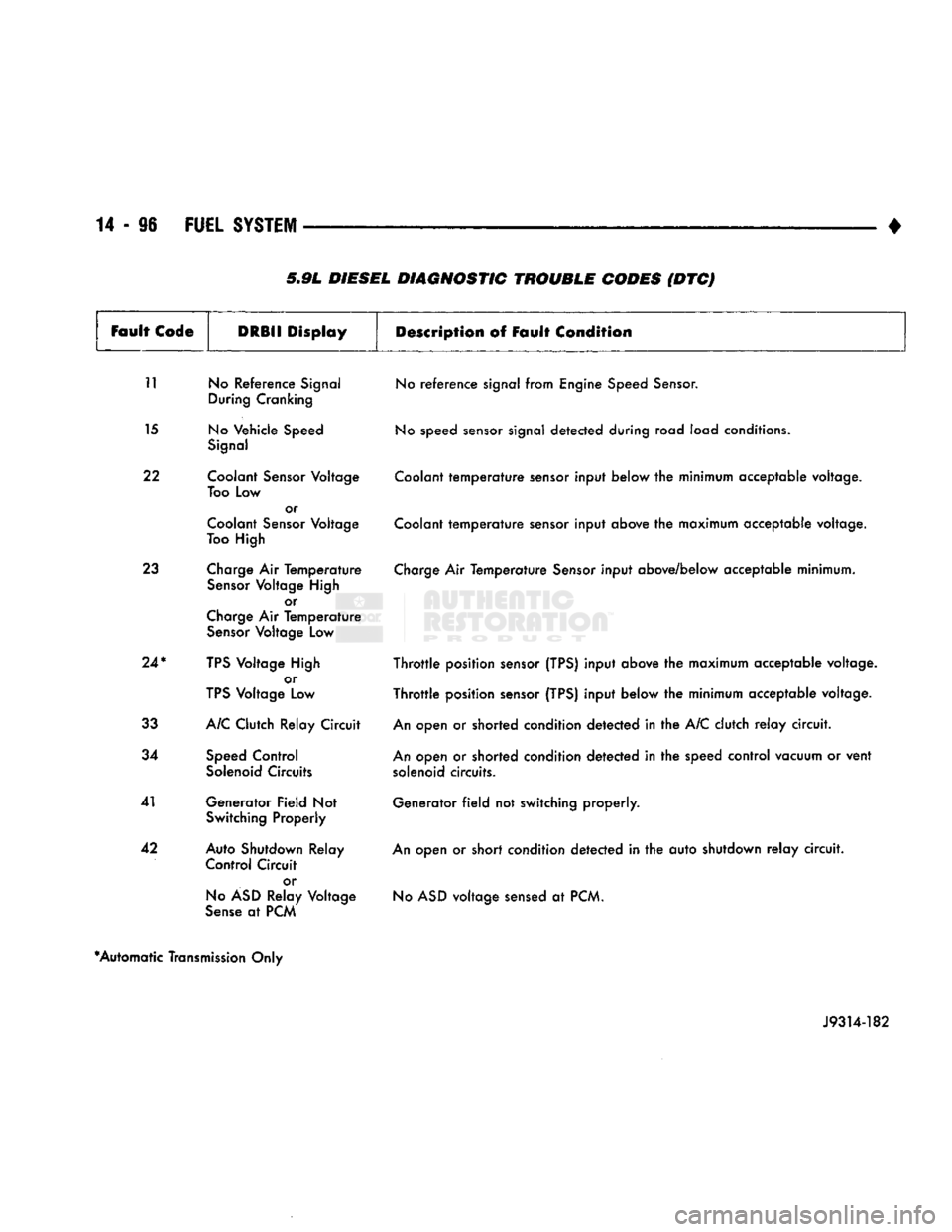
5.9L DIESEL DIAGNOSTIC TROUBLE CODES (DTC)
Fault
Code
DRBII
Display
Description
of Fault
Condition
11 No Reference Signal During Cranking
15 No Vehicle Speed Signal
22 Coolant Sensor Voltage Too Low or
Coolant Sensor Voltage
Too High
23 Charge Air Temperature Sensor Voltage High or
Charge Air Temperature Sensor Voltage Low
24*
TPS Voltage High or
TPS Voltage Low
33 A/C Clutch Relay Circuit
34 Speed Control Solenoid Circuits
41 Generator Field Not Switching Properly
42 Auto Shutdown Relay Control Circuit
or
No ASD Relay Voltage
Sense at PCM No reference signal from Engine Speed Sensor.
No speed sensor signal detected during road load conditions.
Coolant temperature sensor input below the minimum acceptable voltage.
Coolant temperature sensor input above the maximum acceptable voltage.
Charge Air Temperature Sensor input above/below acceptable minimum.
Throttle position sensor (TPS) input above the maximum acceptable voltage.
Throttle position sensor (TPS) input below the minimum acceptable voltage.
An open or shorted condition detected in the A/C clutch relay circuit.
An open or shorted condition detected in the speed control vacuum or vent solenoid circuits.
Generator field not switching properly.
An open or short condition detected in the auto shutdown relay circuit. No ASD voltage sensed at PCM.
*Automatic Transmission Only
J9314-182
Page 916 of 1502
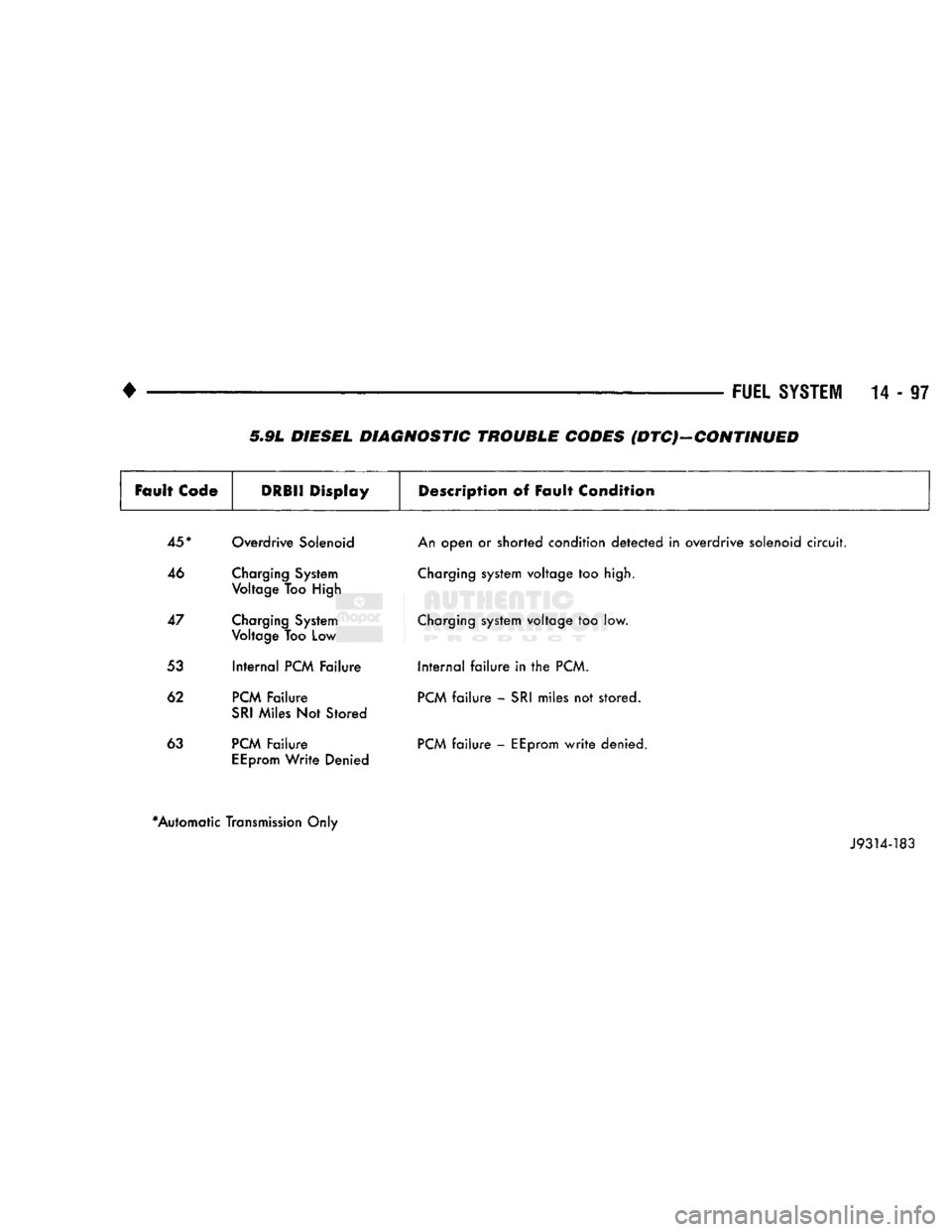
FUEL
SYSTEM
14 - 97
5„9L DIESEL DIAGNOSTIC TROUBLE CODES {DTC}-CONTINUED
Fault
Code
DRBII Display
Description
of Fault Condition
45*
Overdrive Solenoid
46 Charging System Voltage Too High
47 Charging System Voltage Too Low
53 Internal PCM Failure
62 PCM Failure SRI Miles Not Stored
63 PCM Failure EEprom Write Denied An open or shorted condition detected in overdrive solenoid circuit.
Charging system voltage too high.
Charging system voltage too low. Internal failure in the PCM.
PCM failure - SRI miles not stored.
PCM failure - EEprom write denied.
*Automatic Transmission Only J9314-183
Page 962 of 1502
•
STEERING STEERING
19-1
CONTENTS
page
GENERAL INFORMATION
1
POWER STEERING PUMP
11
POWER STEERING SYSTEM DIAGNOSIS
..... 2
RECIRCULATING
BALL
POWER STEERING GEAR
. 20
page
STEERING COLUMN
3i
STEERING LINKAGE
17
TORQUE SPECIFICATIONS
40
GENERAL
INFORMATION
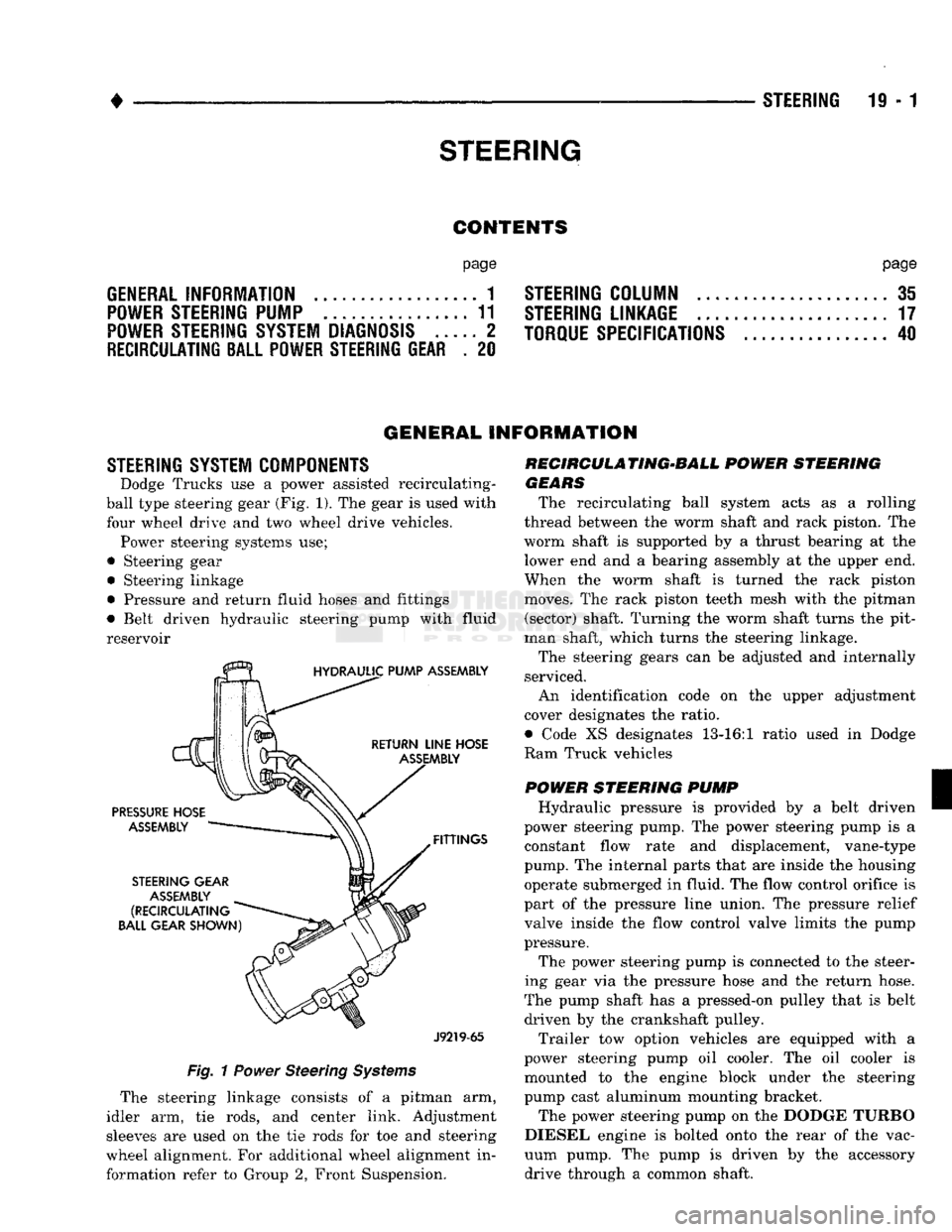
STEERING SYSTEM COMPONENTS
Dodge Trucks
use a
power
assisted recirculating-
ball
type steering gear
(Fig.
1). The
gear
is
used with
four
wheel drive
and two
wheel
drive
vehicles. Power steering systems
use;
•
Steering
gear • Steering linkage
• Pressure
and
return fluid hoses
and
fittings
• Belt driven hydraulic steering pump with
fluid
reservoir
J9219-65
Fig.
1
Power
Steering
Systems
The steering linkage consists
of a
pitman
arm,
idler
arm, tie
rods,
and
center link. Adjustment
sleeves
are
used
on the tie
rods
for toe and
steering
wheel alignment.
For
additional wheel alignment
in
formation refer
to
Group
2,
Front Suspension. RECIRCULA TING-BALL
POWER
STEERING
GEARS
The recirculating ball system acts
as a
rolling
thread between
the
worm shaft
and
rack piston.
The
worm shaft
is
supported
by a
thrust bearing
at the
lower
end
and a
bearing assembly
at
the
upper
end.
When
the
worm shaft
is
turned
the
rack piston
moves.
The
rack piston teeth mesh with
the
pitman (sector) shaft. Turning
the
worm shaft turns
the
pit
man shaft, which turns
the
steering linkage.
The steering gears
can be
adjusted
and
internally
serviced.
An identification code
on the
upper adjustment
cover designates
the
ratio.
• Code
XS
designates 13-16:1 ratio used
in
Dodge
Ram Truck vehicles
POWER
STEERING
PUMP
Hydraulic pressure
is
provided
by a
belt driven
power steering pump.
The
power steering pump
is a
constant flow rate
and
displacement, vane-type
pump.
The
internal parts that
are
inside
the
housing operate submerged
in
fluid.
The
flow control orifice
is
part
of
the
pressure line union.
The
pressure relief
valve inside
the
flow control valve limits
the
pump
pressure.
The power steering pump
is
connected
to
the
steer
ing gear
via the
pressure hose
and the
return hose.
The pump shaft
has
a
pressed-on pulley that
is
belt driven
by the
crankshaft pulley.
Trailer
tow
option vehicles
are
equipped with
a
power steering pump
oil
cooler.
The oil
cooler
is
mounted
to the
engine block under
the
steering
pump cast aluminum mounting bracket.
The power steering pump
on
the
DODGE TURBO
DIESEL engine
is
bolted onto
the
rear
of
the
vac
uum pump.
The
pump
is
driven
by the
accessory drive through
a
common shaft.
Page 1084 of 1502
•
AUTOMATIC TRANSiISSIO|-32RH/8iRH/37RH/42RH/4iRH
21 - 83 plate. The overdrive clutch also disengages the direct
clutch during 3-4 upshifts. As fluid pressure extends
the overdrive piston, the piston contacts the direct clutch hub pressing it rearward. This action com
presses the direct clutch spring relieving spring load on the clutch pack. The clutch is disengaged once
spring load is relieved.
The 3-4 accumulator cushions overdrive clutch en
gagement to smooth the transition into fourth gear.
The accumulator is charged at the same time as ap
ply pressure acts against the overdrive piston.
Converter clutch engagement in overdrive fourth
gear is controlled by sensor inputs to the powertrain
control module. In third gear above 25 mph, sensor inputs to the control module that determine clutch
engagement and shift timing are:
• coolant temperature (verifies minimum of 60° F)
• engine speed • vehicle speed
• throttle position
• manifold vacuum (MAP sensor)
Gearshift
Mechanism
The gear shift mechanism provides the same shift
positions used with 3-speed Chrysler transmissions
(P-R-N-D-2-1).
The shift into overdrive fourth gear range occurs
only after the transmission has completed the shift into D third gear range. No further movement of the
shift mechanism is required to complete the 3-4 shift.
The fourth gear upshift occurs automatically when
the overdrive control switch is in the ON position. Shift timing is determined by sensor inputs to the
engine controller.
Overdrive Control
Switch
The overdrive control switch is located in the in
strument panel. In the On position, automatic shifts
into fourth gear overdrive will occur. In the Off posi
tion, the switch overrides the engine controller pre
venting a shift to overdrive fourth gear range.
The switch has an indicator light that illuminates
when overdrive is turned off. The switch also resets
when the ignition key is turned to the OFF position so that the automatic overdrive feature is restored.
The use of fault codes is employed to help diagnose
the electronic components that operate the overdrive
unit and converter clutch.
HYDRAULIC
CONTROLS
The 42REJ/46RH hydraulic control system provides
fully automatic operation. The system performs five
basic functions which are: pressure supply, pressure regulation, flow control, clutch/band application, and
lubrication. 42RH/46RH system operation is similar to that de
scribed in the 32RH/36RH/37RH General Informa tion section. The main difference being fourth gear
operation which is covered here.
Pressure
Regulation
The pressure regulator valve maintains line pres
sure.
The amount of pressure developed is controlled
by throttle pressure which is dependent on the de gree of throttle opening. The regulator valve is lo
cated in the valve body.
The throttle valve determines line pressure and
shift speed. Governor pressure increases in propor
tion to vehicle speed. The throttle valve controls up shift and downshift speeds by regulating pressure
according to throttle position.
Flow
Control And Lubrication The manual valve is operated by the gearshift link
age and provides the operating range selected by the
driver.
The 1-2 shift valve provides 1-2 or 2-1 shifts and
the 2-3 shift valve provides 2-3 or 3-2 shifts.
The kickdown valve provides forced 3-2 or 3-1
downshifts depending on vehicle speed. Downshifts
occur when the throttle is opened beyond downshift
detent position which is just before wide open throt
tle.
The 2-3 valve throttle pressure plug provides 3-2
downshifts at varying throttle openings depending on
vehicle speed.
The 1-2 shift control valve transmits 1-2 shift pres
sure to the accumulator piston. This controls kick-
down band capacity on 1-2 upshifts and 3-2 downshifts.
The 3-4 shift valve, shuttle valve, timing valve and
accumulator are only actuated when the overdrive
solenoid is energized.
The solenoid contains a check ball that controls a
vent port to the 3-4 valve. The check ball either di
verts line pressure away from or directly to, the 3-4 shift valve. Energizing the solenoid causes the check
ball to close the vent port allowing line pressure to act upon the 3-4 upshift valve.
The limit valve determines maximum speed at
which a 3-2 part throttle kickdown can be made. Some transmissions do not have the limit valve and
maximum speed for a 3-2 kickdown is at the detent
position.
The 2-3 shuttle valve has two functions. First is
fast front band release and smooth engagement dur ing lift-foot 2-3 upshifts. The second is to regulate
front clutch and band application during 3-2 down
shifts.
The 3-4 shuttle valve uses a combination of throt
tle and governor pressure to control the rate of over
drive piston apply and release. This is done to
maintain shift quality at varying throttle openings.
Page 1380 of 1502
•
WHEELS
AND
TIRES
22-11 VEHICLE VIBRATION
Vehicle vibration can
be
caused by:
• Tire/wheel unbalance
or
excessive runout
• Defective tires with extreme tread wear
• Nylon overlay flat spots (performance tires only)
• Incorrect wheel bearing adjustment
(if
applicable)
• Loose
or
worn suspension/steering components
• Certain tire tread patterns
• Incorrect drive shaft angles
or
excessive drive
shaft/yoke runout
• Defective
or
worn U-joints
• Excessive brake rotor
or
drum runout
• Loose engine
or
transmission supports/mounts
• And
by
engine operated accessories Refer
to the
appropriate Groups
in
this man
ual for additional information.
VIBRATION
TYPES
There are two types
of
vehicle vibration:
• Mechanical
• Audible. Mechanical vehicle vibration
can be
felt through
the seats, floor pan and/or steering wheel. Audible vehicle vibration
is
heard above normal
background noise.
The
sound
can be a
droning
or
drumming noise. Vibrations
are
sensitive
to
change
in
engine
torque, vehicle speed
or
engine speed.
ENGINE TORQUE SENSITIVE VIBRATION
This vibration can
be
increased
or
decreased by:
• Accelerating
• Decelerating
• Coasting
• Maintaining
a
constant vehicle speed
VEHICLE SPEED SENSITIVE VIBRATION
This vibration condition always occurs
at
the same
vehicle speed regardless
of
the engine torque
or en
gine speed.
ENGINE SPEED
{RPM}
SENSITIVE VIBRATION
This vibration occurs
at
varying engine speeds.
It
can
be
isolated
by
increasing
or
decreasing
the en
gine speed with the transmission
in
NEUTRAL posi
tion.
VIBRATION
DIAGNOSIS
A vibration diagnosis should always begin with
a
10 mile (16 km) trip (to warm the vehicle and tires).
Then
a
road test
to
identify the vibration. Corrective action should
not be
attempted until
the
vibration
type has been identified
via a
road test. During the road test, drive the vehicle
on a
smooth
surface.
If
vibration exists, note
and
record
the
fol
lowing information: • Identify
the
vehicle speed range when
the
vibra
tion occurs
• Identify the type
of
vibration
• Identify the vibration sensitivity
• Determine
if
the vibration
is
affected
by
changes
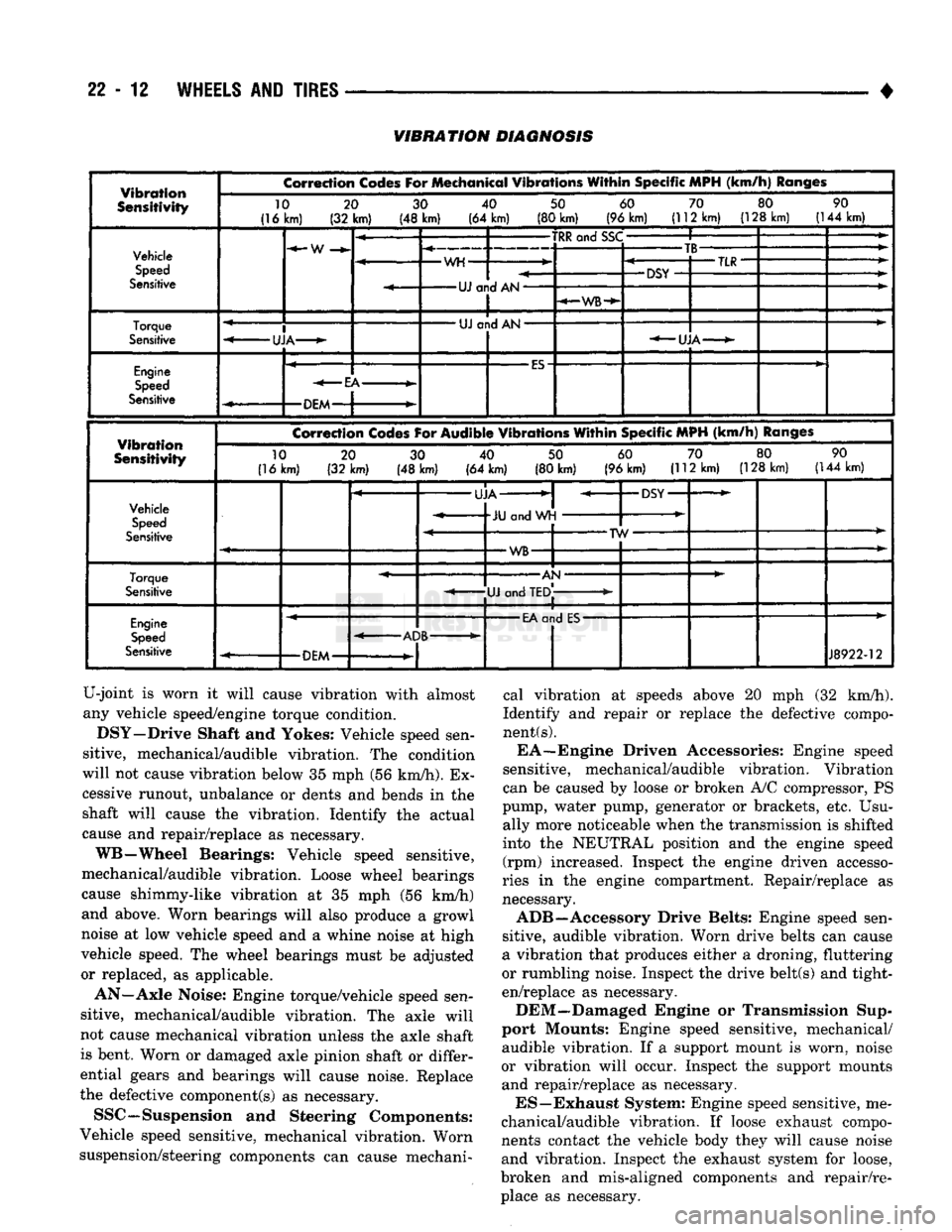
in vehicle speed, engine speed and engine torque. When the vibration has been identified, refer to the
Vibration Diagnosis chart
for
causes. Consider cor
recting only those causes coded
in
the chart that
are
related
to
the vibration condition.
Refer
to
the following cause codes and descriptions
for explanations when referring
to
the chart.
TRR—Tire
and
Wheel Radial Runout: Vehicle
speed sensitive, mechanical vibration.
The
runout
will not cause vibration below
20
mph (32 km/h).
WH—Wheel Hop: Vehicle speed sensitive,
me
chanical vibration.
The
wheel
hop
generates rapid
up-down movement
in
the steering wheel. The vibra
tion
is
most noticeable
in the 20 - 40
mph
(32 - 64
km/h) range. The wheel hop will not cause vibration
below
20
mph (32 km/h). Wheel hop
is
caused
by a
tire/wheel that
has a
radial runout
of
more than 0.045 of-an-inch (1.14 mm).
If
wheel runout
is
accept
able
and
combined runout cannot
be
reduced
by re
positioning the tire
on
wheel, replace tire.
TB—Tire/Wheel Balance: Vehicle speed sensitive,
mechanical vibration. Static tire/wheel unbalance
will not cause vibration below 30 mph (46 km/h). Dy
namic tire/wheel unbalance will
not
cause vibration
below
40
mph (64 km/h). TLR—Tire/Wheel Lateral runout: Vehicle speed
sensitive, mechanical vibration. The runout will
not
cause vibration below
50 - 55 mph (80 - 88
km/h).
Excessive lateral runout will also cause front-end shimmy. TW—Tire Wear: Vehicle speed sensitive, audible
vibration. Abnormal tire wear causes small vibration in
the 30 - 55
mph
(88
km/h) range. This will pro
duce
a
whine noise
at
high speed.
The
whine will
change
to a
growl noise when the speed
is
reduced. W—Tire Waddle: Vehicle speed sensitive, mechan
ical vibration. Irregular tire uniformity
can
cause
side-to-side motion during speeds
up to 15
mph
(24
km/h).
If
the motion
is
excessive, identify
the
defec
tive tire and replace
it.
U A J—Universal Joint (Drive Shaft) Angles:
Torque/vehicle speed sensitive, mechanical/audible
vibration. Incorrect drive shaft angles cause mechan ical vibration below
20
mph (32 km/h) and
in
the
70
mph (112 km/h) range. The incorrect angles can also
produce
an
audible vibration
in
the 20
-
50 mph (32
-
80 km/h) range. Caster adjustment could
be
required
to correct the angles. UJ—Universal Joints: Engine torque/vehicle
speed sensitive, mechanical/audible vibration.
If
the
Page 1381 of 1502
22-12
WHEELS
AND
TIRES
VIBRATION
DIAGNOSIS
Vibration
Sensitivity
Correction
Codes
For
Mechanical
Vibrations
Within
Specific
MPH
(km/h)
Ranges
10
(16km)
20
(32 km) 30
(48 km) 40
(64 km) 50
(80 km) 60
(96 km) 70
(112 km) 80
(128 km) 90
(144 km) Vehicle
Speed
Sensitive
•W
-WH-
-TRR
and
SSC-
-UJ
and AN-
-WB-
-TB-
-DSY
•TLR-
Torque
Sensitive
I
-UJA-
•
UJ
and AN
•
•UJA-
Engine
Speed
Sensitive
•ES
•EA-
•DEM-
Vibration
Sensitivity
Correction
Codes
For
Audible
Vibrations
Within
Specific
MPH
(km/h)
Ranges
10
(16 km) 20
(32 km) 30
(48 km) 40
(64 km) 50
(80 km) 60
(96 km) 70
(112 km) 80
(128 km) 90
(144 km)
Vehicle
Speed
Sensitive
•UJA-
JU
and WH
•DSY"
-TW-
•WB-
Torque
Sensitive
-AN
*
-UJ
and
TED,
Engine
Speed
Sensitive
•
EA
and
ES-
-ADB-
-DEM-
J8922-12
U-joint is worn it will cause vibration with almost
any vehicle speed/engine torque condition. DSY—Drive Shaft and Yokes: Vehicle speed sen
sitive, mechanical/audible vibration. The condition
will not cause vibration below 35 mph (56 km/h). Ex
cessive runout, unbalance or dents and bends in the shaft will cause the vibration. Identify the actual
cause and repair/replace as necessary.
WB—Wheel Bearings: Vehicle speed sensitive,
mechanical/audible vibration. Loose wheel bearings
cause shimmy-like vibration at 35 mph (56 km/h)
and above. Worn bearings will also produce a growl
noise at low vehicle speed and a whine noise at high
vehicle speed. The wheel bearings must be adjusted
or replaced, as applicable.
AN—Axle Noise: Engine torque/vehicle speed sen
sitive, mechanical/audible vibration. The axle will
not cause mechanical vibration unless the axle shaft
is bent. Worn or damaged axle pinion shaft or differ
ential gears and bearings will cause noise. Replace
the defective component(s) as necessary.
SSC—Suspension and Steering Components:
Vehicle speed sensitive, mechanical vibration. Worn
suspension/steering components can cause mechani cal vibration at speeds above 20 mph (32 km/h).
Identify and repair or replace the defective compo
nent
(s).
EA—Engine Driven Accessories: Engine speed
sensitive, mechanical/audible vibration. Vibration
can be caused by loose or broken A/C compressor, PS
pump, water pump, generator or brackets, etc. Usu ally more noticeable when the transmission is shifted
into the NEUTRAL position and the engine speed (rpm) increased. Inspect the engine driven accesso
ries in the engine compartment. Repair/replace as
necessary.
ADB—Accessory Drive Belts: Engine speed sen
sitive, audible vibration. Worn drive belts can cause
a vibration that produces either a droning, fluttering
or rumbling noise. Inspect the drive belt(s) and tight
en/replace as necessary.
DEM—Damaged Engine or Transmission Sup
port Mounts: Engine speed sensitive, mechanical/ audible vibration. If a support mount is worn, noise
or vibration will occur. Inspect the support mounts and repair/replace as necessary.
ES—Exhaust System: Engine speed sensitive, me
chanical/audible vibration. If loose exhaust compo
nents contact the vehicle body they will cause noise
and vibration. Inspect the exhaust system for loose,
broken and mis-aligned components and repair/re place as necessary.