warning light DODGE VIPER 2004 ZB / 2.G User Guide
[x] Cancel search | Manufacturer: DODGE, Model Year: 2004, Model line: VIPER, Model: DODGE VIPER 2004 ZB / 2.GPages: 236, PDF Size: 4.18 MB
Page 80 of 236

Gauges
Tachometer
This gauge shows engine speed in revolutions-
per-minute (RPM) times 1,000. Avoid excessive
engine speeds in any part of the red warning
zone, particularly when driving downhill or in
lower gears.
Coolant Temperature Gauge
This gauge shows the engine coolant tempera-
ture. The gauge pointer will likely show higher
temperatures when driving in hot weather, up
mountain grades, or in heavy stop and go
traffic. If the red LED light turns on, stop the vehicle and
turn off the engine until the cause is corrected.
Oil Temperature Gauge
This gauge shows the oil temperature. The
gauge pointer will likely show higher tempera-
tures when driving in hot weather, up moun-
tain grades, or in heavy stop and go traffic. If
the red LED light turns on, stop the vehicle and turn off
the engine until the cause is corrected.
Oil Pressure Gauge
This gauge shows engine oil pressure when the
engine is running. The pressure will vary with
engine speed, oil viscosity, and engine tem-
perature. Oil pressures will be higher as the
engine is warming up. The normal operating pressure is
between 20 and 80 psi (pounds per square inch). If the
pointer remains in the red range, turn off the engine until
the cause is corrected.
80 UNDERSTANDING YOUR INSTRUMENT PANEL
Page 100 of 236

After Starting
The idle speed will automatically decrease as the engine
warms up.
WARNING!
Never pour fuel or other flammable liquid into the
throttle body air inlet opening in an attempt to start
the vehicle. This could result in flash fire causing
serious personal injury.
TRANSMISSION SHIFTING
NOTE:The parking brake should be engaged and the
gear selector placed in REVERSE before leaving the
vehicle, especially on an incline.
Fully depress the clutch pedal before you shift gears. As
you release the clutch pedal, lightly depress the accelera-
tor pedal.Be sure the transmission is in FIRST gear, (not THIRD),
when starting from a standing position. Damage to the
clutch can result from starting in THIRD.
For most city driving you will find it easier to use only
the lower gears. For steady highway driving with light
accelerations, 6th gear is recommended.
Never drive with your foot resting on the clutch pedal, or
try to hold the vehicle on a hill with the clutch pedal
partially engaged. This will cause abnormal wear on the
clutch.
Never shift into REVERSE until the vehicle has come to a
complete stop.
NOTE:During cold weather, until the transmission
lubricant has warmed, you may have difficulty shifting.
This is normal and not harmful to the transmission.
100 STARTING AND OPERATING
Page 102 of 236
To maintain a safe speed and prolong brake life, down-
shift to maintain a safe speed when descending a steep
grade.
WARNING!
Skipping more than one gear while downshifting,
could cause you to lose control of your vehicle. You
could have an accident.
CAUTION!
If you skip more than one gear while downshifting
or downshift at too high an engine speed, you could
damage the engine, transmission, or clutch.
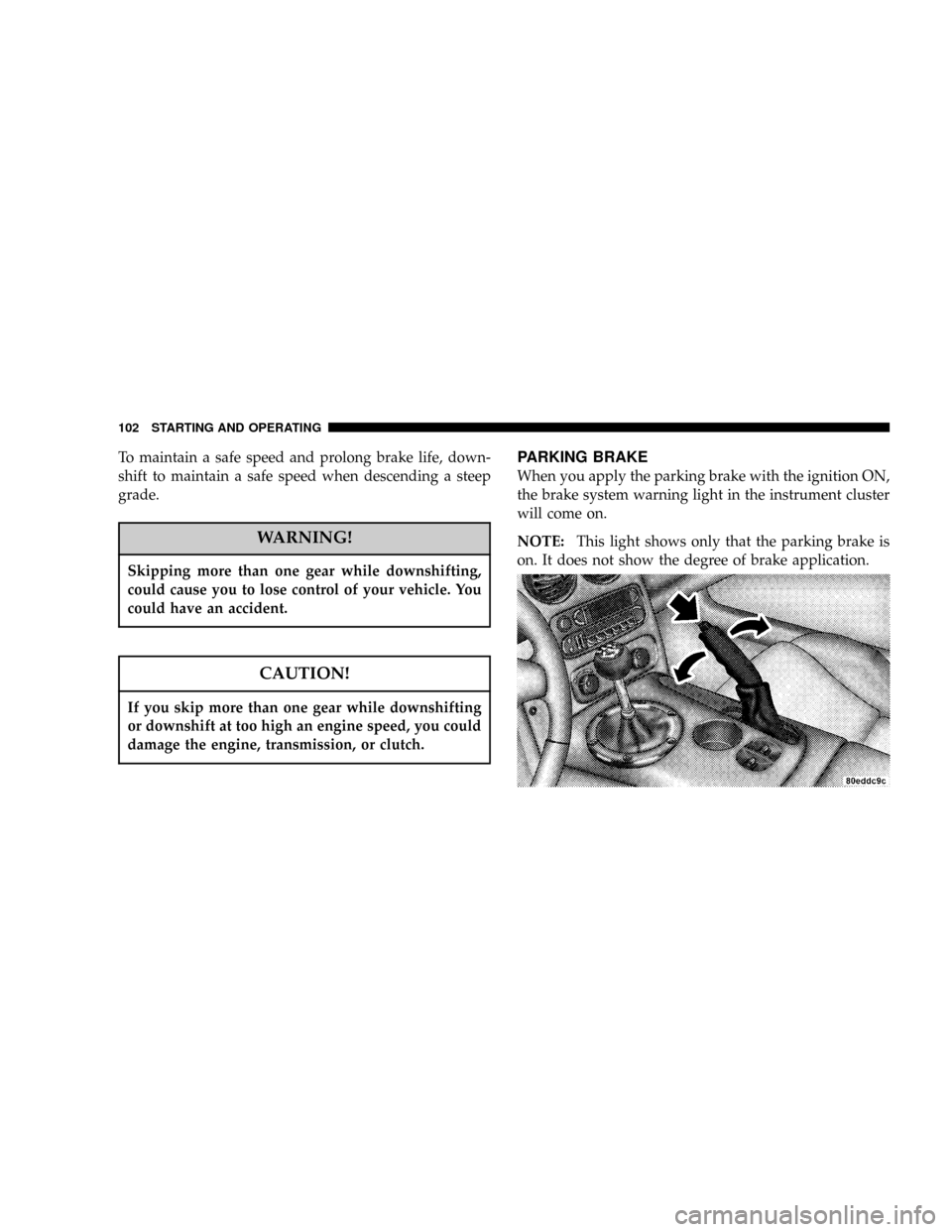
PARKING BRAKE
When you apply the parking brake with the ignition ON,
the brake system warning light in the instrument cluster
will come on.
NOTE:This light shows only that the parking brake is
on. It does not show the degree of brake application.
102 STARTING AND OPERATING
Page 104 of 236
BRAKE SYSTEM
The Anti-Lock Brake System (ABS) is designed to aid the
driver in maintaining vehicle control under adverse
braking conditions. The system operates with a separate
computer to modulate hydraulic pressure to prevent
wheel lock-up and help avoid skidding on slippery
surfaces.
All vehicle wheels and tires must be the same size and
type as the original equipment wheels and tires must be
properly inflated to produce accurate signals for the
computer.
WARNING!
Significant over or under inflation of tires, or mixing
sizes of front or rear tires or wheels on the vehicle
can lead to loss of braking effectiveness.
The Anti-Lock Brake System conducts a low-speed self-
test at about 12 mph (20 km/h). If you have your foot
lightly on the brake while this test is occurring, you may
feel slight pedal movement. The movement can be more
apparent on ice and snow. This is normal.
The Anti-Lock Brake System pump motor runs during
the self-test at 12 mph (20 km/h) and during an ABS stop.
The pump motor makes a low humming noise during
operation, which is normal.
WARNING!
Pumping of the Anti-Lock Brakes will diminish
their effectiveness and may lead to an accident.
Pumping makes the stopping distance longer. Just
press firmly on your brake pedal when you need to
slow down or stop.
104 STARTING AND OPERATING
Page 107 of 236

In the event power assist is lost for any reason (for
example, repeated brake applications with the engine
off), the brakes will still function. The effort required to
brake the vehicle will be much greater than that required
with the power system operating.
If either the front or rear hydraulic system loses normal
capability, the remaining system will still function with
some loss of overall braking effectiveness. This will be
evident by increased pedal travel during application,
greater pedal force required to slow or stop, and activa-
tion of the Brake Warning Lamp during brake use.
NOTE:Your Viper has a very high performance braking
system. The brake pads are a semi-metallic compound
which has been selected for superior fade resistance and
consistent operation. A compromise is that under some
weather and operating conditions, the brakes may squeal
slightly during light brake applications.Brake Pad Break-In
The brakes on your new Viper do not require a long
break-in period, but avoid repeated hard brake applica-
tions from high speeds during initial break-in. Also avoid
severe brake loading such as may be encountered when
descending long mountain grades.
POWER STEERING
The power assisted steering system of your vehicle
provides mechanical steering capability in the event
power assist is lost.
If for some reason the hydraulic pressure is interrupted,
it will still be possible to steer your vehicle. Under these
conditions you will observe a substantial increase in
steering effort.
STARTING AND OPERATING 107
5
Page 188 of 236

NOTE:On vehicles equipped with High Intensity Dis-
charge Headlights (HID), when the headlights are turned
on there is a blue hue to the lights. This diminishes and
becomes more white after approximately 10 seconds, as
the system charges.
High Intensity Discharge Headlights (HID)
The headlights are a type of high voltage discharge tube.
High voltage can remain in the circuit even with the
headlight switch off and the key removed.Because of
this, you should not attempt to service a headlight bulb
yourself. If a headlight bulb fails, take your vehicle to
an authorized dealer for service.
WARNING!
A transient high tension occurs at the bulb sockets of
High Intensity Discharge (HID) headlights when the
headlight switch is turned ON. It may cause serious
electrical shock or electrocution if not serviced prop-
erly. See your authorized dealer for service.
NOTE:If High Intensity Discharge (HID) lights are not
working, recycle the headlight switch 4 times to see if it
will restrike.
188 MAINTAINING YOUR VEHICLE
Page 226 of 236

11786.1............................... 111
1819................................. 109
ABS (Anti-Lock Brake) System............... 75
Accessory Delay, Power..................13,24
Adding Engine Coolant (Antifreeze).......... 168
Adding Fuel........................... 129
Additives, Fuel......................... 129
Adjustable Pedals........................ 66
Aiming Headlights....................... 193
Air Cleaner, Engine...................... 155
Air Conditioning......................90,160
Air Conditioning Refrigerant............... 160
Air Pressure, Tires....................... 117
Airbag................................ 38
Airbag Deployment....................... 42
Airbag Light..........................41,79
Airbag Maintenance....................... 45
Airbag On/Off Switch...................34,43Alarm................................ 19
Alignment and Balance................... 123
Alterations/Modifications, Vehicle............. 7
Antenna............................... 90
Antifreeze Disposal...................... 167
Antifreeze (Engine Coolant)..............167,168
Capacities........................... 195
Anti-Lock Warning Light................... 75
Appearance Care........................ 177
Auto Down Power Windows................ 24
Automatic Door Locks..................... 15
Ball Joints............................. 162
Battery.............................78,156
Gas Caution.......................... 157
Bearings.............................. 177
Belt System, Six Point..................... 31
Belts, Drive............................ 152
Belts, Seat.............................. 26
226 INDEX
Page 227 of 236

Body Damage.......................... 178
Body Mechanism Lubrication............162,163
Body Mechanisms....................... 164
B-Pillar Location........................ 112
Brake, Parking.......................... 102
Brake System........................104,171
Anti-Lock........................... 104
Fluid Check.......................... 173
Master Cylinder....................... 174
Warning Light......................... 79
Break-In Recommendations, New Vehicle.....46,107
Bulbs, Light............................ 186
Capacities, Antifreeze (Engine Coolant)........ 195
Capacities, Fluid......................195,196
Capacity, Cargo Weight................... 130
Caps, Filler
Power Steering........................ 161
Car Washes............................ 179Carbon Monoxide Warning................. 47
Cargo Compartment
Capacity............................ 130
Carpeting............................. 179
Catalytic Converter...................... 153
CD Player............................82,85
Chains, Tire............................ 125
Charging System Light..................... 78
Checks, Safety........................... 47
Child Restraint.......................... 33
Child Restraint Tether Anchors............... 36
Circuit Breakers......................... 180
Clean Air Gasoline....................... 127
Climate Control.......................... 90
Clock................................. 81
Compact Disc Maintenance................. 89
Compact Spare Tire...................... 120
Contract, Service........................ 218
Converter, Catalytic...................... 153
INDEX 227
10
Page 228 of 236

Convertible Top......................... 178
Convertible Top Maintenance............... 178
Cooling System......................... 166
Adding Coolant (Antifreeze).............. 168
Coolant Capacity...................... 195
Coolant Level......................... 169
Disposal of Used Coolant................ 167
Drain, Flush, and Refill.................. 166
Inspection........................... 166
Points to Remember.................... 170
Pressure Cap......................... 168
Rubber and Plastic Components............ 170
Selection of Coolant.................... 167
Crankcase Emission Control System.......... 155
Customer Assistance..................... 216
Dealer Service.......................... 147
Defroster, Windshield...................... 48
Dimmer Switch, Headlight.................. 65Door Locks............................. 13
Door Locks, Automatic.................... 15
Doors................................. 13
Drive Belts............................ 152
Driving
On Slippery Surfaces.................... 137
Electric Remote Mirrors.................... 55
Emergency, In Case of
Hazard Warning Flasher................. 132
Jump Starting......................... 134
Overheating.......................... 132
Towing............................. 139
Emission Control System Maintenance......146,200
Engine
Break-In Recommendations................ 46
Cooling.............................. 78
Oil ..............................148,195
Oil Disposal.......................... 151
228 INDEX
Page 229 of 236

Oil Filter............................ 152
Oil Selection.......................... 150
Overheating........................... 78
Exhaust Gas Caution...................47,165
Exhaust System......................... 165
Exterior Lights.......................... 186
Filters
Air Cleaner.......................... 155
Flashers
Hazard Warning........................ 75
Fluid Capacities......................195,196
Fluid Leaks............................. 48
Fluid Level Checks
Capacities........................... 195
Manual Transmission................... 175
Power Steering........................ 161
Fog Lights.........................62,64,78
Four-Way Hazard Flasher.................. 132Freeing A Stuck Vehicle................... 138
Fuel................................. 127
Adding............................. 129
Gauge............................... 81
Octane Rating........................ 127
Tank Capacity........................ 195
Fuses................................ 180
GasCap .............................. 129
Gasoline/Oxygenate Blends................ 128
Gauges................................ 80
Coolant Temperature..................78,80
Fuel................................ 81
Oil Pressure........................... 80
Tachometer........................... 80
Voltmeter............................ 81
Gear Ratios............................ 196
Glass Cleaning.......................... 178
Ground Clearance....................... 126
INDEX 229
10