transmission DODGE VIPER 2004 ZB / 2.G Owners Manual
[x] Cancel search | Manufacturer: DODGE, Model Year: 2004, Model line: VIPER, Model: DODGE VIPER 2004 ZB / 2.GPages: 236, PDF Size: 4.18 MB
Page 95 of 236

STARTING AND OPERATING
CONTENTS
mStarting Procedures......................97
NIf Engine Fails To Start..................98
NAfter Starting........................100
mTransmission Shifting....................100
NRecommended Shift Speeds..............101
NSkip Shift Light.......................101
mParking Brake.........................102
mBrake System..........................104
NBrake Pad Break-In....................107mPower Steering........................107
mTire Safety Information...................108
NTire Markings........................108
NTire Identification Number (TIN)..........111
NTire Loading And Tire Pressure...........112
mTiresÐGeneral Information................116
NTire Pressure.........................116
NTire Inflation Pressures.................117
NRadial-Ply Tires......................120
5
Page 100 of 236
After Starting
The idle speed will automatically decrease as the engine
warms up.
WARNING!
Never pour fuel or other flammable liquid into the
throttle body air inlet opening in an attempt to start
the vehicle. This could result in flash fire causing
serious personal injury.
TRANSMISSION SHIFTING
NOTE:The parking brake should be engaged and the
gear selector placed in REVERSE before leaving the
vehicle, especially on an incline.
Fully depress the clutch pedal before you shift gears. As
you release the clutch pedal, lightly depress the accelera-
tor pedal.Be sure the transmission is in FIRST gear, (not THIRD),
when starting from a standing position. Damage to the
clutch can result from starting in THIRD.
For most city driving you will find it easier to use only
the lower gears. For steady highway driving with light
accelerations, 6th gear is recommended.
Never drive with your foot resting on the clutch pedal, or
try to hold the vehicle on a hill with the clutch pedal
partially engaged. This will cause abnormal wear on the
clutch.
Never shift into REVERSE until the vehicle has come to a
complete stop.
NOTE:During cold weather, until the transmission
lubricant has warmed, you may have difficulty shifting.
This is normal and not harmful to the transmission.
100 STARTING AND OPERATING
Page 101 of 236
Recommended Shift Speeds
To use your manual transmission for fuel economy it
should be upshifted as listed below. Shift at the vehicle
speeds listed for acceleration. Earlier upshifts during
cruise conditions (relatively steady speeds) will result in
increased fuel economy, and may be used as indicated.
MANUAL TRANSMISSION
RECOMMENDED SHIFT SPEEDS
1-2 2-3 3-4 4-5 5-6
MPH 15 25 40 45 50
(km/h) (24) (40) (64) (72) (80)
Higher upshift speeds may be used to obtain a desired
acceleration rate.
Skip Shift Light
There are times when you must shift directly from First to
Fourth gear instead of from First to Second. An amber
(LED) arrow on the instrument cluster will light up
during these times. This is to help you get the best
possible fuel economy.
The shift arrow will light up when engine coolant is
higher than 106ÉF (41ÉC), vehicle speed is greater than 12
MPH and less than 20 MPH, engine speed is less than
1322 RPM, you are in 1st gear and you are at 1/4 throttle
or less.
When the arrow is lit, the shift mechanism will only
allow shifts from First to Fourth gears. After you shift to
Fourth gear, you can press the clutch in and shift to
another forward gear.
Downshifting - Proper downshifting will improve fuel
economy and prolong engine life.
STARTING AND OPERATING 101
5
Page 102 of 236
To maintain a safe speed and prolong brake life, down-
shift to maintain a safe speed when descending a steep
grade.
WARNING!
Skipping more than one gear while downshifting,
could cause you to lose control of your vehicle. You
could have an accident.
CAUTION!
If you skip more than one gear while downshifting
or downshift at too high an engine speed, you could
damage the engine, transmission, or clutch.
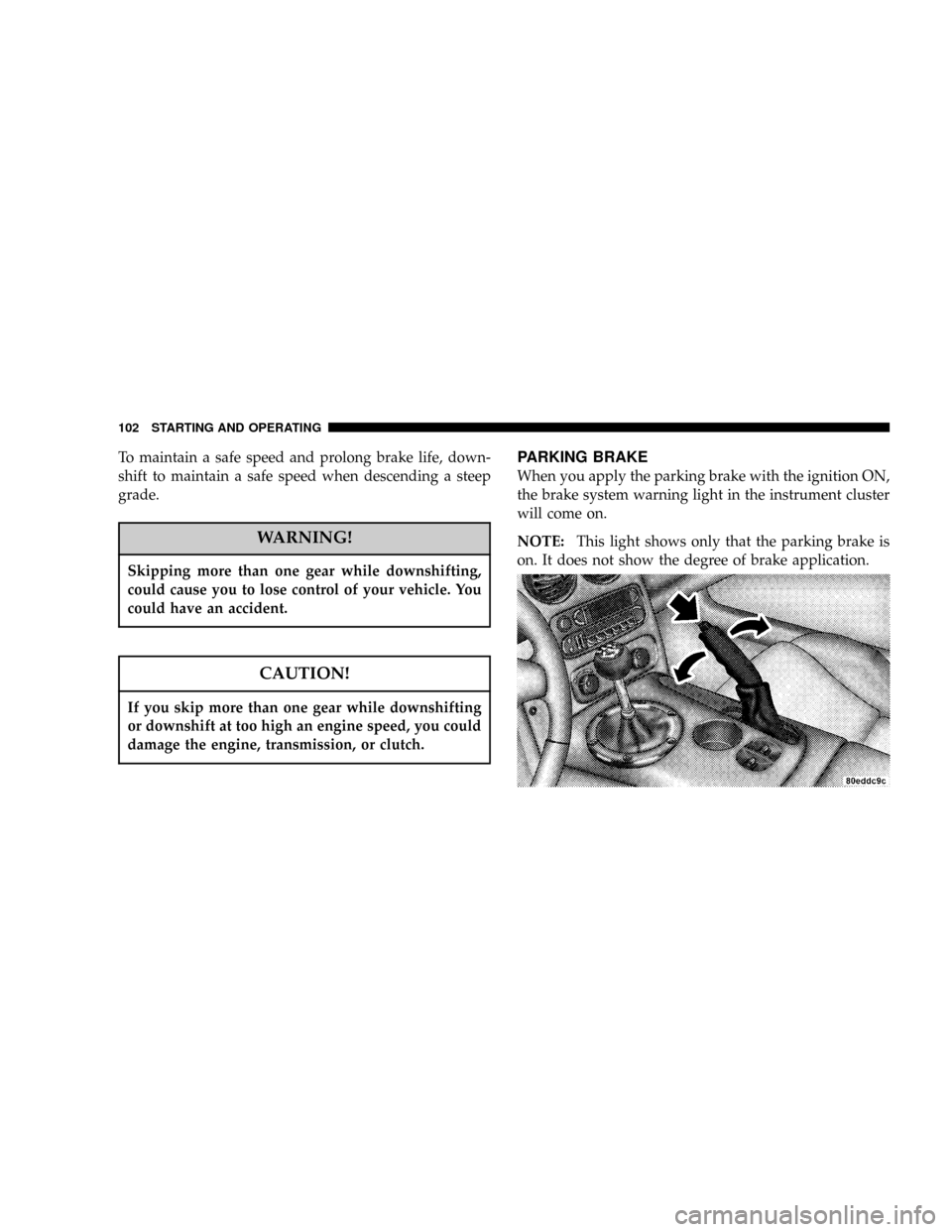
PARKING BRAKE
When you apply the parking brake with the ignition ON,
the brake system warning light in the instrument cluster
will come on.
NOTE:This light shows only that the parking brake is
on. It does not show the degree of brake application.
102 STARTING AND OPERATING
Page 103 of 236
Before leaving the vehicle, make sure you fully apply the
parking brake. Place the transmission in REVERSE. Fail-
ure to do so may cause the vehicle to roll and cause
damage or injury.
As an added precaution, turn the front wheels toward the
curb on a downhill grade and away from the curb on an
uphill grade.
Always apply the parking brake whenever you are not in
the vehicle.WARNING!
Leaving children in a vehicle unattended is danger-
ous for a number of reasons. A child or others could
be injured. Children should be warned not to touch
the parking brake release lever or the gear selection
lever as doing so may move the vehicle. Don't leave
the keys in the ignition. Be sure the parking brake is
fully disengaged before driving: failure to do so can
lead to brake failure, and an accident.
STARTING AND OPERATING 103
5
Page 106 of 236
NOTE:During severe braking conditions, a pulsing
sensation may occur and a clicking noise will be heard.
This is normal, indicating that the Anti-Lock Brake
System is functioning.WARNING!
To use your brakes and accelerator more safely, follow
these tips:
²Do not ªrideº the brakes by resting your foot on
the pedal. This could overheat the brakes and
result in unpredictable braking action, longer
stopping distances, or brake damage.
²When descending mountains or hills, repeated
braking can cause brake fade with loss of braking
control. Avoid repeated heavy braking by down-
shifting the transmission whenever possible.
²Do not drive too fast for road conditions, espe-
cially when roads are wet or slushy. A wedge of
water can build up between the tire tread and the
road. This hydroplaning action can cause loss of
traction, braking ability, and control.
²After going through deep water or a car wash,
brakes may become wet, resulting in decreased
performance and unpredictable braking action.
Dry the brakes by gentle, intermittent pedal ac-
tion while driving at very slow speeds.
106 STARTING AND OPERATING
Page 132 of 236

HAZARD WARNING FLASHER
The flasher switch is on the top of the steering
column, just behind the steering wheel. Depress
the flasher button and all front and rear directional
signals will flash. Depress the flasher button again to turn
the flashers off.Do not use this emergency warning system when the
vehicle is in motion. Use it when your vehicle is disabled
and is creating a safety hazard for other motorists.
If it is necessary to leave the vehicle to go for service, the
flasher system will continue to operate with the ignition
key removed.
NOTE:With extended use, the flasher may run down
your battery.
IF YOUR ENGINE OVERHEATS
In any of the following situations, you can reduce the
potential for overheating by taking the appropriate ac-
tion.
²On the highways ÐSlow down and use the highest
gear possible.
²In city traffic ÐWhile stopped, put the transmission
in neutral, but do not increase engine idle speed.
132 WHAT TO DO IN EMERGENCIES
Page 136 of 236

without letting the vehicles touch. Set the parking brake,
place the transmission in neutral and turn the ignition
OFF for both vehicles.
3. Turn off the heater, radio and all unnecessary electrical
loads.
4. If you are jump starting your Viper, connect one end of
a jumper cable to the positive terminal of the booster
battery. Connect the other end of the same cable to the
remote battery positive terminal after removing the plas-
tic cover.
5. If you are jump starting another vehicle, connect one
end of a jumper cable to the remote battery positive
terminal post on the Power Distribution Center. Connect
the other end of the same cable to the positive terminal of
the discharged battery after removing the plastic cover.6. Connect the other cable, first to the negative terminal
of the booster battery and then to the ground (on the ear
of the Thermostat Housing) of your Viper as shown.
Make sure you have a good contact.
7. If you are jump starting another vehicle, connect one
end of a jumper cable to the ground (on the ear of the
Thermostat Housing shown in illustration) of your Viper
136 WHAT TO DO IN EMERGENCIES
Page 138 of 236

²Slow down during rainstorms or when roads are
slushy.
²Slow down if road has standing water or puddles.
CAUTION!
Driving your Viper through deep puddles at speeds
over 5 mph, may cause water to be ingested into the
engine. This can cause severe engine damage.
²Replace tires when tread wear indicators first become
visible.
²Keep tires properly inflated.
²Maintain enough distance between your vehicle and
the vehicle in front to avoid a collision in a sudden
stop.
FREEING A STUCK VEHICLE
If your vehicle becomes stuck in mud, sand or snow, it
can often be moved by a rocking motion. Turn your
steering wheel right and left to clear the area around the
front wheels. Then shift back and forth between Reverse
and First gear. Usually the least accelerator pedal pres-
sure to maintain the rocking motion without spinning the
wheels is most effective.
CAUTION!
Racing the engine or spinning the wheels too fast
may lead to transmission/axle overheating and fail-
ure. It can also damage the tires. Do not spin the
wheels above 30 mph (48 km/h).
138 WHAT TO DO IN EMERGENCIES
Page 142 of 236

NPower Steering (Pump And Reservoir)......161
NBody Lubrication.....................162
NFront And Rear Suspension Ball Joints......162
NSteering Linkage......................163
NBody Mechanism Lubrication.............163
NWindshield Washers...................165
NExhaust System......................165
NCooling System.......................166
NHoses And Vacuum/Vapor Harnesses.......170
NBrake System........................171
NBrake, Power Steering, And Fuel System
Hoses.............................171NBrake And Clutch Fluid.................173
NMaster Cylinder......................174
NHydraulic Clutch.....................175
NTransmission........................175
NRear Axle...........................176
NWheel Bearings.......................177
NAppearance Care.....................177
mFuses Ð Power Distribution Center..........180
mVehicle Storage........................183
mReplacement Bulbs......................186
NInterior Light Bulbs....................186
NExterior Light Bulbs...................186
142 MAINTAINING YOUR VEHICLE