transmission DODGE VIPER 2015 VX / 3.G User Guide
[x] Cancel search | Manufacturer: DODGE, Model Year: 2015, Model line: VIPER, Model: DODGE VIPER 2015 VX / 3.GPages: 400, PDF Size: 9.59 MB
Page 229 of 400
NOTE:
•Your vehicle is equipped with a transmission reverse
inhibitor system. When vehicle speed is greater than
3 mph (5 km/h), the reverse inhibitor activates to help
prevent shifts into REVERSE. When at a complete stop,
you may notice light shift efforts into REVERSE with
the ignition in the ON position, and increased shift
efforts into REVERSE with the ignition in the OFF
position. This is normal operation of the transmission
reverse inhibitor system.
•Shifting gears during cold weather may require an
increased effort until the transmission lubricant is
warm. This is normal and not harmful to the transmis-
sion.
•Due to the high performance nature of your drivetrain,
a certain amount of noise from the transmission is
normal. This noise can be most noticeable when the
vehicle is idling in NEUTRAL with the clutch engaged
(clutch pedal released), but it may also be heard when
driving. The noise may also be more noticeable when
the transmission is warm. This noise is normal and is
not an indication of a problem with your clutch or
transmission.
•You must always use first gear (or Reverse) when
starting from a standing position.
CAUTION!
Always make sure the vehicle comes to a complete
stop before shifting into REVERSE. Failure to do so
may result in transmission damage.
Recommended Shift Speeds
To use your manual transmission for fuel economy it
should be upshifted as listed below. Shift at the vehicle
speeds listed for acceleration. Earlier upshifts during
5
STARTING AND OPERATING 227
Page 230 of 400
cruise conditions (relatively steady speeds) will result in
increased fuel economy, and may be used as indicated.
MANUAL TRANSMISSION
RECOMMENDED SHIFT SPEEDS
1-4 4-55-6
mph 174550
(km/h) (27) (72) (80)
Higher upshift speeds may be used to obtain a desired
acceleration rate.
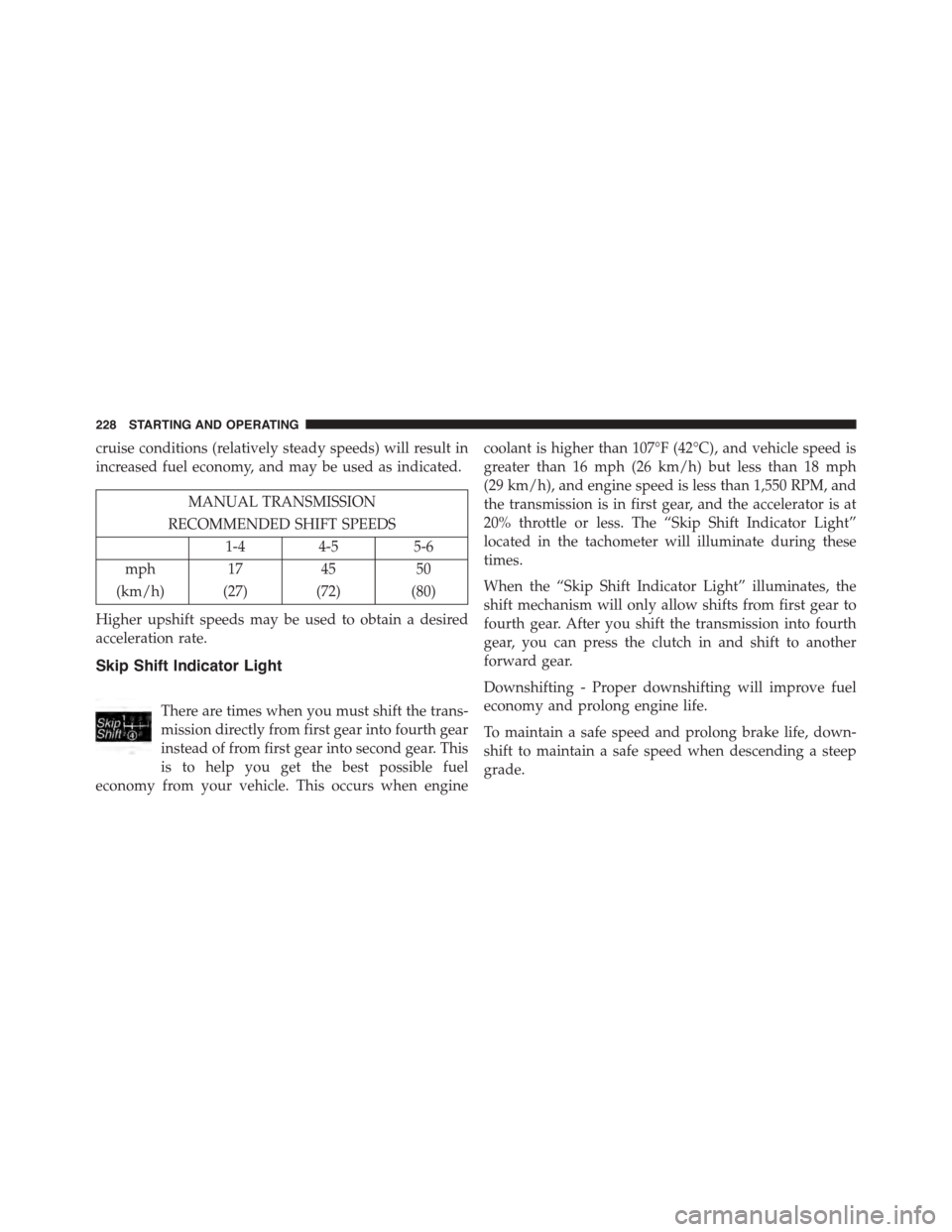
Skip Shift Indicator Light
There are times when you must shift the trans-
mission directly from first gear into fourth gear
instead of from first gear into second gear. This
is to help you get the best possible fuel
economy from your vehicle. This occurs when engine
coolant is higher than 107°F (42°C), and vehicle speed is
greater than 16 mph (26 km/h) but less than 18 mph
(29 km/h), and engine speed is less than 1,550 RPM, and
the transmission is in first gear, and the accelerator is at
20% throttle or less. The “Skip Shift Indicator Light”
located in the tachometer will illuminate during these
times.
When the “Skip Shift Indicator Light” illuminates, the
shift mechanism will only allow shifts from first gear to
fourth gear. After you shift the transmission into fourth
gear, you can press the clutch in and shift to another
forward gear.
Downshifting - Proper downshifting will improve fuel
economy and prolong engine life.
To maintain a safe speed and prolong brake life, down-
shift to maintain a safe speed when descending a steep
grade.
228 STARTING AND OPERATING
Page 231 of 400
CAUTION!
If you skip more than one gear while downshifting
or downshift at too high a vehicle speed, you could
damage the engine, transmission, or clutch.
WARNING!
Skipping more than one gear while downshifting,
could cause you to lose control of your vehicle. You
could have a collision.
STREET/RACE MODE — IF EQUIPPED
This vehicle is equipped with a two mode electronic
controlled damping system. This system allows for a
compliant street suspension damping setting or a firmer
race suspension damping setting. When in street mode
the system will automatically shift the suspension damp-
ers to the firmer Race damping setting during some hard
acceleration and braking situations. There are two modes
of operation:
•Street Mode — This mode will give a sporty, but
comfortable ride. This mode is driver selectable when
the vehicle is placed in STREET mode (press the
“STREET” button on the Instrument Panel). This mode
is intended for a smoother ride on the various types of
pavement and road conditions while still providing
damping levels appropriate extreme capabilities.
•Race Mode — This mode is driver selectable when the
vehicle is placed in RACE mode (press the “RACE”
button on the Instrument Panel). This mode is for track
use only and will supply maximum grip to the tires.
5
STARTING AND OPERATING 229
Page 239 of 400
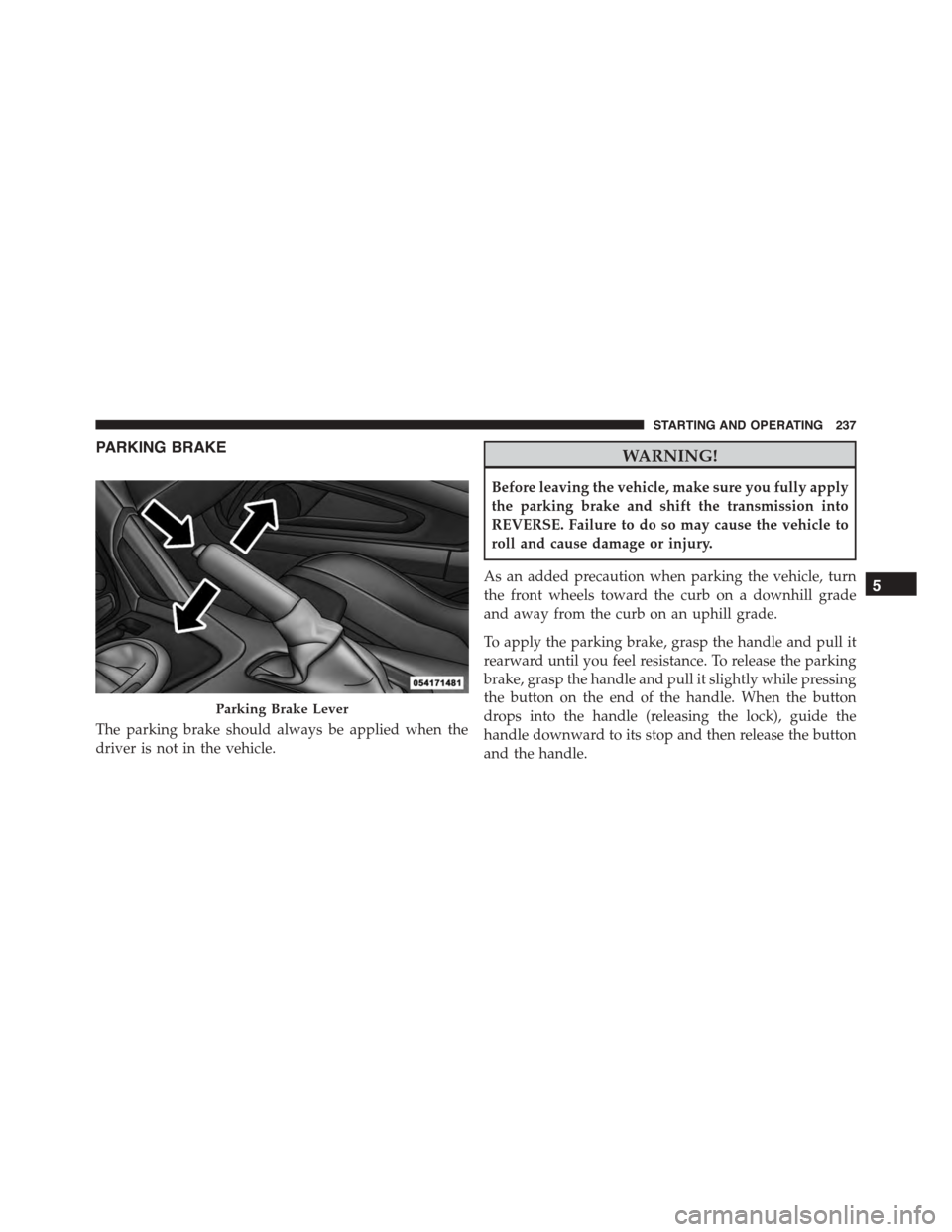
PARKING BRAKE
The parking brake should always be applied when the
driver is not in the vehicle.
WARNING!
Before leaving the vehicle, make sure you fully apply
the parking brake and shift the transmission into
REVERSE. Failure to do so may cause the vehicle to
roll and cause damage or injury.
As an added precaution when parking the vehicle, turn
the front wheels toward the curb on a downhill grade
and away from the curb on an uphill grade.
To apply the parking brake, grasp the handle and pull it
rearward until you feel resistance. To release the parking
brake, grasp the handle and pull it slightly while pressing
the button on the end of the handle. When the button
drops into the handle (releasing the lock), guide the
handle downward to its stop and then release the button
and the handle.
Parking Brake Lever
5
STARTING AND OPERATING 237
Page 242 of 400
Safe Operating Tips
WARNING!
To use your brakes and accelerator more safely,
follow these tips:
•Do not “ride” the brakes by resting your foot on the
pedal. This could overheat the brakes and result in
unpredictable braking action, longer stopping dis-
tances, or brake damage.
•When descending mountains or hills, repeated
braking can cause brake fade with loss of braking
control. Avoid repeated heavy braking by down-
shifting the transmission whenever possible.
(Continued)
WARNING!(Continued)
•Do not drive too fast for road conditions, especially
when roads are wet or slushy. A wedge of water can
build up between the tire tread and the road. This
hydroplaning action can cause loss of traction,
braking ability, and control.
•After going through deep water or a car wash,
brakes may become wet, resulting in decreased
performance and unpredictable braking action.
Dry the brakes by gentle, intermittent pedal action
while driving at very slow speeds.
240 STARTING AND OPERATING
Page 289 of 400
RECREATIONAL TOWING (BEHIND MOTORHOME, ETC.)
Towing This Vehicle Behind Another Vehicle (Flat
Towing With All Four Wheels On The Ground)
Towing ConditionWheels OFF The GroundManual Transmission
Flat TowNoneNOT ALLOWED
Dolly TowFrontNOT ALLOWED
RearNOT RECOMMENDED
On TrailerAllOK
NOTE:If the vehicle requires towing, make sure all four
wheels are off the ground.CAUTION!
Towing this vehicle in violation of the above require-
ments can cause severe transmission damage. Dam-
age from improper towing is not covered under the
New Vehicle Limited Warranty.
5
STARTING AND OPERATING 287
Page 292 of 400
HAZARD WARNING FLASHER
The Hazard Warning flasher switch is located in the
center of the instrument panel above the climate controls.
Push the switch to turn on the Hazard Warning
flasher. When the switch is activated, all direc-
tional turn signals will flash on and off to warn oncoming
traffic of an emergency. Push the switch a second time to
turn off the Hazard Warning flasher.
This is an emergency warning system and it should not
be used when the vehicle is in motion. Use it when your
vehicle is disabled and it is creating a safety hazard for
other motorists.
When you must leave the vehicle to seek assistance, the
Hazard Warning flasher will continue to operate even
though the ignition is placed in the OFF position.
NOTE:With extended use the Hazard Warning flasher
may wear down your battery.
IF YOUR ENGINE OVERHEATS
In any of the following situations, you can reduce the
potential for overheating by taking the appropriate ac-
tion.
•On the highways —Slow down and use the highest
gear possible.
•In city traffic —While stopped, put the transmission
in NEUTRAL, but do not increase engine idle speed.
•In city traffic —While moving, shift into the highest
gear possible to reduce engine RPM.
NOTE:There are steps that you can take to slow down
an impending overheat condition:
290 WHAT TO DO IN EMERGENCIES
Page 300 of 400
on the ground. This will provide the best positioning
of the kit when injecting the sealant into the deflated
tire and running the air pump. Move the vehicle as
necessary to place the valve stem in this position
before proceeding.
3. Place the transmission in PARK (auto transmission) or
in Gear (manual transmission) and place the ignition
in the OFF position.
4. Set the parking brake.
(B) Setting Up To Use Tire Service Kit:
1. Push in the Mode Select Knob (5) and turn to the
Sealant Mode position.
2. Uncoil the Sealant Hose (6) and then remove the cap
from the fitting at the end of the hose.
3. Place the Tire Service Kit flat on the ground next to the
deflated tire.
4. Remove the cap from the valve stem and then screw
the fitting at the end of the Sealant Hose (6) onto the
valve stem.
5. Uncoil the Power Plug (8) and insert the plug into the
vehicle’s 12 Volt power outlet.
NOTE:Do not remove foreign objects (e.g., screws or
nails) from the tire.
(C) Injecting Tire Service Kit Sealant Into The
Deflated Tire:
•Always start the engine before turning ON the Tire
Service Kit.
NOTE:Manual transmission vehicles must have the
parking brake engaged and the shift lever in NEUTRAL.
•After pushing the Power Button (4), the sealant (white
fluid) will flow from the Sealant Bottle (1) through the
Sealant Hose (6) and into the tire.
298 WHAT TO DO IN EMERGENCIES
Page 306 of 400
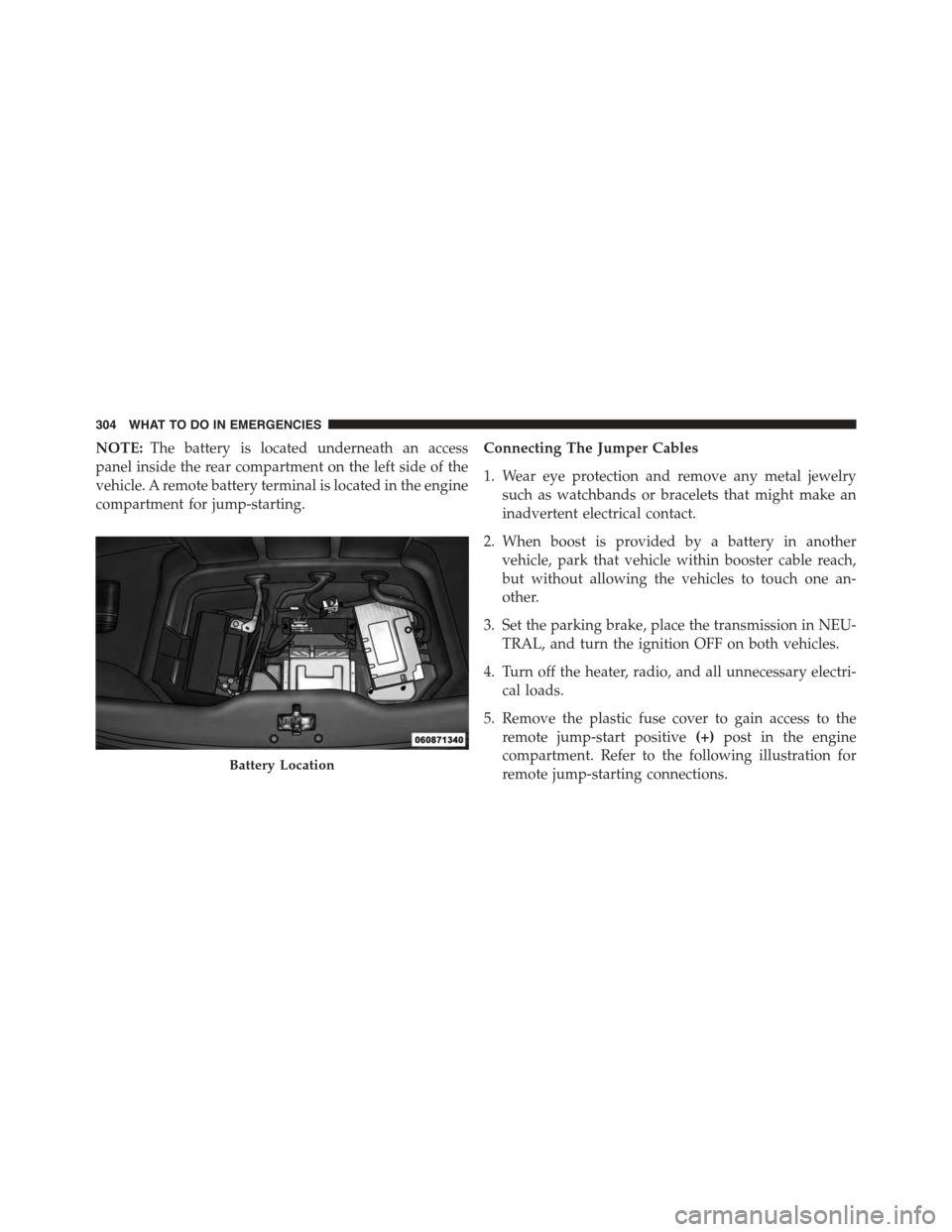
NOTE:The battery is located underneath an access
panel inside the rear compartment on the left side of the
vehicle. A remote battery terminal is located in the engine
compartment for jump-starting.
Connecting The Jumper Cables
1. Wear eye protection and remove any metal jewelry
such as watchbands or bracelets that might make an
inadvertent electrical contact.
2. When boost is provided by a battery in another
vehicle, park that vehicle within booster cable reach,
but without allowing the vehicles to touch one an-
other.
3. Set the parking brake, place the transmission in NEU-
TRAL, and turn the ignition OFF on both vehicles.
4. Turn off the heater, radio, and all unnecessary electri-
cal loads.
5. Remove the plastic fuse cover to gain access to the
remote jump-start positive(+)post in the engine
compartment. Refer to the following illustration for
remote jump-starting connections.Battery Location
304 WHAT TO DO IN EMERGENCIES
Page 309 of 400
CAUTION!
Accessories plugged into the vehicle power outlets
draw power from the vehicle’s battery, even when not
in use (i.e., cellular phones, etc.). Eventually, if
plugged in long enough without engine operation,
the vehicle’s battery will discharge sufficiently to
degrade battery life and/or prevent the engine from
starting.
FREEING A STUCK VEHICLE
If your vehicle becomes stuck in mud, sand, or snow, it
can often be moved using a rocking motion. Turn your
steering wheel right and left to clear the area around the
front wheels. Then shift back and forth between 1st gear
and REVERSE, while gently pushing the accelerator. Use
the least amount of pressure to maintain the rocking
motion, without spinning the wheels, or racing the
engine.
CAUTION!
•When “rocking” a stuck vehicle by shifting be-
tween 1st gear and REVERSE, do not spin the
wheels faster than 15 mph (24 km/h), or drivetrain
damage may result.
•Revving the engine or spinning the wheels too fast
may lead to transmission overheating and failure.
It can also damage the tires. Do not spin the wheels
above 30 mph (48 km/h) while in gear (no trans-
mission shifting occurring).
6
WHAT TO DO IN EMERGENCIES 307