radio DODGE VIPER 2015 VX / 3.G Owner's Manual
[x] Cancel search | Manufacturer: DODGE, Model Year: 2015, Model line: VIPER, Model: DODGE VIPER 2015 VX / 3.GPages: 400, PDF Size: 9.59 MB
Page 278 of 400
seconds and then display dashes (- -) in place of the
pressure value to indicate which sensor is not being
received.
If the ignition switch is cycled, this sequence will repeat,
providing the system fault still exists. If the system fault
no longer exists, the TPM Telltale Light will no longer
flash, and the#SERVICE TPM SYSTEM#message will no
longer display, and a pressure value will display in place
of the dashes. A system fault can occur due to any of the
following:
1. Signal interference due to electronic devices or driving
next to facilities emitting the same radio frequencies as
the TPM sensors.
2. Installing aftermarket window tinting that contains
materials that may block radio wave signals.
3. Accumulation of snow or ice around the wheels or
wheel housings.
4. Using tire chains on the vehicle.
5. Using wheels/tires not equipped with TPM sensors.
The DID will also display a#SERVICE TPM SYSTEM#
message for a minimum of five seconds when a system
fault related to an incorrect sensor location fault is
detected. In this case, the#SERVICE TPM SYSTEM#
message is then followed with a graphic display with
pressure values still shown. This indicates that the pres-
sure values are still being received from the TPM sensors
but they may not be located in the correct vehicle
position. The system still needs to be serviced as long as
the#SERVICE TPM SYSTEM#message is displayed.
General Information
This device complies with Part 15 of the FCC rules and
RSS 210 of Industry Canada. Operation is subject to the
following conditions:
•This device may not cause harmful interference.
276 STARTING AND OPERATING
Page 306 of 400
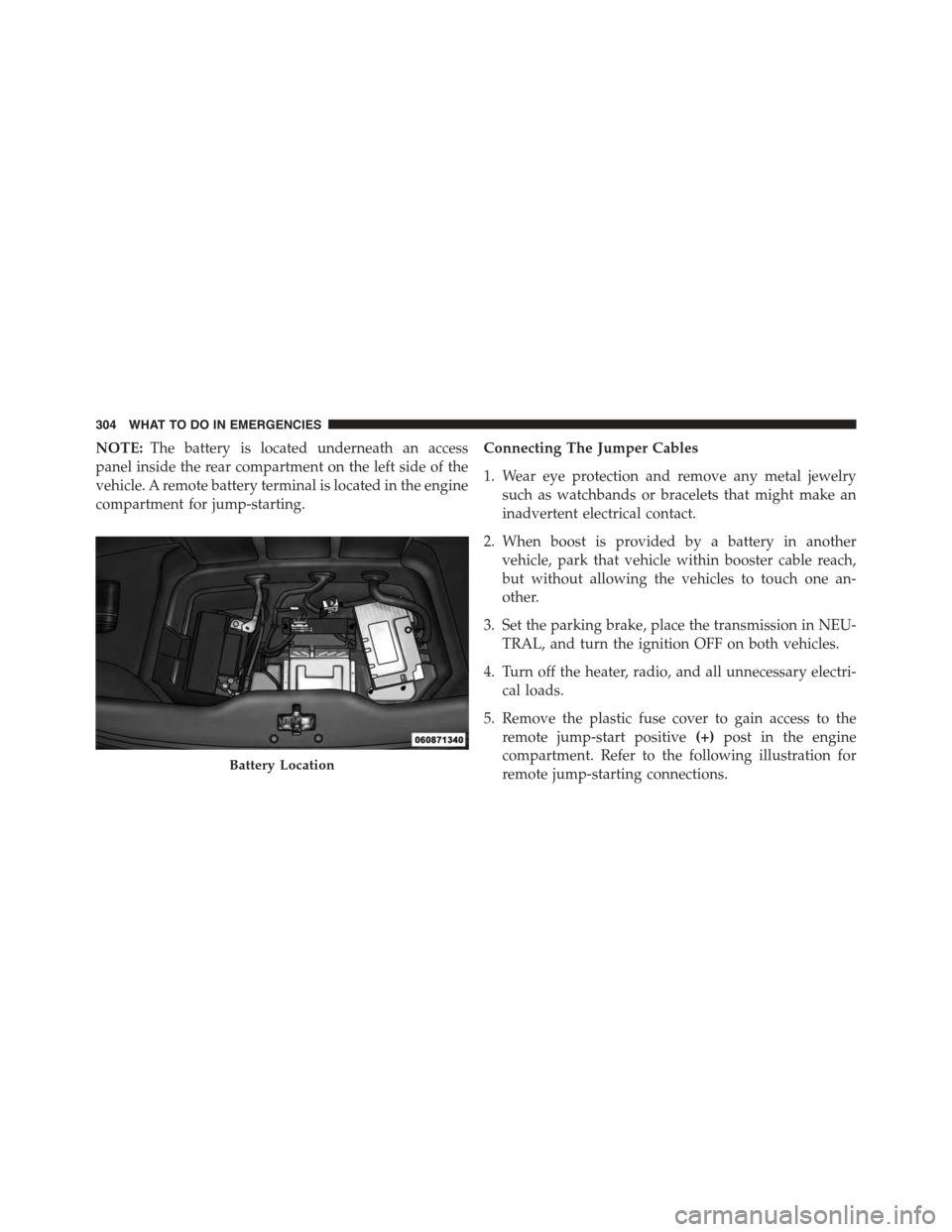
NOTE:The battery is located underneath an access
panel inside the rear compartment on the left side of the
vehicle. A remote battery terminal is located in the engine
compartment for jump-starting.
Connecting The Jumper Cables
1. Wear eye protection and remove any metal jewelry
such as watchbands or bracelets that might make an
inadvertent electrical contact.
2. When boost is provided by a battery in another
vehicle, park that vehicle within booster cable reach,
but without allowing the vehicles to touch one an-
other.
3. Set the parking brake, place the transmission in NEU-
TRAL, and turn the ignition OFF on both vehicles.
4. Turn off the heater, radio, and all unnecessary electri-
cal loads.
5. Remove the plastic fuse cover to gain access to the
remote jump-start positive(+)post in the engine
compartment. Refer to the following illustration for
remote jump-starting connections.Battery Location
304 WHAT TO DO IN EMERGENCIES
Page 322 of 400
CAUTION!
•It is essential when replacing the cables on the
battery that the positive cable is attached to the
positive post and the negative cable is attached to
the negative post. Battery posts are marked positive
(+) and negative (-) and are identified on the
battery case. Cable clamps should be tight on the
terminal posts and free of corrosion.
•If a “fast charger” is used while the battery is in the
vehicle, disconnect both vehicle battery cables be-
fore connecting the charger to the battery. Do not
use a “fast charger” to provide starting voltage.
Hibernation Mode
The Hibernation mode feature conserves battery power
when storing the vehicle. It allows for up to three months
of storage time without losing radio and engine control-
ler adaptive memory. Using this feature is an alternative
to disconnecting the battery.
NOTE:This vehicle is designed to sit in storage with a
fully charged battery for up to 30 days. If you plan to
store the vehicle longer than 30 days, we recommend
doing one of the following:
•Disconnect the battery.
•Use the battery charger.
•Put the vehicle into Hibernation mode (3-month
charge).
To Activate Hibernation Mode
1. Cycle the ignition switch to (ACC).
2. Select Hibernation mode within the Driver Informa-
tion Display (DID).
320 MAINTAINING YOUR VEHICLE
Page 342 of 400
equipped with radio antennas. Do not use scrapers or
other sharp instrument that may scratch the elements.
When cleaning the rear view mirror, spray cleaner on the
towel or rag that you are using. Do not spray cleaner
directly on the mirror.
Cleaning Plastic Instrument Cluster Lenses
The lenses in front of the instruments in this vehicle are
molded in clear plastic. When cleaning the lenses, care
must be taken to avoid scratching the plastic.
1. Clean with a wet soft rag. A mild soap solution may be
used, but do not use high alcohol content or abrasive
cleaners. If soap is used, wipe clean with a clean damp
rag.
2. Dry with a soft cloth.
Seat Belt Maintenance
Do not bleach, dye or clean the belts with chemical
solvents or abrasive cleaners. This will weaken the fabric.
Sun damage can also weaken the fabric.
If the belts need cleaning, use a mild soap solution or
lukewarm water. Do not remove the belts from the car to
wash them. Dry with a soft cloth.
Replace the belts if they appear frayed or worn or if the
buckles do not work properly.
WARNING!
A frayed or torn belt could rip apart in a collision and
leave you with no protection. Inspect the belt system
periodically, checking for cuts, frays, or loose parts.
Damaged parts must be replaced immediately. Do
not disassemble or modify the system. Seat belt
(Continued)
340 MAINTAINING YOUR VEHICLE
Page 352 of 400
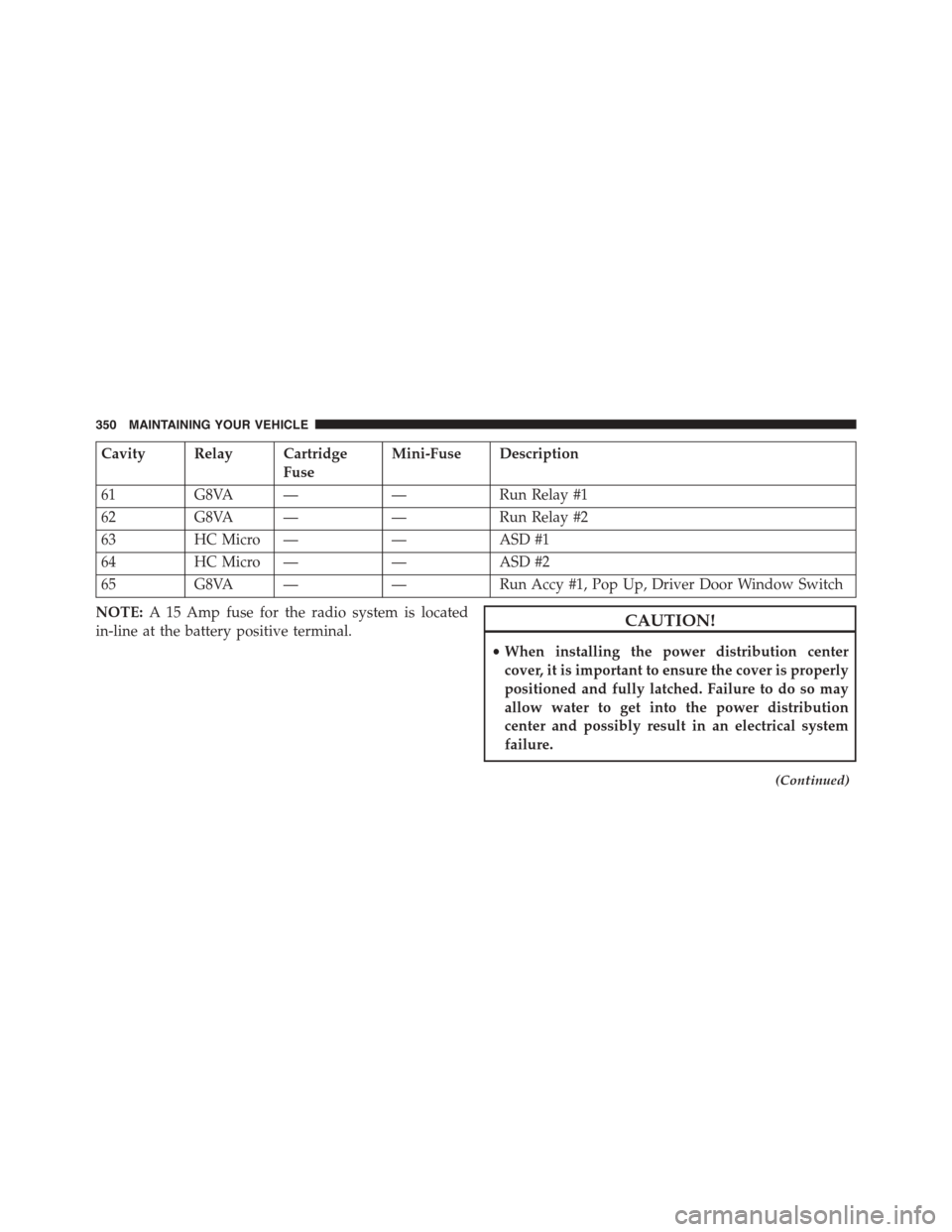
Cavity Relay Cartridge
Fuse
Mini-Fuse Description
61 G8VA — — Run Relay #1
62 G8VA — — Run Relay #2
63HC Micro ——ASD #1
64HC Micro ——ASD #2
65G8VA ——Run Accy #1, Pop Up, Driver Door Window Switch
NOTE:A 15 Amp fuse for the radio system is located
in-line at the battery positive terminal.CAUTION!
•When installing the power distribution center
cover, it is important to ensure the cover is properly
positioned and fully latched. Failure to do so may
allow water to get into the power distribution
center and possibly result in an electrical system
failure.
(Continued)
350 MAINTAINING YOUR VEHICLE
Page 392 of 400
Pets....................................81
Placard, Tire And Loading Information..........255
Power
Brakes...............................239
Door Locks............................25
Mirrors...............................92
Outlet (Auxiliary Electrical Outlet)...........129
Steering..............................235
Windows..............................27
Pregnant Women And Seat Belts...............40
Pretensioners
Seat Belts..............................41
Programming Transmitters (Remote Keyless Entry) . .22
Radial Ply Tires..........................261
Radiator Cap (Coolant Pressure Cap)...........330
Radio Antenna...........................195
Radio Operation..........................196
Radio (Sound Systems).....................193
Rear Camera.............................118
Rear Liftgate.............................30
Rear Window Defroster.....................138
Rear Window Features.....................138
Reclining Front Seats.......................96
Recorder, Event Data.......................69
Recreational Towing.......................287
Reformulated Gasoline.....................278
Refrigerant..............................322
Reminder, Lights On.......................104
Reminder, Seat Belt.........................34
Remote Keyless Entry (RKE)..................20
FCC General Information..................24
Programming Additional Key Fobs...........16
Programming Additional Transmitters.........16
Remote Battery Replacement................22
Transmitter Battery Replacement.............22
Remote Sound System (Radio) Controls.........194
Replacement Keys.........................15
390 INDEX
Page 399 of 400

INSTALLATION OF RADIO TRANSMITTING
EQUIPMENT
Special design considerations are incorporated into this
vehicle’s electronic system to provide immunity to radio
frequency signals. Mobile two-way radios and telephone
equipment must be installed properly by trained person-
nel. The following must be observed during installation.
The positive power connection should be made directly
to the battery and fused as close to the battery as possible.
The negative power connection should be made to body
sheet metal adjacent to the negative battery connection.
This connection should not be fused.
Antennas for two-way radios should be mounted on the
roof or the rear area of the vehicle. Care should be used
in mounting antennas with magnet bases. Magnets may
affect the accuracy or operation of the compass on
vehicles so equipped.
The antenna cable should be as short as practical and
routed away from the vehicle wiring when possible. Use
only fully shielded coaxial cable.
Carefully match the antenna and cable to the radio to
ensure a low Standing Wave Ratio (SWR).
Mobile radio equipment with output power greater than
normal may require special precautions.
All installations should be checked for possible interfer-
ence between the communications equipment and the
vehicle’s electronic systems.