engine DODGE VIPER 2016 VX / 3.G Owners Manual
[x] Cancel search | Manufacturer: DODGE, Model Year: 2016, Model line: VIPER, Model: DODGE VIPER 2016 VX / 3.GPages: 423, PDF Size: 2.75 MB
Page 356 of 423
When additional engine coolant (antifreeze) is needed to
maintain the proper level, only OAT coolant that meets
the requirements of FCA Material Standard MS.90032
should be added to the coolant bottle. Do not overfill.
Points To Remember
NOTE:When the vehicle is stopped after a few miles/
kilometers of operation, you may observe vapor coming
from the front of the engine compartment. This is nor-
mally a result of moisture from rain, snow, or high
humidity accumulating on the radiator and being vapor-
ized when the thermostat opens, allowing hot engine
coolant (antifreeze) to enter the radiator.
If an examination of your engine compartment shows no
evidence of radiator or hose leaks, the vehicle may be
safely driven. The vapor will soon dissipate.
• Do not overfill the coolant expansion bottle. •
Check the coolant freeze point in the radiator and in
the coolant expansion bottle. If engine coolant (anti-
freeze) needs to be added, the contents of the coolant
expansion bottle must also be protected against freez-
ing.
• If frequent engine coolant (antifreeze) additions are
required, the cooling system should be pressure tested
for leaks.
• Maintain engine coolant (antifreeze) concentration at a
minimum of 50% OAT coolant (conforming to
MS.90032) and distilled water for proper corrosion
protection of your engine which contains aluminum
components.
• Make sure that the coolant expansion bottle overflow
hoses are not kinked or obstructed.
• Keep the front of the radiator clean. If your vehicle is
equipped with air conditioning, keep the front of the
condenser clean.
354 MAINTAINING YOUR VEHICLE
Page 357 of 423
•Do not change the thermostat for Summer or Winter
operation. If replacement is ever necessary, install
ONLY the correct type thermostat. Other designs may
result in unsatisfactory engine coolant (antifreeze)
performance, poor gas mileage, and increased emis-
sions.
Brake System
To ensure brake system performance, all brake system
components should be inspected periodically. Refer to
“Maintenance Schedule” for the proper maintenance
intervals.
WARNING!
Riding the brakes can lead to brake failure and
possibly an accident. Driving with your foot resting
or riding on the brake pedal can result in abnormally
(Continued)
WARNING! (Continued)
high brake temperatures, excessive lining wear, and
possible brake damage. You would not have your full
braking capacity in an emergency.
Master Cylinder — Brake Fluid Level Check
Check the fluid level in the master cylinder immediately
if the brake system warning light indicates system fail-
ure.
Check the fluid level in the master cylinder when per-
forming underhood services.
Clean the top of the master cylinder area before removing
the cap. If necessary, add fluid to bring the fluid level up
to the requirements described on the brake fluid reser-
voir.
Overfilling of fluid is not recommended because it may
cause leaking in the system.
7
MAINTAINING YOUR VEHICLE 355
Page 358 of 423
With disc brakes, fluid level can be expected to fall as the
brake pads wear. However, low fluid level may be caused
by a leak and a checkup may be needed.
Use only the manufacturer’s recommended brake fluid.
Refer to “Fluids, Lubricants, And Genuine Parts” in
“Maintaining Your Vehicle” for further information. Use
of a brake fluid that may have a lower initial boiling
point or unidentified as to specification, may result in
sudden brake failure during hard prolonged braking.
WARNING!
•Use only manufacturer ’s recommended brake fluid.
Refer to “Fluids, Lubricants, And Genuine Parts” in
“Maintaining Your Vehicle” for further information.
Using the wrong type of brake fluid can severely
damage your brake system and/or impair its perfor-
mance. The proper type of brake fluid for your
(Continued)
WARNING! (Continued)
vehicle is also identified on the original factory
installed hydraulic master cylinder reservoir.
•To avoid contamination from foreign matter or
moisture, use only new brake fluid or fluid that has
been in a tightly closed container. Keep the master
cylinder reservoir cap secured at all times. Brake
fluid in a open container absorbs moisture from the
air resulting in a lower boiling point. This may
cause it to boil unexpectedly during hard or pro-
longed braking, resulting in sudden brake failure.
This could result in a accident.
• Overfilling the brake fluid reservoir can result in
spilling brake fluid on hot engine parts, causing
the brake fluid to catch fire. Brake fluid can also
damage painted and vinyl surfaces, care should be
taken to avoid its contact with these surfaces.
(Continued)
356 MAINTAINING YOUR VEHICLE
Page 368 of 423
system and the clear coat. As with any automotive
coating, storing your vehicle in a covered location will
guarantee a long lasting finish.
The rear wing is molded with unidirectional carbon fiber
and painted in body color. Some patterned or linear
conditions may be visible in the painted carbon fiber
surfaces. This is also a normal result of the carbon fiber
process.
FUSES
WARNING!
•When replacing a blown fuse, always use an ap-
propriate replacement fuse with the same amp
rating as the original fuse. Never replace a fuse
with another fuse of higher amp rating. Never
replace a blown fuse with metal wires or any other
(Continued)
WARNING! (Continued)
material. Failure to use proper fuses may result in
serious personal injury, fire and/or property dam-
age.
• Before replacing a fuse, make sure that the ignition
is off and that all the other services are switched off
and/or disengaged.
• If the replaced fuse blows again, contact an autho-
rized dealer.
• If a general protection fuse for safety systems (air
bag system, braking system), power unit systems
(engine system, gearbox system) or steering system
blows, contact an authorized dealer.
366 MAINTAINING YOUR VEHICLE
Page 369 of 423
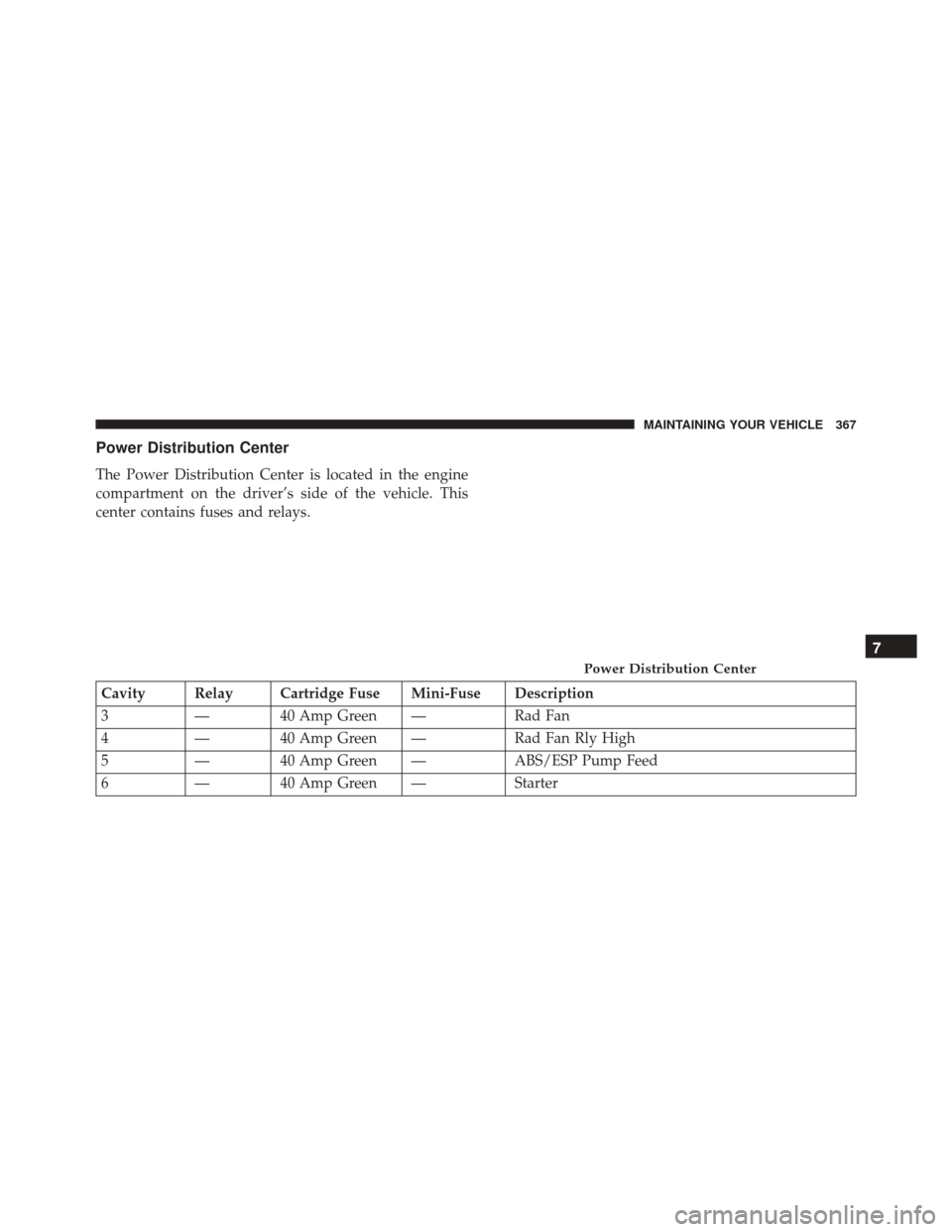
Power Distribution Center
The Power Distribution Center is located in the engine
compartment on the driver’s side of the vehicle. This
center contains fuses and relays.
Cavity Relay Cartridge Fuse Mini-Fuse Description
3— 40 Amp Green — Rad Fan
4 — 40 Amp Green — Rad Fan Rly High
5 — 40 Amp Green — ABS/ESP Pump Feed
6 — 40 Amp Green — Starter
Power Distribution Center
7
MAINTAINING YOUR VEHICLE 367
Page 377 of 423
•Block the wheels. Do not apply the parking brake.
• Cut blocks of plywood about the same size of the tires.
Cover each block with indoor/outdoor carpeting and
place them between the tires and concrete. This will
prevent tire flat spotting.
• For long-term storage, remove the tires and put the
vehicle up on blocks. Stack the tires on plywood and
cover with a tarp to prevent flat spotting.
• If the vehicle will be subjected to freezing tempera-
tures, either remove the battery and store it in a dry,
well ventilated area or connect a trickle charger (1.5
Amp) with automatic shutdown / overcharge protec-
tion to the battery. However, do not leave the trickle
charger hooked up to the battery without being
plugged in to a 110 Volt AC outlet, as this will result in
further drain on the vehicle’s battery. If the vehicle is
not going to be driven in the next three weeks, perform
the battery recharge procedure in the Service Manual. Then, either disconnect the battery at the negative
terminal or use the “Battery Save Feature” to conserve
battery power. Refer to “Maintenance Procedures/
Battery Save Feature” in “Maintaining Your Vehicle”
for further information.
• Cover the vehicle whenever possible to prevent acci-
dental damage to the finish.
NOTE: Disconnecting the battery causes the engine con-
trol system to lose memory of some “learned” functions.
After reconnecting the battery, the engine may run rough
until the control module “relearns” these functions. Us-
ing the Battery Save Feature will prevent the engine
controller from loosing its memory.
7
MAINTAINING YOUR VEHICLE 375
Page 382 of 423
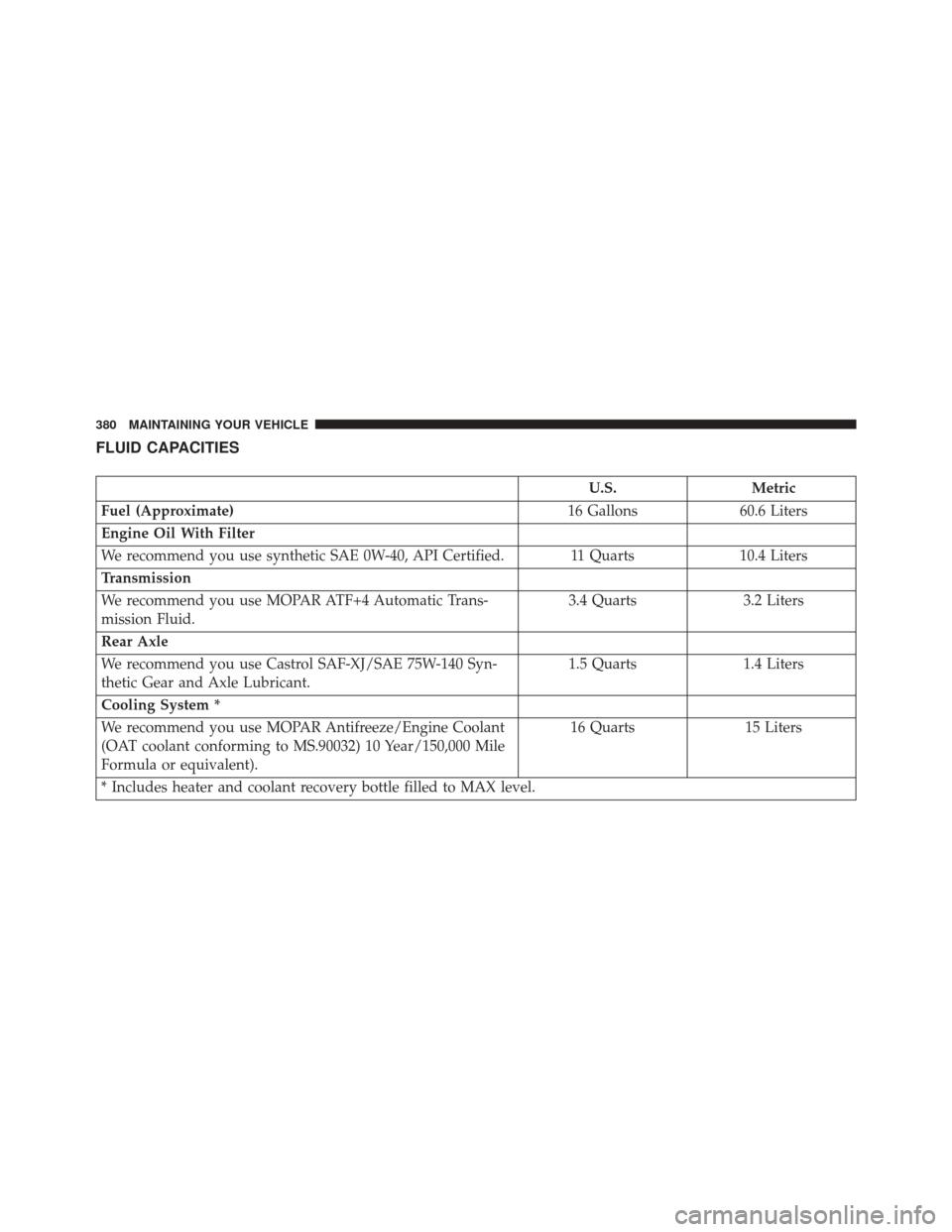
FLUID CAPACITIES
U.S.Metric
Fuel (Approximate) 16 Gallons60.6 Liters
Engine Oil With Filter
We recommend you use synthetic SAE 0W-40, API Certified. 11 Quarts 10.4 Liters
Transmission
We recommend you use MOPAR ATF+4 Automatic Trans-
mission Fluid. 3.4 Quarts
3.2 Liters
Rear Axle
We recommend you use Castrol SAF-XJ/SAE 75W-140 Syn-
thetic Gear and Axle Lubricant. 1.5 Quarts
1.4 Liters
Cooling System *
We recommend you use MOPAR Antifreeze/Engine Coolant
(OAT coolant conforming to MS.90032) 10 Year/150,000 Mile
Formula or equivalent). 16 Quarts
15 Liters
* Includes heater and coolant recovery bottle filled to MAX level.
380 MAINTAINING YOUR VEHICLE
Page 383 of 423
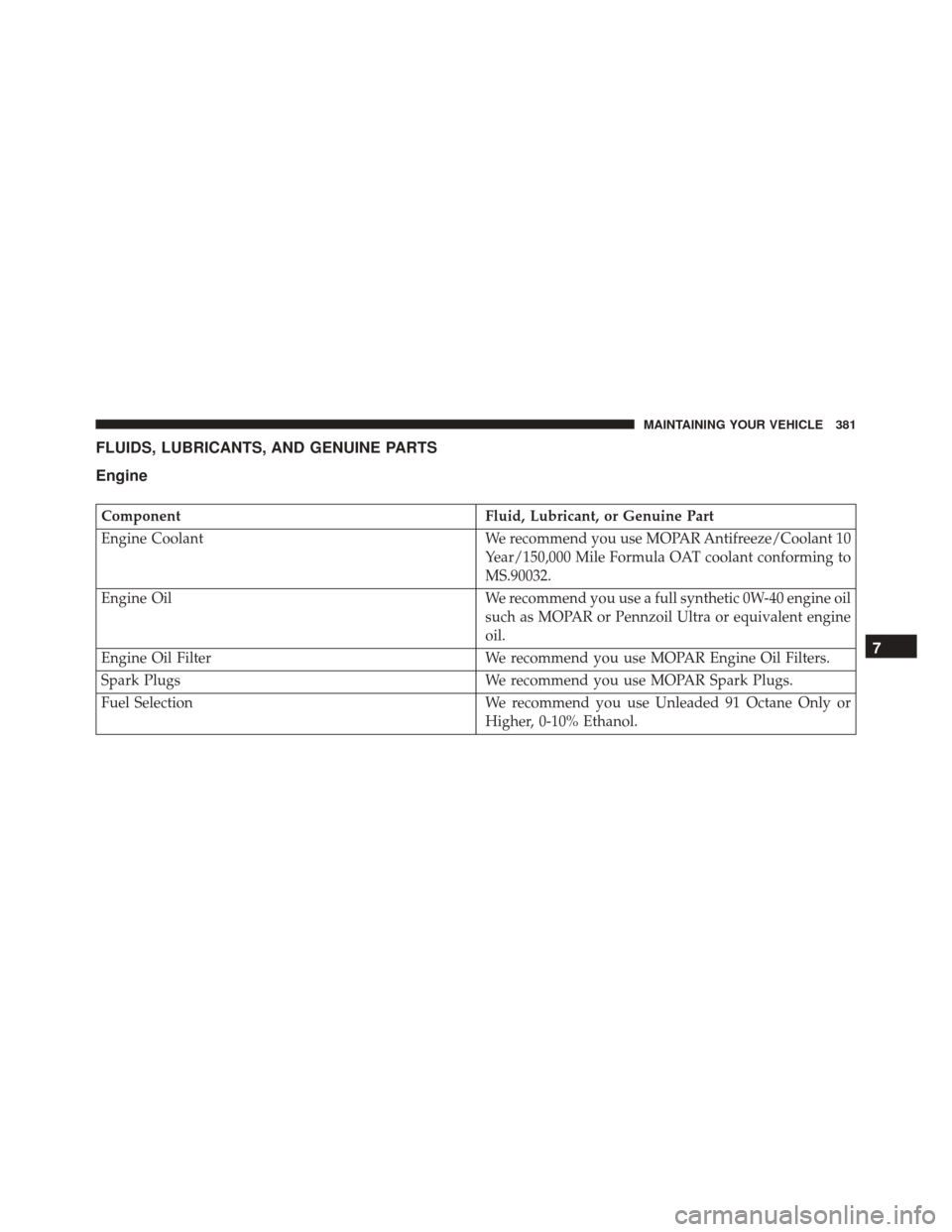
FLUIDS, LUBRICANTS, AND GENUINE PARTS
Engine
ComponentFluid, Lubricant, or Genuine Part
Engine Coolant We recommend you use MOPAR Antifreeze/Coolant 10
Year/150,000 Mile Formula OAT coolant conforming to
MS.90032.
Engine Oil We recommend you use a full synthetic 0W-40 engine oil
such as MOPAR or Pennzoil Ultra or equivalent engine
oil.
Engine Oil Filter We recommend you use MOPAR Engine Oil Filters.
Spark Plugs We recommend you use MOPAR Spark Plugs.
Fuel Selection We recommend you use Unleaded 91 Octane Only or
Higher, 0-10% Ethanol.
7
MAINTAINING YOUR VEHICLE 381
Page 384 of 423
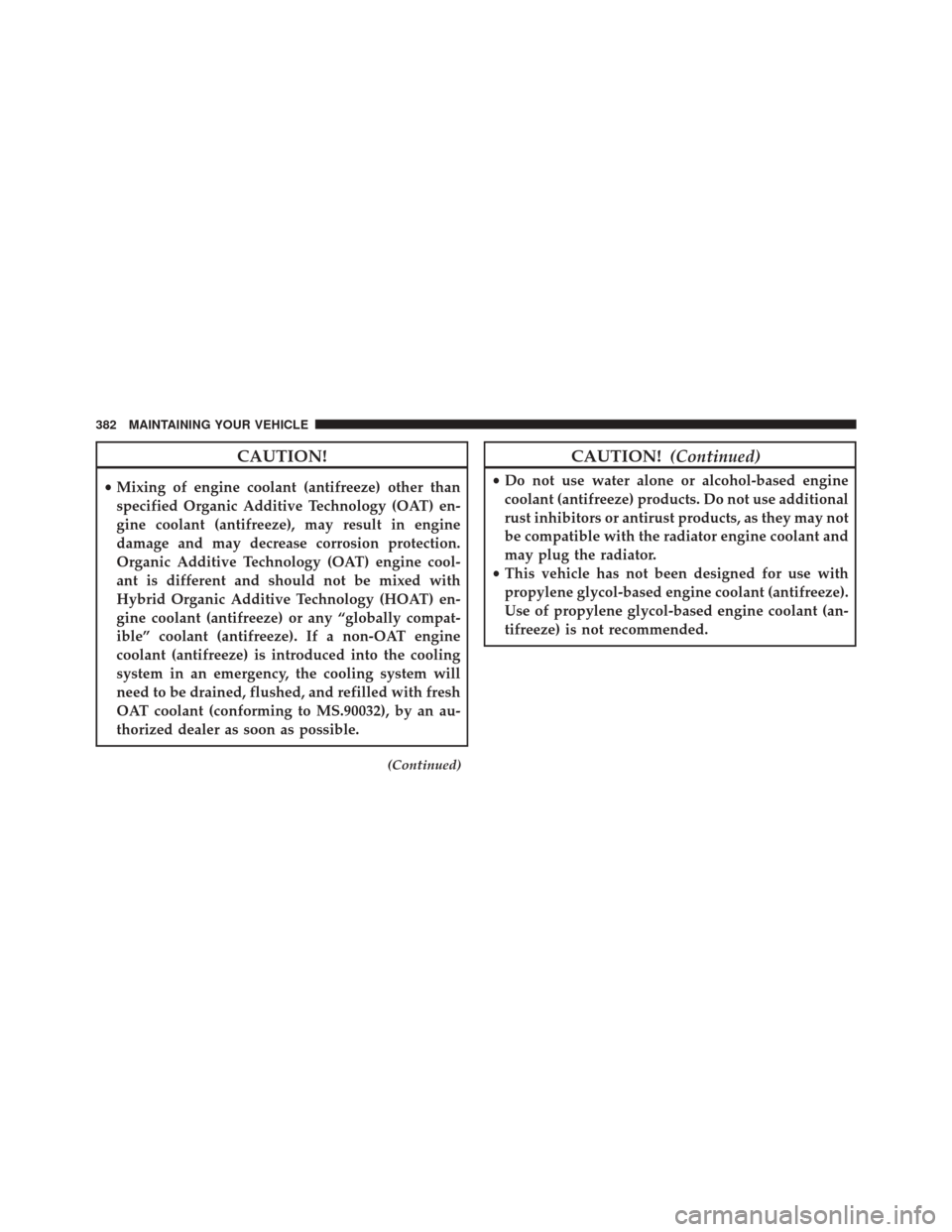
CAUTION!
•Mixing of engine coolant (antifreeze) other than
specified Organic Additive Technology (OAT) en-
gine coolant (antifreeze), may result in engine
damage and may decrease corrosion protection.
Organic Additive Technology (OAT) engine cool-
ant is different and should not be mixed with
Hybrid Organic Additive Technology (HOAT) en-
gine coolant (antifreeze) or any “globally compat-
ible” coolant (antifreeze). If a non-OAT engine
coolant (antifreeze) is introduced into the cooling
system in an emergency, the cooling system will
need to be drained, flushed, and refilled with fresh
OAT coolant (conforming to MS.90032), by an au-
thorized dealer as soon as possible.
(Continued)
CAUTION! (Continued)
•Do not use water alone or alcohol-based engine
coolant (antifreeze) products. Do not use additional
rust inhibitors or antirust products, as they may not
be compatible with the radiator engine coolant and
may plug the radiator.
• This vehicle has not been designed for use with
propylene glycol-based engine coolant (antifreeze).
Use of propylene glycol-based engine coolant (an-
tifreeze) is not recommended.
382 MAINTAINING YOUR VEHICLE
Page 388 of 423
MAINTENANCE SCHEDULES
The Scheduled Maintenance services listed in this
manual must be done at the times or mileages specified
to protect your vehicle warranty and ensure the best
vehicle performance and reliability. More frequent main-
tenance may be needed for vehicles in severe operating
conditions, such as dusty areas and very short trip
driving. Inspection and service should also be done
anytime a malfunction is suspected.
NOTE: Under no circumstances should oil change in-
tervals exceed 6,000 miles (10 000 km) or six months,
whichever comes first.
CAUTION!
Failure to perform the required maintenance items
may result in damage to the vehicle.
At Each Stop For Fuel
• Check the engine oil level about five minutes after a
fully warmed engine is shut off. Checking the oil level
while the vehicle is on level ground will improve the
accuracy of the oil level reading. Add oil only when
the level is at or below the ADD or MIN mark.
• Check the windshield washer solvent and add if
required.
386 MAINTENANCE SCHEDULES