cooling DODGE VIPER 2016 VX / 3.G User Guide
[x] Cancel search | Manufacturer: DODGE, Model Year: 2016, Model line: VIPER, Model: DODGE VIPER 2016 VX / 3.GPages: 423, PDF Size: 2.75 MB
Page 355 of 423
WARNING!(Continued)
engine is overheated. Do not loosen or remove the
cap to cool an overheated engine. Heat causes
pressure to build up in the cooling system. To
prevent scalding or injury, do not remove the
pressure cap while the system is hot or under
pressure.
• Do not use a pressure cap other than the one
specified for your vehicle. Personal injury or en-
gine damage may result.
Disposal Of Used Engine Coolant
Used ethylene glycol-based engine coolant (antifreeze) is
a regulated substance requiring proper disposal. Check
with your local authorities to determine the disposal
rules for your community. To prevent ingestion by ani-
mals or children, do not store ethylene glycol-based
engine coolant (antifreeze) in open containers or allow it to remain in puddles on the ground. If ingested by a child
or pet, seek emergency assistance immediately. Clean up
any ground spills immediately.
Coolant Level
The coolant bottle provides a quick visual method for
determining that the coolant level is adequate. With the
engine OFF and cold, the level of the engine coolant
(antifreeze) in the bottle should be between the ranges
indicated on the bottle.
The radiator normally remains completely full, so there is
no need to remove the radiator/coolant pressure cap
unless checking for engine coolant (antifreeze) freeze
point or replacing coolant. Advise your service attendant
of this. As long as the engine operating temperature is
satisfactory, the coolant bottle need only be checked once
a month.
7
MAINTAINING YOUR VEHICLE 353
Page 356 of 423
When additional engine coolant (antifreeze) is needed to
maintain the proper level, only OAT coolant that meets
the requirements of FCA Material Standard MS.90032
should be added to the coolant bottle. Do not overfill.
Points To Remember
NOTE:When the vehicle is stopped after a few miles/
kilometers of operation, you may observe vapor coming
from the front of the engine compartment. This is nor-
mally a result of moisture from rain, snow, or high
humidity accumulating on the radiator and being vapor-
ized when the thermostat opens, allowing hot engine
coolant (antifreeze) to enter the radiator.
If an examination of your engine compartment shows no
evidence of radiator or hose leaks, the vehicle may be
safely driven. The vapor will soon dissipate.
• Do not overfill the coolant expansion bottle. •
Check the coolant freeze point in the radiator and in
the coolant expansion bottle. If engine coolant (anti-
freeze) needs to be added, the contents of the coolant
expansion bottle must also be protected against freez-
ing.
• If frequent engine coolant (antifreeze) additions are
required, the cooling system should be pressure tested
for leaks.
• Maintain engine coolant (antifreeze) concentration at a
minimum of 50% OAT coolant (conforming to
MS.90032) and distilled water for proper corrosion
protection of your engine which contains aluminum
components.
• Make sure that the coolant expansion bottle overflow
hoses are not kinked or obstructed.
• Keep the front of the radiator clean. If your vehicle is
equipped with air conditioning, keep the front of the
condenser clean.
354 MAINTAINING YOUR VEHICLE
Page 382 of 423
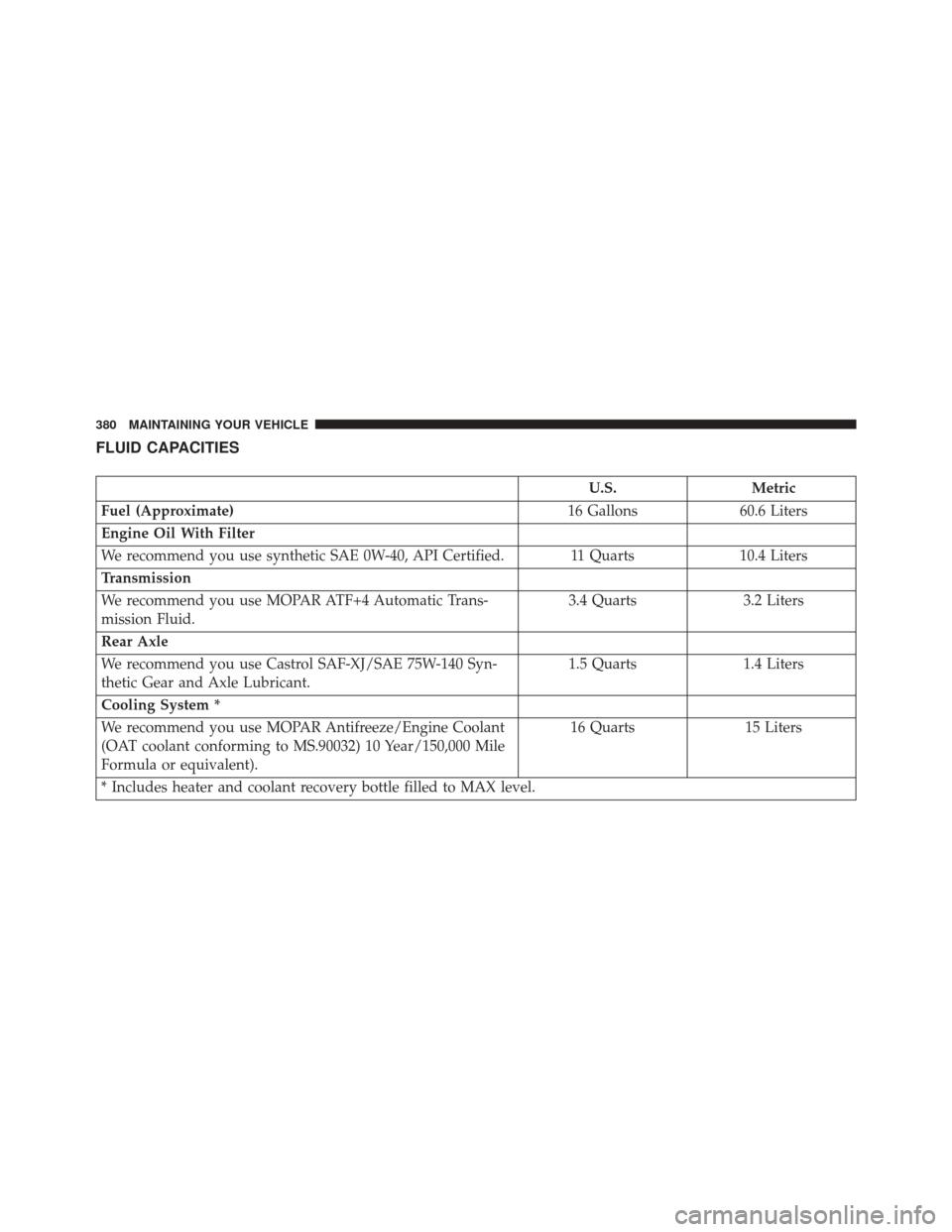
FLUID CAPACITIES
U.S.Metric
Fuel (Approximate) 16 Gallons60.6 Liters
Engine Oil With Filter
We recommend you use synthetic SAE 0W-40, API Certified. 11 Quarts 10.4 Liters
Transmission
We recommend you use MOPAR ATF+4 Automatic Trans-
mission Fluid. 3.4 Quarts
3.2 Liters
Rear Axle
We recommend you use Castrol SAF-XJ/SAE 75W-140 Syn-
thetic Gear and Axle Lubricant. 1.5 Quarts
1.4 Liters
Cooling System *
We recommend you use MOPAR Antifreeze/Engine Coolant
(OAT coolant conforming to MS.90032) 10 Year/150,000 Mile
Formula or equivalent). 16 Quarts
15 Liters
* Includes heater and coolant recovery bottle filled to MAX level.
380 MAINTAINING YOUR VEHICLE
Page 384 of 423
CAUTION!
•Mixing of engine coolant (antifreeze) other than
specified Organic Additive Technology (OAT) en-
gine coolant (antifreeze), may result in engine
damage and may decrease corrosion protection.
Organic Additive Technology (OAT) engine cool-
ant is different and should not be mixed with
Hybrid Organic Additive Technology (HOAT) en-
gine coolant (antifreeze) or any “globally compat-
ible” coolant (antifreeze). If a non-OAT engine
coolant (antifreeze) is introduced into the cooling
system in an emergency, the cooling system will
need to be drained, flushed, and refilled with fresh
OAT coolant (conforming to MS.90032), by an au-
thorized dealer as soon as possible.
(Continued)
CAUTION! (Continued)
•Do not use water alone or alcohol-based engine
coolant (antifreeze) products. Do not use additional
rust inhibitors or antirust products, as they may not
be compatible with the radiator engine coolant and
may plug the radiator.
• This vehicle has not been designed for use with
propylene glycol-based engine coolant (antifreeze).
Use of propylene glycol-based engine coolant (an-
tifreeze) is not recommended.
382 MAINTAINING YOUR VEHICLE
Page 408 of 423
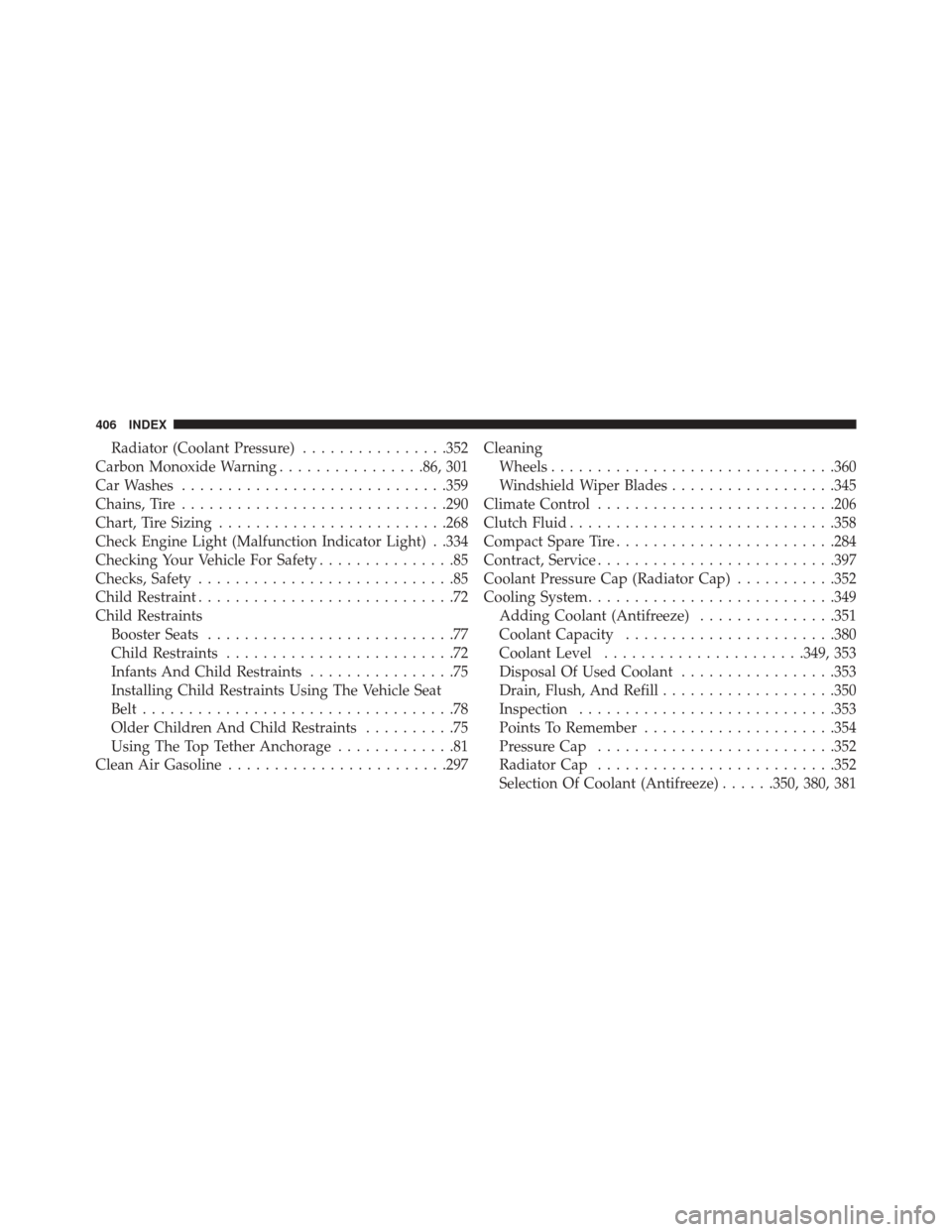
Radiator (Coolant Pressure)................352
Carbon Monoxide Warning ................86, 301
Car Washes ............................ .359
Chains, Tire ............................ .290
Chart, Tire Sizing ........................ .268
Check Engine Light (Malfunction Indicator Light) . .334
Checking Your Vehicle For Safety ...............85
Checks, Safety ............................85
Child Restraint ............................72
Child Restraints Booster Seats ...........................77
Child Restraints .........................72
Infants And Child Restraints ................75
Installing Child Restraints Using The Vehicle Seat
Belt ..................................78
Older Children And Child Restraints ..........75
Using The Top Tether Anchorage .............81
Clean Air Gasoline ....................... .297Cleaning
Wheels .............................. .360
Windshield Wiper Blades ..................345
Climate Control ......................... .206
Clutch Fluid ............................ .358
Compact Spare Tire ....................... .284
Contract, Service ......................... .397
Coolant Pressure Cap (Radiator Cap) ...........352
Cooling System .......................... .349
Adding Coolant (Antifreeze) ...............351
Coolant Capacity ...................... .380
Coolant Level ..................... .349, 353
Disposal Of Used Coolant .................353
Drain, Flush, And Refill ...................350
Inspection ........................... .353
Points To Remember .....................354
Pressure Cap ......................... .352
Radiator Cap ......................... .352
Selection Of Coolant (Antifreeze) ......350, 380, 381
406 INDEX
Page 410 of 423
Emergency, In Case OfFreeing Vehicle When Stuck ................327
Hazard Warning Flasher ..................310
Jump Starting ......................... .323
Overheating .......................... .310
Towing ............................. .329
Emission Control System Maintenance ..........334
Engine ................................ .333
Air Cleaner .......................... .340
Checking Oil Level ..................... .337
Compartment ......................... .333
Coolant (Antifreeze) ..................349, 381
Cooling ............................. .349
Exhaust Gas Caution ..................86, 301
Fails To Start ......................... .240
Flooded, Starting ...................... .240
Fuel Requirements ...................297, 380
Oil .......................... .337, 380, 381
Oil Change Interval ..................... .338Oil Filler Cap
......................... .339
Oil Filter ............................ .339
Oil Selection ...................... .338, 380
Overheating .......................... .310
Engine Oil Viscosity ....................339, 380
Enhanced Accident Response Feature ............67
Ethanol ............................... .298
Event Data Recorder ........................71
Exhaust Gas Caution ....................86, 301
Exhaust System ....................... .86, 346
Exterior Lighting ......................... .105
Exterior Lights ............................88
Filters Air Cleaner .......................... .340
Engine Oil ........................ .339, 381
Engine Oil Disposal .....................339
Flashers Hazard Warning ....................... .310
408 INDEX
Page 411 of 423
Turn Signal..................... .88, 108, 167
Flash-To-Pass ........................... .109
Flooded Engine Starting ....................240
Fluid Capacities ......................... .380
Fluid Leaks ..............................88
Fluid Level Checks Brake ........................... .355, 383
Capacities ........................... .380
Clutch Fluid .......................... .358
Cooling System ........................ .349
Engine Oil ........................... .337
Manual Transmission .................357, 383
Power Steering ..................... .254, 383
Fluids, Lubricants And Genuine Parts ...........381
Four-Way Hazard Flasher ...................310
Freeing A Stuck Vehicle .....................327
Fuel .................................. .297
Additives ............................ .299Clean Air
............................ .297
Ethanol ............................. .298
Gasoline ............................. .297
Light ............................... .165
Materials Added ....................... .299
Methanol ............................ .298
Octane Rating ..................... .297, 381
Requirements ...................... .297, 380
Tank Capacity ......................... .380
Fuses ................................. .366
Garage Door Opener (HomeLink) ..........123, 130
Gasoline, Clean Air ....................... .297
Gasoline (Fuel) .......................... .297
Gasoline, Reformulated .....................297
General Information ...................... .206
Glass Cleaning .......................... .362
Ground Clearance ........................ .307
10
INDEX 409