light DODGE VIPER 2016 VX / 3.G User Guide
[x] Cancel search | Manufacturer: DODGE, Model Year: 2016, Model line: VIPER, Model: DODGE VIPER 2016 VX / 3.GPages: 423, PDF Size: 2.75 MB
Page 48 of 423
How To Disengage The Automatic Locking Mode
Unbuckle the combination lap/shoulder belt and allow it
to retract completely to disengage the Automatic Locking
Mode and activate the vehicle sensitive (emergency)
locking mode.
WARNING!
•The seat belt assembly must be replaced if the
switchable Automatic Locking Retractor (ALR) fea-
ture or any other seat belt function is not working
properly when checked according to the proce-
dures in the Service Manual.
• Failure to replace the seat belt assembly could
increase the risk of injury in collisions.
• Do not use the Automatic Locking Mode to restrain
occupants who are wearing the seat belt or children
who are using booster seats. The locked mode is
(Continued)
WARNING! (Continued)
only used to install rear-facing or forward-facing
child restraints that have a harness for restraining
the child.
Supplemental Restraint System (SRS)
Air Bag System Components
Your vehicle may be equipped with the following air bag
system components:
•Occupant Restraint Controller (ORC)
• Air Bag Warning Light
•Steering Wheel and Column
• Instrument Panel
• Knee Impact Bolsters
• Advanced Front Air Bags
46 THINGS TO KNOW BEFORE STARTING YOUR VEHICLE
Page 51 of 423
Advanced Air Bag Features
This vehicle has an Occupant Classification System
(“OCS”) in the front passenger seat. The OCS is designed
to activate or deactivate the Passenger Advanced Front
Air Bag depending on the occupant’s seated weight. It is
designed to deactivate the Passenger Advanced Front Air
Bag for an unoccupied seat and for occupants whose
seated weight classifies them in a category other than a
properly seated adult. This could be a child, teenager, or
even an adult.
The Passenger Air Bag Disable (“PAD”) Indicator Light
(an amber light located in the center of the instrument
panel) tells the driver and front passenger when the
Passenger Advanced Front Air Bag is deactivated. The
PAD Indicator Light illuminates the words “PASSENGER
AIR BAG OFF” to show that the Passenger Advanced
Front Air Bag will not deploy during a collision.NOTE:
When the front passenger seat is empty or when
very light objects are placed on the seat, the Passenger
Advanced Front Air Bag will not deploy even though the
Passenger Air Bag Disable (PAD) System Indicator Light
is NOT illuminated.
WARNING!
• No objects should be placed over or near the air
bag on the instrument panel or steering wheel,
because any such objects could cause harm if the
vehicle is in a collision severe enough to cause the
air bags to inflate.
• Do not put anything on or around the air bag
covers or attempt to open them manually. You may
damage the air bags and you could be injured
because the air bags may no longer be functional.
The protective covers for the air bag cushions are
(Continued)
2
THINGS TO KNOW BEFORE STARTING YOUR VEHICLE 49
Page 54 of 423
The Occupant Classification System (OCS) consists of
the following:
•Occupant Restraint Controller (ORC)
• Occupant Classification Module (OCM) and Sensor
located in the front passenger seat
• Passenger Air Bag Disabled (PAD) Indicator Light – an
amber light located in the center of the instrument
panel (show icon)
• Air Bag Warning Light
Occupant Classification Module (OCM) And Sensor
The Occupant Classification Module (OCM) is located
underneath the front passenger seat. The Sensor is lo-
cated beneath the passenger seat cushion foam. Any
weight on the seat will be sensed by the Sensor. The OCM uses input from the Sensor to determine the front pas-
senger ’s most probable classification. The OCM commu-
nicates this information to the ORC. The ORC uses the
classification to determine whether it should activate or
deactivate the Passenger Advanced Front Air Bag. In
order for the OCS to operate as designed, it is important
for the front passenger to be seated properly and prop-
erly wearing the seat belt. Properly seated passengers are:
•
Sitting upright
• Facing forward
• Sitting in the center of the seat with their feet comfort-
ably on or near the floor.
52 THINGS TO KNOW BEFORE STARTING YOUR VEHICLE
Page 55 of 423
•Sitting with their back against the seat back and the
seat back in an upright position The OCS may deactivate the deployment of the Passen-
ger Advanced Front Air Bag if the OCS estimates that:
•
The front passenger seat is unoccupied or has very
light objects in it.
• The front passenger seat is occupied by a rear-facing
child restraint.
• The front passenger seat is occupied by a child,
including a child seated in a forward-facing child
restraint or booster seat.
• The front passenger seat is occupied by a small pas-
senger, including a child or small adult.
• The front passenger is not properly seated or his or her
weight is taken off of the seat for a period of time.
Seated Properly
2
THINGS TO KNOW BEFORE STARTING YOUR VEHICLE 53
Page 56 of 423
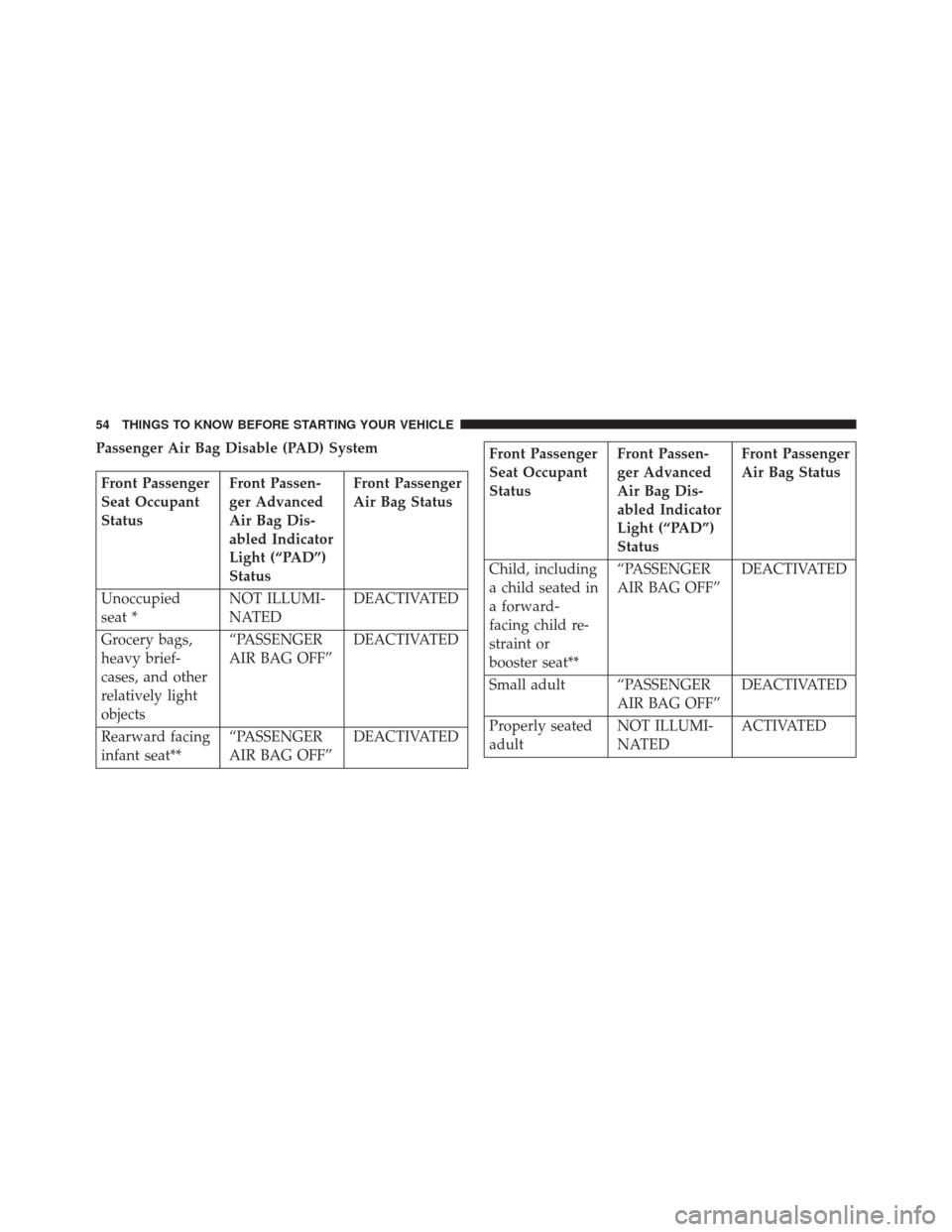
Passenger Air Bag Disable (PAD) System
Front Passenger
Seat Occupant
StatusFront Passen-
ger Advanced
Air Bag Dis-
abled Indicator
Light (“PAD”)
StatusFront Passenger
Air Bag Status
Unoccupied
seat * NOT ILLUMI-
NATEDDEACTIVATED
Grocery bags,
heavy brief-
cases, and other
relatively light
objects “PASSENGER
AIR BAG OFF”
DEACTIVATED
Rearward facing
infant seat** “PASSENGER
AIR BAG OFF”DEACTIVATED
Front Passenger
Seat Occupant
Status Front Passen-
ger Advanced
Air Bag Dis-
abled Indicator
Light (“PAD”)
StatusFront Passenger
Air Bag Status
Child, including
a child seated in
a forward-
facing child re-
straint or
booster seat** “PASSENGER
AIR BAG OFF”
DEACTIVATED
Small adult “PASSENGER AIR BAG OFF”DEACTIVATED
Properly seated
adult NOT ILLUMI-
NATEDACTIVATED
54 THINGS TO KNOW BEFORE STARTING YOUR VEHICLE
Page 57 of 423
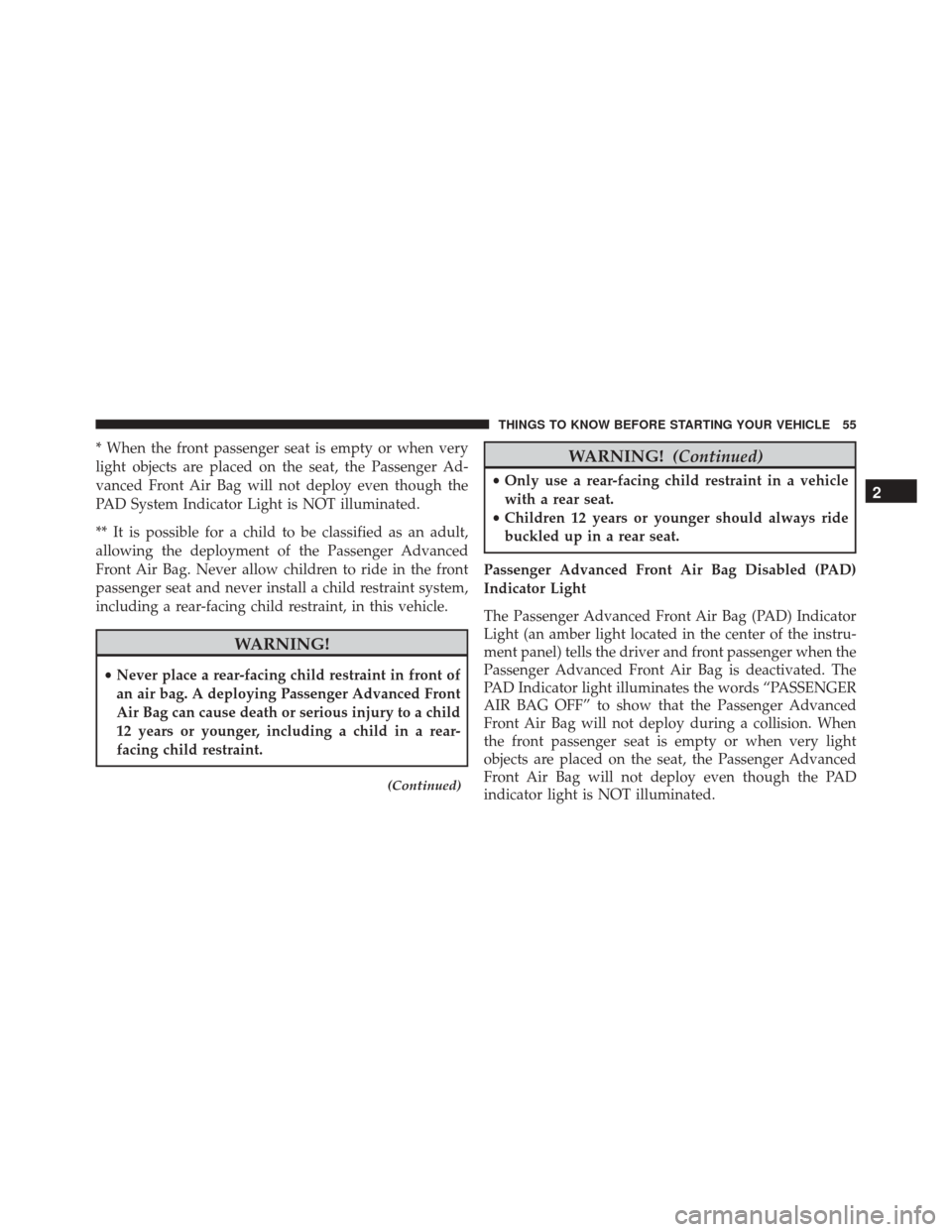
* When the front passenger seat is empty or when very
light objects are placed on the seat, the Passenger Ad-
vanced Front Air Bag will not deploy even though the
PAD System Indicator Light is NOT illuminated.
** It is possible for a child to be classified as an adult,
allowing the deployment of the Passenger Advanced
Front Air Bag. Never allow children to ride in the front
passenger seat and never install a child restraint system,
including a rear-facing child restraint, in this vehicle.
WARNING!
•Never place a rear-facing child restraint in front of
an air bag. A deploying Passenger Advanced Front
Air Bag can cause death or serious injury to a child
12 years or younger, including a child in a rear-
facing child restraint.
(Continued)
WARNING! (Continued)
•Only use a rear-facing child restraint in a vehicle
with a rear seat.
• Children 12 years or younger should always ride
buckled up in a rear seat.
Passenger Advanced Front Air Bag Disabled (PAD)
Indicator Light
The Passenger Advanced Front Air Bag (PAD) Indicator
Light (an amber light located in the center of the instru-
ment panel) tells the driver and front passenger when the
Passenger Advanced Front Air Bag is deactivated. The
PAD Indicator light illuminates the words “PASSENGER
AIR BAG OFF” to show that the Passenger Advanced
Front Air Bag will not deploy during a collision. When
the front passenger seat is empty or when very light
objects are placed on the seat, the Passenger Advanced
Front Air Bag will not deploy even though the PAD
indicator light is NOT illuminated.2
THINGS TO KNOW BEFORE STARTING YOUR VEHICLE 55
Page 58 of 423
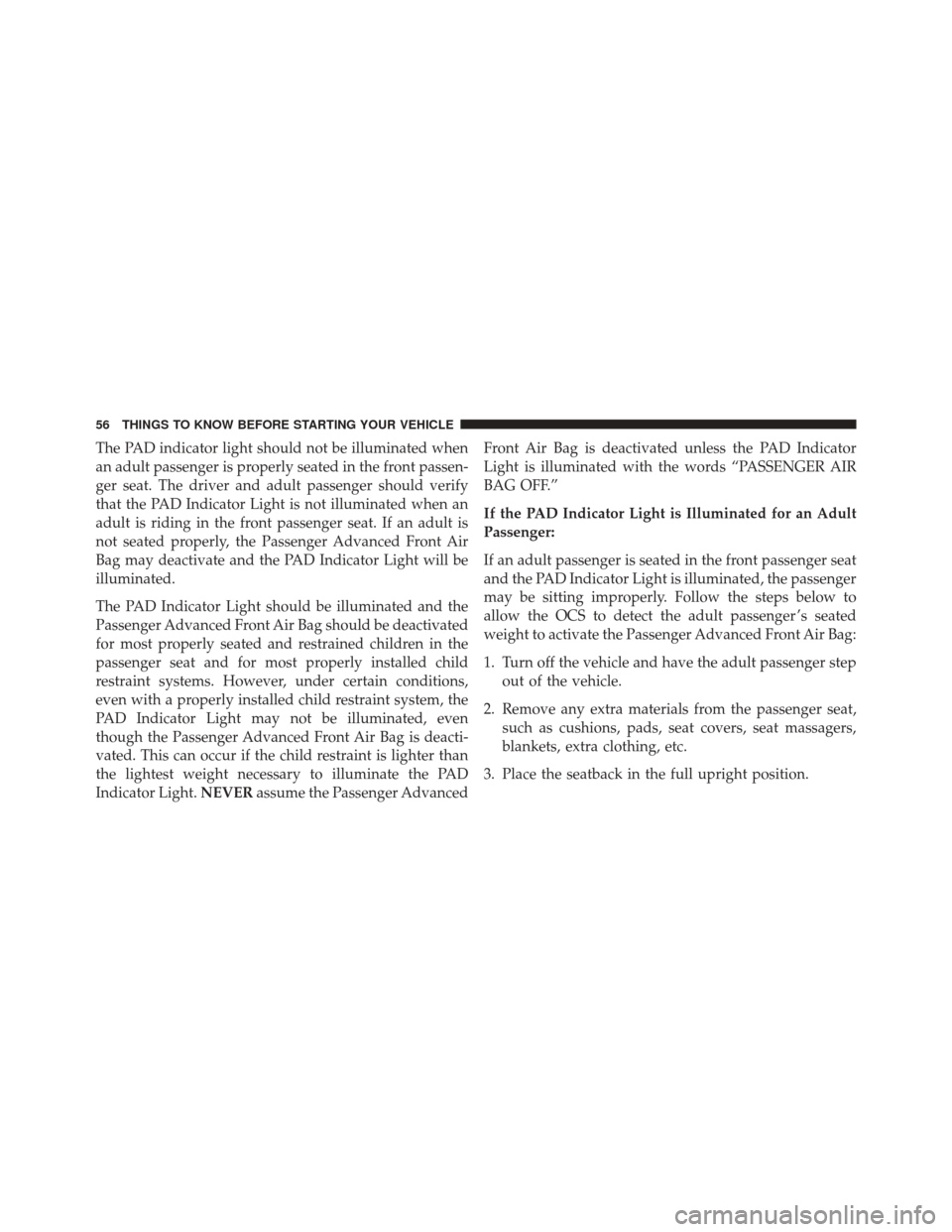
The PAD indicator light should not be illuminated when
an adult passenger is properly seated in the front passen-
ger seat. The driver and adult passenger should verify
that the PAD Indicator Light is not illuminated when an
adult is riding in the front passenger seat. If an adult is
not seated properly, the Passenger Advanced Front Air
Bag may deactivate and the PAD Indicator Light will be
illuminated.
The PAD Indicator Light should be illuminated and the
Passenger Advanced Front Air Bag should be deactivated
for most properly seated and restrained children in the
passenger seat and for most properly installed child
restraint systems. However, under certain conditions,
even with a properly installed child restraint system, the
PAD Indicator Light may not be illuminated, even
though the Passenger Advanced Front Air Bag is deacti-
vated. This can occur if the child restraint is lighter than
the lightest weight necessary to illuminate the PAD
Indicator Light.NEVERassume the Passenger Advanced Front Air Bag is deactivated unless the PAD Indicator
Light is illuminated with the words “PASSENGER AIR
BAG OFF.”
If the PAD Indicator Light is Illuminated for an Adult
Passenger:
If an adult passenger is seated in the front passenger seat
and the PAD Indicator Light is illuminated, the passenger
may be sitting improperly. Follow the steps below to
allow the OCS to detect the adult passenger ’s seated
weight to activate the Passenger Advanced Front Air Bag:
1. Turn off the vehicle and have the adult passenger step
out of the vehicle.
2. Remove any extra materials from the passenger seat, such as cushions, pads, seat covers, seat massagers,
blankets, extra clothing, etc.
3. Place the seatback in the full upright position.
56 THINGS TO KNOW BEFORE STARTING YOUR VEHICLE
Page 59 of 423
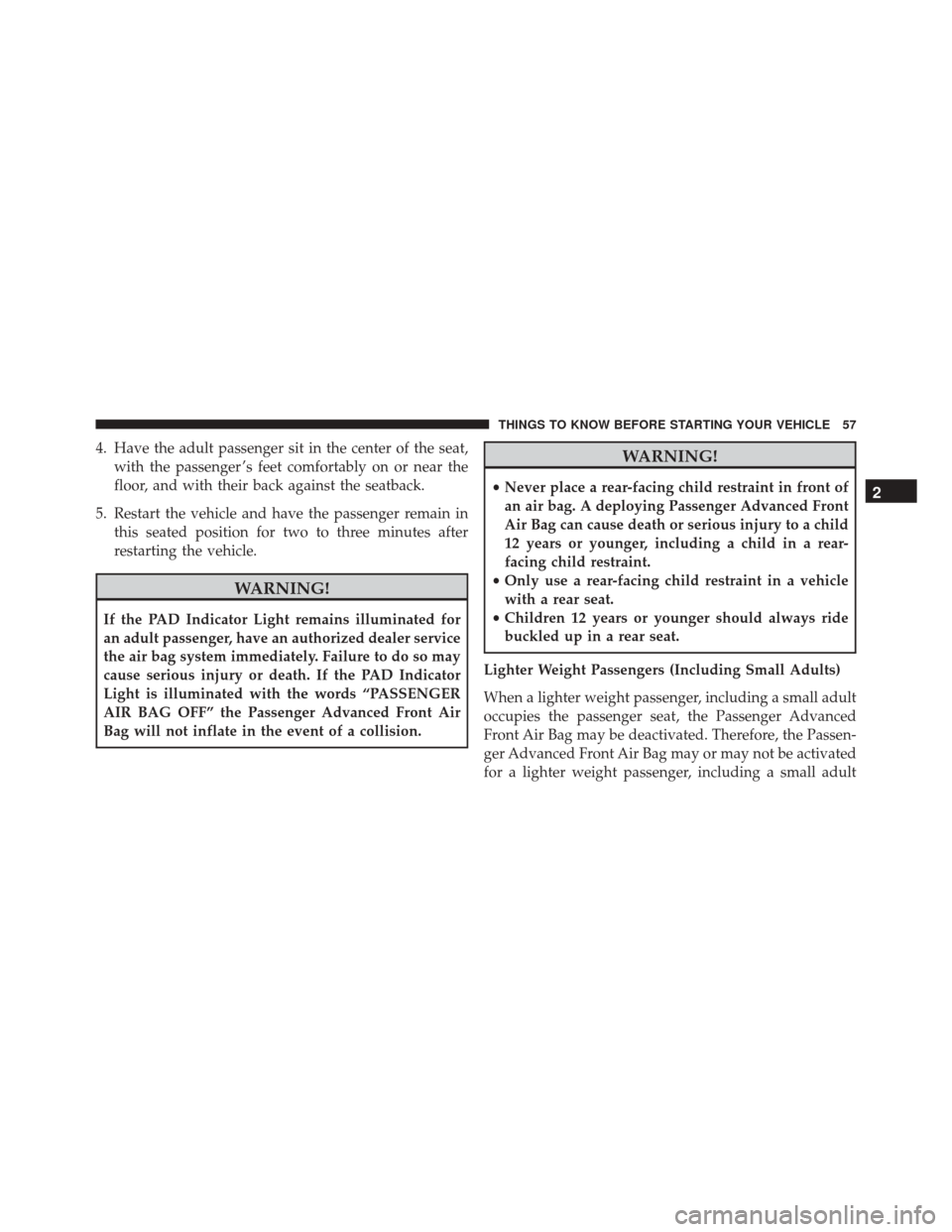
4. Have the adult passenger sit in the center of the seat,with the passenger ’s feet comfortably on or near the
floor, and with their back against the seatback.
5. Restart the vehicle and have the passenger remain in this seated position for two to three minutes after
restarting the vehicle.
WARNING!
If the PAD Indicator Light remains illuminated for
an adult passenger, have an authorized dealer service
the air bag system immediately. Failure to do so may
cause serious injury or death. If the PAD Indicator
Light is illuminated with the words “PASSENGER
AIR BAG OFF” the Passenger Advanced Front Air
Bag will not inflate in the event of a collision.
WARNING!
•Never place a rear-facing child restraint in front of
an air bag. A deploying Passenger Advanced Front
Air Bag can cause death or serious injury to a child
12 years or younger, including a child in a rear-
facing child restraint.
• Only use a rear-facing child restraint in a vehicle
with a rear seat.
• Children 12 years or younger should always ride
buckled up in a rear seat.
Lighter Weight Passengers (Including Small Adults)
When a lighter weight passenger, including a small adult
occupies the passenger seat, the Passenger Advanced
Front Air Bag may be deactivated. Therefore, the Passen-
ger Advanced Front Air Bag may or may not be activated
for a lighter weight passenger, including a small adult2
THINGS TO KNOW BEFORE STARTING YOUR VEHICLE 57
Page 60 of 423
(depending on size) who is seated in the passenger seat.
This does not mean that the OCS is working improperly.
The driver and passenger must always use the PAD
Indicator Light as a determination of whether the Pas-
senger Advanced Front Air Bag is activated or deacti-
vated. If the PAD Indicator Light is illuminated with the
words “PASSENGER AIR BAG OFF” when an adult is in
the front passenger seat, have the passenger reposition
his or her body in the seat until the PAD Indicator Light
goes out.
If the PAD Indicator Light is illuminated with the words
“PASSENGER AIR BAG OFF” the Passenger Advanced
Front Air Bag will not inflate in the event of a collision.
Do not decrease OR increase the front passenger ’s
seated weight on the front passenger seat
The front passenger ’s seated weight must be properly
positioned on the front passenger seat. Failure to do somay result in serious injury or death. The OCS deter-
mines the most probable classification of the occupant
that it detects. The OCS will detect the front passenger ’s
decreased or increased seated weight, which may result
in deactivation or activation of the Passenger Advanced
Front Air Bag in a collision. This does not mean that the
OCS is working improperly. Decreasing the front passen-
ger ’s seated weight on the front passenger seat may
result in deactivation of the Passenger Advanced Front
Air Bag causing serious injury or death. Increasing the
front passenger ’s seated weight on the front passenger
seat may result in activation of the Passenger Advanced
Front Air Bag. Examples of improper front passenger
seating include:
•
The front passenger ’s weight is transferred to another
part of the vehicle (like the door, arm rest or instru-
ment panel).
58 THINGS TO KNOW BEFORE STARTING YOUR VEHICLE
Page 63 of 423
WARNING!
•If an occupant in the front passenger seat is seated
improperly, the occupant may provide an output
signal to the OCS that is different from the occu-
pant’s properly seated weight input. This may
result in serious injury or death in a collision.
• Always wear your seat belt and sit properly, with
the seatback in an upright position, your back
against the seatback, sitting upright, facing for-
ward, in the center of the seat, with your feet
comfortably on or near the floor.
• Do not carry or hold any objects (e.g., backpacks,
boxes, etc.) while seated in the front passenger seat.
Holding an object may provide an output signal to
the OCS that is different than the occupant’s prop-
erly seated weight input, which may result in
serious injury or death in a collision. The Air Bag Warning Light
will illuminate whenever
the OCS is unable to classify the front passenger seat
status. A malfunction in the OCS may affect the
operation of the air bag system.
If the Air Bag Warning Lightdoes not come on, or
stays on after you start the vehicle, or it comes on as
you drive, take the vehicle to an authorized dealer for
service immediately.
WARNING!
Ignoring the Air Bag Warning Light in your instru-
ment panel could mean you won’t have the air bags
to protect you in a collision. If the light does not come
on as a bulb check when the ignition is first turned
on, stays on after you start the vehicle, or if it comes
on as you drive, have an authorized dealer service the
air bag system immediately.
(Continued)
2
THINGS TO KNOW BEFORE STARTING YOUR VEHICLE 61