coolant DODGE VIPER 2016 VX / 3.G Owner's Manual
[x] Cancel search | Manufacturer: DODGE, Model Year: 2016, Model line: VIPER, Model: DODGE VIPER 2016 VX / 3.GPages: 423, PDF Size: 2.75 MB
Page 356 of 423
When additional engine coolant (antifreeze) is needed to
maintain the proper level, only OAT coolant that meets
the requirements of FCA Material Standard MS.90032
should be added to the coolant bottle. Do not overfill.
Points To Remember
NOTE:When the vehicle is stopped after a few miles/
kilometers of operation, you may observe vapor coming
from the front of the engine compartment. This is nor-
mally a result of moisture from rain, snow, or high
humidity accumulating on the radiator and being vapor-
ized when the thermostat opens, allowing hot engine
coolant (antifreeze) to enter the radiator.
If an examination of your engine compartment shows no
evidence of radiator or hose leaks, the vehicle may be
safely driven. The vapor will soon dissipate.
• Do not overfill the coolant expansion bottle. •
Check the coolant freeze point in the radiator and in
the coolant expansion bottle. If engine coolant (anti-
freeze) needs to be added, the contents of the coolant
expansion bottle must also be protected against freez-
ing.
• If frequent engine coolant (antifreeze) additions are
required, the cooling system should be pressure tested
for leaks.
• Maintain engine coolant (antifreeze) concentration at a
minimum of 50% OAT coolant (conforming to
MS.90032) and distilled water for proper corrosion
protection of your engine which contains aluminum
components.
• Make sure that the coolant expansion bottle overflow
hoses are not kinked or obstructed.
• Keep the front of the radiator clean. If your vehicle is
equipped with air conditioning, keep the front of the
condenser clean.
354 MAINTAINING YOUR VEHICLE
Page 357 of 423
•Do not change the thermostat for Summer or Winter
operation. If replacement is ever necessary, install
ONLY the correct type thermostat. Other designs may
result in unsatisfactory engine coolant (antifreeze)
performance, poor gas mileage, and increased emis-
sions.
Brake System
To ensure brake system performance, all brake system
components should be inspected periodically. Refer to
“Maintenance Schedule” for the proper maintenance
intervals.
WARNING!
Riding the brakes can lead to brake failure and
possibly an accident. Driving with your foot resting
or riding on the brake pedal can result in abnormally
(Continued)
WARNING! (Continued)
high brake temperatures, excessive lining wear, and
possible brake damage. You would not have your full
braking capacity in an emergency.
Master Cylinder — Brake Fluid Level Check
Check the fluid level in the master cylinder immediately
if the brake system warning light indicates system fail-
ure.
Check the fluid level in the master cylinder when per-
forming underhood services.
Clean the top of the master cylinder area before removing
the cap. If necessary, add fluid to bring the fluid level up
to the requirements described on the brake fluid reser-
voir.
Overfilling of fluid is not recommended because it may
cause leaking in the system.
7
MAINTAINING YOUR VEHICLE 355
Page 376 of 423
CAUTION!
•When installing the power distribution center
cover, it is important to ensure the cover is properly
positioned and fully latched. Failure to do so may
allow water to get into the power distribution
center and possibly result in an electrical system
failure.
• When replacing a blown fuse, it is important to use
only a fuse having the correct amperage rating. The
use of a fuse with a rating other than indicated may
result in a dangerous electrical system overload. If
a properly rated fuse continues to blow, it indicates
a problem in the circuit that must be corrected.
VEHICLE STORAGE
We recommend that you follow these guidelines for
storing your vehicle for extended periods.
• Fill the fuel tank. This will prevent water condensation
inside the tank. If you plan to store your vehicle more
than two months, add an anti-oxidant fuel stabilizer to
the fuel tank.
• Change the oil to remove any corrosive combustion
related acids in the crankcase.
• Check that the radiator coolant level of protection is to
at least -20°F (-29°C).
• Make sure that all tires are inflated to the optimum
pressure.
• Wash and wax the vehicle to protect the finish.
• Store the vehicle in a dry, well-ventilated location.
• Move the wiper blades away from the windshield.
374 MAINTAINING YOUR VEHICLE
Page 382 of 423
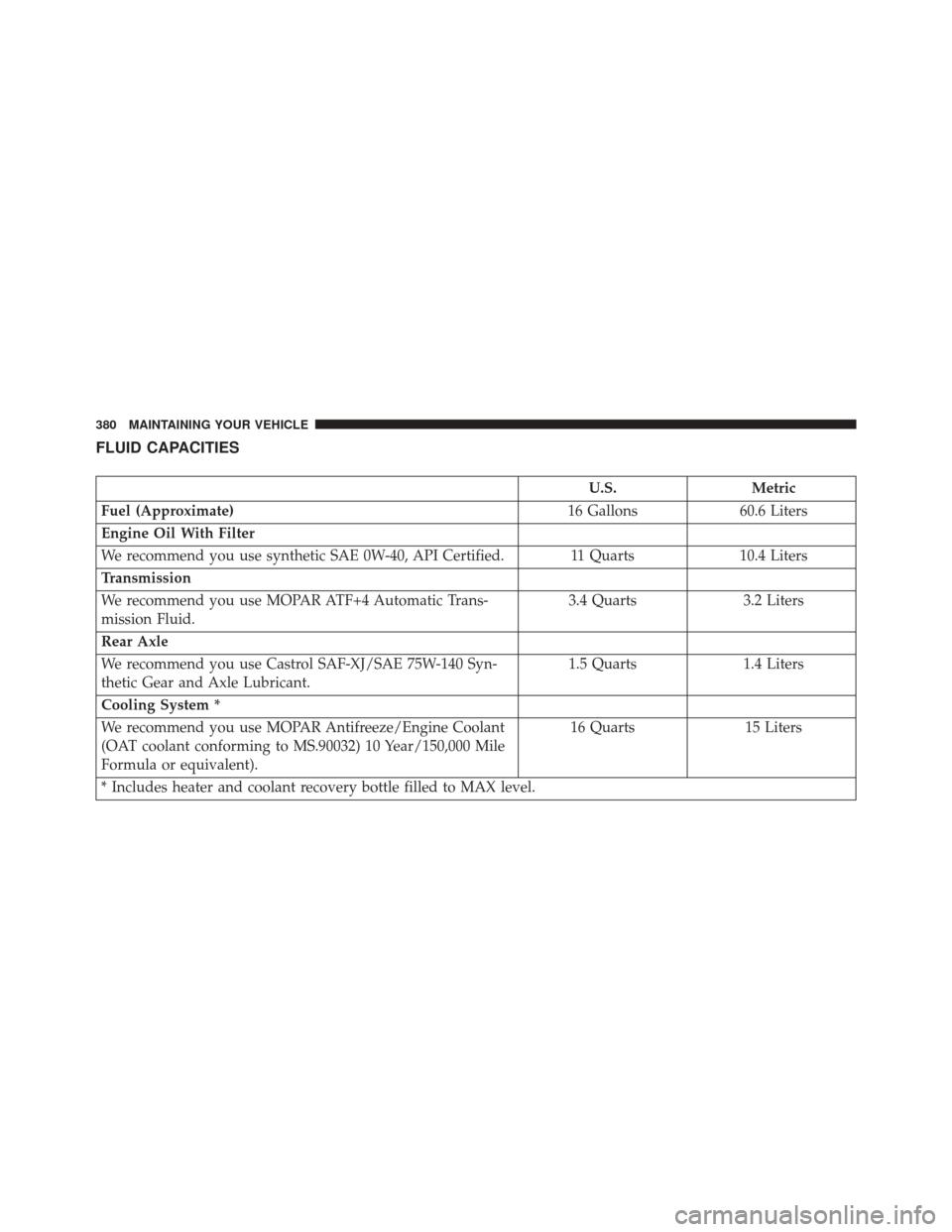
FLUID CAPACITIES
U.S.Metric
Fuel (Approximate) 16 Gallons60.6 Liters
Engine Oil With Filter
We recommend you use synthetic SAE 0W-40, API Certified. 11 Quarts 10.4 Liters
Transmission
We recommend you use MOPAR ATF+4 Automatic Trans-
mission Fluid. 3.4 Quarts
3.2 Liters
Rear Axle
We recommend you use Castrol SAF-XJ/SAE 75W-140 Syn-
thetic Gear and Axle Lubricant. 1.5 Quarts
1.4 Liters
Cooling System *
We recommend you use MOPAR Antifreeze/Engine Coolant
(OAT coolant conforming to MS.90032) 10 Year/150,000 Mile
Formula or equivalent). 16 Quarts
15 Liters
* Includes heater and coolant recovery bottle filled to MAX level.
380 MAINTAINING YOUR VEHICLE
Page 383 of 423
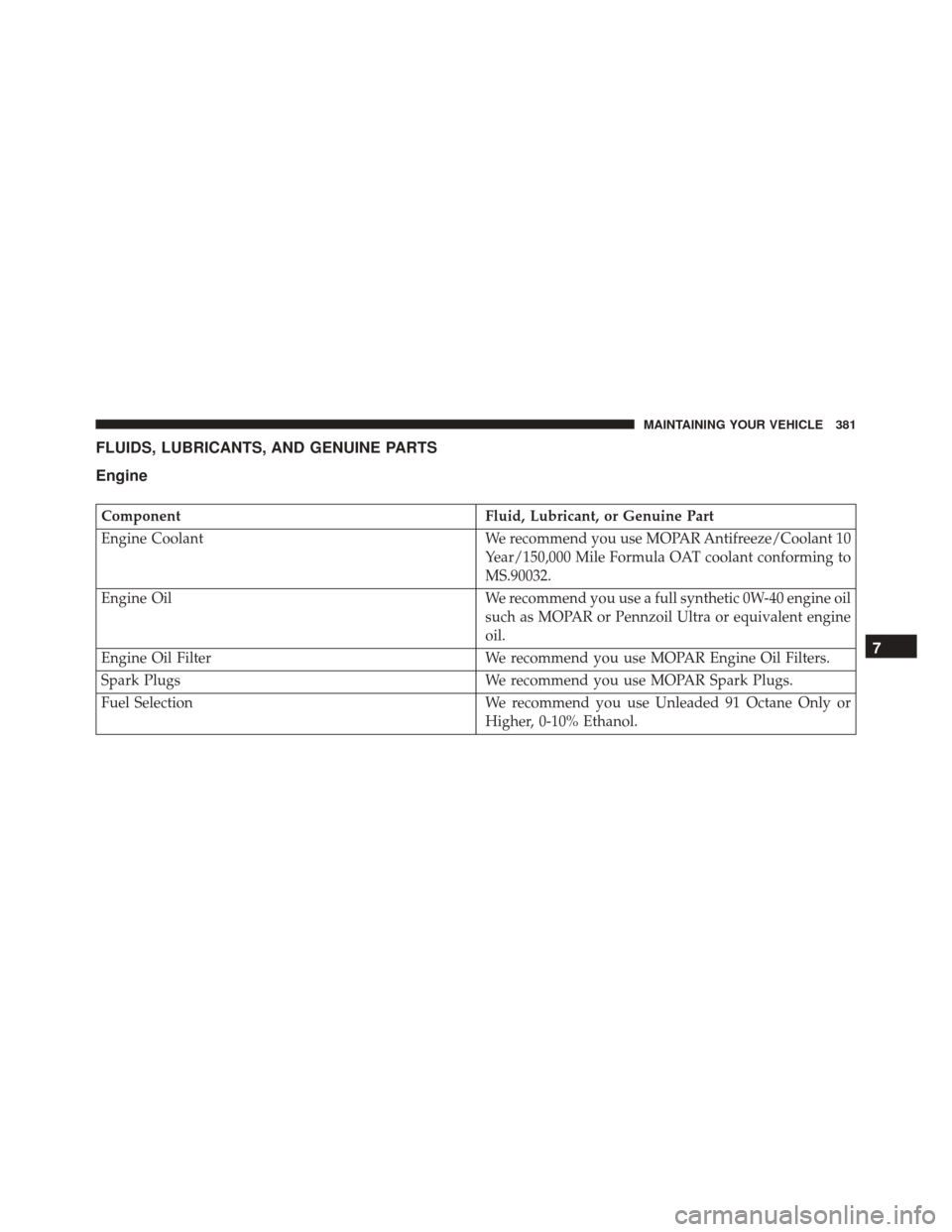
FLUIDS, LUBRICANTS, AND GENUINE PARTS
Engine
ComponentFluid, Lubricant, or Genuine Part
Engine Coolant We recommend you use MOPAR Antifreeze/Coolant 10
Year/150,000 Mile Formula OAT coolant conforming to
MS.90032.
Engine Oil We recommend you use a full synthetic 0W-40 engine oil
such as MOPAR or Pennzoil Ultra or equivalent engine
oil.
Engine Oil Filter We recommend you use MOPAR Engine Oil Filters.
Spark Plugs We recommend you use MOPAR Spark Plugs.
Fuel Selection We recommend you use Unleaded 91 Octane Only or
Higher, 0-10% Ethanol.
7
MAINTAINING YOUR VEHICLE 381
Page 384 of 423
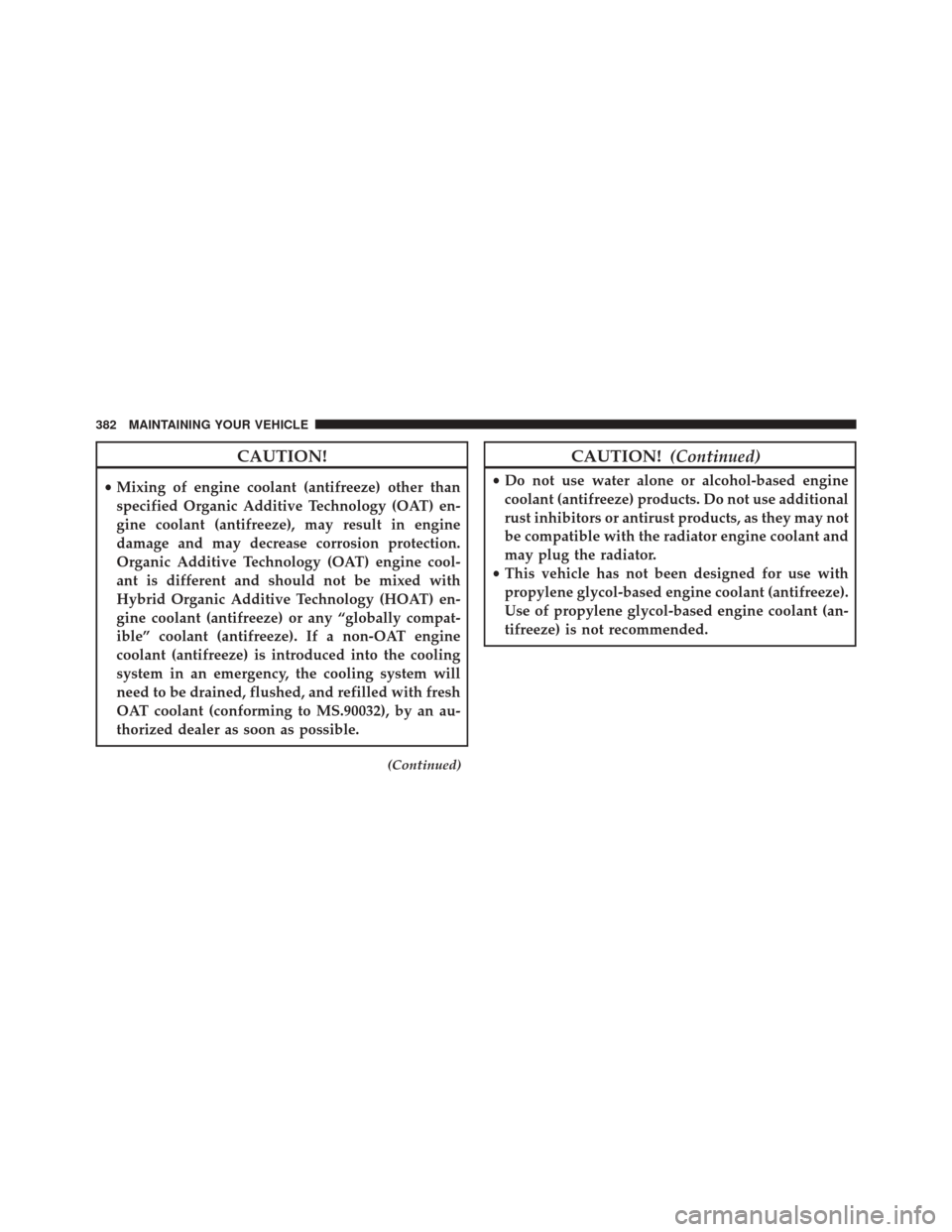
CAUTION!
•Mixing of engine coolant (antifreeze) other than
specified Organic Additive Technology (OAT) en-
gine coolant (antifreeze), may result in engine
damage and may decrease corrosion protection.
Organic Additive Technology (OAT) engine cool-
ant is different and should not be mixed with
Hybrid Organic Additive Technology (HOAT) en-
gine coolant (antifreeze) or any “globally compat-
ible” coolant (antifreeze). If a non-OAT engine
coolant (antifreeze) is introduced into the cooling
system in an emergency, the cooling system will
need to be drained, flushed, and refilled with fresh
OAT coolant (conforming to MS.90032), by an au-
thorized dealer as soon as possible.
(Continued)
CAUTION! (Continued)
•Do not use water alone or alcohol-based engine
coolant (antifreeze) products. Do not use additional
rust inhibitors or antirust products, as they may not
be compatible with the radiator engine coolant and
may plug the radiator.
• This vehicle has not been designed for use with
propylene glycol-based engine coolant (antifreeze).
Use of propylene glycol-based engine coolant (an-
tifreeze) is not recommended.
382 MAINTAINING YOUR VEHICLE
Page 389 of 423
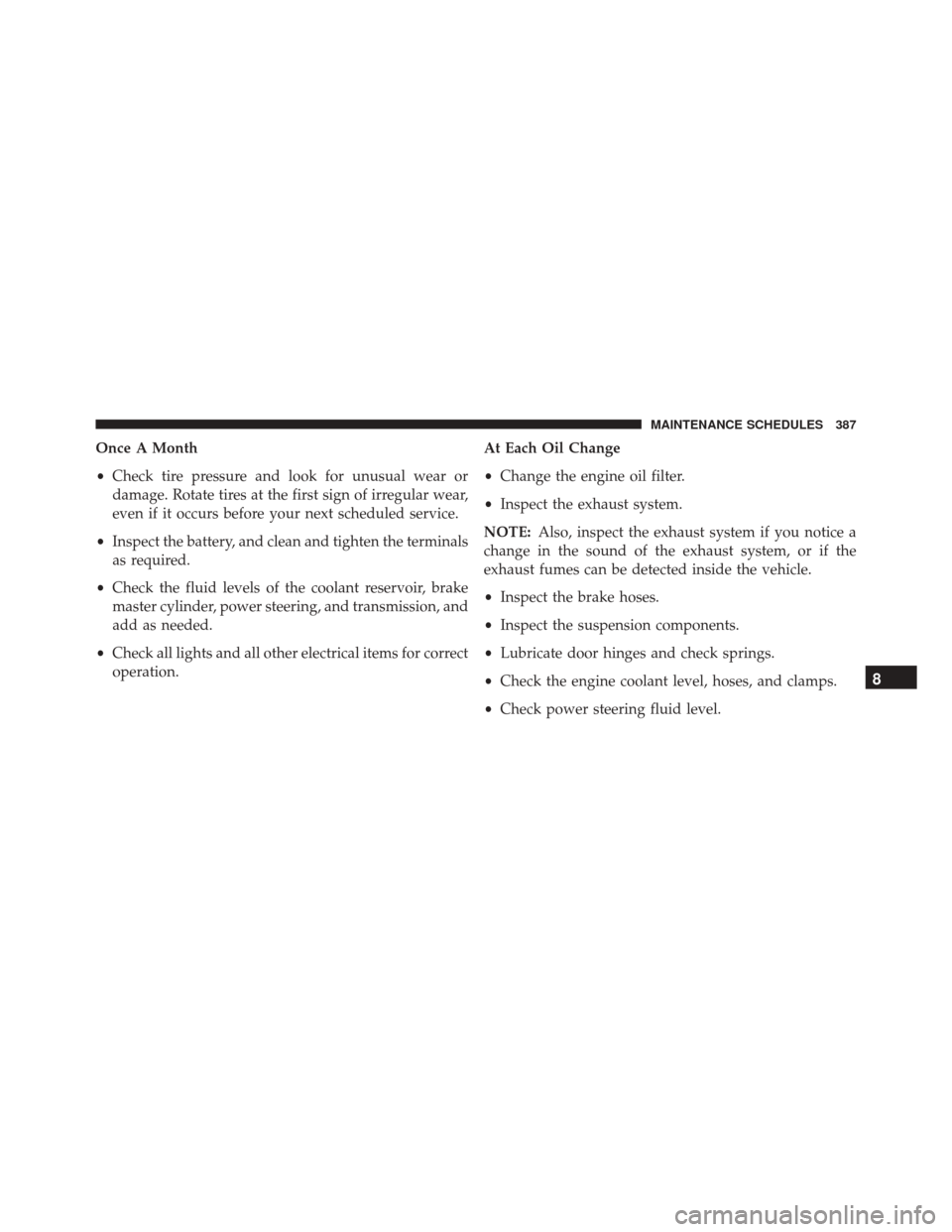
Once A Month
•Check tire pressure and look for unusual wear or
damage. Rotate tires at the first sign of irregular wear,
even if it occurs before your next scheduled service.
• Inspect the battery, and clean and tighten the terminals
as required.
• Check the fluid levels of the coolant reservoir, brake
master cylinder, power steering, and transmission, and
add as needed.
• Check all lights and all other electrical items for correct
operation. At Each Oil Change
•
Change the engine oil filter.
• Inspect the exhaust system.
NOTE: Also, inspect the exhaust system if you notice a
change in the sound of the exhaust system, or if the
exhaust fumes can be detected inside the vehicle.
• Inspect the brake hoses.
• Inspect the suspension components.
• Lubricate door hinges and check springs.
• Check the engine coolant level, hoses, and clamps.
• Check power steering fluid level.
8
MAINTENANCE SCHEDULES 387
Page 392 of 423
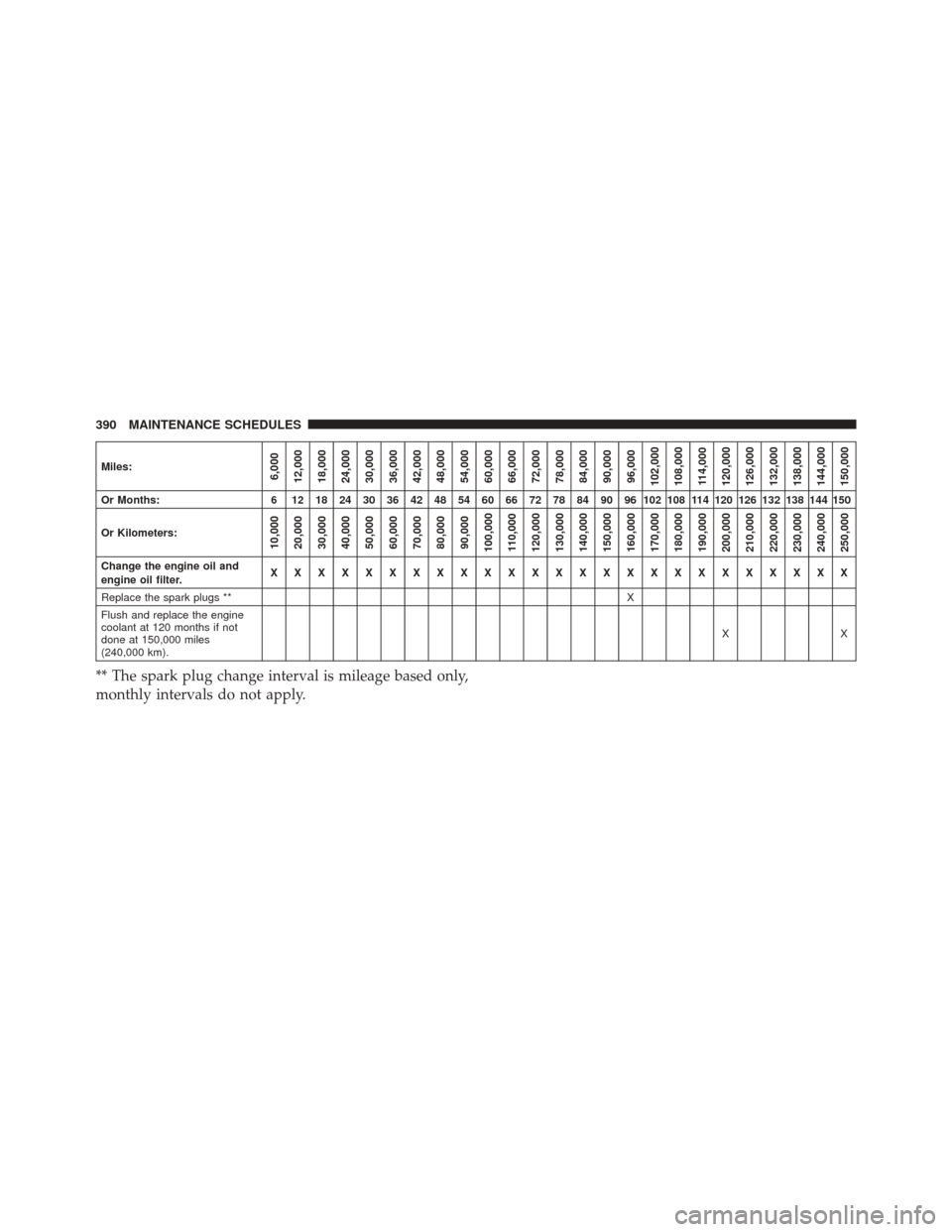
Miles:6,000
12,000
18,000
24,000
30,000
36,000
42,000
48,000
54,000
60,000
66,000
72,000
78,000
84,000
90,000
96,000
102,000
108,000 114,000
120,000
126,000
132,000
138,000
144,000
150,000
Or Months: 6 12 18 24 30 36 42 48 54 60 66 72 78 84 90 96 102 108 114 120 126 132 138 144 150
Or Kilometers:
10,000
20,000
30,000
40,000
50,000
60,000
70,000
80,000
90,000
100,000 110,000
120,000
130,000
140,000
150,000
160,000
170,000
180,000
190,000
200,000
210,000
220,000
230,000
240,000
250,000
Change the engine oil and
engine oil filter. XXXXXXXXXXXXXXXXXXXXXXXXX
Replace the spark plugs ** X
Flush and replace the engine
coolant at 120 months if not
done at 150,000 miles
(240,000 km). XX
** The spark plug change interval is mileage based only,
monthly intervals do not apply.
390 MAINTENANCE SCHEDULES
Page 406 of 423
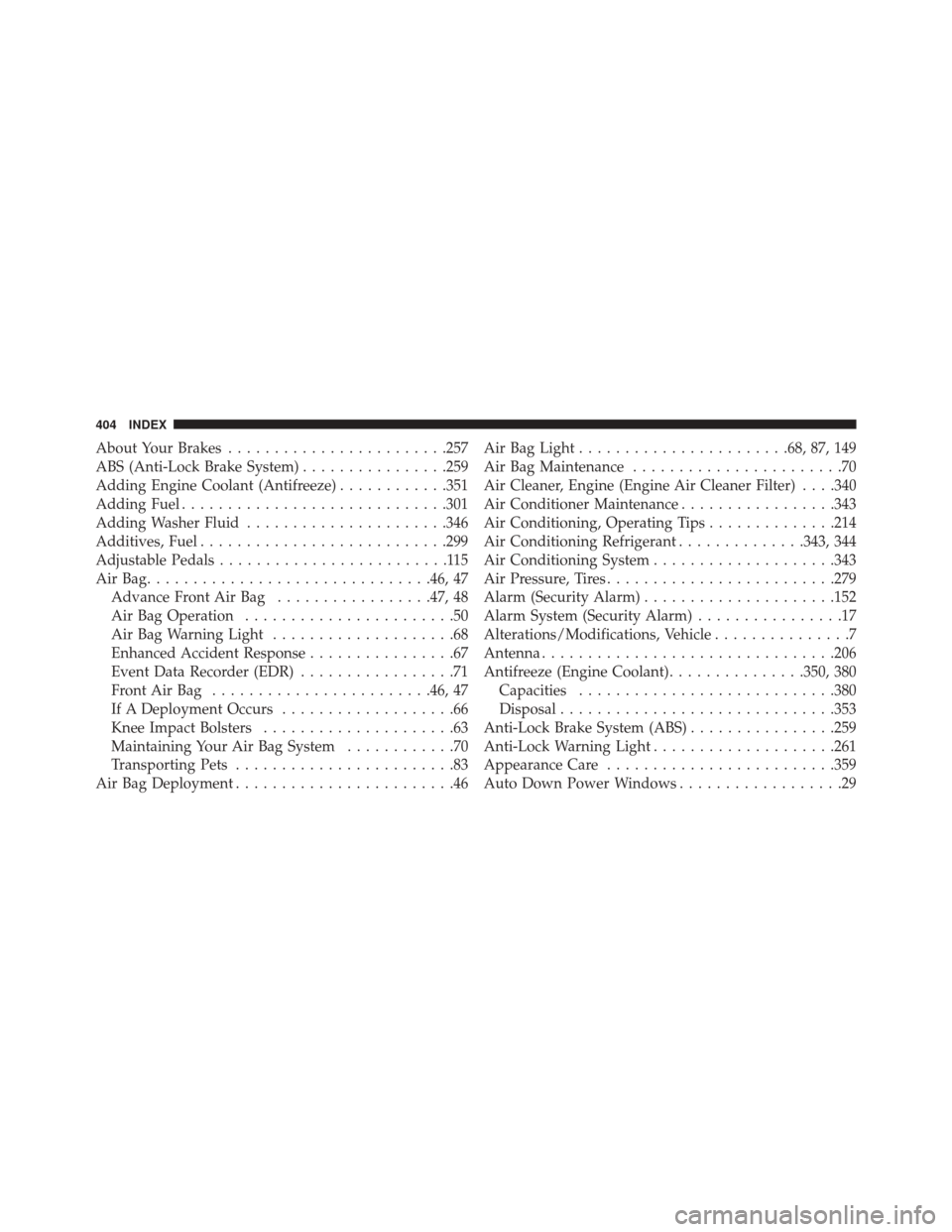
About Your Brakes....................... .257
ABS (Anti-Lock Brake System) ................259
Adding Engine Coolant (Antifreeze) ............351
Adding Fuel ............................ .301
Adding Washer Fluid ..................... .346
Additives, Fuel .......................... .299
Adjustable Pedals .........................115
AirBag.............................. .46, 47
Advance Front Air Bag .................47, 48
Air Bag Operation .......................50
Air Bag Warning Light ....................68
Enhanced Accident Response ................67
Event Data Recorder (EDR) .................71
FrontAirBag ........................46, 47
If A Deployment Occurs ...................66
Knee Impact Bolsters .....................63
Maintaining Your Air Bag System ............70
Transporting Pets ........................83
Air Bag Deployment ........................46 Air Bag Light
...................... .68, 87, 149
Air Bag Maintenance .......................70
Air Cleaner, Engine (Engine Air Cleaner Filter) . . . .340
Air Conditioner Maintenance .................343
Air Conditioning, Operating Tips ..............214
Air Conditioning Refrigerant ..............343, 344
Air Conditioning System ....................343
Air Pressure, Tires ........................ .279
Alarm (Security Alarm) .....................152
Alarm System (Security Alarm) ................17
Alterations/Modifications, Vehicle ...............7
Antenna ............................... .206
Antifreeze (Engine Coolant) ...............350, 380
Capacities ........................... .380
Disposal ............................. .353
Anti-Lock Brake System (ABS) ................259
Anti-Lock Warning Light ....................261
Appearance Care ........................ .359
Auto Down Power Windows ..................29
404 INDEX
Page 407 of 423
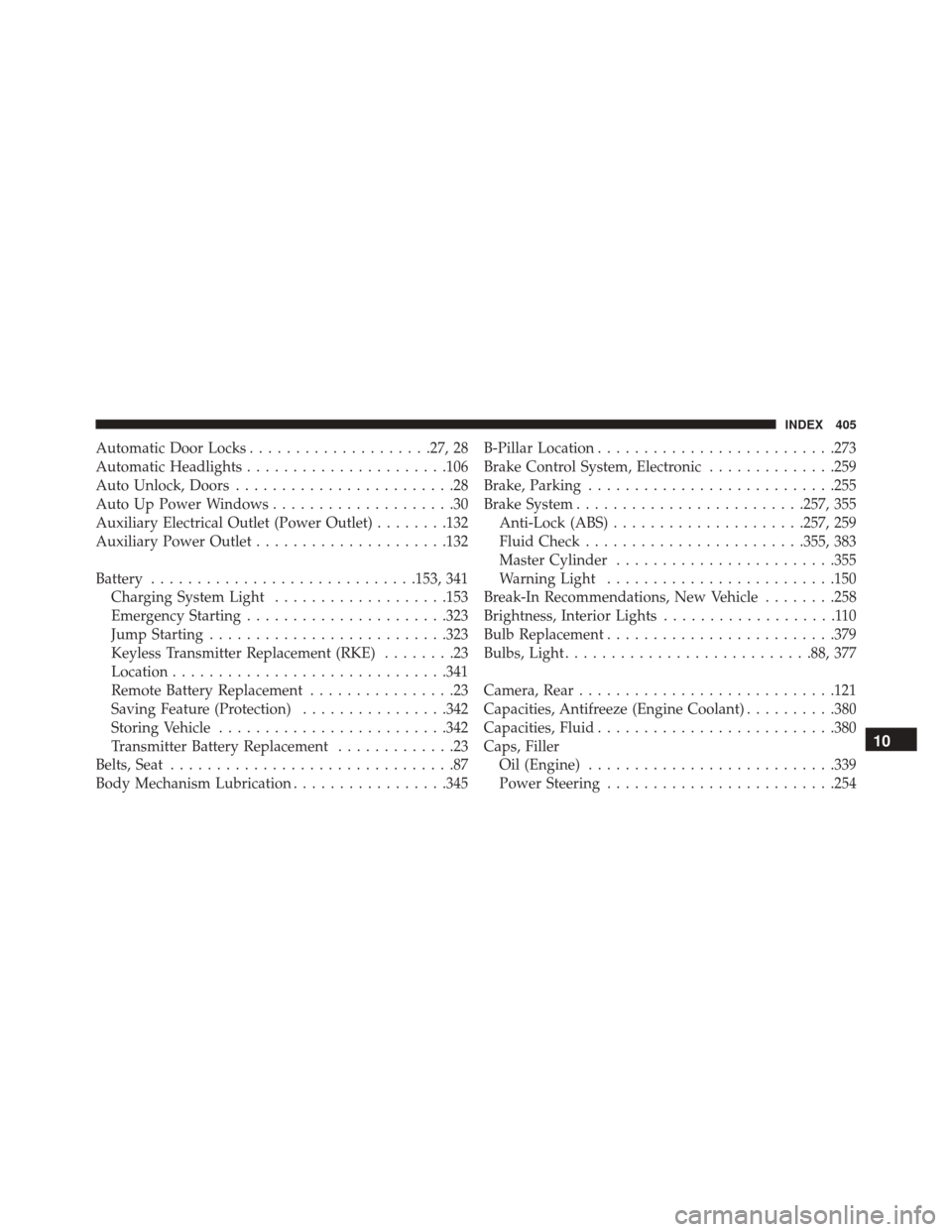
Automatic Door Locks....................27, 28
Automatic Headlights ..................... .106
Auto Unlock, Doors ........................28
Auto Up Power Windows ....................30
Auxiliary Electrical Outlet (Power Outlet) ........132
Auxiliary Power Outlet .....................132
Battery ............................ .153, 341
Charging System Light ...................153
Emergency Starting ..................... .323
Jump Starting ......................... .323
Keyless Transmitter Replacement (RKE) ........23
Location ............................. .341
Remote Battery Replacement ................23
Saving Feature (Protection) ................342
Storing Vehicle ........................ .342
Transmitter Battery Replacement .............23
Belts, Seat ...............................87
Body Mechanism Lubrication .................345B-Pillar Location
......................... .273
Brake Control System, Electronic ..............259
Brake, Parking .......................... .255
Brake System ........................ .257, 355
Anti-Lock (ABS) .....................257, 259
Fluid Check ....................... .355, 383
Master Cylinder ....................... .355
Warning Light ........................ .150
Break-In Recommendations, New Vehicle ........258
Brightness, Interior Lights ...................110
Bulb Replacement ........................ .379
Bulbs, Light .......................... .88, 377
Camera, Rear ........................... .121
Capacities, Antifreeze (Engine Coolant) ..........380
Capacities, Fluid ......................... .380
Caps, Filler Oil (Engine) .......................... .339
Power Steering ........................ .254
10
INDEX 405