brake light DODGE VIPER 2017 VX / 3.G User Guide
[x] Cancel search | Manufacturer: DODGE, Model Year: 2017, Model line: VIPER, Model: DODGE VIPER 2017 VX / 3.GPages: 329, PDF Size: 2.83 MB
Page 193 of 329
NOTE:
•You must disarm the security system in order to start the
engine. Refer to “Security Alarm System” in “Things To
Know Before Starting Your Vehicle” for further informa-
tion.
• Normal starting of either a cold or a warm engine does
not require pumping or pressing the accelerator pedal.
However, if the engine has not started within three
seconds, slightly press the accelerator pedal while con-
tinuing to crank. If the engine fails to start within 15
seconds, wait five seconds, then repeat the “Normal
Starting” procedure.
To Start The Engine:
1. Fully apply the parking brake.
2. Press the clutch pedal to the floor.
NOTE: The engine will not start unless the clutch pedal is
pressed to the floor. 3. Place the gear selector in NEUTRAL.
4. Push the red ENGINE START/STOP button located on
the instrument panel. Release the button when the
engine starts.
Engine START/STOP Button
5
STARTING AND OPERATING 191
Page 194 of 329
If Engine Fails To Start
CAUTION!
To prevent damage to the starter, do not crank the
engine for more than 15 seconds at a time. Wait 10 to 15
seconds before trying again.
WARNING!
•Never pour fuel or other flammable liquids into the
throttle body air inlet opening in an attempt to start
the vehicle. This could result in a flash fire causing
serious personal injury.
• Do not attempt to push or tow your vehicle to get it
started. Unburned fuel could enter the catalytic con-
verter and once the engine has started, ignite and
damage the converter and vehicle. If the vehicle has
a discharged battery, booster cables may be used to
obtain a start from a booster battery or the battery in
another vehicle. This type of start can be dangerous
if done improperly, so follow this procedure care-
fully. Refer to “Jump-Starting” in “What To Do In
Emergencies” for further information. If the engine is flooded, it may start to run, but not have
enough power to continue running when the ENGINE
START button is released. If this occurs, continue cranking
up to 15 seconds with the accelerator pedal pushed all the
way to the floor. Release the accelerator pedal and the
ENGINE START button once the engine is running
smoothly.
If the engine shows no sign of starting after two 15 second
periods of cranking with the accelerator pedal held to the
floor, the “Normal Starting” procedure should be repeated.
After Starting
The idle speed is controlled automatically, and it will
decrease as the engine warms up.
MANUAL TRANSMISSION
NOTE:
The parking brake should be engaged and the gear
selector placed into REVERSE before leaving the vehicle,
especially when parked on an incline.
Your vehicle is equipped with a high torque capacity dual
disc clutch. The clutch pedal must be fully pressed to the
floor during each shift. As you release the clutch pedal,
lightly press the accelerator pedal.
192 STARTING AND OPERATING
Page 197 of 329
Recommended Shift Speeds
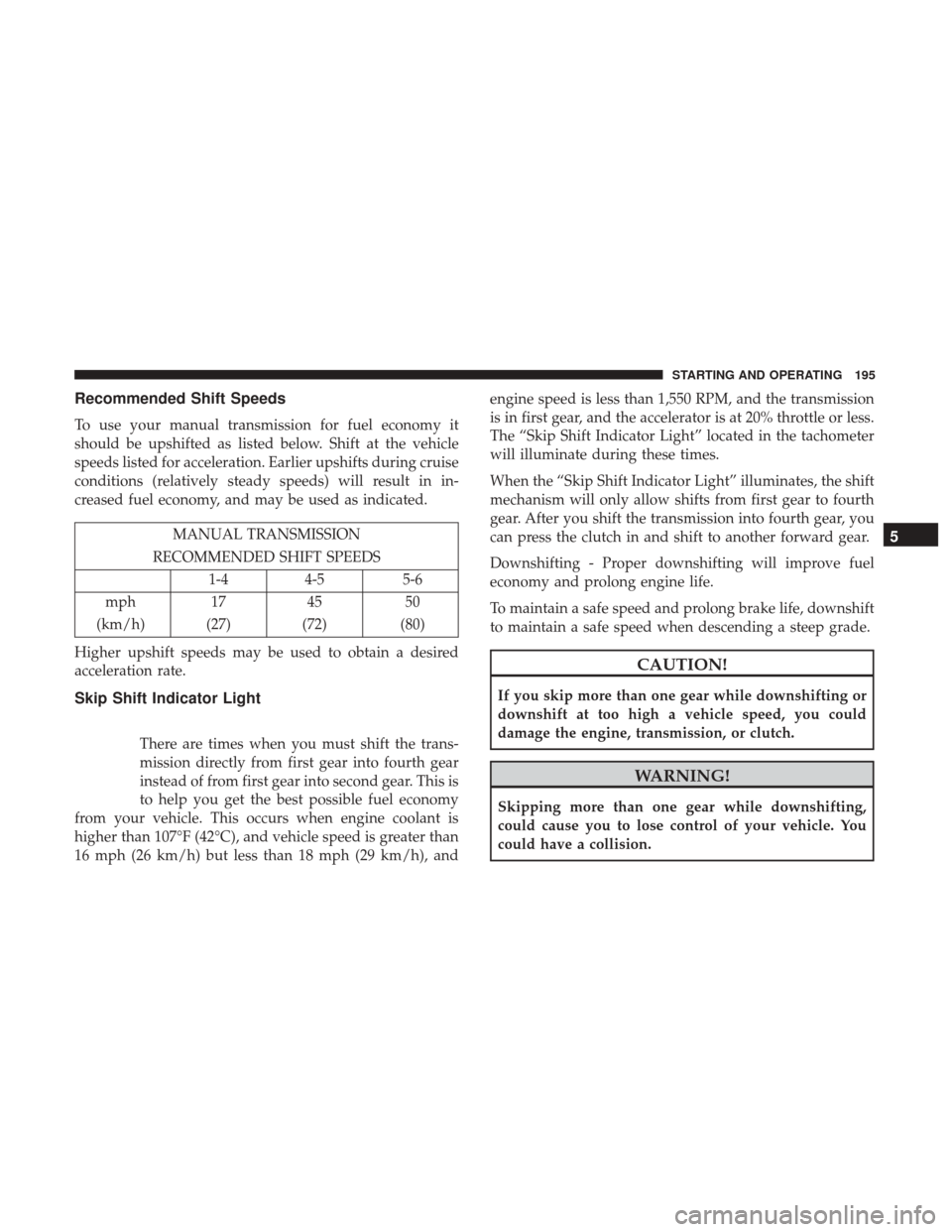
To use your manual transmission for fuel economy it
should be upshifted as listed below. Shift at the vehicle
speeds listed for acceleration. Earlier upshifts during cruise
conditions (relatively steady speeds) will result in in-
creased fuel economy, and may be used as indicated.
MANUAL TRANSMISSION
RECOMMENDED SHIFT SPEEDS 1-4 4-5 5-6
mph 1745 50
(km/h) (27) (72) (80)
Higher upshift speeds may be used to obtain a desired
acceleration rate.
Skip Shift Indicator Light
There are times when you must shift the trans-
mission directly from first gear into fourth gear
instead of from first gear into second gear. This is
to help you get the best possible fuel economy
from your vehicle. This occurs when engine coolant is
higher than 107°F (42°C), and vehicle speed is greater than
16 mph (26 km/h) but less than 18 mph (29 km/h), and engine speed is less than 1,550 RPM, and the transmission
is in first gear, and the accelerator is at 20% throttle or less.
The “Skip Shift Indicator Light” located in the tachometer
will illuminate during these times.
When the “Skip Shift Indicator Light” illuminates, the shift
mechanism will only allow shifts from first gear to fourth
gear. After you shift the transmission into fourth gear, you
can press the clutch in and shift to another forward gear.
Downshifting - Proper downshifting will improve fuel
economy and prolong engine life.
To maintain a safe speed and prolong brake life, downshift
to maintain a safe speed when descending a steep grade.
CAUTION!
If you skip more than one gear while downshifting or
downshift at too high a vehicle speed, you could
damage the engine, transmission, or clutch.
WARNING!
Skipping more than one gear while downshifting,
could cause you to lose control of your vehicle. You
could have a collision.
5
STARTING AND OPERATING 195
Page 202 of 329
DRIVING THROUGH WATER
Driving through water more than a few inches/centimeters
deep will require extra caution to ensure safety and pre-
vent damage to your vehicle.
Flowing/Rising Water
WARNING!
Do not drive on or across a road or path where water is
flowing and/or rising (as in storm run-off). Flowing
water can wear away the road or path’s surface and
cause your vehicle to sink into deeper water. Further-
more, flowing and/or rising water can carry your ve-
hicle away swiftly. Failure to follow this warning may
result in injuries that are serious or fatal to you, your
passengers, and others around you.
Shallow Standing Water
Although your vehicle is capable of driving through shal-
low standing water, consider the following Cautions and
Warnings before doing so.
WARNING!
•Driving through standing water limits your vehicle’s
traction capabilities. Do not exceed 5 mph (8 km/h)
when driving through standing water.
• Driving through standing water limits your vehicle’s
braking capabilities, which increases stopping dis-
tances. Therefore, after driving through standing
water, drive slowly and lightly press on the brake
pedal several times to dry the brakes.
• Failure to follow these warnings may result in inju-
ries that are serious or fatal to you, your passengers,
and others around you.
CAUTION!
• Always check the depth of the standing water before
driving through it. Never drive through standing
water that is deeper than the bottom of the tire rims
mounted on the vehicle.
• Determine the condition of the road or the path that
is under water and if there are any obstacles in the
way before driving through the standing water.
(Continued)
200 STARTING AND OPERATING
Page 205 of 329
As an added precaution when parking the vehicle, turn the
front wheels toward the curb on a downhill grade and
away from the curb on an uphill grade.
To apply the parking brake, grasp the handle and pull it
rearward until you feel resistance. To release the parking
brake, grasp the handle and pull it slightly while pushing
the button on the end of the handle. When the button drops
into the handle (releasing the lock), guide the handle
downward to its stop and then release the button and the
handle.
The “Brake System Warning Light” in the instrument
cluster will turn on when the ignition is in the ON/RUN
position and the parking brake is applied.
NOTE:
•This light only shows that the parking brake is applied
or a brake/ABS system fault. It does not show the
degree of brake application. If the “Brake System Warn-
ing Light” is illuminated when the parking brake is not
applied, please see your authorized dealer.
• Each time the parking brake is applied, the instrument
cluster will automatically go to the highest illumination
setting regardless of the dimmer control setting.WARNING!
• Never leave children alone in a vehicle, or with
access to an unlocked vehicle. Allowing children to
be in a vehicle unattended is dangerous for a number
of reasons. A child or others could be injured seri-
ously or fatally. Do not leave the key fob in or near
the vehicle (or in a location accessible to children),
and do not leave the ignition of a vehicle equipped
with Keyless Enter-N-Go in the ACC or ON/RUN
mode. A child could operate power windows, other
controls, or move the vehicle.
• Ensure the parking brake is fully disengaged before
driving. Failure to do so can lead to brake failure,
and an accident.
BRAKE SYSTEM
Your vehicle is equipped with dual hydraulic
brake systems. If either of the two hydraulic
systems loses normal capability, the remaining
system will still function. However, there will be
some loss of overall braking effectiveness. You may notice
increased pedal travel during application, greater pedal
force required to slow or stop, and potential activation of
the “Brake System Warning Light.”
5
STARTING AND OPERATING 203
Page 206 of 329
In the event power assist is lost for any reason (i.e.,
repeated brake applications with the engine off) the brakes
will still function. However, the effort required to brake the
vehicle will be much greater than that required with the
power system operating.
Brake Pad Break-In
NOTE:Your vehicle is equipped with a high performance
braking system. The brake pads are a semi-metallic com-
pound, which offer superior fade resistance for consistent
operation. A compromise to using this type of brake pad is
that the brakes may squeal slightly under certain weather
and operating conditions (.i.e., during light brake applica-
tions).
The brakes on your new vehicle do not require a long
break-in period. However, you should avoid repeated hard
brake applications from high speeds during initial break-
in. In addition, you should avoid severe brake loading,
such as may be encountered when descending long moun-
tain grades.
For ACR models, please review the supplemental manual
for CCM brake pad and rotor burnishing.
Safe Operating Tips
WARNING!
To use your brakes and accelerator more safely, follow
these tips:
• Do not “ride” the brakes by resting your foot on the
pedal. This could overheat the brakes and result in
unpredictable braking action, longer stopping dis-
tances, or brake damage.
• When descending mountains or hills, repeated brak-
ing can cause brake fade with loss of braking control.
Avoid repeated heavy braking by downshifting the
transmission whenever possible.
• Do not drive too fast for road conditions, especially
when roads are wet or slushy. A wedge of water can
build up between the tire tread and the road. This
hydroplaning action can cause loss of traction, brak-
ing ability, and control.
• After going through deep water or a car wash, brakes
may become wet, resulting in decreased performance
and unpredictable braking action. Dry the brakes by
gentle, intermittent pedal action while driving at
very slow speeds.
204 STARTING AND OPERATING
Page 207 of 329
ELECTRONIC BRAKE CONTROL SYSTEM
Your vehicle is equipped with an advanced electronic
brake control system that includes the Anti-Lock Brake
System (ABS), Traction Control System (TCS), and Elec-
tronic Stability Control (ESC). All of these systems work
together to enhance vehicle stability and control in various
driving conditions.
Anti-Lock Brake System
The Anti-Lock Brake System (ABS) is designed to aid the
driver in maintaining vehicle control under adverse brak-
ing conditions. The system operates with a separate com-
puter to modulate hydraulic pressure to prevent wheel
lock-up and help avoid skidding on slippery surfaces.
NOTE:During severe braking conditions, a pulsing sen-
sation may occur and a clicking noise will be heard. This is
normal, indicating that the ABS is functioning.
The ABS conducts a low-speed self-test at approximately
12 mph (20 km/h). If you have your foot lightly on the
brake pedal while this test is occurring, you may feel a
slight pedal movement. The movement can be more appar-
ent on ice and snow and be considered normal.
The ABS pump motor runs during the self-test at 12 mph
(20 km/h) and during an ABS stop. The pump motor makes a low humming noise during operation, which is
normal.
CAUTION!
The Anti-Lock Brake System is subject to possible
detrimental effects of electronic interference caused by
improperly installed aftermarket radios or telephones.
WARNING!
•
The Anti-Lock Brake System (ABS) contains sophis-
ticated electronic equipment that may be susceptible
to interference caused by improperly installed or
high output radio transmitting equipment. This in-
terference can cause possible loss of anti-lock brak-
ing capability. Installation of such equipment should
be performed by qualified professionals.
• Pumping of the Anti-Lock Brakes will diminish their
effectiveness and may lead to a collision. Pumping
makes the stopping distance longer. Just press firmly
on your brake pedal when you need to slow down or
stop.
(Continued)
5
STARTING AND OPERATING 205
Page 208 of 329
WARNING!(Continued)
•The Anti-Lock Brake System (ABS) cannot prevent
the natural laws of physics from acting on the
vehicle, nor can it increase braking or steering effi-
ciency beyond that afforded by the condition of the
vehicle brakes and tires or the traction afforded.
• The Anti-Lock Brake System (ABS) cannot prevent
collisions, including those resulting from excessive
speed in turns, following another vehicle too closely,
or hydroplaning.
• The capabilities of an Anti-Lock Brake System (ABS)
equipped vehicle must never be exploited in a reck-
less or dangerous manner, that could jeopardize the
user’s safety or the safety of others.
All vehicle wheels and tires must be the same size and type
as the original equipment and the tires must be properly
inflated to produce accurate signals for the computer.
WARNING!
Significant over or underinflation of tires, or mixing
sizes of tires or wheels on the vehicle can lead to loss
of braking effectiveness.
Anti-Lock Brake Warning Light
The “Anti-Lock Brake Warning Light” will turn
on and stay on briefly as a bulb check when the
ignition is first turned on. If the light does not
turn on during starting, have it repaired
promptly.
This light also illuminates at vehicle start-up to indicate
that the ABS self-check is in process. If the light remains on
after start-up, or turns on and remains on at road speeds, it
may indicate a system malfunction or that the system is
inoperative. In this case, the system reverts to standard
non-anti-lock brakes. If this occurs, safely bring the vehicle
to a complete stop as soon as possible and cycle the ignition
to attempt to reset the ABS. If the light remains on, see your
authorized dealer immediately to have the system ser-
viced. Also, if the “BRAKE Warning Light” and the “ABS
Warning Light” are on, and the parking brake is fully
released, see your authorized dealer immediately.
Traction Control System (TCS)
The TCS system monitors the amount of wheel spin of each
driven wheel. If wheel spin is detected, brake pressure is
applied to the slipping wheel(s) and engine power is
reduced to provide enhanced acceleration and stability.
206 STARTING AND OPERATING
Page 282 of 329
Master Cylinder — Brake Fluid Level Check
Check the fluid level in the master cylinder immediately if
the brake system warning light indicates system failure.
Check the fluid level in the master cylinder when perform-
ing underhood services.
Clean the top of the master cylinder area before removing
the cap. If necessary, add fluid to bring the fluid level up to
the requirements described on the brake fluid reservoir.
Overfilling of fluid is not recommended because it may
cause leaking in the system.
With disc brakes, fluid level can be expected to fall as the
brake pads wear. However, low fluid level may be caused
by a leak and a checkup may be needed.
Use only the manufacturer’s recommended brake fluid.
Refer to “Fluids, Lubricants, And Genuine Parts” in “Main-
taining Your Vehicle” for further information. Use of a
brake fluid that may have a lower initial boiling point or
unidentified as to specification, may result in sudden brake
failure during hard prolonged braking.
WARNING!
•Use only manufacturer ’s recommended brake fluid.
Refer to “Fluids, Lubricants, And Genuine Parts” in
“Maintaining Your Vehicle” for further information.
Using the wrong type of brake fluid can severely
damage your brake system and/or impair its perfor-
mance. The proper type of brake fluid for your
vehicle is also identified on the original factory
installed hydraulic master cylinder reservoir.
• To avoid contamination from foreign matter or mois-
ture, use only new brake fluid or fluid that has been
in a tightly closed container. Keep the master cylin-
der reservoir cap secured at all times. Brake fluid in
a open container absorbs moisture from the air
resulting in a lower boiling point. This may cause it
to boil unexpectedly during hard or prolonged brak-
ing, resulting in sudden brake failure. This could
result in a accident.
• Overfilling the brake fluid reservoir can result in
spilling brake fluid on hot engine parts, causing the
brake fluid to catch fire. Brake fluid can also damage
painted and vinyl surfaces, care should be taken to
avoid its contact with these surfaces.
(Continued)
280 MAINTAINING YOUR VEHICLE
Page 304 of 329
MAINTENANCE SCHEDULES
The Scheduled Maintenance services listed in this manual
must be done at the times or mileages specified to protect
your vehicle warranty and ensure the best vehicle perfor-
mance and reliability. More frequent maintenance may be
needed for vehicles in severe operating conditions, such as
dusty areas and very short trip driving. Inspection and
service should also be done anytime a malfunction is
suspected.
NOTE: Under no circumstances should oil change inter-
vals exceed 6,000 miles (10 000 km) or six months,
whichever comes first.
CAUTION!
Failure to perform the required maintenance items
may result in damage to the vehicle.At Each Stop For Fuel
•
Check the engine oil level about five minutes after a
fully warmed engine is shut off. Checking the oil level
while the vehicle is on level ground will improve the
accuracy of the oil level reading. Add oil only when the
level is at or below the ADD or MIN mark.
• Check the windshield washer solvent, and add if re-
quired.
Once A Month
• Check tire pressure and look for unusual wear or
damage. Rotate tires at the first sign of irregular wear,
even if it occurs before your next scheduled service.
• Inspect the battery, and clean and tighten the terminals
as required.
• Check the fluid levels of the coolant reservoir, brake
master cylinder, power steering, and transmission, and
add as needed.
• Check all lights and all other electrical items for correct
operation.
302 MAINTENANCE SCHEDULES