parking brake DODGE VIPER 2017 VX / 3.G User Guide
[x] Cancel search | Manufacturer: DODGE, Model Year: 2017, Model line: VIPER, Model: DODGE VIPER 2017 VX / 3.GPages: 329, PDF Size: 2.83 MB
Page 204 of 329
Power Steering Fluid Check
Checking the power steering fluid level at a defined service
interval is not required. The fluid should be checked at every
oil change if a leak is suspected, abnormal noises are apparent,
and/or the system is not functioning as anticipated. Coordi-
nate inspection efforts through an authorized dealer.
CAUTION!
Do not use chemical flushes in your power steering
system as the chemicals can damage your power steer-
ing components. Such damage is not covered by the
New Vehicle Limited Warranty.
WARNING!
Fluid level should be checked on a level surface and
with the engine off to prevent injury from moving
parts and to ensure accurate fluid level reading. Do not
overfill. Use only manufacturer’s recommended power
steering fluid.
If necessary, add fluid to restore to the proper indicated
level. With a clean cloth, wipe any spilled fluid from all
surfaces. Refer to “Fluids, Lubricants And Genuine Parts”
in “Maintaining Your Vehicle” for further information.
PARKING BRAKE
The parking brake should always be applied when the
driver is not in the vehicle.
WARNING!
Before leaving the vehicle, make sure you fully apply
the parking brake and shift the transmission into
REVERSE. Failure to do so may cause the vehicle to
roll and cause damage or injury.
Parking Brake Lever
202 STARTING AND OPERATING
Page 205 of 329
As an added precaution when parking the vehicle, turn the
front wheels toward the curb on a downhill grade and
away from the curb on an uphill grade.
To apply the parking brake, grasp the handle and pull it
rearward until you feel resistance. To release the parking
brake, grasp the handle and pull it slightly while pushing
the button on the end of the handle. When the button drops
into the handle (releasing the lock), guide the handle
downward to its stop and then release the button and the
handle.
The “Brake System Warning Light” in the instrument
cluster will turn on when the ignition is in the ON/RUN
position and the parking brake is applied.
NOTE:
•This light only shows that the parking brake is applied
or a brake/ABS system fault. It does not show the
degree of brake application. If the “Brake System Warn-
ing Light” is illuminated when the parking brake is not
applied, please see your authorized dealer.
• Each time the parking brake is applied, the instrument
cluster will automatically go to the highest illumination
setting regardless of the dimmer control setting.WARNING!
• Never leave children alone in a vehicle, or with
access to an unlocked vehicle. Allowing children to
be in a vehicle unattended is dangerous for a number
of reasons. A child or others could be injured seri-
ously or fatally. Do not leave the key fob in or near
the vehicle (or in a location accessible to children),
and do not leave the ignition of a vehicle equipped
with Keyless Enter-N-Go in the ACC or ON/RUN
mode. A child could operate power windows, other
controls, or move the vehicle.
• Ensure the parking brake is fully disengaged before
driving. Failure to do so can lead to brake failure,
and an accident.
BRAKE SYSTEM
Your vehicle is equipped with dual hydraulic
brake systems. If either of the two hydraulic
systems loses normal capability, the remaining
system will still function. However, there will be
some loss of overall braking effectiveness. You may notice
increased pedal travel during application, greater pedal
force required to slow or stop, and potential activation of
the “Brake System Warning Light.”
5
STARTING AND OPERATING 203
Page 208 of 329
WARNING!(Continued)
•The Anti-Lock Brake System (ABS) cannot prevent
the natural laws of physics from acting on the
vehicle, nor can it increase braking or steering effi-
ciency beyond that afforded by the condition of the
vehicle brakes and tires or the traction afforded.
• The Anti-Lock Brake System (ABS) cannot prevent
collisions, including those resulting from excessive
speed in turns, following another vehicle too closely,
or hydroplaning.
• The capabilities of an Anti-Lock Brake System (ABS)
equipped vehicle must never be exploited in a reck-
less or dangerous manner, that could jeopardize the
user’s safety or the safety of others.
All vehicle wheels and tires must be the same size and type
as the original equipment and the tires must be properly
inflated to produce accurate signals for the computer.
WARNING!
Significant over or underinflation of tires, or mixing
sizes of tires or wheels on the vehicle can lead to loss
of braking effectiveness.
Anti-Lock Brake Warning Light
The “Anti-Lock Brake Warning Light” will turn
on and stay on briefly as a bulb check when the
ignition is first turned on. If the light does not
turn on during starting, have it repaired
promptly.
This light also illuminates at vehicle start-up to indicate
that the ABS self-check is in process. If the light remains on
after start-up, or turns on and remains on at road speeds, it
may indicate a system malfunction or that the system is
inoperative. In this case, the system reverts to standard
non-anti-lock brakes. If this occurs, safely bring the vehicle
to a complete stop as soon as possible and cycle the ignition
to attempt to reset the ABS. If the light remains on, see your
authorized dealer immediately to have the system ser-
viced. Also, if the “BRAKE Warning Light” and the “ABS
Warning Light” are on, and the parking brake is fully
released, see your authorized dealer immediately.
Traction Control System (TCS)
The TCS system monitors the amount of wheel spin of each
driven wheel. If wheel spin is detected, brake pressure is
applied to the slipping wheel(s) and engine power is
reduced to provide enhanced acceleration and stability.
206 STARTING AND OPERATING
Page 254 of 329
WARNING!(Continued)
•A loose Tire Service Kit thrown forward in a collision
or hard stop could endanger the occupants of the
vehicle. Always stow the Tire Service Kit in the place
provided. Failure to follow these warnings can result
in injuries that are serious or fatal to you, your
passengers, and others around you.
• Take care not to allow the contents of Tire Service Kit
to come in contact with hair, eyes, or clothing. Tire
Service Kit sealant is harmful if inhaled, swallowed,
or absorbed through the skin. It causes skin, eye, and
respiratory irritation. Flush immediately with plenty
of water if there is any contact with eyes or skin.
Change clothing as soon as possible, if there is any
contact with clothing.
• Tire Service Kit Sealant solution contains latex. In
case of an allergic reaction or rash, consult a physi-
cian immediately. Keep Tire Service Kit out of reach
of children. If swallowed, rinse mouth immediately
with plenty of water and drink plenty of water. Do
not induce vomiting! Consult a physician immedi-
ately.
Sealing A Tire With Tire Service Kit
(A) Whenever You Stop To Use Tire Service Kit:
1. Pull over to a safe location and turn on the vehicle’s Hazard Warning flashers.
2. Verify that the valve stem (on the wheel with the deflated tire) is in a position that is near to the ground.
This will allow the Tire Service Kit Hoses (6) and (7) to
reach the valve stem and keep the Tire Service Kit flat on
the ground. This will provide the best positioning of the
kit when injecting the sealant into the deflated tire and
running the air pump. Move the vehicle as necessary to
place the valve stem in this position before proceeding.
3. Place the transmission in PARK (auto transmission) or in Gear (manual transmission) and place the ignition in the
OFF position.
4. Set the parking brake.
(B) Setting Up To Use Tire Service Kit:
1. Push in the Mode Select Knob (5) and turn to the Sealant Mode position.
2. Uncoil the Sealant Hose (6) and then remove the cap from the fitting at the end of the hose.
252 WHAT TO DO IN EMERGENCIES
Page 259 of 329
NOTE:The battery is located underneath an access panel
inside the rear compartment on the left side of the vehicle.
A remote battery terminal is located in the engine compart-
ment for jump-starting. Connecting The Jumper Cables
1. Wear eye protection and remove any metal jewelry such
as watchbands or bracelets that might make an inadver-
tent electrical contact.
2. When boost is provided by a battery in another vehicle, park that vehicle within booster cable reach, but without
allowing the vehicles to touch one another.
3. Set the parking brake, place the transmission in NEU- TRAL, and turn the ignition OFF on both vehicles.
4. Turn off the heater, radio, and all unnecessary electrical loads.
5. Remove the plastic fuse cover to gain access to the remote jump-start positive (+)post in the engine com-
partment. Refer to the following illustration for remote
jump-starting connections.
Battery Location
1 — Positive Battery Post
2 — Negative Battery Post
6
WHAT TO DO IN EMERGENCIES 257
Page 286 of 329
CAUTION!
Do not use scouring pads, steel wool, a bristle brush,
metal polishes or oven cleaner. These products may
damage the wheel’s protective finish. Such damage is
not covered by the New Vehicle Limited Warranty.
Only car wash soap, MOPAR Wheel Cleaner or equiva-
lent is recommended.
NOTE: If you intend parking or storing your vehicle for an
extended period after cleaning the wheels with wheel
cleaner, drive your vehicle for a few minutes before doing
so. Driving the vehicle and applying the brakes when
stopping will reduce the risk of brake rotor corrosion.
Dark Vapor Or Black Satin Chrome Wheels
CAUTION!
If your vehicle is equipped with Dark Vapor or Black
Satin Chrome wheels DO NOT USE wheel cleaners,
abrasives or polishing compounds. They will perma-
nently damage this finish and such damage is not
covered by the New Vehicle Limited Warranty. USE
ONLY MILD SOAP AND WATER WITH A SOFT
(Continued)
CAUTION! (Continued)
CLOTH. Used on a regular basis; this is all that is
required to maintain this finish.
Interior Care
Use MOPAR Total Clean to clean fabric upholstery and
carpeting.
Use MOPAR Total Clean to clean vinyl upholstery.
MOPAR Total Clean is specifically recommended for
leather upholstery.
Your leather upholstery can be best preserved by regular
cleaning with a damp soft cloth. Small particles of dirt can
act as an abrasive and damage the leather upholstery and
should be removed promptly with a damp cloth. Stubborn
soils can be removed easily with a soft cloth and MOPAR
Total Clean. Care should be taken to avoid soaking your
leather upholstery with any liquid. Please do not use
polishes, oils, cleaning fluids, solvents, detergents, or
ammonia-based cleaners to clean your leather upholstery.
Application of a leather conditioner is not required to
maintain the original condition.
284 MAINTAINING YOUR VEHICLE
Page 296 of 329
CAUTION!
•When installing the power distribution center cover,
it is important to ensure the cover is properly posi-
tioned and fully latched. Failure to do so may allow
water to get into the power distribution center and
possibly result in an electrical system failure.
• When replacing a blown fuse, it is important to use
only a fuse having the correct amperage rating. The
use of a fuse with a rating other than indicated may
result in a dangerous electrical system overload. If a
properly rated fuse continues to blow, it indicates a
problem in the circuit that must be corrected.
VEHICLE STORAGE
We recommend that you follow these guidelines for storing
your vehicle for extended periods.
• Fill the fuel tank. This will prevent water condensation
inside the tank. If you plan to store your vehicle more
than two months, add an anti-oxidant fuel stabilizer to
the fuel tank.
• Change the oil to remove any corrosive combustion
related acids in the crankcase. •
Check that the radiator coolant level of protection is to at
least -20°F (-29°C).
• Make sure that all tires are inflated to the optimum
pressure.
• Wash and wax the vehicle to protect the finish.
• Store the vehicle in a dry, well-ventilated location.
• Move the wiper blades away from the windshield.
• Block the wheels. Do not apply the parking brake.
• Cut blocks of plywood about the same size of the tires.
Cover each block with indoor/outdoor carpeting and
place them between the tires and concrete. This will
prevent tire flat spotting.
• For long-term storage, remove the tires and put the
vehicle up on blocks. Stack the tires on plywood and
cover with a tarp to prevent flat spotting.
• If the vehicle will be subjected to freezing temperatures,
either remove the battery and store it in a dry, well
ventilated area or connect a trickle charger (1.5 Amp)
with automatic shutdown / overcharge protection to the
battery. However, do not leave the trickle charger
hooked up to the battery without being plugged in to a
110 Volt AC outlet, as this will result in further drain on
294 MAINTAINING YOUR VEHICLE
Page 306 of 329
Miles:6,000
12,000
18,000
24,000
30,000
36,000
42,000
48,000
54,000
60,000
66,000
72,000
78,000
84,000
90,000
96,000
102,000
108,000 114,000
120,000
126,000
132,000
138,000
144,000
150,000
Or Months: 6 12 18 24 30 36 42 48 54 60 66 72 78 84 90 96 102 108 114 120 126 132 138 144 150
Or Kilometers:
10,000
20,000
30,000
40,000
50,000
60,000
70,000
80,000
90,000
100,000 110,000
120,000
130,000
140,000
150,000
160,000
170,000
180,000
190,000
200,000
210,000
220,000
230,000
240,000
250,000
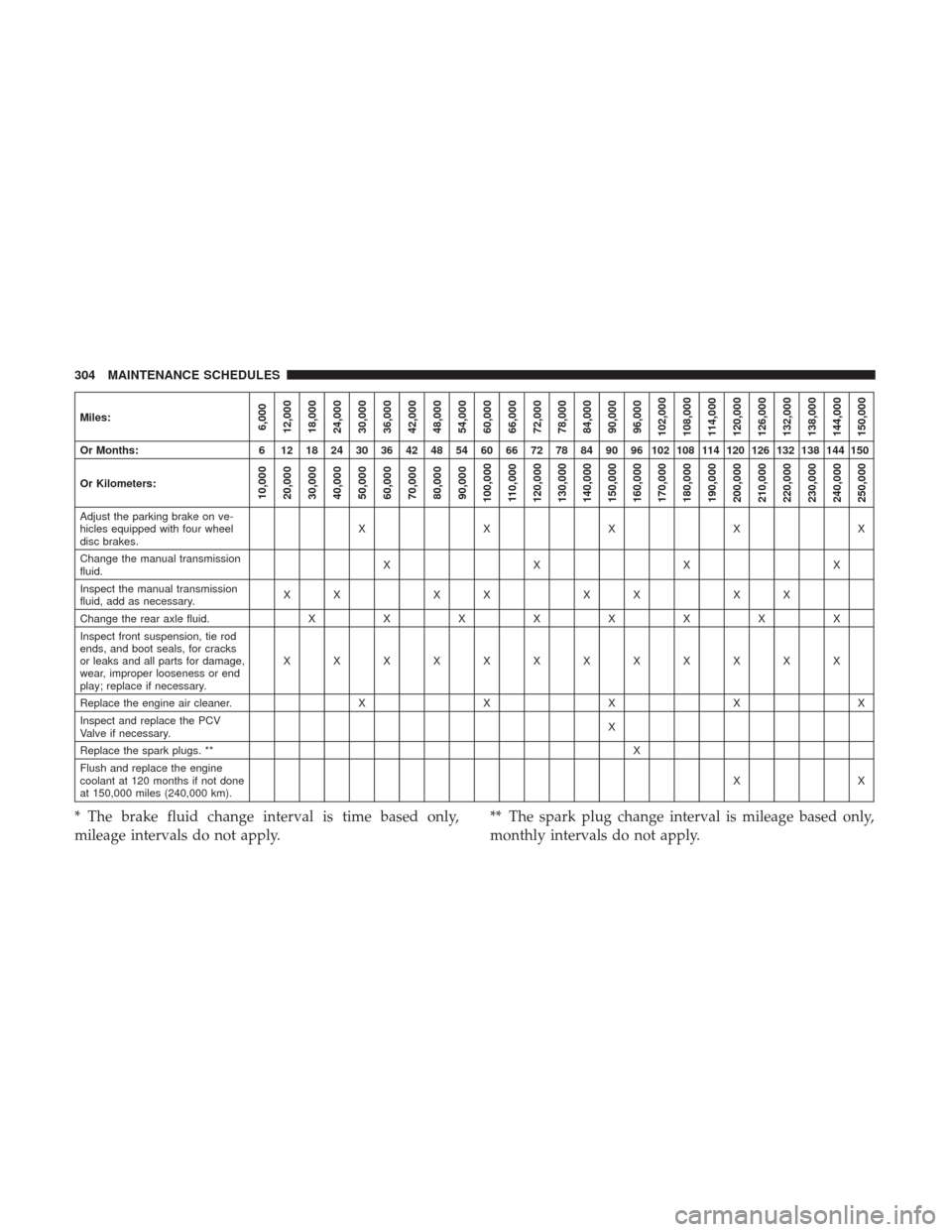
Adjust the parking brake on ve-
hicles equipped with four wheel
disc brakes. XXXXX
Change the manual transmission
fluid. XXXX
Inspect the manual transmission
fluid, add as necessary. XX XX XX XX
Change the rear axle fluid. XXXXXXXX
Inspect front suspension, tie rod
ends, and boot seals, for cracks
or leaks and all parts for damage,
wear, improper looseness or end
play; replace if necessary. XXXXXXXXXXXX
Replace the engine air cleaner. XXXXX
Inspect and replace the PCV
Valve if necessary. X
Replace the spark plugs. ** X
Flush and replace the engine
coolant at 120 months if not done
at 150,000 miles (240,000 km). XX
* The brake fluid change interval is time based only,
mileage intervals do not apply.** The spark plug change interval is mileage based only,
monthly intervals do not apply.
304 MAINTENANCE SCHEDULES
Page 317 of 329
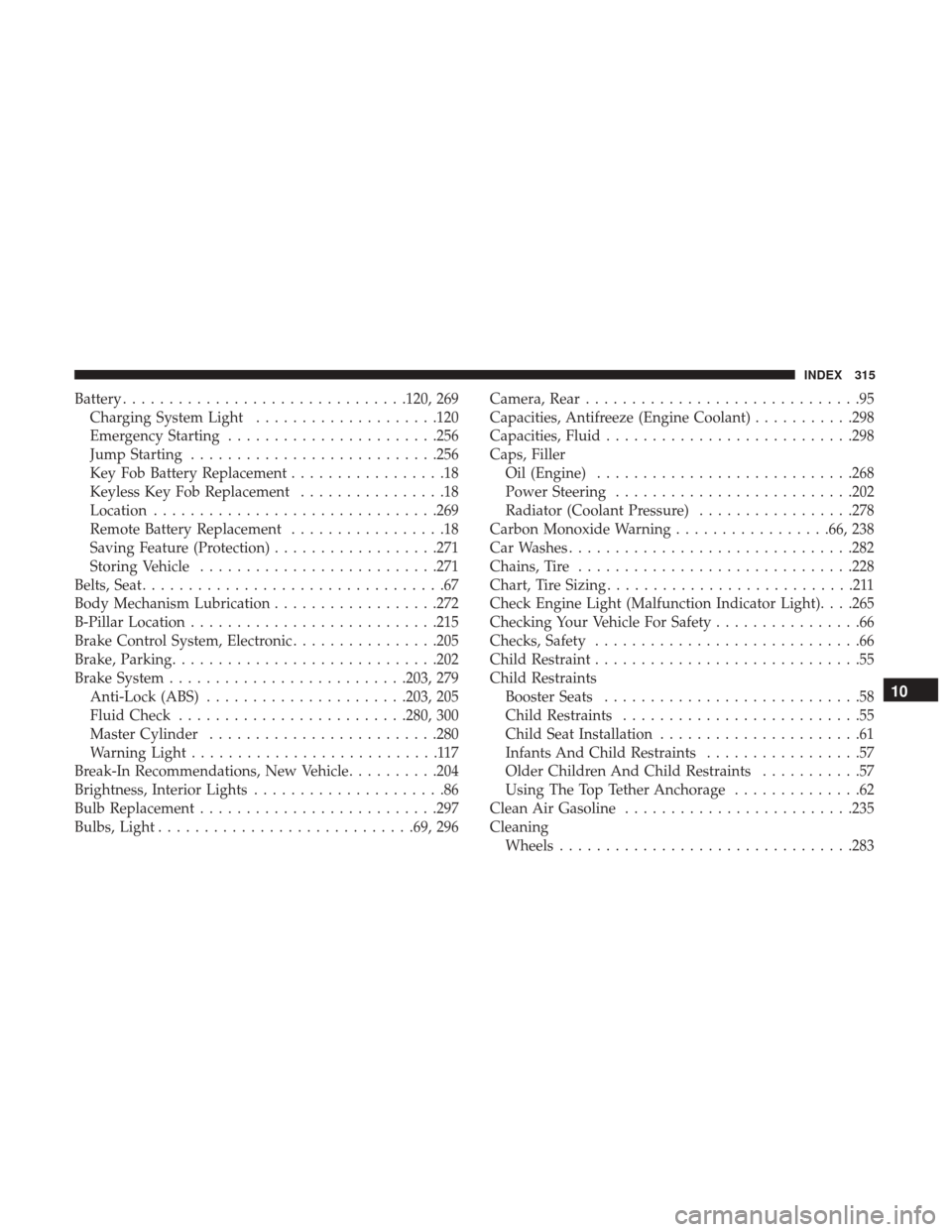
Battery.............................. .120, 269
Charging System Light ....................120
Emergency Starting ...................... .256
Jump Starting .......................... .256
Key Fob Battery Replacement .................18
Keyless Key Fob Replacement ................18
Location .............................. .269
Remote Battery Replacement .................18
Saving Feature (Protection) ..................271
Storing Vehicle ......................... .271
Belts, Seat .................................67
Body Mechanism Lubrication ..................272
B-Pillar Location .......................... .215
Brake Control System, Electronic ................205
Brake, Parking ............................ .202
Brake System ......................... .203, 279
Anti-Lock (ABS) ..................... .203, 205
Fluid Check ........................ .280, 300
Master Cylinder ........................ .280
Warning Light ...........................117
Break-In Recommendations, New Vehicle ..........204
Brightness, Interior Lights .....................86
Bulb Replacement ......................... .297
Bulbs, Light ........................... .69, 296Camera, Rear
..............................95
Capacities, Antifreeze (Engine Coolant) ...........298
Capacities, Fluid .......................... .298
Caps, Filler Oil (Engine) ........................... .268
Power Steering ......................... .202
Radiator (Coolant Pressure) .................278
Carbon Monoxide Warning .................66, 238
Car Washes .............................. .282
Chains, Tire ............................. .228
Chart, Tire Sizing ...........................211
Check Engine Light (Malfunction Indicator Light). . . .265
Checking Your Vehicle For Safety ................66
Checks, Safety .............................66
Child Restraint .............................
55
Child Restraints Booster Seats ............................58
Child Restraints ..........................55
Child Seat Installation ......................61
Infants And Child Restraints .................57
Older Children And Child Restraints ...........57
Using The Top Tether Anchorage ..............62
Clean Air Gasoline ........................ .235
Cleaning Wheels ............................... .283
10
INDEX 315
Page 323 of 329
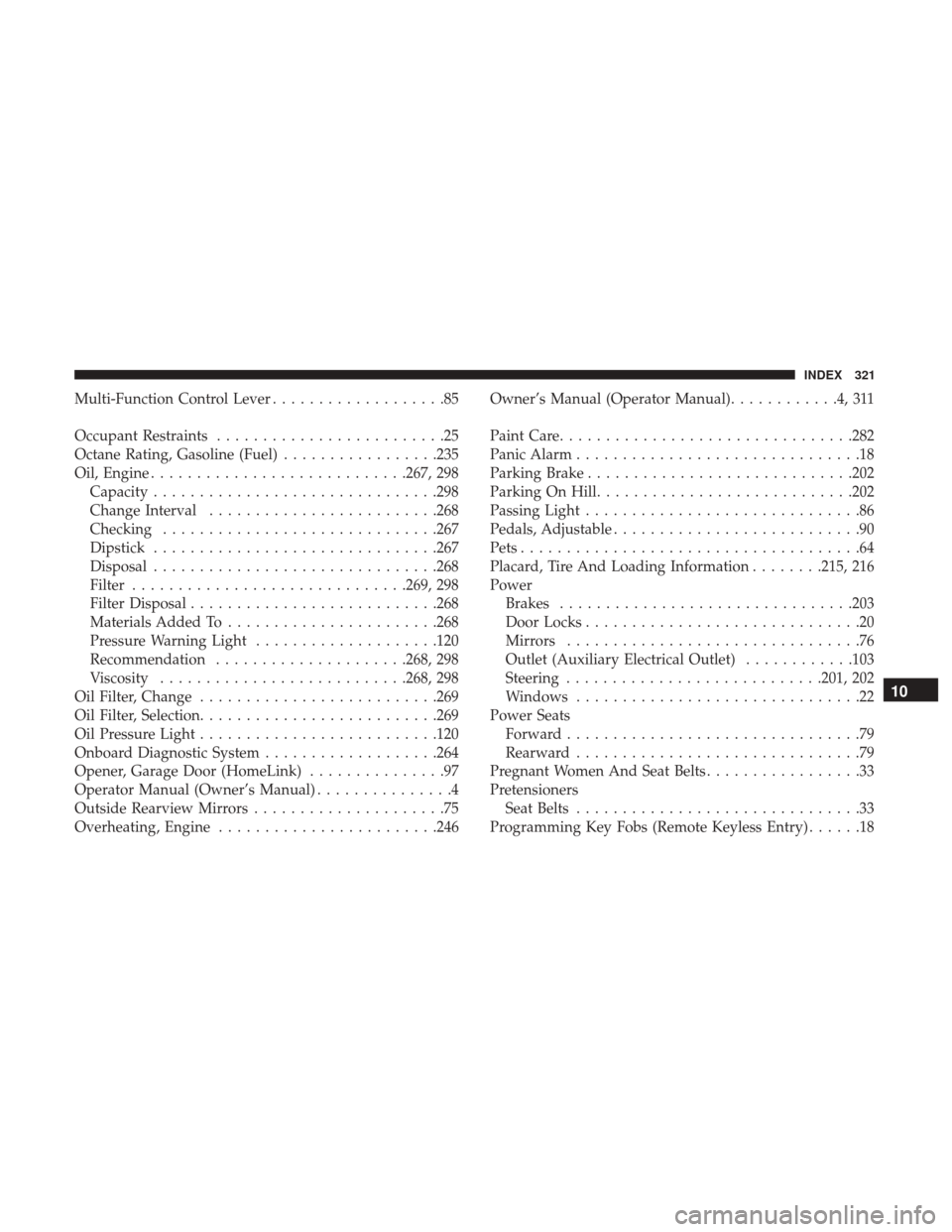
Multi-Function Control Lever...................85
Occupant Restraints .........................25
Octane Rating, Gasoline (Fuel) .................235
Oil, Engine ........................... .267, 298
Capacity .............................. .298
Change Interval ........................ .268
Checking ............................. .267
Dipstick .............................. .267
Disposal .............................. .268
Filter ............................. .269, 298
Filter Disposal .......................... .268
Materials Added To ...................... .268
Pressure Warning Light ....................120
Recommendation .....................268, 298
Viscosity .......................... .268, 298
Oil Filter, Change ......................... .269
Oil Filter, Selection ......................... .269
Oil Pressure Light ......................... .120
Onboard Diagnostic System ...................264
Opener, Garage Door (HomeLink) ...............97
Operator Manual (Owner’s Manual) ...............4
Outside Rearview Mirrors .....................75
Overheating, Engine ....................... .246Owner’s Manual (Operator Manual)
............4,311
Paint Care ............................... .282
Panic Alarm ...............................18
Parking Brake ............................ .202
Parking On Hill ........................... .202
Passing Light ..............................86
Pedals, Adjustable ...........................90
Pets .....................................64
Placard, Tire And Loading Information ........215, 216
Power Brakes ............................... .203
Door Locks ..............................20
Mirrors ................................76
Outlet (Auxiliary Electrical Outlet) ............103
Steering ........................... .201, 202
Windows ...............................22
Power
Seats
Forward ................................79
Rearward ...............................79
Pregnant Women And Seat Belts .................33
Pretensioners Seat Belts ...............................33
Programming Key Fobs (Remote Keyless Entry) ......1810
INDEX 321