tow DODGE VIPER 2017 VX / 3.G Owner's Manual
[x] Cancel search | Manufacturer: DODGE, Model Year: 2017, Model line: VIPER, Model: DODGE VIPER 2017 VX / 3.GPages: 329, PDF Size: 2.83 MB
Page 254 of 329
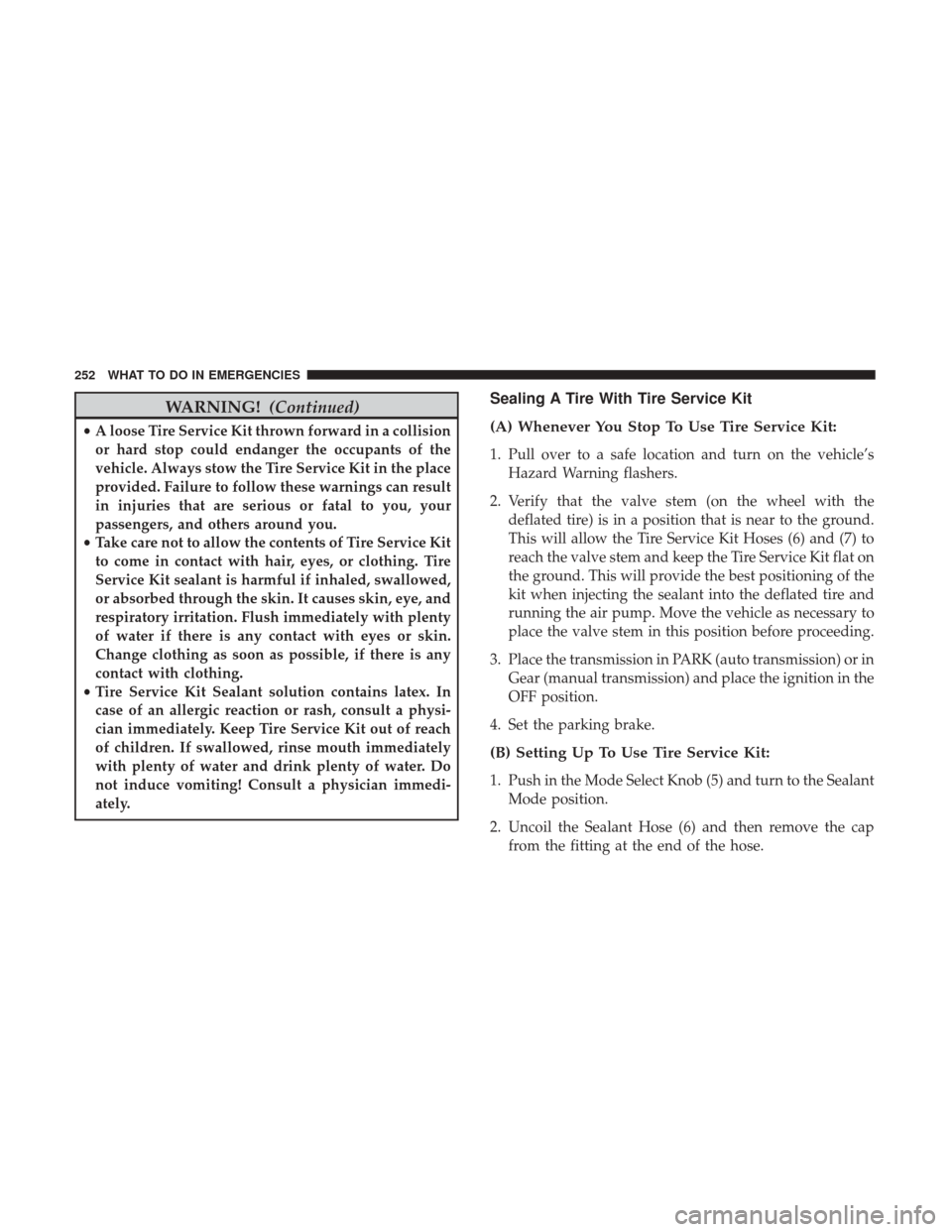
WARNING!(Continued)
•A loose Tire Service Kit thrown forward in a collision
or hard stop could endanger the occupants of the
vehicle. Always stow the Tire Service Kit in the place
provided. Failure to follow these warnings can result
in injuries that are serious or fatal to you, your
passengers, and others around you.
• Take care not to allow the contents of Tire Service Kit
to come in contact with hair, eyes, or clothing. Tire
Service Kit sealant is harmful if inhaled, swallowed,
or absorbed through the skin. It causes skin, eye, and
respiratory irritation. Flush immediately with plenty
of water if there is any contact with eyes or skin.
Change clothing as soon as possible, if there is any
contact with clothing.
• Tire Service Kit Sealant solution contains latex. In
case of an allergic reaction or rash, consult a physi-
cian immediately. Keep Tire Service Kit out of reach
of children. If swallowed, rinse mouth immediately
with plenty of water and drink plenty of water. Do
not induce vomiting! Consult a physician immedi-
ately.
Sealing A Tire With Tire Service Kit
(A) Whenever You Stop To Use Tire Service Kit:
1. Pull over to a safe location and turn on the vehicle’s Hazard Warning flashers.
2. Verify that the valve stem (on the wheel with the deflated tire) is in a position that is near to the ground.
This will allow the Tire Service Kit Hoses (6) and (7) to
reach the valve stem and keep the Tire Service Kit flat on
the ground. This will provide the best positioning of the
kit when injecting the sealant into the deflated tire and
running the air pump. Move the vehicle as necessary to
place the valve stem in this position before proceeding.
3. Place the transmission in PARK (auto transmission) or in Gear (manual transmission) and place the ignition in the
OFF position.
4. Set the parking brake.
(B) Setting Up To Use Tire Service Kit:
1. Push in the Mode Select Knob (5) and turn to the Sealant Mode position.
2. Uncoil the Sealant Hose (6) and then remove the cap from the fitting at the end of the hose.
252 WHAT TO DO IN EMERGENCIES
Page 258 of 329
5. Remove the Speed Limit sticker from the instrumentpanel after the tire has been repaired.
6. Replace the Sealant Bottle (1) and Sealant Hose (6) assembly at your authorized dealer as soon as possible.
Refer to (F) “Sealant Bottle and Hose Replacement”.
NOTE: When having the tire serviced, advise the autho-
rized dealer or service center that the tire has been sealed
using the Tire Service Kit.
(F) Sealant Bottle And Hose Replacement:
1. Uncoil the Sealant Hose (6) (clear in color).
2. Locate the round Sealant Bottle release button in the recessed area under the sealant bottle.
3. Push the Sealant Bottle release button. The Sealant Bottle (1) will pop up. Remove the bottle and dispose of it
accordingly.
4. Clean any remaining sealant from the Tire Service Kit housing.
5. Position the new Sealant Bottle (1) in the housing so that the Sealant Hose (6) aligns with the hose slot in the front
of the housing. Push the bottle into the housing. An
audible click will be heard indicating the bottle is locked
into place. 6. Verify that the cap is installed on the fitting at the end of
the Sealant Hose (6) and return the hose to its storage
area (located on the bottom of the air pump).
7. Return the Tire Service Kit to its storage location in the vehicle.
JUMP-STARTING PROCEDURES
WARNING!
•Take care to avoid the radiator cooling fan whenever
the hood is raised. It can start anytime the ignition
switch is ON. You can be hurt by the fan.
• Do not attempt to push or tow your vehicle to get it
started. Unburned fuel could enter the catalytic con-
verter and once the engine has started, ignite and
damage the converter and vehicle. If the vehicle has
a discharged battery, booster cables may be used to
obtain a start from another vehicle. This type of start
can be dangerous if done improperly, so follow this
procedure carefully.
• Wear eye protection and remove any metal jewelry
such as watch bands or bracelets that might make an
inadvertent electrical contact. You could be seriously
injured.
256 WHAT TO DO IN EMERGENCIES
Page 262 of 329
CAUTION!
•When “rocking” a stuck vehicle by shifting between
1st gear and REVERSE, do not spin the wheels faster
than 15 mph (24 km/h), or drivetrain damage may
result.
• Revving the engine or spinning the wheels too fast
may lead to transmission overheating and failure. It
can also damage the tires. Do not spin the wheels
above 30 mph (48 km/h) while in gear (no transmis-
sion shifting occurring).
TOWING A DISABLED VEHICLE
Do not tow with sling-type equipment. Only use flatbed
equipment. Always comply with applicable state or local
towing ordinances.
CAUTION!
Towing this vehicle in violation of the above require-
ments can cause severe transmission damage. Damage
from improper towing is not covered under the New
Vehicle Limited Warranty.
ENHANCED ACCIDENT RESPONSE SYSTEM
(EARS)
This vehicle is equipped with an Enhanced Accident
Response System.
Please refer to “Supplemental Restraint System (SRS) —
Air Bags” in “Occupant Restraints” for further information
on the Enhanced Accident Response System (EARS) func-
tion.
EVENT DATA RECORDER (EDR)
This vehicle is equipped with an Event Data Recorder
(EDR). The main purpose of an EDR is to record, in certain
crash or near crash-like situations, such as an air bag
deployment or hitting a road obstacle, data that will assist
in understanding how a vehicle’s systems performed.
Please refer to “Supplemental Restraint System (SRS) —
Air Bags” in “Occupant Restraints” for further information
on the Event Data Recorder (EDR).
260 WHAT TO DO IN EMERGENCIES
Page 266 of 329
ONBOARD DIAGNOSTIC SYSTEM (OBD II)
To meet new government regulations and promote cleaner
air, your vehicle is equipped with a sophisticated onboard
diagnostic system called OBD II. This system monitors the
performance of the emissions and engine control systems.
When these systems are operating properly, your vehicle
will provide excellent performance and fuel economy, as
well as engine emissions well within current government
regulations.
If any of these systems require service, the OBD II system
will turn on the Malfunction Indicator Light. It will also
store diagnostic codes and other information to assist your
service technician in making repairs. Although your ve-
hicle will usually be drivable and not need towing, see
your authorized dealer for service as soon as possible.
CAUTION!
Prolonged driving with the light on could cause fur-
ther damage to the emission control system. It could
also affect fuel economy and driveability. The vehicle
must be serviced before any state emissions tests can
be performed.If the light is flashing, severe catalytic converter damage
and power loss will soon occur. Immediate service is
required.
Onboard Diagnostic System (OBD II) Cybersecurity
Your vehicle is required to have an Onboard Diagnostic
system (OBD II) and a connection port to allow access to
information related to the performance of your emissions
controls. Authorized service technicians may need to ac-
cess this information to assist with the diagnosis and
service of your vehicle and emissions system.
WARNING!
•
ONLY an authorized service technician should con-
nect equipment to the OBD II connection port in
order to diagnose or service your vehicle.
• If unauthorized equipment is connected to the OBD
II connection port, such as a driver-behavior tracking
device, it may:
• Be possible that vehicle systems, including safety
related systems, could be impaired or a loss of
vehicle control could occur that may result in an
accident involving serious injury or death.
(Continued)
264 MAINTAINING YOUR VEHICLE
Page 277 of 329
Under normal operating conditions, the catalytic converter
will not require maintenance. However, it is important to
keep the engine properly tuned to assure proper catalyst
operation and prevent possible catalyst damage.
NOTE:Intentional tampering with emissions control sys-
tems can result in civil penalties being assessed against
you.
In unusual situations involving grossly malfunctioning
engine operation, a scorching odor may suggest severe and
abnormal catalyst overheating. If this occurs, stop the
vehicle, turn off the engine and allow it to cool. Service,
including a tune-up to manufacturer’s specifications,
should be obtained immediately.
To minimize the possibility of catalytic converter damage:
• Do not shut off the engine or interrupt the ignition,
when the transmission is in gear and the vehicle is in
motion.
• Do not try to start the engine by pushing or towing the
vehicle.
• Do not idle the engine with any spark plug wires
disconnected or removed, such as when diagnostic
testing, or for prolonged periods during very rough idle
or malfunctioning operating conditions.Cooling System
WARNING!
• When working near the radiator cooling fan, discon-
nect the fan motor lead or cycle the ignition switch to
the LOCK position. The fan is temperature con-
trolled and can start at any time the ignition switch is
in the ON position.
• You or others can be badly burned by hot engine
coolant (antifreeze) or steam from your radiator. If
you see or hear steam coming from under the hood,
do not open the hood until the radiator has had time
to cool. Never try to open a cooling system pressure
cap when the radiator is hot.
Coolant Checks
Check engine coolant (antifreeze) protection every 12
months (before the onset of freezing weather, where appli-
cable). If the engine coolant (antifreeze) is dirty, the system
should be drained, flushed, and refilled with fresh OAT
coolant (conforming to MS.90032) by an authorized dealer.
Check the front of the A/C condenser/radiator for any
accumulation of bugs, leaves, etc. If dirty, clean by gently
spraying water from a garden hose vertically down the face
of the condenser/radiator.
7
MAINTAINING YOUR VEHICLE 275
Page 287 of 329
WARNING!
Do not use volatile solvents for cleaning purposes.
Many are potentially flammable, and if used in closed
areas they may cause respiratory harm.
CAUTION!
Direct contact of air fresheners, insect repellents, sun-
tan lotions, or hand sanitizers to the plastic, painted, or
decorated surfaces of the interior may cause permanent
damage. Wipe away immediately.
CAUTION!
Damage caused by these type of products may not be
covered by your New Vehicle Limited Warranty.
CAUTION!
Do not use Alcohol and Alcohol-based and/or Keton
based cleaning products to clean leather seats, as
damage to the seat may result.
Leather Or Vinyl Seat/Trim Care And Cleaning
Leather is best preserved by regular cleaning with a damp
soft cloth. Small particles of dirt can act as an abrasive and
damage the leather surface and should be removed imme-
diately with a damp cloth. Stubborn soils can be removed
easily with a soft cloth and MOPAR Total Clean or equiva-
lent. Care should be taken to avoid soaking the leather with
any liquid. Please do not use polishes, oils, cleaning fluids,
solvents, detergents, or ammonia-based cleaners to clean
the leather. Application of a leather conditioner is not
required to maintain the original condition.
Glass Surfaces
All glass surfaces should be cleaned on a regular basis with
MOPAR Glass Cleaner, or any commercial household-type
glass cleaner. Never use an abrasive type cleaner. Use
caution when cleaning the inside rear window equipped
with electric defrosters or windows equipped with radio
antennas. Do not use scrapers or other sharp instrument
that may scratch the elements.
When cleaning the rear view mirror, spray cleaner on the
towel or cloth that you are using. Do not spray cleaner
directly on the mirror.
7
MAINTAINING YOUR VEHICLE 285
Page 319 of 329
Electronic Speed Control (Cruise Control)..........92
Electronic Stability Control (ESC) ...............207
Electronic Throttle Control Warning Light .........121
Emergency Brake .......................... .202
Emergency, In Case Of Freeing Vehicle When Stuck .................259
Hazard Warning Flasher ...................246
Jump Starting .......................... .256
Overheating ........................... .246
Towing ............................... .260
Emission Control System Maintenance ............265
Engine ................................. .263
Air Cleaner ............................ .269
Checking Oil Level ...................... .267
Compartment .......................... .263
Coolant (Antifreeze) ...................275, 298
Cooling .............................. .275
Exhaust Gas Caution ...................66, 238
Fails To Start ........................... .192
Flooded, Starting ........................ .192
Fuel Requirements ....................235, 298
Oil .............................. .267, 298
Oil Change Interval ...................... .268
Oil Filler Cap .......................... .268
Oil Filter .............................. .269Oil Selection
........................ .268, 298
Overheating ........................... .246
Engine Oil Viscosity .....................268, 298
Enhanced Accident Response Feature ..........53, 260
Ethanol ................................. .235
Exhaust Gas Caution .....................66, 238
Exhaust System ........................ .66, 274
Exterior Lighting ............................83
Exterior Lights .............................69
Filters Air Cleaner ............................ .269
Air Conditioning ........................ .169
Engine
Oil ......................... .269, 298
Engine Oil Disposal ...................... .268
Flashers Hazard Warning ........................ .246
Turn Signal ....................... .69, 85, 129
Flash-To-Pass ..............................86
Flooded Engine Starting ..................... .192
Fluid Capacities ........................... .298
Fluid Leaks ...............................69
Fluid Level Checks Brake ............................. .280, 300
Capacities ............................. .298
10
INDEX 317
Page 324 of 329
Radial Ply Tires........................... .222
Radiator Cap (Coolant Pressure Cap) .............278
Radio Antenna ........................... .160
Radio Frequency General Information ..................12, 13, 19
Radio Operation .......................... .160
Radio (Sound Systems) ..................... .158
Rear Camera ...............................95
Rear Liftgate ...............................24
Rear Window Defroster ......................110
Rear Window Features .......................110
Reclining Front Seats .........................78
Recreational Towing ........................ .242
Reformulated Gasoline ...................... .235
Refrigerant .............................. .272
Reminder, Lights On .........................85
Reminder, Seat Belt ..........................27
Remote Keyless Entry ........................16
Key Fob Battery Replacement .................18
Programming Additional Key Fobs .............13
Remote Battery Replacement .................18
Remote Sound System (Radio) Controls ...........159
Replacement Keys ...........................13
Replacement Parts ......................... .266
Replacement Tires ......................... .227Reporting Safety Defects
......................311
Restraint, Head .............................81
Restraints, Child ............................55
Rocking Vehicle When Stuck ...................259
Rotation, Tires ............................ .229
Safety Checks Inside Vehicle ...................67
Safety Checks Outside Vehicle ..................69
Safety Defects, Reporting .....................311
Safety, Exhaust Gas ..........................66
Safety Information, Tire ..................... .210
Safety Tips ................................66
Schedule, Maintenance ...................301, 302
Seat Belt Automatic Locking Retractor (ALR) ............34
Energy Management Feature .................33
Lap/Shoulder Belt Operation .................30
Lap/Shoulder Belts ........................28
Lap/Shoulder Belt Untwisting ................32
Pregnant Women .........................33
Seat
Belt Extender .........................32
Seat Belt Pretensioner ......................33
Seat Belt Reminder ........................27
Seat Belt Maintenance ...................... .286
Seat Belt Reminder ..........................27
322 INDEX
Page 326 of 329
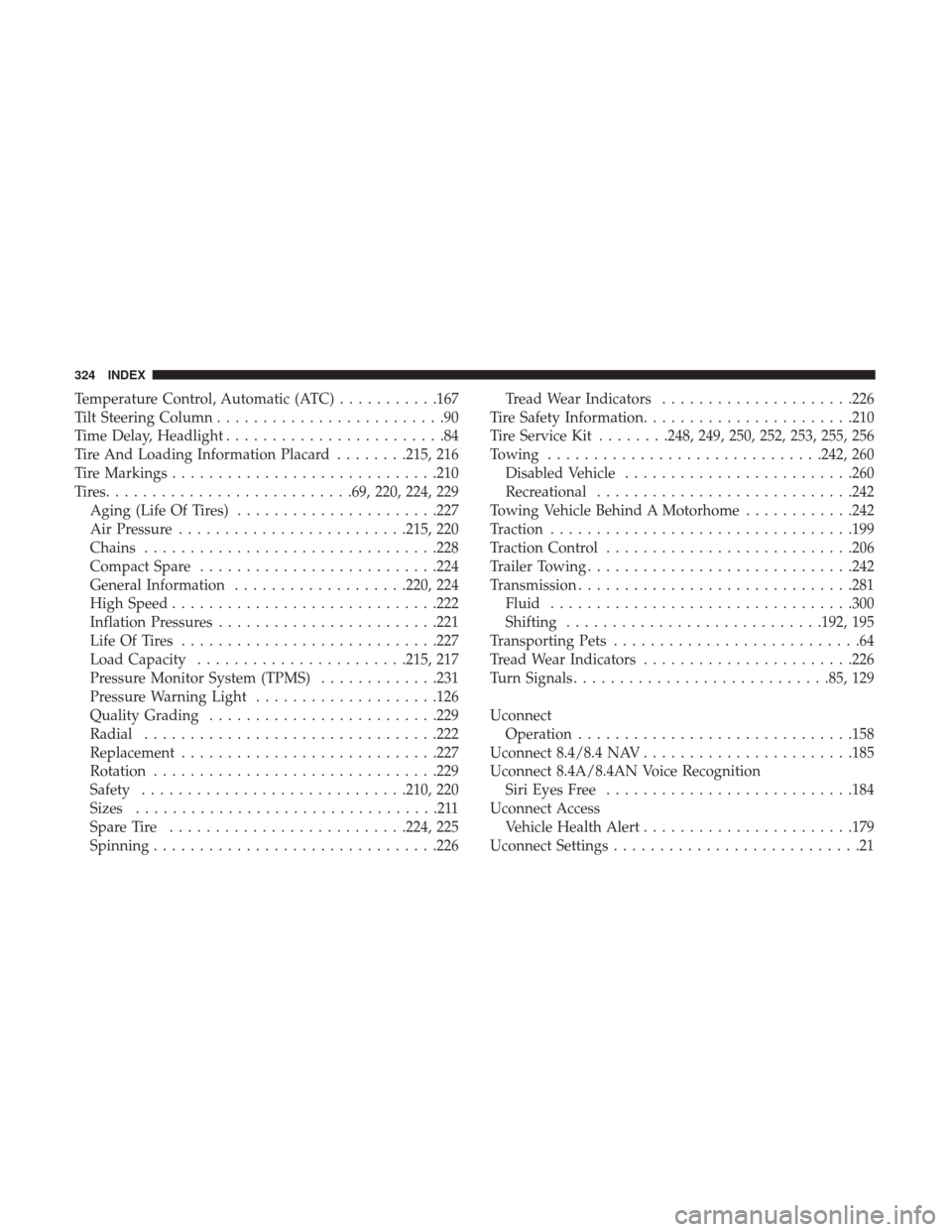
Temperature Control, Automatic (ATC)...........167
Tilt Steering Column .........................90
Time Delay, Headlight ........................84
Tire And Loading Information Placard ........215, 216
Tire Markings ............................ .210
Tires.......................... .69, 220, 224, 229
Aging (Life Of Tires) ..................... .227
Air Pressure ........................ .215, 220
Chains ............................... .228
Compact Spare ......................... .224
General Information ...................220, 224
High Speed ............................ .222
Inflation Pressures ....................... .221
Life Of Tires ........................... .227
Load Capacity ...................... .215, 217
Pressure Monitor System (TPMS) .............231
Pressure Warning Light ....................126
Quality Grading ........................ .229
Radial ............................... .222
Replacement ........................... .227
Rotation .............................. .229
Safety ............................ .210, 220
Sizes .................................211
Spare Tire ......................... .224, 225
Spinning .............................. .226Tread Wear Indicators
.....................226
Tire Safety Information ...................... .210
Tire Service Kit ........248, 249, 250, 252, 253, 255, 256
Towing ............................. .242, 260
Disabled Vehicle ........................ .260
Recreational ........................... .242
Towing Vehicle Behind A Motorhome ............242
Traction ................................ .199
Traction Control .......................... .206
Trailer Towing ............................ .242
Transmission ............................. .281
Fluid ................................ .300
Shifting ........................... .192,
195
Transporting Pets ...........................64
Tread Wear Indicators ...................... .226
Turn Signals ........................... .85, 129
Uconnect Operation ............................. .158
Uconnect 8.4/8.4 NAV ...................... .185
Uconnect 8.4A/8.4AN Voice Recognition Siri Eyes Free .......................... .184
Uconnect Access Vehicle Health Alert ...................... .179
Uconnect Settings ...........................21
324 INDEX