service DODGE VIPER 2017 VX / 3.G Repair Manual
[x] Cancel search | Manufacturer: DODGE, Model Year: 2017, Model line: VIPER, Model: DODGE VIPER 2017 VX / 3.GPages: 329, PDF Size: 2.83 MB
Page 276 of 329
Exhaust System
The best protection against carbon monoxide entry into the
vehicle body is a properly maintained engine exhaust
system.
If you notice a change in the sound of the exhaust system;
or if the exhaust fumes can be detected inside the vehicle;
or when the underside or rear of the vehicle is damaged;
have an authorized technician inspect the complete ex-
haust system and adjacent body areas for broken, dam-
aged, deteriorated, or mispositioned parts. Open seams or
loose connections could permit exhaust fumes to seep into
the passenger compartment. In addition, have the exhaust
system inspected each time the vehicle is raised for lubri-
cation or oil change. Replace as required.
WARNING!
•Exhaust gases can injure or kill. They contain carbon
monoxide (CO), which is colorless and odorless.
Breathing it can make you unconscious and can even-
tually poison you. To avoid breathing CO, refer to
“Safety Tips/Exhaust Gas” in “Things To Know Before
Starting Your Vehicle” for further information.
(Continued)
WARNING! (Continued)
•A hot exhaust system can start a fire if you park over
materials that can burn. Such materials might be
grass or leaves coming into contact with your exhaust
system. Do not park or operate your vehicle in areas
where your exhaust system can contact anything that
can burn.
CAUTION!
• The catalytic converter requires the use of unleaded
fuel only. Leaded gasoline will destroy the effective-
ness of the catalyst as an emissions control device
and may seriously reduce engine performance and
cause serious damage to the engine.
• Damage to the catalytic converter can result if your
vehicle is not kept in proper operating condition. In
the event of engine malfunction, particularly involv-
ing engine misfire or other apparent loss of perfor-
mance, have your vehicle serviced promptly. Contin-
ued operation of your vehicle with a severe
malfunction could cause the converter to overheat,
resulting in possible damage to the converter and
vehicle.
274 MAINTAINING YOUR VEHICLE
Page 277 of 329
Under normal operating conditions, the catalytic converter
will not require maintenance. However, it is important to
keep the engine properly tuned to assure proper catalyst
operation and prevent possible catalyst damage.
NOTE:Intentional tampering with emissions control sys-
tems can result in civil penalties being assessed against
you.
In unusual situations involving grossly malfunctioning
engine operation, a scorching odor may suggest severe and
abnormal catalyst overheating. If this occurs, stop the
vehicle, turn off the engine and allow it to cool. Service,
including a tune-up to manufacturer’s specifications,
should be obtained immediately.
To minimize the possibility of catalytic converter damage:
• Do not shut off the engine or interrupt the ignition,
when the transmission is in gear and the vehicle is in
motion.
• Do not try to start the engine by pushing or towing the
vehicle.
• Do not idle the engine with any spark plug wires
disconnected or removed, such as when diagnostic
testing, or for prolonged periods during very rough idle
or malfunctioning operating conditions.Cooling System
WARNING!
• When working near the radiator cooling fan, discon-
nect the fan motor lead or cycle the ignition switch to
the LOCK position. The fan is temperature con-
trolled and can start at any time the ignition switch is
in the ON position.
• You or others can be badly burned by hot engine
coolant (antifreeze) or steam from your radiator. If
you see or hear steam coming from under the hood,
do not open the hood until the radiator has had time
to cool. Never try to open a cooling system pressure
cap when the radiator is hot.
Coolant Checks
Check engine coolant (antifreeze) protection every 12
months (before the onset of freezing weather, where appli-
cable). If the engine coolant (antifreeze) is dirty, the system
should be drained, flushed, and refilled with fresh OAT
coolant (conforming to MS.90032) by an authorized dealer.
Check the front of the A/C condenser/radiator for any
accumulation of bugs, leaves, etc. If dirty, clean by gently
spraying water from a garden hose vertically down the face
of the condenser/radiator.
7
MAINTAINING YOUR VEHICLE 275
Page 280 of 329
Cooling System Pressure Cap
The cap must be fully tightened to prevent loss of engine
coolant (antifreeze), and to insure that engine coolant
(antifreeze) will return to the radiator from the coolant
recovery bottle.
The cap should be inspected and cleaned if there is any
accumulation of foreign material on the sealing surfaces.
WARNING!
•The warning words “DO NOT OPEN HOT” on the
cooling system pressure cap are a safety precaution.
Never add engine coolant (antifreeze) when the
engine is overheated. Do not loosen or remove the
cap to cool an overheated engine. Heat causes pres-
sure to build up in the cooling system. To prevent
scalding or injury, do not remove the pressure cap
while the system is hot or under pressure.
• Do not use a pressure cap other than the one speci-
fied for your vehicle. Personal injury or engine
damage may result.
Disposal Of Used Engine Coolant
Used ethylene glycol-based engine coolant (antifreeze) is a
regulated substance requiring proper disposal. Check with your local authorities to determine the disposal rules for
your community. To prevent ingestion by animals or
children, do not store ethylene glycol-based engine coolant
(antifreeze) in open containers or allow it to remain in
puddles on the ground. If ingested by a child or pet, seek
emergency assistance immediately. Clean up any ground
spills immediately.
Coolant Level
The coolant bottle provides a quick visual method for
determining that the coolant level is adequate. With the
engine OFF and cold, the level of the engine coolant
(antifreeze) in the bottle should be between the ranges
indicated on the bottle.
The radiator normally remains completely full, so there is
no need to remove the radiator/coolant pressure cap
unless checking for engine coolant (antifreeze) freeze point
or replacing coolant. Advise your service attendant of this.
As long as the engine operating temperature is satisfactory,
the coolant bottle need only be checked once a month.
When additional engine coolant (antifreeze) is needed to
maintain the proper level, only OAT coolant that meets the
requirements of FCA Material Standard MS.90032 should
be added to the coolant bottle. Do not overfill.
278 MAINTAINING YOUR VEHICLE
Page 282 of 329
Master Cylinder — Brake Fluid Level Check
Check the fluid level in the master cylinder immediately if
the brake system warning light indicates system failure.
Check the fluid level in the master cylinder when perform-
ing underhood services.
Clean the top of the master cylinder area before removing
the cap. If necessary, add fluid to bring the fluid level up to
the requirements described on the brake fluid reservoir.
Overfilling of fluid is not recommended because it may
cause leaking in the system.
With disc brakes, fluid level can be expected to fall as the
brake pads wear. However, low fluid level may be caused
by a leak and a checkup may be needed.
Use only the manufacturer’s recommended brake fluid.
Refer to “Fluids, Lubricants, And Genuine Parts” in “Main-
taining Your Vehicle” for further information. Use of a
brake fluid that may have a lower initial boiling point or
unidentified as to specification, may result in sudden brake
failure during hard prolonged braking.
WARNING!
•Use only manufacturer ’s recommended brake fluid.
Refer to “Fluids, Lubricants, And Genuine Parts” in
“Maintaining Your Vehicle” for further information.
Using the wrong type of brake fluid can severely
damage your brake system and/or impair its perfor-
mance. The proper type of brake fluid for your
vehicle is also identified on the original factory
installed hydraulic master cylinder reservoir.
• To avoid contamination from foreign matter or mois-
ture, use only new brake fluid or fluid that has been
in a tightly closed container. Keep the master cylin-
der reservoir cap secured at all times. Brake fluid in
a open container absorbs moisture from the air
resulting in a lower boiling point. This may cause it
to boil unexpectedly during hard or prolonged brak-
ing, resulting in sudden brake failure. This could
result in a accident.
• Overfilling the brake fluid reservoir can result in
spilling brake fluid on hot engine parts, causing the
brake fluid to catch fire. Brake fluid can also damage
painted and vinyl surfaces, care should be taken to
avoid its contact with these surfaces.
(Continued)
280 MAINTAINING YOUR VEHICLE
Page 283 of 329
WARNING!(Continued)
•Do not allow petroleum based fluid to contaminate
the brake fluid. Brake seal components could be
damaged, causing partial or complete brake failure.
This could result in an accident.
Change Brake Fluid
Brake fluid will tend to absorb moisture from the atmo-
sphere over time. If the fluid becomes contaminated with
water, brake performance will deteriorate. Therefore, the
brake fluid must be changed at the intervals specified in
the “Maintenance Schedule.” Refer to “Maintenance
Schedule” for further information. See your authorized
dealer for service.
Manual Transmission
Transmission Fluid Level Check
Check the fluid in the transmission when performing other
underbody services.
Check the fluid level by removing the fill plug located on
the left side of the transmission. The fluid level should be
approximately 1/4 in (6.4 mm) below the bottom of the fill
hole. Add fluid, if necessary, to maintain the proper level. Refer to “Fluids, Lubricants, And Genuine Parts” in “Main-
taining Your Vehicle” for further information.
NOTE: DO NOT
overfill transmission, damage can occur.
CAUTION!
Using a transmission fluid other than the manufactur-
er’s recommended fluid may cause deterioration in
transmission shift quality and/or damage to the trans-
mission. Refer to “Fluids, Lubricants, And Genuine
Parts” in this section for fluid specifications.
Change Transmission Fluid
Refer to “Maintenance Schedule” for the proper mainte-
nance intervals. If contaminated with water, change the
fluid immediately. See your authorized dealer for service.
Hydraulic Clutch
Master Cylinder — Clutch Fluid Level Check
The clutch hydraulic system is fed by a segregated volume
of fluid within the brake system master cylinder reservoir.
In the event of leakage or wear, use only the manufactur-
er’s recommended brake fluid. Refer to “Fluids, Lubri-
cants, And Genuine Parts” in “Maintaining Your Vehicle”
for further information.
7
MAINTAINING YOUR VEHICLE 281
Page 284 of 329
Rear Axle
Axle Lubricant Level Check
Check the exterior of the axle for evidence of gear oil
leakage every 12 months or 6,000 miles (10 000 km). This
check should be made with the vehicle level and on the
ground or raised on an axle and wheel type hoist. The axle
lubricant level should be between the bottom of the filler
plug and a point approximately 3/8 inch (9.5 mm) below
the filler plug. If adding axle lubricant, use only the
manufacturer’s recommended axle lubricant. Refer to “Flu-
ids, Lubricants, And Genuine Parts” in “Maintaining Your
Vehicle” for further information.
CAUTION!
Using axle fluid other than the manufactured recom-
mended fluid may cause a shudder/noise issue. refer to
“Fluids, Lubes, And Genuine Parts” in “ Maintaining
Your Vehicle” for further information.
Change Axle Lubricant
Refer to “Maintenance Schedule” for the proper mainte-
nance intervals. Change the lubricant immediately if con-
taminated with water. See your authorized dealer for
service.
Appearance Care And Protection From Corrosion
Protection Of Body And Paint From Corrosion
Vehicle body care requirements vary according to geo-
graphic locations and usage. Chemicals that make roads
passable in snow and ice, and chemicals that are sprayed
on trees and road surfaces during other seasons, are highly
corrosive to the metal in your vehicle. Outside parking,
which exposes your vehicle to airborne contaminants, road
surfaces on which the vehicle is operated, extreme hot or
cold weather and other extreme conditions will have an
adverse effect on paint, metal trim, and underbody protec-
tion.
The following maintenance recommendations will enable
you to obtain maximum benefit from the corrosion resis-
tance built into your vehicle.
Washing
•Wash your vehicle regularly. Always wash your vehicle
in the shade using MOPAR Car Wash, or a mild car wash
soap, and rinse the panels completely with clear water.
• If insects, tar, or other similar deposits have accumulated
on your vehicle, use MOPAR Super Kleen Bug and Tar
Remover to remove.
282 MAINTAINING YOUR VEHICLE
Page 291 of 329
FUSES
WARNING!
•When replacing a blown fuse, always use an appro-
priate replacement fuse with the same amp rating as
the original fuse. Never replace a fuse with another
fuse of higher amp rating. Never replace a blown
fuse with metal wires or any other material. Failure
to use proper fuses may result in serious personal
injury, fire and/or property damage.
• Before replacing a fuse, make sure that the ignition is
off and that all the other services are switched off
and/or disengaged.
• If the replaced fuse blows again, contact an autho-
rized dealer.
• If a general protection fuse for safety systems (air
bag system, braking system), power unit systems
(engine system, gearbox system) or steering system
blows, contact an authorized dealer.
Power Distribution Center
The Power Distribution Center is located in the engine
compartment on the driver’s side of the vehicle. This center
contains fuses and relays.
Cavity RelayCartridge FuseMini-Fuse Description
3 — 40 Amp Green — Rad Fan
4 — 40 Amp Green — Rad Fan Rly High
5 — 40 Amp Green — ABS/ESP Pump Feed
Power Distribution Center
7
MAINTAINING YOUR VEHICLE 289
Page 297 of 329
the vehicle’s battery. If the vehicle is not going to be
driven in the next three weeks, perform the battery
recharge procedure in the Service Manual. Then, either
disconnect the battery at the negative terminal or use
“Hibernation Mode” to conserve battery power. Refer to
“Maintenance Procedures/Hibernation Mode” in
“Maintaining Your Vehicle” for further information.
• Cover the vehicle whenever possible to prevent acciden-
tal damage to the finish.
NOTE: Disconnecting the battery causes the engine control
system to lose memory of some “learned” functions. After
reconnecting the battery, the engine may run rough until
the control module “relearns” these functions. Using the
Battery Save Feature will prevent the engine controller
from loosing its memory.
CAUTION!
Use care when disconnecting the remote positive cable.
It is connected to the battery and can short out to any
metal on the vehicle. Always tape or wrap the exposed
cable end to prevent electrical shorts.
Check the battery every four to six weeks to ensure that the
voltage is above 12.10 Volts. The voltage will drop more rapidly in hot temperatures. If battery voltage drops below
12.10 Volts, follow the battery recharge procedure in the
Service Manual.
NOTE:
To help prevent the battery from discharging dur-
ing shorter periods of inactivity, perform the following:
1. Make sure that the liftgate, hood, doors, windows are completely closed.
2. Make sure that the key fob is operating and that the battery is good.
3. Make sure that the HOOD, LIFTGATE, and DOOR switches are in adjustment. Perform the quick system
check, which follows:
Use the key fob to set the alarm. If the alarm SET light
comes on and flashes, the system is operating properly. If
not, there is a problem with a switch or the system. See
your authorized dealer for service.
If you plan to store the vehicle longer than 30 days, we
recommend using Hibernation Mode to conserve battery
power. Refer to “Hibernation Mode” in Maintenance
Procedures for further information.
7
MAINTAINING YOUR VEHICLE 295
Page 298 of 329
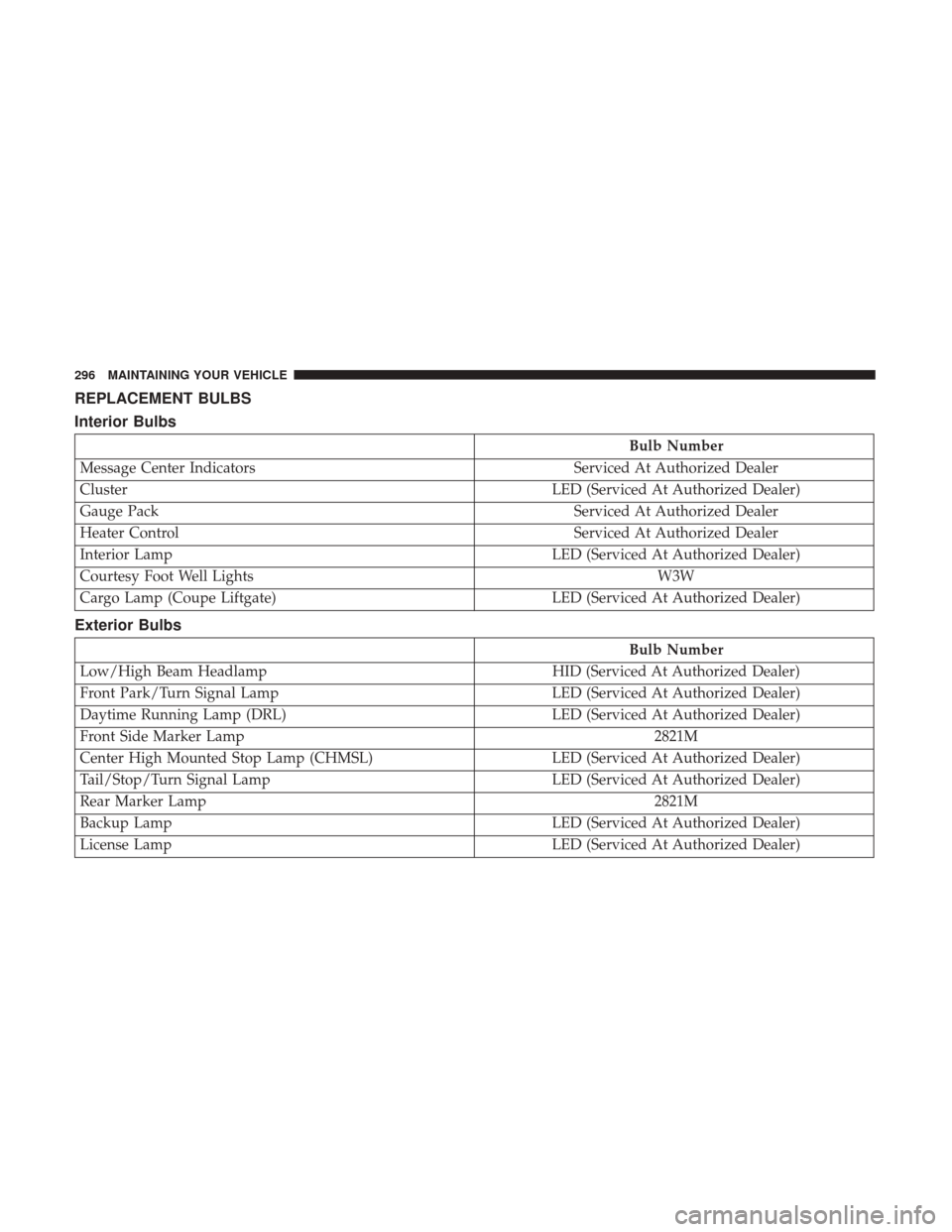
REPLACEMENT BULBS
Interior Bulbs
Bulb Number
Message Center Indicators Serviced At Authorized Dealer
Cluster LED (Serviced At Authorized Dealer)
Gauge Pack Serviced At Authorized Dealer
Heater Control Serviced At Authorized Dealer
Interior Lamp LED (Serviced At Authorized Dealer)
Courtesy Foot Well Lights W3W
Cargo Lamp (Coupe Liftgate) LED (Serviced At Authorized Dealer)
Exterior Bulbs
Bulb Number
Low/High Beam Headlamp HID (Serviced At Authorized Dealer)
Front Park/Turn Signal Lamp LED (Serviced At Authorized Dealer)
Daytime Running Lamp (DRL) LED (Serviced At Authorized Dealer)
Front Side Marker Lamp 2821M
Center High Mounted Stop Lamp (CHMSL) LED (Serviced At Authorized Dealer)
Tail/Stop/Turn Signal Lamp LED (Serviced At Authorized Dealer)
Rear Marker Lamp 2821M
Backup Lamp LED (Serviced At Authorized Dealer)
License Lamp LED (Serviced At Authorized Dealer)
296 MAINTAINING YOUR VEHICLE
Page 304 of 329
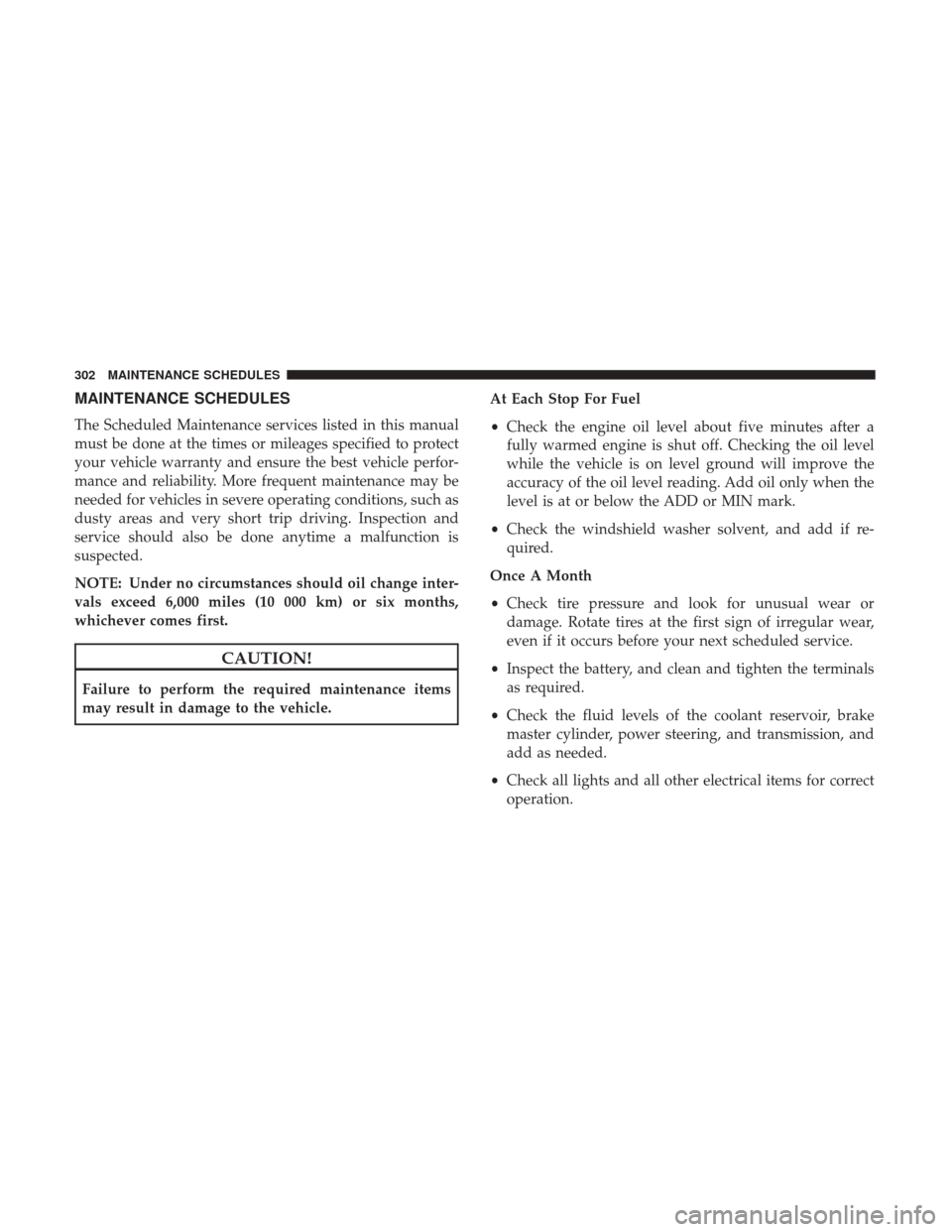
MAINTENANCE SCHEDULES
The Scheduled Maintenance services listed in this manual
must be done at the times or mileages specified to protect
your vehicle warranty and ensure the best vehicle perfor-
mance and reliability. More frequent maintenance may be
needed for vehicles in severe operating conditions, such as
dusty areas and very short trip driving. Inspection and
service should also be done anytime a malfunction is
suspected.
NOTE: Under no circumstances should oil change inter-
vals exceed 6,000 miles (10 000 km) or six months,
whichever comes first.
CAUTION!
Failure to perform the required maintenance items
may result in damage to the vehicle.At Each Stop For Fuel
•
Check the engine oil level about five minutes after a
fully warmed engine is shut off. Checking the oil level
while the vehicle is on level ground will improve the
accuracy of the oil level reading. Add oil only when the
level is at or below the ADD or MIN mark.
• Check the windshield washer solvent, and add if re-
quired.
Once A Month
• Check tire pressure and look for unusual wear or
damage. Rotate tires at the first sign of irregular wear,
even if it occurs before your next scheduled service.
• Inspect the battery, and clean and tighten the terminals
as required.
• Check the fluid levels of the coolant reservoir, brake
master cylinder, power steering, and transmission, and
add as needed.
• Check all lights and all other electrical items for correct
operation.
302 MAINTENANCE SCHEDULES