ESP DODGE VIPER SRT 2016 VX / 3.G Owner's Guide
[x] Cancel search | Manufacturer: DODGE, Model Year: 2016, Model line: VIPER SRT, Model: DODGE VIPER SRT 2016 VX / 3.GPages: 427, PDF Size: 3.02 MB
Page 308 of 427
CAUTION!(Continued)
•The use of fuel additives, which are now being
sold as octane enhancers, is not recommended.
Most of these products contain high concentrations
of methanol. Fuel system damage or vehicle perfor-
mance problems resulting from the use of such
fuels or additives is not the responsibility of the
manufacturer and may void or not be covered
under the New Vehicle Limited Warranty.
NOTE: Intentional tampering with the emissions control
system can result in civil penalties being assessed against
you.
Carbon Monoxide Warnings
WARNING!
Carbon monoxide (CO) in exhaust gases is deadly.
Follow the precautions below to prevent carbon
monoxide poisoning:
• Do not inhale exhaust gases. They contain carbon
monoxide, a colorless and odorless gas, which can
kill. Never run the engine in a closed area, such as
a garage, and never sit in a parked vehicle with the
engine running for an extended period. If the
vehicle is stopped in an open area with the engine
running for more than a short period, adjust the
ventilation system to force fresh, outside air into
the vehicle.
• Guard against carbon monoxide with proper main-
tenance. Have the exhaust system inspected every
(Continued)
306 STARTING AND OPERATING
Page 323 of 427
WARNING!(Continued)
•Keep Tire Service Kit away from open flames or
heat source.
• A loose Tire Service Kit thrown forward in a
collision or hard stop could endanger the occupants
of the vehicle. Always stow the Tire Service Kit in
the place provided. Failure to follow these warn-
ings can result in injuries that are serious or fatal to
you, your passengers, and others around you.
• Take care not to allow the contents of Tire Service
Kit to come in contact with hair, eyes, or clothing.
Tire Service Kit sealant is harmful if inhaled,
swallowed, or absorbed through the skin. It causes
skin, eye, and respiratory irritation. Flush immedi-
ately with plenty of water if there is any contact
with eyes or skin. Change clothing as soon as
possible, if there is any contact with clothing.
(Continued)
WARNING! (Continued)
•Tire Service Kit Sealant solution contains latex. In
case of an allergic reaction or rash, consult a phy-
sician immediately. Keep Tire Service Kit out of
reach of children. If swallowed, rinse mouth imme-
diately with plenty of water and drink plenty of
water. Do not induce vomiting! Consult a physician
immediately.
Sealing A Tire With Tire Service Kit
(A) Whenever You Stop To Use Tire Service Kit:
1. Pull over to a safe location and turn on the vehicle’s Hazard Warning flashers.
2. Verify that the valve stem (on the wheel with the deflated tire) is in a position that is near to the ground.
This will allow the Tire Service Kit Hoses (6) and (7) to
reach the valve stem and keep the Tire Service Kit flat
6
WHAT TO DO IN EMERGENCIES 321
Page 357 of 427
•Use only high purity water such as distilled or deion-
ized water when mixing the water/engine coolant
(antifreeze) solution. The use of lower quality water
will reduce the amount of corrosion protection in the
engine cooling system.
NOTE:
• It is the owner’s responsibility to maintain the proper
level of protection against freezing according to the
temperatures occurring in the area where the vehicle is
operated.
• Some vehicles require special tools to add coolant
properly. Failure to fill these systems properly could
lead to severe internal engine damage. If any coolant is
needed to be added to the system, please contact your
local authorized dealer.
• Mixing engine coolant (antifreeze) types is not recom-
mended and can result in cooling system damage. If HOAT and OAT coolant are mixed in an emergency,
have a authorized dealer drain, flush, and refill with
OAT coolant (conforming to MS.90032) as soon as
possible.
Cooling System Pressure Cap
The cap must be fully tightened to prevent loss of engine
coolant (antifreeze), and to insure that engine coolant
(antifreeze) will return to the radiator from the coolant
recovery bottle.
The cap should be inspected and cleaned if there is any
accumulation of foreign material on the sealing surfaces.
WARNING!
•
The warning words “DO NOT OPEN HOT” on the
cooling system pressure cap are a safety precaution.
Never add engine coolant (antifreeze) when the
(Continued)
7
MAINTAINING YOUR VEHICLE 355
Page 365 of 427
•Use a high quality cleaner wax, such as MOPAR
Cleaner Wax to remove road film, stains and to protect
your paint finish. Take care never to scratch the paint.
• Avoid using abrasive compounds and power buffing
that may diminish the gloss or thin out the paint finish.
CAUTION!
• Do not use abrasive or strong cleaning materials
such as steel wool or scouring powder that will
scratch metal and painted surfaces.
• Use of power washers exceeding 1,200 psi
(8 274 kPa) can result in damage or removal of paint
and decals.
Wheel And Wheel Trim Care
All wheels and wheel trim, especially aluminum and
chrome plated wheels, should be cleaned regularly using
mild (neutral Ph) soap and water to maintain their luster
and to prevent corrosion. Wash wheels with the same
soap solution recommended for the body of the vehicle.
Your wheels are susceptible to deterioration caused by
salt, sodium chloride, magnesium chloride, calcium chlo-
ride, etc., and other road chemicals used to melt ice or
control dust on dirt roads. Use a soft cloth or sponge and
mild soap to wipe away promptly. Do not use harsh
chemicals or a stiff brush. They can damage the wheel’s
protective coating that helps keep them from corroding
and tarnishing.
NOTE: Many aftermarket wheel cleaners contain strong
acids or strong alkaline additives that can harm the wheel
surface.
7
MAINTAINING YOUR VEHICLE 363
Page 367 of 427
Dark Vapor Or Black Satin Chrome Wheels
CAUTION!
If your vehicle is equipped with Dark Vapor or Black
Satin Chrome wheels DO NOT USE wheel cleaners,
abrasives or polishing compounds. They will perma-
nently damage this finish and such damage is not
covered by the New Vehicle Limited Warranty. USE
ONLY MILD SOAP AND WATER WITH A SOFT
CLOTH. Used on a regular basis this is all that is
required to maintain this finish.
Interior Care
Use MOPAR Total Clean to clean fabric upholstery and
carpeting.
Use MOPAR Total Clean to clean vinyl upholstery.MOPAR Total Clean is specifically recommended for
leather upholstery.
Your leather upholstery can be best preserved by regular
cleaning with a damp soft cloth. Small particles of dirt
can act as an abrasive and damage the leather upholstery
and should be removed promptly with a damp cloth.
Stubborn soils can be removed easily with a soft cloth
and MOPAR Total Clean. Care should be taken to avoid
soaking your leather upholstery with any liquid. Please
do not use polishes, oils, cleaning fluids, solvents, deter-
gents, or ammonia-based cleaners to clean your leather
upholstery. Application of a leather conditioner is not
required to maintain the original condition.WARNING!
Do not use volatile solvents for cleaning purposes.
Many are potentially flammable, and if used in
closed areas they may cause respiratory harm.
7
MAINTAINING YOUR VEHICLE 365
Page 374 of 427
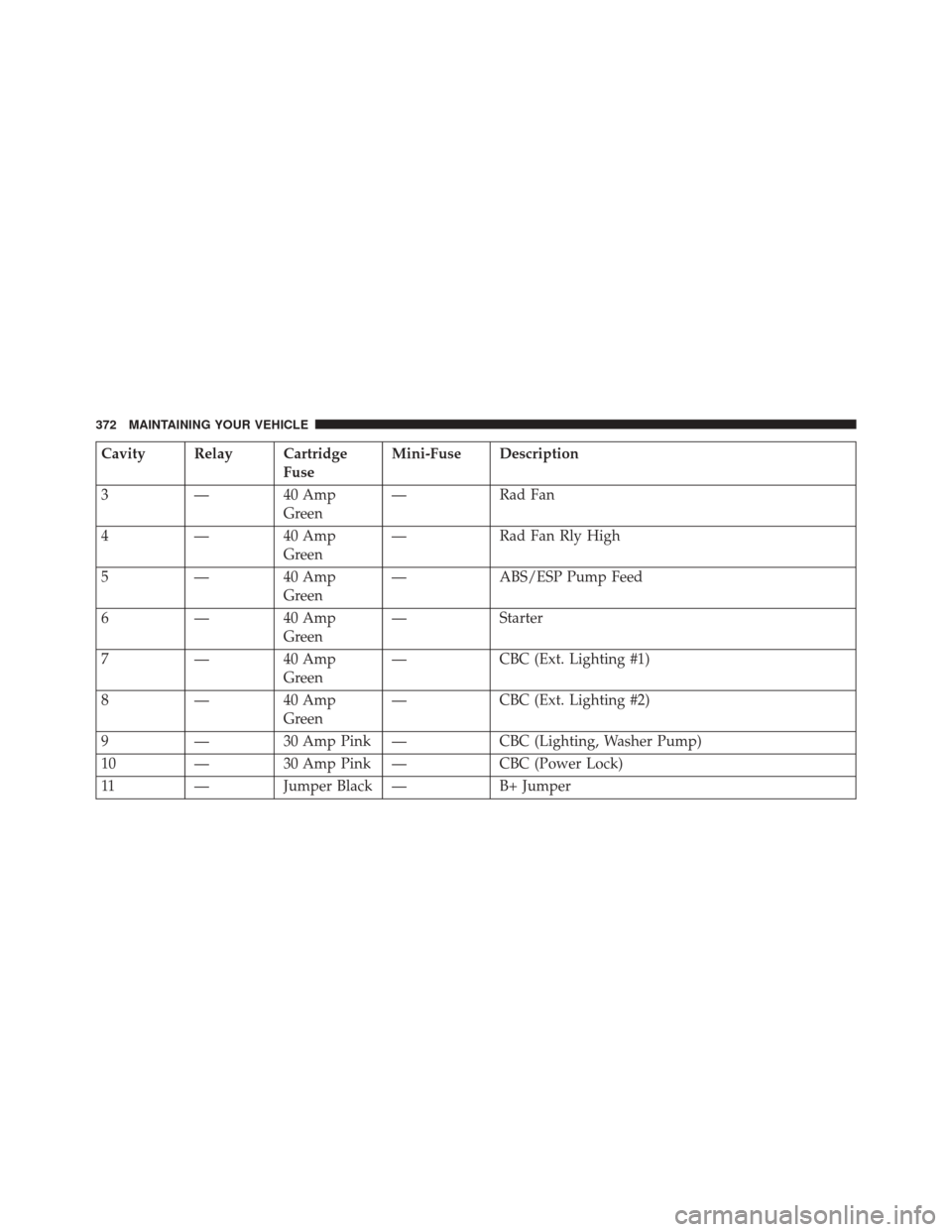
Cavity Relay CartridgeFuseMini-Fuse Description
3 — 40 Amp Green— Rad Fan
4 — 40 Amp Green— Rad Fan Rly High
5 — 40 Amp Green— ABS/ESP Pump Feed
6 — 40 Amp Green— Starter
7 — 40 Amp Green— CBC (Ext. Lighting #1)
8 — 40 Amp Green— CBC (Ext. Lighting #2)
9 — 30 Amp Pink — CBC (Lighting, Washer Pump)
10 — 30 Amp Pink — CBC (Power Lock)
11 — Jumper Black — B+ Jumper
372 MAINTAINING YOUR VEHICLE
Page 375 of 427
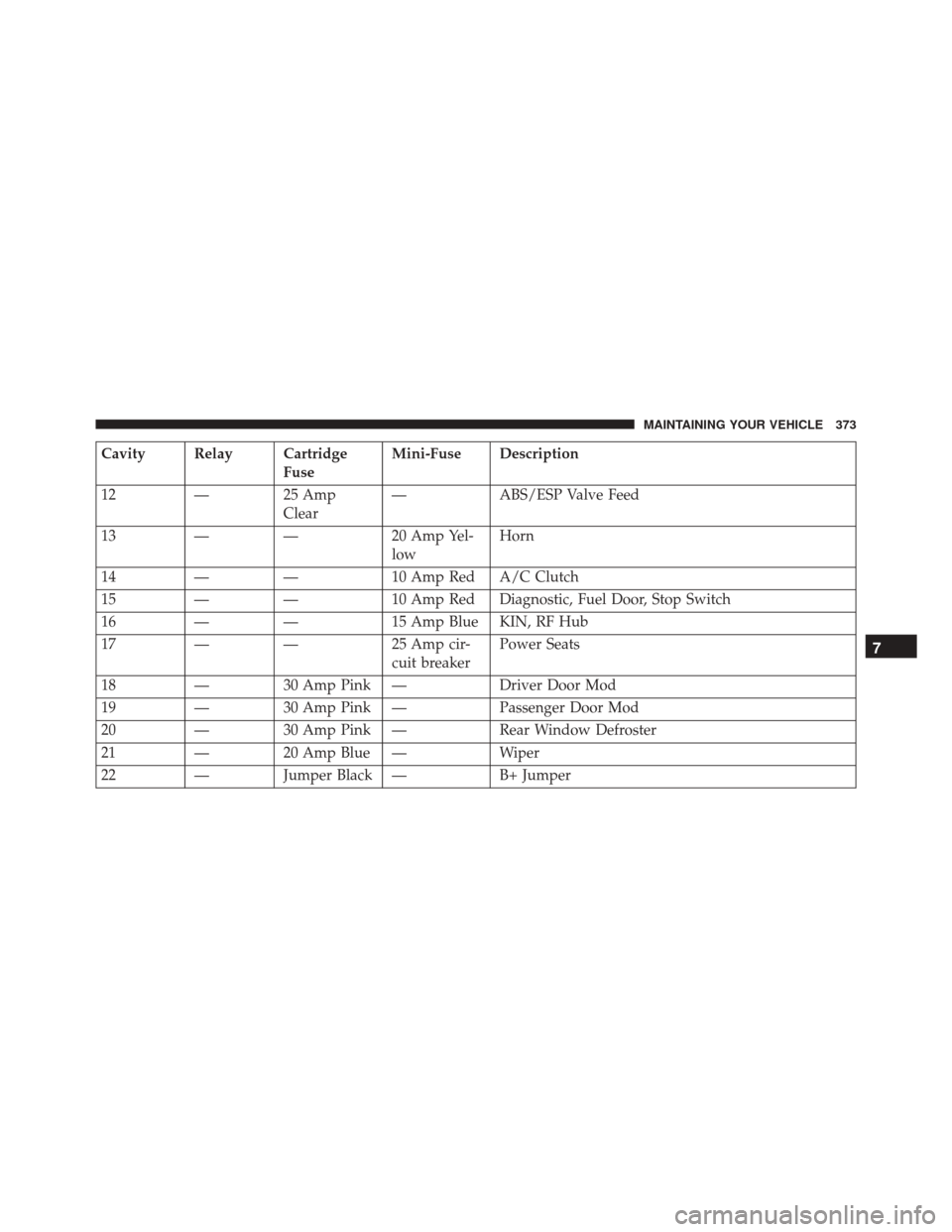
Cavity Relay CartridgeFuseMini-Fuse Description
12 — 25 Amp Clear— ABS/ESP Valve Feed
13 — — 20 Amp Yel- lowHorn
14 —— 10 Amp Red A/C Clutch
15 —— 10 Amp Red Diagnostic, Fuel Door, Stop Switch
16 —— 15 Amp Blue KIN, RF Hub
17 —— 25 Amp cir-
cuit breakerPower Seats
18 —30 Amp Pink — Driver Door Mod
19 —30 Amp Pink — Passenger Door Mod
20 —30 Amp Pink — Rear Window Defroster
21 —20 Amp Blue — Wiper
22 —Jumper Black — B+ Jumper
7
MAINTAINING YOUR VEHICLE 373
Page 404 of 427
The manufacturer will not stand behind any service
contract that is not the manufacturer’s service contract. It
is not responsible for any service contract other than the
manufacturer’s service contract. If you purchased a ser-
vice contract that is not a manufacturer’s service contract,
and you require service after the manufacturer’s New
Vehicle Limited Warranty expires, please refer to the
contract documents, and contact the person listed in
those documents.
We appreciate that you have made a major investment
when you purchased the vehicle. An authorized dealer
has also made a major investment in facilities, tools, and
training to assure that you are absolutely delighted with
the ownership experience. You will be pleased with their
sincere efforts to resolve any warranty issues or related
concerns.WARNING!
Engine exhaust (internal combustion engines only),
some of its constituents, and certain vehicle compo-
nents contain, or emit, chemicals known to the State
of California to cause cancer and birth defects, or
other reproductive harm. In addition, certain fluids
contained in vehicles and certain products of compo-
nent wear contain, or emit, chemicals known to the
State of California to cause cancer and birth defects,
or other reproductive harm.
WARRANTY INFORMATION
See the Warranty Information Booklet, located on the
DVD, for the terms and provisions of FCA US LLC
warranties applicable to this vehicle and market.
402 IF YOU NEED CONSUMER ASSISTANCE
Page 408 of 427
WARNING!
The traction grade assigned to this tire is based on
straight-ahead braking traction tests, and does not
include acceleration, cornering, hydroplaning, or
peak traction characteristics.
Temperature Grades
The temperature grades are A (the highest), B, and C,
representing the tire’s resistance to the generation of heat
and its ability to dissipate heat, when tested under
controlled conditions on a specified indoor laboratory
test wheel. Sustained high temperature can cause the
material of the tire to degenerate and reduce tire life, and
excessive temperature can lead to sudden tire failure. The
grade C corresponds to a level of performance, which all
passenger vehicle tires must meet under the Federal
Motor Vehicle Safety Standard No. 109. Grades B and Arepresent higher levels of performance on the laboratory
test wheel, than the minimum required by law.
WARNING!
The temperature grade for this tire is established for
a tire that is properly inflated and not overloaded.
Excessive speed, under-inflation, or excessive load-
ing, either separately or in combination, can cause
heat buildup and possible tire failure.
406 IF YOU NEED CONSUMER ASSISTANCE
Page 410 of 427
About Your Brakes....................... .263
ABS (Anti-Lock Brake System) ................265
Adding Engine Coolant (Antifreeze) ............354
Adding Fuel ............................ .307
Adding Washer Fluid ..................... .349
Additives, Fuel .......................... .304
Adjust Forward ............................. .103
Rearward ............................ .103
Adjustable Pedals .........................118
AirBag.............................. .47, 48
Advance Front Air Bag .................48, 49
Air Bag Operation .......................51
Air Bag Warning Light ....................69
Enhanced Accident Response ................68
Event Data Recorder (EDR) .................72
FrontAirBag ........................47, 48
If A Deployment Occurs ...................67
Knee Impact Bolsters .....................64 Maintaining Your Air Bag System
............71
Transporting Pets ........................84
Air Bag Deployment ........................47
Air Bag Light ...................... .69, 88, 153
Air Bag Maintenance .......................71
Air Cleaner, Engine (Engine Air Cleaner Filter) . . . .343
Air Conditioner Maintenance .................346
Air Conditioning, Operating Tips ..............220
Air Conditioning Refrigerant ..............346, 347
Air Conditioning System ....................346
Air Pressure, Tires ........................ .284
Alarm (Security Alarm) .....................156
Alarm System (Security Alarm) ................18
Alterations/Modifications, Vehicle ...............7
Antenna ............................... .212
Antifreeze (Engine Coolant) ...............353, 384
Capacities ........................... .384
Disposal ............................. .356
Anti-Lock Brake System (ABS) ................265
408 INDEX