wheel DODGE VIPER SRT 2016 VX / 3.G Workshop Manual
[x] Cancel search | Manufacturer: DODGE, Model Year: 2016, Model line: VIPER SRT, Model: DODGE VIPER SRT 2016 VX / 3.GPages: 427, PDF Size: 3.02 MB
Page 333 of 427
11. Once the engine is started, remove the jumper cablesin the reverse sequence:
Disconnecting The Jumper Cables
1. Disconnect the negative (-)end of the jumper cable
from the remote negative (-)post of the vehicle with
the discharged battery.
2. Disconnect the opposite end of the negative (-)jumper
cable from the negative (-)post of the booster battery.
3. Disconnect the positive (+)end of the jumper cable
from the positive (+)post of the booster battery.
4. Disconnect the opposite end of the positive (+)jumper
cable from the remote positive (+)post of the vehicle
with the discharged battery.
If frequent jump-starting is required to start your vehicle
you should have the battery and charging system in-
spected at your authorized dealer.CAUTION!
Accessories plugged into the vehicle power outlets
draw power from the vehicle’s battery, even when not
in use (i.e., cellular devices, etc.). Eventually, if
plugged in long enough without engine operation,
the vehicle’s battery will discharge sufficiently to
degrade battery life and/or prevent the engine from
starting.
FREEING A STUCK VEHICLE
If your vehicle becomes stuck in mud, sand, or snow, it
can often be moved using a rocking motion. Turn your
steering wheel right and left to clear the area around the
front wheels. Then shift back and forth between 1st gear
and REVERSE, while gently pushing the accelerator. Use
the least amount of pressure to maintain the rocking
motion, without spinning the wheels, or racing the
engine.
6
WHAT TO DO IN EMERGENCIES 331
Page 334 of 427
CAUTION!
•When “rocking” a stuck vehicle by shifting be-
tween 1st gear and REVERSE, do not spin the
wheels faster than 15 mph (24 km/h), or drivetrain
damage may result.
• Revving the engine or spinning the wheels too fast
may lead to transmission overheating and failure.
It can also damage the tires. Do not spin the wheels
above 30 mph (48 km/h) while in gear (no trans-
mission shifting occurring).
WARNING!
Fast spinning tires can be dangerous. Forces gener-
ated by excessive wheel speeds may cause damage, or
even failure, of the axle and tires. A tire could
(Continued)
WARNING! (Continued)
explode and injure someone. Do not spin your vehi-
cle’s wheels faster than 30 mph (48 km/h) or for
longer than 30 seconds continuously without stop-
ping when you are stuck. And do not let anyone near
a spinning wheel, no matter what the speed.
TOWING A DISABLED VEHICLE
Do not tow with sling-type equipment. Only use flatbed
equipment. Always comply with applicable state or local
towing ordinances.
CAUTION!
Towing this vehicle in violation of the above require-
ments can cause severe transmission damage. Dam-
age from improper towing is not covered under the
New Vehicle Limited Warranty.
332 WHAT TO DO IN EMERGENCIES
Page 348 of 427
of storage time without losing radio and engine control-
ler adaptive memory. Using this feature is an alternative
to disconnecting the battery.
NOTE:This vehicle is designed to sit in storage with a
fully charged battery for up to 30 days. If you plan to
store the vehicle longer than 30 days, we recommend
doing one of the following:
• Disconnect the battery.
• Use the battery charger.
• Put the vehicle into Hibernation mode (3-month
charge).
To Activate Hibernation Mode
1. Cycle the ignition switch to (ACC).
2. Select Hibernation mode within the Driver Informa- tion Display (DID). 3. Push the right arrow button on the steering wheel
controls for one second. Vehicle will countdown from
ten seconds and enter Hibernation Mode.
NOTE: You may push the right arrow button on the
steering wheel controls during the countdown to abort
Hibernation Mode.
To Deactivate Hibernation Mode
1. Push the RKE UNLOCK button to unlock the vehicle.
2. Push the ignition switch to the ON/RUN position.
Air Conditioner Maintenance
For best possible performance, your air conditioner
should be checked and serviced by an authorized dealer
at the start of each warm season. This service should
include cleaning of the condenser fins and a performance
test. Drive belt tension should also be checked at this
time.
346 MAINTAINING YOUR VEHICLE
Page 363 of 427
CAUTION!
Using a transmission fluid other than the manufac-
turer’s recommended fluid may cause deterioration
in transmission shift quality and/or damage to the
transmission. Refer to “Fluids, Lubricants, And
Genuine Parts” in this section for fluid specifica-
tions.
Change Transmission Fluid
Refer to “Maintenance Schedule” for the proper mainte-
nance intervals. If contaminated with water, change the
fluid immediately. See your authorized dealer for service.
Hydraulic Clutch
Master Cylinder — Clutch Fluid Level Check
The clutch hydraulic system is fed by a segregated
volume of fluid within the brake system master cylinder
reservoir. In the event of leakage or wear, use only themanufacturer’s recommended brake fluid. Refer to “Flu-
ids, Lubricants, And Genuine Parts” in “Maintaining
Your Vehicle” for further information.
Rear Axle
Axle Lubricant Level Check
Check the exterior of the axle for evidence of gear oil
leakage every 12 months or 6,000 miles (10 000 km). This
check should be made with the vehicle level and on the
ground or raised on an axle and wheel type hoist. The
axle lubricant level should be between the bottom of the
filler plug and a point approximately 3/8 inch (9.5 mm)
below the filler plug. If adding axle lubricant, use only
the manufacturer’s recommended axle lubricant. Refer to
“Fluids, Lubricants, And Genuine Parts” in “Maintaining
Your Vehicle” for further information.
7
MAINTAINING YOUR VEHICLE 361
Page 365 of 427
•Use a high quality cleaner wax, such as MOPAR
Cleaner Wax to remove road film, stains and to protect
your paint finish. Take care never to scratch the paint.
• Avoid using abrasive compounds and power buffing
that may diminish the gloss or thin out the paint finish.
CAUTION!
• Do not use abrasive or strong cleaning materials
such as steel wool or scouring powder that will
scratch metal and painted surfaces.
• Use of power washers exceeding 1,200 psi
(8 274 kPa) can result in damage or removal of paint
and decals.
Wheel And Wheel Trim Care
All wheels and wheel trim, especially aluminum and
chrome plated wheels, should be cleaned regularly using
mild (neutral Ph) soap and water to maintain their luster
and to prevent corrosion. Wash wheels with the same
soap solution recommended for the body of the vehicle.
Your wheels are susceptible to deterioration caused by
salt, sodium chloride, magnesium chloride, calcium chlo-
ride, etc., and other road chemicals used to melt ice or
control dust on dirt roads. Use a soft cloth or sponge and
mild soap to wipe away promptly. Do not use harsh
chemicals or a stiff brush. They can damage the wheel’s
protective coating that helps keep them from corroding
and tarnishing.
NOTE: Many aftermarket wheel cleaners contain strong
acids or strong alkaline additives that can harm the wheel
surface.
7
MAINTAINING YOUR VEHICLE 363
Page 366 of 427
CAUTION!
Avoid products or automatic car washes that use
acidic solutions or strong alkaline additives or harsh
brushes. These products and automatic car washes
may damage the wheel’s protective finish. Such
damage is not covered by the New Vehicle Limited
Warranty. Only car wash soap, MOPAR Wheel
Cleaner or equivalent is recommended.
When cleaning extremely dirty wheels including exces-
sive brake dust, care must be taken in the selection of tire
and wheel cleaning chemicals and equipment to prevent
damage to the wheels. Mopar Wheel Treatment or Mopar
Chrome Cleaner or their equivalent is recommended or
select a non-abrasive, non-acidic cleaner for aluminum or
chrome wheels. Do not use any products on Dark Vapor
or Black Satin Chrome Wheels. They will permanently damage this finish and such damage is not covered by
the New Vehicle Limited Warranty.
CAUTION!
Do not use scouring pads, steel wool, a bristle brush,
metal polishes or oven cleaner. These products may
damage the wheel’s protective finish. Such damage is
not covered by the New Vehicle Limited Warranty.
Only car wash soap, MOPAR Wheel Cleaner or
equivalent is recommended.
NOTE: If you intend parking or storing your vehicle for
an extended period after cleaning the wheels with wheel
cleaner, drive your vehicle for a few minutes before doing
so. Driving the vehicle and applying the brakes when
stopping will reduce the risk of brake rotor corrosion.
364 MAINTAINING YOUR VEHICLE
Page 367 of 427
Dark Vapor Or Black Satin Chrome Wheels
CAUTION!
If your vehicle is equipped with Dark Vapor or Black
Satin Chrome wheels DO NOT USE wheel cleaners,
abrasives or polishing compounds. They will perma-
nently damage this finish and such damage is not
covered by the New Vehicle Limited Warranty. USE
ONLY MILD SOAP AND WATER WITH A SOFT
CLOTH. Used on a regular basis this is all that is
required to maintain this finish.
Interior Care
Use MOPAR Total Clean to clean fabric upholstery and
carpeting.
Use MOPAR Total Clean to clean vinyl upholstery.MOPAR Total Clean is specifically recommended for
leather upholstery.
Your leather upholstery can be best preserved by regular
cleaning with a damp soft cloth. Small particles of dirt
can act as an abrasive and damage the leather upholstery
and should be removed promptly with a damp cloth.
Stubborn soils can be removed easily with a soft cloth
and MOPAR Total Clean. Care should be taken to avoid
soaking your leather upholstery with any liquid. Please
do not use polishes, oils, cleaning fluids, solvents, deter-
gents, or ammonia-based cleaners to clean your leather
upholstery. Application of a leather conditioner is not
required to maintain the original condition.WARNING!
Do not use volatile solvents for cleaning purposes.
Many are potentially flammable, and if used in
closed areas they may cause respiratory harm.
7
MAINTAINING YOUR VEHICLE 365
Page 381 of 427
CAUTION!(Continued)
result in a dangerous electrical system overload. If
a properly rated fuse continues to blow, it indicates
a problem in the circuit that must be corrected.
VEHICLE STORAGE
We recommend that you follow these guidelines for
storing your vehicle for extended periods.
•Fill the fuel tank. This will prevent water condensation
inside the tank. If you plan to store your vehicle more
than two months, add an anti-oxidant fuel stabilizer to
the fuel tank.
• Change the oil to remove any corrosive combustion
related acids in the crankcase.
• Check that the radiator coolant level of protection is to
at least -20°F (-29°C). •
Make sure that all tires are inflated to the optimum
pressure.
• Wash and wax the vehicle to protect the finish.
• Store the vehicle in a dry, well-ventilated location.
• Move the wiper blades away from the windshield.
• Block the wheels. Do not apply the parking brake.
• Cut blocks of plywood about the same size of the tires.
Cover each block with indoor/outdoor carpeting and
place them between the tires and concrete. This will
prevent tire flat spotting.
• For long-term storage, remove the tires and put the
vehicle up on blocks. Stack the tires on plywood and
cover with a tarp to prevent flat spotting.
• If the vehicle will be subjected to freezing tempera-
tures, either remove the battery and store it in a dry,
well ventilated area or connect a trickle charger
7
MAINTAINING YOUR VEHICLE 379
Page 394 of 427
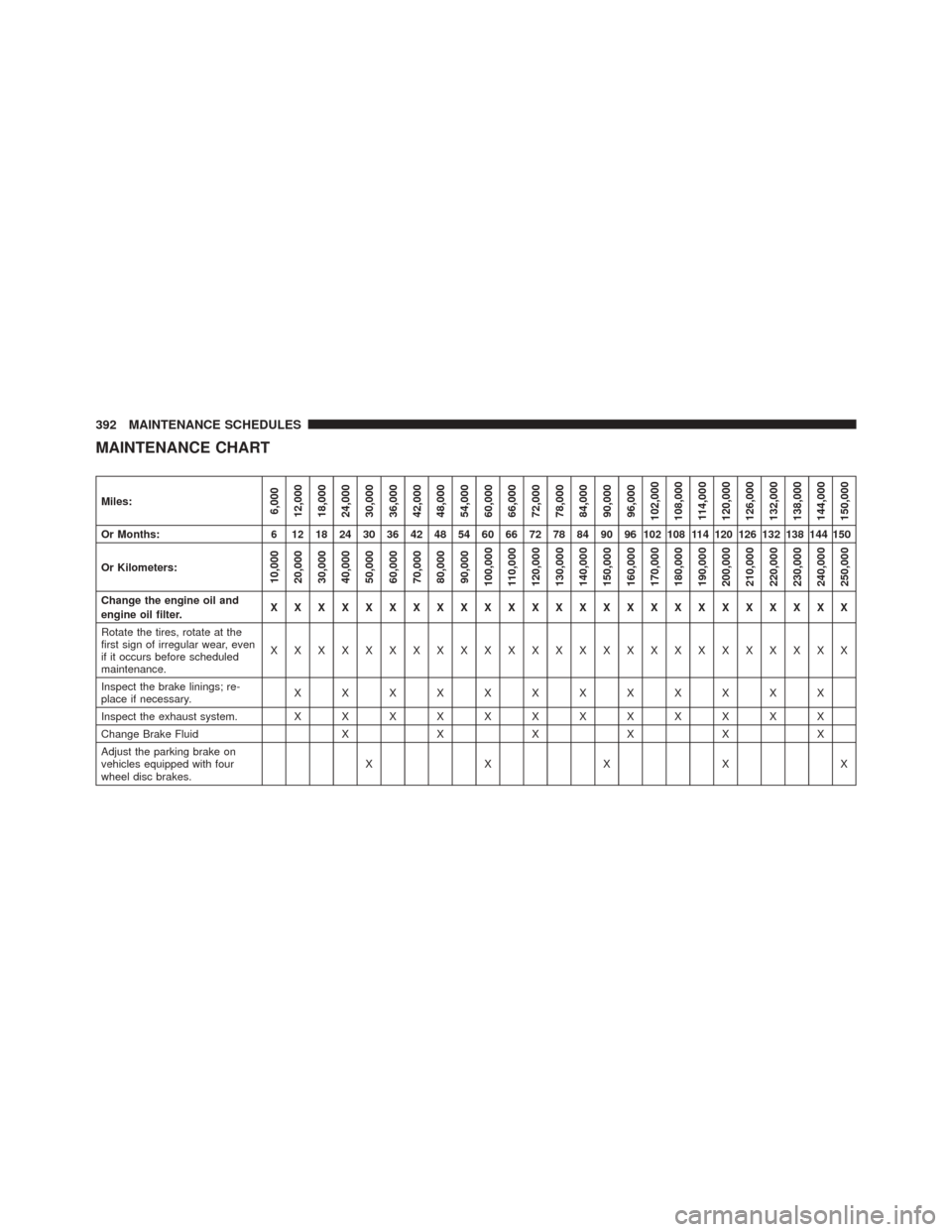
MAINTENANCE CHART
Miles:6,000
12,000
18,000
24,000
30,000
36,000
42,000
48,000
54,000
60,000
66,000
72,000
78,000
84,000
90,000
96,000
102,000
108,000 114,000
120,000
126,000
132,000
138,000
144,000
150,000
Or Months: 6 12 18 24 30 36 42 48 54 60 66 72 78 84 90 96 102 108 114 120 126 132 138 144 150
Or Kilometers:
10,000
20,000
30,000
40,000
50,000
60,000
70,000
80,000
90,000
100,000 110,000
120,000
130,000
140,000
150,000
160,000
170,000
180,000
190,000
200,000
210,000
220,000
230,000
240,000
250,000
Change the engine oil and
engine oil filter. XXXXXXXXXXXXXXXXXXXXXXXXX
Rotate the tires, rotate at the
first sign of irregular wear, even
if it occurs before scheduled
maintenance. XXXXXXXXXXXXXXXXXXXXXXXXX
Inspect the brake linings; re-
place if necessary. XXXXXXXXXXXX
Inspect the exhaust system. XXXXXXXXXXXX
Change Brake Fluid XXXXXX
Adjust the parking brake on
vehicles equipped with four
wheel disc brakes. XXXXX
392 MAINTENANCE SCHEDULES
Page 408 of 427
WARNING!
The traction grade assigned to this tire is based on
straight-ahead braking traction tests, and does not
include acceleration, cornering, hydroplaning, or
peak traction characteristics.
Temperature Grades
The temperature grades are A (the highest), B, and C,
representing the tire’s resistance to the generation of heat
and its ability to dissipate heat, when tested under
controlled conditions on a specified indoor laboratory
test wheel. Sustained high temperature can cause the
material of the tire to degenerate and reduce tire life, and
excessive temperature can lead to sudden tire failure. The
grade C corresponds to a level of performance, which all
passenger vehicle tires must meet under the Federal
Motor Vehicle Safety Standard No. 109. Grades B and Arepresent higher levels of performance on the laboratory
test wheel, than the minimum required by law.
WARNING!
The temperature grade for this tire is established for
a tire that is properly inflated and not overloaded.
Excessive speed, under-inflation, or excessive load-
ing, either separately or in combination, can cause
heat buildup and possible tire failure.
406 IF YOU NEED CONSUMER ASSISTANCE