air condition FIAT 124 SPIDER 2016 2.G User Guide
[x] Cancel search | Manufacturer: FIAT, Model Year: 2016, Model line: 124 SPIDER, Model: FIAT 124 SPIDER 2016 2.GPages: 216, PDF Size: 3.1 MB
Page 104 of 216
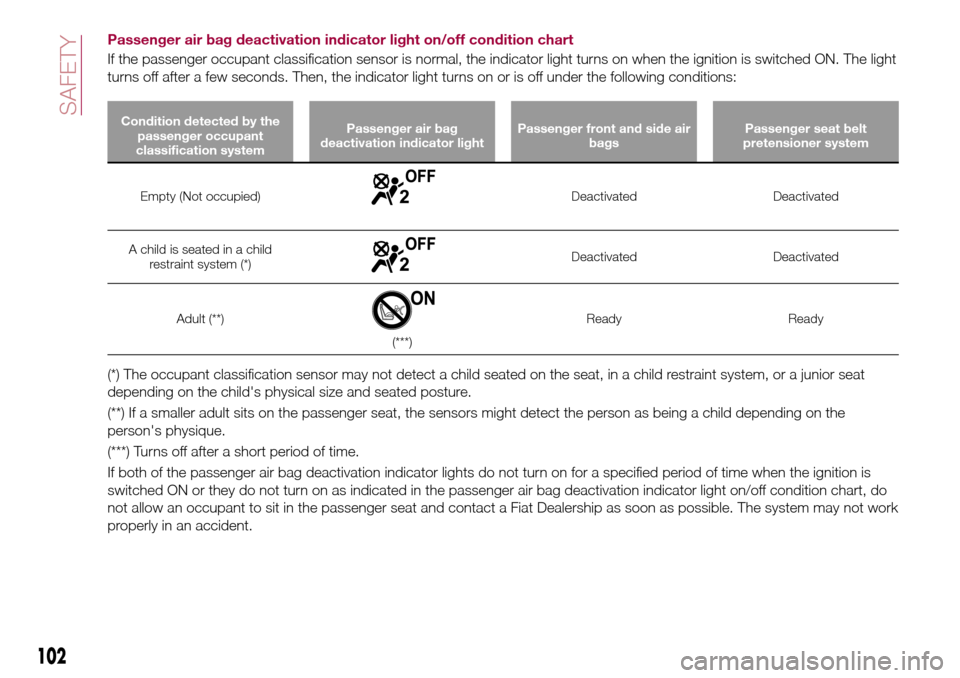
Passenger air bag deactivation indicator light on/off condition chart
If the passenger occupant classification sensor is normal, the indicator light turns on when the ignition is switched ON. The light
turns off after a few seconds. Then, the indicator light turns on or is off under the following conditions:
Condition detected by the
passenger occupant
classification systemPassenger air bag
deactivation indicator lightPassenger front and side air
bagsPassenger seat belt
pretensioner system
Empty (Not occupied)Deactivated Deactivated
A child is seated in a child
restraint system (*)
Deactivated Deactivated
Adult (**)
(***)Ready Ready
(*) The occupant classification sensor may not detect a child seated on the seat, in a child restraint system, or a junior seat
depending on the child's physical size and seated posture.
(**) If a smaller adult sits on the passenger seat, the sensors might detect the person as being a child depending on the
person's physique.
(***) Turns off after a short period of time.
If both of the passenger air bag deactivation indicator lights do not turn on for a specified period of time when the ignition is
switched ON or they do not turn on as indicated in the passenger air bag deactivation indicator light on/off condition chart, do
not allow an occupant to sit in the passenger seat and contact a Fiat Dealership as soon as possible. The system may not work
properly in an accident.
102
SAFETY
Page 107 of 216
126)Do not operate a vehicle with
damaged air bag/seat belt pretensioner
system components. Expended or
damaged air bag/seat belt pretensioner
system components must be replaced
after any collision which caused them to
deploy or damage them. Only a trained
expert repairer, we recommend a Fiat
Dealership that can fully evaluate these
systems to see that they will work in any
subsequent accident. Driving with an
expended or damaged air bag or
pretensioner unit will not afford you the
necessary protection in the event of any
subsequent accident which could result in
serious injury or death.
127)Do not remove interior air bag parts.
Removing any components such as the
seats, front instrument panel, the steering
wheel, containing air bag parts or sensors
is dangerous. These parts contain essential
air bag components. The air bag could
accidentally activate and cause serious
injuries. Always have a Fiat Dealership
remove these parts.128)Do not allow an occupant in the
passenger's seat to sit with a posture
which makes it difficult for the passenger
occupant classification sensor to detect
the occupant correctly. Sitting in the
passenger's seat with a posture which
makes it difficult for the passenger
occupant classification sensor to detect
the occupant correctly is dangerous. If the
passenger occupant classification sensor
cannot detect the occupant sitting on the
passenger's seat correctly, the passenger
front and side air bags and pretensioner
system may not operate (deploy) or they
may operate (deploy) accidentally. The
passenger will not have the supplementary
protection of the air bags or the accidental
operation (deployment) of the air bags
could result in serious injury or death.129)Under the following conditions, the
passenger occupant classification sensor
cannot detect a passenger sitting on the
passenger's seat correctly and the
deployment/non-deployment of the air
bags cannot be controlled as indicated in
the passenger air bag deactivation
indicator light on/off condition chart. For
example: luggage or other items placed
under the passenger seat or between the
passenger seat and driver seat that push
up the passenger seat bottom / An object,
such as a seat cushion, is put on the
passenger's seat or between the
passenger's back and the seat back / A
seat cover is put on the passenger's seat /
Luggage or other items are placed on the
seat with the child in the child restraint
system / The seat is washed / Liquids are
spilled on the seat / The passenger seat is
moved backward, pushing into luggage or
other items placed behind it / Luggage or
other items are placed between the
passenger seat and driver seat / An electric
device is put on the passenger's seat. The
passenger front and side air bags and seat
belt pretensioner systems will deactivate if
the passenger air bag deactivation OFF
indicator light turns on.
IMPORTANT
22)To assure proper deployment of the
front air bag and to prevent damage to the
sensor in the seat cushion: do not place
sharp objects on the seat cushion or leave
heavy luggage on them. Do not spill any
liquids on the seats or under the seats.
105
Page 141 of 216
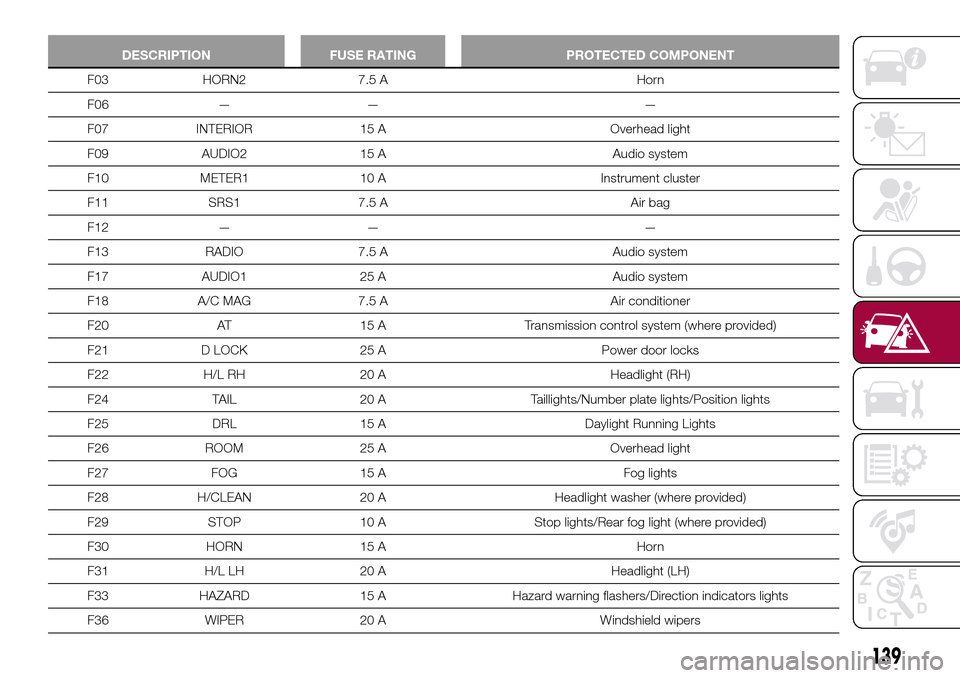
DESCRIPTION FUSE RATING PROTECTED COMPONENT
F03 HORN2 7.5 A Horn
F06 — — —
F07 INTERIOR 15 A Overhead light
F09 AUDIO2 15 A Audio system
F10 METER1 10 A Instrument cluster
F11 SRS1 7.5 A Air bag
F12 — — —
F13 RADIO 7.5 A Audio system
F17 AUDIO1 25 A Audio system
F18 A/C MAG 7.5 A Air conditioner
F20 AT 15 A Transmission control system (where provided)
F21 D LOCK 25 A Power door locks
F22 H/L RH 20 A Headlight (RH)
F24 TAIL 20 A Taillights/Number plate lights/Position lights
F25 DRL 15 A Daylight Running Lights
F26 ROOM 25 A Overhead light
F27 FOG 15 A Fog lights
F28 H/CLEAN 20 A Headlight washer (where provided)
F29 STOP 10 A Stop lights/Rear fog light (where provided)
F30 HORN 15 A Horn
F31 H/L LH 20 A Headlight (LH)
F33 HAZARD 15 A Hazard warning flashers/Direction indicators lights
F36 WIPER 20 A Windshield wipers
139
Page 142 of 216
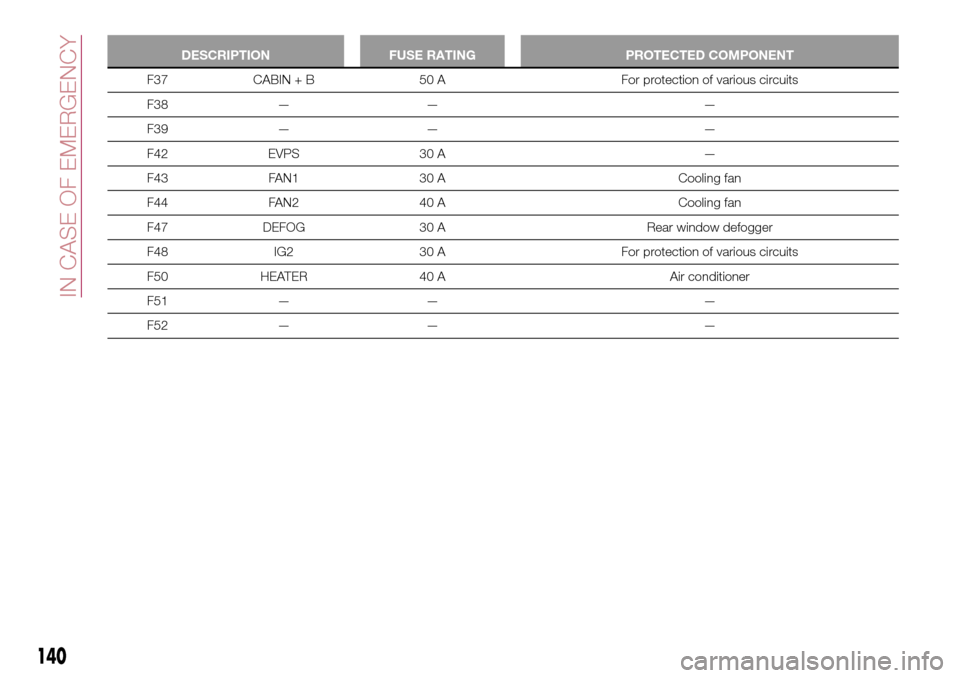
DESCRIPTION FUSE RATING PROTECTED COMPONENT
F37 CABIN + B 50 A For protection of various circuits
F38 — — —
F39 — — —
F42 EVPS 30 A —
F43 FAN1 30 A Cooling fan
F44 FAN2 40 A Cooling fan
F47 DEFOG 30 A Rear window defogger
F48 IG2 30 A For protection of various circuits
F50 HEATER 40 A Air conditioner
F51 — — —
F52 — — —
140
IN CASE OF EMERGENCY
Page 146 of 216
of effectiveness is indicated on the
bottle label);
– the tear or puncture exceeds about
4 mm;
– the damage has occurred to an
area of the tire other than the tread;
– the vehicle has been driven with
nearly no air remaining in the tire;
– the tire has come off the wheel rim;
– damage to the wheel rim has
occurred;
– the tire has two or more punctures.
SEALING A TIRE WITH
TIRE SERVICE
Proceed as follows:
move the vehicle off the right-of-way
to a safe place on a level and hard
surface where the vehicle does not
obstruct traffic;
shift the shift lever to the 1 or
Reverse (R) position (manual
transmission), and shift the selector
lever to the P position (automatic
transmission);
apply the parking brake with the
brake pedal depressed and turn off the
engine;
if necessary, flash the hazard warning
lights and set up the roadside
emergency triangle;
unload passengers and cargo and
remove the tire service kit;
shake the tire sealant well. If the
bottle is shaken after the injection hose
is screwed on, tire sealant could spray
out from the injection hose. Tire sealant
contacting clothing or other objects
may be impossible to remove. Shake
the bottle before screwing on the
injection hose;
IMPORTANT The sealant hardens easily
and injecting it will be difficult under
cold weather conditions (0°C or below).
Warm the sealant inside the vehicle to
facilitate injection.
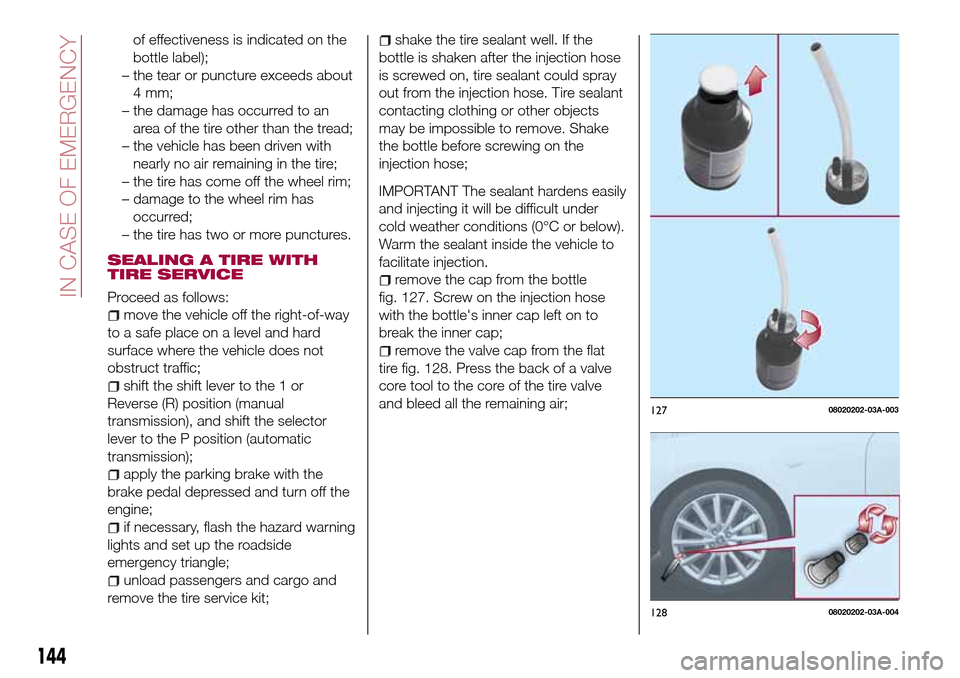
remove the cap from the bottle
fig. 127. Screw on the injection hose
with the bottle's inner cap left on to
break the inner cap;
remove the valve cap from the flat
tire fig. 128. Press the back of a valve
core tool to the core of the tire valve
and bleed all the remaining air;
12708020202-03A-003
12808020202-03A-004
144
IN CASE OF EMERGENCY
Page 149 of 216
WARNING
169)Punctures on the sides of the tire may
not be repaired. Do not use the kit if the tire
was damaged as a result of being used
when underinflated.
170)Do not adhere the speed restriction
sticker to the padded area on the steering
wheel. Adhering the speed restriction
sticker to the padded area on the steering
wheel is dangerous because the air bag
may not operate (deploy) normally resulting
in serious injury. In addition, do not adhere
the sticker to areas where warning lights or
the speedometer cannot be viewed.
171)If the tire inflation pressure has
decreased below 130 kPa (1.3 kgf/cm
2or
bar, 18.9 psi), stop driving and contact a
Fiat Dealership. The repair using the
emergency at tire repair kit was not
successful. If you see a decrease in the tire
inflation pressure, stop driving. Contact a
Fiat Dealership.
172)You must always indicate that the tyre
was repaired using the kit. Give the booklet
to the technicians who will be handling the
tire that was treated using the kit.
173)Repairs are not possible in the case of
damage to the wheel rim (bad groove
distortion causing air loss). Do not remove
foreign bodies (screws or nails) from the
tire.174)The information required by the
applicable regulation is indicated on the tire
service kit package label. Compliance with
the indications on the label is an essential
condition to ensure the safety and the
effectiveness of the tire service kit. Carefully
read the label before use, avoid improper
use. Tire service kit is subject to expiration
and must be replaced periodically. The kit
should be used by adults and cannot be
used by children.
175)Do not allow children to touch the tire
sealant: ingestion of tire sealant is
dangerous. In the event tire sealant is
accidentally swallowed, drink large
amounts of water immediately and seek
medical assistance. Tire sealant that
comes into contact with the eyes and skin
is dangerous. If tire sealant enters the eyes
or contacts the skin, flush immediately with
large amounts of water and seek medical
assistance.
IMPORTANT
3)Dispose of the bottle and the sealant
liquid properly. Have them disposed of in
compliance with national and local
regulations.
147
the emergency flat tire repair is
completed successfully if the tire
inflation pressure does not decrease.
Carefully drive the vehicle to the nearest
Fiat Dealership and have the flat tire
replaced. Replacement with a new tire
is recommended. If the tire is to be
repaired or reused, contact a Fiat
Dealership.
IMPORTANT Before checking the tire
inflation pressure using the tire pressure
gauge, turn the air compressor switch
off.
NOTEIf an emergency flat tire repair has
been performed using the tire service
kit, FCA recommends that the tire be
replaced with a new one as soon as
possible. If the tire is to be repaired or
reused, contact a Fiat Dealership.
The wheel can be reused if the
sealant adhering to it is removed.
However, replace the valve with a new
one.
Page 157 of 216
warning lights, etc.);
operation of windscreen
washer/wiper system and
positioning/wear of windscreen window
wiper blades.
Every 3,000 km, check and top up if
required: engine oil level.
HEAVY-DUTY USE OF THE
VEHICLE
If the vehicle is used under one of the
following conditions:
dusty roads;
short, repeated journeys (less than
7-8 km) at sub-zero outside
temperatures;
engine often idling or driving long
distances at low speeds or long periods
of inactivity;
the following checks must be carried
out more often than indicated in the
Scheduled Servicing Plan:
check front disc brake pad condition
and wear;
check cleanliness of bonnet and
luggage compartment locks,
cleanliness and lubrication of linkage;
visually inspect conditions of: engine,
gearbox, transmission, pipes and hoses
(exhaust/fuel system/brakes) and
rubber elements (gaiters/sleeves/
bushes, etc.);
check battery charge and battery
fluid level (electrolyte);
visually inspect conditions of the
accessory drive belts;
check and, if necessary, change
engine oil and replace oil filter;
check and, if necessary, replace
pollen filter;
check and, if necessary, replace air
cleaner.
155
PERIODIC CHECKS
Every1,000 kmor before long trips
check and, if necessary, top up:
engine coolant level;
brake fluid level;
windscreen washer fluid level;
tire inflation pressure and condition;
operation of lighting system
(headlights, direction indicators, hazard
Page 158 of 216
SCHEDULED SERVICING PLAN
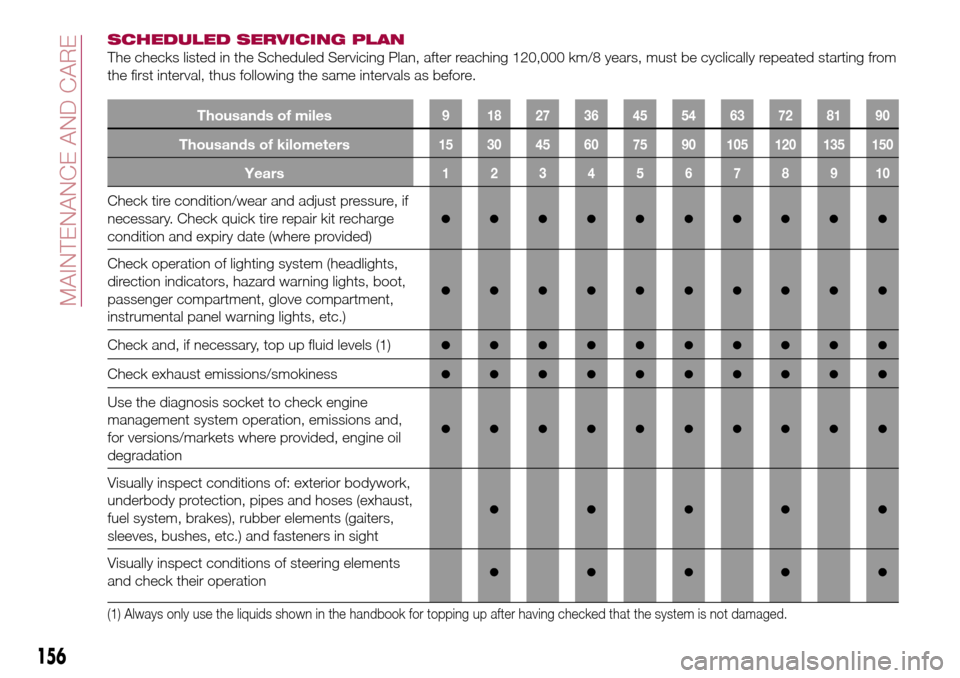
The checks listed in the Scheduled Servicing Plan, after reaching 120,000 km/8 years, must be cyclically repeated starting from
the first interval, thus following the same intervals as before.
Thousands of miles9 182736455463728190
Thousands of kilometers15 30 45 60 75 90 105 120 135 150
Years12345678910
Check tire condition/wear and adjust pressure, if
necessary. Check quick tire repair kit recharge
condition and expiry date (where provided)
●●●●●●●●●●
Check operation of lighting system (headlights,
direction indicators, hazard warning lights, boot,
passenger compartment, glove compartment,
instrumental panel warning lights, etc.)
●●●●●●●●●●
Check and, if necessary, top up fluid levels (1)●●●●●●●●●●
Check exhaust emissions/smokiness●●●●●●●●●●
Use the diagnosis socket to check engine
management system operation, emissions and,
for versions/markets where provided, engine oil
degradation
●●●●●●●●●●
Visually inspect conditions of: exterior bodywork,
underbody protection, pipes and hoses (exhaust,
fuel system, brakes), rubber elements (gaiters,
sleeves, bushes, etc.) and fasteners in sight
●●●●●
Visually inspect conditions of steering elements
and check their operation●●●●●
(1) Always only use the liquids shown in the handbook for topping up after having checked that the system is not damaged.
156
MAINTENANCE AND CARE
Page 185 of 216
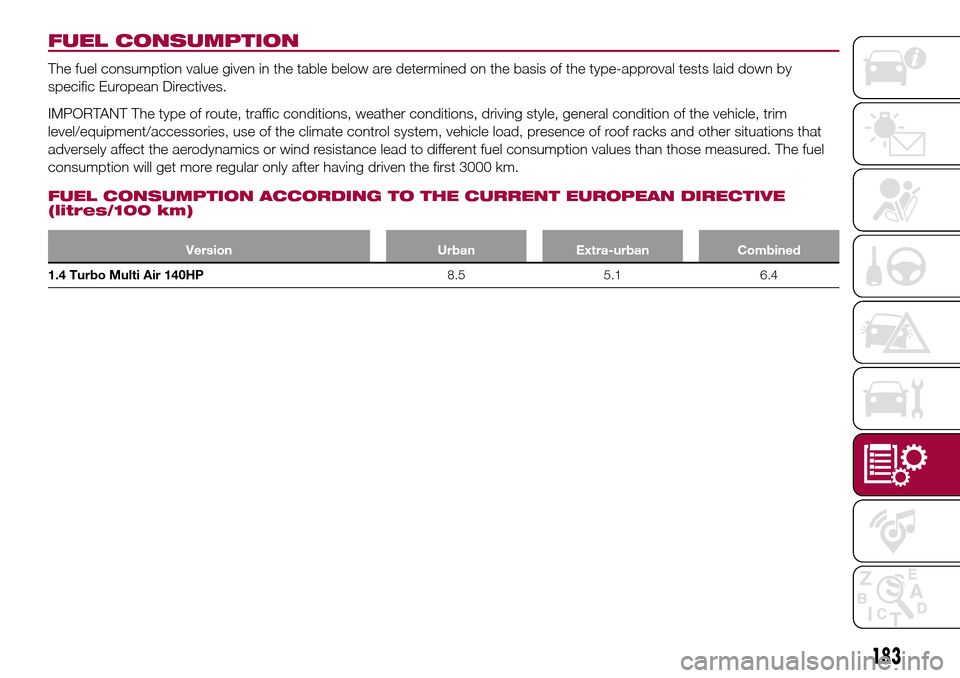
FUEL CONSUMPTION
The fuel consumption value given in the table below are determined on the basis of the type-approval tests laid down by
specific European Directives.
IMPORTANT The type of route, traffic conditions, weather conditions, driving style, general condition of the vehicle, trim
level/equipment/accessories, use of the climate control system, vehicle load, presence of roof racks and other situations that
adversely affect the aerodynamics or wind resistance lead to different fuel consumption values than those measured. The fuel
consumption will get more regular only after having driven the first 3000 km.
FUEL CONSUMPTION ACCORDING TO THE CURRENT EUROPEAN DIRECTIVE
(litres/100 km)
Version Urban Extra-urban Combined
1.4 Turbo Multi Air 140HP8.5 5.1 6.4
183
Page 189 of 216
TIPS, CONTROLS
AND GENERAL
INFORMATION
ROAD SAFETY
220) 221)
Learn how to use the various system
functions before setting off.
Read the instructions for the system
carefully before setting off.
RECEPTION CONDITIONS
Reception conditions change
constantly while driving.
Reception may be interfered with by the
presence of mountains, buildings or
bridges, especially when you are far
away from the broadcaster.
IMPORTANT The volume may be
increased when receiving traffic alerts
and news.
CARE AND
MAINTENANCE
57) 58)
Observe the following precautions to
ensure the system is fully operational:
the display lens should not come into
contact with pointed or rigid objects
which could damage its surface; use a
soft, dry anti-static cloth to clean and
do not press;
never use alcohol, petrols and
derivatives to clean the display lens;
prevent any liquid from entering the
system: this could damage it beyond
repair.
IMPORTANT
INFORMATION
Look at the screen only when it is
necessary and safe. If you need to look
at the screen for a long time, pull over
to a safe place so as not to be
distracted while driving.
Immediately stop using the system in
the event of a fault. Otherwise the
system might be damaged.
Contact a Fiat Dealership as soon as
possible to have the system repaired.
WARNING
220)Follow the safety rules below:
otherwise serious injuries may occur to the
occupants or the system may be
damaged.
221)If the volume is too loud this can be
dangerous. Adjust the volume so that you
can still hear background noises (e.g.
horns, ambulances, police vehicles, etc.).
IMPORTANT
57)Only clean the front panel and the
display lens with a soft, clean, dry,
anti-static cloth. Cleaning and polishing
products may damage the surface. Never
use alcohol, petrols and derivatives.
58)Do not use the display as a base for
supports with suction pads or adhesives for
external navigators or smartphones or
similar devices.
187