belt FIAT 124 SPIDER 2016 2.G User Guide
[x] Cancel search | Manufacturer: FIAT, Model Year: 2016, Model line: 124 SPIDER, Model: FIAT 124 SPIDER 2016 2.GPages: 216, PDF Size: 3.1 MB
Page 79 of 216
USING THE SEAT BELTS
81) 82) 83) 84) 85)
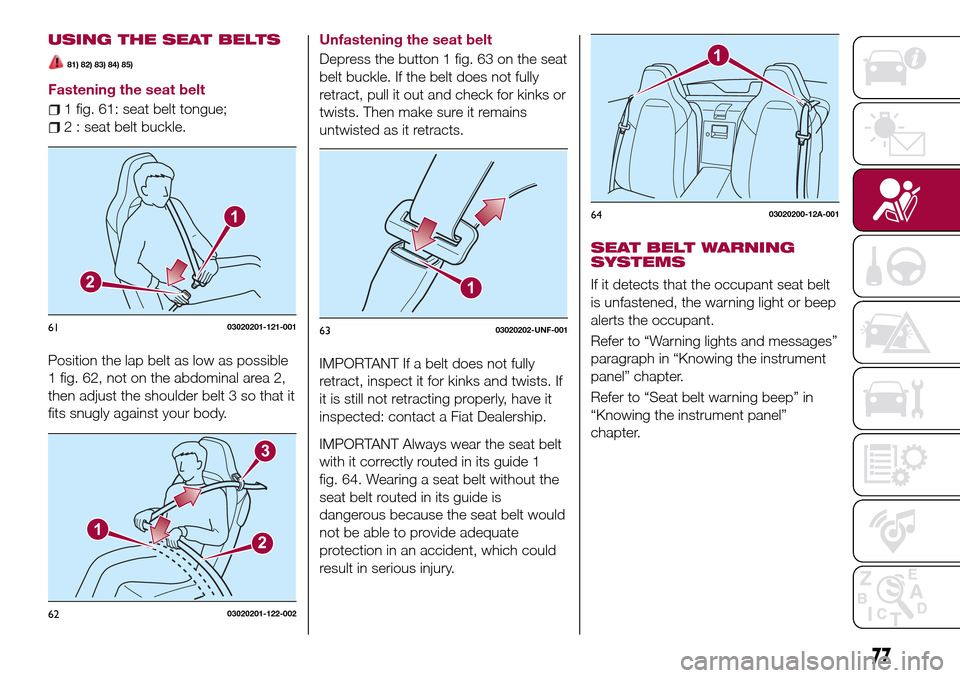
Fastening the seat belt
1 fig. 61: seat belt tongue;
2 : seat belt buckle.
Position the lap belt as low as possible
1 fig. 62, not on the abdominal area 2,
then adjust the shoulder belt 3 so that it
fits snugly against your body.Unfastening the seat belt
Depress the button 1 fig. 63 on the seat
belt buckle. If the belt does not fully
retract, pull it out and check for kinks or
twists. Then make sure it remains
untwisted as it retracts.
IMPORTANT If a belt does not fully
retract, inspect it for kinks and twists. If
it is still not retracting properly, have it
inspected: contact a Fiat Dealership.
IMPORTANT Always wear the seat belt
with it correctly routed in its guide 1
fig. 64. Wearing a seat belt without the
seat belt routed in its guide is
dangerous because the seat belt would
not be able to provide adequate
protection in an accident, which could
result in serious injury.SEAT BELT WARNING
SYSTEMS
If it detects that the occupant seat belt
is unfastened, the warning light or beep
alerts the occupant.
Refer to “Warning lights and messages”
paragraph in “Knowing the instrument
panel” chapter.
Refer to “Seat belt warning beep” in
“Knowing the instrument panel”
chapter.
1
2
6103020201-121-001
1
3
2
6203020201-122-002
1
6303020202-UNF-001
1
6403020200-12A-001
77
Page 80 of 216
WARNING
79)Always wear your seat belt and make
sure all occupants are properly restrained.
Not wearing a seat belt is extremely
dangerous. During a collision, occupants
not wearing seat belts could hit someone
or things inside the vehicle or even be
thrown out of the vehicle. They could be
seriously injured or even killed. In the same
collision, occupants wearing seat belts
would be much safer.
80)Do not wear twisted seat belts. Twisted
seat belts are dangerous. In a collision, the
full width of the belt is not available to
absorb the impact. This puts more force on
the bones beneath the belt, which could
cause serious injury or death. So, if your
seat belt is twisted, you must straighten
the seat belt to remove any twists and to
allow the full width of the belt to be used.
81)Never use one seat belt on more than
one person at a time. Using one seat belt
for more than one person at a time is
dangerous. A seat belt used in this way
cannot spread the impact forces properly
and the two passengers could be crushed
together and seriously injured or even
killed. Never use one belt for more than
one person at a time and always operate
the vehicle with each occupant properly
restrained.82)Do not operate a vehicle with a
damaged seat belt. Using a damaged seat
belt is dangerous. An accident could
damage the belt webbing of the seat belt in
use. A damaged seat belt cannot provide
adequate protection in a collision. Contact
a Fiat Dealership to inspect all seat belt
systems in use during an accident before
they are used again.
83)Have your seat belts changed
immediately if the pretensioner or load
limiter has been expended. Always have an
expert repairer, we recommend a Fiat
Dealership immediately inspect the seat
belt pretensioners and air bags after any
collision. Like the air bags, the seat belt
pretensioners and load limiters will only
function once and must be replaced after
any collision that caused them to deploy. If
the seat belt pretensioners and load
limiters are not replaced, the risk of injury in
a collision will increase.
84)Positioning the shoulder portion of the
seat belt. Improper positioning of the
shoulder portion of the seat belt is
dangerous. Always make sure the shoulder
portion of the seat belt is positioned across
your shoulder and near your neck, but
never under your arm, on your neck, or on
your upper arm.
85)Positioning the lap portion of the seat
belt. The lap portion of the seat belt worn
too high is dangerous. In a collision, this
would concentrate the impact force directly
on the abdominal area, causing serious
injury. Wear the lap portion of the belt
snugly and as low as possible.86)Instructions for use of seat belt
assemblies. Seat belts are designed to
bear upon the bony structure of the body,
and should be worn low across the front of
the pelvis or the pelvis, chest and
shoulders, as applicable; wearing the lap
section of the belt across the abdominal
area must be avoided. Seat belts should
be adjusted as firmly as possible,
consistent with comfort, to provide the
protection for which they have been
designed. A slack belt will greatly reduce
the protection afforded to the wearer. Care
should be taken to avoid contamination of
the webbing with polishes, oils and
chemicals, and particularly battery acid.
Cleaning may safely be carried out using
mild soap and water. The belt should be
replaced if webbing becomes frayed,
contaminated or damaged. It is essential to
replace the entire assembly after it has
been worn in a severe impact even if
damage to the assembly is not obvious.
Belts should not be worn with straps
twisted. Each belt assembly must only be
used by one occupant; it is dangerous to
put a belt around a child being carried on
the occupant's lap.
87)No modifications or additions should
be made by the user which will either
prevent the seat belt adjusting devices
from operating to remove slack, or prevent
the seat belt assembly from being adjusted
to remove slack.
78
SAFETY
Page 81 of 216
SBA SYSTEM
(Seat Belt Alert)
SEAT BELT WARNING
LIGHT
The LED on dashboard trim turns on if
the driver or passenger's seat is
occupied and the seat belt is not
fastened with the ignition switched ON.
If the driver or passenger's seat belt is
unfastened (only when the passenger
seat is occupied) and the vehicle is
driven at a speed faster than about
20 km/h, the
LED flashes. After a
short time, the LED stops flashing, but
remains illuminated.
If a seat belt remains unfastened, the
LED flashes again for a given period of
time. In this case, fasten the seat belt.
If the driver or passenger's seat belt is
unfastened after the LED turns on, and
the vehicle speed exceeds 20 km/h, the
LED flashes again.
SEAT BELT
PRETENSIONER AND
LOAD LIMITING
SYSTEMS
PRETENSIONERS
88) 89) 90) 91)
For optimum protection, the driver and
passenger seat belts are equipped with
pretensioner and load limiting systems.
For both these systems to work
properly you must wear the seat belt
properly.
When a collision is detected, the
pretensioners deploy simultaneously
with the air bags. For deployment
details, refer to the “SRS air bag
deployment criteria” paragraph in this
chapter.
The seat belt retractors remove slack
quickly as the air bags are expanding.
Any time the air bags and seat belt
pretensioners have fired they must be
replaced.
A system malfunction or operation
conditions are indicated by a warning.
Refer to “Warning lights and messages”
and “Warning sound is activated”
paragraph in “Knowing the instrument
panel” chapter.
In addition, the pretensioner system for
the passenger, like the front and side
passenger air bag, is designed to onlydeploy when the passenger occupant
classification sensor detects a
passenger sitting on the passenger's
seat. For details, refer to the passenger
occupant classification sensor.
IMPORTANT The pretensioner system
may not operate depending on the type
of the collision. For details, refer to the
“SRS Air Bag deployment criteria”
paragraph.
IMPORTANT Some smoke (non-toxic
gas) will be released when the air bags
and pretensioners deploy. This does
not indicate a fire. This gas normally
has no effect on occupants, however,
those with sensitive skin may
experience slight skin irritation. If
residue from the deployment of the air
bags or the pretensioner system gets
on the skin or in the eyes, wash it off as
soon as possible.
LOAD LIMITER
The load limiting system releases belt
webbing in a controlled manner to
reduce belt force on the occupant's
chest.
While the most severe load on a seat
belt occurs in frontal collisions, the load
limiter has an automatic mechanical
function and can activate in any
accident mode with sufficient occupant
movement.
79
Page 82 of 216
Even if the pretensioners have not fired,
the load limiting function must be
checked by Fiat Dealership.
WARNING
88)Wear seat belts only as recommended
in this Owner Handbook. Incorrect
positioning of the driver and passenger
seat belts is dangerous. Without proper
positioning, the pretensioner and load
limiting systems cannot provide adequate
protection in an accident and this could
result in serious injury. For more details
about wearing seat belts, refer to
"Fastening the seat belts".
89)Have your seat belts changed
immediately if the pretensioner or load
limiter has been expended. Always have an
expert repairer: contact a Fiat Dealership
immediately for seat belt pretensioners and
air bags inspections after any collision. Like
the air bags, the seat belt pretensioners
and load limiters will only function once and
must be replaced after any collision that
caused them to deploy. If the seat belt
pretensioners and load limiters are not
replaced, the risk of injury in a collision will
increase.
90)Do not modify the components or
wiring, or use electronic testing devices on
the pretensioner system. Modifying the
components or wiring of the pretensioner
system, including the use of electronic
testing devices is dangerous. You could
accidentally activate it or make it inoperable
which would prevent it from activating in an
accident. The occupants or repairers could
be seriously injured.91)Properly dispose of the pretensioner
system. Improper disposal of the
pretensioner system or a vehicle with non
deactivated pretensioners is dangerous.
Unless all safety procedures are followed,
injury could result. Contact a Fiat
Dealership for safely dispose of the
pretensioner system or scrap a
pretensioner system equipped vehicle.
CHILD-RESTRAINT
PRECAUTIONS
92) 93) 94) 95) 96) 97) 98) 99) 100) 101) 102)
FCA strongly urges the use of
child-restraint systems for children small
enough to use them.
FCA recommends use of a genuine
child-restraint system or one that
complies with the UNECE 44 (*)
regulation. If you would like to purchase
a FCA genuine child-restraint system,
please contact a Fiat Dealership.
Check your local and state or provincial
laws for specific requirements regarding
the safety of children riding in your
vehicle.
(*) UNECE stands for United Nations
Economic Commission for Europe.
Whatever child-restraint system you
consider, please pick the appropriate
one for the age and size of the child,
obey the law and follow the instructions
that come with the individual
child-restraint system.
A child who has outgrown
child-restraint systems should use seat
belts, both lap and shoulder. If the
shoulder belt crosses the neck or face,
move the child closer to the centre of
the vehicle.
A rear-facing child-restraint system
shouldNEVERbe used on the
80
SAFETY
Page 83 of 216
passenger seat with the air bag system
activated. In the event of an impact the
air bag activation may cause fatal
injuries to the transported child.
To reduce the chance of injuries caused
by deployment of the passenger air
bag, the passenger occupant
classification sensor work as a part of
the supplementary restraint system.
This system deactivates the passenger
front and side air bags and also the
passenger seat belt pretensioner
system when the passenger air bag
deactivation OFF indicator light
illuminates.
When an infant or small child sits on the
passenger seat, the system shuts off
the passenger front and side air bags
and seat belt pretensioner system, so
make sure the passenger air bag
deactivation OFF indicator light
illuminates. For more details, refer to
"Passenger occupant classification
sensor" in “Front Air Bags” paragraph.IMPORTANT A seat belt or
child-restraint system can become very
hot in a closed vehicle during warm
weather. To avoid burning yourself or a
child, check them before you or your
child touches them.
NOTE Your vehicle is equipped with
ISOFIX anchors for attachment of
ISOFIX child-restraint systems. When
using these anchors to secure a
child-restraint system, refer to “Using
ISOFIX anchor” paragraph in this
chapter.
81
Page 85 of 216
CHILD-RESTRAINT
SYSTEM TYPES
In this Owner Handbook, explanation of
child restraint systems secured with
seat belts is provided for the following
three types of popular child-restraint
systems: baby seat, child seat, junior
seat.
IMPORTANT Installation position is
determined by the type of child-restraint
system. Always read the
manufacturer's instructions and this
Owner Handbook carefully.
IMPORTANT Due to variations in the
design of child restraint systems,
vehicle seats and seat belts, not all
child restraint may fit all seating
positions. Before purchasing a
child-restraint system, it should be
tested in the specific vehicle seating
position (or positions) where it is
intended to be used. If a previously
purchased child-restraint system does
not fit, you may need to purchase a
different one that will.
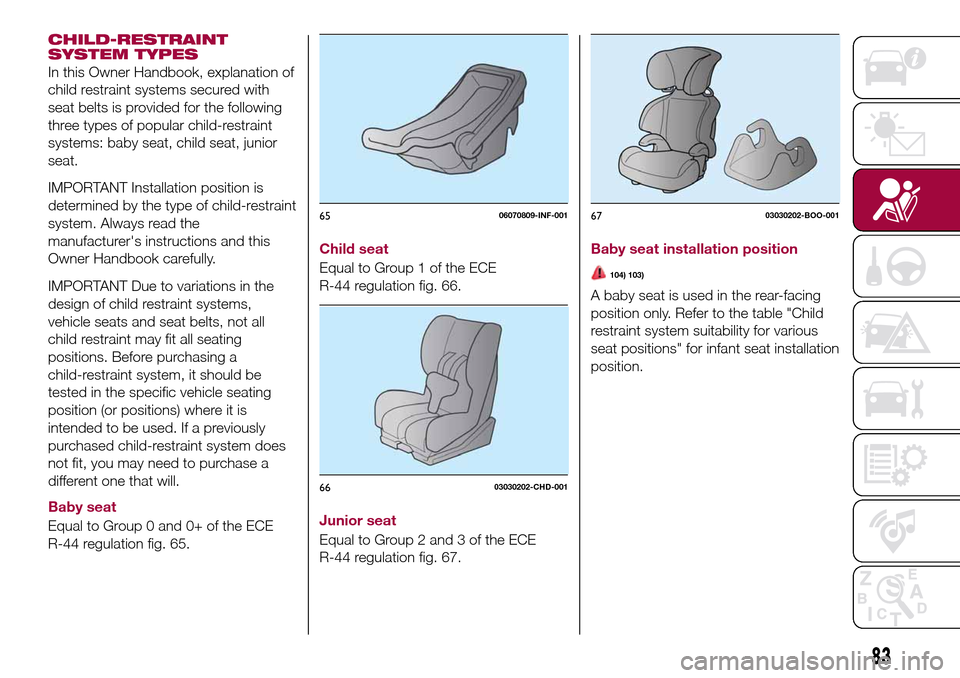
Baby seat
Equal to Group 0 and 0+ of the ECE
R-44 regulation fig. 65.Child seat
Equal to Group 1 of the ECE
R-44 regulation fig. 66.
Junior seat
Equal to Group 2 and 3 of the ECE
R-44 regulation fig. 67.Baby seat installation position
104) 103)
A baby seat is used in the rear-facing
position only. Refer to the table "Child
restraint system suitability for various
seat positions" for infant seat installation
position.
6506070809-INF-001
6603030202-CHD-001
6703030202-BOO-001
83
Page 90 of 216
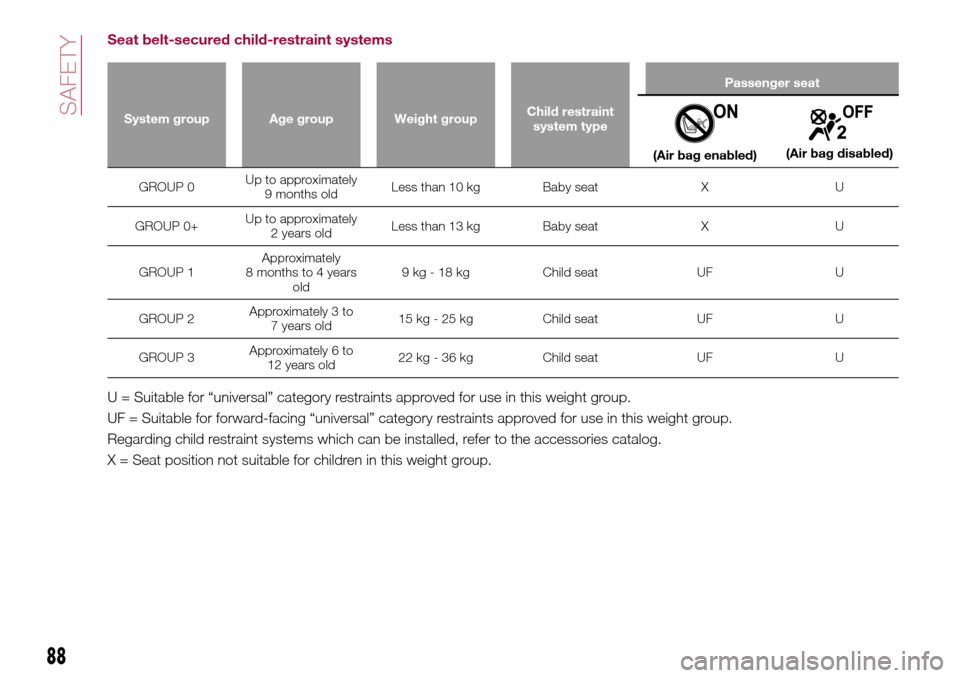
Seat belt-secured child-restraint systems
System group Age group Weight groupChild restraint
system typePassenger seat
(Air bag enabled)(Air bag disabled)
GROUP 0Up to approximately
9 months oldLess than 10 kg Baby seat X U
GROUP 0+Up to approximately
2 years oldLess than 13 kg Baby seat X U
GROUP 1Approximately
8 months to 4 years
old9 kg - 18 kg Child seat UF U
GROUP 2Approximately 3 to
7 years old15 kg - 25 kg Child seat UF U
GROUP 3Approximately 6 to
12 years old22 kg - 36 kg Child seat UF U
U = Suitable for “universal” category restraints approved for use in this weight group.
UF = Suitable for forward-facing “universal” category restraints approved for use in this weight group.
Regarding child restraint systems which can be installed, refer to the accessories catalog.
X = Seat position not suitable for children in this weight group.
88
SAFETY
Page 91 of 216
INSTALLING CHILD
RESTRAINT SYSTEMS
107) 108)
Anchor bracket
Anchor brackets for securing child
restraint systems are provided in the
vehicle. Locate anchor position.
To install a child restraint system,
always follow the instruction manual
accompanying the child-restraint
system.
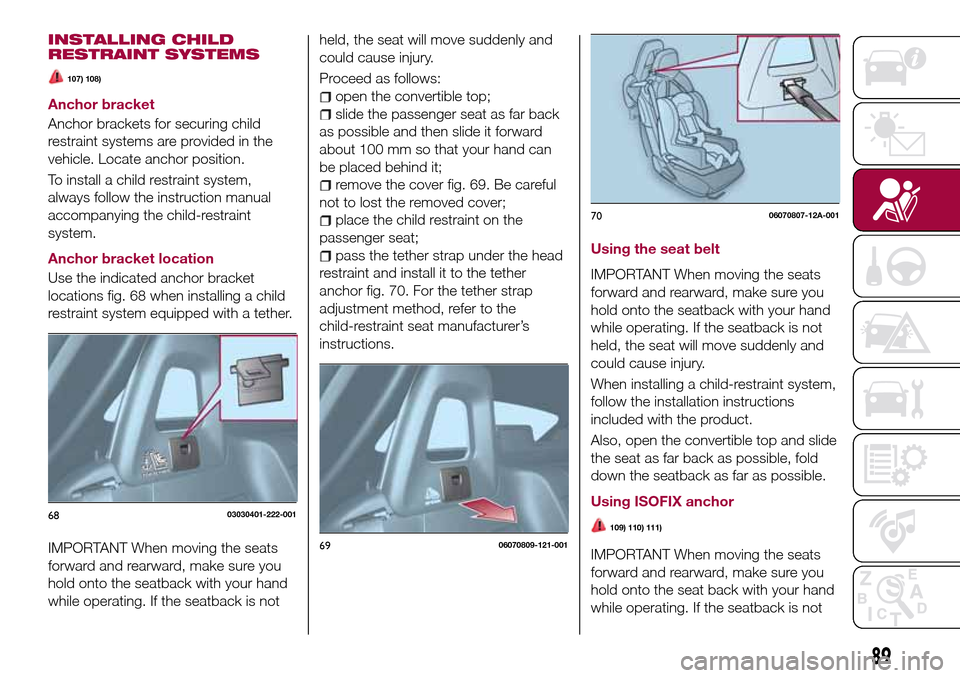
Anchor bracket location
Use the indicated anchor bracket
locations fig. 68 when installing a child
restraint system equipped with a tether.
IMPORTANT When moving the seats
forward and rearward, make sure you
hold onto the seatback with your hand
while operating. If the seatback is notheld, the seat will move suddenly and
could cause injury.
Proceed as follows:
open the convertible top;
slide the passenger seat as far back
as possible and then slide it forward
about 100 mm so that your hand can
be placed behind it;
remove the cover fig. 69. Be careful
not to lost the removed cover;
place the child restraint on the
passenger seat;
pass the tether strap under the head
restraint and install it to the tether
anchor fig. 70. For the tether strap
adjustment method, refer to the
child-restraint seat manufacturer’s
instructions.Using the seat belt
IMPORTANT When moving the seats
forward and rearward, make sure you
hold onto the seatback with your hand
while operating. If the seatback is not
held, the seat will move suddenly and
could cause injury.
When installing a child-restraint system,
follow the installation instructions
included with the product.
Also, open the convertible top and slide
the seat as far back as possible, fold
down the seatback as far as possible.
Using ISOFIX anchor
109) 110) 111)
IMPORTANT When moving the seats
forward and rearward, make sure you
hold onto the seat back with your hand
while operating. If the seatback is not
6803030401-222-001
6906070809-121-001
7006070807-12A-001
89
Page 92 of 216
held, the seat will move suddenly and
could cause injury.
Proceed as follows:
open the convertible top;
make sure the ignition is switched
off;
slide the passenger seat as far back
as possible. You may need to move the
seat forward slightly and recline the
back of the seat, in order to assist in
the fittment of some child-restraint
systems;
make sure the seatback is securely
latched by pushing it back until it is fully
locked;
expand the area between the seat
bottom and the seatback slightly to
verify the locations of the ISOFIX anchor
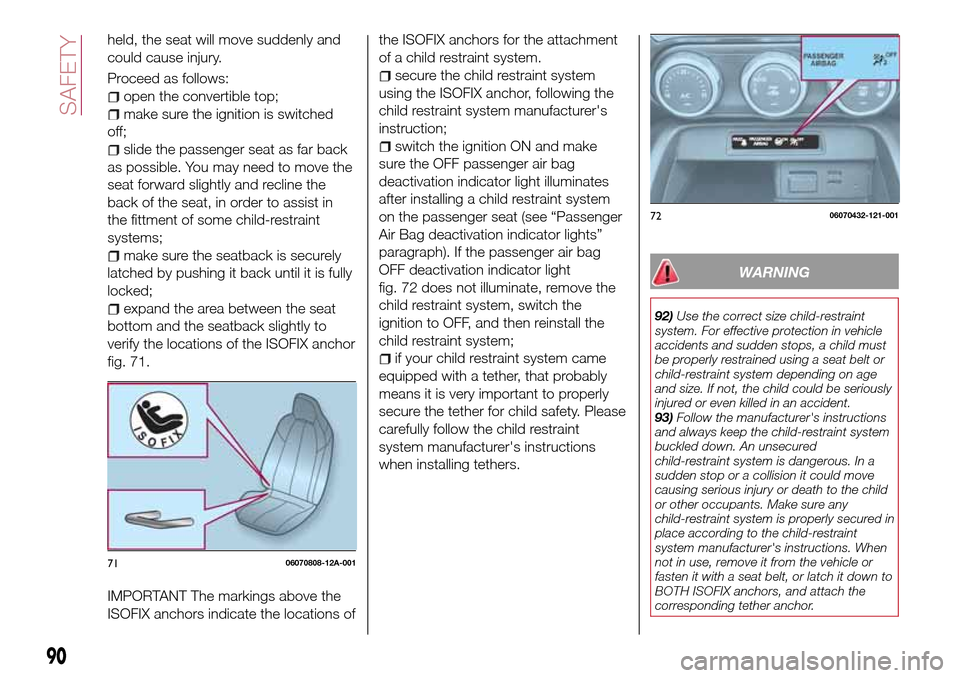
fig. 71.
IMPORTANT The markings above the
ISOFIX anchors indicate the locations ofthe ISOFIX anchors for the attachment
of a child restraint system.
secure the child restraint system
using the ISOFIX anchor, following the
child restraint system manufacturer's
instruction;
switch the ignition ON and make
sure the OFF passenger air bag
deactivation indicator light illuminates
after installing a child restraint system
on the passenger seat (see “Passenger
Air Bag deactivation indicator lights”
paragraph). If the passenger air bag
OFF deactivation indicator light
fig. 72 does not illuminate, remove the
child restraint system, switch the
ignition to OFF, and then reinstall the
child restraint system;
if your child restraint system came
equipped with a tether, that probably
means it is very important to properly
secure the tether for child safety. Please
carefully follow the child restraint
system manufacturer's instructions
when installing tethers.
WARNING
92)Use the correct size child-restraint
system. For effective protection in vehicle
accidents and sudden stops, a child must
be properly restrained using a seat belt or
child-restraint system depending on age
and size. If not, the child could be seriously
injured or even killed in an accident.
93)Follow the manufacturer's instructions
and always keep the child-restraint system
buckled down. An unsecured
child-restraint system is dangerous. In a
sudden stop or a collision it could move
causing serious injury or death to the child
or other occupants. Make sure any
child-restraint system is properly secured in
place according to the child-restraint
system manufacturer's instructions. When
not in use, remove it from the vehicle or
fasten it with a seat belt, or latch it down to
BOTH ISOFIX anchors, and attach the
corresponding tether anchor.
7106070808-12A-001
7206070432-121-001
90
SAFETY
Page 94 of 216
100)Do not allow a child or anyone to lean
over or against the side window of a
vehicle with side air bags. It is dangerous
to allow anyone to lean over or against the
side window, the area of the passenger
seat from which the side air bags deploy,
even if a child-restraint system is used. The
impact of inflation from a side air bag could
cause serious injury or death to an out of
position child. Furthermore, leaning over or
against the door could block the side air
bags and eliminate the advantages of
supplementary protection. Because the
side air bag deploys from the outer
shoulder of the seat, do not allow the child
to lean over or against the side window,
even if the child is seated in a
child-restraint system.
101)Never use one seat belt on more than
one person at a time. Using one seat belt
for more than one person at a time is
dangerous. A seat belt used in this way
cannot spread the impact forces properly
and the two passengers could be crushed
together and seriously injured or even
killed. Never use one belt for more than
one person at a time and always operate
the vehicle with each occupant properly
restrained.
102)Use the tether and tether anchor only
for a child-restraint system. Child restraint
system anchorages are designed to
withstand only those loads imposed by
correctly installed child-restraint systems.
Under no circumstances are they to be
used for adult seat belts, harnesses, or for
attaching other items or equipment to the
vehicle.103)Always install a rear-facing child seat
in the correct seat position. Installing a
rear-facing child seat without first
consulting the table “Child restraint system
suitability for various seat positions” is
dangerous. A rear-facing child seat
installed on the wrong seat position cannot
be properly secured. In a collision, the child
could hit something or someone in the
vehicle and be seriously injured or even
killed.
104)Never use a rear-facing child-restraint
system on the passenger seat protected
by an air bag. Extreme Hazard! Do not use
a rearward facing child restraint on a seat
protected by an airbag in front of it! The
child-restraint system can be hit by the
deploying air bag and knocked out of
position. A child in the child-restraint
system could be seriously injured or killed.
If your vehicle is equipped with a
passenger occupant classification system,
always make sure the passenger air bag
deactivation OFF indicator light is
illuminated, if installing a rear-facing
child-restraint system on the passenger
seat is unavoidable.
105)Never install a front-facing child seat
in the wrong seat position: Installing a
front-facing child seat without first
consulting the table “Child restraint system
suitability for various seat positions” is
dangerous. A front-facing child seat
installed in the wrong seat position cannot
be properly secured. In a collision, the child
could hit something or someone in the
vehicle and be seriously injured or even
killed. Make sure the passenger air bag
deactivation OFF indicator light is
illuminated.106)Before installing child-restraint system
on the passenger seat, move the
passenger seat as far back as possible: In
a collision, the force of a deploying air bag
could cause serious injury or death to the
child. Make sure the passenger air bag
deactivation OFF indicator light is
illuminated.
107)Always attach the tether strap to the
correct tether anchor position. Attaching
the tether strap to the incorrect tether
anchor position is dangerous. In a collision,
the tether strap could come off and loosen
the child restraint system. If the child
restraint system moves it could result in
death or injury to the child.
108)Always route the tether strap between
the head restraint and the seat back.
Routing the tether strap on top of the head
restraint is dangerous. In a collision the
tether strap could slide off the head
restraint and loosen the child restraint
system. The child restraint system could
move which may result in death or injury to
the child.
109)Follow the manufacturer's instructions
for the use of the child-restraint system. An
unsecured child restraint system is
dangerous. In a sudden stop or a collision
it could move causing serious injury or
death to the child or other occupants.
Make sure any child restraint system is
properly secured in place according to the
manufacturer's instructions.
92
SAFETY