child lock FIAT 124 SPIDER 2016 2.G User Guide
[x] Cancel search | Manufacturer: FIAT, Model Year: 2016, Model line: 124 SPIDER, Model: FIAT 124 SPIDER 2016 2.GPages: 216, PDF Size: 3.1 MB
Page 105 of 216
WARNING
112)Seat belts must be worn in air bag
equipped vehicles. Depending only on the
air bags for protection during an accident
is dangerous. Alone, air bags may not
prevent serious injuries. The appropriate air
bags can be expected to inflate only in the
first accident, such as frontal, near frontal
or side collisions that are at least
moderate. Vehicle occupants should
always wear seat belts.
113)Always make sure the passenger air
bag deactivation OFF indicator light is
illuminated when using a child restraint
system. Seating a child in a child-restraint
system that is installed on the passenger
seat with the passenger air bag
deactivation OFF indicator light not
illuminated is extremely dangerous. In an
accident, an air bag could inflate and
cause serious injuries or even death to the
child seated in the child restraint system.
Always make sure the passenger air bag
deactivation OFF indicator light is
illuminated.114)EXTREME HAZARD! Never use a
rear-facing child-restraint system on the
passenger seat with an air bag that could
deploy. NEVER use a rearward facing child
restraint on a seat protected by an ACTIVE
AIR BAG in front of it, DEATH or SERIOUS
INJURY to the CHILD can occur. Even in a
moderate collision, the child-restraint
system can be hit by a deploying air bag
and moved violently backward resulting in
serious injury or death to the child. If your
vehicle is equipped with on passenger
occupant classification system, always
make sure the passenger air bag
deactivation OFF indicator light is
illuminated.
115)Do not sit too close to the driver and
passenger air bags. Sitting too close to the
driver and passenger air bag modules or
placing hands or feet on them is extremely
dangerous. The driver and passenger air
bags inflate with great force and speed.
Serious injuries could occur if someone is
too close. The driver should always hold
onto only the rim of the steering wheel. The
passenger should keep both feet on the
floor. Seat occupants should adjust their
seats as far back as possible and always
sit upright against the seat backs with seat
belts worn properly.116)Do not sit too close to a door or lean
against doors in vehicles with side air bags.
Sitting too close to the side air bag
modules or placing hands on them is
extremely dangerous. A side air bag
inflates with great force and speed directly
out of the outer shoulder of the seat and
expands along the door on the side the car
is hit. Serious injury could occur if someone
is sitting too close to the door or leaning
against a window in the seats.
Furthermore, sleeping up against the door
or hanging out the driver-side window while
driving could block the side air bag and
eliminate the advantages of supplementary
protection. Give the side air bags room to
work by sitting in the center of the seat
while the vehicle is moving with seat belts
worn properly.
117)Sit in the center of the seat and wear
seat belts properly. Sitting too close to the
side air bag modules or placing hands on
them, or sleeping up against the door or
hanging out the windows is extremely
dangerous. The side air bags inflate with
great force and speed directly expanding
along the door on the side the car is hit.
Serious injury could occur if someone is
sitting too close to the door. Give the side
air bags room to work by sitting in the
center of the seat while the vehicle is
moving with seat belts worn properly.
118)Do not attach objects on or around
the area where driver and passenger air
bags deploy. Attaching an object to the
driver and passenger air bag modules or
placing something in front of them is
dangerous. In an accident, an object could
interfere with air bag inflation and injure the
occupants.
103
Page 112 of 216
Brake Assist
During emergency braking situations
when it is necessary to depress the
brake pedal with greater force, the
brake assist system provides braking
assistance, thus enhancing braking
performance.
When the brake pedal is depressed
hard or depressed more quickly, the
brakes apply more firmly.
NOTE When the brake pedal is
depressed hard or depressed more
quickly, the pedal will feel softer but the
brakes will apply more firmly. This is a
normal effect of the brake assist
operation and does not indicate a
malfunction.
NOTE When the brake pedal is
depressed hard or depressed more
quickly, a motor/pump operation noise
may be heard. This is a normal effect of
the brake assist and does not indicate a
malfunction.
NOTE The brake assist equipment does
not supersede the functionality of the
vehicle's main braking system.
WARNING
133)In the case of parking manoeuvres on
roads on a gradient, the front wheels must
be steered towards the pavement (when
parking downhill), or in the opposite
direction if the vehicle is parked uphill. If the
vehicle is parked on a steep slope, it is
advisable to block the wheels with a wedge
or stone.
134)Never leave children unattended in
the vehicle. Keep away the key when
leaving the vehicle and take it with you.
135)Do not drive with worn disc pads.
Driving with worn disc pads is dangerous.
The brakes could fail and cause a serious
accident. As soon as you hear a
screeching noise contact a Fiat Dealership.
MANUAL
TRANSMISSION
136) 137) 138)
25)
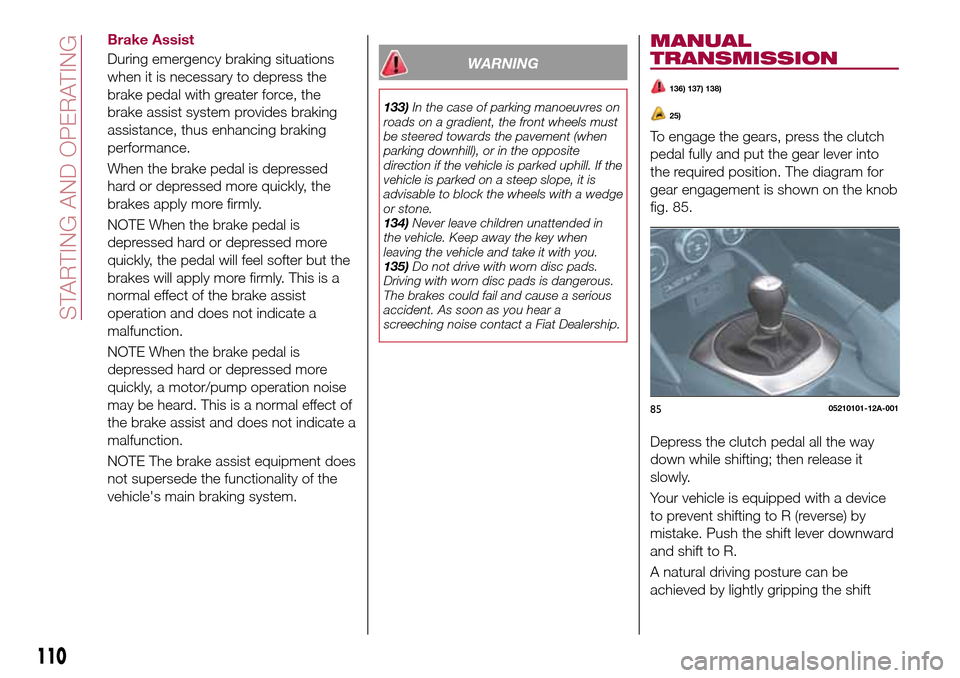
To engage the gears, press the clutch
pedal fully and put the gear lever into
the required position. The diagram for
gear engagement is shown on the knob
fig. 85.
Depress the clutch pedal all the way
down while shifting; then release it
slowly.
Your vehicle is equipped with a device
to prevent shifting to R (reverse) by
mistake. Push the shift lever downward
and shift to R.
A natural driving posture can be
achieved by lightly gripping the shift
8505210101-12A-001
110
STARTING AND OPERATING
Page 212 of 216
INDEX
ABS system................67
Active bonnet precautions........68
Active safety systems...........67
Advanced Keyless Entry System....14
AFS (Adaptive Front Lighting
System)..................27
Attaching the tow hooks........150
Auto-wiper control............29
Automatic climate control system.......................34
Automatic lighting.............25
Automatic transmission.........111
Auxiliary driving systems.........71
Battery (maintenance).........162
Battery recharging............164
Bodywork (care and
maintenance).............167
Bonnet....................40
Boot lid...................38
Boot lid (opening).............38
Brake Assist................110
Brake/clutch fluid (level check). . . .162
Checking levels.............160
Child restraint system suitability
for various seat position.......85
Child seat installation position.....84
Child-restraint precautions.......80
Child-restraint system types......83
Climate control system..........31CO2 emissions..............184
Coming Home light system.......25
Constant monitoring..........107
Control panel and instruments.....46
Convertible Top (lowering)........41
Convertible Top (Soft Top)........41
Cruise Control..............114
Dashboard..................8
Dimensions................177
Doors.....................16
Double locking system..........16
Driver Air Bag................95
DRL (Daytime Running Lights).....24
DSC system................67
Emergency flap opening.......120
Emergency stop signal system. . . .127
Emergency towing............152
Engine...................172
Engine compartment..........160
Engine coolant (level check)......161
Engine oil (level check).........161
Essential information............3
Exterior lights................24
Flash to pass...............25
Fluid capacities..............178
Fluids and lubricants..........179
Front fog lights...............25
Fuel consumption............183
Fuel filler cap...............120Fuse block (engine compartment)......................138
Fuse block (left side of the vehicle)......................141
Fuses (under the bonnet)........137
Fuses (vehicle's left side)........136
Gear lever positions..........112
Gear Shift Indicator............50
Hazard warning lights.........127
Hazard warning lights (control). . . .127
Head restraints...............21
Headlight washer.............30
Headlights..................24
Heated seats................19
Heavy-dute use of the vehicle
(scheduled servicing)........155
High beams.................25
HLA function................74
How the SRS Air bags work......95
How to use this manual..........3
Identification data............171
Ignition switch...............11
Immobilizer system............15
INFO switch.................49
Installing child restraint systems....89
Interiors..................169
Jump starting..............148
Jump starting (procedure).......148
Key battery replacement........10
Keyless Entry System...........9
Keys......................9
INDEX