fuel FIAT 124 SPIDER 2016 2.G User Guide
[x] Cancel search | Manufacturer: FIAT, Model Year: 2016, Model line: 124 SPIDER, Model: FIAT 124 SPIDER 2016 2.GPages: 216, PDF Size: 3.1 MB
Page 52 of 216
press the INFO switch and set the
two lower digits (tenths and ones place)
to the desired vehicle speed. The
numerical value changes each time the
INFO switch is pressed;
press the INFO switch continuously
until a beep sound is heard. The set
vehicle speed is displayed on the
vehicle speed alarm screen.
GEAR SHIFT INDICATOR
The gear shift indicator supports you to
obtain optimum fuel economy and
smooth driving.
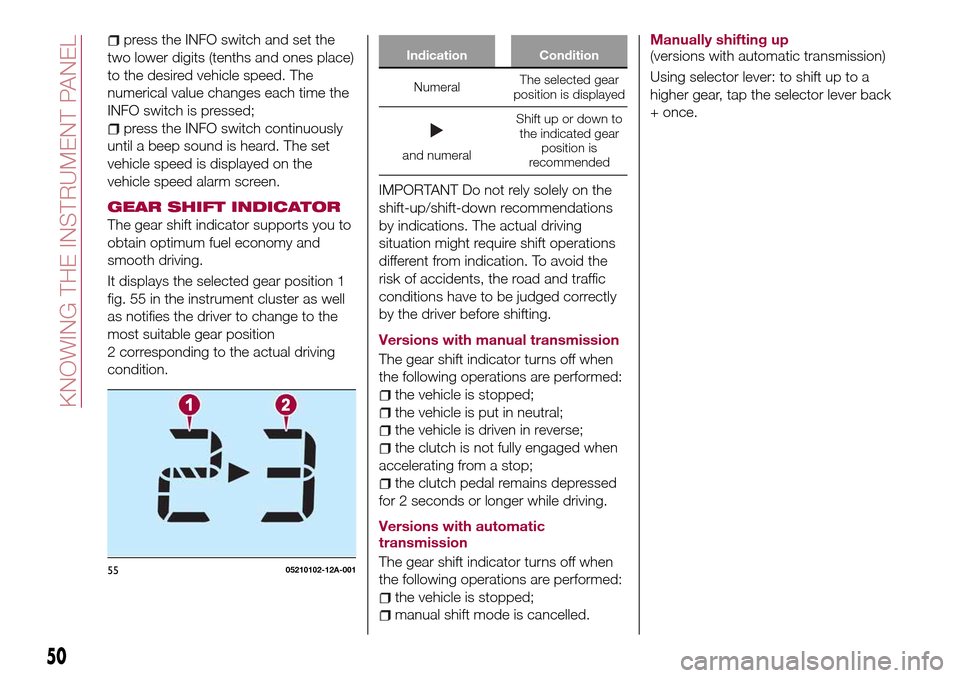
It displays the selected gear position 1
fig. 55 in the instrument cluster as well
as notifies the driver to change to the
most suitable gear position
2 corresponding to the actual driving
condition.
Indication Condition
NumeralThe selected gear
position is displayed
and numeralShift up or down to
the indicated gear
position is
recommended
IMPORTANT Do not rely solely on the
shift-up/shift-down recommendations
by indications. The actual driving
situation might require shift operations
different from indication. To avoid the
risk of accidents, the road and traffic
conditions have to be judged correctly
by the driver before shifting.
Versions with manual transmission
The gear shift indicator turns off when
the following operations are performed:
the vehicle is stopped;
the vehicle is put in neutral;
the vehicle is driven in reverse;
the clutch is not fully engaged when
accelerating from a stop;
the clutch pedal remains depressed
for 2 seconds or longer while driving.
Versions with automatic
transmission
The gear shift indicator turns off when
the following operations are performed:
the vehicle is stopped;
manual shift mode is cancelled.Manually shifting up
(versions with automatic transmission)
Using selector lever: to shift up to a
higher gear, tap the selector lever back
+ once.
5505210102-12A-001
50
KNOWING THE INSTRUMENT PANEL
Page 53 of 216
WARNING LIGHTS AND MESSAGES
IMPORTANT The warning light in the instrument panel appears together with a dedicated message and/or acoustic signal
when applicable. These indications are indicative and precautionary and as such must not be considered as exhaustive and/or
alternative to the information contained in the Owner Handbook, which you are advised to read carefully in all cases. Always
refer to the information in this chapter in the event of a failure indication.
IMPORTANT Failure indications displayed are divided into two categories: serious and less serious failures. Serious failures are
indicated by a repeated and prolonged warning "cycle". Less serious failures are indicated by a warning "cycle" with a shorter
duration. The display cycle of both categories can be interrupted. The instrument panel warning light will stay on until the cause
of the failure is eliminated.
Vehicles with Radio 7”
The warning contents can be verified on the audio system.
Proceed as follows:
if the warning light is turned on, selecticon on the home screen to display the application screen;
select “Warning Guidance” to display the current warnings;
select the applicable warning to view the warning details.
For the following warning/indicator lights:
Master warning light;
Brake system warning light;
ABS warning light;
Charging system warning light;
Engine oil warning light;
Check engine light;
High engine coolant temperature warning light;
Automatic transmission warning light;
Power steering malfunction indicator light;
Air Bag/Seat Belt pretensioner system warning light;
Active bonnet warning light;
Low fuel warning light;
Seat belt warning light;
Door-ajar warning light;
Low washer fluid level warning light;
Tyre Pressure Monitoring System warning light;
51
Page 59 of 216
Amber warning lights
Warning light What it means
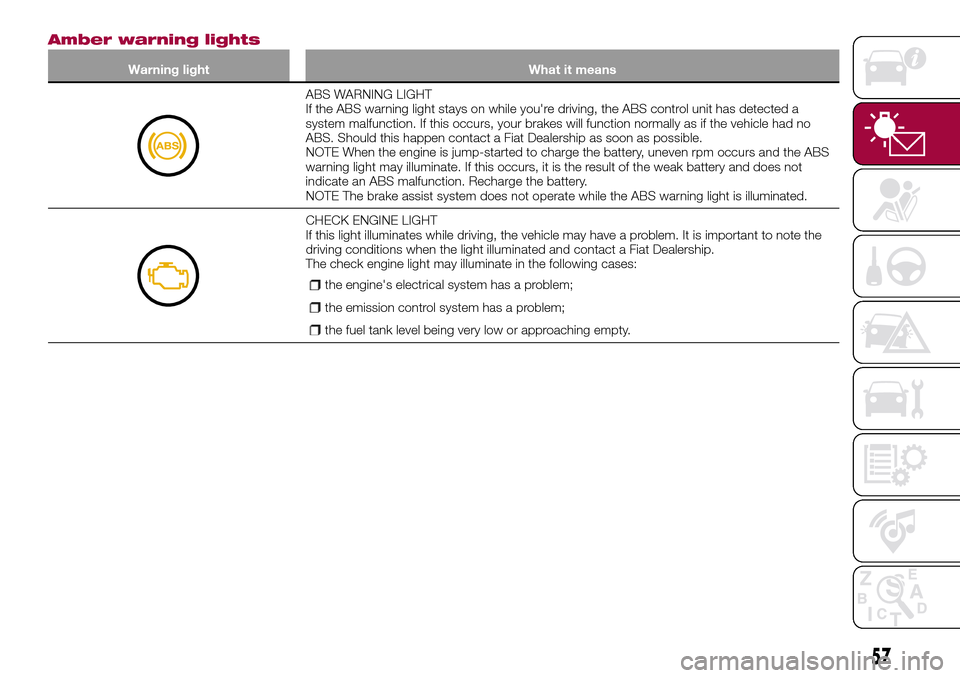
ABS WARNING LIGHT
If the ABS warning light stays on while you're driving, the ABS control unit has detected a
system malfunction. If this occurs, your brakes will function normally as if the vehicle had no
ABS. Should this happen contact a Fiat Dealership as soon as possible.
NOTE When the engine is jump-started to charge the battery, uneven rpm occurs and the ABS
warning light may illuminate. If this occurs, it is the result of the weak battery and does not
indicate an ABS malfunction. Recharge the battery.
NOTE The brake assist system does not operate while the ABS warning light is illuminated.
CHECK ENGINE LIGHT
If this light illuminates while driving, the vehicle may have a problem. It is important to note the
driving conditions when the light illuminated and contact a Fiat Dealership.
The check engine light may illuminate in the following cases:
the engine's electrical system has a problem;
the emission control system has a problem;
the fuel tank level being very low or approaching empty.
57
Page 62 of 216
Warning lights What it means
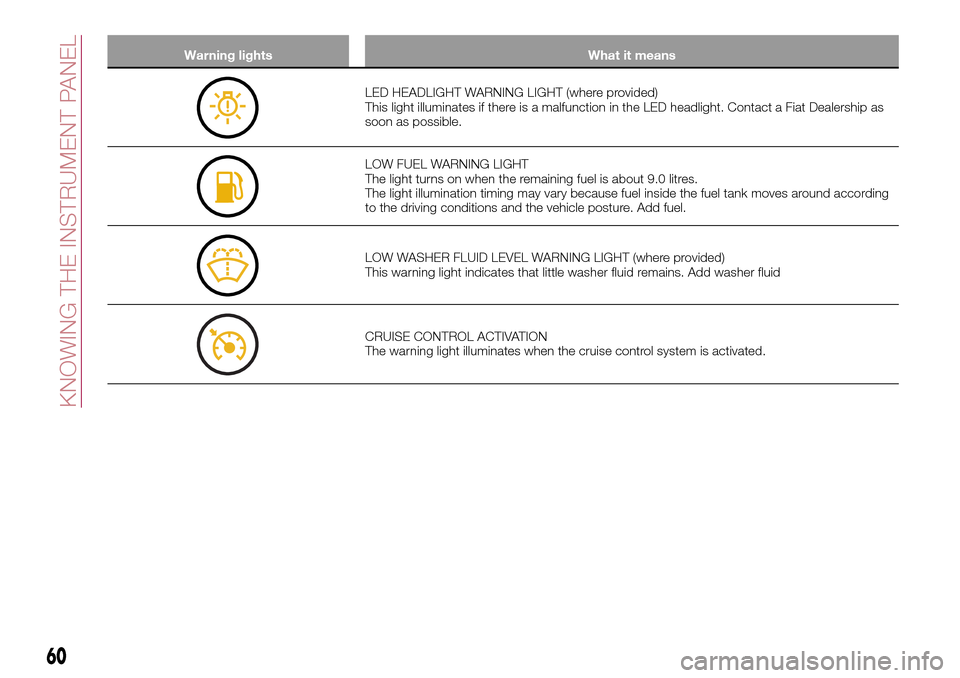
LED HEADLIGHT WARNING LIGHT (where provided)
This light illuminates if there is a malfunction in the LED headlight. Contact a Fiat Dealership as
soon as possible.
LOW FUEL WARNING LIGHT
The light turns on when the remaining fuel is about 9.0 litres.
The light illumination timing may vary because fuel inside the fuel tank moves around according
to the driving conditions and the vehicle posture. Add fuel.
LOW WASHER FLUID LEVEL WARNING LIGHT (where provided)
This warning light indicates that little washer fluid remains. Add washer fluid
CRUISE CONTROL ACTIVATION
The warning light illuminates when the cruise control system is activated.
60
KNOWING THE INSTRUMENT PANEL
Page 73 of 216
75)If the active bonnet has activated,
always contact a Fiat Dealership. If the
bonnet release handle is pulled after the
active bonnet has activated, the bonnet will
rise even further. If the vehicle is driven with
the bonnet raised it will obstruct visibility
and could result in an accident. In addition,
do not attempt to push the bonnet back
down. Otherwise, it could deform the
bonnet or cause injury because the
activated bonnet cannot be lowered
manually. Before driving the vehicle contact
a Fiat Dealership after the active bonnet
has activated, make sure that the raised
bonnet does not obstruct vision and drive
the vehicle at a low speed.AUXILIARY DRIVING
SYSTEMS
TPMS (Tire Pressure
Monitoring System)
76) 77) 78)
The Tire Pressure Monitoring System
(TPMS) monitors the air pressure of all
four tires. If the air pressure of one or
more tires is too low, the system warns
the driver by indicating the tire pressure
monitoring system warning light in the
instrument cluster and operating a beep
sound. The system monitors the tire
pressures indirectly using the data sent
from the ABS wheel speed sensors.
To allow the system to operate
correctly, the system needs to be
initialized with the specifi ed tyre
pressure (value on the tire pressure
label). Follow the procedure and
perform the initialization. Refer to “Tire
Pressure Monitoring System
Initialization” in this paragraph.
The warning light flashes when the
system has a malfunction. Refer to
“Warning lights and messages”
paragraph in “Knowing the instrument
panel” chapter.
IMPORTANT Each tire, including the
spare (where provided), should be
checked monthly when cold and
inflated to the inflation pressurerecommended by the vehicle
manufacturer on the vehicle placard or
tire inflation pressure label (if your
vehicle has tires of a different size than
the size indicated on the vehicle placard
or tire inflation pressure label, you
should determine the proper tire
inflation pressure for those tires).
IMPORTANT As an added safety
feature, your vehicle has been equipped
with a TMPS system that illuminates a
low tire pressure telltale when one or
more of your tires is significantly
under-inflated. Accordingly, when the
low tire pressure telltale illuminates, you
should stop and check your tires as
soon as possible, and inflate them to
the proper pressure. Driving on a
significantly under-inflated tire causes
the tire to overheat and can lead to tire
failure. Under-inflation also reduces fuel
efficiency and tire tread life, and may
affect the vehicle's handling and
stopping ability.
IMPORTANT Please note that the
TPMS is not a substitute for proper tire
maintenance, and it is the driver's
responsibility to maintain correct tire
pressure, even if under-inflation has not
reached the level to trigger illumination
of the TPMS low tire pressure telltale.
Your vehicle has also been equipped
with a TPMS malfunction indicator to
71
Page 110 of 216
STARTING AND OPERATING
Let’s get to the "heart" of the vehicle:
seeing how you can exploit all of its
potential to the full.
We’ll look at how to drive it safely in any
situation, so that it can be a welcome
companion, with our comfort and our
wallets in mind.STARTING THE ENGINE.......109
PARKING BRAKE............109
MANUAL TRANSMISSION......110
AUTOMATIC TRANSMISSION. . . .111
CRUISE CONTROL...........114
SPEED LIMITER.............117
PARKING SENSOR SYSTEM.....118
REFUELLING THE VEHICLE.....120
REAR CAMERA (PARKVIEW REAR
BACKUP CAMERA)...........121
TOWING TRAILERS..........125
108
STARTING AND OPERATING
Page 111 of 216
STARTING THE
ENGINE
130) 131) 132)
24)
Before starting the engine, adjust the
seat, the interior rear view mirrors, the
door mirrors and fasten the seat belt
correctly.
Never press the accelerator pedal for
starting the engine.
For starting procedure see “Starting the
engine” in “Getting to know your
vehicle” chapter.
STOPPING THE ENGINE
Proceed as follows:
park the car in a position that is not
dangerous for oncoming traffic; engage
a gear (versions with manual
transmission) or position the gear lever
to P (Parking) (versions with automatic
transmission);
turn the ignition device to STOP with
the engine idling.
WARNING
130)It is dangerous to run the engine in
enclosed areas. The engine takes in
oxygen and releases carbon dioxide,
carbon monoxide and other toxic gases.131)The brake servo is not active until the
engine is started, so you would need to
apply much more force than usual to the
brake pedal.
132)Do not start the engine by pushing,
towing or driving downhill. These
manoeuvres may damage the catalytic
converter.
IMPORTANT
24)A quick burst on the accelerator before
turning off the engine serves absolutely no
practical purpose; it wastes fuel and is
damaging for the engine.
PARKING BRAKE
133) 134) 135)
IMPORTANT Driving with the parking
brake on will cause excessive wear of
the brake parts.
Setting the parking brake
Depress the brake pedal and then firmly
pull the parking brake lever fully
upwards with sufficient force to hold the
vehicle in a stationary position.
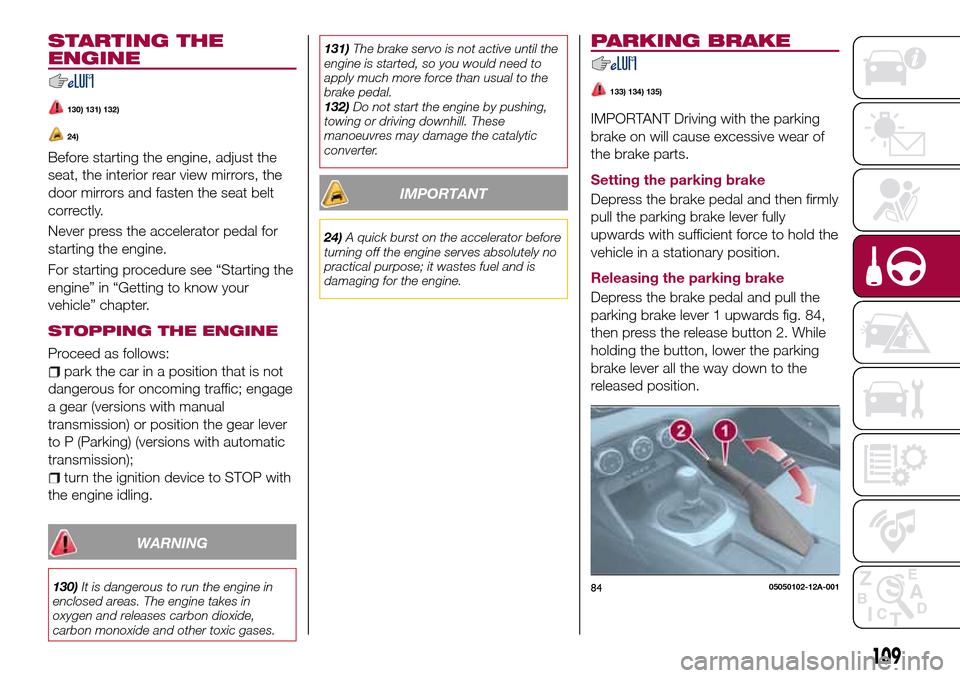
Releasing the parking brake
Depress the brake pedal and pull the
parking brake lever 1 upwards fig. 84,
then press the release button 2. While
holding the button, lower the parking
brake lever all the way down to the
released position.
8405050102-12A-001
109
Page 122 of 216
REFUELLING THE
VEHICLE
152) 153) 154) 155) 156) 157)
Always stop the engine before
refuelling.
FUEL REQUIREMENTS
Only use premium unleaded fuel
(conforming to EN 228 specification
within E10) with a number of octanes
not lower than 95.
IMPORTANT USE ONLY UNLEADED
FUEL. Leaded fuel is harmful to the
catalytic converter and oxygen sensors
and will lead to deterioration of the
emission control system and or failures.
IMPORTANT The use of E10 fuel with
10% ethanol in Europe is safe for your
vehicle. Damage to your vehicle may
occur when ethanol exceeds this
recommendation.
IMPORTANT Never add fuel system
additives, otherwise the emission
control system could be damaged.
Contact a Fiat Dealership for details.
REFUELLING
PROCEDURE
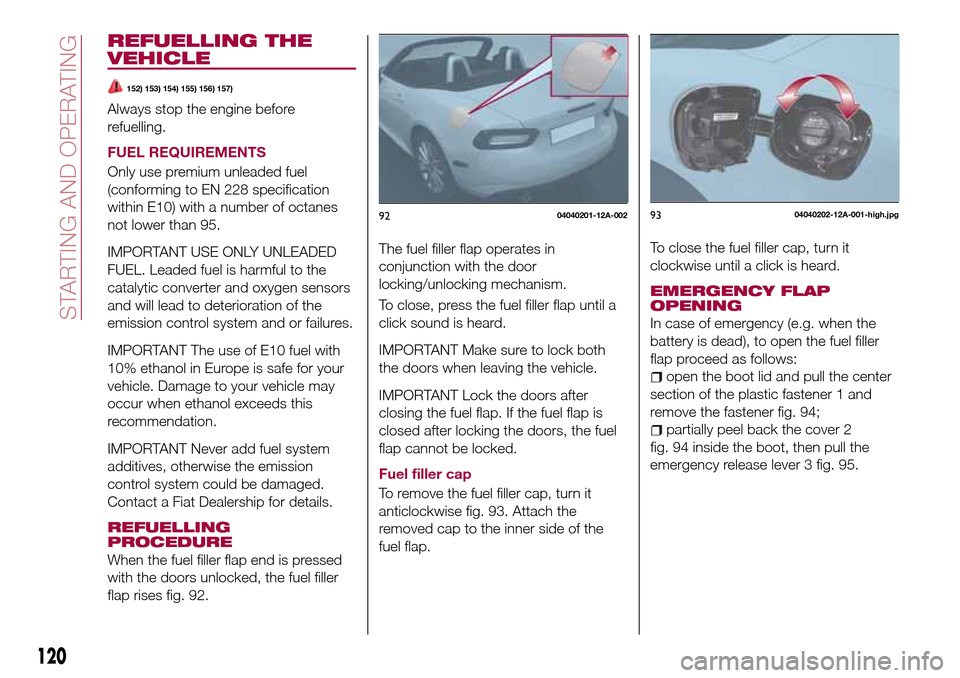
When the fuel filler flap end is pressed
with the doors unlocked, the fuel filler
flap rises fig. 92.The fuel filler flap operates in
conjunction with the door
locking/unlocking mechanism.
To close, press the fuel filler flap until a
click sound is heard.
IMPORTANT Make sure to lock both
the doors when leaving the vehicle.
IMPORTANT Lock the doors after
closing the fuel flap. If the fuel flap is
closed after locking the doors, the fuel
flap cannot be locked.
Fuel filler cap
To remove the fuel filler cap, turn it
anticlockwise fig. 93. Attach the
removed cap to the inner side of the
fuel flap.To close the fuel filler cap, turn it
clockwise until a click is heard.
EMERGENCY FLAP
OPENING
In case of emergency (e.g. when the
battery is dead), to open the fuel filler
flap proceed as follows:
open the boot lid and pull the center
section of the plastic fastener 1 and
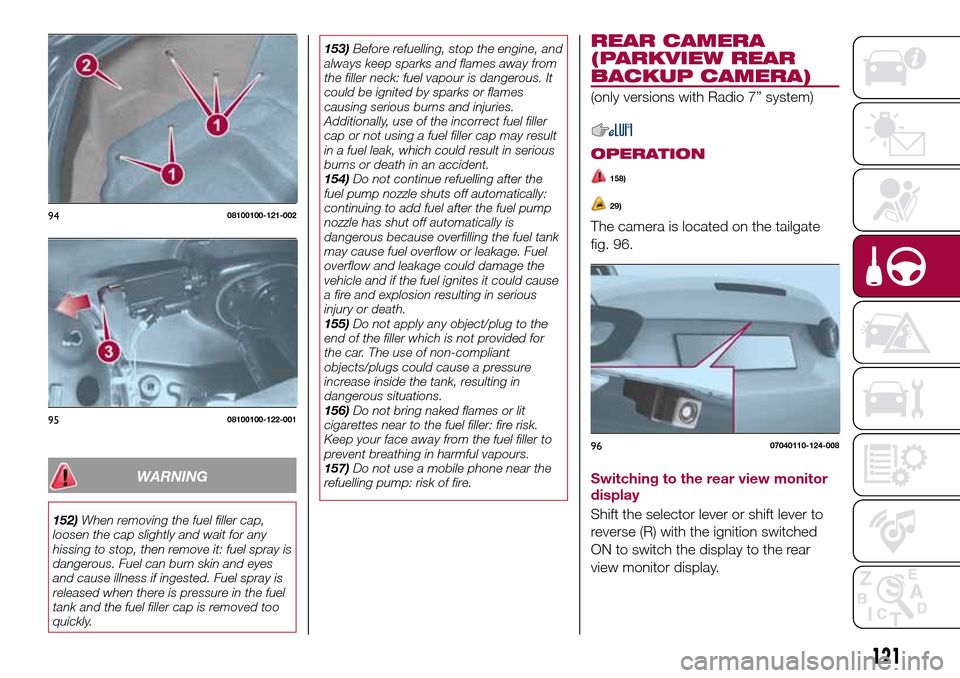
remove the fastener fig. 94;
partially peel back the cover 2
fig. 94 inside the boot, then pull the
emergency release lever 3 fig. 95.
9204040201-12A-0029304040202-12A-001-high.jpg
120
STARTING AND OPERATING
Page 123 of 216
WARNING
152)When removing the fuel filler cap,
loosen the cap slightly and wait for any
hissing to stop, then remove it: fuel spray is
dangerous. Fuel can burn skin and eyes
and cause illness if ingested. Fuel spray is
released when there is pressure in the fuel
tank and the fuel filler cap is removed too
quickly.153)Before refuelling, stop the engine, and
always keep sparks and flames away from
the filler neck: fuel vapour is dangerous. It
could be ignited by sparks or flames
causing serious burns and injuries.
Additionally, use of the incorrect fuel filler
cap or not using a fuel filler cap may result
in a fuel leak, which could result in serious
burns or death in an accident.
154)Do not continue refuelling after the
fuel pump nozzle shuts off automatically:
continuing to add fuel after the fuel pump
nozzle has shut off automatically is
dangerous because overfilling the fuel tank
may cause fuel overflow or leakage. Fuel
overflow and leakage could damage the
vehicle and if the fuel ignites it could cause
a fire and explosion resulting in serious
injury or death.
155)Do not apply any object/plug to the
end of the filler which is not provided for
the car. The use of non-compliant
objects/plugs could cause a pressure
increase inside the tank, resulting in
dangerous situations.
156)Do not bring naked flames or lit
cigarettes near to the fuel filler: fire risk.
Keep your face away from the fuel filler to
prevent breathing in harmful vapours.
157)Do not use a mobile phone near the
refuelling pump: risk of fire.
REAR CAMERA
(PARKVIEW REAR
BACKUP CAMERA)
(only versions with Radio 7” system)
OPERATION
158)
29)
The camera is located on the tailgate
fig. 96.
Switching to the rear view monitor
display
Shift the selector lever or shift lever to
reverse (R) with the ignition switched
ON to switch the display to the rear
view monitor display.9408100100-121-002
9508100100-122-001
9607040110-124-008
121
Page 151 of 216
if the battery cover has been
removed, install it in the reverse order of
removal.
IMPORTANT Verify that the covers are
securely installed.
WARNING
176)Before opening the bonnet, make
sure that the engine is off and that the
ignition switch is in OFF position. During
refuelling, make sure that the engine is off
(and that the ignition switch is in OFF
position).
177)Do not get too close to the radiator
cooling fan: the electric fan may start;
danger of injury. Pay attention to scarves,
ties and other loose clothing which might
be pulled by moving parts.
178)Remove any metal objects (e.g. rings,
watches, bracelets), that might cause an
accidental electrical contact and cause
serious injury.
179)Batteries contain acid which may
burn skin and eyes. Batteries produce
hydrogen, which is easily flammable and
explosive. Thus keep away flames or
devices which may cause sparks.180)Do not allow the positive (+) terminal
to contact any other metal object that
could cause sparks. Flames and sparks
near open battery cells are dangerous.
Hydrogen gas, produced during normal
battery operation, could ignite and cause
the battery to explode. An exploding
battery can cause serious burns and
injuries. When working near a battery, do
not allow metal tools to contact the positive
(+) or negative (–) terminal of the battery.
181)Keep all flames, including cigarettes,
and sparks away from open battery cells.
Flames and sparks near open battery cells
are dangerous. Hydrogen gas, produced
during normal battery operation, could
ignite and cause the battery to explode. An
exploding battery can cause serious burns
and injuries.
182)Do not jump-start a frozen battery or
one with a low fluid level. Jump-starting a
frozen battery or one with a low fluid level is
dangerous. It may rupture or explode,
causing serious injury.
183)Route the jumper leads away from
parts that will be moving. Connecting a
jumper lead near or to moving parts
(cooling fans, belts) is dangerous. The lead
could get caught when the engine starts
and cause serious injury.
184)Never tow a vehicle to start it. Towing
a vehicle to start it is dangerous. The
vehicle being towed could surge forward
when its engine starts, causing the two
vehicles to collide. The occupants could be
injured.
149
connect the jumper leads in the
exact sequence as in “Preparations for
jump starting” paragraph:
– connect one end of a lead to the
positive terminal on the discharged
battery;
– attach the other end to the positive
terminal on the booster battery;
– connect one end of the other lead
to the negative terminal of the
booster battery;
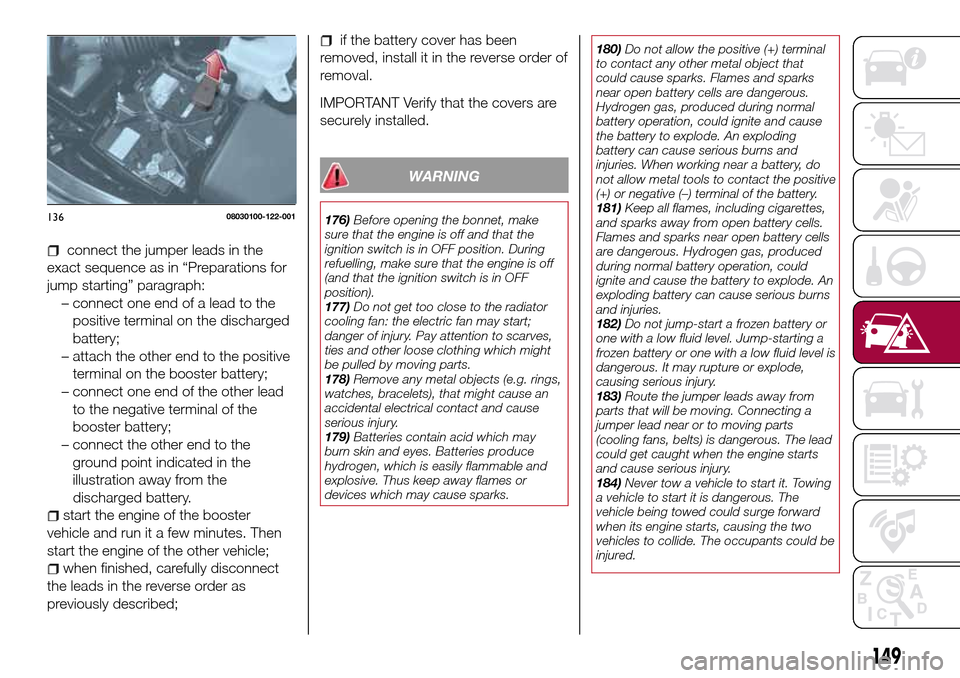
– connect the other end to the
ground point indicated in the
illustration away from the
discharged battery.
start the engine of the booster
vehicle and run it a few minutes. Then
start the engine of the other vehicle;
when finished, carefully disconnect
the leads in the reverse order as
previously described;
13608030100-122-001