tires FIAT 124 SPIDER 2016 2.G User Guide
[x] Cancel search | Manufacturer: FIAT, Model Year: 2016, Model line: 124 SPIDER, Model: FIAT 124 SPIDER 2016 2.GPages: 216, PDF Size: 3.1 MB
Page 116 of 216
DRIVING TIPS
142) 143)
Passing
For extra power when passing another
vehicle or climbing steep grades,
depress the accelerator fully. The
transmission will shift to a lower gear,
depending on vehicle speed.
Climbing steep grades from a stop
To climb a steep grade from a stopped
position depress the brake pedal, shift
to D or M1, depending on the load
weight and grade steepness, release
the brake pedal while gradually
accelerating.
Descending steep grades
When descending a steep grade, shift
to lower gears, depending on load
weight and grade steepness.
Descend slowly, using the brakes only
occasionally to prevent them from
overheating.
WARNING
139)Always set the selector lever to P and
set the parking brake. Only setting the
selector lever to the P position without
using the parking brake to hold the vehicle
is dangerous. If P fails to hold, the vehicle
could move and cause an accident.140)If the engine is running faster than
idle, do not shift from N or P into a driving
gear. It's dangerous to shift from N or P
into a driving gear when the engine is
running faster than idle. If this is done, the
vehicle could move suddenly, causing an
accident or serious injury.
141)Do not shift into N when driving the
vehicle. Shifting into N while driving is
dangerous. Engine braking cannot be
applied when decelerating which could
lead to an accident or serious injury.
142)Do not use engine braking on slippery
road surfaces or at high speeds. Shifting
down while driving on wet, snowy, or
frozen roads, or while driving at high
speeds causes sudden engine braking,
which is dangerous. The sudden change in
tire speed could cause the tires to skid.
This could lead to loss of vehicle control
and an accident.
143)Do not let the vehicle move in a
direction opposite to the direction selected
by the selector lever. Do not let the vehicle
move backward with the selector lever in a
forward position, or do not let the vehicle
move forward with the selector lever in the
reverse position. Otherwise, the engine
may stop, causing the loss of the power
brake and power steering functions, and
make it difficult to control the vehicle which
could result in an accident.
CRUISE CONTROL
This is an electronically controlled
driving assistance device that allows the
desired vehicle speed to be maintained,
without having to press the accelerator
pedal.
This device can be used at a speed
above 25 km/h on long stretches of dry,
straight roads with few variations (e.g.
motorways).
It is therefore not recommended to use
this device on extra-urban roads with
traffic. Do not use it in town.
ACTIVATION /
DEACTIVATION
144) 145) 146) 147)
IMPORTANT When the ignition is
switched off, the system status before it
was turned off is maintained. For
example, if the ignition is switched off
while the cruise control is operating, the
system will be operable when the
ignition is switched ON the next time.
Activating the device
With Speed limiter: press the MODE
switch. The
warning light (amber)
turns on.
114
STARTING AND OPERATING
Page 124 of 216
IMPORTANT When parking, take the
utmost care over obstacles that may be
above or under the camera range.
IMPORTANT Always use extreme
caution and verify the real conditions of
the area behind the vehicle with you
own eyes. Reversing while looking only
at the screen is dangerous and can
lead to an accident or collision with an
object. The rear-view monitor is simply
a system to aid reversing. The images
on the screen can show a situation that
differs from the real one.
When the display is cold, the images
could scroll on the monitor or the
screen and could be more blurred than
usual, making it difficult to check the
conditions of the area around the
vehicle. Always use extreme caution
and verify the real conditions of the area
behind the vehicle with you own eyes.
IMPORTANT Do not apply excessive
force to the camera. You could alter the
position and angle of the camera. Do
not disassemble, modify or remove it as
this could compromise the hermetic
seal.
IMPORTANT The camera cover is
made of plastic. Do not apply
degreasing agents, organic solvents,
wax, or glass coating agents to thecamera cover. If any are spilled on the
cover, wipe off with a soft cloth
immediately.
IMPORTANT Do not rub the camera
cover forcefully with an abrasive or hard
brush. The camera cover or lens may
be scratched which might affect the
images.
IMPORTANT If water, snow or mud is
deposited on the camera lens, clean it
with a soft cloth. If this does not clean
it, use a mild detergent.
IMPORTANT If the camera is subjected
to abrupt temperature changes (from
hot to cold or vice versa), the rear-view
monitor may not work properly.
IMPORTANT When replacing tires,
contact a Fiat Dealership. Replacing the
tires can cause the guide lines that
appear on the display to be diverted.
IMPORTANT If the vehicle has been
involved in a frontal, lateral or rear
collision, the rear parking camera’s
alignment (location or installation angle)
may have been altered. Contact a Fiat
Dealership.
IMPORTANT If the display shows "no
video signal", there may be a problem
with the camera. Contact a Fiat
Dealership.VIEWING THE DISPLAY
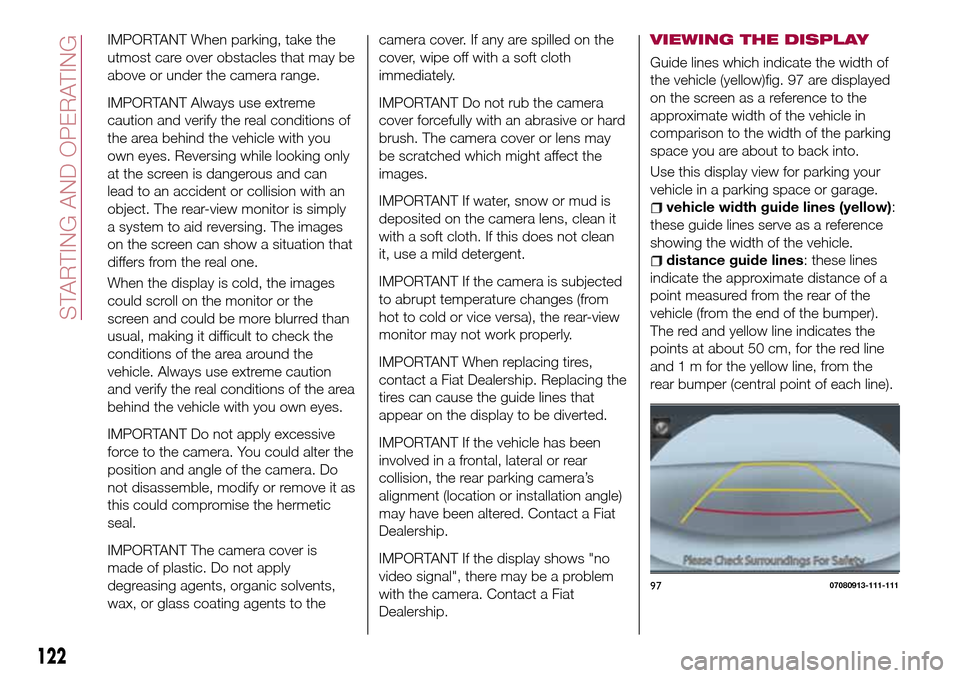
Guide lines which indicate the width of
the vehicle (yellow)fig. 97 are displayed
on the screen as a reference to the
approximate width of the vehicle in
comparison to the width of the parking
space you are about to back into.
Use this display view for parking your
vehicle in a parking space or garage.
vehicle width guide lines (yellow):
these guide lines serve as a reference
showing the width of the vehicle.
distance guide lines: these lines
indicate the approximate distance of a
point measured from the rear of the
vehicle (from the end of the bumper).
The red and yellow line indicates the
points at about 50 cm, for the red line
and 1 m for the yellow line, from the
rear bumper (central point of each line).
9707080913-111-111
122
STARTING AND OPERATING
Page 155 of 216
MAINTENANCE AND CARE
Correct maintenance permits the
performance of the vehicle to be
maintained over time, as well as limited
running costs and safeguarding the
efficiency of the safety systems.INTRODUCTION.............154
ENGINE COMPARTMENT......160
BATTERY RECHARGING.......164
WHEELS AND TIRES..........165
BODYWORK...............167
INTERIORS................169
153
Page 167 of 216
WHEELS AND TIRES
SAFETY INFORMATION
206) 207) 208)
49) 50)
Before embarking on a long trip, and
approximately every two weeks, check
the tire inflation pressure, including the
spare wheel, if present. Check the tires
when cold.
It is normal for the pressure to increase
when the vehicle is used due to tire
heating; for the correct tire inflation
pressure, see the "Wheels and tire
specifications" paragraph in the
"Technical specifications" chapter.
The tires must be replaced when the
tread is less than 1.6 mm thick.
REPLACING A TIRE
209)
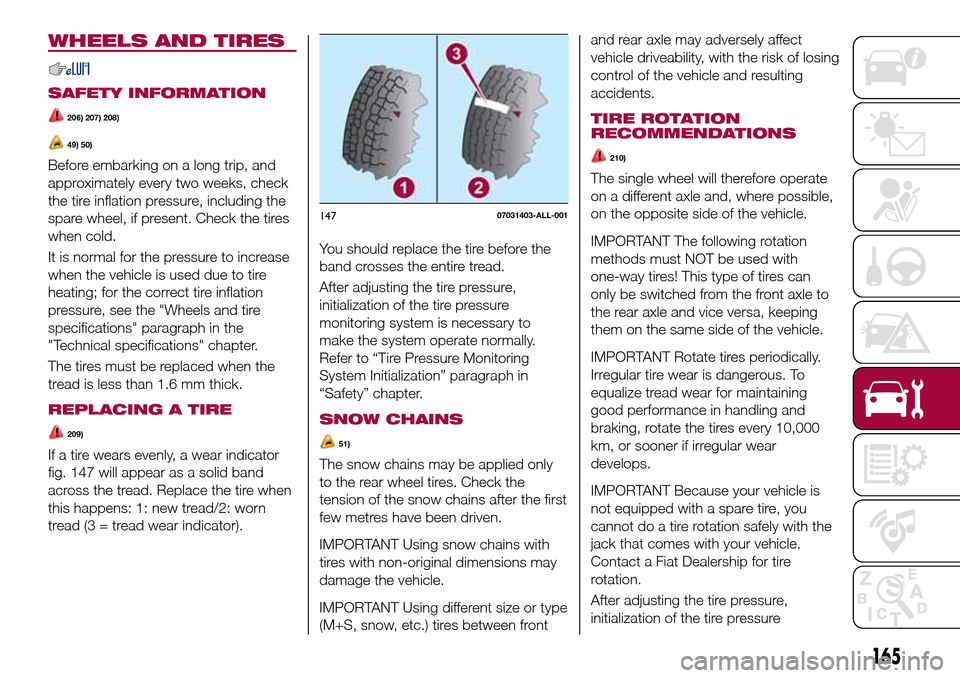
If a tire wears evenly, a wear indicator
fig. 147 will appear as a solid band
across the tread. Replace the tire when
this happens: 1: new tread/2: worn
tread (3 = tread wear indicator).You should replace the tire before the
band crosses the entire tread.
After adjusting the tire pressure,
initialization of the tire pressure
monitoring system is necessary to
make the system operate normally.
Refer to “Tire Pressure Monitoring
System Initialization” paragraph in
“Safety” chapter.
SNOW CHAINS
51)
The snow chains may be applied only
to the rear wheel tires. Check the
tension of the snow chains after the first
few metres have been driven.
IMPORTANT Using snow chains with
tires with non-original dimensions may
damage the vehicle.
IMPORTANT Using different size or type
(M+S, snow, etc.) tires between frontand rear axle may adversely affect
vehicle driveability, with the risk of losing
control of the vehicle and resulting
accidents.
TIRE ROTATION
RECOMMENDATIONS
210)
The single wheel will therefore operate
on a different axle and, where possible,
on the opposite side of the vehicle.
IMPORTANT The following rotation
methods must NOT be used with
one-way tires! This type of tires can
only be switched from the front axle to
the rear axle and vice versa, keeping
them on the same side of the vehicle.
IMPORTANT Rotate tires periodically.
Irregular tire wear is dangerous. To
equalize tread wear for maintaining
good performance in handling and
braking, rotate the tires every 10,000
km, or sooner if irregular wear
develops.
IMPORTANT Because your vehicle is
not equipped with a spare tire, you
cannot do a tire rotation safely with the
jack that comes with your vehicle.
Contact a Fiat Dealership for tire
rotation.
After adjusting the tire pressure,
initialization of the tire pressure
14707031403-ALL-001
165
Page 168 of 216
monitoring system is necessary to
make the system operate normally.
Refer to “Tire Pressure Monitoring
System Initialization” paragraph in
“Safety” chapter.
IMPORTANT Rotate unidirectional tires
and radial tires that have an
asymmetrical tread pattern or studs
only from front to rear, not from side to
side. Tire performance will be reduced if
rotated from side to side.
With limited-slip differential
(where provided)
Do not use the following:
tires not of the designated size;
tires of different sizes or types at the
same time;
tires not sufficiently inflated.
If these instructions are not followed,
the rotation of the left and right wheels
will be different and will thus apply a
constant load on the limited-slip
differential. This will cause a
malfunction.
WARNING
206)If the tires are "unidirectional", do not
switch tires from the right-hand side of the
vehicle to the left-hand side, and vice
versa. This type of tires can only be
switched from the front axle to the rear axle
and vice versa, keeping them on the same
side of the vehicle.
207)Travelling with partially or completely
flat tires can cause safety problems and
irreparable damages to the tire.
208)Always use tires that are in good
condition. Driving with worn tires is
dangerous. Reduced braking, steering, and
traction could result in an accident.
209)Replace all four tires at the same time.
Replacing just one tyre is dangerous. It
could cause poor handling and poor
braking resulting in loss of vehicle control.
FCA strongly recommends that you
replace all four tires at the same time.
210)Always use wheels of the correct size
on your vehicle. Using a wrong-sized wheel
is dangerous. Braking and handling could
be affected, leading to loss of control and
an accident.
IMPORTANT
49)Road holding depends also on the
correct tire inflating pressure.
50)If the pressure is too low the tire
overheats and this can cause it serious
damage.51)Keep your speed down when snow
chains are fitted; do not exceed 50 km/h
(30 mph). Avoid potholes, steps and
pavements and avoid driving for long
distances on roads not covered with snow
to prevent damaging the vehicle and the
road surface.
166
MAINTENANCE AND CARE
Page 169 of 216
BODYWORK
PRESERVING THE
PAINTWORK
52) 53)
7)
Touch up abrasions and scratches
immediately to prevent the formation of
rust.
To correctly wash the vehicle, follow
these instructions:
is the vehicle is washed remove the
aerial;
if high pressure jets or cleaners are
used to wash the vehicle, keep a
distance of at least 40 cm from the
bodywork to avoid damage or
alteration. Build up of water could
cause damage to the vehicle in the long
term;
wash the bodywork using a low
pressure jet of water if possible;
wipe a sponge with a slightly soapy
solution over the bodywork, frequently
rinsing the sponge;
rinse well with water and dry with a
jet of air or a chamois leather.
Dry the less visible parts (e.g. door
frames, bonnet, headlight frames, etc.)
with special care, as water may
stagnate more easily in these areas. Do
not wash the vehicle after it has beenleft in the sun or with the bonnet hot:
this may alter the shine of the
paintwork.
Exterior plastic parts must be cleaned
in the same way as the rest of the
vehicle.
IMPORTANT Avoid parking under trees;
the resin dropped by trees makes the
paintwork go opaque and increases the
possibility of corrosion.
IMPORTANT Bird droppings must be
washed off immediately and thoroughly
as the acid they contain is particularly
aggressive.
Paint chipping
Paint chipping occurs when gravel
thrown in the air by another vehicle's
tires hits your vehicle.
Keeping a safe distance between you
and the vehicle ahead reduces the
chances of having your paint chipped
by flying gravel.
IMPORTANT The paint chipping zone
varies with the speed of the vehicle. For
example, when travelling at 90 km/h,
the paint chipping zone is 50 m.
IMPORTANT In low temperatures a
vehicle's finish hardens. This increases
the chance of paint chipping.IMPORTANT Chipped paint can lead to
rust forming on your vehicle. Before this
happens, repair the damage by using
FCA touch-up paint according to the
instructions in this section. Failure to
repair the affected area could lead to
serious rusting and expensive repairs.
MAINTAINING THE
FINISH
Washing
To help protect the finish from rust and
deterioration, wash your vehicle
thoroughly and frequently, at least once
a month, with lukewarm or cold water.
IMPORTANT FCA is not responsible for
scratches caused by automatic car
washes or improper washing.
Scratches are more noticeable on
vehicles with darker paint finishes.
IMPORTANT Keep hands and scrapers
clear of the windscreen when the wiper
lever is in the AUTO position and the
ignition is switched ON as fingers could
be pinched or the wipers and wiper
blades damaged when the wipers
activate automatically. If you are going
to clean the windscreen, be sure the
wipers are turned off completely (when
it is most likely that the engine is left
running) this is particularly important
when clearing ice and snow.
167
Page 175 of 216
WHEEL AND TIRE
SPECIFICATIONS
RIMS AND TIRES
219)
55)
NOTE The tires have been optimally
matched with the chassis of your
vehicle. When replacing tires, FCA
recommends that you replace tires of
the same type originally fitted to your
vehicle. For details, contact a Fiat
Dealership.
Check the tire pressure label for tire size
and inflation pressure (refer to “Tire
inflation pressure” paragraph in
“Maintenance and care” chapter). After
adjusting the tire pressure, initialization
of the TPMS system is necessary to
make the system operate normally
(refer to “Tire Pressure Monitoring
System initialization” in “Safety”
chapter).
IMPORTANT If there are any
discrepancies between the Owner
Handbook and the registration
document, take the information from
the latter. For safe driving, the vehicle
must be fitted with tires of the same
make and type on all wheels.
IMPORTANT Do not use tubes with
tubeless tires.
173
Page 176 of 216
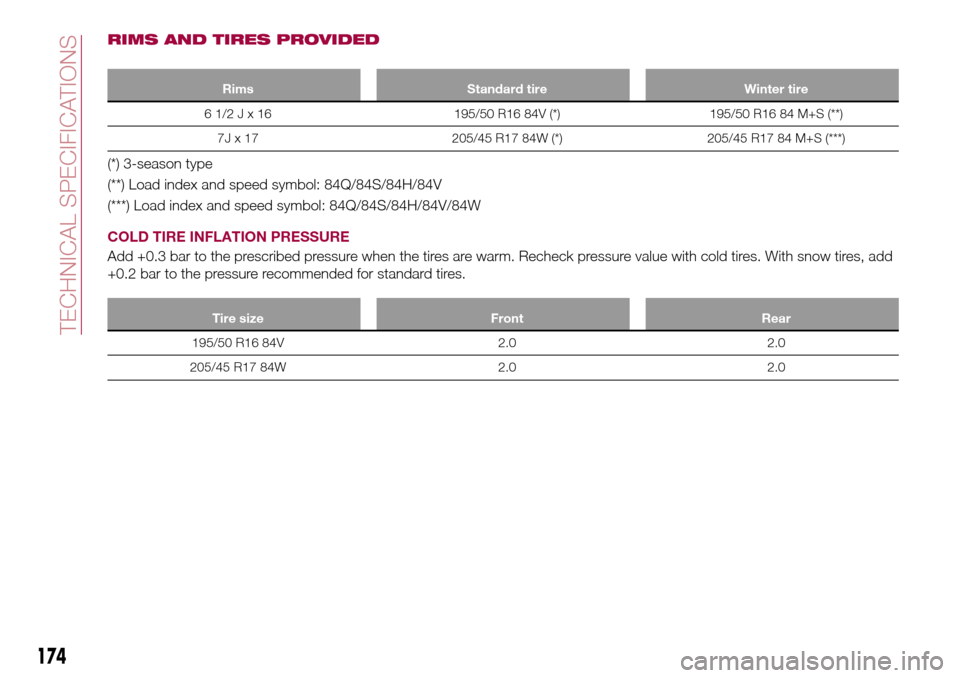
RIMS AND TIRES PROVIDED
Rims Standard tire Winter tire
61/2Jx16195/50 R16 84V (*) 195/50 R16 84 M+S (**)
7J x 17 205/45 R17 84W (*) 205/45 R17 84 M+S (***)
(*) 3-season type
(**) Load index and speed symbol: 84Q/84S/84H/84V
(***) Load index and speed symbol: 84Q/84S/84H/84V/84W
COLD TIRE INFLATION PRESSURE
Add +0.3 bar to the prescribed pressure when the tires are warm. Recheck pressure value with cold tires. With snow tires, add
+0.2 bar to the pressure recommended for standard tires.
Tire size Front Rear
195/50 R16 84V 2.0 2.0
205/45 R17 84W 2.0 2.0
174
TECHNICAL SPECIFICATIONS
Page 213 of 216
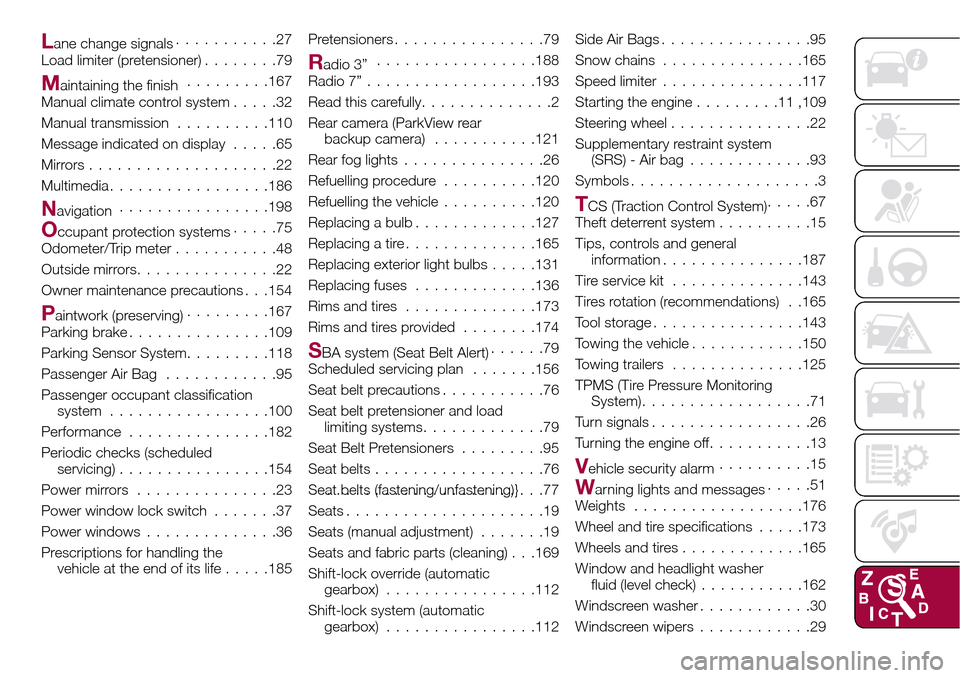
Lane change signals...........27
Load limiter (pretensioner)........79
Maintaining the finish.........167
Manual climate control system.....32
Manual transmission..........110
Message indicated on display.....65
Mirrors....................22
Multimedia.................186
Navigation................198
Occupant protection systems.....75
Odometer/Trip meter...........48
Outside mirrors...............22
Owner maintenance precautions . . .154
Paintwork (preserving).........167
Parking brake...............109
Parking Sensor System.........118
Passenger Air Bag............95
Passenger occupant classification
system.................100
Performance...............182
Periodic checks (scheduled
servicing)................154
Power mirrors...............23
Power window lock switch.......37
Power windows..............36
Prescriptions for handling the
vehicle at the end of its life.....185Pretensioners................79
Radio 3”.................188
Radio 7”..................193
Read this carefully..............2
Rear camera (ParkView rear
backup camera)...........121
Rear fog lights...............26
Refuelling procedure..........120
Refuelling the vehicle..........120
Replacing a bulb.............127
Replacing a tire..............165
Replacing exterior light bulbs.....131
Replacing fuses.............136
Rims and tires..............173
Rims and tires provided........174
SBA system (Seat Belt Alert)......79
Scheduled servicing plan.......156
Seat belt precautions...........76
Seat belt pretensioner and load
limiting systems.............79
Seat Belt Pretensioners.........95
Seat belts..................76
Seat belts (fastening/unfastening)}.......................77
Seats.....................19
Seats (manual adjustment).......19
Seats and fabric parts (cleaning) . . .169
Shift-lock override (automatic
gearbox)................112
Shift-lock system (automatic
gearbox)................112Side Air Bags................95
Snow chains...............165
Speed limiter...............117
Starting the engine.........11,109
Steering wheel...............22
Supplementary restraint system
(SRS) - Air bag.............93
Symbols....................3
TCS (Traction Control System).....67
Theft deterrent system..........15
Tips, controls and general
information...............187
Tire service kit..............143
Tires rotation (recommendations) . .165
Tool storage................143
Towing the vehicle............150
Towing trailers..............125
TPMS (Tire Pressure Monitoring
System)..................71
Turn signals.................26
Turning the engine off...........13
Vehicle security alarm..........15
Warning lights and messages.....51
Weights..................176
Wheel and tire specifications.....173
Wheels and tires.............165
Window and headlight washer
fluid (level check)...........162
Windscreen washer............30
Windscreen wipers............29