tow FIAT 124 SPIDER 2016 2.G User Guide
[x] Cancel search | Manufacturer: FIAT, Model Year: 2016, Model line: 124 SPIDER, Model: FIAT 124 SPIDER 2016 2.GPages: 216, PDF Size: 3.1 MB
Page 127 of 216
IMPORTANT
29)It is vital, for correct operation, that the
camera is always kept clean and free from
mud, dirt, snow or ice. Be careful not to
scratch or damage the camera while
cleaning it. Avoid using dry, rough or hard
cloths. The camera must be washed using
clean water, with the addition of car
shampoo if necessary. In washing stations
which use steam or high-pressure jets,
clean the camera quickly, keeping the
nozzle more than 10 cm away from the
sensors. Do not apply stickers to the
camera.
TOWING TRAILERS
Your car is not designed for towing.
125
Page 128 of 216
IN CASE OF EMERGENCY
A punctured tyre or a burnt-out bulb?
At times, a problem may interfere with
our journey.
The pages on emergencies can help
you to deal with critical situations
independently and with calm.
In an emergency we recommend that
you call the freephone number found in
the Warranty Booklet.
It is also possible to call the national or
international universal freephone
number to search for the nearest
Dealership.HAZARD WARNING LIGHTS.....127
REPLACING A BULB..........127
REPLACING FUSES..........136
TIRE SERVICE KIT...........143
JUMP STARTING............148
TOWING THE VEHICLE........150
EMERGENCY TOWING........152
126
IN CASE OF EMERGENCY
Page 130 of 216
IMPORTANT When the weather is cold
or damp or after heavy rain or washing,
the surface of headlights or rear lights
may steam up and/or form drops of
condensation on the inside. This is a
natural phenomenon due to the
difference in temperature and humidity
between the inside and the outside of
the glass which does not indicate a
fault and does not compromise the
normal operation of lighting devices.
The mist disappears quickly when the
lights are turned on, starting from the
center of the diffuser, extending
progressively towards the edges.
128
IN CASE OF EMERGENCY
Page 145 of 216
WARNING
164)If the fuse blows again contact a Fiat
Dealership.
165)Never replace a fuse with another
with a higher amp rating; DANGER OF
FIRE.
166)Contact a Fiat Dealership if a safety
system (airbags, brakes), power unit
system (engine, gearbox) or steering
system general protection fuse blows.
167)Do not replace the main fuse and
multiplex slow blow fuse by yourself.
Contact a Fiat Dealership to perform the
replacement. Replacing these fuses by
yourself is dangerous because they are
high current fuses. Incorrect replacement
could cause an electrical shock or a short
circuit resulting in a fire.
168)Before replacing a fuse, make sure
that the ignition device is in OFF position
and that all the other services are switched
off and/or deactivated.
IMPORTANT
32)Never replace a fuse with metal wires
or anything else.
33)If it is necessary to wash the engine
compartment, take care not to directly hit
the junction unit and the window wiper
motors with the water jet.
TIRE SERVICE KIT
(where provided)
169) 170) 171) 172) 173) 174) 175)
3)
TOOL STORAGE
Your vehicle is not equipped with a
spare tire, jack and wheel brace. For
details, contact a Fiat Dealership.
Tools are stored in the locations
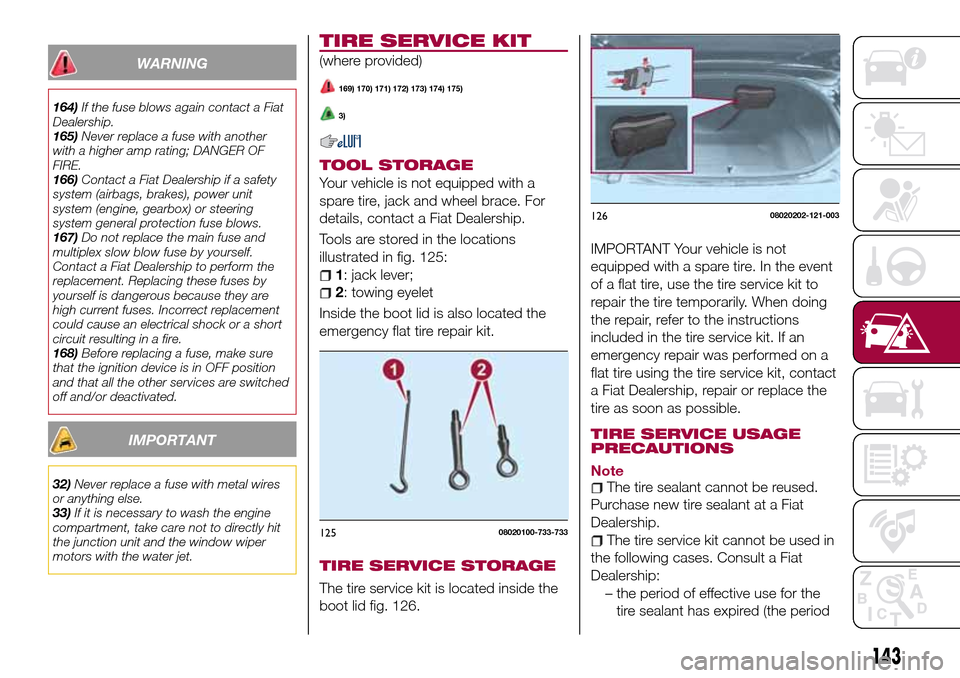
illustrated in fig. 125:
1: jack lever;
2: towing eyelet
Inside the boot lid is also located the
emergency flat tire repair kit.
TIRE SERVICE STORAGE
The tire service kit is located inside the
boot lid fig. 126.
IMPORTANT Your vehicle is not
equipped with a spare tire. In the event
of a flat tire, use the tire service kit to
repair the tire temporarily. When doing
the repair, refer to the instructions
included in the tire service kit. If an
emergency repair was performed on a
flat tire using the tire service kit, contact
a Fiat Dealership, repair or replace the
tire as soon as possible.
TIRE SERVICE USAGE
PRECAUTIONS
NoteThe tire sealant cannot be reused.
Purchase new tire sealant at a Fiat
Dealership.
The tire service kit cannot be used in
the following cases. Consult a Fiat
Dealership:
– the period of effective use for the
tire sealant has expired (the period12508020100-733-733
12608020202-121-003
143
Page 151 of 216
if the battery cover has been
removed, install it in the reverse order of
removal.
IMPORTANT Verify that the covers are
securely installed.
WARNING
176)Before opening the bonnet, make
sure that the engine is off and that the
ignition switch is in OFF position. During
refuelling, make sure that the engine is off
(and that the ignition switch is in OFF
position).
177)Do not get too close to the radiator
cooling fan: the electric fan may start;
danger of injury. Pay attention to scarves,
ties and other loose clothing which might
be pulled by moving parts.
178)Remove any metal objects (e.g. rings,
watches, bracelets), that might cause an
accidental electrical contact and cause
serious injury.
179)Batteries contain acid which may
burn skin and eyes. Batteries produce
hydrogen, which is easily flammable and
explosive. Thus keep away flames or
devices which may cause sparks.180)Do not allow the positive (+) terminal
to contact any other metal object that
could cause sparks. Flames and sparks
near open battery cells are dangerous.
Hydrogen gas, produced during normal
battery operation, could ignite and cause
the battery to explode. An exploding
battery can cause serious burns and
injuries. When working near a battery, do
not allow metal tools to contact the positive
(+) or negative (–) terminal of the battery.
181)Keep all flames, including cigarettes,
and sparks away from open battery cells.
Flames and sparks near open battery cells
are dangerous. Hydrogen gas, produced
during normal battery operation, could
ignite and cause the battery to explode. An
exploding battery can cause serious burns
and injuries.
182)Do not jump-start a frozen battery or
one with a low fluid level. Jump-starting a
frozen battery or one with a low fluid level is
dangerous. It may rupture or explode,
causing serious injury.
183)Route the jumper leads away from
parts that will be moving. Connecting a
jumper lead near or to moving parts
(cooling fans, belts) is dangerous. The lead
could get caught when the engine starts
and cause serious injury.
184)Never tow a vehicle to start it. Towing
a vehicle to start it is dangerous. The
vehicle being towed could surge forward
when its engine starts, causing the two
vehicles to collide. The occupants could be
injured.
149
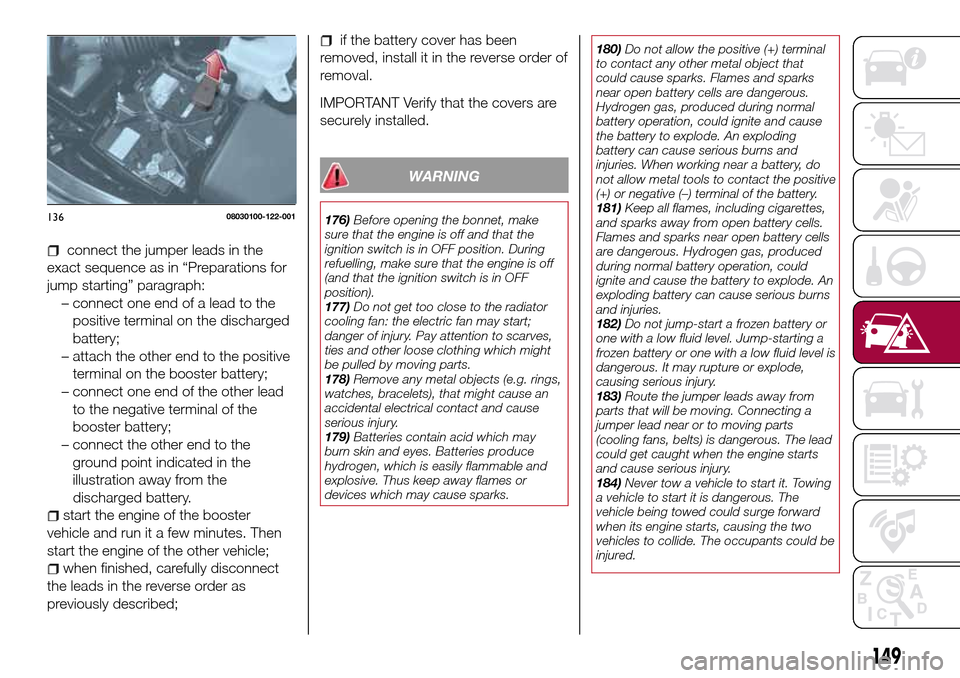
connect the jumper leads in the
exact sequence as in “Preparations for
jump starting” paragraph:
– connect one end of a lead to the
positive terminal on the discharged
battery;
– attach the other end to the positive
terminal on the booster battery;
– connect one end of the other lead
to the negative terminal of the
booster battery;
– connect the other end to the
ground point indicated in the
illustration away from the
discharged battery.
start the engine of the booster
vehicle and run it a few minutes. Then
start the engine of the other vehicle;
when finished, carefully disconnect
the leads in the reverse order as
previously described;
13608030100-122-001
Page 152 of 216
TOWING THE
VEHICLE
ATTACHING THE TOW
HOOKS
35) 36) 37)
Proceed as follows:
remove the towing eyelet and the
wheel brace from the luggage
compartment;
wrap a flathead screwdriver or similar
tool with a soft cloth to prevent damage
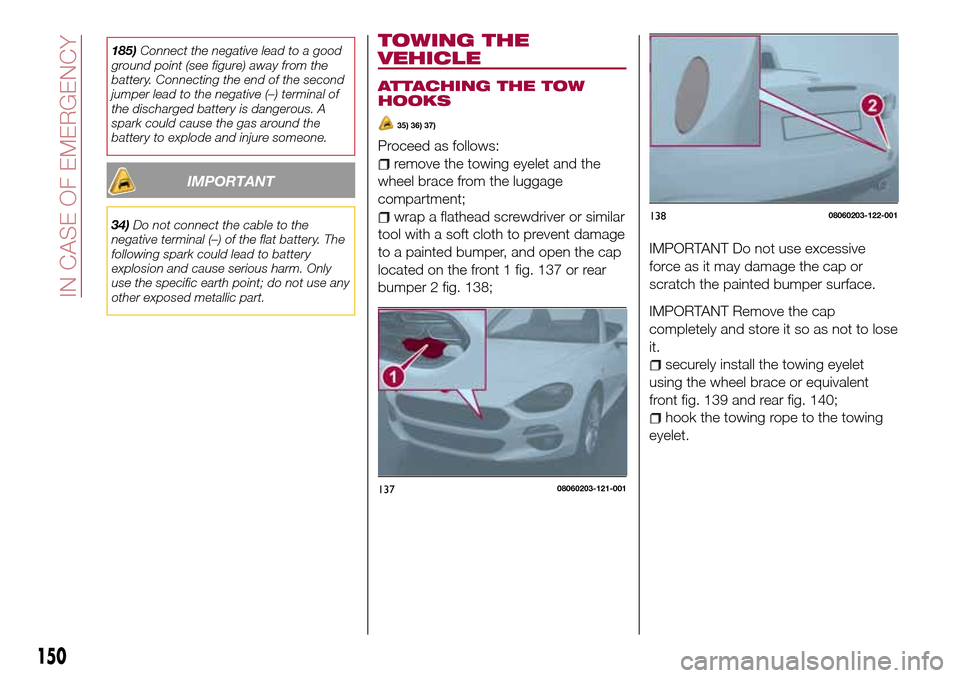
to a painted bumper, and open the cap
located on the front 1 fig. 137 or rear
bumper 2 fig. 138;
IMPORTANT Do not use excessive
force as it may damage the cap or
scratch the painted bumper surface.
IMPORTANT Remove the cap
completely and store it so as not to lose
it.
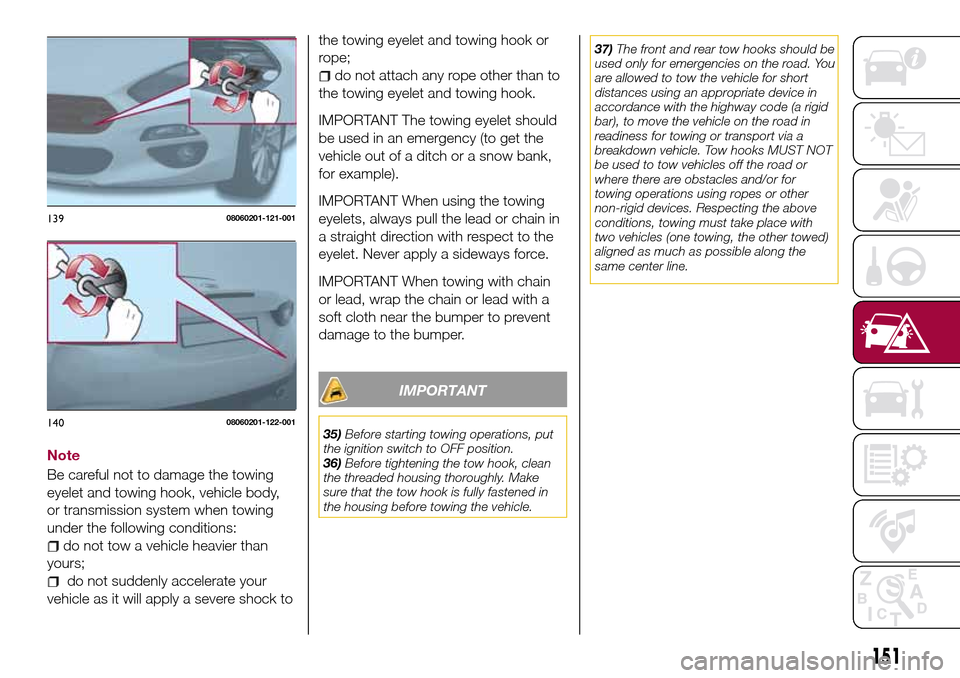
securely install the towing eyelet
using the wheel brace or equivalent
front fig. 139 and rear fig. 140;
hook the towing rope to the towing
eyelet.
13708060203-121-001
13808060203-122-001
150
IN CASE OF EMERGENCY
185)Connect the negative lead to a good
ground point (see figure) away from the
battery. Connecting the end of the second
jumper lead to the negative (–) terminal of
the discharged battery is dangerous. A
spark could cause the gas around the
battery to explode and injure someone.
IMPORTANT
34)Do not connect the cable to the
negative terminal (–) of the flat battery. The
following spark could lead to battery
explosion and cause serious harm. Only
use the specific earth point; do not use any
other exposed metallic part.
Page 153 of 216
the towing eyelet and towing hook or
rope;
do not attach any rope other than to
the towing eyelet and towing hook.
IMPORTANT The towing eyelet should
be used in an emergency (to get the
vehicle out of a ditch or a snow bank,
for example).
IMPORTANT When using the towing
eyelets, always pull the lead or chain in
a straight direction with respect to the
eyelet. Never apply a sideways force.
IMPORTANT When towing with chain
or lead, wrap the chain or lead with a
soft cloth near the bumper to prevent
damage to the bumper.
IMPORTANT
35)Before starting towing operations, put
the ignition switch to OFF position.
36)Before tightening the tow hook, clean
the threaded housing thoroughly. Make
sure that the tow hook is fully fastened in
the housing before towing the vehicle.37)The front and rear tow hooks should be
used only for emergencies on the road. You
are allowed to tow the vehicle for short
distances using an appropriate device in
accordance with the highway code (a rigid
bar), to move the vehicle on the road in
readiness for towing or transport via a
breakdown vehicle. Tow hooks MUST NOT
be used to tow vehicles off the road or
where there are obstacles and/or for
towing operations using ropes or other
non-rigid devices. Respecting the above
conditions, towing must take place with
two vehicles (one towing, the other towed)
aligned as much as possible along the
same center line.
151
Note
Be careful not to damage the towing
eyelet and towing hook, vehicle body,
or transmission system when towing
under the following conditions:
do not tow a vehicle heavier than
yours;
do not suddenly accelerate your
vehicle as it will apply a severe shock to
13908060201-121-001
14008060201-122-001
Page 154 of 216
If towing service is not available in an
emergency, the vehicle may be towed
with all four wheels on the ground using
the towing hook at the front of the
vehicle. Only tow the vehicle on paved
surfaces for short distances at low
speeds.
Follow these instructions when towing
the vehicle with all wheels on the
ground:
shift to neutral (manual transmission),
or the N position (automatic
transmission);
switch the ignition to ACC;
release the parking brake.
NOTE Remember that power assist for
the brakes and steering will not be
available when the engine is not
running.
152
IN CASE OF EMERGENCY
EMERGENCY
TOWING
TOWING DESCRIPTION
Proper lifting and towing are necessary
to prevent damage to the vehicle.
Government and local laws must be
followed.
A towed vehicle usually should have its
drive wheels (rear wheels) off the
ground. If excessive damage or other
conditions prevent this, use wheel
dollies.
When towing with the rear wheels on
the ground, release the parking brake.
IMPORTANT Do not tow the vehicle
pointed backward with driving wheels
on the ground. This may cause internal
damage to the transmission.
IMPORTANT Do not tow with sling-type
equipment. This could damage your
vehicle. Use wheel-lift or flatbed
equipment.
Page 160 of 216
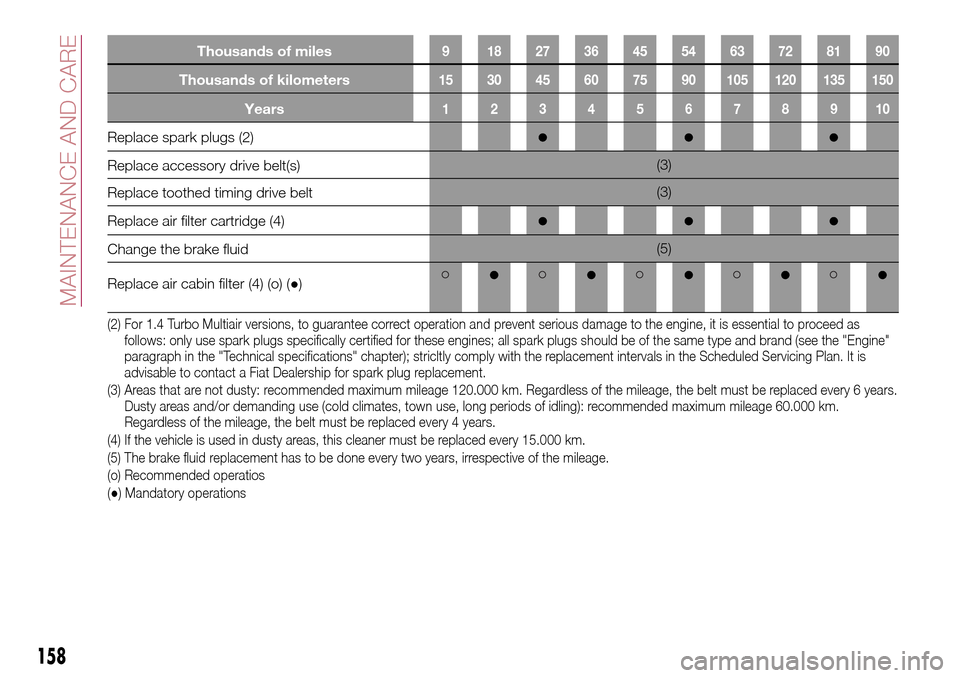
Thousands of miles9 182736455463728190
Thousands of kilometers15 30 45 60 75 90 105 120 135 150
Years12345678910
Replace spark plugs (2)●●●
Replace accessory drive belt(s)(3)
Replace toothed timing drive belt(3)
Replace air filter cartridge (4)
●●●
Change the brake fluid(5)
Replace air cabin filter (4) (o) (●)
●●●●●
(2) For 1.4 Turbo Multiair versions, to guarantee correct operation and prevent serious damage to the engine, it is essential to proceed as
follows: only use spark plugs specifically certified for these engines; all spark plugs should be of the same type and brand (see the "Engine"
paragraph in the "Technical specifications" chapter); stricltly comply with the replacement intervals in the Scheduled Servicing Plan. It is
advisable to contact a Fiat Dealership for spark plug replacement.
(3) Areas that are not dusty: recommended maximum mileage 120.000 km. Regardless of the mileage, the belt must be replaced every 6 years.
Dusty areas and/or demanding use (cold climates, town use, long periods of idling): recommended maximum mileage 60.000 km.
Regardless of the mileage, the belt must be replaced every 4 years.
(4) If the vehicle is used in dusty areas, this cleaner must be replaced every 15.000 km.
(5) The brake fluid replacement has to be done every two years, irrespective of the mileage.
(o) Recommended operatios
(●) Mandatory operations
158
MAINTENANCE AND CARE
Page 201 of 216
iDisplays the screen where traffic
information and the GPS reception
conditions can be set and verified.
Cancels waypoint/route.
Finds Places nearby. You can
search for Points Of Interest (POI) near
the vehicle position.
Displays the route parameters
and the route in its full length on the
map. You can also perform
route-related actions such as editing or
cancelling your route, picking route
alternatives, avoiding parts of the route,
simulating navigation or adding the
destination to your Favourites.
2D/3DChanges View mode. The
map view mode can be changed (2D
north up/2D heading up/3D).
Switches to the Settings screen
where you change navigation settings.
NOTE Some functions are not available
depending on some countries and
regions.
NAVIGATING ON THE MAP
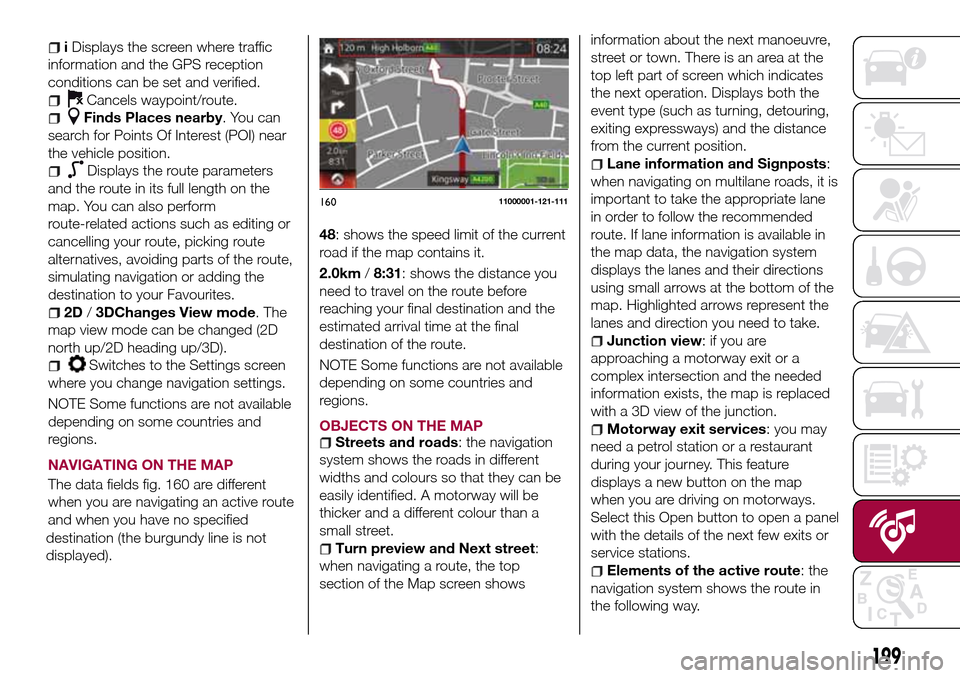
The data fields fig. 160 are different
when you are navigating an active route
and when you have no specified
destination (the burgundy line is not
displayed).48: shows the speed limit of the current
road if the map contains it.
2.0km/8:31: shows the distance you
need to travel on the route before
reaching your final destination and the
estimated arrival time at the final
destination of the route.
NOTE Some functions are not available
depending on some countries and
regions.
OBJECTS ON THE MAP
Streets and roads: the navigation
system shows the roads in different
widths and colours so that they can be
easily identified. A motorway will be
thicker and a different colour than a
small street.
Turn preview and Next street:
when navigating a route, the top
section of the Map screen showsinformation about the next manoeuvre,
street or town. There is an area at the
top left part of screen which indicates
the next operation. Displays both the
event type (such as turning, detouring,
exiting expressways) and the distance
from the current position.
Lane information and Signposts:
when navigating on multilane roads, it is
important to take the appropriate lane
in order to follow the recommended
route. If lane information is available in
the map data, the navigation system
displays the lanes and their directions
using small arrows at the bottom of the
map. Highlighted arrows represent the
lanes and direction you need to take.
Junction view: if you are
approaching a motorway exit or a
complex intersection and the needed
information exists, the map is replaced
with a 3D view of the junction.
Motorway exit services: you may
need a petrol station or a restaurant
during your journey. This feature
displays a new button on the map
when you are driving on motorways.
Select this Open button to open a panel
with the details of the next few exits or
service stations.
Elements of the active route: the
navigation system shows the route in
the following way.
16011000001-121-111
199