ESP FIAT 124 SPIDER 2016 2.G Owner's Manual
[x] Cancel search | Manufacturer: FIAT, Model Year: 2016, Model line: 124 SPIDER, Model: FIAT 124 SPIDER 2016 2.GPages: 216, PDF Size: 3.1 MB
Page 156 of 216
INTRODUCTION
Be extremely careful and prevent injury
to yourself and others or damage to
your vehicle when using this manual for
inspection and maintenance.
If you are unsure about any procedure it
describes, we strongly urge you to have
a reliable and qualified service shop
perform the work, preferably at Fiat
Dealership.
Factory-trained FCA technicians and
genuine FCA parts are best for your
vehicle. Without this expertise and the
parts that have been designed and
made especially for your vehicle,
inadequate, incomplete, and insufficient
servicing may result in problems. This
could lead to vehicle damage or an
accident and injuries.
For expert advice and quality service,
contact a Fiat Dealership.
The owner should retain evidence that
proper maintenance has been
performed as prescribed.
A claim against a warranty will not
qualify if it results from lack of
maintenance and not from defective
material or authorised workmanship.
Claims against the warranty resulting
from lack of maintenance, as opposed
to defective materials or authorized FCA
workmanship, will not be honored.Scheduled maintenance
NOTE After the prescribed period,
continue to follow the described
maintenance at the recommended
intervals.
Emission control and related
systems
The ignition and fuel systems are highly
important to the emission control
system and to efficient engine
operation. Do not tamper with them.
All inspections and adjustments must
be made by an expert repairer, we
recommend a Fiat Dealership.
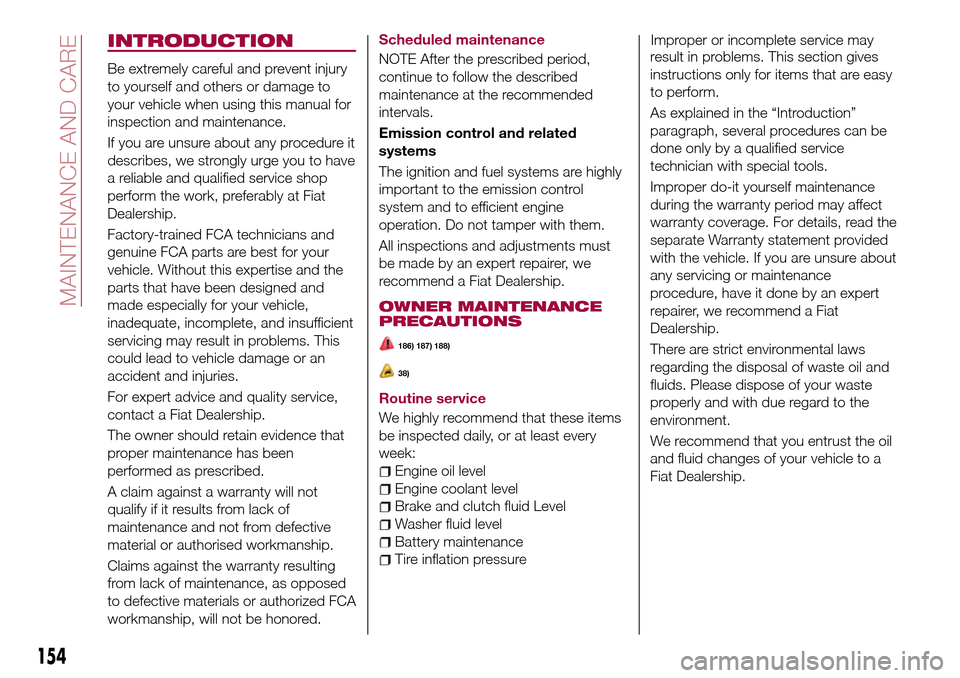
OWNER MAINTENANCE
PRECAUTIONS
186) 187) 188)
38)
Routine service
We highly recommend that these items
be inspected daily, or at least every
week:
Engine oil level
Engine coolant level
Brake and clutch fluid Level
Washer fluid level
Battery maintenance
Tire inflation pressureImproper or incomplete service may
result in problems. This section gives
instructions only for items that are easy
to perform.
As explained in the “Introduction”
paragraph, several procedures can be
done only by a qualified service
technician with special tools.
Improper do-it yourself maintenance
during the warranty period may affect
warranty coverage. For details, read the
separate Warranty statement provided
with the vehicle. If you are unsure about
any servicing or maintenance
procedure, have it done by an expert
repairer, we recommend a Fiat
Dealership.
There are strict environmental laws
regarding the disposal of waste oil and
fluids. Please dispose of your waste
properly and with due regard to the
environment.
We recommend that you entrust the oil
and fluid changes of your vehicle to a
Fiat Dealership.
154
MAINTENANCE AND CARE
Page 160 of 216
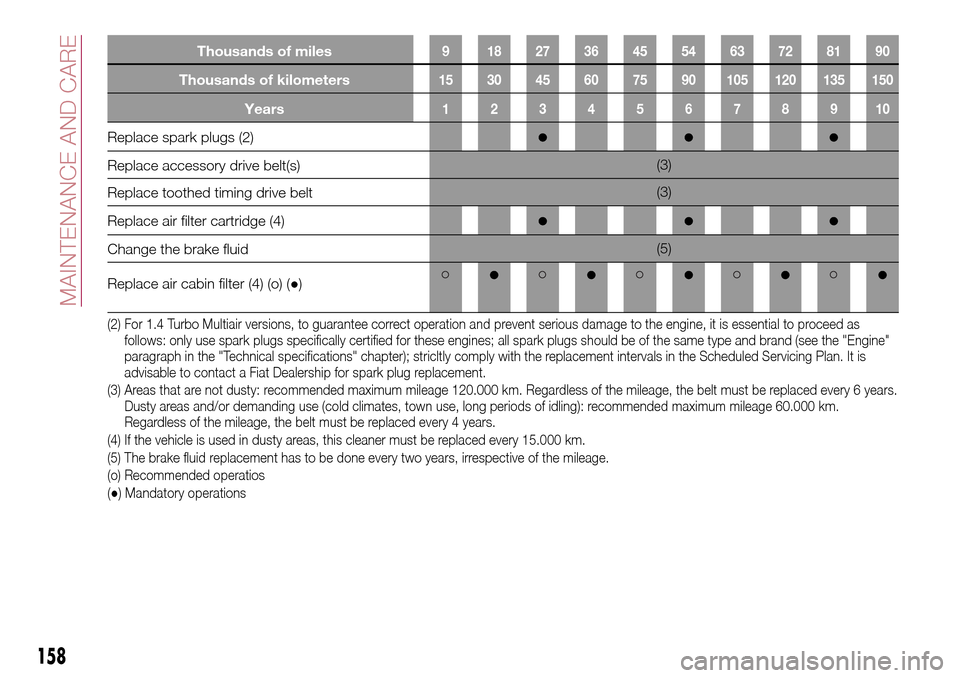
Thousands of miles9 182736455463728190
Thousands of kilometers15 30 45 60 75 90 105 120 135 150
Years12345678910
Replace spark plugs (2)●●●
Replace accessory drive belt(s)(3)
Replace toothed timing drive belt(3)
Replace air filter cartridge (4)
●●●
Change the brake fluid(5)
Replace air cabin filter (4) (o) (●)
●●●●●
(2) For 1.4 Turbo Multiair versions, to guarantee correct operation and prevent serious damage to the engine, it is essential to proceed as
follows: only use spark plugs specifically certified for these engines; all spark plugs should be of the same type and brand (see the "Engine"
paragraph in the "Technical specifications" chapter); stricltly comply with the replacement intervals in the Scheduled Servicing Plan. It is
advisable to contact a Fiat Dealership for spark plug replacement.
(3) Areas that are not dusty: recommended maximum mileage 120.000 km. Regardless of the mileage, the belt must be replaced every 6 years.
Dusty areas and/or demanding use (cold climates, town use, long periods of idling): recommended maximum mileage 60.000 km.
Regardless of the mileage, the belt must be replaced every 4 years.
(4) If the vehicle is used in dusty areas, this cleaner must be replaced every 15.000 km.
(5) The brake fluid replacement has to be done every two years, irrespective of the mileage.
(o) Recommended operatios
(●) Mandatory operations
158
MAINTENANCE AND CARE
Page 161 of 216
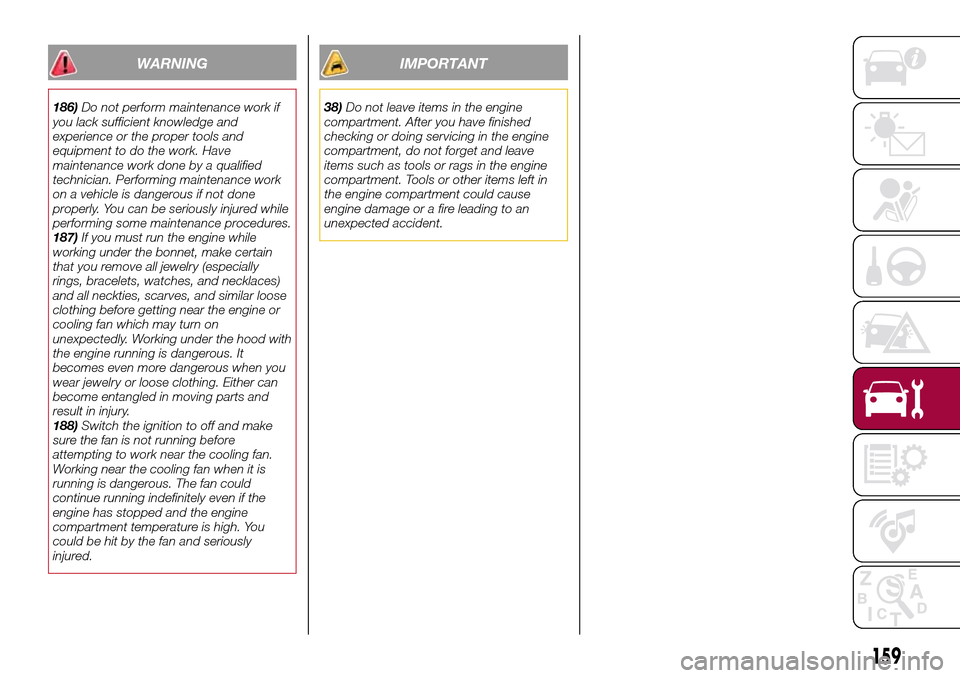
WARNING
186)Do not perform maintenance work if
you lack sufficient knowledge and
experience or the proper tools and
equipment to do the work. Have
maintenance work done by a qualified
technician. Performing maintenance work
on a vehicle is dangerous if not done
properly. You can be seriously injured while
performing some maintenance procedures.
187)If you must run the engine while
working under the bonnet, make certain
that you remove all jewelry (especially
rings, bracelets, watches, and necklaces)
and all neckties, scarves, and similar loose
clothing before getting near the engine or
cooling fan which may turn on
unexpectedly. Working under the hood with
the engine running is dangerous. It
becomes even more dangerous when you
wear jewelry or loose clothing. Either can
become entangled in moving parts and
result in injury.
188)Switch the ignition to off and make
sure the fan is not running before
attempting to work near the cooling fan.
Working near the cooling fan when it is
running is dangerous. The fan could
continue running indefinitely even if the
engine has stopped and the engine
compartment temperature is high. You
could be hit by the fan and seriously
injured.
IMPORTANT
38)Do not leave items in the engine
compartment. After you have finished
checking or doing servicing in the engine
compartment, do not forget and leave
items such as tools or rags in the engine
compartment. Tools or other items left in
the engine compartment could cause
engine damage or a fire leading to an
unexpected accident.
159
Page 165 of 216
electrolyte with a hydrometer, especially
during cold weather. If it is low,
recharge the battery.
Battery replacement
Contact a Fiat Dealership for a battery
replacement purchase.
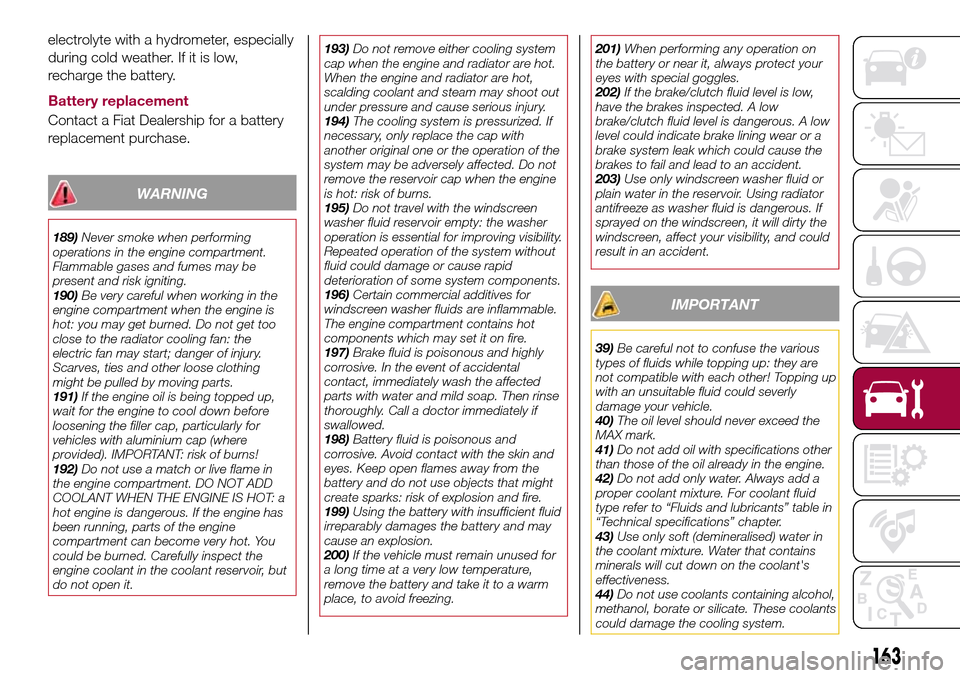
WARNING
189)Never smoke when performing
operations in the engine compartment.
Flammable gases and fumes may be
present and risk igniting.
190)Be very careful when working in the
engine compartment when the engine is
hot: you may get burned. Do not get too
close to the radiator cooling fan: the
electric fan may start; danger of injury.
Scarves, ties and other loose clothing
might be pulled by moving parts.
191)If the engine oil is being topped up,
wait for the engine to cool down before
loosening the filler cap, particularly for
vehicles with aluminium cap (where
provided). IMPORTANT: risk of burns!
192)Do not use a match or live flame in
the engine compartment. DO NOT ADD
COOLANT WHEN THE ENGINE IS HOT: a
hot engine is dangerous. If the engine has
been running, parts of the engine
compartment can become very hot. You
could be burned. Carefully inspect the
engine coolant in the coolant reservoir, but
do not open it.193)Do not remove either cooling system
cap when the engine and radiator are hot.
When the engine and radiator are hot,
scalding coolant and steam may shoot out
under pressure and cause serious injury.
194)The cooling system is pressurized. If
necessary, only replace the cap with
another original one or the operation of the
system may be adversely affected. Do not
remove the reservoir cap when the engine
is hot: risk of burns.
195)Do not travel with the windscreen
washer fluid reservoir empty: the washer
operation is essential for improving visibility.
Repeated operation of the system without
fluid could damage or cause rapid
deterioration of some system components.
196)Certain commercial additives for
windscreen washer fluids are inflammable.
The engine compartment contains hot
components which may set it on fire.
197)Brake fluid is poisonous and highly
corrosive. In the event of accidental
contact, immediately wash the affected
parts with water and mild soap. Then rinse
thoroughly. Call a doctor immediately if
swallowed.
198)Battery fluid is poisonous and
corrosive. Avoid contact with the skin and
eyes. Keep open flames away from the
battery and do not use objects that might
create sparks: risk of explosion and fire.
199)Using the battery with insufficient fluid
irreparably damages the battery and may
cause an explosion.
200)If the vehicle must remain unused for
a long time at a very low temperature,
remove the battery and take it to a warm
place, to avoid freezing.201)When performing any operation on
the battery or near it, always protect your
eyes with special goggles.
202)If the brake/clutch fluid level is low,
have the brakes inspected. A low
brake/clutch fluid level is dangerous. A low
level could indicate brake lining wear or a
brake system leak which could cause the
brakes to fail and lead to an accident.
203)Use only windscreen washer fluid or
plain water in the reservoir. Using radiator
antifreeze as washer fluid is dangerous. If
sprayed on the windscreen, it will dirty the
windscreen, affect your visibility, and could
result in an accident.
IMPORTANT
39)Be careful not to confuse the various
types of fluids while topping up: they are
not compatible with each other! Topping up
with an unsuitable fluid could severly
damage your vehicle.
40)The oil level should never exceed the
MAX mark.
41)Do not add oil with specifications other
than those of the oil already in the engine.
42)Do not add only water. Always add a
proper coolant mixture. For coolant fluid
type refer to “Fluids and lubricants” table in
“Technical specifications” chapter.
43)Use only soft (demineralised) water in
the coolant mixture. Water that contains
minerals will cut down on the coolant's
effectiveness.
44)Do not use coolants containing alcohol,
methanol, borate or silicate. These coolants
could damage the cooling system.
163
Page 169 of 216
BODYWORK
PRESERVING THE
PAINTWORK
52) 53)
7)
Touch up abrasions and scratches
immediately to prevent the formation of
rust.
To correctly wash the vehicle, follow
these instructions:
is the vehicle is washed remove the
aerial;
if high pressure jets or cleaners are
used to wash the vehicle, keep a
distance of at least 40 cm from the
bodywork to avoid damage or
alteration. Build up of water could
cause damage to the vehicle in the long
term;
wash the bodywork using a low
pressure jet of water if possible;
wipe a sponge with a slightly soapy
solution over the bodywork, frequently
rinsing the sponge;
rinse well with water and dry with a
jet of air or a chamois leather.
Dry the less visible parts (e.g. door
frames, bonnet, headlight frames, etc.)
with special care, as water may
stagnate more easily in these areas. Do
not wash the vehicle after it has beenleft in the sun or with the bonnet hot:
this may alter the shine of the
paintwork.
Exterior plastic parts must be cleaned
in the same way as the rest of the
vehicle.
IMPORTANT Avoid parking under trees;
the resin dropped by trees makes the
paintwork go opaque and increases the
possibility of corrosion.
IMPORTANT Bird droppings must be
washed off immediately and thoroughly
as the acid they contain is particularly
aggressive.
Paint chipping
Paint chipping occurs when gravel
thrown in the air by another vehicle's
tires hits your vehicle.
Keeping a safe distance between you
and the vehicle ahead reduces the
chances of having your paint chipped
by flying gravel.
IMPORTANT The paint chipping zone
varies with the speed of the vehicle. For
example, when travelling at 90 km/h,
the paint chipping zone is 50 m.
IMPORTANT In low temperatures a
vehicle's finish hardens. This increases
the chance of paint chipping.IMPORTANT Chipped paint can lead to
rust forming on your vehicle. Before this
happens, repair the damage by using
FCA touch-up paint according to the
instructions in this section. Failure to
repair the affected area could lead to
serious rusting and expensive repairs.
MAINTAINING THE
FINISH
Washing
To help protect the finish from rust and
deterioration, wash your vehicle
thoroughly and frequently, at least once
a month, with lukewarm or cold water.
IMPORTANT FCA is not responsible for
scratches caused by automatic car
washes or improper washing.
Scratches are more noticeable on
vehicles with darker paint finishes.
IMPORTANT Keep hands and scrapers
clear of the windscreen when the wiper
lever is in the AUTO position and the
ignition is switched ON as fingers could
be pinched or the wipers and wiper
blades damaged when the wipers
activate automatically. If you are going
to clean the windscreen, be sure the
wipers are turned off completely (when
it is most likely that the engine is left
running) this is particularly important
when clearing ice and snow.
167
Page 174 of 216
ENGINE
218)
Version 1.4 Turbo Multi Air 140HP
CycleOtto
Number and position of cylinders 4 in line
Piston bore and stroke (mm) 72.0 x 84.0
Total displacement (cm³) 1368
Compression ratio9.8:1
Maximum power (EEC) (kW) 103
Maximum power (EEC) (HP) 140
corresponding engine speed (rpm) 5000
Maximum torque (EEC) (Nm) 240
Maximum torque (EEC) (kgm) 24,5
corresponding engine speed (rpm) 2250
Spark plugsNGK SIKR9A7
Fuel Unleaded petrol 95 R.O.N. (EN 228 specifications)
IMPORTANT When cleaning the iridium plugs, do not use a wire brush. The fine particulate coating on the iridium alloy and
platinum tips could be damaged.
WARNING
218)Modifications or repairs to the fuel supply system that are not carried out correctly or do not take the system's technical specifications
into account can cause malfunctions leading to the risk of fire.
172
TECHNICAL SPECIFICATIONS
Page 177 of 216
WARNING
219)If winter tyres with a lower speed
rating than that indicated in the
Registration Document are used, do not
exceed the maximum speed
corresponding to the speed rating of the
tyres used.
IMPORTANT
55)Keep your speed down when snow
chains are fitted; do not exceed 50 km/h
(30 mph). Avoid potholes, steps and
pavements and avoid driving for long
distances on roads not covered with snow
to prevent damaging the vehicle and the
road surface.
175
Page 187 of 216
PRESCRIPTIONS FOR HANDLING THE VEHICLE AT THE END OF ITS
LIFE
(where provided)
FCA has been committed for many years to safeguarding the environment through the constant improvement of its production
processes and manufacturing products that are increasingly "eco-compatible". To grant customers the best possible service in
terms of respecting environmental laws and in response to European Directive 2000/53/EC governing vehicles at the end of
their life, FCA is offering its customers the chance to hand over their vehicle at the end of its life without incurring any additional
costs. The European Directive sets out that when the vehicle is handed over, the last keeper or owner should not incur any
expenses as a result of it having a zero or negative market value.
To hand your vehicle over at the end of its life without extra cost, contact one of our dealerships if you are purchasing another
vehicle or a FCA-authorised collection and scrapping center. These centers have been carefully chosen to offer high quality
service for the collection, treatment and recycling of vehicles at their end of life, respecting the surrounding environment.
You can find further information on these collection and scrapping centers either from a FCA dealership or by calling the
number in the Warranty Booklet or by consulting the websites of the various FCA brands.
185
Page 189 of 216
TIPS, CONTROLS
AND GENERAL
INFORMATION
ROAD SAFETY
220) 221)
Learn how to use the various system
functions before setting off.
Read the instructions for the system
carefully before setting off.
RECEPTION CONDITIONS
Reception conditions change
constantly while driving.
Reception may be interfered with by the
presence of mountains, buildings or
bridges, especially when you are far
away from the broadcaster.
IMPORTANT The volume may be
increased when receiving traffic alerts
and news.
CARE AND
MAINTENANCE
57) 58)
Observe the following precautions to
ensure the system is fully operational:
the display lens should not come into
contact with pointed or rigid objects
which could damage its surface; use a
soft, dry anti-static cloth to clean and
do not press;
never use alcohol, petrols and
derivatives to clean the display lens;
prevent any liquid from entering the
system: this could damage it beyond
repair.
IMPORTANT
INFORMATION
Look at the screen only when it is
necessary and safe. If you need to look
at the screen for a long time, pull over
to a safe place so as not to be
distracted while driving.
Immediately stop using the system in
the event of a fault. Otherwise the
system might be damaged.
Contact a Fiat Dealership as soon as
possible to have the system repaired.
WARNING
220)Follow the safety rules below:
otherwise serious injuries may occur to the
occupants or the system may be
damaged.
221)If the volume is too loud this can be
dangerous. Adjust the volume so that you
can still hear background noises (e.g.
horns, ambulances, police vehicles, etc.).
IMPORTANT
57)Only clean the front panel and the
display lens with a soft, clean, dry,
anti-static cloth. Cleaning and polishing
products may damage the surface. Never
use alcohol, petrols and derivatives.
58)Do not use the display as a base for
supports with suction pads or adhesives for
external navigators or smartphones or
similar devices.
187