ignition FIAT 124 SPIDER 2016 2.G Workshop Manual
[x] Cancel search | Manufacturer: FIAT, Model Year: 2016, Model line: 124 SPIDER, Model: FIAT 124 SPIDER 2016 2.GPages: 216, PDF Size: 3.1 MB
Page 139 of 216
FUSES UNDER THE
BONNET
Make sure the ignition is switched off,
and other switches are off and remove
the fuse block cover. If the lock is
forcefully opened, the fuse block cover
may come in contact with the frame
when it is removed and become
scratched.When removing the cover, remove it
slowly according to the following
procedure:
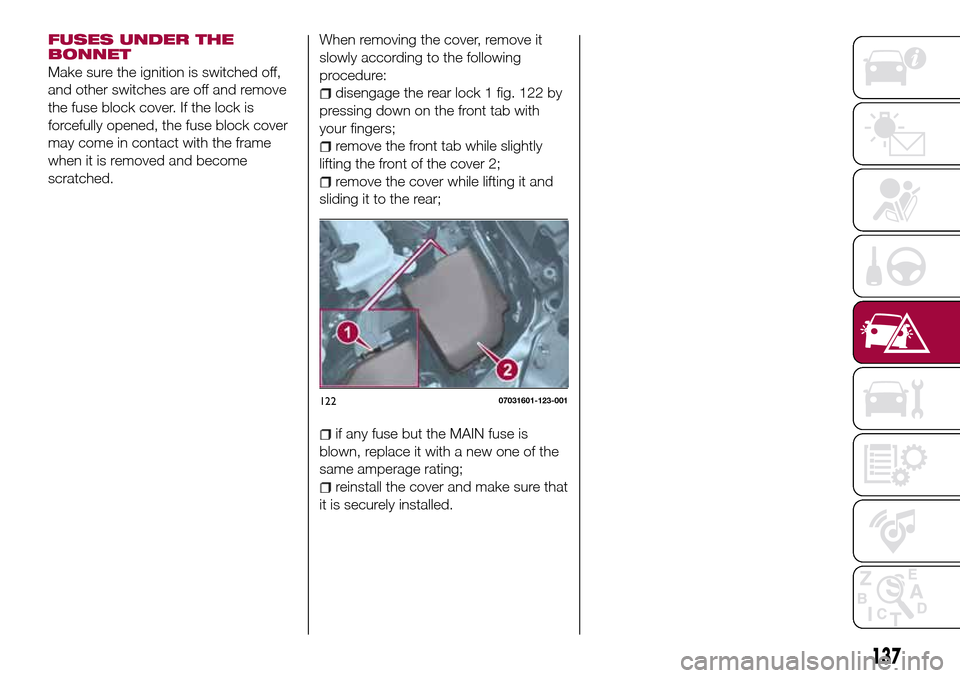
disengage the rear lock 1 fig. 122 by
pressing down on the front tab with
your fingers;
remove the front tab while slightly
lifting the front of the cover 2;
remove the cover while lifting it and
sliding it to the rear;
if any fuse but the MAIN fuse is
blown, replace it with a new one of the
same amperage rating;
reinstall the cover and make sure that
it is securely installed.
12207031601-123-001
137
Page 145 of 216
WARNING
164)If the fuse blows again contact a Fiat
Dealership.
165)Never replace a fuse with another
with a higher amp rating; DANGER OF
FIRE.
166)Contact a Fiat Dealership if a safety
system (airbags, brakes), power unit
system (engine, gearbox) or steering
system general protection fuse blows.
167)Do not replace the main fuse and
multiplex slow blow fuse by yourself.
Contact a Fiat Dealership to perform the
replacement. Replacing these fuses by
yourself is dangerous because they are
high current fuses. Incorrect replacement
could cause an electrical shock or a short
circuit resulting in a fire.
168)Before replacing a fuse, make sure
that the ignition device is in OFF position
and that all the other services are switched
off and/or deactivated.
IMPORTANT
32)Never replace a fuse with metal wires
or anything else.
33)If it is necessary to wash the engine
compartment, take care not to directly hit
the junction unit and the window wiper
motors with the water jet.
TIRE SERVICE KIT
(where provided)
169) 170) 171) 172) 173) 174) 175)
3)
TOOL STORAGE
Your vehicle is not equipped with a
spare tire, jack and wheel brace. For
details, contact a Fiat Dealership.
Tools are stored in the locations
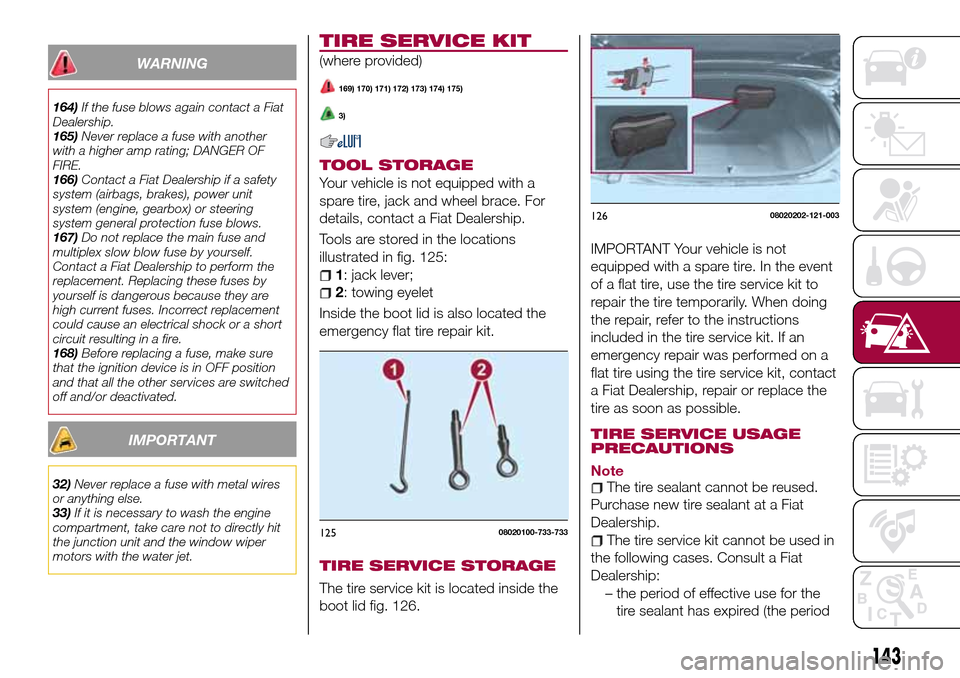
illustrated in fig. 125:
1: jack lever;
2: towing eyelet
Inside the boot lid is also located the
emergency flat tire repair kit.
TIRE SERVICE STORAGE
The tire service kit is located inside the
boot lid fig. 126.
IMPORTANT Your vehicle is not
equipped with a spare tire. In the event
of a flat tire, use the tire service kit to
repair the tire temporarily. When doing
the repair, refer to the instructions
included in the tire service kit. If an
emergency repair was performed on a
flat tire using the tire service kit, contact
a Fiat Dealership, repair or replace the
tire as soon as possible.
TIRE SERVICE USAGE
PRECAUTIONS
NoteThe tire sealant cannot be reused.
Purchase new tire sealant at a Fiat
Dealership.
The tire service kit cannot be used in
the following cases. Consult a Fiat
Dealership:
– the period of effective use for the
tire sealant has expired (the period12508020100-733-733
12608020202-121-003
143
Page 147 of 216
IMPORTANT If there is air remaining in
the tire when the valve core is removed,
the valve core could fly out. Remove
the valve core carefully.
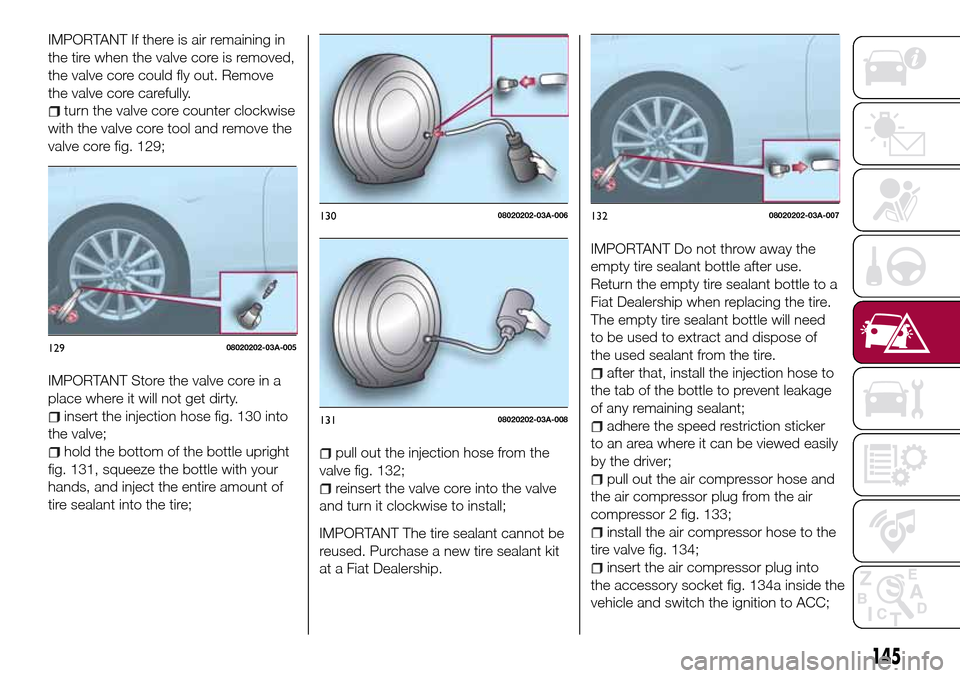
turn the valve core counter clockwise
with the valve core tool and remove the
valve core fig. 129;
IMPORTANT Store the valve core in a
place where it will not get dirty.
insert the injection hose fig. 130 into
the valve;
hold the bottom of the bottle upright
fig. 131, squeeze the bottle with your
hands, and inject the entire amount of
tire sealant into the tire;pull out the injection hose from the
valve fig. 132;
reinsert the valve core into the valve
and turn it clockwise to install;
IMPORTANT The tire sealant cannot be
reused. Purchase a new tire sealant kit
at a Fiat Dealership.IMPORTANT Do not throw away the
empty tire sealant bottle after use.
Return the empty tire sealant bottle to a
Fiat Dealership when replacing the tire.
The empty tire sealant bottle will need
to be used to extract and dispose of
the used sealant from the tire.
after that, install the injection hose to
the tab of the bottle to prevent leakage
of any remaining sealant;
adhere the speed restriction sticker
to an area where it can be viewed easily
by the driver;
pull out the air compressor hose and
the air compressor plug from the air
compressor 2 fig. 133;
install the air compressor hose to the
tire valve fig. 134;
insert the air compressor plug into
the accessory socket fig. 134a inside the
vehicle and switch the ignition to ACC;
12908020202-03A-005
13008020202-03A-006
13108020202-03A-008
13208020202-03A-007
145
Page 150 of 216
IMPORTANT Do not use the booster
battery or any other source of external
supply with a voltage above 12 V: the
battery, the starter, the alternator and
the electrical system of the vehicle
could be damaged. You can damage a
12 V starter, ignition system, and other
electrical parts beyond repair with a
24 V power supply (two 12 V batteries
in series or a 24 V motor generator set).IMPORTANT Do not attempt jump
starting if the battery is wet. The battery
could break and explode!
JUMP-STARTING
PROCEDURE
IMPORTANT If the procedure below is
carried out incorrectly can cause severe
injuries to people or damage the
recharging system of one or both
vehicles. Carefully follow the
instructions given below.
Proceed as follows to carry out a jump
starting:
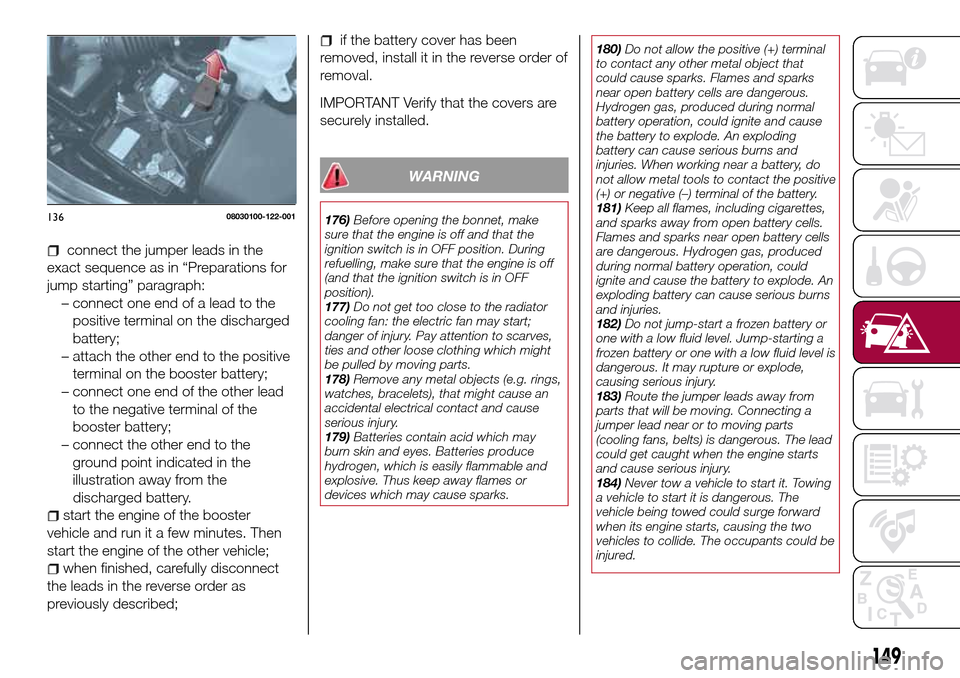
remove the battery cover fig. 136;
make sure the booster battery is
12 V and that its negative terminal is
grounded;
if the booster battery is in another
vehicle, do not allow both vehicles to
touch. Turn off the engine of the vehicle
with the booster battery and all
unnecessary electrical loads in both
vehicles;
13508030100-121-001
148
IN CASE OF EMERGENCY
JUMP STARTING
PREPARATIONS FOR
JUMP STARTING
176) 177) 178) 179) 180) 181) 182) 183) 184) 185)
34)
Jump-starting is dangerous if done
incorrectly. So follow the procedure
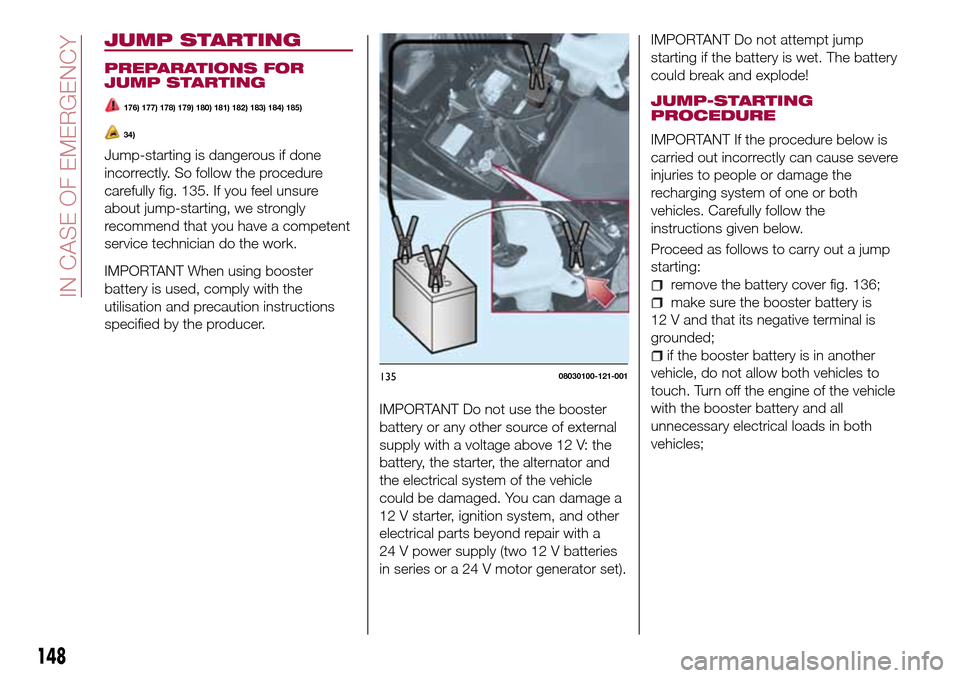
carefully fig. 135. If you feel unsure
about jump-starting, we strongly
recommend that you have a competent
service technician do the work.
IMPORTANT When using booster
battery is used, comply with the
utilisation and precaution instructions
specified by the producer.
Page 151 of 216
if the battery cover has been
removed, install it in the reverse order of
removal.
IMPORTANT Verify that the covers are
securely installed.
WARNING
176)Before opening the bonnet, make
sure that the engine is off and that the
ignition switch is in OFF position. During
refuelling, make sure that the engine is off
(and that the ignition switch is in OFF
position).
177)Do not get too close to the radiator
cooling fan: the electric fan may start;
danger of injury. Pay attention to scarves,
ties and other loose clothing which might
be pulled by moving parts.
178)Remove any metal objects (e.g. rings,
watches, bracelets), that might cause an
accidental electrical contact and cause
serious injury.
179)Batteries contain acid which may
burn skin and eyes. Batteries produce
hydrogen, which is easily flammable and
explosive. Thus keep away flames or
devices which may cause sparks.180)Do not allow the positive (+) terminal
to contact any other metal object that
could cause sparks. Flames and sparks
near open battery cells are dangerous.
Hydrogen gas, produced during normal
battery operation, could ignite and cause
the battery to explode. An exploding
battery can cause serious burns and
injuries. When working near a battery, do
not allow metal tools to contact the positive
(+) or negative (–) terminal of the battery.
181)Keep all flames, including cigarettes,
and sparks away from open battery cells.
Flames and sparks near open battery cells
are dangerous. Hydrogen gas, produced
during normal battery operation, could
ignite and cause the battery to explode. An
exploding battery can cause serious burns
and injuries.
182)Do not jump-start a frozen battery or
one with a low fluid level. Jump-starting a
frozen battery or one with a low fluid level is
dangerous. It may rupture or explode,
causing serious injury.
183)Route the jumper leads away from
parts that will be moving. Connecting a
jumper lead near or to moving parts
(cooling fans, belts) is dangerous. The lead
could get caught when the engine starts
and cause serious injury.
184)Never tow a vehicle to start it. Towing
a vehicle to start it is dangerous. The
vehicle being towed could surge forward
when its engine starts, causing the two
vehicles to collide. The occupants could be
injured.
149
connect the jumper leads in the
exact sequence as in “Preparations for
jump starting” paragraph:
– connect one end of a lead to the
positive terminal on the discharged
battery;
– attach the other end to the positive
terminal on the booster battery;
– connect one end of the other lead
to the negative terminal of the
booster battery;
– connect the other end to the
ground point indicated in the
illustration away from the
discharged battery.
start the engine of the booster
vehicle and run it a few minutes. Then
start the engine of the other vehicle;
when finished, carefully disconnect
the leads in the reverse order as
previously described;
13608030100-122-001
Page 153 of 216
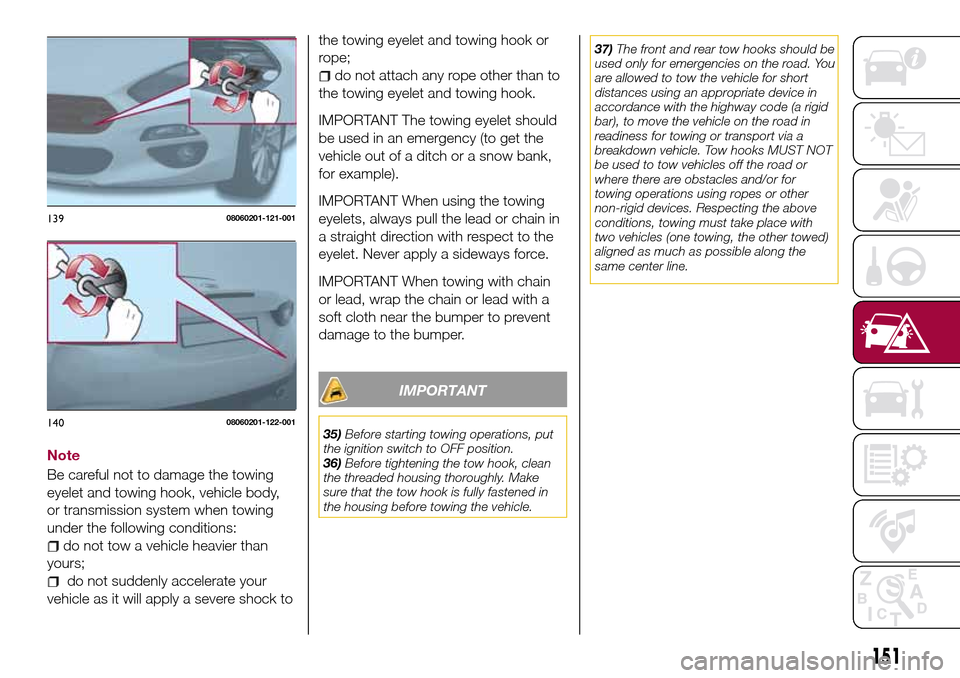
the towing eyelet and towing hook or
rope;
do not attach any rope other than to
the towing eyelet and towing hook.
IMPORTANT The towing eyelet should
be used in an emergency (to get the
vehicle out of a ditch or a snow bank,
for example).
IMPORTANT When using the towing
eyelets, always pull the lead or chain in
a straight direction with respect to the
eyelet. Never apply a sideways force.
IMPORTANT When towing with chain
or lead, wrap the chain or lead with a
soft cloth near the bumper to prevent
damage to the bumper.
IMPORTANT
35)Before starting towing operations, put
the ignition switch to OFF position.
36)Before tightening the tow hook, clean
the threaded housing thoroughly. Make
sure that the tow hook is fully fastened in
the housing before towing the vehicle.37)The front and rear tow hooks should be
used only for emergencies on the road. You
are allowed to tow the vehicle for short
distances using an appropriate device in
accordance with the highway code (a rigid
bar), to move the vehicle on the road in
readiness for towing or transport via a
breakdown vehicle. Tow hooks MUST NOT
be used to tow vehicles off the road or
where there are obstacles and/or for
towing operations using ropes or other
non-rigid devices. Respecting the above
conditions, towing must take place with
two vehicles (one towing, the other towed)
aligned as much as possible along the
same center line.
151
Note
Be careful not to damage the towing
eyelet and towing hook, vehicle body,
or transmission system when towing
under the following conditions:
do not tow a vehicle heavier than
yours;
do not suddenly accelerate your
vehicle as it will apply a severe shock to
13908060201-121-001
14008060201-122-001
Page 154 of 216
If towing service is not available in an
emergency, the vehicle may be towed
with all four wheels on the ground using
the towing hook at the front of the
vehicle. Only tow the vehicle on paved
surfaces for short distances at low
speeds.
Follow these instructions when towing
the vehicle with all wheels on the
ground:
shift to neutral (manual transmission),
or the N position (automatic
transmission);
switch the ignition to ACC;
release the parking brake.
NOTE Remember that power assist for
the brakes and steering will not be
available when the engine is not
running.
152
IN CASE OF EMERGENCY
EMERGENCY
TOWING
TOWING DESCRIPTION
Proper lifting and towing are necessary
to prevent damage to the vehicle.
Government and local laws must be
followed.
A towed vehicle usually should have its
drive wheels (rear wheels) off the
ground. If excessive damage or other
conditions prevent this, use wheel
dollies.
When towing with the rear wheels on
the ground, release the parking brake.
IMPORTANT Do not tow the vehicle
pointed backward with driving wheels
on the ground. This may cause internal
damage to the transmission.
IMPORTANT Do not tow with sling-type
equipment. This could damage your
vehicle. Use wheel-lift or flatbed
equipment.
Page 156 of 216
INTRODUCTION
Be extremely careful and prevent injury
to yourself and others or damage to
your vehicle when using this manual for
inspection and maintenance.
If you are unsure about any procedure it
describes, we strongly urge you to have
a reliable and qualified service shop
perform the work, preferably at Fiat
Dealership.
Factory-trained FCA technicians and
genuine FCA parts are best for your
vehicle. Without this expertise and the
parts that have been designed and
made especially for your vehicle,
inadequate, incomplete, and insufficient
servicing may result in problems. This
could lead to vehicle damage or an
accident and injuries.
For expert advice and quality service,
contact a Fiat Dealership.
The owner should retain evidence that
proper maintenance has been
performed as prescribed.
A claim against a warranty will not
qualify if it results from lack of
maintenance and not from defective
material or authorised workmanship.
Claims against the warranty resulting
from lack of maintenance, as opposed
to defective materials or authorized FCA
workmanship, will not be honored.Scheduled maintenance
NOTE After the prescribed period,
continue to follow the described
maintenance at the recommended
intervals.
Emission control and related
systems
The ignition and fuel systems are highly
important to the emission control
system and to efficient engine
operation. Do not tamper with them.
All inspections and adjustments must
be made by an expert repairer, we
recommend a Fiat Dealership.
OWNER MAINTENANCE
PRECAUTIONS
186) 187) 188)
38)
Routine service
We highly recommend that these items
be inspected daily, or at least every
week:
Engine oil level
Engine coolant level
Brake and clutch fluid Level
Washer fluid level
Battery maintenance
Tire inflation pressureImproper or incomplete service may
result in problems. This section gives
instructions only for items that are easy
to perform.
As explained in the “Introduction”
paragraph, several procedures can be
done only by a qualified service
technician with special tools.
Improper do-it yourself maintenance
during the warranty period may affect
warranty coverage. For details, read the
separate Warranty statement provided
with the vehicle. If you are unsure about
any servicing or maintenance
procedure, have it done by an expert
repairer, we recommend a Fiat
Dealership.
There are strict environmental laws
regarding the disposal of waste oil and
fluids. Please dispose of your waste
properly and with due regard to the
environment.
We recommend that you entrust the oil
and fluid changes of your vehicle to a
Fiat Dealership.
154
MAINTENANCE AND CARE
Page 161 of 216
WARNING
186)Do not perform maintenance work if
you lack sufficient knowledge and
experience or the proper tools and
equipment to do the work. Have
maintenance work done by a qualified
technician. Performing maintenance work
on a vehicle is dangerous if not done
properly. You can be seriously injured while
performing some maintenance procedures.
187)If you must run the engine while
working under the bonnet, make certain
that you remove all jewelry (especially
rings, bracelets, watches, and necklaces)
and all neckties, scarves, and similar loose
clothing before getting near the engine or
cooling fan which may turn on
unexpectedly. Working under the hood with
the engine running is dangerous. It
becomes even more dangerous when you
wear jewelry or loose clothing. Either can
become entangled in moving parts and
result in injury.
188)Switch the ignition to off and make
sure the fan is not running before
attempting to work near the cooling fan.
Working near the cooling fan when it is
running is dangerous. The fan could
continue running indefinitely even if the
engine has stopped and the engine
compartment temperature is high. You
could be hit by the fan and seriously
injured.
IMPORTANT
38)Do not leave items in the engine
compartment. After you have finished
checking or doing servicing in the engine
compartment, do not forget and leave
items such as tools or rags in the engine
compartment. Tools or other items left in
the engine compartment could cause
engine damage or a fire leading to an
unexpected accident.
159
Page 169 of 216
BODYWORK
PRESERVING THE
PAINTWORK
52) 53)
7)
Touch up abrasions and scratches
immediately to prevent the formation of
rust.
To correctly wash the vehicle, follow
these instructions:
is the vehicle is washed remove the
aerial;
if high pressure jets or cleaners are
used to wash the vehicle, keep a
distance of at least 40 cm from the
bodywork to avoid damage or
alteration. Build up of water could
cause damage to the vehicle in the long
term;
wash the bodywork using a low
pressure jet of water if possible;
wipe a sponge with a slightly soapy
solution over the bodywork, frequently
rinsing the sponge;
rinse well with water and dry with a
jet of air or a chamois leather.
Dry the less visible parts (e.g. door
frames, bonnet, headlight frames, etc.)
with special care, as water may
stagnate more easily in these areas. Do
not wash the vehicle after it has beenleft in the sun or with the bonnet hot:
this may alter the shine of the
paintwork.
Exterior plastic parts must be cleaned
in the same way as the rest of the
vehicle.
IMPORTANT Avoid parking under trees;
the resin dropped by trees makes the
paintwork go opaque and increases the
possibility of corrosion.
IMPORTANT Bird droppings must be
washed off immediately and thoroughly
as the acid they contain is particularly
aggressive.
Paint chipping
Paint chipping occurs when gravel
thrown in the air by another vehicle's
tires hits your vehicle.
Keeping a safe distance between you
and the vehicle ahead reduces the
chances of having your paint chipped
by flying gravel.
IMPORTANT The paint chipping zone
varies with the speed of the vehicle. For
example, when travelling at 90 km/h,
the paint chipping zone is 50 m.
IMPORTANT In low temperatures a
vehicle's finish hardens. This increases
the chance of paint chipping.IMPORTANT Chipped paint can lead to
rust forming on your vehicle. Before this
happens, repair the damage by using
FCA touch-up paint according to the
instructions in this section. Failure to
repair the affected area could lead to
serious rusting and expensive repairs.
MAINTAINING THE
FINISH
Washing
To help protect the finish from rust and
deterioration, wash your vehicle
thoroughly and frequently, at least once
a month, with lukewarm or cold water.
IMPORTANT FCA is not responsible for
scratches caused by automatic car
washes or improper washing.
Scratches are more noticeable on
vehicles with darker paint finishes.
IMPORTANT Keep hands and scrapers
clear of the windscreen when the wiper
lever is in the AUTO position and the
ignition is switched ON as fingers could
be pinched or the wipers and wiper
blades damaged when the wipers
activate automatically. If you are going
to clean the windscreen, be sure the
wipers are turned off completely (when
it is most likely that the engine is left
running) this is particularly important
when clearing ice and snow.
167