coolant temperature FIAT 124 SPIDER 2016 2.G Owners Manual
[x] Cancel search | Manufacturer: FIAT, Model Year: 2016, Model line: 124 SPIDER, Model: FIAT 124 SPIDER 2016 2.GPages: 216, PDF Size: 3.1 MB
Page 48 of 216
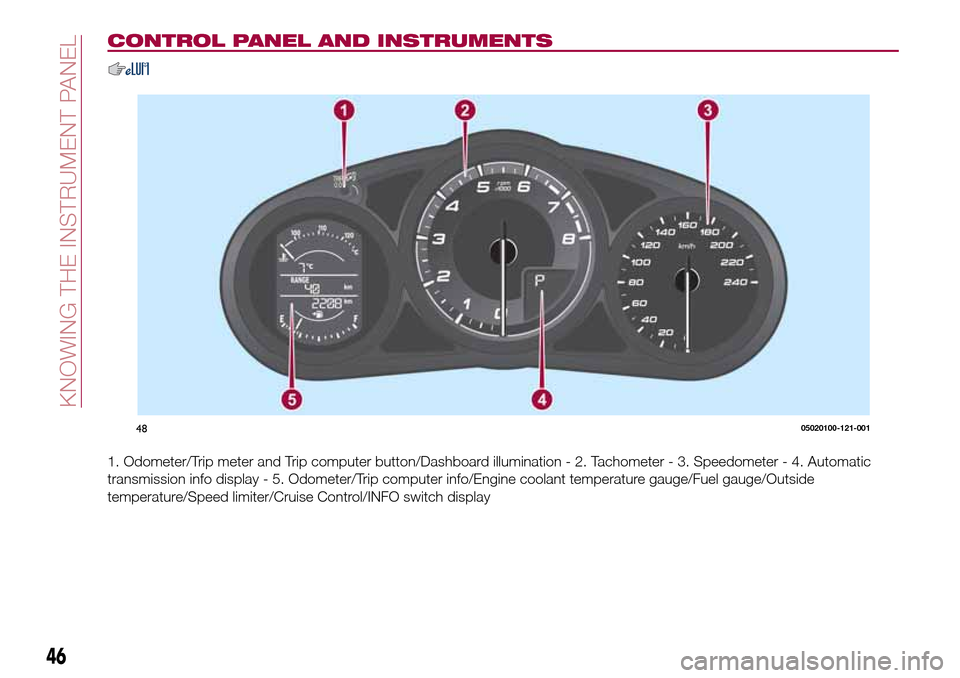
CONTROL PANEL AND INSTRUMENTS
1. Odometer/Trip meter and Trip computer button/Dashboard illumination - 2. Tachometer - 3. Speedometer - 4. Automatic
transmission info display - 5. Odometer/Trip computer info/Engine coolant temperature gauge/Fuel gauge/Outside
temperature/Speed limiter/Cruise Control/INFO switch display
4805020100-121-001
46
KNOWING THE INSTRUMENT PANEL
Page 49 of 216
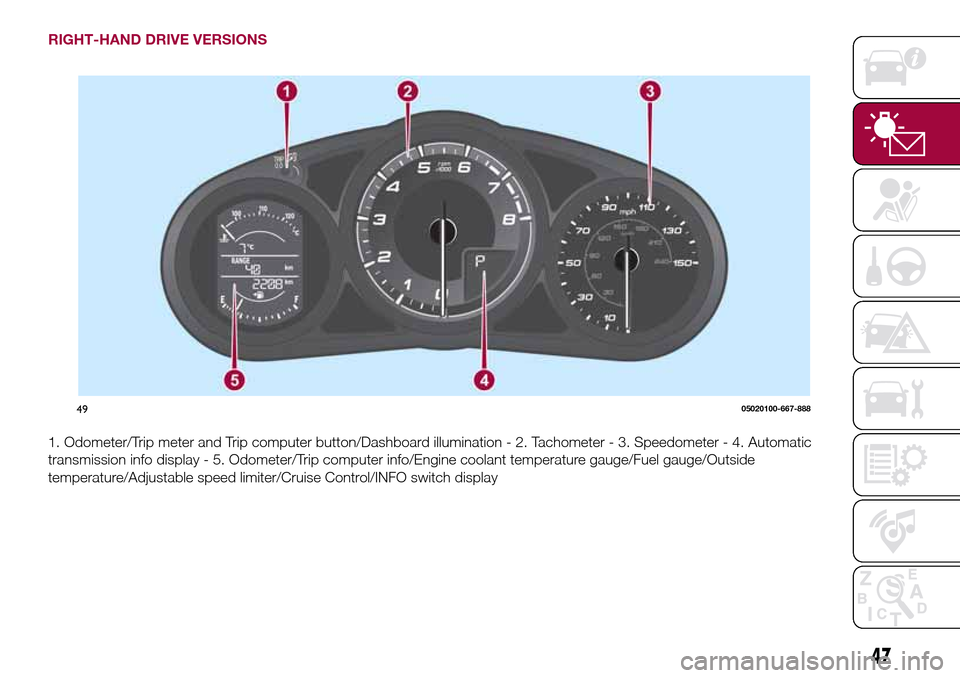
RIGHT-HAND DRIVE VERSIONS
1. Odometer/Trip meter and Trip computer button/Dashboard illumination - 2. Tachometer - 3. Speedometer - 4. Automatic
transmission info display - 5. Odometer/Trip computer info/Engine coolant temperature gauge/Fuel gauge/Outside
temperature/Adjustable speed limiter/Cruise Control/INFO switch display
4905020100-667-888
47
Page 53 of 216
WARNING LIGHTS AND MESSAGES
IMPORTANT The warning light in the instrument panel appears together with a dedicated message and/or acoustic signal
when applicable. These indications are indicative and precautionary and as such must not be considered as exhaustive and/or
alternative to the information contained in the Owner Handbook, which you are advised to read carefully in all cases. Always
refer to the information in this chapter in the event of a failure indication.
IMPORTANT Failure indications displayed are divided into two categories: serious and less serious failures. Serious failures are
indicated by a repeated and prolonged warning "cycle". Less serious failures are indicated by a warning "cycle" with a shorter
duration. The display cycle of both categories can be interrupted. The instrument panel warning light will stay on until the cause
of the failure is eliminated.
Vehicles with Radio 7”
The warning contents can be verified on the audio system.
Proceed as follows:
if the warning light is turned on, selecticon on the home screen to display the application screen;
select “Warning Guidance” to display the current warnings;
select the applicable warning to view the warning details.
For the following warning/indicator lights:
Master warning light;
Brake system warning light;
ABS warning light;
Charging system warning light;
Engine oil warning light;
Check engine light;
High engine coolant temperature warning light;
Automatic transmission warning light;
Power steering malfunction indicator light;
Air Bag/Seat Belt pretensioner system warning light;
Active bonnet warning light;
Low fuel warning light;
Seat belt warning light;
Door-ajar warning light;
Low washer fluid level warning light;
Tyre Pressure Monitoring System warning light;
51
Page 57 of 216
Warning light What it means
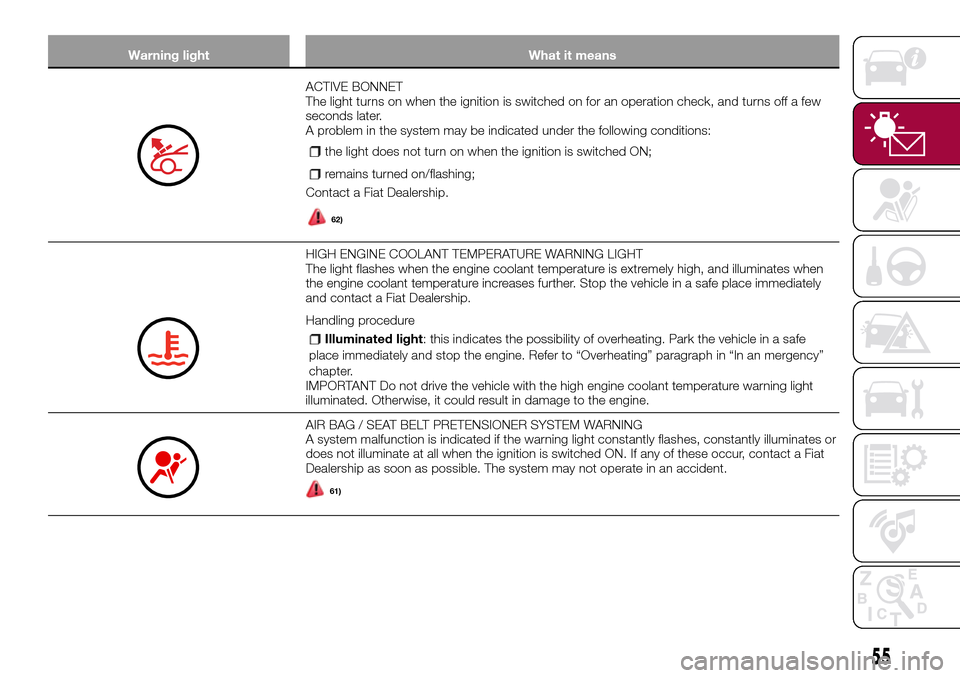
ACTIVE BONNET
The light turns on when the ignition is switched on for an operation check, and turns off a few
seconds later.
A problem in the system may be indicated under the following conditions:
the light does not turn on when the ignition is switched ON;
remains turned on/flashing;
Contact a Fiat Dealership.
62)
HIGH ENGINE COOLANT TEMPERATURE WARNING LIGHT
The light flashes when the engine coolant temperature is extremely high, and illuminates when
the engine coolant temperature increases further. Stop the vehicle in a safe place immediately
and contact a Fiat Dealership.
Handling procedure
Illuminated light: this indicates the possibility of overheating. Park the vehicle in a safe
place immediately and stop the engine. Refer to “Overheating” paragraph in “In an mergency”
chapter.
IMPORTANT Do not drive the vehicle with the high engine coolant temperature warning light
illuminated. Otherwise, it could result in damage to the engine.
AIR BAG / SEAT BELT PRETENSIONER SYSTEM WARNING
A system malfunction is indicated if the warning light constantly flashes, constantly illuminates or
does not illuminate at all when the ignition is switched ON. If any of these occur, contact a Fiat
Dealership as soon as possible. The system may not operate in an accident.
61)
55
Page 65 of 216
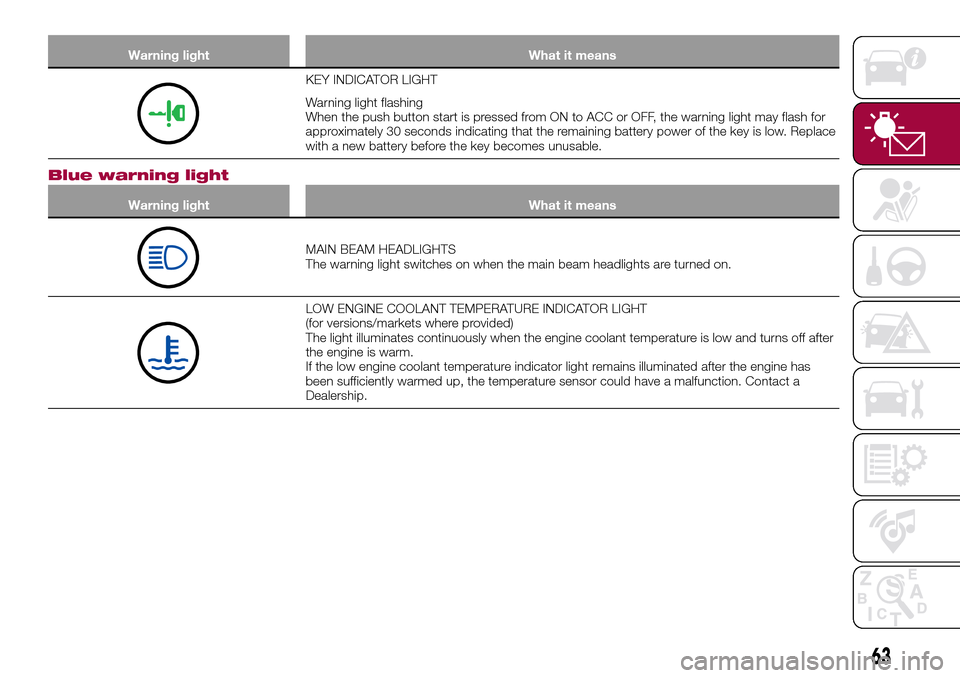
Warning light What it means
KEY INDICATOR LIGHT
Warning light flashing
When the push button start is pressed from ON to ACC or OFF, the warning light may flash for
approximately 30 seconds indicating that the remaining battery power of the key is low. Replace
with a new battery before the key becomes unusable.
Blue warning light
Warning light What it means
MAIN BEAM HEADLIGHTS
The warning light switches on when the main beam headlights are turned on.
LOW ENGINE COOLANT TEMPERATURE INDICATOR LIGHT
(for versions/markets where provided)
The light illuminates continuously when the engine coolant temperature is low and turns off after
the engine is warm.
If the low engine coolant temperature indicator light remains illuminated after the engine has
been sufficiently warmed up, the temperature sensor could have a malfunction. Contact a
Dealership.
63
Page 67 of 216
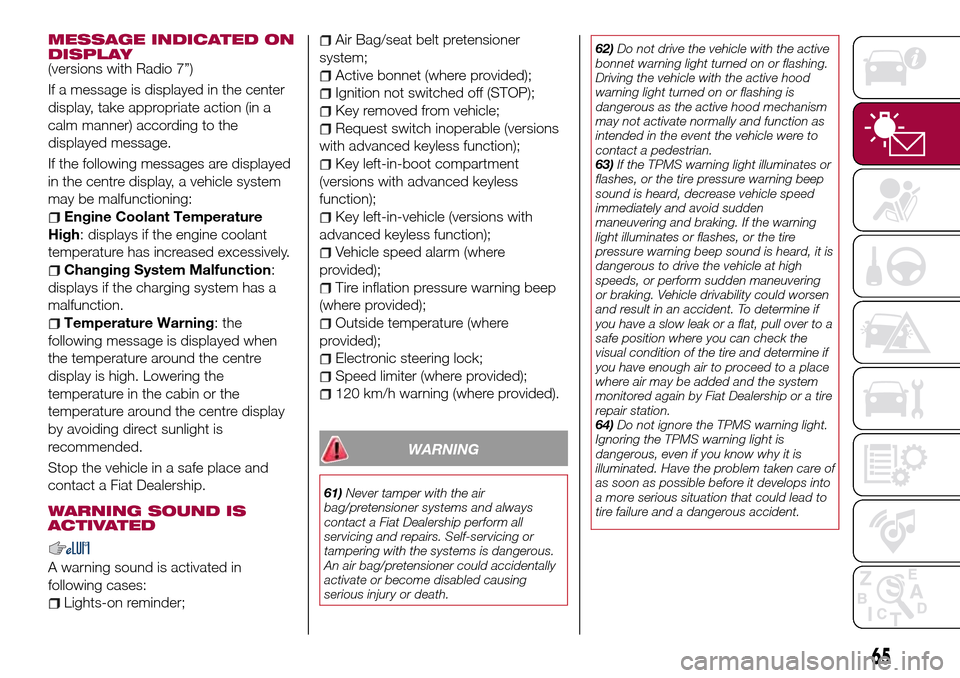
MESSAGE INDICATED ON
DISPLAY
(versions with Radio 7”)
If a message is displayed in the center
display, take appropriate action (in a
calm manner) according to the
displayed message.
If the following messages are displayed
in the centre display, a vehicle system
may be malfunctioning:
Engine Coolant Temperature
High: displays if the engine coolant
temperature has increased excessively.
Changing System Malfunction:
displays if the charging system has a
malfunction.
Temperature Warning: the
following message is displayed when
the temperature around the centre
display is high. Lowering the
temperature in the cabin or the
temperature around the centre display
by avoiding direct sunlight is
recommended.
Stop the vehicle in a safe place and
contact a Fiat Dealership.
WARNING SOUND IS
ACTIVATED
A warning sound is activated in
following cases:
Lights-on reminder;
Air Bag/seat belt pretensioner
system;
Active bonnet (where provided);
Ignition not switched off (STOP);
Key removed from vehicle;
Request switch inoperable (versions
with advanced keyless function);
Key left-in-boot compartment
(versions with advanced keyless
function);
Key left-in-vehicle (versions with
advanced keyless function);
Vehicle speed alarm (where
provided);
Tire inflation pressure warning beep
(where provided);
Outside temperature (where
provided);
Electronic steering lock;
Speed limiter (where provided);
120 km/h warning (where provided).
WARNING
61)Never tamper with the air
bag/pretensioner systems and always
contact a Fiat Dealership perform all
servicing and repairs. Self-servicing or
tampering with the systems is dangerous.
An air bag/pretensioner could accidentally
activate or become disabled causing
serious injury or death.62)Do not drive the vehicle with the active
bonnet warning light turned on or flashing.
Driving the vehicle with the active hood
warning light turned on or flashing is
dangerous as the active hood mechanism
may not activate normally and function as
intended in the event the vehicle were to
contact a pedestrian.
63)If the TPMS warning light illuminates or
flashes, or the tire pressure warning beep
sound is heard, decrease vehicle speed
immediately and avoid sudden
maneuvering and braking. If the warning
light illuminates or flashes, or the tire
pressure warning beep sound is heard, it is
dangerous to drive the vehicle at high
speeds, or perform sudden maneuvering
or braking. Vehicle drivability could worsen
and result in an accident. To determine if
you have a slow leak or a flat, pull over to a
safe position where you can check the
visual condition of the tire and determine if
you have enough air to proceed to a place
where air may be added and the system
monitored again by Fiat Dealership or a tire
repair station.
64)Do not ignore the TPMS warning light.
Ignoring the TPMS warning light is
dangerous, even if you know why it is
illuminated. Have the problem taken care of
as soon as possible before it develops into
a more serious situation that could lead to
tire failure and a dangerous accident.
65
Page 157 of 216
warning lights, etc.);
operation of windscreen
washer/wiper system and
positioning/wear of windscreen window
wiper blades.
Every 3,000 km, check and top up if
required: engine oil level.
HEAVY-DUTY USE OF THE
VEHICLE
If the vehicle is used under one of the
following conditions:
dusty roads;
short, repeated journeys (less than
7-8 km) at sub-zero outside
temperatures;
engine often idling or driving long
distances at low speeds or long periods
of inactivity;
the following checks must be carried
out more often than indicated in the
Scheduled Servicing Plan:
check front disc brake pad condition
and wear;
check cleanliness of bonnet and
luggage compartment locks,
cleanliness and lubrication of linkage;
visually inspect conditions of: engine,
gearbox, transmission, pipes and hoses
(exhaust/fuel system/brakes) and
rubber elements (gaiters/sleeves/
bushes, etc.);
check battery charge and battery
fluid level (electrolyte);
visually inspect conditions of the
accessory drive belts;
check and, if necessary, change
engine oil and replace oil filter;
check and, if necessary, replace
pollen filter;
check and, if necessary, replace air
cleaner.
155
PERIODIC CHECKS
Every1,000 kmor before long trips
check and, if necessary, top up:
engine coolant level;
brake fluid level;
windscreen washer fluid level;
tire inflation pressure and condition;
operation of lighting system
(headlights, direction indicators, hazard
Page 163 of 216
ENGINE OIL
191)
40)
4)
Inspecting engine oil level
Proceed as follows:
be sure the vehicle is on a level
surface;
warm up the engine to normal
operating temperature;
turn it off and wait at least 5 minutes
for the oil to return to the sump;
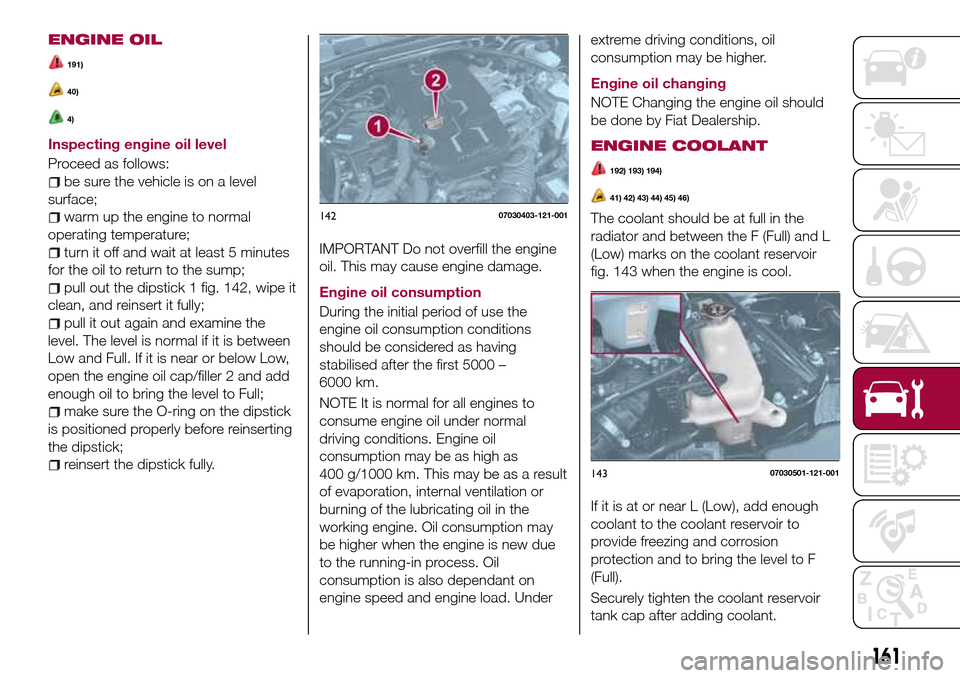
pull out the dipstick 1 fig. 142, wipe it
clean, and reinsert it fully;
pull it out again and examine the
level. The level is normal if it is between
Low and Full. If it is near or below Low,
open the engine oil cap/filler 2 and add
enough oil to bring the level to Full;
make sure the O-ring on the dipstick
is positioned properly before reinserting
the dipstick;
reinsert the dipstick fully.
IMPORTANT Do not overfill the engine
oil. This may cause engine damage.
Engine oil consumption
During the initial period of use the
engine oil consumption conditions
should be considered as having
stabilised after the first 5000 –
6000 km.
NOTE It is normal for all engines to
consume engine oil under normal
driving conditions. Engine oil
consumption may be as high as
400 g/1000 km. This may be as a result
of evaporation, internal ventilation or
burning of the lubricating oil in the
working engine. Oil consumption may
be higher when the engine is new due
to the running-in process. Oil
consumption is also dependant on
engine speed and engine load. Underextreme driving conditions, oil
consumption may be higher.
Engine oil changing
NOTE Changing the engine oil should
be done by Fiat Dealership.
ENGINE COOLANT
192) 193) 194)
41) 42) 43) 44) 45) 46)
The coolant should be at full in the
radiator and between the F (Full) and L
(Low) marks on the coolant reservoir
fig. 143 when the engine is cool.
If it is at or near L (Low), add enough
coolant to the coolant reservoir to
provide freezing and corrosion
protection and to bring the level to F
(Full).
Securely tighten the coolant reservoir
tank cap after adding coolant.14207030403-121-001
14307030501-121-001
161
Page 165 of 216
electrolyte with a hydrometer, especially
during cold weather. If it is low,
recharge the battery.
Battery replacement
Contact a Fiat Dealership for a battery
replacement purchase.
WARNING
189)Never smoke when performing
operations in the engine compartment.
Flammable gases and fumes may be
present and risk igniting.
190)Be very careful when working in the
engine compartment when the engine is
hot: you may get burned. Do not get too
close to the radiator cooling fan: the
electric fan may start; danger of injury.
Scarves, ties and other loose clothing
might be pulled by moving parts.
191)If the engine oil is being topped up,
wait for the engine to cool down before
loosening the filler cap, particularly for
vehicles with aluminium cap (where
provided). IMPORTANT: risk of burns!
192)Do not use a match or live flame in
the engine compartment. DO NOT ADD
COOLANT WHEN THE ENGINE IS HOT: a
hot engine is dangerous. If the engine has
been running, parts of the engine
compartment can become very hot. You
could be burned. Carefully inspect the
engine coolant in the coolant reservoir, but
do not open it.193)Do not remove either cooling system
cap when the engine and radiator are hot.
When the engine and radiator are hot,
scalding coolant and steam may shoot out
under pressure and cause serious injury.
194)The cooling system is pressurized. If
necessary, only replace the cap with
another original one or the operation of the
system may be adversely affected. Do not
remove the reservoir cap when the engine
is hot: risk of burns.
195)Do not travel with the windscreen
washer fluid reservoir empty: the washer
operation is essential for improving visibility.
Repeated operation of the system without
fluid could damage or cause rapid
deterioration of some system components.
196)Certain commercial additives for
windscreen washer fluids are inflammable.
The engine compartment contains hot
components which may set it on fire.
197)Brake fluid is poisonous and highly
corrosive. In the event of accidental
contact, immediately wash the affected
parts with water and mild soap. Then rinse
thoroughly. Call a doctor immediately if
swallowed.
198)Battery fluid is poisonous and
corrosive. Avoid contact with the skin and
eyes. Keep open flames away from the
battery and do not use objects that might
create sparks: risk of explosion and fire.
199)Using the battery with insufficient fluid
irreparably damages the battery and may
cause an explosion.
200)If the vehicle must remain unused for
a long time at a very low temperature,
remove the battery and take it to a warm
place, to avoid freezing.201)When performing any operation on
the battery or near it, always protect your
eyes with special goggles.
202)If the brake/clutch fluid level is low,
have the brakes inspected. A low
brake/clutch fluid level is dangerous. A low
level could indicate brake lining wear or a
brake system leak which could cause the
brakes to fail and lead to an accident.
203)Use only windscreen washer fluid or
plain water in the reservoir. Using radiator
antifreeze as washer fluid is dangerous. If
sprayed on the windscreen, it will dirty the
windscreen, affect your visibility, and could
result in an accident.
IMPORTANT
39)Be careful not to confuse the various
types of fluids while topping up: they are
not compatible with each other! Topping up
with an unsuitable fluid could severly
damage your vehicle.
40)The oil level should never exceed the
MAX mark.
41)Do not add oil with specifications other
than those of the oil already in the engine.
42)Do not add only water. Always add a
proper coolant mixture. For coolant fluid
type refer to “Fluids and lubricants” table in
“Technical specifications” chapter.
43)Use only soft (demineralised) water in
the coolant mixture. Water that contains
minerals will cut down on the coolant's
effectiveness.
44)Do not use coolants containing alcohol,
methanol, borate or silicate. These coolants
could damage the cooling system.
163