clutch FIAT 124 SPIDER 2017 2.G User Guide
[x] Cancel search | Manufacturer: FIAT, Model Year: 2017, Model line: 124 SPIDER, Model: FIAT 124 SPIDER 2017 2.GPages: 300, PDF Size: 121.24 MB
Page 182 of 300
ONLY use the driver’s side floor mat on
the driver’s side floor area. To check for
interference, with the vehicle properly
parked with the engine off, fully depress the
accelerator, the brake, and the clutch pedal
(if present) to check for interference. If your
floor mat interferes with the operation of
any pedal, or is not secure to the floor,
remove the floor mat from the vehicle and
place the floor mat in your trunk.
ONLY use the passenger’s side floor
mat on the passenger’s side floor area.
ALWAYS make sure objects cannot fall
or slide into the driver’s side floor area
when the vehicle is moving. Objects can
become trapped under accelerator, brake,
or clutch pedals and could cause a loss of
vehicle control.
NEVER place any objects under the
floor mat (e.g., towels, keys, etc.). These
objects could change the position of the
floor mat and may cause interference with
the accelerator, brake, or clutch pedals.
If the vehicle carpet has been removed
and re-installed, always properly attach
carpet to the floor and check the floor mat
fasteners are secure to the vehicle carpet.
Fully depress each pedal to check for
interference with the accelerator, brake, or
clutch pedals then re-install the floor mats.
It is recommended to only use mild soap
and water to clean your floor mats. After
cleaning, always check your floor mat has
been properly installed and is secured to
your vehicle using the floor mat fasteners
by lightly pulling mat.
Rocking The Vehicle
Note: Too much rocking may cause
engine overheating, transmission failure,
and tire damage.
If you must rock the vehicle to free it
from snow, sand or mud, depress the
accelerator slightly and slowly move the
gear selector from 1 (D) to R.
Warning!
Fast spinning tires can be dangerous.
Forces generated by excessive wheel
speeds may cause damage, or even
failure, of the axle and tires. A tire could
explode and injure someone. Do not spin
your vehicle's wheels faster than 30 mph
(48 km/h) or for longer than 30 seconds
continuously without stopping when you
are stuck and do not let anyone near a
spinning wheel, no matter what the speed.
Caution!
When “rocking” a stuck vehicle by
shifting between DRIVE and REVERSE, do
not spin the wheels faster than 15 mph
(24 km/h), or drivetrain damage may result.
Revving the engine or spinning the
wheels too fast may lead to transmission
overheating and failure. It can also damage
the tires. Do not spin the wheels above
30 mph (48 km/h) while in gear (no
transmission shifting occurring).
Winter Driving
Carry emergency gear, including tire
chains, window scraper, flares, a small
shovel, jumper leads, and a small bag
of sand or salt.
Contact an Authorized Dealer to check
the following:
Have the proper ratio of antifreeze in
the radiator.
Inspect the battery and its leads.
Cold reduces battery capacity.
Use an engine oil appropriate for the
lowest ambient temperatures that the
vehicle will be driven in.
Inspect the ignition system for
damage and loose connections.
Use winter windshield washer fluid
that will not freeze.
180
STARTING AND OPERATING
Page 222 of 300
4. Connect one end of a jumper cables
to the positive terminal on the
discharged battery.
5. Connect the other end to the
positive terminal on the booster battery.
6. Connect one end of the other
jumper cables to the negative terminal
of the booster battery.
7. Connect the other end to a good
engine ground of the vehicle with the
discharged battery (exposed metal part
of the engine) away from the battery
and the fuel injection system.
8. Start the engine of the booster
vehicle and run it a few minutes. Then
start the engine of the other vehicle.
9. Once the engine is started, remove
the jumper cables in the reverse
sequence.
10. Replace the positive terminal
cover. Make sure cover is secure.
Bump Starting
Never jump start the engine by pushing,
towing or coasting downhill.
Note:
You cannot start a vehicle with an
automatic transmission by pushing it.
Do not push-start a vehicle that has
a manual transmission. It can damage
the emission control system.
STARTING A FLOODED
ENGINE
If the engine fails to start, it may be
flooded (excessive fuel in the engine).
Follow this procedure:
1. If the engine does not start within
5 seconds on the first try, wait
10 seconds and try again.
2. Make sure the parking brake is on.
3. Depress the accelerator all the way
and hold it there.
4. Depress the clutch pedal (manual
transmission) or the brake pedal
(automatic transmission), then push the
push button start. If the engine starts,
release the accelerator immediately
because the engine will suddenly rev
up.
5. If the engine fails to start, crank it
without depressing the accelerator.
If the engine still does not start using
the above procedure, have your vehicle
inspected an Authorized Dealer.
OVERHEATING
Overheating
In any of the following situations, you
can reduce the potential for overheating
by taking the appropriate action.
On the highways — slow down.
In city traffic — while stopped, place
the transmission in NEUTRAL, but do
not increase engine idle speed.
Note: There are steps that you can
take to slow down an impending
overheat condition:
If your air conditioner (A/C) is on,
turn it off. The A/C system adds heat
to the engine cooling system and
turning the A/C off can help remove
this heat.
You can also turn the temperature
control to maximum heat, the mode
control to floor and the blower control
to high. This allows the heater core to
act as a supplement to the radiator
and aids in removing heat from the
engine cooling system.
220
IN CASE OF EMERGENCY
Page 227 of 300
INTRODUCTION
Be extremely careful and prevent injury
to yourself and others or damage to
your vehicle when using this Owner’s
Manual for inspection and maintenance.
If you are unsure about any procedure it
describes, we strongly urge you to have
a reliable and qualified service shop
perform the work, preferably at your
Authorized Dealer.
Factory-trained FCA technicians and
genuine FCA parts are best for your
vehicle. Without this expertise and the
parts that have been designed and
made especially for your vehicle,
inadequate, incomplete, and insufficient
servicing may result in problems. This
could lead to vehicle damage or an
accident and injuries.
For expert advice and quality service,
contact your Authorized Dealer.
To continue New Vehicle Limited
Warranty eligibility and to protect your
investment, it is your responsibility to
properly maintain your vehicle
according to factory recommended
schedules outlined in this Owner’s
Manual. As part of this you must keep
your maintenance records, receipts,
repair orders and any other documents
as evidence this maintenance was
performed. You must present these
documents, should any New Vehicle
Limited Warranty coverage
disagreement occur. Failure to do so
can result in your New Vehicle LimitedWarranty being voided either in whole
or in part.
This evidence may consist of the
following:
The FCA Scheduled Maintenance
Record, refer to the Warranty Booklet,
must be completely filled out showing
mileage, repair order number, date for
each service, and signed by a qualified
automotive service technician who
service vehicles.
Original copies of repair orders or
other receipts that include the mileage
and date the vehicle was serviced.
Each receipt should be signed by a
qualified automotive service technician.
For self maintenance, a statement
that you completed the maintenance
yourself, displaying mileage and the
date the work was performed. Also,
receipts for the replacement parts (fluid,
filters, etc.) indicating the date and
mileage must accompany this
statement.
Note:
If you elect to perform maintenance
yourself or have your vehicle serviced at
a location other than an Authorized
Dealer, FCA requires that all fluids, parts
and materials must meet FCA
standards for durability and
performance as described in this
Owner’s Manual. Claims against the warranty resulting
from lack of maintenance, as opposed
to defective materials or authorized FCA
workmanship, will not be honored.
Any auto repair shop using parts
equivalent to your vehicle's original
equipment may perform maintenance.
But we recommend that it always be
done by an Authorized Dealer using
genuine FCA parts. Selecting
“Maintenance Monitor” enables the
system to notify you of your vehicle's
approaching inspection/servicing
period.
Owner Maintenance
Precautions
The owner or a qualified service
technician should make these vehicle
inspections at the indicated intervals to
ensure safe and dependable operation.
Bring any problem to the attention of an
Authorized Dealer or qualified service
technician as soon as possible.
When refueling perform inspection
of:
Brake and clutch fluid level
Engine coolant level
Engine oil level
Washer fluid level
At least monthly perform inspection
of:
Tire inflation pressures
225
Page 229 of 300
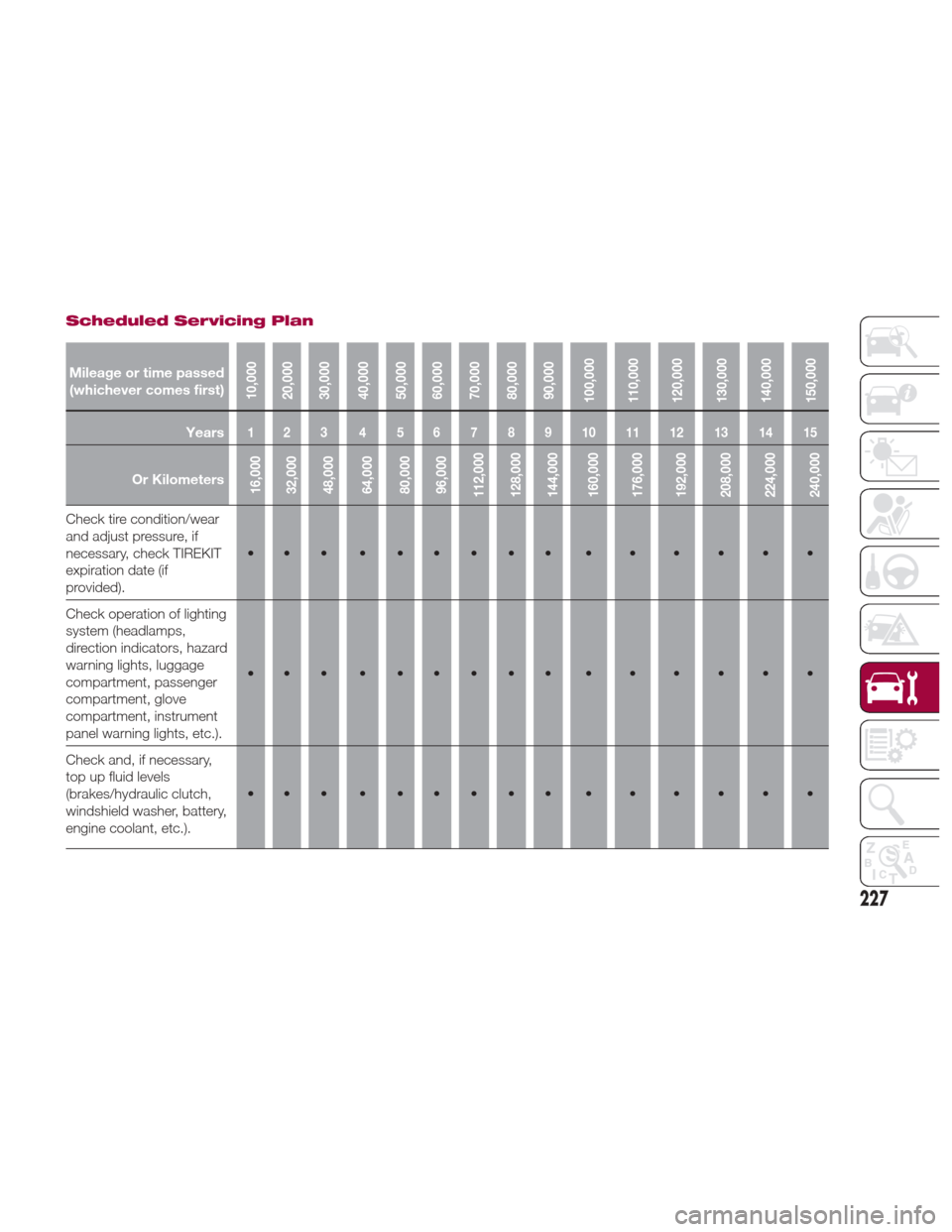
Scheduled Servicing Plan
Mileage or time passed(whichever comes first)
10,000
20,000
30,000
40,000
50,000
60,000
70,000
80,000
90,000
100,000
110,000
120,000
130,000
140,000
150,000
Years123 456789101112131415
Or Kilometers16,000
32,000
48,000
64,000
80,000
96,000
112,000
128,000
144,000
160,000
176,000
192,000
208,000
224,000
240,000
Check tire condition/wear
and adjust pressure, if
necessary, check TIREKIT
expiration date (if
provided). •••••••••••••••
Check operation of lighting
system (headlamps,
direction indicators, hazard
warning lights, luggage
compartment, passenger
compartment, glove
compartment, instrument
panel warning lights, etc.). •••••••••••••••
Check and, if necessary,
top up fluid levels
(brakes/hydraulic clutch,
windshield washer, battery,
engine coolant, etc.). •••••••••••••••
227
Page 234 of 300
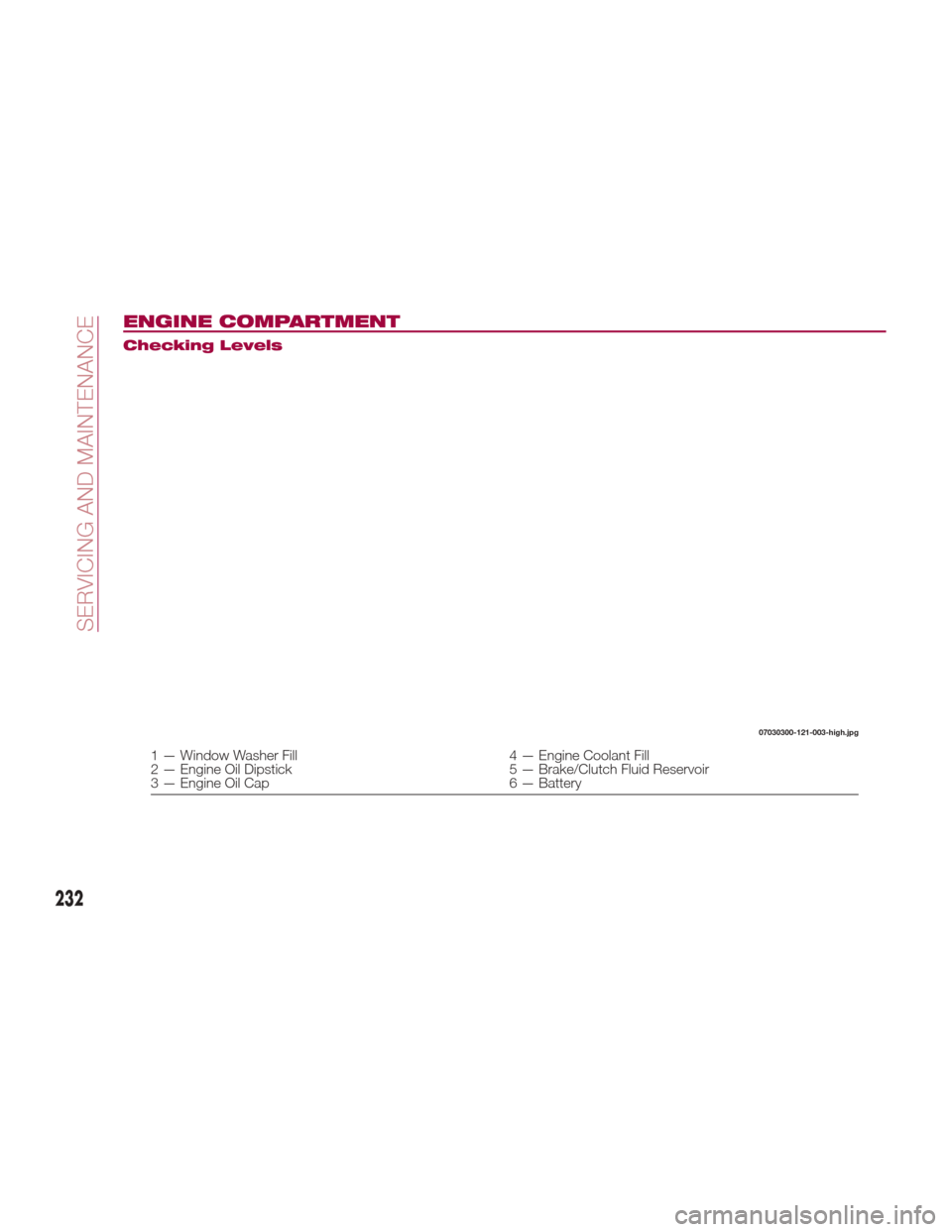
ENGINE COMPARTMENT
Checking Levels
07030300-121-003-high.jpg
1 — Window Washer Fill4 — Engine Coolant Fill
2 — Engine Oil Dipstick 5 — Brake/Clutch Fluid Reservoir
3 — Engine Oil Cap 6 — Battery
232
SERVICING AND MAINTENANCE
Page 236 of 300
Warning!
Do not open hot engine cooling system.
Never add engine coolant (antifreeze) when
the engine is overheated. Do not loosen or
remove the cap to cool an overheated
engine. Heat causes pressure to build up in
the cooling system. To prevent scalding or
injury, do not remove the pressure cap
while the system is hot or under pressure.
Do not use a pressure cap other than
the one specified for your vehicle. Personal
injury or engine damage may result.
The coolant should be at full in the
radiator and between the F (Full) and L
(Low) marks on the coolant reservoir
when the engine is cool. If it is at or near L (Low), add coolant by
mixing a minimum solution of 50%
Mopar Long Life Coolant Concentrate
for FIAT Spider. Use higher
concentrations (not to exceed 70%) if
temperatures below −34°F (−37°C) are
anticipated. Bring the level to F (Full).
Please contact your Authorized Dealer
for assistance.
Securely tighten the coolant reservoir
tank cap after adding coolant.
If the coolant reservoir is empty or new
coolant is required frequently, contact
your Authorized Dealer.
Brake/Clutch Fluid
Inspecting Brake/Clutch Fluid Level
The brakes and clutch draw fluid
from the same reservoir.
Inspect the fluid level in the reservoir
regularly.
It should be kept between the MAX
and MIN lines.
The level normally drops with
accumulated use, a condition
associated with wear of brake and
clutch linings. If it is excessively low,
have the brake/clutch system
inspected. Contact your Authorized
Dealer.
Warning!
Use only manufacturer's recommended
brake fluid. Refer to “Fluids And Lubricants”
in “Technical Specifications” for further
information. Using the wrong type of brake
fluid can severely damage your brake
system and/or impair its performance. The
proper type of brake fluid for your vehicle is
also identified on the original factory
installed hydraulic master cylinder reservoir.
To avoid contamination from foreign
matter or moisture, use only new brake
fluid or fluid that has been in a tightly
closed container. Keep the master cylinder
reservoir cap secured at all times. Brake
fluid in a open container absorbs moisture
from the air resulting in a lower boiling
point. This may cause it to boil
unexpectedly during hard or prolonged
braking, resulting in sudden brake failure.
This could result in a collision.
07030501-121-001Coolant Reservoir
07030601-121-002Brake Fluid Reservoir
234
SERVICING AND MAINTENANCE
Page 276 of 300
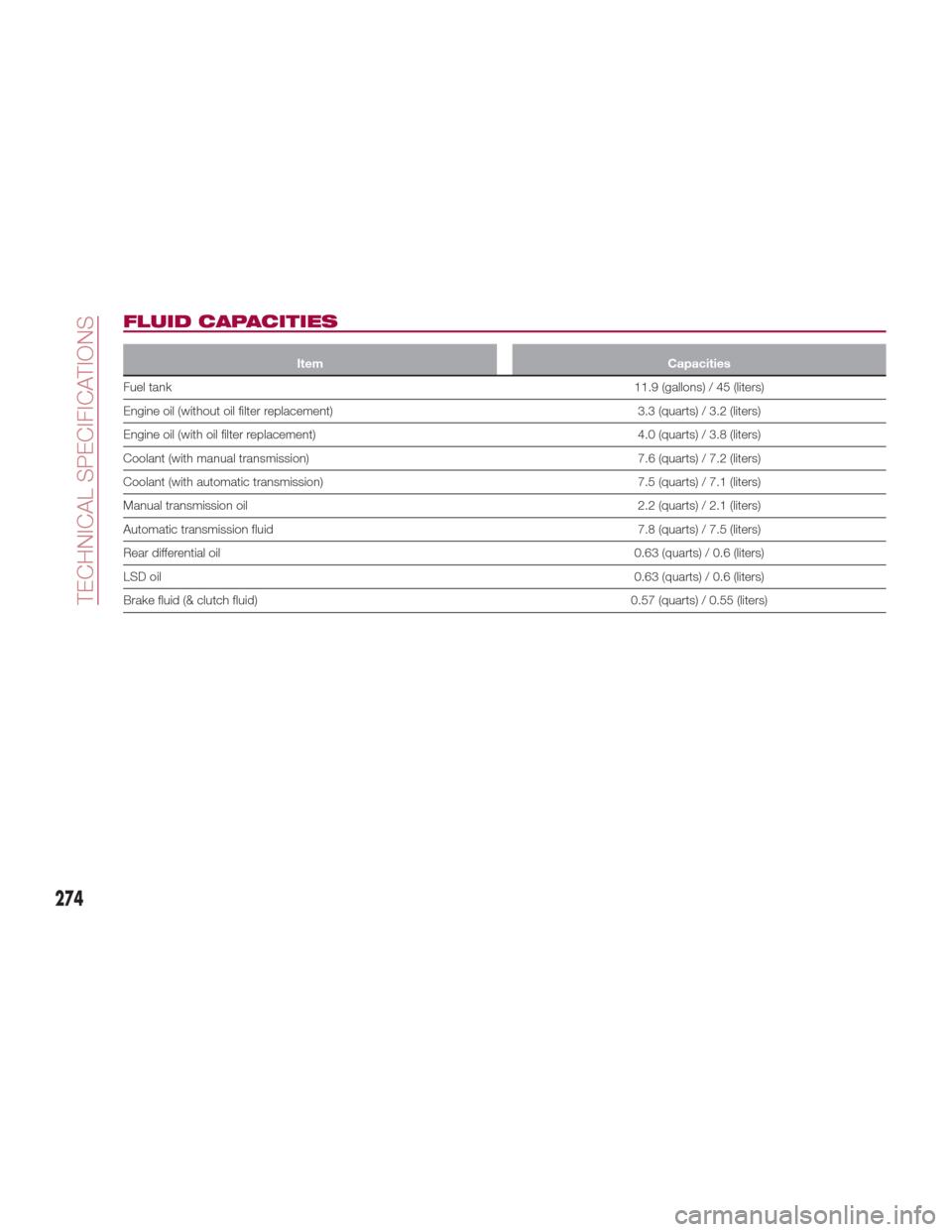
FLUID CAPACITIES
ItemCapacities
Fuel tank 11.9
(gallons) / 45 (liters)
Engine oil (without oil filter replacement) 3.3 (quarts) / 3.2 (liters)
Engine oil (with oil filter replacement) 4.0 (quarts) / 3.8 (liters)
Coolant (with manual transmission) 7.6 (quarts) / 7.2 (liters)
Coolant (with automatic transmission) 7.5 (quarts) / 7.1 (liters)
Manual transmission oil 2.2 (quarts) / 2.1 (liters)
Automatic transmission fluid 7.8 (quarts) / 7.5 (liters)
Rear differential oil 0.63 (quarts) / 0.6 (liters)
LSD oil 0.63 (quarts) / 0.6 (liters)
Brake fluid (& clutch fluid) 0.57 (quarts) / 0.55 (liters)
274
TECHNICAL SPECIFICATIONS
Page 277 of 300
FLUIDS AND LUBRICANTS
Fluids And Lubricants
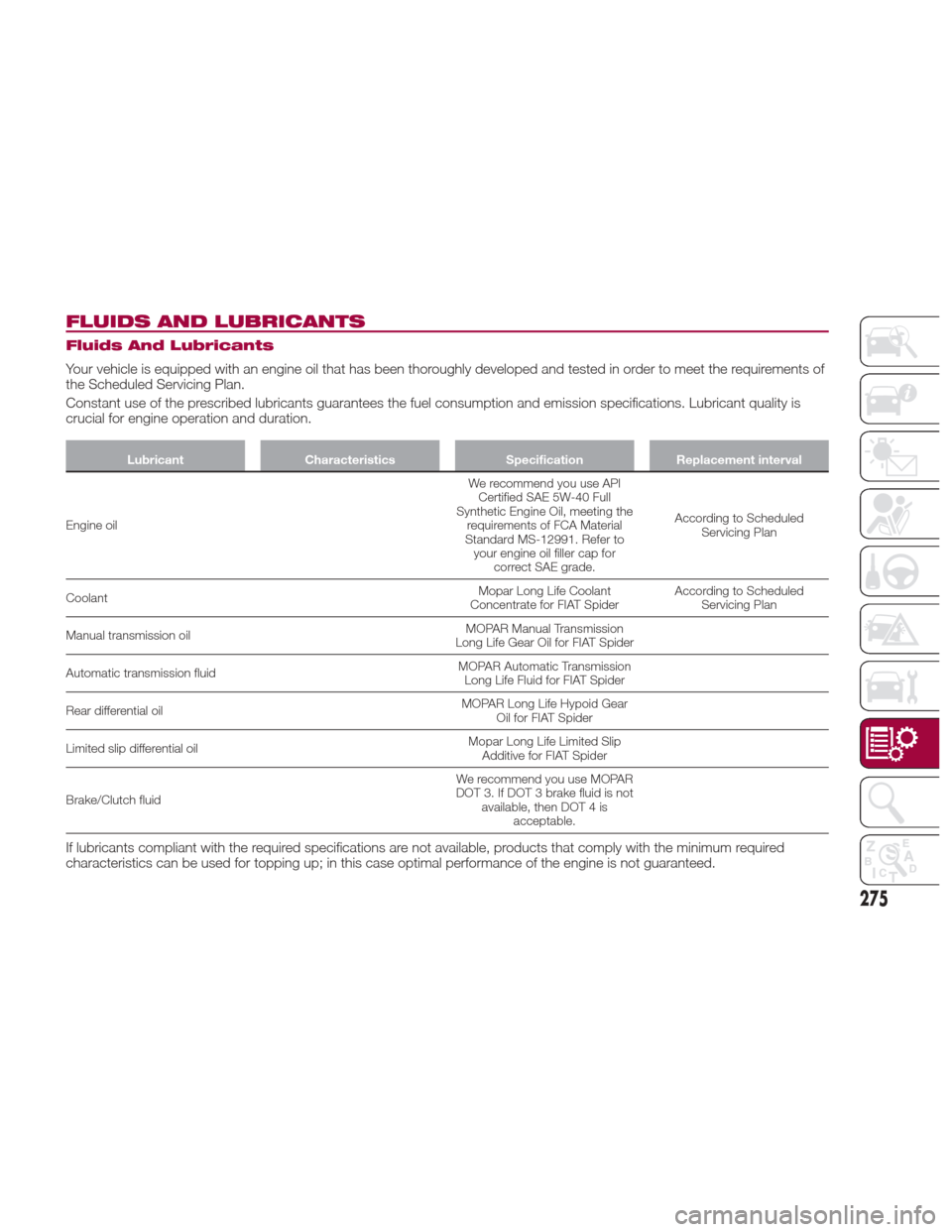
Your vehicle is equipped with an engine oil that has been thoroughly developed and tested in order to meet the requirements of
the Scheduled Servicing Plan.
Constant use of the prescribed lubricants guarantees the fuel consumption and emission specifications. Lubricant quality is
crucial for engine operation and duration.
LubricantCharacteristics SpecificationReplacement interval
Engine oil W
e recommend you use API
Certified SAE 5W-40 Full
Synthetic Engine Oil, meeting the requirements of FCA Material
Standard MS-12991. Refer to your engine oil filler cap for correct SAE grade. According to Scheduled
Servicing Plan
Coolant Mopar Long Life Coolant
Concentrate for FIAT Spider According to Scheduled
Servicing Plan
Manual transmission oil MOPAR Manual Transmission
Long Life Gear Oil for FIAT Spider
Automatic transmission fluid MOPAR Automatic Transmission
Long Life Fluid for FIAT Spider
Rear differential oil MOPAR Long Life Hypoid Gear
Oil for FIAT Spider
Limited slip differential oil Mopar Long Life Limited Slip
Additive for FIAT Spider
Brake/Clutch fluid We recommend you use MOPAR
DOT 3. If DOT 3 brake fluid is not available, then DOT 4 is acceptable.
If lubricants compliant with the required specifications are not available, products that comply with the minimum required
characteristics can be used for topping up; in this case optimal performance of the engine is not guaranteed.
275
Page 288 of 300
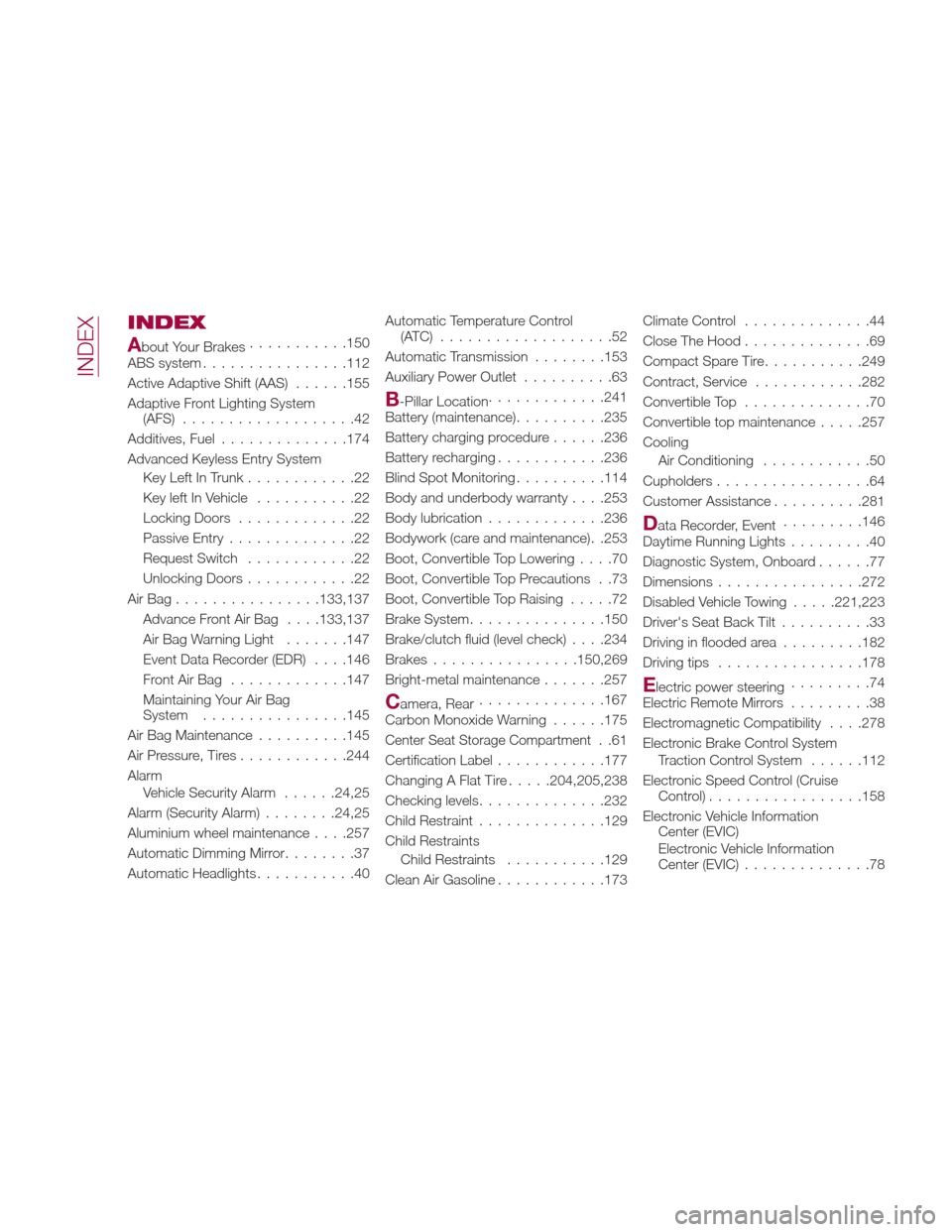
INDEX
About Your Brakes...........150
ABS system ............... .112
Active Adaptive Shift (AAS) ......155
Adaptive Front Lighting System (AFS) ...................42
Additives, Fuel ..............174
Advanced Keyless Entry System Key Left In Trunk ............22
Key left In Vehicle ...........22
Locking Doors .............22
Passive Entry ..............22
Request Switch ............22
Unlocking Doors ............22
AirBag............... .133,137
Advance Front Air Bag . . . .133,137
Air Bag Warning Light .......147
Event Data Recorder (EDR) . . . .146
FrontAirBag ............ .147
Maintaining Your Air Bag
System ............... .145
Air Bag Maintenance ..........145
Air Pressure, Tires ............244
Alarm Vehicle Security Alarm ......24,25
Alarm (Security Alarm) ........24,25
Aluminium wheel maintenance . . . .257
Automatic Dimming Mirror ........37
Automatic Headlights ...........40Automatic Temperature Control
(ATC) ...................52
Automatic Transmission ........153
Auxiliary Power Outlet ..........63
B-Pillar Location.............241
Battery (maintenance) ..........235
Battery charging procedure ......236
Battery recharging ............236
Blind Spot Monitoring ..........114
Body and underbody warranty . . . .253
Body lubrication .............236
Bodywork (care and maintenance). .253
Boot, Convertible Top Lowering ....70
Boot, Convertible Top Precautions . .73
Boot, Convertible Top Raising .....72
Brake System ...............150
Brake/clutch fluid (level check) . . . .234
Brakes ............... .150,269
Bright-metal maintenance .......257
Camera, Rear..............167
Carbon Monoxide Warning ......175
Center Seat Storage Compartment. .61
Certification Label ............177
Changing A Flat Tire .....204,205,238
Checking levels ..............232
Child Restraint ..............129
Child Restraints Child Restraints ...........129
Clean Air Gasoline ............173 Climate Control
..............44
Close The Hood ..............69
Compact Spare Tire ...........249
Contract, Service ............282
Convertible Top ..............70
Convertible top maintenance .....257
Cooling Air Conditioning ............50
Cupholders .................64
Customer Assistance ..........281
Data Recorder, Event.........146
Daytime Running Lights .........40
Diagnostic System, Onboard ......77
Dimensions ............... .272
Disabled Vehicle Towing .....221,223
Driver's Seat Back Tilt ..........33
Driving in flooded area .........182
Driving tips ............... .178
Electric power steering.........74
Electric Remote Mirrors .........38
Electromagnetic Compatibility . . . .278
Electronic Brake Control System Traction Control System ......112
Electronic Speed Control (Cruise Control) ................ .158
Electronic Vehicle Information Center (EVIC)
Electronic Vehicle Information
Center (EVIC) ..............78
INDEX