tow FIAT 124 SPIDER 2017 2.G Owner's Manual
[x] Cancel search | Manufacturer: FIAT, Model Year: 2017, Model line: 124 SPIDER, Model: FIAT 124 SPIDER 2017 2.GPages: 300, PDF Size: 121.24 MB
Page 212 of 300
Tire Service Usage
Precautions
The tire sealant cannot be reused. If the
sealant has been used, or is expired,
purchase new tire sealant at an
Authorized Dealer.
Note:The tire service kit cannot be
used in the following cases. Consult an
Authorized Dealer if any of these
conditions exist:
The period of effective use for the
tire sealant has expired (the period of
effectiveness is indicated on the bottle
label)
The tear or puncture in the tire
exceeds about 0.16 in (4 mm)
The damage has occurred to an
area of the tire other than the tread
The vehicle has been driven with
nearly no air remaining in the tire
The tire has come off the wheel rim
Damage to the wheel rim has
occurred
The tire has two or more punctures
Sealing A Tire With Tire
Service
Warning!
Do not attempt to seal a tire on the side
of the vehicle closest to traffic. Pull far
enough off the road to avoid the danger of
being hit when using the Tire Service Kit.
Do not use Tire Service Kit or drive the
vehicle under the following circumstances:
If the puncture in the tire tread is
approximately 1/4 inch (6 mm) or larger.
If the tire has any sidewall damage.
If the tire has any damage from driving
with extremely low tire pressure.
If the tire has any damage from driving
on a flat tire.
If the wheel has any damage.
If you are unsure of the condition of the
tire or the wheel.
Keep Tire Service Kit away from open
flames or heat source.
A loose Tire Service Kit thrown forward
in a collision or hard stop could endanger
the occupants of the vehicle. Always stow
the Tire Service Kit in the place provided.
Failure to follow these warnings can result
in injuries that are serious or fatal to you,
your passengers, and others around you.
Take care not to allow the contents of
Tire Service Kit to come in contact with
hair, eyes, or clothing. Tire Service Kit
sealant is harmful if inhaled, swallowed, or
absorbed through the skin. It causes skin,
eye, and respiratory irritation. Flush
immediately with plenty of water if there is
any contact with eyes or skin. Change
clothing as soon as possible, if there is any
contact with clothing.
Tire Service Kit Sealant solution contains
latex. In case of an allergic reaction or rash,
consult a physician immediately. Keep Tire
Service Kit out of reach of children. If
swallowed, rinse mouth immediately with
plenty of water and drink plenty of water.
Do not induce vomiting! Consult a
physician immediately.
210
IN CASE OF EMERGENCY
Page 216 of 300
Note:Carefully drive the vehicle at a
speed of 50 mph (80 km/h) or less. If
the vehicle is driven at a speed of
50 mph (80 km/h) or more, the vehicle
may vibrate.
Note: With TPMS system: if the tire is
not properly inflated, the
warning
light will illuminate.
After driving the vehicle for about
10 minutes or 3 miles (5 km), connect
the air compressor to the tire using
Step 9 of the procedure, and check the
tire inflation pressure using the tire
pressure gauge on the air compressor.
If the tire inflation pressure is lower than
the specified tire inflation pressure, turn
the air compressor on and wait until it
reaches the specified tire inflation
pressure.
the tire service kit is completed
successfully if the tire inflation pressure
does not decrease. Carefully drive the
vehicle to the nearest Authorized Dealer
immediately and have the flat tire
replaced. Replacement with a new tire
is recommended. If the tire is to be
repaired or reused, consult an
Authorized Dealer.
Note:
If an emergency flat tire repair has
been performed using the tire service
kit, FCA recommends that the tire be
replaced with a new one as soon as possible. If the tire is to be repaired or
reused, contact an Authorized Dealer.
The wheel can be reused if the
sealant adhering to it is removed.
However, replace the valve with a new
one.
Sealing A Tire With Tire
Service
Warning!
Do not attempt to seal a tire on the side
of the vehicle closest to traffic. Pull far
enough off the road to avoid the danger of
being hit when using the Tire Service Kit.
Do not use Tire Service Kit or drive the
vehicle under the following circumstances:
If the puncture in the tire tread is
approximately 1/4 inch (6 mm) or larger.
If the tire has any sidewall damage.
If the tire has any damage from driving
with extremely low tire pressure.
If the tire has any damage from driving
on a flat tire.
If the wheel has any damage.
If you are unsure of the condition of the
tire or the wheel.
Keep Tire Service Kit away from open
flames or heat source.
A loose Tire Service Kit thrown forward
in a collision or hard stop could endanger
the occupants of the vehicle. Always stow
the Tire Service Kit in the place provided.
Failure to follow these warnings can result
in injuries that are serious or fatal to you,
your passengers, and others around you.
Take care not to allow the contents of
Tire Service Kit to come in contact with
hair, eyes, or clothing. Tire Service Kit
sealant is harmful if inhaled, swallowed, or
absorbed through the skin. It causes skin,
eye, and respiratory irritation. Flush
immediately with plenty of water if there is
any contact with eyes or skin. Change
clothing as soon as possible, if there is any
contact with clothing.
Tire Service Kit Sealant solution contains
latex. In case of an allergic reaction or rash,
consult a physician immediately. Keep Tire
Service Kit out of reach of children. If
swallowed, rinse mouth immediately with
plenty of water and drink plenty of water.
Do not induce vomiting! Consult a
physician immediately.
214
IN CASE OF EMERGENCY
Page 222 of 300
4. Connect one end of a jumper cables
to the positive terminal on the
discharged battery.
5. Connect the other end to the
positive terminal on the booster battery.
6. Connect one end of the other
jumper cables to the negative terminal
of the booster battery.
7. Connect the other end to a good
engine ground of the vehicle with the
discharged battery (exposed metal part
of the engine) away from the battery
and the fuel injection system.
8. Start the engine of the booster
vehicle and run it a few minutes. Then
start the engine of the other vehicle.
9. Once the engine is started, remove
the jumper cables in the reverse
sequence.
10. Replace the positive terminal
cover. Make sure cover is secure.
Bump Starting
Never jump start the engine by pushing,
towing or coasting downhill.
Note:
You cannot start a vehicle with an
automatic transmission by pushing it.
Do not push-start a vehicle that has
a manual transmission. It can damage
the emission control system.
STARTING A FLOODED
ENGINE
If the engine fails to start, it may be
flooded (excessive fuel in the engine).
Follow this procedure:
1. If the engine does not start within
5 seconds on the first try, wait
10 seconds and try again.
2. Make sure the parking brake is on.
3. Depress the accelerator all the way
and hold it there.
4. Depress the clutch pedal (manual
transmission) or the brake pedal
(automatic transmission), then push the
push button start. If the engine starts,
release the accelerator immediately
because the engine will suddenly rev
up.
5. If the engine fails to start, crank it
without depressing the accelerator.
If the engine still does not start using
the above procedure, have your vehicle
inspected an Authorized Dealer.
OVERHEATING
Overheating
In any of the following situations, you
can reduce the potential for overheating
by taking the appropriate action.
On the highways — slow down.
In city traffic — while stopped, place
the transmission in NEUTRAL, but do
not increase engine idle speed.
Note: There are steps that you can
take to slow down an impending
overheat condition:
If your air conditioner (A/C) is on,
turn it off. The A/C system adds heat
to the engine cooling system and
turning the A/C off can help remove
this heat.
You can also turn the temperature
control to maximum heat, the mode
control to floor and the blower control
to high. This allows the heater core to
act as a supplement to the radiator
and aids in removing heat from the
engine cooling system.
220
IN CASE OF EMERGENCY
Page 223 of 300
Warning!
You or others can be badly burned by hot
engine coolant (antifreeze) or steam from
your radiator. If you see or hear steam
coming from under the hood, do not open
the hood until the radiator has had time to
cool. Never try to open a cooling system
pressure cap when the radiator or coolant
bottle is hot.
Caution!
Driving with a hot cooling system could
damage your vehicle. If temperature gauge
reads “H”, pull over and stop the vehicle.
Idle the vehicle with the air conditioner
turned off until the pointer drops back into
the normal range. If the pointer remains on
the “H”, turn the engine off immediately,
and call for service.
If Steam Is Coming From The
Engine Compartment:
Do not go near the front of the vehicle.
Stop the engine. Wait until the steam
dissipates, then open the hood and
start the engine.
If Neither Coolant Nor Steam Is
Escaping:
Open the hood and idle the engine until
it cools.
Note:
If the cooling fan does not operate
while the engine is running, the engine
temperature will increase. Stop the
engine and contact an Authorized
Dealer.
If the engine continues to overheat
or frequently overheats, have the
cooling system inspected. The engine
could be seriously damaged unless
repairs are made. Contact an
Authorized Dealer.
TOWING THE
VEHICLE
Attaching The Tow Eyes
Warning!
Stand clear of vehicles when pulling with
tow eyes.
Do not use a chain with a tow eye.
Chains may break, causing serious injury or
death.
Do not use a tow strap with a tow eye.
Tow straps may break or become
disengaged, causing serious injury or
death.
Failure to follow proper tow eye usage
may cause components to break resulting
in serious injury or death.
221
Page 224 of 300
Caution!
The tow eye must be used exclusively
for roadside assistance operations. Only
use the tow eye with an appropriate device
in accordance with the highway code (a
rigid bar or rope) to flat tow the vehicle for
a short distance to the nearest service
location.
Tow eyes MUST NOT be used to tow
vehicles off the road or where there are
obstacles.
In compliance with the above
conditions, towing with a tow eye must
take place with two vehicles (one towing,
the other towed) aligned as much as
possible along the same center line.
Damage to your vehicle may occur if these
guidelines are not followed.
When towing, only use a facility that can
tow vehicles with low ground clearances as
extensive damage can result by using a
standard tow truck platform.
Proceed as follows:
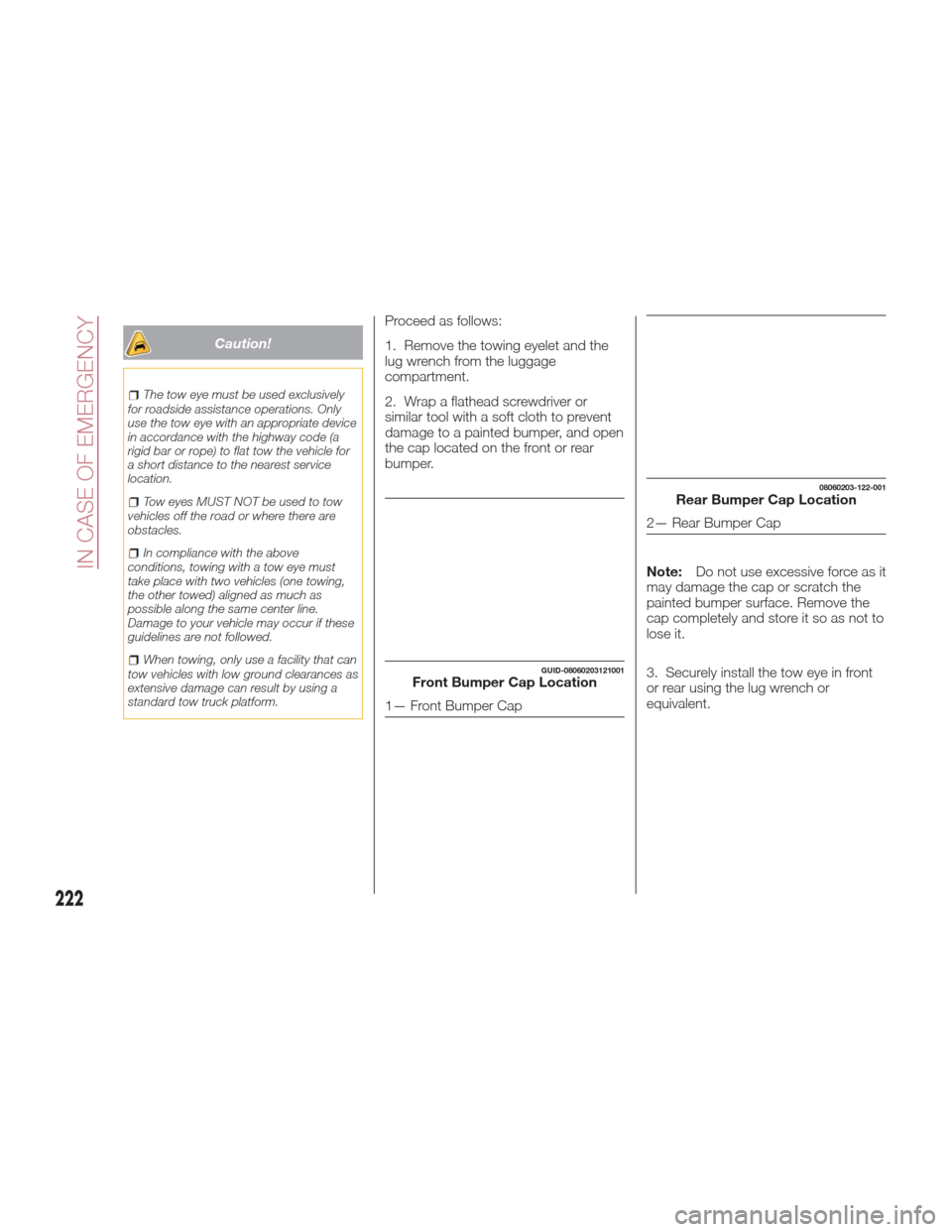
1. Remove the towing eyelet and the
lug wrench from the luggage
compartment.
2. Wrap a flathead screwdriver or
similar tool with a soft cloth to prevent
damage to a painted bumper, and open
the cap located on the front or rear
bumper.
Note:Do not use excessive force as it
may damage the cap or scratch the
painted bumper surface. Remove the
cap completely and store it so as not to
lose it.
3. Securely install the tow eye in front
or rear using the lug wrench or
equivalent.
GUID-08060203121001Front Bumper Cap Location
1— Front Bumper Cap
08060203-122-001Rear Bumper Cap Location
2— Rear Bumper Cap
222
IN CASE OF EMERGENCY
Page 225 of 300
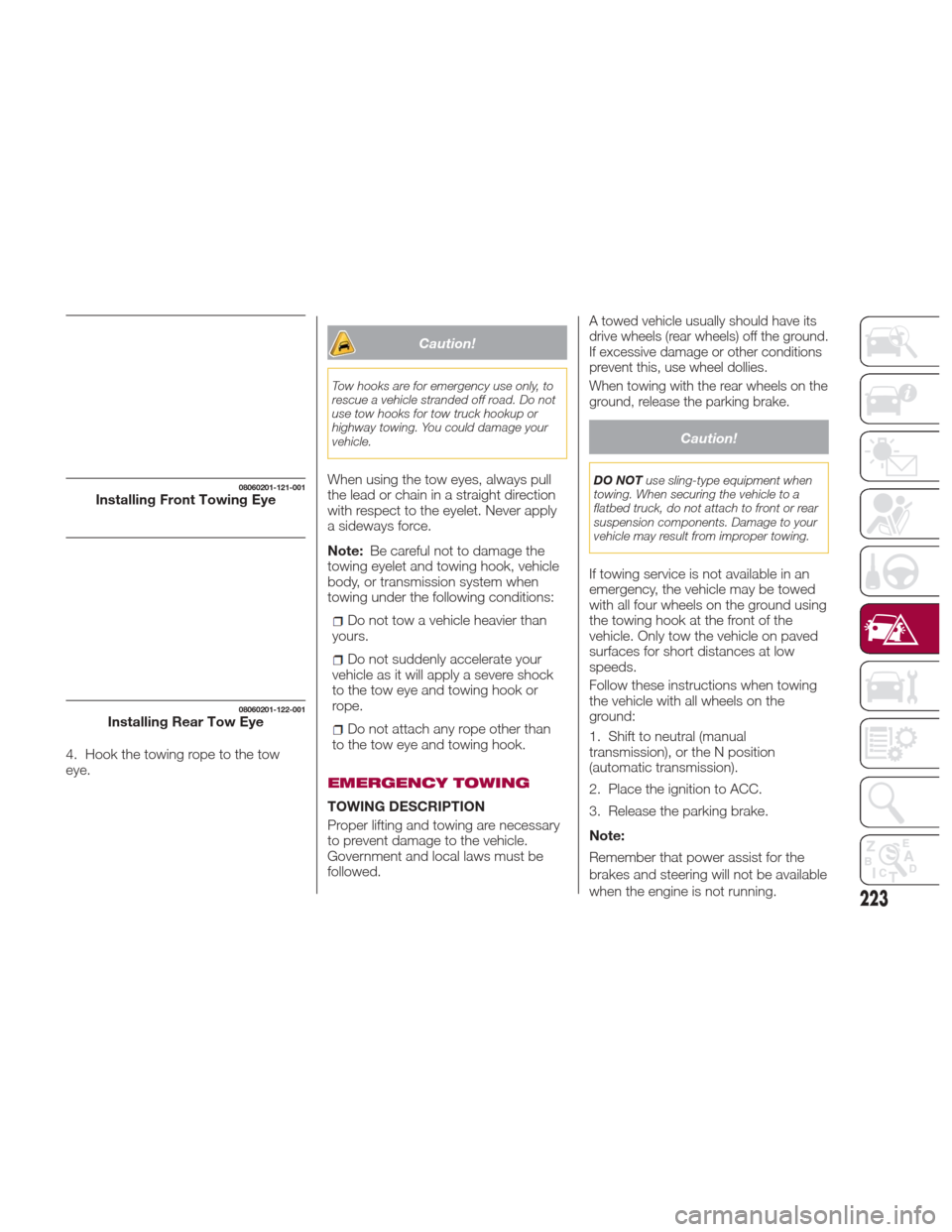
4. Hook the towing rope to the tow
eye.
Caution!
Tow hooks are for emergency use only, to
rescue a vehicle stranded off road. Do not
use tow hooks for tow truck hookup or
highway towing. You could damage your
vehicle.
When using the tow eyes, always pull
the lead or chain in a straight direction
with respect to the eyelet. Never apply
a sideways force.
Note:Be careful not to damage the
towing eyelet and towing hook, vehicle
body, or transmission system when
towing under the following conditions:
Do not tow a vehicle heavier than
yours.
Do not suddenly accelerate your
vehicle as it will apply a severe shock
to the tow eye and towing hook or
rope.
Do not attach any rope other than
to the tow eye and towing hook.
EMERGENCY TOWING
TOWING DESCRIPTION
Proper lifting and towing are necessary
to prevent damage to the vehicle.
Government and local laws must be
followed.
A towed vehicle usually should have its
drive wheels (rear wheels) off the ground.
If excessive damage or other conditions
prevent this, use wheel dollies.
When towing with the rear wheels on the
ground, release the parking brake.
Caution!
DO NOT use sling-type equipment when
towing. When securing the vehicle to a
flatbed truck, do not attach to front or rear
suspension components. Damage to your
vehicle may result from improper towing.
If towing service is not available in an
emergency, the vehicle may be towed
with all four wheels on the ground using
the towing hook at the front of the
vehicle. Only tow the vehicle on paved
surfaces for short distances at low
speeds.
Follow these instructions when towing
the vehicle with all wheels on the
ground:
1. Shift to neutral (manual
transmission), or the N position
(automatic transmission).
2. Place the ignition to ACC.
3. Release the parking brake.
Note:
Remember that power assist for the
brakes and steering will not be available
when the engine is not running.
08060201-121-001Installing Front Towing Eye
08060201-122-001Installing Rear Tow Eye
223
Page 243 of 300
Tire Loading And Tire Pressure
Note:
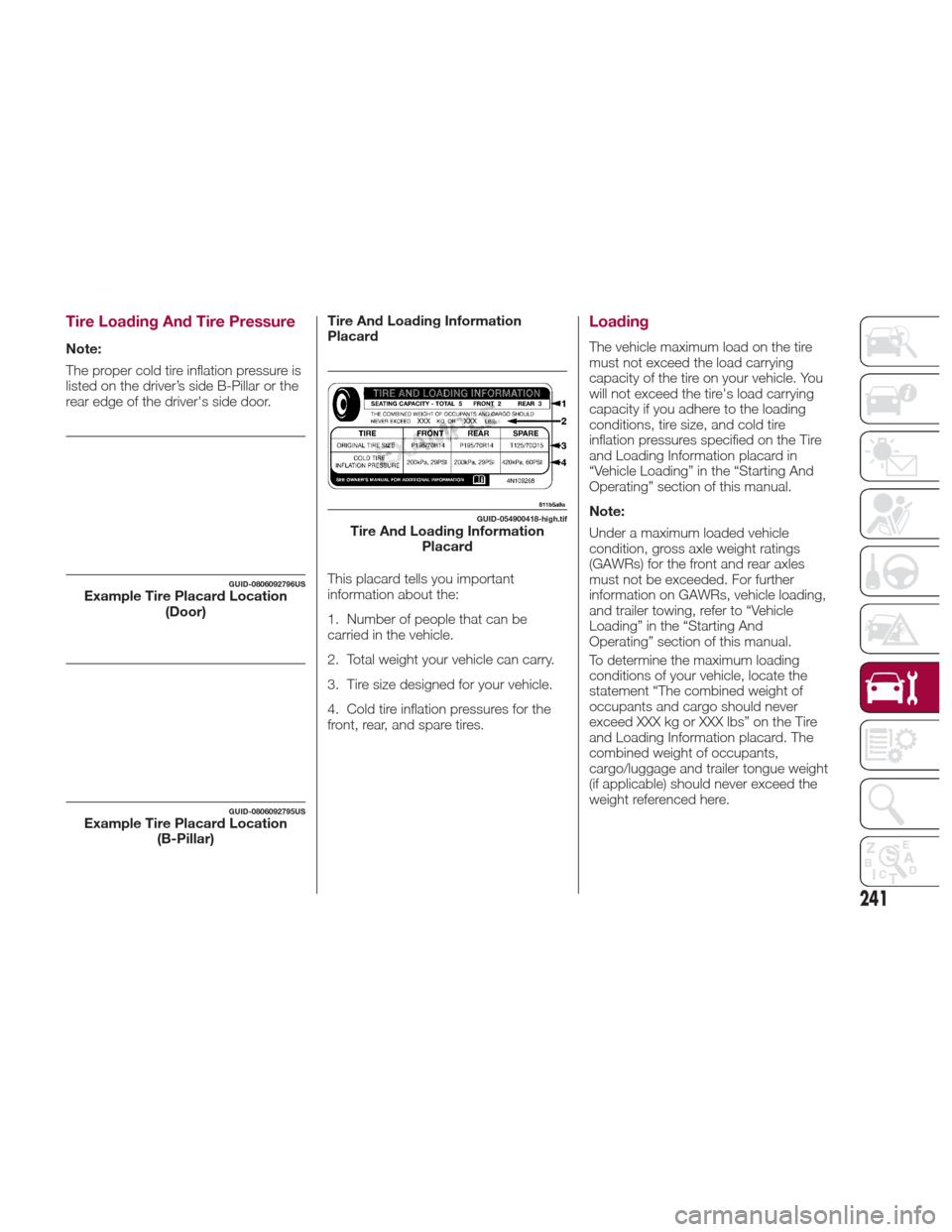
The proper cold tire inflation pressure is
listed on the driver’s side B-Pillar or the
rear edge of the driver's side door.Tire And Loading Information
Placard
This placard tells you important
information about the:
1. Number of people that can be
carried in the vehicle.
2. Total weight your vehicle can carry.
3. Tire size designed for your vehicle.
4. Cold tire inflation pressures for the
front, rear, and spare tires.
Loading
The vehicle maximum load on the tire
must not exceed the load carrying
capacity of the tire on your vehicle. You
will not exceed the tire's load carrying
capacity if you adhere to the loading
conditions, tire size, and cold tire
inflation pressures specified on the Tire
and Loading Information placard in
“Vehicle Loading” in the “Starting And
Operating” section of this manual.
Note:
Under a maximum loaded vehicle
condition, gross axle weight ratings
(GAWRs) for the front and rear axles
must not be exceeded. For further
information on GAWRs, vehicle loading,
and trailer towing, refer to “Vehicle
Loading” in the “Starting And
Operating” section of this manual.
To determine the maximum loading
conditions of your vehicle, locate the
statement “The combined weight of
occupants and cargo should never
exceed XXX kg or XXX lbs” on the Tire
and Loading Information placard. The
combined weight of occupants,
cargo/luggage and trailer tongue weight
(if applicable) should never exceed the
weight referenced here.
GUID-0806092796USExample Tire Placard Location
(Door)
GUID-0806092795USExample Tire Placard Location(B-Pillar)
GUID-054900418-high.tifTire And Loading InformationPlacard
241
Page 244 of 300
Steps For Determining Correct
Load Limit—
(1) Locate the statement “The
combined weight of occupants and
cargo should never exceed XXX kg
or XXX lbs.” on your vehicle's
placard.
(2) Determine the combined weight
of the driver and passengers that
will be riding in your vehicle.
(3) Subtract the combined weight of
the driver and passengers from
XXX kg or XXX lbs.
(4) The resulting figure equals the
available amount of cargo and
luggage load capacity. For
example, if “XXX” amount equals
1400 lbs. and there will be five
150 lb passengers in your vehicle,
the amount of available cargo and
luggage load capacity is 650 lbs.
(1400-750 (5x150) = 650 lbs.)(5) Determine the combined weight
of luggage and cargo being loaded
on the vehicle. That weight may not
safely exceed the available cargo
and luggage load capacity
calculated in Step 4.
(6) If your vehicle will be towing a
trailer, load from your trailer will be
transferred to your vehicle. Consult
this manual to determine how this
reduces the available cargo and
luggage load capacity of your
vehicle.
Metric Example For Load Limit
For example, if “XXX” amount equals
635 kg and there will be five 68 kg
passengers in your vehicle, the amount
of available cargo and luggage load
capacity is 295 kg (635-340 (5x68) =
295 kg) as shown in step 4.
Note:
If your vehicle will be towing a trailer,
load from your trailer will be transferred
to your vehicle. The following table
shows examples on how to calculate
total load, cargo/luggage, and towing
capacities of your vehicle with varying
seating configurations and number and
size of occupants. This table is for
illustration purposes only and may not
be accurate for the seating and load
carry capacity of your vehicle.
For the following example, the
combined weight of occupants and
cargo should never exceed 865 lbs
(392 kg).
242
SERVICING AND MAINTENANCE
Page 248 of 300
Run Flat Tires — If Equipped
Run Flat tires allow you the capability to
drive 50 miles (80 km) at 50 mph
(80 km/h) after a rapid loss of inflation
pressure. This rapid loss of inflation is
referred to as the Run Flat mode. A Run
Flat mode occurs when the tire inflation
pressure is of/or below 14 psi (96 kPa).
Once a Run Flat tire reaches the run flat
mode it has limited driving capabilities
and needs to be replaced immediately.
A Run Flat tire is not repairable.
It is not recommended driving a vehicle
loaded at full capacity or to tow a trailer
while a tire is in the run flat mode.
See the tire pressure monitoring section
for more information.
Tire Spinning
When stuck in mud, sand, snow, or ice
conditions, do not spin your vehicle's
wheels above 30 mph (48 km/h) or for
longer than 30 seconds continuously
without stopping.
Refer to “Freeing A Stuck Vehicle” in “In
Case Of Emergency” for further
information.
Warning!
Fast spinning tires can be dangerous.
Forces generated by excessive wheel
speeds may cause tire damage or failure.
A tire could explode and injure someone.
Do not spin your vehicle's wheels faster
than 30 mph (48 km/h) for more than
30 seconds continuously when you are
stuck, and do not let anyone near a
spinning wheel, no matter what the speed.
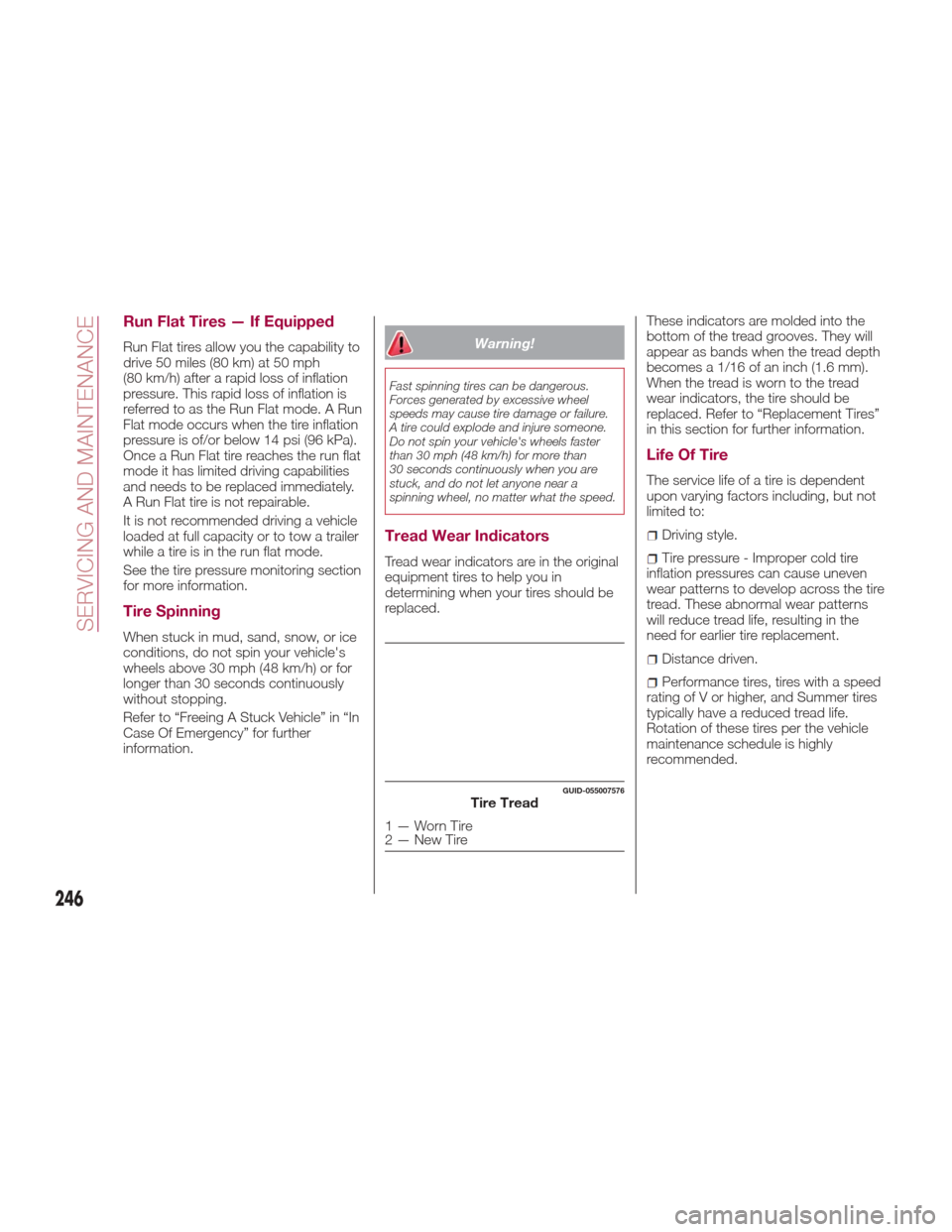
Tread Wear Indicators
Tread wear indicators are in the original
equipment tires to help you in
determining when your tires should be
replaced.These indicators are molded into the
bottom of the tread grooves. They will
appear as bands when the tread depth
becomes a 1/16 of an inch (1.6 mm).
When the tread is worn to the tread
wear indicators, the tire should be
replaced. Refer to “Replacement Tires”
in this section for further information.
Life Of Tire
The service life of a tire is dependent
upon varying factors including, but not
limited to:
Driving style.
Tire pressure - Improper cold tire
inflation pressures can cause uneven
wear patterns to develop across the tire
tread. These abnormal wear patterns
will reduce tread life, resulting in the
need for earlier tire replacement.
Distance driven.
Performance tires, tires with a speed
rating of V or higher, and Summer tires
typically have a reduced tread life.
Rotation of these tires per the vehicle
maintenance schedule is highly
recommended.
GUID-055007576Tire Tread
1—WornTire
2—NewTire
246
SERVICING AND MAINTENANCE
Page 263 of 300
Plastic And Coated
Parts
Clean interior plastic parts with a damp
cloth (if possible made from microfiber),
and a solution of water and neutral,
non-abrasive detergent.
To clean oily or persistent stains, use
specific products free from solvents and
designed to maintain the original
appearance and color of the
components.
Remove any dust using a microfiber
cloth, if necessary moistened with
water. The use of paper tissues is not
recommended as these may leave
residues.
Instrument panel precautions
Prevent caustic solutions such as
perfume and cosmetic oils from
contacting the instrument panel. They
will damage and discolor the instrument
panel. If these solutions get on the
instrument panel, wipe them off
immediately.
Note:Never use alcohol, gasoline and
derivatives to clean the instrument
panel lens.
Caution!
Do not use glazing agents. Glazing agents
contain ingredients which may cause
discoloration, wrinkling, cracks and peeling.
Instrument Panel Top
When cleaning, it is recommended that
you use a clean towel dampened in a
mild detergent to remove debris.
Caution!
If the surface is rubbed harshly, it could
result in the surface being damaged leaving
white scratch marks.
Window Interiors
If the windows become covered with an
oily, greasy, or waxy film, clean them
with glass cleaner. Follow the directions
on the container.
Note: Do not scrape or scratch the
inside of the window glass. It could
damage the thermal filaments.
Caution!
When washing the inside of the window
glass, use a soft cloth dampened in
lukewarm water, gently wiping the thermal
filaments. Use of glass cleaning products
could damage the thermal filaments.
Leather Parts(If — Equipped)
Caution!
Do not use Alcohol and Alcohol-based
and/or Keton based cleaning products to
clean leather seats, as damage to the seat
may result.
Remove dust and sand first using a
vacuum cleaner or other means, then
wipe dirt off using a soft cloth with a
leather cleaner or a soft cloth soaked in
mild soap.
Wipe off the remaining cleaner or soap
using a cloth soaked in clean water and
wrung out well.
261