belt FIAT 124 SPIDER 2017 2.G Owner's Guide
[x] Cancel search | Manufacturer: FIAT, Model Year: 2017, Model line: 124 SPIDER, Model: FIAT 124 SPIDER 2017 2.GPages: 300, PDF Size: 121.24 MB
Page 147 of 300
If the passenger air bag deactivation
indicator light does not turn on when
the ignition is switched ON and does
not turn on as indicated in the
passenger air bag deactivation indicator
light on/off condition chart, do not allow
an occupant to sit in the passenger
seat and contact an Authorized
Dealership as soon as possible. The
system may not work properly in an
accident.
Warning!
If a child restraint system, child, small
teenager or adult in the front passenger
seat is seated improperly, the occupant
may provide an output signal to the
occupant classification sensor that is
different from the occupant’s properly
seated weight input. This may result in
serious injury or death in a collision.
Warning!
Never place a rear-facing child restraint
in front of an air bag. A deploying
passenger front air bag can cause death or
serious injury to a child 12 years or
younger, including a child in a rear-facing
child restraint.
Only use a rear-facing child restraint in a
vehicle with a rear seat.
Children 12 years or younger should
always ride buckled up in a vehicle with a
rear seat.
Warning!
No objects should be placed over or
near the air bag on the instrument panel or
steering wheel because any such objects
could cause harm if the vehicle is in a
collision severe enough to cause the air
bag to inflate.
Do not put anything on or around the air
bag covers or attempt to open them
manually. You may damage the air bags
and you could be injured because the air
bags may no longer be functional. The
protective covers for the air bag cushions
are designed to open only when the air
bags are inflating.
Relying on the air bags alone could lead
to more severe injuries in a collision. The air
bags work with your seat belt to restrain
you properly. In some collisions, air bags
won’t deploy at all. Always wear your seat
belts even though you have air bags.
Maintaining Your Air Bag
System
Warning!
Modifications to any part of the air bag
system could cause it to fail when you
need it. You could be injured if the air bag
system is not there to protect you. Do not
modify the components or wiring, including
adding any kind of badges or stickers to
the steering wheel hub trim cover or the
upper right side of the instrument panel. Do
not modify the front bumper, vehicle body
structure, or add aftermarket side steps or
running boards.
It is dangerous to try to repair any part
of the air bag system yourself. Be sure to
tell anyone who works on your vehicle that
it has an air bag system.
Do not attempt to modify any part of
your air bag system. The air bag may inflate
accidentally or may not function properly if
modifications are made. Take your vehicle
to an authorized dealer for any air bag
system service. If your seat, including your
trim cover and cushion, needs to be
serviced in any way (including removal or
loosening/tightening of seat attachment
bolts), take the vehicle to your authorized
dealer. Only manufacturer approved seat
accessories may be used. If it is necessary
to modify the air bag system for persons
with disabilities, contact your authorized
dealer.
145
Page 148 of 300
EVENT DATA
RECORDER (EDR)
This vehicle is equipped with an event
data recorder (EDR).
The main purpose of an EDR is to
record, in certain crash or near
crash-like situations, such as an air bag
deployment or hitting a road obstacle,
data that will assist in understanding
how a vehicle’s systems performed.
The EDR is designed to record data
related to vehicle dynamics and safety
systems for a short period of time,
typically 30 seconds or less.
The EDR in this vehicle is designed to
record such data as:
How various systems in your vehicle
were operating.
Whether or not the driver and
passenger safety belts were
buckled/fastened.
How far (if at all) the driver was
pushing the accelerator and/or brake
pedal.
How fast the vehicle was traveling.
This data can help provide a better
understanding of the circumstances in
which crashes and injuries occur. Note:
EDR data are recorded by your
vehicle only if a non-trivial crash or near
crash-like situation occurs; no data are
recorded by the EDR under normal
driving conditions and no personal
data (e.g., name, gender, age, and
crash location) are recorded. However,
other parties, such as law
enforcement, could combine the EDR
data with the type of personally
identifying data routinely acquired
during a crash investigation.
To read data recorded by an EDR,
special equipment is required, and
access to the vehicle or the EDR is
needed. In addition to the vehicle
manufacturer, other parties, such as
law enforcement, that have the special
equipment, can read the information if
they have access to the vehicle or the
EDR.
FCA will not disclose any of the data
recorded in an EDR to a third party
unless:
A written agreement from the
vehicle owner or the lessee is
obtained.
Officially requested by the police or
other law enforcement authorities.
Used as a defense for FCA in a law
suit, claim, or arbitration.
Ordered by a judge or court. However, if necessary, FCA will:
Use the data for research on FCA
vehicle performance, including safety.
Disclose the data or the
summarized data to a third party for
research purposes without disclosing
vehicle or owner identification
information.
Recording Of Vehicle Data
This vehicle is equipped with a
computer which records the following
main vehicle data related to vehicle
controls, operation, and other driving
conditions.
Recorded Data
Vehicle conditions such as engine
speed and vehicle speed.
Driving operation conditions such
as accelerator and brake pedals, and
information related to the
environmental circumstances while the
vehicle is driven.
Malfunction diagnosis information
from each on-vehicle computer.
Information related to controls of
other on-vehicle computers.
The recorded data may vary depending
on the vehicle grade and optional
equipment. Voice and images are not
recorded.
146
SAFETY
Page 149 of 300
Data Handling
FCA and its subcontracting parties may
obtain and use the recorded data for
vehicle malfunction diagnosis, research
and development, and quality
improvement.
FCA will not disclose or provide any of
the obtained data to a third party
unless:
An agreement from the vehicle
owner (agreements from lessor and
lessee for leased vehicle) is obtained.
Officially requested by the police or
other law enforcement authorities.
For statistical processing by a
research institution, after processing
the data so that identification of the
owner or the vehicle is impossible.
CONSTANT
MONITORING
The following components of the Air
Bag systems are monitored by a
diagnostic system:
Crash Sensors, And Diagnostic
Module (Sas Unit)
Front Air Bag Sensors
Air Bag Modules
Side Crash Sensors
Air Bag/Seat Belt Pretensioner
System Warning Light
Seat Belt Pretensioners
Related Wiring With Passenger Occupant
Classification System
Passenger Air Bag Deactivation
Indicator Light
Passenger Occupant Classification
Sensor
Passenger Occupant Classification
Module — If Equipped
The diagnostic module continuously
monitors the system's readiness. This
begins when the ignition is switched
ON and continues while the vehicle is
being driven.
147
Page 151 of 300
STARTING THE
ENGINE
Starting The Engine
Before starting the engine, adjust the
seat, the interior rear view mirrors, the
door mirrors and fasten the seat belt
correctly.
Warning!
When leaving the vehicle, always remove
the key fob from the vehicle and lock your
vehicle.
Never leave children alone in a vehicle,
or with access to an unlocked vehicle.
Allowing children to be in a vehicle
unattended is dangerous for a number of
reasons. A child or others could be
seriously or fatally injured. Children should
be warned not to touch the parking brake,
brake pedal or the transmission gear
selector.
Do not leave the key fob in or near the
vehicle, or in a location accessible to
children, and do not leave the ignition of a
vehicle equipped with Advanced Keyless
Entry in the ACC or ON/RUN mode. A child
could operate power windows, other
controls, or move the vehicle.
Do not leave children or animals inside
parked vehicles in hot weather. Interior heat
build-up may cause serious injury or death.
Never press the accelerator pedal for
starting the engine.
Models Equipped With A
Manual Transmission
Proceed as follows:
1. Engage the parking brake and place
the gear selector in NEUTRAL.
2. Place the start button in the ACC
mode.
3. Fully depress the clutch pedal
without touching the accelerator.
4. Place the start button in the ON
mode, push and release it as soon as
the engine starts. If the engine does not
start within 10 seconds, push the start
button to OFF mode and wait for
10-15 seconds before repeating the
starting procedure.
Models Equipped With
An Automatic
Transmission
Proceed as follows:
1. Engage the parking brake and place
the gear selector to P (PARK) or N
(NEUTRAL).
2. Fully depress the brake pedal
without touching the accelerator.
3. Place the start button in the ACC
mode. 4. Place the start button in the ON
mode, push and release it as soon as
the engine starts. If the engine does not
start within 10 seconds, push the start
button to OFF mode and wait for
10-15 seconds before repeating the
starting procedure.
Cold Weather Operation
Regarding Cold Start Disable
When the ambient temperature is
extremely low, the engine may not
crank even when the engine starting
procedure is performed. At this time,
the Cold Start Disable Indicator light in
the instrument cluster flashes. However,
this does not indicate a problem.
Perform the necessary procedures (see
“Warning lights And Messages”
paragraph in “Getting To Know Your
Instrument Panel” chapter).
Regarding Ice Breaker
When the ambient temperature is low,
the start of cranking may be delayed
after engine starting procedure is
performed. At this time, the Cold Start
Disable Indicator light in the instrument
cluster illumintes. However, this does
not indicate a problem.
Refer to your authorized dealer
regarding other related parts which are
to be input such as function name,
operating scenario (condition) of each
function, indicator operation, and user
operation/procedure information.
149
Page 228 of 300
At least twice a year (for example,
every spring and fall) perform
inspection of:
Engine coolant
Engine oil
As explained in the “Introduction”
paragraph, several procedures can be
done only by a qualified service
technician with special tools.
For details, read the separate Warranty
Booklet provided with the vehicle. If you
are unsure about any servicing or
maintenance procedure, have it done
by an Authorized Dealer.
There are strict environmental laws
regarding the disposal of waste oil and
fluids. Please dispose of your waste
properly and with due regard to the
environment.
We recommend that you entrust the oil
and fluid changes of your vehicle to an
Authorized Dealer.
Periodic Checks
Every 620 miles (1,000 km) or before
long trips check and, if necessary, top
off:
Engine coolant level.
Brake fluid level.
Windshield washer fluid level.
Tire inflation pressure and condition.
Operation of lighting system
(headlights, direction indicators, hazard
warning lights, etc.).
Operation of windshield
washer/wiper system and
positioning/wear of windshield wiper
blades.
Every 1860 miles (3,000 km) check
and top off the engine oil level if
required.
Heavy-Duty Use Of The
Vehicle
If the vehicle is used under one of the
following conditions:
Dusty roads.
Short, repeated trips less than 4.4 -
5 miles (7-8km)atsub -zero outside
temperatures.
Engine idling for long periods of time
or driving long distances at low speeds
or long periods of inactivity. The following checks must be carried
out more often than indicated in the
Scheduled Servicing Plan:
Check front disc brake pad condition
and wear.
Check cleanliness of underhood area
and all door and trunk locks, cleanliness
and lubrication of linkage.
Visually inspect conditions of the:
engine, transmission, lines and hoses
(exhaust/fuel system/brakes) and
rubber elements (hoses/belts/etc.).
Check battery charge and battery
fluid level.
Visually inspect conditions of the
accessory drive belts.
Check and, if necessary, change
engine oil and replace oil filter.
Check and, if necessary, replace
cabin air filter.
Check and, if necessary, replace air
cleaner.
Severe Duty All Models
Change Engine Oil at 4,000 miles
(6,500 km) if the vehicle is operated in a
dusty and off road environment or is
operated predominately at idle or only
very low engine RPM’s. This type of
vehicle use is considered Severe Duty.
226
SERVICING AND MAINTENANCE
Page 232 of 300
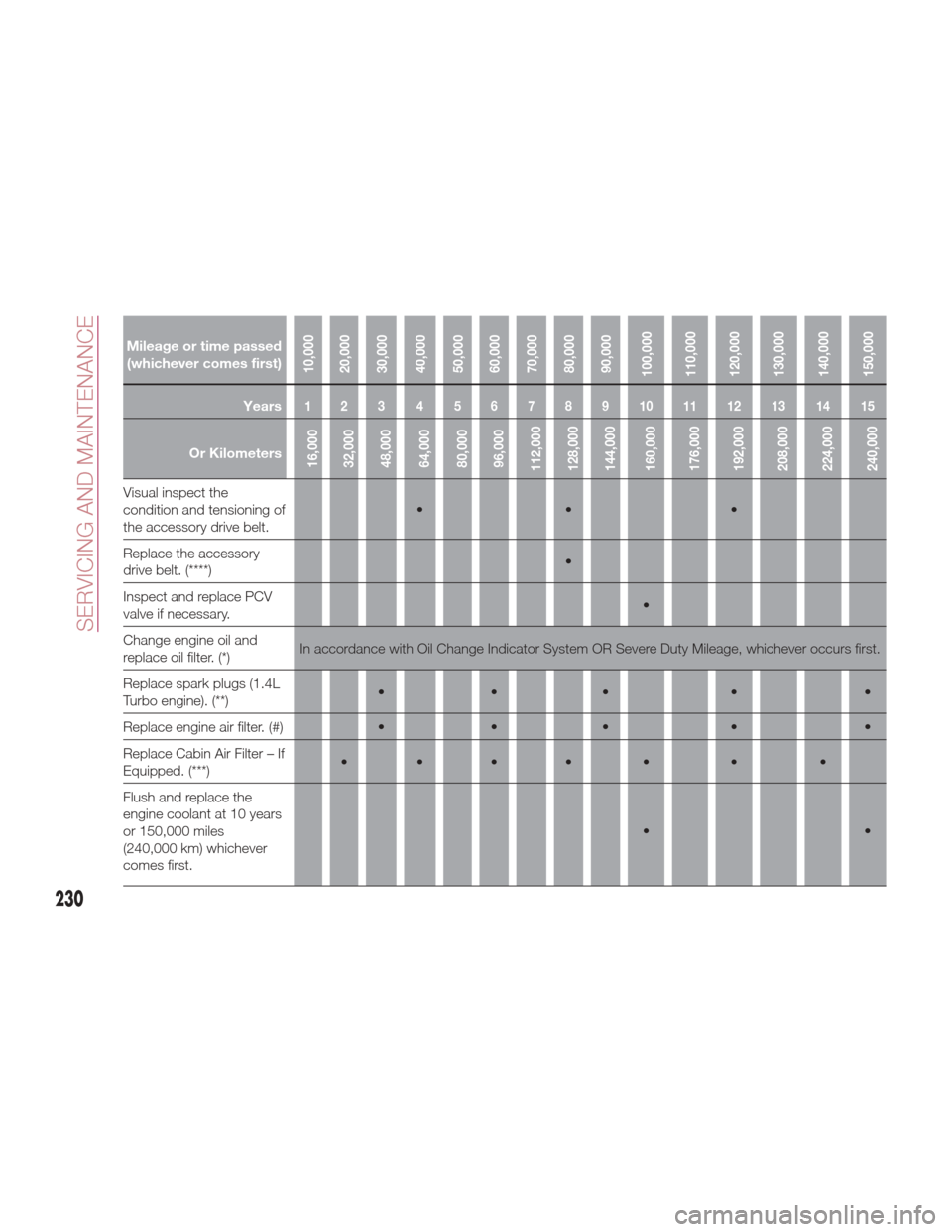
Mileage or time passed(whichever comes first)
10,000
20,000
30,000
40,000
50,000
60,000
70,000
80,000
90,000
100,000
110,000
120,000
130,000
140,000
150,000
Years123 456789101112131415
Or Kilometers16,000
32,000
48,000
64,000
80,000
96,000
112,000
128,000
144,000
160,000
176,000
192,000
208,000
224,000
240,000
Visual inspect the
condition and tensioning of
the accessory drive belt. •• •
Replace the accessory
drive belt. (****) •
Inspect and replace PCV
valve if necessary. •
Change engine oil and
replace oil filter. (*) In accordance with Oil Change Indicator System OR Severe Duty Mileage, whichever occurs first.
Replace spark plugs (1.4L
Turbo engine). (**) ••• • •
Replace engine air filter. (#) • • • • •
Replace Cabin Air Filter – If
Equipped. (***) •••• • • •
Flush and replace the
engine coolant at 10 years
or 150,000 miles
(240,000 km) whichever
comes first. ••
230
SERVICING AND MAINTENANCE
Page 233 of 300
Mileage or time passed(whichever comes first)
10,000
20,000
30,000
40,000
50,000
60,000
70,000
80,000
90,000
100,000
110,000
120,000
130,000
140,000
150,000
Years123 456789101112131415
Or Kilometers16,000
32,000
48,000
64,000
80,000
96,000
112,000
128,000
144,000
160,000
176,000
192,000
208,000
224,000
240,000
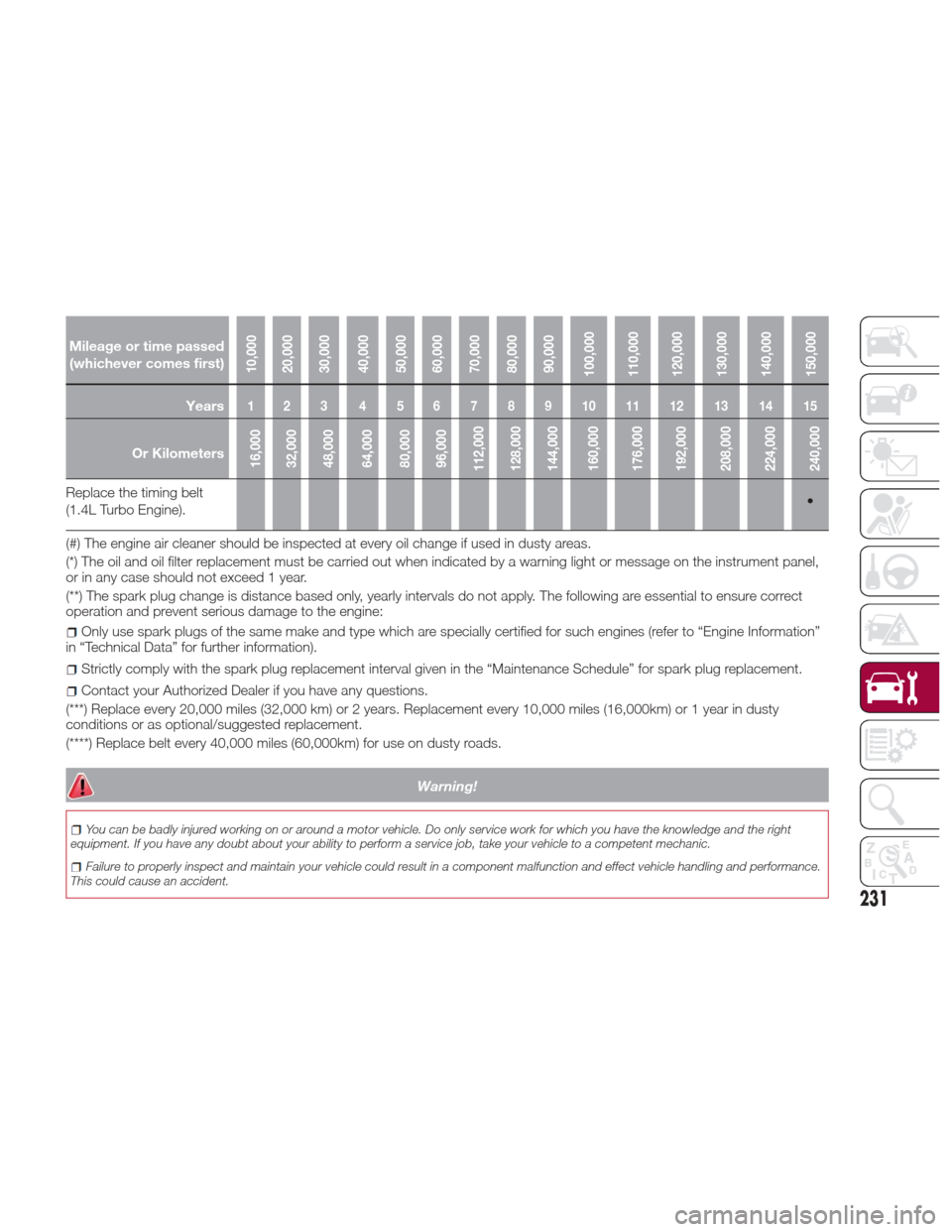
Replace the timing belt
(1.4L Turbo Engine). •
(#) The engine air cleaner should be inspected at every oil change if used in dusty areas.
(*) The oil and oil filter replacement must be carried out when indicated by a warning light or message on the instrument panel,
or in any case should not exceed 1 year.
(**) The spark plug change is distance based only, yearly intervals do not apply. The following are essential to ensure correct
operation and prevent serious damage to the engine:
Only use spark plugs of the same make and type which are specially certified for such engines (refer to “Engine Information”
in “Technical Data” for further information).
Strictly comply with the spark plug replacement interval given in the “Maintenance Schedule” for spark plug replacement.
Contact your Authorized Dealer if you have any questions.
(***) Replace every 20,000 miles (32,000 km) or 2 years. Replacement every 10,000 miles (16,000km) or 1 year in dusty
conditions or as optional/suggested replacement.
(****) Replace belt every 40,000 miles (60,000km) for use on dusty roads.
Warning!
You can be badly injured working on or around a motor vehicle. Do only service work for which you have the knowledge and the right
equipment. If you have any doubt about your ability to perform a service job, take your vehicle to a competent mechanic.
Failure to properly inspect and maintain your vehicle could result in a component malfunction and effect vehicle handling and performance.
This could cause an accident.
231
Page 262 of 300
Vinyl
Remove dust and loose dirt from vinyl
with a whisk broom or vacuum cleaner.
Clean vinyl with a leather-and-vinyl
cleaner.
Fabric
Remove dust and loose dirt from fabric
with a whisk broom or vacuum cleaner.
Clean it with a mild soap solution good
for upholstery and carpets.
Remove fresh spots immediately with a
fabric spot cleaner.
To keep the fabric looking clean and
fresh, take care of it. Otherwise its color
will be affected, it can be stained easily,
and its fire-resistance may be reduced.
Note:Use only recommended cleaners
and procedures. Others may affect
appearance and fire-resistance.
Caution!
Rubbing the interior side of the convertible
top vigorously with a stiff brush or cloth
may cause damage.
Interior Panels
When the interior panels need to be
cleaned, use soft material such as a
soft cloth soaked in clean water and
wrung out well and lightly wipe off dirt
from the surface.
If a panel requires further cleaning, wipe
dirt off using a soft cloth soaked in mild
detergent (about 5% solution) and wipe
off any remaining detergent using a
cloth soaked in clean water and wrung
out well.
Caution!
Do not wipe leather parts using alcohol,
chlorine bleach, or organic solvents such
as thinner, benzene, or gasoline. Otherwise,
it may cause discoloration or stains.
Note:
Scratches or nicks on the panels
and metallic trim resulting from the use
of a hard brush or cloth may not be
repairable.
Be particularly careful when
cleaning high gloss panels and metallic
trim as they can be easily scratched. Lap / Shoulder Belt
Warning!
A frayed or torn belt could rip apart in a
collision and leave you with no protection.
Inspect the belt system periodically,
checking for cuts, frays, or loose parts.
Damaged parts must be replaced
immediately. Do not disassemble or modify
the system. Seat belt assemblies must be
replaced after a collision if they have been
damaged (i.e., bent retractor, torn
webbing, etc.).
Clean the webbing with a mild soap
solution recommended for upholstery or
carpets. Follow instructions. Do not
bleach or dye the belts, this may
weaken them.
After cleaning the belts, thoroughly dry
the belt webbing and make sure there
is no remaining moisture before
retracting them.
260
SERVICING AND MAINTENANCE
Page 290 of 300
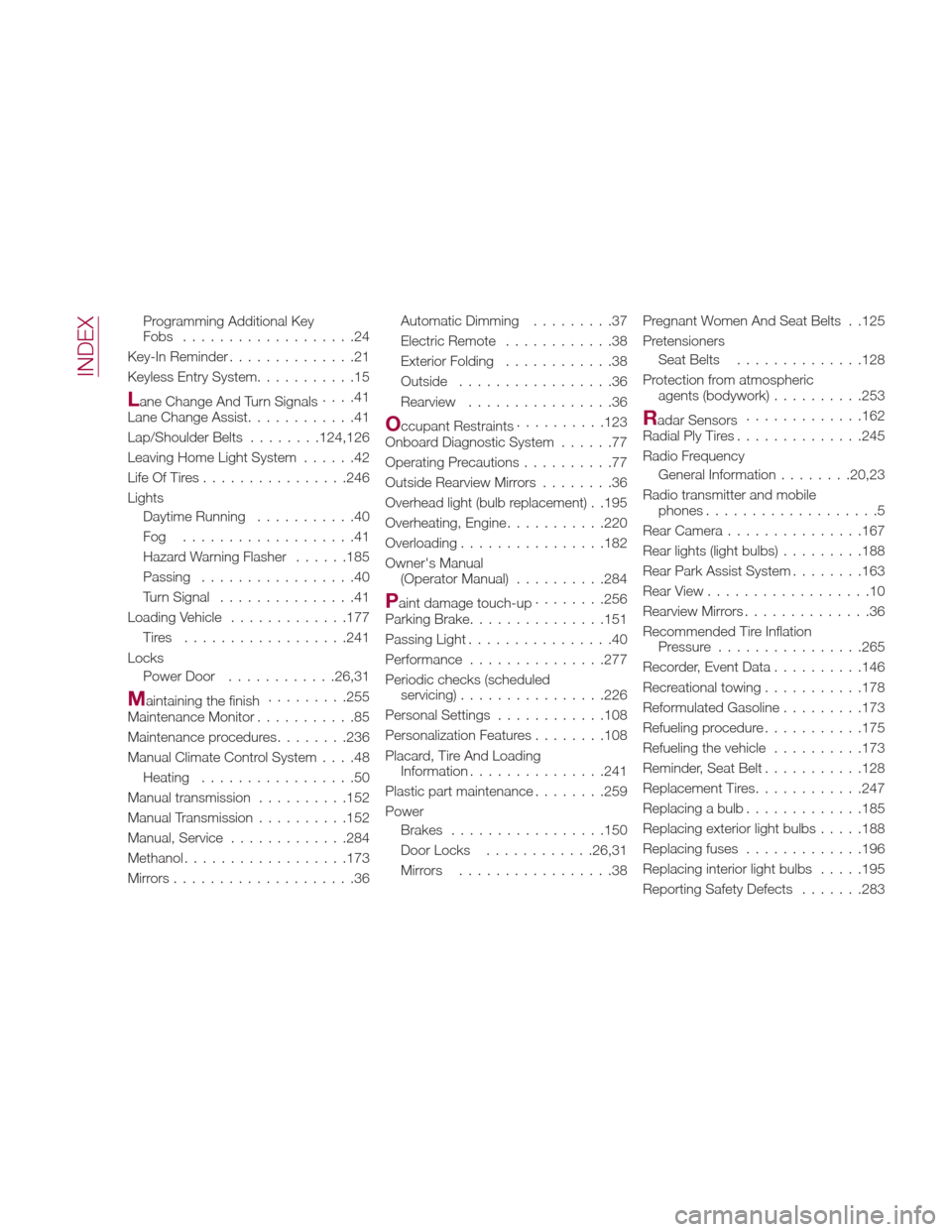
Programming Additional Key
Fobs...................24
Key-In Reminder ..............21
Keyless Entry System...........15
Lane Change And Turn Signals ....41
Lane Change Assist ............41
Lap/Shoulder Belts ........124,126
Leaving Home Light System ......42
Life Of Tires ............... .246
Lights Daytime Running ...........40
Fog ...................41
Hazard Warning Flasher ......185
Passing .................40
Turn Signal ...............41
Loading Vehicle .............177
Tires ................. .241
Locks PowerDoor ........... .26,31
Maintaining the finish.........255
Maintenance Monitor ...........85
Maintenance procedures ........236
Manual Climate Control System ....48
Heating .................50
Manual transmission ..........152
Manual Transmission ..........152
Manual, Service .............284
Methanol ................. .173
Mirrors....................36 Automatic Dimming
.........37
Electric Remote ............38
Exterior Folding ............38
Outside .................36
Rearview ................36
Occupant Restraints ..........123
Onboard Diagnostic System ......77
Operating Precautions ..........77
Outside Rearview Mirrors ........36
Overhead light (bulb replacement) . .195
Overheating, Engine ...........220
Overloading ............... .182
Owner's Manual (Operator Manual) ..........284
Paint damage touch-up ........256
Parking Brake ...............151
Passing Light ................40
Performance ...............277
Periodic checks (scheduled servicing) ............... .226
Personal Settings ............108
Personalization Features ........108
Placard, Tire And Loading Information ...............241
Plastic part maintenance ........259
Power Brakes ................ .150
Door Locks ............26,31
Mirrors .................38 Pregnant Women And Seat Belts . .125
Pretensioners
Seat Belts ..............128
Protection from atmospheric agents (bodywork) ..........253
Radar Sensors.............162
Radial Ply Tires ..............245
Radio Frequency General Information ........20,23
Radio transmitter and mobile phones ...................5
Rear Camera ...............167
Rear lights (light bulbs) .........188
Rear Park Assist System ........163
Rear View ..................10
Rearview Mirrors ..............36
Recommended Tire Inflation Pressure ............... .265
Recorder, Event Data ..........146
Recreational towing ...........178
Reformulated Gasoline .........173
Refueling procedure ...........175
Refueling the vehicle ..........173
Reminder, Seat Belt ...........128
Replacement Tires ............247
Replacing a bulb .............185
Replacing exterior light bulbs .....188
Replacing fuses .............196
Replacing interior light bulbs .....195
Reporting Safety Defects .......283
INDEX
Page 291 of 300
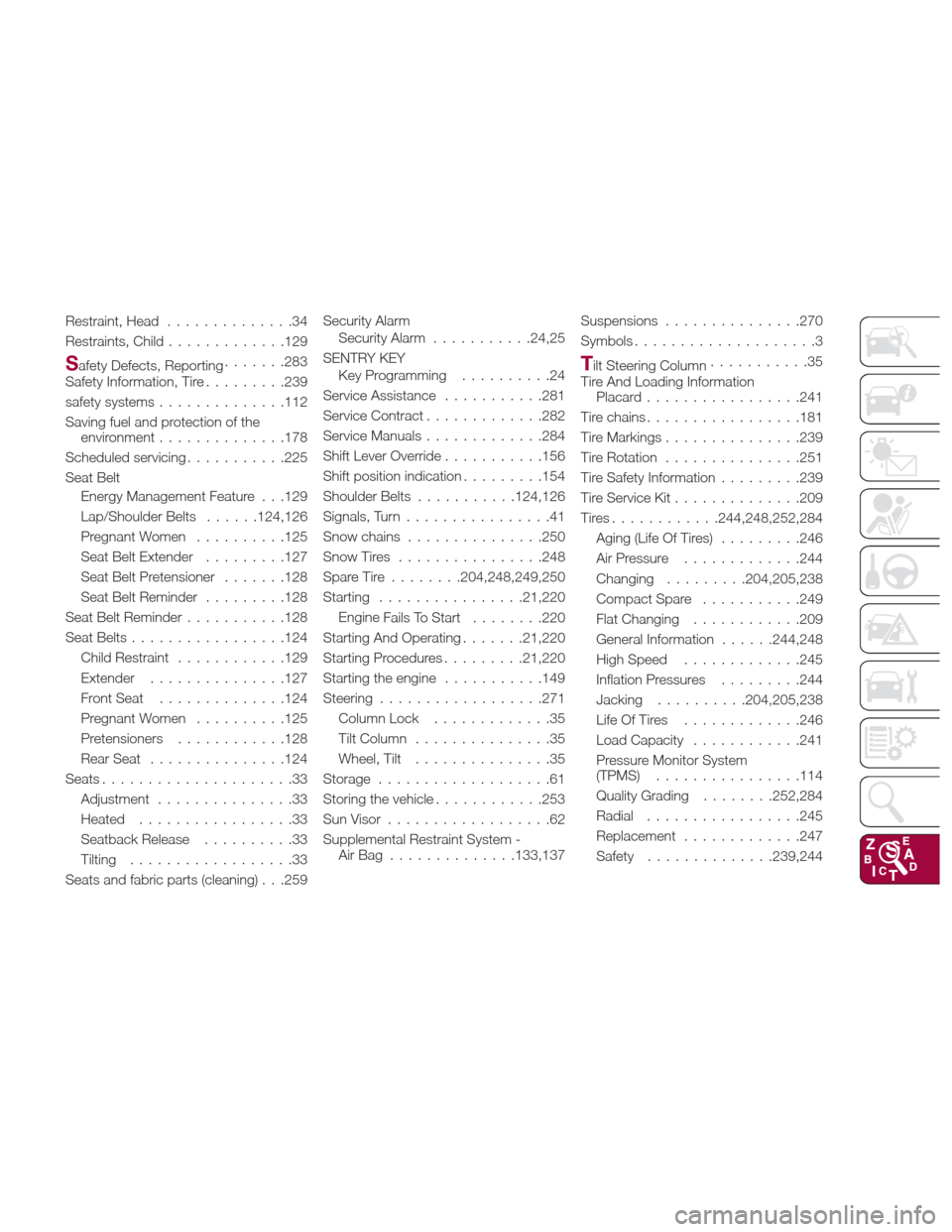
Restraint, Head..............34
Restraints, Child .............129
Safety Defects, Reporting .......283
Safety Information, Tire .........239
safety systems ..............112
Saving fuel and protection of the environment ..............178
Scheduled servicing ...........225
Seat Belt Energy Management Feature . . .129
Lap/Shoulder Belts ......124,126
Pregnant Women ..........125
Seat Belt Extender .........127
Seat Belt Pretensioner .......128
Seat Belt Reminder .........128
Seat Belt Reminder ...........128
Seat Belts ................ .124
Child Restraint ............129
Extender ...............127
Front Seat ..............124
Pregnant Women ..........125
Pretensioners ............128
Rear Seat ...............124
Seats .....................33
Adjustment ...............33
Heated .................33
Seatback Release ..........33
Tilting ..................33
Seats and fabric parts (cleaning) . . .259 Security Alarm
Security Alarm ...........24,25
SENTRY KEY Key Programming ..........24
Service Assistance ...........281
Service Contract .............282
Service Manuals .............284
Shift Lever Override ...........156
Shift position indication .........154
Shoulder Belts ...........124,126
Signals, Turn ................41
Snow chains ...............250
Snow Tires ............... .248
Spare Tire ........204,248,249,250
Starting ............... .21,220
Engine
Fails To Start ........220
Starting And Operating .......21,220
Starting Procedures .........21,220
Starting the engine ...........149
Steering ................. .271
Column Lock .............35
Tilt Column ...............35
Wheel, Tilt ...............35
Storage ...................61
Storing the vehicle ............253
Sun Visor ..................62
Supplemental Restraint System - AirBag ............. .133,137Suspensions
...............270
Symbols ....................3
Tilt Steering Column ...........35
Tire And Loading Information Placard ................ .241
Tire chains ................ .181
Tire Markings ...............239
Tire Rotation ...............251
Tire Safety Information .........239
Tire Service Kit ..............209
Tires............244,248,252,284 Aging (Life Of Tires) .........246
Air Pressure .............244
Changing .........204,205,238
Compact Spare ...........249
Flat Changing ............209
General Information ......244,248
High Speed .............245
Inflation Pressures .........244
Jacking ..........204,205,238
Life Of Tires .............246
Load Capacity ............241
Pressure Monitor System
(TPMS) ............... .114
Quality Grading ........252,284
Radial ................ .245
Replacement .............247
Safety ..............239,244