ignition FIAT 124 SPIDER 2017 2.G Manual Online
[x] Cancel search | Manufacturer: FIAT, Model Year: 2017, Model line: 124 SPIDER, Model: FIAT 124 SPIDER 2017 2.GPages: 300, PDF Size: 121.24 MB
Page 192 of 300
5. Turn the socket and bulb assembly
counterclockwise and remove it.
6. Disconnect the bulb from the
socket.7. Install the new bulb in the reverse
order of the removal procedure.
Fog Lights
Proceed as follows:
1. If you are changing the right bulb,
start the engine, turn the steering wheel
all the way to the right, and turn off
engine. If you are changing the left bulb,
turn the steering wheel to the left.
2. Make sure the ignition is switched
off, and the headlight switch is off.
3. Remove the fasteners in the five
locations and partially peel back the
mud guard.
4. Disconnect the connector from the
unit by pressing the tab on the
connector with your finger and pulling
the connector.
5. Turn the socket and bulb assembly
counterclockwise, extract the bulb and
remove it;
6. Disconnect the bulb from the
socket.
7. Install the new bulb in the reverse
order of the removal procedure.Brake lights / Tail lights
Go to your authorized dealer when the
replacement of this lights is necessary.
Side Direction Indicator Lights
Proceed as follows:
1. Make sure the ignition is placed in
the OFF mode, and the headlight
switch is off.
2. If you are changing the right bulb,
start the engine, turn the steering wheel
all the way to the right, and turn off
engine. If you are changing the left bulb,
turn the steering wheel to the left.
3. Remove the fasteners in the five
locations and partially peel back the
mud guard.
4. Disconnect the electrical connector
from the bulb by pressing the tab on
the connector with your finger and
pulling the connector.
5. Remove the lens assembly by
pressing the tab on the unit with your
finger and pulling the unit forward to
compress in the internal catch, then pull
the cluster outwards.
6. Lift up the lens assembly, and then
remove the cluster and install the new
side direction indicator lens assembly in
the reverse order of the removal
procedure.
07031501-207-001Front Direction Indicator Housing
1 — Socket Assembly
2 — Bulb
GUID-07031501208002Direction Indicator Lamp Connector
190
IN CASE OF EMERGENCY
Page 195 of 300
5. Turn the socket and bulb assembly
counterclockwise to remove from
taillight housing, and remove bulb.6. Install the new bulb in the reverse
order of the removal procedure.
Reverse Light
Proceed as follows:
1. Make sure the ignition is placed in
the OFF mode, and the headlight
switch is off.
2. Turn the socket assembly
counterclockwise to remove, and
remove bulb.
3. Install the new bulb in the reverse
order of the removal procedure.Rear Side Marker
Proceed as follows:
1. Push the lens assembly rearward to
compress the internal catch, then pull
the lens assembly outwards.
2. Turn the socket and bulb assembly
counterclockwise to remove, and
remove bulb.
07031501-216-001Rear of Vehicle
6 — Taillight Housing
07031501-203-002Taillight Housing
7 — Socket and Bulb Assembly
07031501-219-001Reverse Light
1 — Socket Assembly
2 — Bulb
08070605-123-100Rear Side Marker
1 — Rear Side Marker Lens Assembly
193
Page 196 of 300
3. Install the new bulb and then
reinstall the socket in the reverse order
of the removal procedure.License Plate Lights
Proceed as follows:
1. Make sure the ignition is placed in
the OFF mode, and the headlight
switch is off.
2. Slide the unit as shown in the figure
to remove it.
3. Turn the socket and bulb assembly
counterclockwise and remove, remove
bulb.
4. Install the new bulb in the reverse
order of the removal procedure. Insert
catch and push the housing back into
place.
08070606-123-100Side Marker Housing
2 — Socket and Bulb Assembly
GUID-07031501220001Trunk Lid
1 — License Plate Light Assembly
07031501-221-001License Plate Light Housing
2 — Socket and Bulb Assembly
194
IN CASE OF EMERGENCY
Page 198 of 300
REPLACING FUSES
General Information
Warning!
When replacing a blown fuse, always
use an appropriate replacement fuse with
the same amp rating as the original fuse.
Never replace a fuse with another fuse of
higher amp rating. Never replace a blown
fuse with metal wires or any other material.
Failure to use proper fuses may result in
serious personal injury, fire and/or property
damage.
Before replacing a fuse, make sure that
the ignition is off and that all the other
services are switched off and/or
disengaged.
If the replaced fuse blows again, contact
an authorized dealer.
If a general protection fuse for safety
systems (air bag system, braking system),
power unit systems (engine system,
gearbox system) or steering system blows,
contact an authorized dealer.
Your vehicle's electrical system is
protected by fuses.
If any lights, accessories, or controls do
not work, inspect the appropriate circuit
protector. If a fuse has blown, the inside
element will be melted. If the same fuse
blows again, go to an Authorized Dealer
as soon as possible.
Fuse location
Fuses are grouped together in two fuse
boxes located in the interior on the left
side of the vehicle and under the hood.
Interior Fuses
If the electrical system does not work,
first inspect the fuses on the vehicle's
left side.
Proceed as follows:
1. Make sure the ignition is placed in
the OFF mode, and other switches are
turned off.
2. Open the fuse panel cover (located
near the door). 3. Press retaining clip and remove
protection cover.
4. Pull the fuse straight out with the
fuse puller provided on the fuse block
located in the engine compartment.
5. Inspect the fuse and replace it if it is
blown.
07031601-121-001Fuse Panel Cover
07031601-122-001Fuse Puller
196
IN CASE OF EMERGENCY
Page 199 of 300
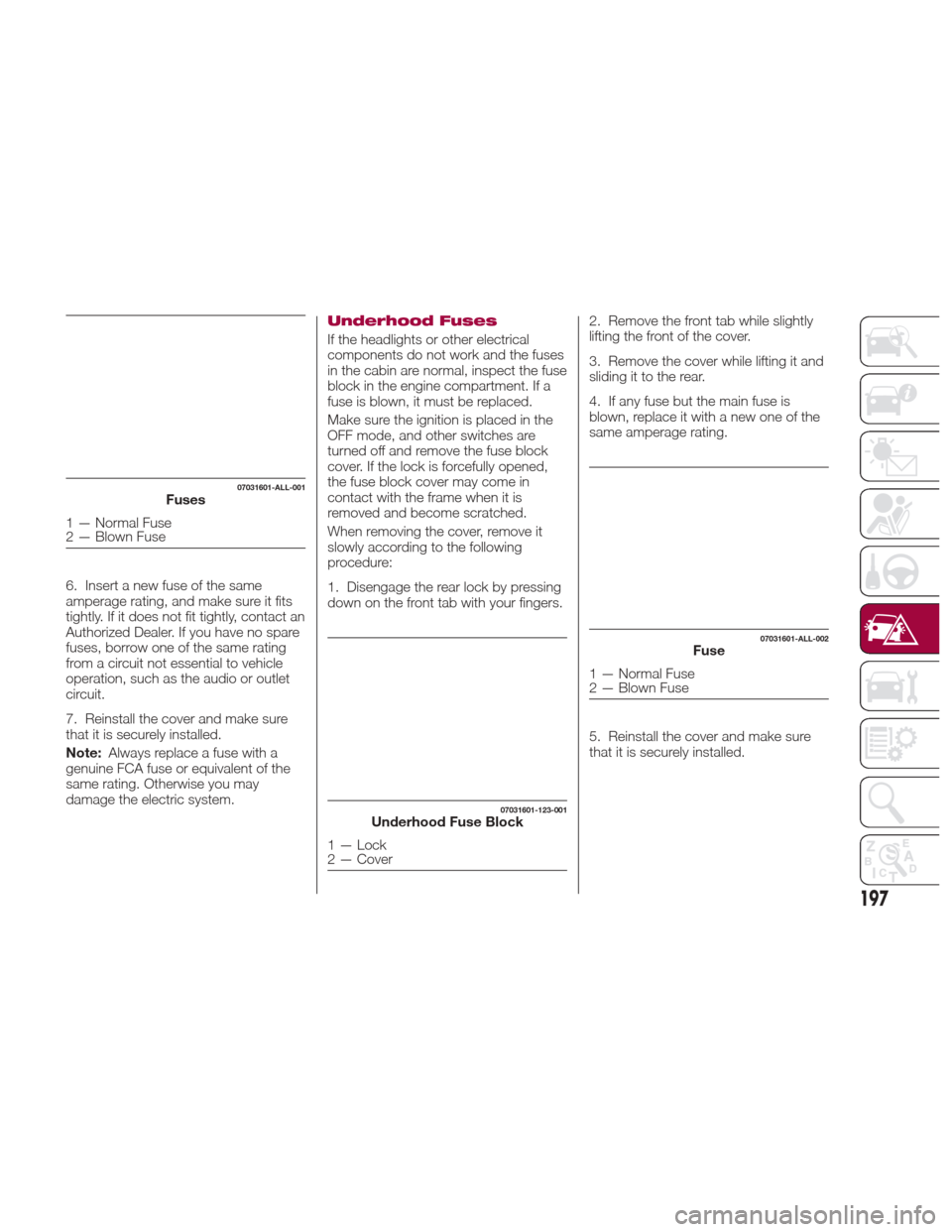
6. Insert a new fuse of the same
amperage rating, and make sure it fits
tightly. If it does not fit tightly, contact an
Authorized Dealer. If you have no spare
fuses, borrow one of the same rating
from a circuit not essential to vehicle
operation, such as the audio or outlet
circuit.
7. Reinstall the cover and make sure
that it is securely installed.
Note:Always replace a fuse with a
genuine FCA fuse or equivalent of the
same rating. Otherwise you may
damage the electric system.
Underhood Fuses
If the headlights or other electrical
components do not work and the fuses
in the cabin are normal, inspect the fuse
block in the engine compartment. If a
fuse is blown, it must be replaced.
Make sure the ignition is placed in the
OFF mode, and other switches are
turned off and remove the fuse block
cover. If the lock is forcefully opened,
the fuse block cover may come in
contact with the frame when it is
removed and become scratched.
When removing the cover, remove it
slowly according to the following
procedure:
1. Disengage the rear lock by pressing
down on the front tab with your fingers. 2. Remove the front tab while slightly
lifting the front of the cover.
3. Remove the cover while lifting it and
sliding it to the rear.
4. If any fuse but the main fuse is
blown, replace it with a new one of the
same amperage rating.
5. Reinstall the cover and make sure
that it is securely installed.
07031601-ALL-001Fuses
1 — Normal Fuse
2 — Blown Fuse
07031601-123-001Underhood Fuse Block
1 — Lock
2 — Cover
07031601-ALL-002Fuse
1 — Normal Fuse
2 — Blown Fuse
197
Page 214 of 300
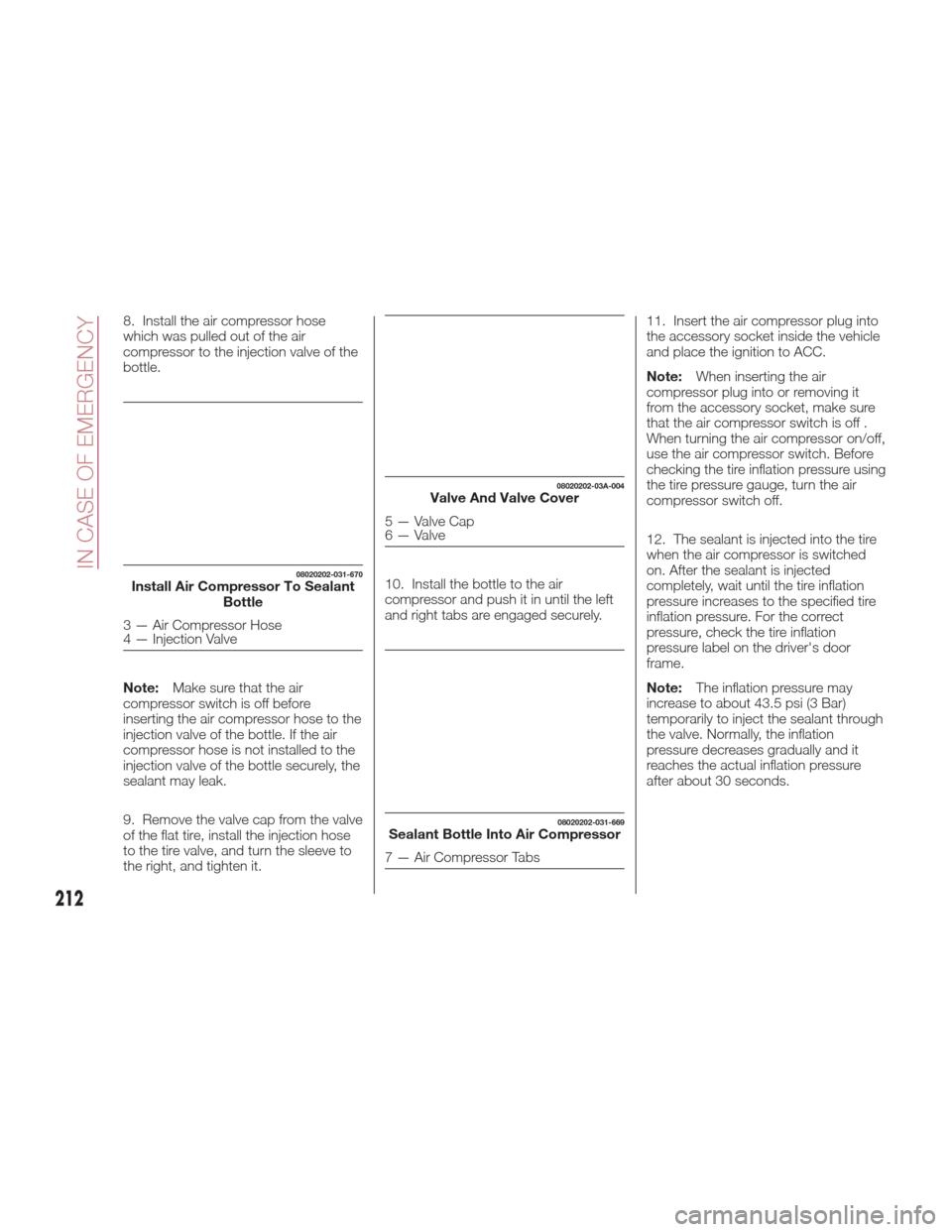
8. Install the air compressor hose
which was pulled out of the air
compressor to the injection valve of the
bottle.
Note:Make sure that the air
compressor switch is off before
inserting the air compressor hose to the
injection valve of the bottle. If the air
compressor hose is not installed to the
injection valve of the bottle securely, the
sealant may leak.
9. Remove the valve cap from the valve
of the flat tire, install the injection hose
to the tire valve, and turn the sleeve to
the right, and tighten it. 10. Install the bottle to the air
compressor and push it in until the left
and right tabs are engaged securely.11. Insert the air compressor plug into
the accessory socket inside the vehicle
and place the ignition to ACC.
Note:
When inserting the air
compressor plug into or removing it
from the accessory socket, make sure
that the air compressor switch is off .
When turning the air compressor on/off,
use the air compressor switch. Before
checking the tire inflation pressure using
the tire pressure gauge, turn the air
compressor switch off.
12. The sealant is injected into the tire
when the air compressor is switched
on. After the sealant is injected
completely, wait until the tire inflation
pressure increases to the specified tire
inflation pressure. For the correct
pressure, check the tire inflation
pressure label on the driver's door
frame.
Note: The inflation pressure may
increase to about 43.5 psi (3 Bar)
temporarily to inject the sealant through
the valve. Normally, the inflation
pressure decreases gradually and it
reaches the actual inflation pressure
after about 30 seconds.
08020202-031-670Install Air Compressor To Sealant Bottle
3 — Air Compressor Hose
4 — Injection Valve
08020202-03A-004Valve And Valve Cover
5 — Valve Cap
6 — Valve
08020202-031-669Sealant Bottle Into Air Compressor
7 — Air Compressor Tabs
212
IN CASE OF EMERGENCY
Page 219 of 300
13. Reinsert the valve core into the
valve and turn it clockwise to install.
Note:
The tire sealant cannot be reused.
If the tire sealant kit has been used, or
is expired, purchase new one at an
Authorized Dealer.
Do not throw away the empty tire
sealant bottle after use. Return the
empty tire sealant bottle to an
Authorized Dealer when replacing the
tire. The empty tire sealant bottle will
need to be used to extract and dispose
of the used sealant from the tire.
14. Install the injection hose to the tab
of the bottle to prevent leakage of any
remaining sealant.
15. Adhere the speed restriction sticker
to an area where it can be viewed easily
by the driver.
Warning!
Do not adhere the speed restriction sticker
to the padded area on the steering wheel.
Adhering the speed restriction sticker to
the padded area on the steering wheel is
dangerous because the air bag may not
operate (deploy) normally resulting in
serious injury. In addition, do not adhere
the sticker to areas where warning lights or
the speedometer cannot be viewed.
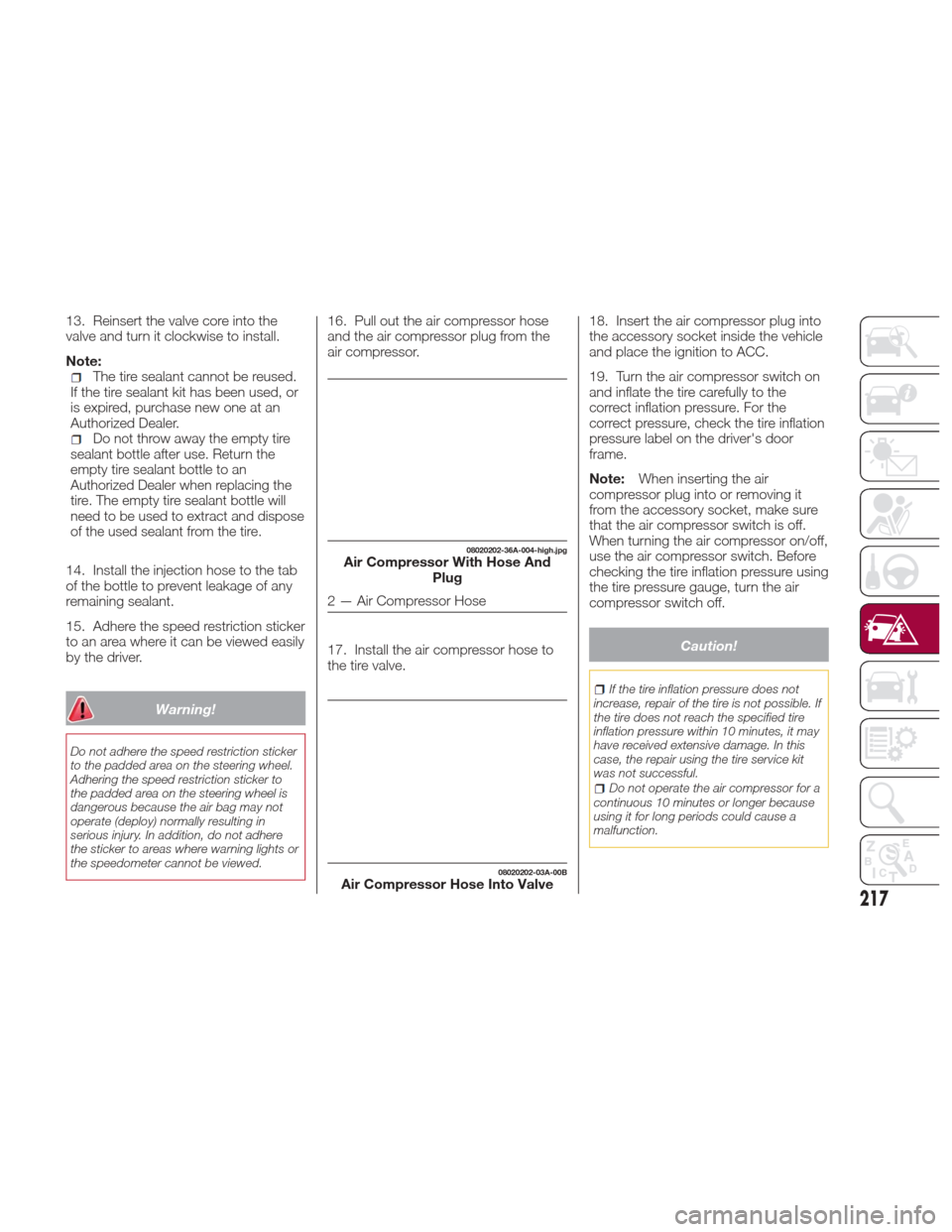
16. Pull out the air compressor hose
and the air compressor plug from the
air compressor.
17. Install the air compressor hose to
the tire valve. 18. Insert the air compressor plug into
the accessory socket inside the vehicle
and place the ignition to ACC.
19. Turn the air compressor switch on
and inflate the tire carefully to the
correct inflation pressure. For the
correct pressure, check the tire inflation
pressure label on the driver's door
frame.
Note:
When inserting the air
compressor plug into or removing it
from the accessory socket, make sure
that the air compressor switch is off.
When turning the air compressor on/off,
use the air compressor switch. Before
checking the tire inflation pressure using
the tire pressure gauge, turn the air
compressor switch off.
Caution!
If the tire inflation pressure does not
increase, repair of the tire is not possible. If
the tire does not reach the specified tire
inflation pressure within 10 minutes, it may
have received extensive damage. In this
case, the repair using the tire service kit
was not successful.
Do not operate the air compressor for a
continuous 10 minutes or longer because
using it for long periods could cause a
malfunction.
08020202-36A-004-high.jpgAir Compressor With Hose And Plug
2 — Air Compressor Hose
08020202-03A-00BAir Compressor Hose Into Valve
217
Page 225 of 300
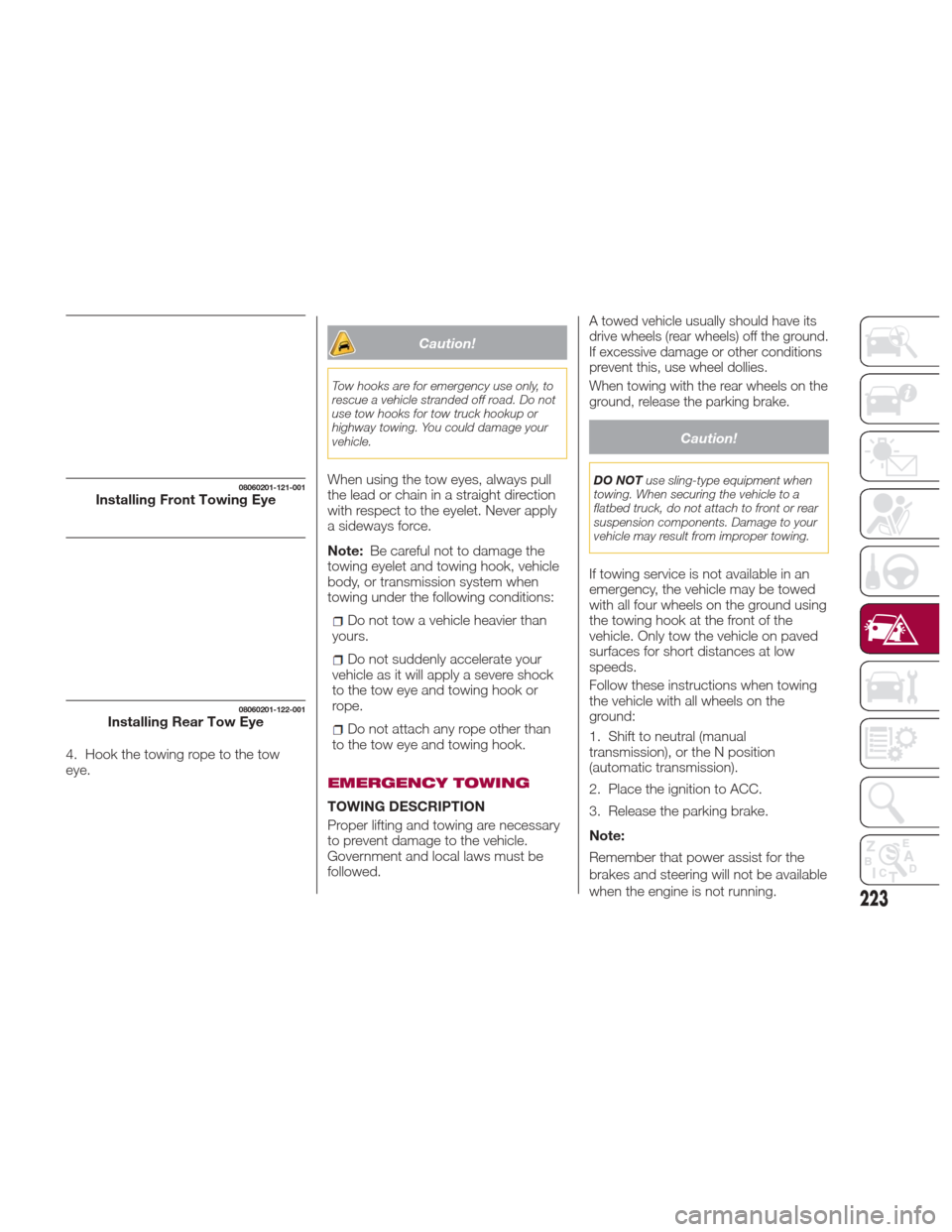
4. Hook the towing rope to the tow
eye.
Caution!
Tow hooks are for emergency use only, to
rescue a vehicle stranded off road. Do not
use tow hooks for tow truck hookup or
highway towing. You could damage your
vehicle.
When using the tow eyes, always pull
the lead or chain in a straight direction
with respect to the eyelet. Never apply
a sideways force.
Note:Be careful not to damage the
towing eyelet and towing hook, vehicle
body, or transmission system when
towing under the following conditions:
Do not tow a vehicle heavier than
yours.
Do not suddenly accelerate your
vehicle as it will apply a severe shock
to the tow eye and towing hook or
rope.
Do not attach any rope other than
to the tow eye and towing hook.
EMERGENCY TOWING
TOWING DESCRIPTION
Proper lifting and towing are necessary
to prevent damage to the vehicle.
Government and local laws must be
followed.
A towed vehicle usually should have its
drive wheels (rear wheels) off the ground.
If excessive damage or other conditions
prevent this, use wheel dollies.
When towing with the rear wheels on the
ground, release the parking brake.
Caution!
DO NOT use sling-type equipment when
towing. When securing the vehicle to a
flatbed truck, do not attach to front or rear
suspension components. Damage to your
vehicle may result from improper towing.
If towing service is not available in an
emergency, the vehicle may be towed
with all four wheels on the ground using
the towing hook at the front of the
vehicle. Only tow the vehicle on paved
surfaces for short distances at low
speeds.
Follow these instructions when towing
the vehicle with all wheels on the
ground:
1. Shift to neutral (manual
transmission), or the N position
(automatic transmission).
2. Place the ignition to ACC.
3. Release the parking brake.
Note:
Remember that power assist for the
brakes and steering will not be available
when the engine is not running.
08060201-121-001Installing Front Towing Eye
08060201-122-001Installing Rear Tow Eye
223
Page 238 of 300
BATTERY
RECHARGING
BATTERY CHARGING
PROCEDURE
Warning!
Battery fluid is a corrosive acid solution
and can burn or even blind you. Do not
allow battery fluid to contact your eyes,
skin, or clothing. Do not lean over a battery
when attaching clamps. If acid splashes in
eyes or on skin, flush the area immediately
with large amounts of water. Refer to
“Jump-Starting” in “In Case Of Emergency”
for further information.
Battery gas is flammable and explosive.
Keep flame or sparks away from the
battery. Do not use a booster battery or
any other booster source with an output
greater than 12 Volts. Do not allow cable
clamps to touch each other.
Battery posts, terminals, and related
accessories contain lead and lead
compounds. Wash hands after handling.
Caution!
It is essential when replacing the cables
on the battery that the positive cable is
attached to the positive post and the
negative cable is attached to the negative
post. Battery posts are marked positive (+)
and negative (-) and are identified on the
battery case. Cable clamps should be tight
on the terminal posts and free of corrosion.
If a “fast charger” is used while the
battery is in the vehicle, disconnect both
vehicle battery cables before connecting
the charger to the battery. Do not use a
“fast charger” to provide starting voltage.
Charge battery as follows:
Before recharging the battery, turn off
all accessories and turn the engine off
by placing the ignition in the OFF mode.
Disconnect the negative battery cable.
Connect the charger cables to
the battery terminals, observing the
polarity (+,–).
Turn on the charger.
When finished, turn the charger off
before disconnecting the battery.
Reconnect the negative battery
terminal.
MAINTENANCE
PROCEDURES
The following pages contain
instructions on the required
maintenance from the technical
personnel who designed the vehicle.
In addition to these specific
maintenance instructions specified for
routine scheduled servicing, there are
other components which may require
periodic maintenance or replacement
over the vehicle’s life cycle.
Body Lubrication
Ensure that the locks and bodywork
junction points, including components
such as the seat guides, door hinges
(and rollers), trunk and hood are
periodically lubricated with lithium
based grease to ensure correct, silent
operation and to protect them from rust
and wear.
Thoroughly clean the components,
eliminating every trace of dirt and dust.
After lubricating, eliminate excess oil
and grease. Also pay particular
attention to the hood closing devices,
to ensure correct operation.
During operations on the hood, be sure
to perform with the engine cold, also
remember to check, clean and lubricate
the locking, release and safety devices.
Make sure the hood's secondary latch
keeps the hood from opening when the
primary latch is released.
236
SERVICING AND MAINTENANCE
Page 239 of 300
Lubricate the external lock cylinders
twice a year. Apply a small amount of
high-quality lubricant directly into the
lock cylinder. If necessary, contact your
Authorized Dealer.
Wiper Blades
Contamination of either the windshield
or the blades with foreign matter can
reduce wiper effectiveness. Common
sources are insects, tree sap, and hot
wax treatments used by some
commercial car washes.
If the blades are not wiping properly,
clean the window and blades with a
good cleaner or mild detergent; then
rinse thoroughly with clean water.
Repeat if necessary.
When the wiper lever is in the AUTO
position and the ignition is placed in the
ON mode, the wipers may move
automatically in the following cases:
If the windshield above the rain
sensor is touched.
If the windshield above the rain
sensor is wiped with a cloth.
If the windshield is struck with a hand
or other object.
If the rain sensor is struck with a
hand or other object from inside the
vehicle. Note:
Hot waxes applied by automatic car
washers have been known to affect
the wiper's ability to clean windows.
To prevent damage to the wiper
blades, do not use gas, paraffin, paint
thinner, or other solvents on or near
them.
Be careful not to pinch hands or
fingers as it may cause injury, or
damage the wipers. When washing or
servicing the vehicle, make sure the
wiper lever is in the OFF position.
Replacing Windshield Wiper Blades
When the wipers no longer clean well,
the blades are probably worn or
cracked. Replace them.
When raising both windshield wiper
arms, raise the driver's side wiper arm
first.
When lowering the wiper arms, slowly
lower the wiper arm from the
passenger's side first while supporting
it with your hand. Forcefully lowering
the wiper arms could damage the wiper
arm and blade, and may scratch or
crack the windshield.
Note: To prevent damage to the wiper
arms and other components, do not try
to sweep the wiper arm by hand. Blade Replacement
Proceed as follows:
1. Raise the wiper arm.
2. Open the clip and slide the blade
assembly in the direction of the arrow.
3. Tilt the blade assembly and remove
it from the arm.
07031101-36A-001Clip
07031101-36A-002Blade Assembly and Arm
237