park assist FIAT 124 SPIDER 2017 2.G Owners Manual
[x] Cancel search | Manufacturer: FIAT, Model Year: 2017, Model line: 124 SPIDER, Model: FIAT 124 SPIDER 2017 2.GPages: 300, PDF Size: 121.24 MB
Page 43 of 300
Follow Me Home
The follow me home light system turns
on the headlights (low beams) when the
lever is operated.
System Activation
When the lever is pulled with the ignition
switched to ACC or OFF, the low beam
headlights turn on.
The headlights turn off after a certain
period of time has elapsed after the
doors are closed.
The time until the headlights turn off
after all of the doors are closed can be
changed. If no operations are done for
three minutes after the lever is pulled,
the headlights turn off.
The headlights turn off if the lever is
pulled again while the headlights are on.
Front Fog Lights
The front fog light can be used when
the ignition is switched to ON and the
headlights or parking lights are on.
Activation
Turn the headlight switch in
orposition before activate front fog
lights.
Rotate the fog light switch to
position. The
fog light indicator in the
instrument cluster illuminates while the
front fog lights are on.
Deactivation
Perform one of the following operations
to turn off the front fog lights:
Rotate the fog light switch to OFF
position.
Turn the headlight switch to OFF
position.
Switch the ignition to a position other
than ON.
The
fog light indicator in the
instrument cluster goes off when the
front fog light is turned off. With auto-light control
When the fog light switch is in
position and the headlight switch is
in AUTO position, the front fog lights
will stay on.
Turn Signals
The ignition must be switched ON to
use the turn and lane-change signals.
Move the signal lever down (for a left
turn) or up (for a right turn) to the stop
position. The signal will self-cancel after
the turn is completed.
If the indicator light continues to flash
after a turn, manually return the lever to
its original position.
The turn signal indicators (green)
in the instrument cluster flash
according to the operation of the turn
signal lever to show which signal is
working.
Note: If an indicator light stays on
without flashing or if it flashes
abnormally, one of the turn signal bulbs
may be burned out.
Lane Change Assist
Move the lever halfway toward the
direction of the lane change (until the
indicator flashes) and hold it there. It will
return to the off position when released.
Three-flash turn signal
After releasing the turn signal lever, the
turn signal indicator flashes three times.
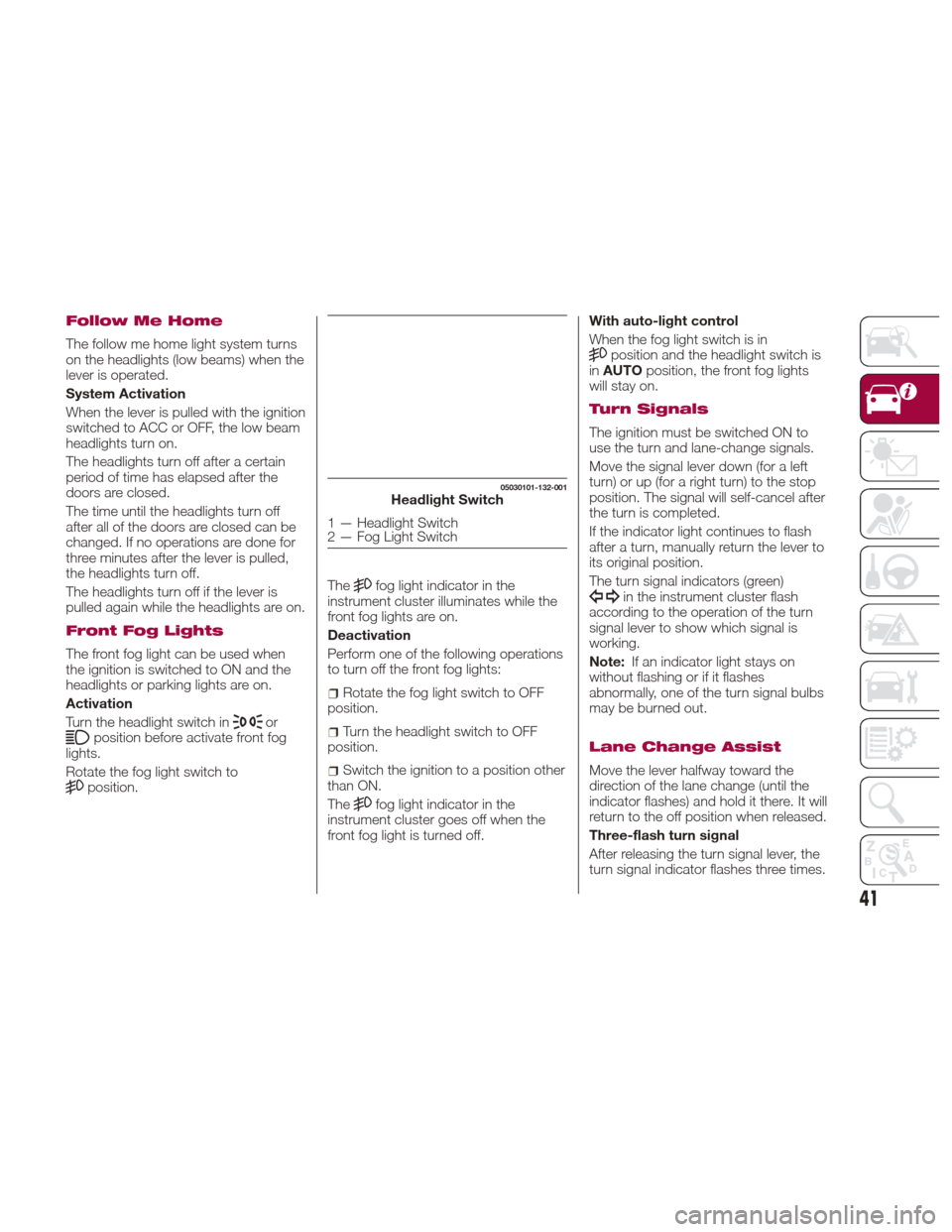
05030101-132-001Headlight Switch
1 — Headlight Switch
2 — Fog Light Switch
41
Page 97 of 300
Amber Warning Lights
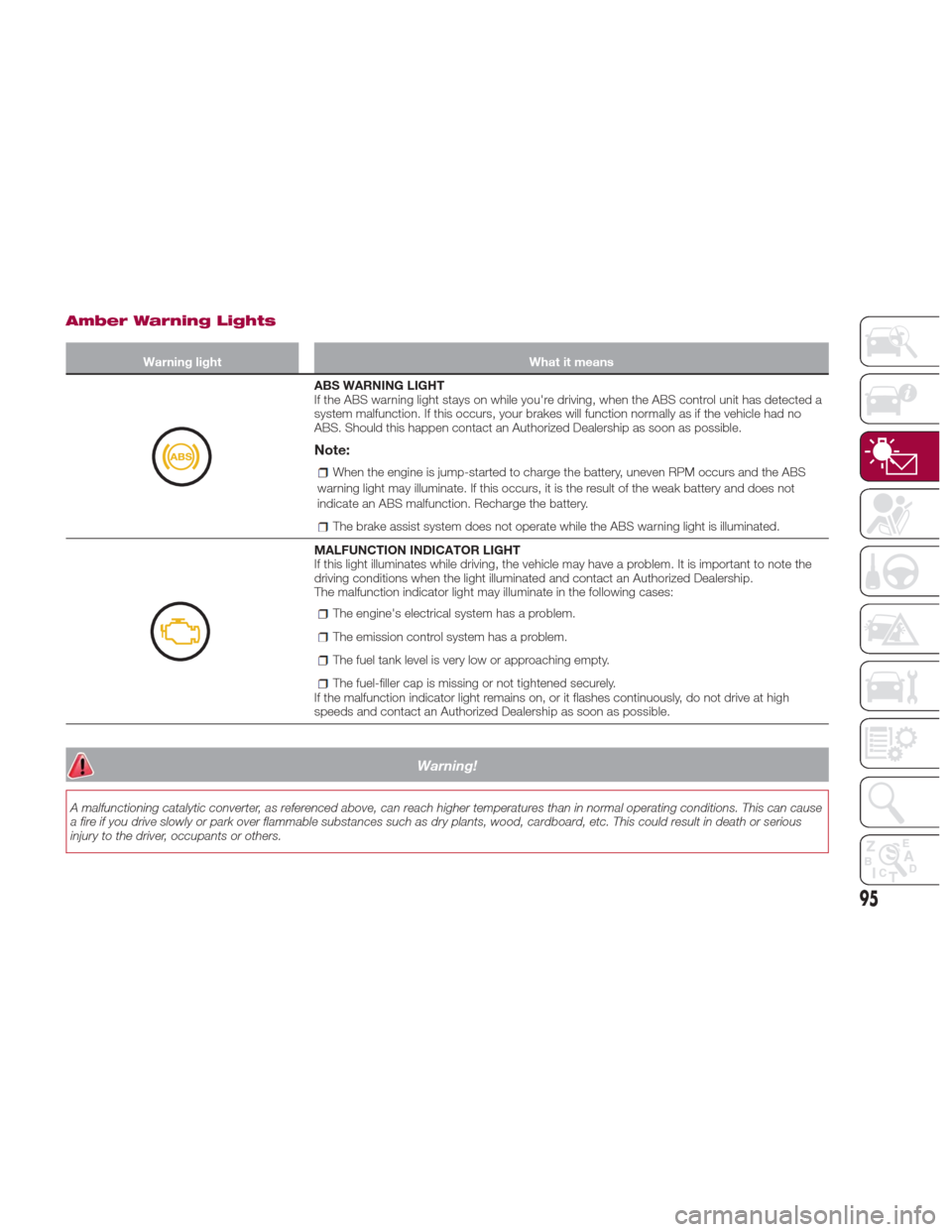
Warning lightWhat it means
ABS WARNING LIGHT
If the ABS warning light stays on while you're driving, when the ABS control unit has detected a
system malfunction. If this occurs, your brakes will function normally as if the vehicle had no
ABS. Should this happen contact an Authorized Dealership as soon as possible.
Note:
When the engine is jump-started to charge the battery, uneven RPM occurs and the ABS
warning light may illuminate. If this occurs, it is the result of the weak battery and does not
indicate an ABS malfunction. Recharge the battery.
The brake assist system does not operate while the ABS warning light is illuminated.
MALFUNCTION INDICATOR LIGHT
If this light illuminates while driving, the vehicle may have a problem. It is important to note the
driving conditions when the light illuminated and contact an Authorized Dealership.
The malfunction indicator light may illuminate in the following cases:
The engine's electrical system has a problem.
The emission control system has a problem.
The fuel tank level is very low or approaching empty.
The fuel-filler cap is missing or not tightened securely.If the malfunction indicator light remains on, or it flashes continuously, do not drive at high
speeds and contact an Authorized Dealership as soon as possible.
Warning!
A malfunctioning catalytic converter, as referenced above, can reach higher temperatures than in normal operating conditions. This can cause
a fire if you drive slowly or park over flammable substances such as dry plants, wood, cardboard, etc. This could result in death or serious
injury to the driver, occupants or others.
95
Page 119 of 300
cancellation button to cancel the
dimmer and increase the brightness of
Blind Spot Monitoring (BSM) warning
lights when they turn on.
Refer to “Instrument Panel Illumination”
in “Knowing The Instrument Panel”
chapter.
BSM Warning Beep
The BSM warning beep is activated
simultaneously with the flashing of a
BSM warning light.
BSM Switch
When the BSM switch is pushed, the
BSM and RCTA systems are turned off
and the BSM OFF indicator light in the
instrument cluster turns on.
If the switch is pushed again, the BSM
and RCTA systems become operable and
the BSM OFF indicator light turns off.
Note:
When the ignition is switched off,
the condition before the system was
turned off is maintained. For example,
if the ignition is switched OFF while the
BSM and RCTA systems are
operational, the BSM and RCTA
systems remain operational the next
time the ignition is switched ON.
The BSM and RCTA systems are
turned off when the battery is
disconnected such as when the
battery terminals or fuses have been
removed and reinstalled. To turn the
BSM and RCTA systems back on,
push the BSM switch.
RCTA (Rear Cross Traffic Alert)
Function
The RCTA system is designed to assist
the driver in checking the area to the
rear of the vehicle on both sides while
the vehicle is reversing by alerting the
driver to the presence of vehicles
approaching the rear of the vehicle.
The RCTA system detects vehicles
approaching from the left and right
sides of the vehicle while the vehicle is
reversing out of a parking space, and
notifies the driver of possible danger
using the BSM warning lights and the
warning buzzer. RCTA Operation
The RCTA system operates when the
gear selector is shifted to the Reverse
(R) position.
If there is the possibility of a collision
with an approaching vehicle, the BSM
warning light flashes and the warning
beep is activated simultaneously.
With Rear View Monitor
The Rear Cross Traffic Alert (RCTA)
waring indication in the rearview
monitor also synchronizes with the
Blind Spot Monitoring (BSM) warning
indicator light on the door mirrors.
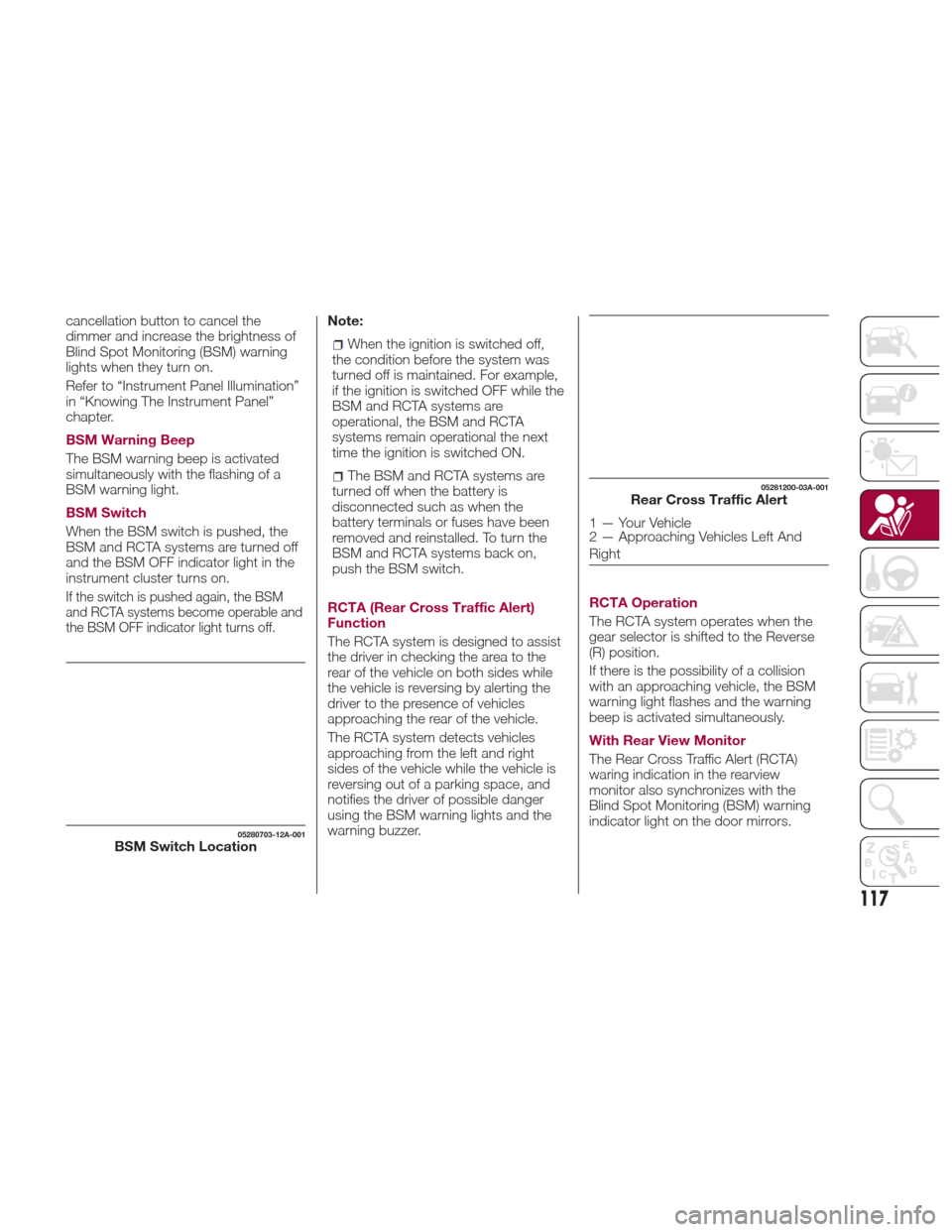
05280703-12A-001BSM Switch Location
05281200-03A-001Rear Cross Traffic Alert
1 — Your Vehicle
2 — Approaching Vehicles Left And
Right
117
Page 150 of 300
STARTING AND OPERATING
STARTINGTHEENGINE .......149
BRAKE SYSTEM............150
MANUAL TRANSMISSION ......152
AUTOMATIC TRANSMISSION —
IF EQUIPPED ..............153
ELECTRONIC SPEED
CONTROL ................158
RADAR SENSORS —
IF EQUIPPED ..............162
REAR PARK ASSIST —
IF EQUIPPED ..............163
PARKVIEW REAR BACKUP
CAMERA — IF EQUIPPED ......167
REFUELING THE VEHICLE ......173
VEHICLELOADING ..........177
TOWING TRAILERS ..........178
DRIVING TIPS ..............178
148
STARTING AND OPERATING
Page 152 of 300
Extended Park Starting
Note:
Extended Park condition occurs when
the vehicle has not been started or
driven for at least 30 days.
1. Install a battery charger or jumper
cables to the battery to ensure a full
battery charge during the crank cycle.
2. Place the ignition in the START
mode and release it when the engine
starts.
3. If the engine fails to start within
10 seconds, place the ignition in the
STOP (OFF/LOCK) mode, wait five
seconds to allow the starter to cool,
then repeat the Extended Park Starting
procedure.
4. If the engine fails to start after eight
attempts, allow the starter to cool for at
least 10 minutes, then repeat the
procedure.
Caution!
To prevent damage to the starter, do not
crank continuously for more than 10
seconds at a time. Wait 10 to 15 seconds
before trying again.
After Starting —
Warming Up The Engine
Proceed as follows:
1. Travel slowly, letting the engine run
at a reduced RPM, without accelerating
suddenly.
2. It is recommended to wait until the
digital engine coolant temperature
indicator starts moving before
demanding full performance.
Stopping The Engine
Proceed as follows:
1. Park the car in a position that is not
dangerous for oncoming traffic, if
equipped with manual transmission
place gear selector in FIRST (1st) or
REVERSE (R) gear, if equipped with
automatic transmission place the gear
selector to PARK (P).
2. Push and release the ignition button
to STOP the engine.
BRAKE SYSTEM
This vehicle has power-assisted brakes
that adjust automatically through
normal use. Should power-assist fail,
you can stop by applying greater force
than normal to the brake pedal. But the
distance required to stop will be greater
than usual.
Note:
Always depress the brake pedal with
the right foot. Applying the brakes with
the unaccustomed left foot could slow
your reaction time to an emergency
situation resulting in insufficient braking
operation.
Do not drive with your foot held on the
clutch pedal or brake pedal, or hold the
clutch pedal depressed halfway
unnecessarily. Doing so could result in
the following:
The clutch and brake parts will wear
out more quickly.
The brakes can overheat and
adversely affect brake performance.
150
STARTING AND OPERATING
Page 154 of 300
should be replaced. When you hear this
noise contact your Authorized Dealer as
soon as possible.
Brake Assist
During emergency braking situations
when it is necessary to depress the
brake pedal with greater force, the
brake assist system provides braking
assistance, thus enhancing braking
performance. When the brake pedal is
depressed hard or depressed more
quickly, the brakes apply more firmly.
Note:
When the brake pedal is depressed
hard or depressed more quickly, the
pedal will feel softer but the brakes will
apply more firmly. This is a normal
effect of the brake assist operation and
does not indicate a malfunction.
When the brake pedal is depressed
hard or depressed more quickly, a
motor/pump operation noise may be
heard. This is a normal effect of the
brake assist and does not indicate a
malfunction.
The brake assist equipment does
not supersede the functionality of the
vehicle's main braking system.
MANUAL
TRANSMISSION
Manual Transmission
Warning!
You or others could be injured if you leave
the vehicle unattended without having the
park brake fully applied. The park brake
should always be applied when the driver
is not in the vehicle, especially on an
incline.
Caution!
Never drive with your foot resting on the
clutch pedal, or attempt to hold the vehicle
on a hill with the clutch pedal partially
engaged, as this will cause abnormal wear
on the clutch.
To engage the gears, press the clutch
pedal fully and put the gear selector
into the required position. The diagram
for gear engagement is shown on the
knob. Depress the clutch pedal all the way
down while shifting, then release it
slowly.
Your vehicle is equipped with a device
to prevent shifting to REVERSE (R) by
mistake. Push the gear selector
downward and shift to REVERSE (R).
A natural driving posture can be
achieved by lightly gripping the gear
selector from the side without having to
rest your elbow on the center console.
If shifting to REVERSE (R) is difficult,
shift back into neutral, release the
clutch pedal, and try again.
With Parking Sensor System
When the gear selector is shifted to the
REVERSE (R) position with the ignition
placed in the ON mode, the parking
sensor system is activated an audible
sound is heard.
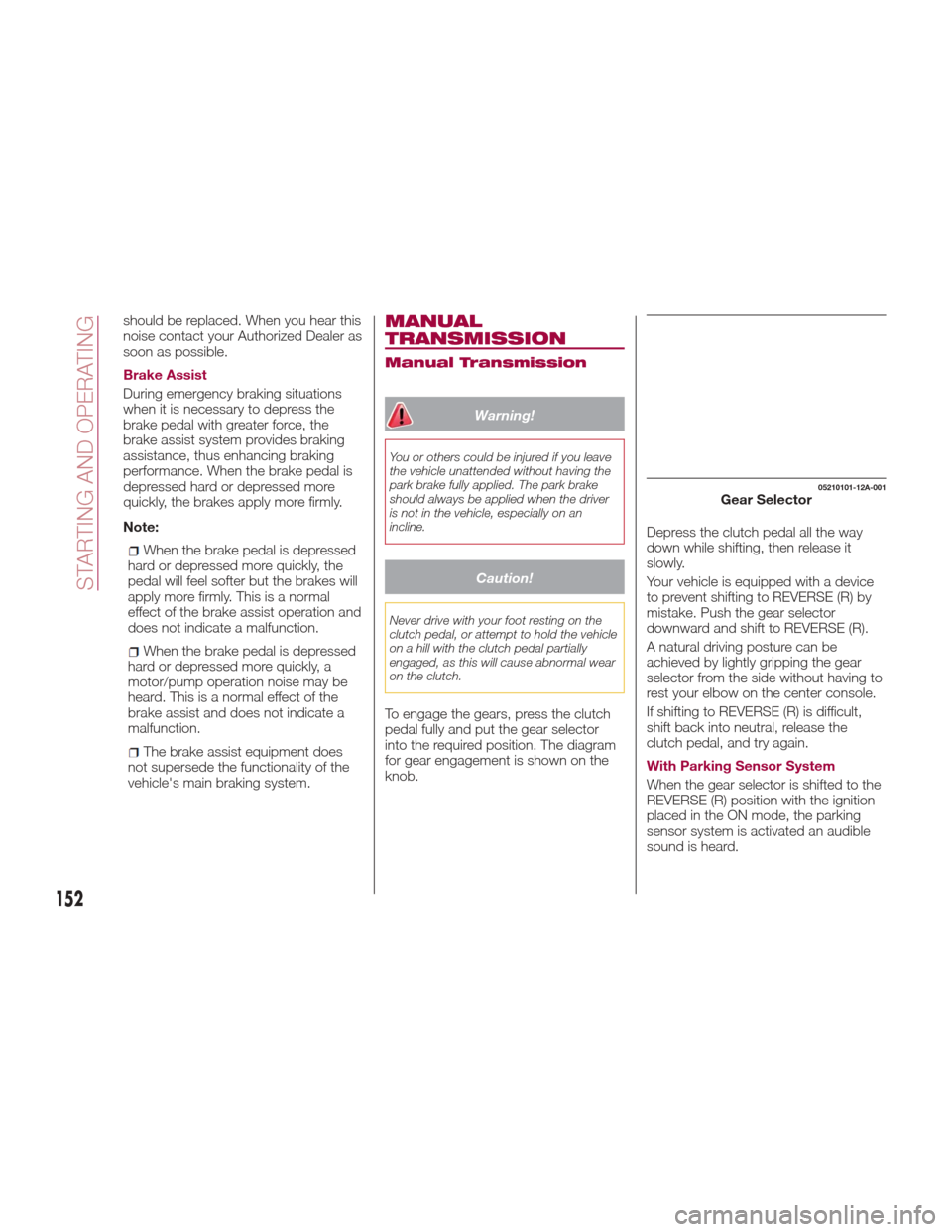
05210101-12A-001Gear Selector
152
STARTING AND OPERATING
Page 165 of 300
REAR PARK ASSIST
— IF EQUIPPED
Rear Park Assist
Warning!
Do not rely completely on the parking
sensor system and be sure to confirm the
safety around your vehicle visually when
driving. This system can assist the driver in
operating the vehicle in the forward and
backward directions while parking. The
detection ranges of the sensors are limited,
therefore, driving the vehicle while relying
only on the system may cause an accident.
Always confirm the safety around your
vehicle visually when driving.
Parking and other potentially dangerous
manoeuvres are, however, always the
driver’s responsibility. When performing
these operations, always make sure that
there are no other people (especially
children) or animals on the route you want
to drive into. The parking sensors are an
aid for the driver, but the driver must
never allow their attention to lapse during
potentially dangerous manoeuvres, even
those executed at low speeds.
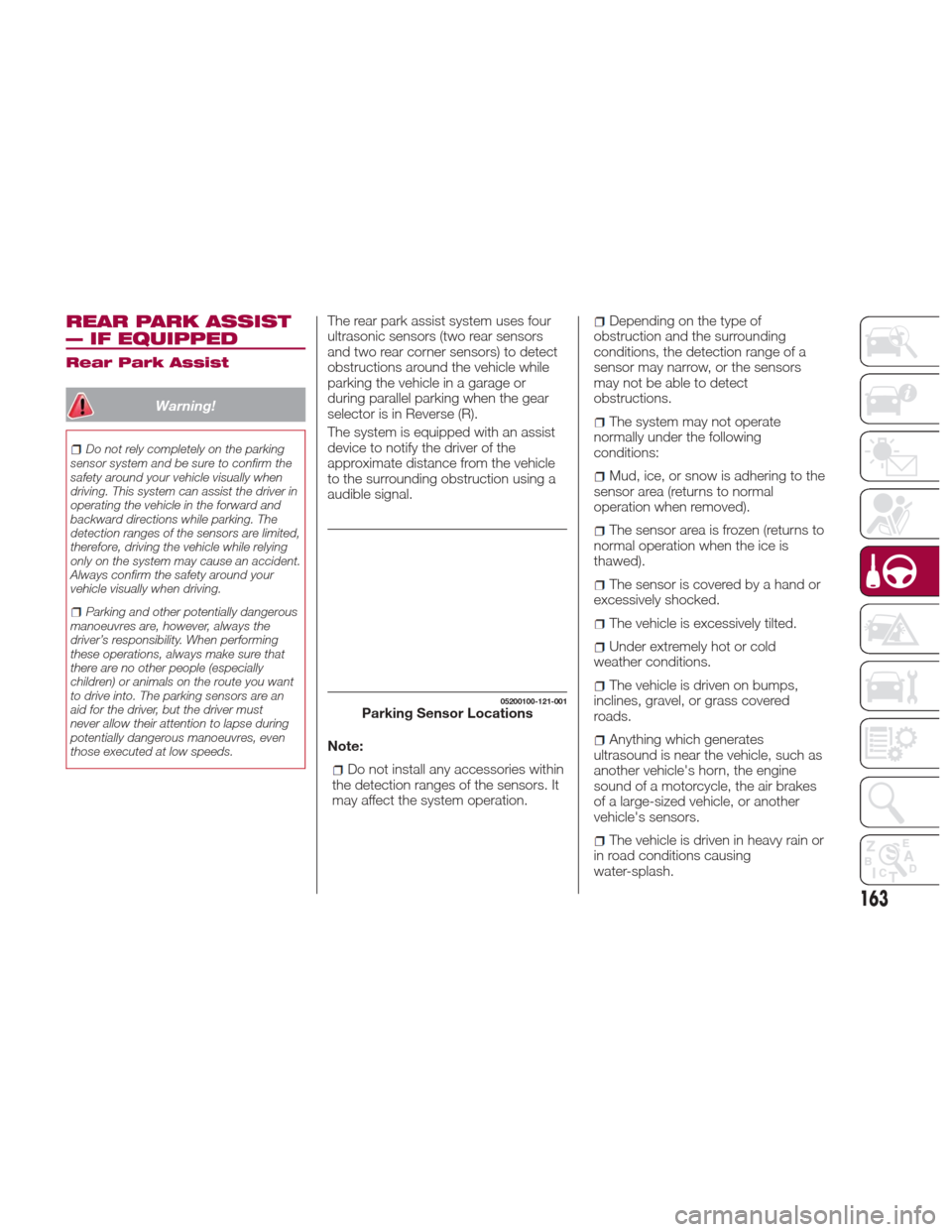
The rear park assist system uses four
ultrasonic sensors (two rear sensors
and two rear corner sensors) to detect
obstructions around the vehicle while
parking the vehicle in a garage or
during parallel parking when the gear
selector is in Reverse (R).
The system is equipped with an assist
device to notify the driver of the
approximate distance from the vehicle
to the surrounding obstruction using a
audible signal.
Note:
Do not install any accessories within
the detection ranges of the sensors. It
may affect the system operation.
Depending on the type of
obstruction and the surrounding
conditions, the detection range of a
sensor may narrow, or the sensors
may not be able to detect
obstructions.
The system may not operate
normally under the following
conditions:
Mud, ice, or snow is adhering to the
sensor area (returns to normal
operation when removed).
The sensor area is frozen (returns to
normal operation when the ice is
thawed).
The sensor is covered by a hand or
excessively shocked.
The vehicle is excessively tilted.
Under extremely hot or cold
weather conditions.
The vehicle is driven on bumps,
inclines, gravel, or grass covered
roads.
Anything which generates
ultrasound is near the vehicle, such as
another vehicle's horn, the engine
sound of a motorcycle, the air brakes
of a large-sized vehicle, or another
vehicle's sensors.
The vehicle is driven in heavy rain or
in road conditions causing
water-splash.
05200100-121-001Parking Sensor Locations
163
Page 176 of 300
E-85 Usage In Non-Flex
Fuel Vehicles
Non-Flex Fuel Vehicles (FFV) are
compatible with gasoline containing up
to 15% ethanol (E-15). Gasoline with
higher ethanol content may void the
New Vehicle Limited Warranty.
If a Non-FFV vehicle is inadvertently
fueled with E-85 fuel, the engine will
have some or all of these symptoms:
Operate in a lean mode.
OBD II “Malfunction Indicator Light”
on.
Poor engine performance.
Poor cold start and cold drivability.
Increased risk for fuel system
component corrosion.
MMT In Gasoline
Methylcyclopentadienyl Manganese
Tricarbonyl (MMT) is a manganese-
containing metallic additive that is
blended into some gasoline to increase
octane. Gasoline blended with MMT
provides no performance advantage
beyond gasoline of the same octane
number without MMT. Gasoline blended
with MMT reduces spark plug life and
reduces emissions system performance
in some vehicles. The manufacturer
recommends that gasoline without
MMT be used in your vehicle. The MMT
content of gasoline may not be
indicated on the gasoline pump, therefore, you should ask your gasoline
retailer whether the gasoline contains
MMT. MMT is prohibited in Federal and
California reformulated gasoline.
Materials Added To Fuel
Besides using unleaded gasoline with
the proper octane rating, gasolines that
contain detergents, corrosion and
stability additives are recommended.
Using gasolines that have these
additives will help improve fuel
economy, reduce emissions, and
maintain vehicle performance.
Designated TOP TIER
Detergent Gasoline
contains a higher level
of detergents to further
aide in minimizing
engine and fuel system
deposits. When
available, the usage of Top Tier
Detergent gasoline is recommended.
Visit www.toptiergas.com for a list of
TOP TIER Detergent Gasoline Retailers.
Indiscriminate use of fuel system
cleaning agents should be avoided.
Many of these materials intended for
gum and varnish removal may contain
active solvents or similar ingredients.
These can harm fuel system gasket and
diaphragm materials.
Fuel System Cautions
Caution!
Follow these guidelines to maintain your
vehicle’s performance:
The use of leaded gasoline is prohibited
by Federal law. Using leaded gasoline can
impair engine performance and damage
the emissions control system.
An out-of-tune engine or certain fuel
or ignition malfunctions can cause the
catalytic converter to overheat. If you
notice a pungent burning odor or some
light smoke, your engine may be out of
tune or malfunctioning and may require
immediate service. Contact your
Authorized Dealer for service assistance.
The use of fuel additives, which are now
being sold as octane enhancers, is not
recommended. Most of these products
contain high concentrations of methanol.
Fuel system damage or vehicle
performance problems resulting from the
use of such fuels or additives is not the
responsibility of the manufacturer and may
void or not be covered under the New
Vehicle Limited Warranty.
Note:
Intentional tampering with the
emissions control system can result in
civil penalties being assessed against
you.
174
STARTING AND OPERATING
Page 225 of 300
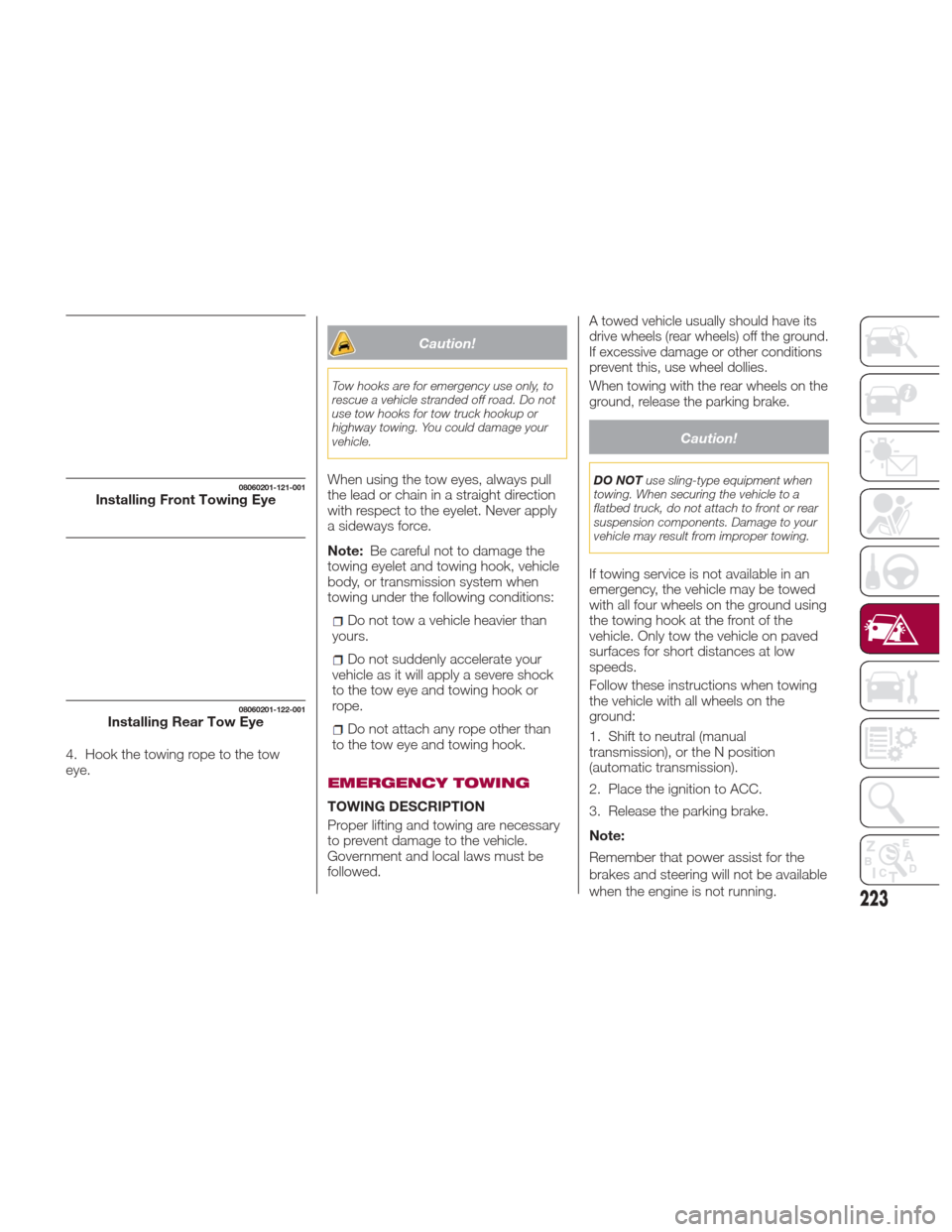
4. Hook the towing rope to the tow
eye.
Caution!
Tow hooks are for emergency use only, to
rescue a vehicle stranded off road. Do not
use tow hooks for tow truck hookup or
highway towing. You could damage your
vehicle.
When using the tow eyes, always pull
the lead or chain in a straight direction
with respect to the eyelet. Never apply
a sideways force.
Note:Be careful not to damage the
towing eyelet and towing hook, vehicle
body, or transmission system when
towing under the following conditions:
Do not tow a vehicle heavier than
yours.
Do not suddenly accelerate your
vehicle as it will apply a severe shock
to the tow eye and towing hook or
rope.
Do not attach any rope other than
to the tow eye and towing hook.
EMERGENCY TOWING
TOWING DESCRIPTION
Proper lifting and towing are necessary
to prevent damage to the vehicle.
Government and local laws must be
followed.
A towed vehicle usually should have its
drive wheels (rear wheels) off the ground.
If excessive damage or other conditions
prevent this, use wheel dollies.
When towing with the rear wheels on the
ground, release the parking brake.
Caution!
DO NOT use sling-type equipment when
towing. When securing the vehicle to a
flatbed truck, do not attach to front or rear
suspension components. Damage to your
vehicle may result from improper towing.
If towing service is not available in an
emergency, the vehicle may be towed
with all four wheels on the ground using
the towing hook at the front of the
vehicle. Only tow the vehicle on paved
surfaces for short distances at low
speeds.
Follow these instructions when towing
the vehicle with all wheels on the
ground:
1. Shift to neutral (manual
transmission), or the N position
(automatic transmission).
2. Place the ignition to ACC.
3. Release the parking brake.
Note:
Remember that power assist for the
brakes and steering will not be available
when the engine is not running.
08060201-121-001Installing Front Towing Eye
08060201-122-001Installing Rear Tow Eye
223
Page 290 of 300
Programming Additional Key
Fobs...................24
Key-In Reminder ..............21
Keyless Entry System...........15
Lane Change And Turn Signals ....41
Lane Change Assist ............41
Lap/Shoulder Belts ........124,126
Leaving Home Light System ......42
Life Of Tires ............... .246
Lights Daytime Running ...........40
Fog ...................41
Hazard Warning Flasher ......185
Passing .................40
Turn Signal ...............41
Loading Vehicle .............177
Tires ................. .241
Locks PowerDoor ........... .26,31
Maintaining the finish.........255
Maintenance Monitor ...........85
Maintenance procedures ........236
Manual Climate Control System ....48
Heating .................50
Manual transmission ..........152
Manual Transmission ..........152
Manual, Service .............284
Methanol ................. .173
Mirrors....................36 Automatic Dimming
.........37
Electric Remote ............38
Exterior Folding ............38
Outside .................36
Rearview ................36
Occupant Restraints ..........123
Onboard Diagnostic System ......77
Operating Precautions ..........77
Outside Rearview Mirrors ........36
Overhead light (bulb replacement) . .195
Overheating, Engine ...........220
Overloading ............... .182
Owner's Manual (Operator Manual) ..........284
Paint damage touch-up ........256
Parking Brake ...............151
Passing Light ................40
Performance ...............277
Periodic checks (scheduled servicing) ............... .226
Personal Settings ............108
Personalization Features ........108
Placard, Tire And Loading Information ...............241
Plastic part maintenance ........259
Power Brakes ................ .150
Door Locks ............26,31
Mirrors .................38 Pregnant Women And Seat Belts . .125
Pretensioners
Seat Belts ..............128
Protection from atmospheric agents (bodywork) ..........253
Radar Sensors.............162
Radial Ply Tires ..............245
Radio Frequency General Information ........20,23
Radio transmitter and mobile phones ...................5
Rear Camera ...............167
Rear lights (light bulbs) .........188
Rear Park Assist System ........163
Rear View ..................10
Rearview Mirrors ..............36
Recommended Tire Inflation Pressure ............... .265
Recorder, Event Data ..........146
Recreational towing ...........178
Reformulated Gasoline .........173
Refueling procedure ...........175
Refueling the vehicle ..........173
Reminder, Seat Belt ...........128
Replacement Tires ............247
Replacing a bulb .............185
Replacing exterior light bulbs .....188
Replacing fuses .............196
Replacing interior light bulbs .....195
Reporting Safety Defects .......283
INDEX