air condition FIAT 500 1966 1.G User Guide
[x] Cancel search | Manufacturer: FIAT, Model Year: 1966, Model line: 500, Model: FIAT 500 1966 1.GPages: 128, PDF Size: 9.01 MB
Page 64 of 128
of wear, distorting or unevenness of the surfaces as this
part is very heavily pressed when the vehicle is negotia-
ting a corner. If the clearance to the idle pinions exceeds
.0059 inch the shaft must be renewed.
2 Inspect the ring gear and pinion seat, the side gears.and
the idle pinions for correct meshing. This will be shown
up by white marks on the sides of the gear teeth. Check
that none of the teeth are broken, chipped or exces-
sively worn and if any part is suspect then it must be
renewed not forgetting that the ring gear and pinion
come as a matched pair.
3 Inspect the condition of the ball and roller bearings, the
rollers and balls and working faces must not show signs
of pitting wear or cracking and if any part is suspect then
the race must be renewed.
4 Check that there is not any undue wear on the faces of
the thrust rings. Any slight indentations may be evened
out using a fine oil stone but if the damage is excessive
then new rings or oversize rings must befitted as neces-
sary. Thrust rings are supplied as service spares in the
following thicknesses.
Standard .0394 inch
Oversize .0512-.0591 inch
6:6 Reassembly—differential unit
To reassemble the differential case proceed as follows:
1 Press onto the differential half housing which carries
the ring gear one differential bearing inner race ensuring
that it is pushed fully home onto its seating. Install the
thrust ring and side gear (see FIG 6 : 7).
2 From t h e inside of the case insert the axle shaft com-
plete with pivot and runners that form the slip joint.
Also install the idle pinions and carrier shaft. Position
the ring gear onto the housing half and install the
differential pinion shaft retainer ring.
3 Press the other differential bearing inner race onto its
seating on the left differential housing half and replace
the left axle shaft complete with slip joint.
4 J o i n the t w o case halves together and tighten the
retaining screws and also the retaining screws of the
ring gear to a torque wrench setting of 23.1 Ib ft. Secure
all screws by bending up the lockplates.
5 Press t h e differential bearing outer races into their
seatings in the bearing housings and also f i t the o i l seals.
Also install the bearing housings over the driving shafts
together with the adjuster rings.
6 Install the differential unit assembly into the final drive
housing front half and bolt the rear
half onto it. Tighten
the six mounting nuts to a torque wrench setting of
27.5 Ib ft. Finally place the bearing housings in their
seats and tighten the mounting nuts to a torque wrench
setting of 13 lb ft.
It should be noted that after the gearbox has been over-
hauled the complete differential unit should only be in-
stalled after the drive pinion depth adjustments has been
carried out.
6 : 7 Final drive gear set adjustment
The installation and adjustment of the final drive gear
set requires special care otherwise the unit may have to be
dismantled again for further adjustment. So as to establish
the correct mesh of the t w o gears, their relative position is
accurately set during initial assembly at the factory.
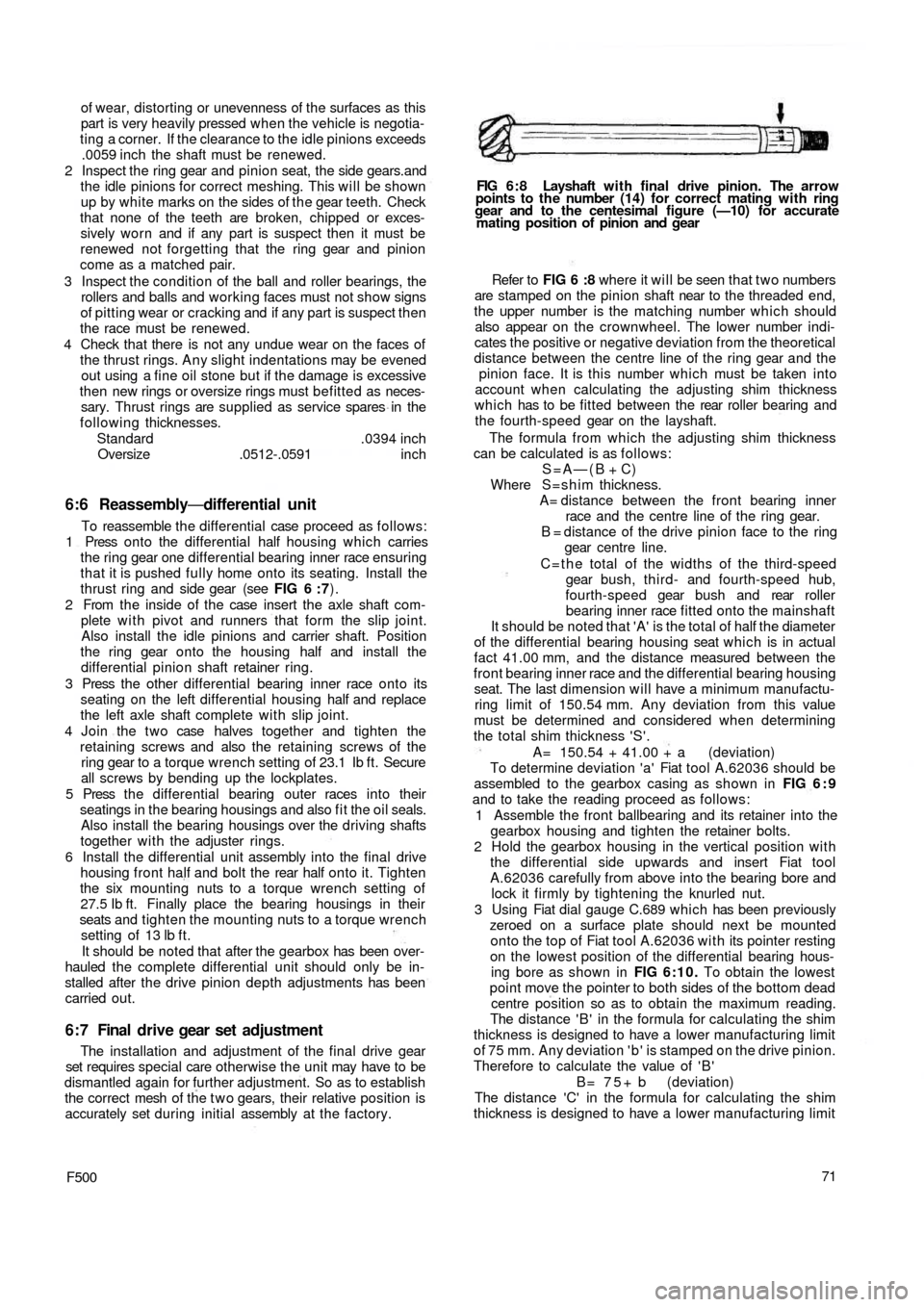
F50071 Refer to FIG 6 :8 where it will be seen that t w o numbers
are stamped on the pinion shaft near to the threaded end,
the upper number is the matching number which should
also appear on the crownwheel. The lower number indi-
cates the positive or negative deviation from the theoretical
distance between the centre line of the ring gear and the
pinion face. It is this number which must be taken into
account when calculating the adjusting shim thickness
which has to be fitted between the rear roller bearing and
the fourth-speed gear on the layshaft.
The formula from which the adjusting shim thickness
can be calculated is as follows:
S=A—(B + C)
Where S=shim thickness.
A= distance between the front bearing inner
race and the centre line of the ring gear.
B = distance of the drive pinion face to the ring
gear centre line.
C = t h e total of the widths of the third-speed
gear bush, third- and fourth-speed hub,
fourth-speed gear bush and rear roller
bearing inner race fitted onto the mainshaft
It should be noted that 'A' is the total of half the diameter
of the differential bearing housing seat which is in actual
fact 41.00 mm, and the distance measured between the
front bearing inner race and the differential bearing housing
seat. The last
dimension will have a minimum manufactu-
ring limit of 150.54 mm. Any deviation from this value
must be determined and considered when determining
the total shim thickness 'S'.
A= 150.54 + 41.00 + a (deviation)
To determine deviation 'a' Fiat tool A.62036 should be
assembled to the gearbox casing as shown in FIG 6 : 9
and to take the reading proceed as follows:
1 Assemble the front ballbearing and its retainer into the
gearbox housing and tighten the retainer bolts.
2 Hold the gearbox housing in the vertical position with
the differential side upwards and insert Fiat tool
A.62036 carefully from above into the bearing bore and
lock it firmly by tightening the knurled nut.
3 Using Fiat dial gauge C.689 which has been previously
zeroed on a surface plate should next be mounted
onto the t o p of Fiat tool A.62036 with its pointer resting
on the lowest position of the differential bearing hous-
ing bore as shown in FIG 6:10. To obtain the lowest
point move the pointer to both sides of the bottom dead
centre position so as to obtain the maximum reading.
The distance ' B ' in the formula for calculating the shim
thickness is designed to have a lower manufacturing limit
of 75 mm. Any deviation ' b ' is stamped on the drive pinion.
Therefore to calculate the value of ' B '
B = 7 5 + b (deviation)
The distance 'C' in the formula for calculating the shim
thickness is designed to have a lower manufacturing limit
FIG 6 : 8 Layshaft w i t h final drive pinion. The arrow
points to the number (14) for correct mating with ring
gear and to the centesimal figure (—10) for accurate
mating position of pinion and gear
Page 69 of 128
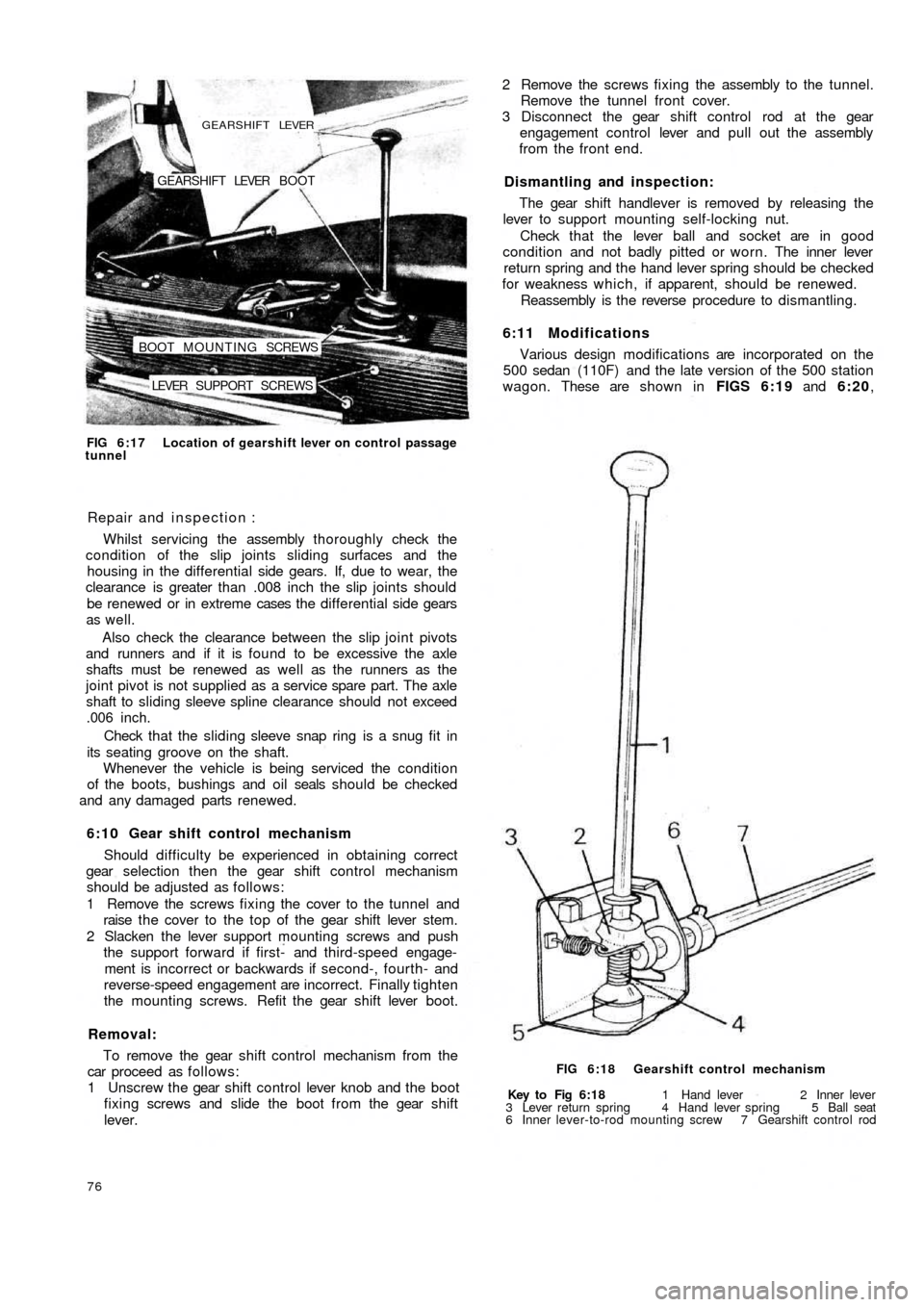
LEVER SUPPORT SCREWS BOOT MOUNTING SCREWSGEARSHIFT LEVER BOOT
GEARSHIFT LEVER
FIG 6:17 Location of gearshift lever on control passage
tunnel
Repair and inspection :
Whilst servicing the assembly thoroughly check the
condition of the slip joints sliding surfaces and the
housing in the differential side gears. If, due to wear, the
clearance is greater than .008 inch the slip joints should
be renewed or in extreme cases the differential side gears
as well.
Also check the clearance between the slip joint pivots
and runners and if it is found to be excessive the axle
shafts must be renewed as well as the runners as the
joint pivot is not supplied as a service spare part. The axle
shaft to sliding sleeve spline clearance should not exceed
.006 inch.
Check that the sliding sleeve snap ring is a snug fit in
its seating groove on the shaft.
Whenever the vehicle is being serviced the condition
of the boots, bushings and oil seals should be checked
and any damaged parts renewed.
6:10 Gear shift control mechanism
Should difficulty be experienced in obtaining correct
gear selection then the gear shift control mechanism
should be adjusted as follows:
1 Remove the screws fixing the cover to the tunnel and
raise t h e cover to t h e t o p of the gear shift lever stem.
2 Slacken the lever support mounting screws and push
the support forward if first- and third-speed engage-
ment is incorrect or backwards if second-, fourth- and
reverse-speed engagement are incorrect. Finally tighten
the mounting screws. Refit the gear shift lever boot.
Removal:
To remove the gear shift control mechanism from the
car proceed as follows:
1 Unscrew the gear shift control lever knob and the boot
fixing screws and slide the boot from the gear shift
lever.
76Key to Fig 6:18 1 Hand lever 2 Inner lever
3 Lever return spring 4 Hand lever spring 5 Ball seat
6 Inner lever-to-rod mounting screw 7 Gearshift control rod FIG 6:18 Gearshift control mechanism
6:11 Modifications
Various design modifications are incorporated on the
500 sedan (110F) and the late version of the 500 station
wagon. These are shown in FIGS 6:19 and 6:20, The gear shift handlever is removed by releasing the
lever to support mounting self-locking nut.
Check that the lever ball and socket are in good
condition and not badly pitted or worn. The inner lever
return spring and the hand lever spring should be checked
for weakness which, if apparent, should be renewed.
Reassembly is the reverse procedure to dismantling. Dismantling and inspection: 2 Remove the screws fixing the assembly to the tunnel.
Remove the tunnel front cover.
3 Disconnect the gear shift control rod at the gear
engagement control lever and pull out the assembly
from the front end.
Page 83 of 128
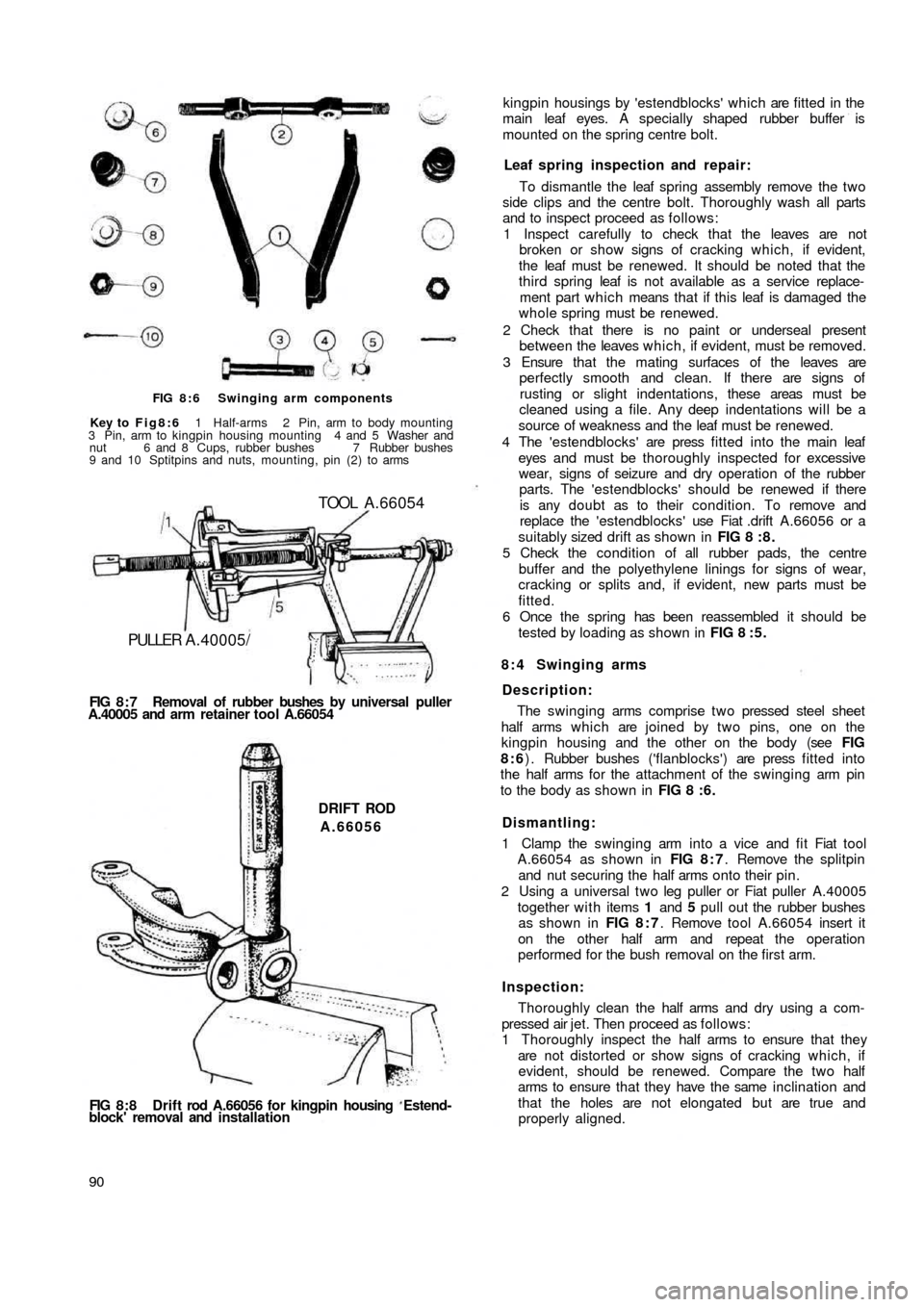
FIG 8:6 Swinging arm components
Key to Fig8:6 1 Half-arms 2 Pin, arm to body mounting
3 Pin, arm to kingpin housing mounting 4 and 5 Washer and
nut 6 and 8 Cups, rubber bushes 7 Rubber bushes
9 and 10 Sptitpins and nuts, mounting, pin (2) to arms
TOOL A.66054
PULLER A.40005/
FIG 8 : 7 Removal of rubber bushes by universal puller
A.40005 and arm retainer tool A.66054
DRIFT ROD
A.66056
FIG 8:8 Drift rod A.66056 for kingpin housing Estend-
block' removal and installation
90Inspection:
Thoroughly clean the half arms and dry using a com-
pressed air jet. Then proceed as follows:
1 Thoroughly inspect the half arms to ensure that they
are not distorted or show signs of cracking which, if
evident, should be renewed. Compare the t w o half
arms to ensure that they have the same inclination and
that the holes are not elongated but are true and
properly aligned. kingpin housings by 'estendblocks' which are fitted in the
main leaf eyes. A specially shaped rubber buffer is
mounted on the spring centre bolt.
Leaf spring inspection and repair:
To dismantle the leaf spring assembly remove the t w o
side clips and the centre bolt. Thoroughly wash all parts
and to inspect proceed as follows:
1 Inspect carefully to check that the leaves are not
broken or show signs of cracking which, if evident,
the leaf must be renewed. It should be noted that the
third spring leaf is not available as a service replace-
ment part which means that if this leaf is damaged the
whole spring must be renewed.
2 Check that there is no paint or underseal present
between the leaves which, if evident, must be removed.
3 Ensure that the mating surfaces of the leaves are
perfectly smooth and clean. If there are signs of
rusting or slight indentations, these areas must be
cleaned using a file. Any deep indentations will be a
source of weakness and the leaf must be renewed.
4 The 'estendblocks' are press fitted into the main leaf
eyes and must be thoroughly inspected for excessive
wear, signs of seizure and dry operation of the rubber
parts. The 'estendblocks' should be renewed if there
is any doubt as to their condition. To remove and
replace the 'estendblocks' use Fiat .drift A.66056 or a
suitably sized drift as shown in FIG 8 : 8 .
5 Check the condition of all rubber pads, the centre
buffer and the polyethylene linings for signs of wear,
cracking or splits and, if evident, new parts must be
fitted.
6 Once the spring has been reassembled it should be
tested by loading as shown in FIG 8 : 5 .
8:4 Swinging arms
Description:
The swinging arms comprise t w o pressed steel sheet
half arms which are joined by two pins, one on the
kingpin housing and the other on the body (see FIG
8:6) . Rubber bushes ('flanblocks') are press fitted into
the half arms for the attachment of the swinging arm pin
to the body as shown in FIG 8 : 6 .
Dismantling:
1 Clamp the swinging arm into a vice and fit Fiat tool
A.66054 as shown in FIG 8 : 7. Remove the splitpin
and nut securing the half arms onto their pin.
2 Using a universal t w o leg puller or Fiat puller A.40005
together with items 1 and 5 pull out the rubber bushes
as shown in FIG 8 : 7. Remove tool A.66054 insert it
on the other half arm and repeat the operation
performed for the bush removal on the first arm.
Page 84 of 128
2 Check that the surface of the pin that is in contact with
the camber and castor adjuster shims does not show
any signs of indentation or roughness which could
affect the accuracy of adjustment on reassembly. If
there are any signs of rust or small markings these
should be smoothed out using a file.
3 Inspect the condition of the half arm bushes, the inner
surface of which must not show signs of seizure and
the clearance of the bush to pin must not be greater
than .01 57 inch. Upon initial assembly the fit clearance
is .00059 to .0059 inch. Ensure t h a t the rubber parts
of the bush are not torn, cracked or show signs of
weakness which, if evident, must be renewed.
4 Use Fiat tool A.66058 or a suitably sized drift for
refitting the rubber bushes into the swinging arms.
Upon reassembly it should be observed that the
tightening of the two swinging arms m o u n t i n g nuts 5
(see FIG 8 : 3) , must be carried out whilst keeping
the axis of the swinging arm and the pin hole for the
screws 7 on the same plane otherwise distortion can
occur.
8 : 5 Kingpin housing
1 To remove and replace the 'estendblocks' use Fiat
tool A.66056 as shown in FIG 8 : 8. Ensure t h a t the
'estendblocks' is not worn and that there are no signs
of seizure on its inner surface, or that the rubber has
hardened. Renew if necessary.
2 Check that the kingpin to bush clearance is not
greater than .0079 inch. The clearance when fitted
new is .00063 to .00213 inch. If the clearance is
excessive the t w o bushes must be renewed and also
the kingpin if excessive wear is evident. To remove and
refit the kingpin bushes use Fiat tool A.66016 and
after reassembly the bushes must be accurately
refaced using a reamer set to a diameter of .5912 to
.5922 inch. If considered necessary use Fiat Fixture
C.1004 to check that the kingpin housing has not been
distorted which, if evident, the housing must be
renewed.
3 Whilst the kingpin assembly is being inspected ensure
that the lubrication hole is free to allow the passage of
oil.
4 To prevent incorrect loading of the 'estendblocks' that
is press fitted into the kingpin housing, the housing
to swinging arm pin nut must be tightened with the
parts so arranged that the angle between the swinging
arm plane and the housing axis is approximately
95 deg. as shown in FIG 8:14.
8:6 Steering knuckle and wheel hub
Dismantling:
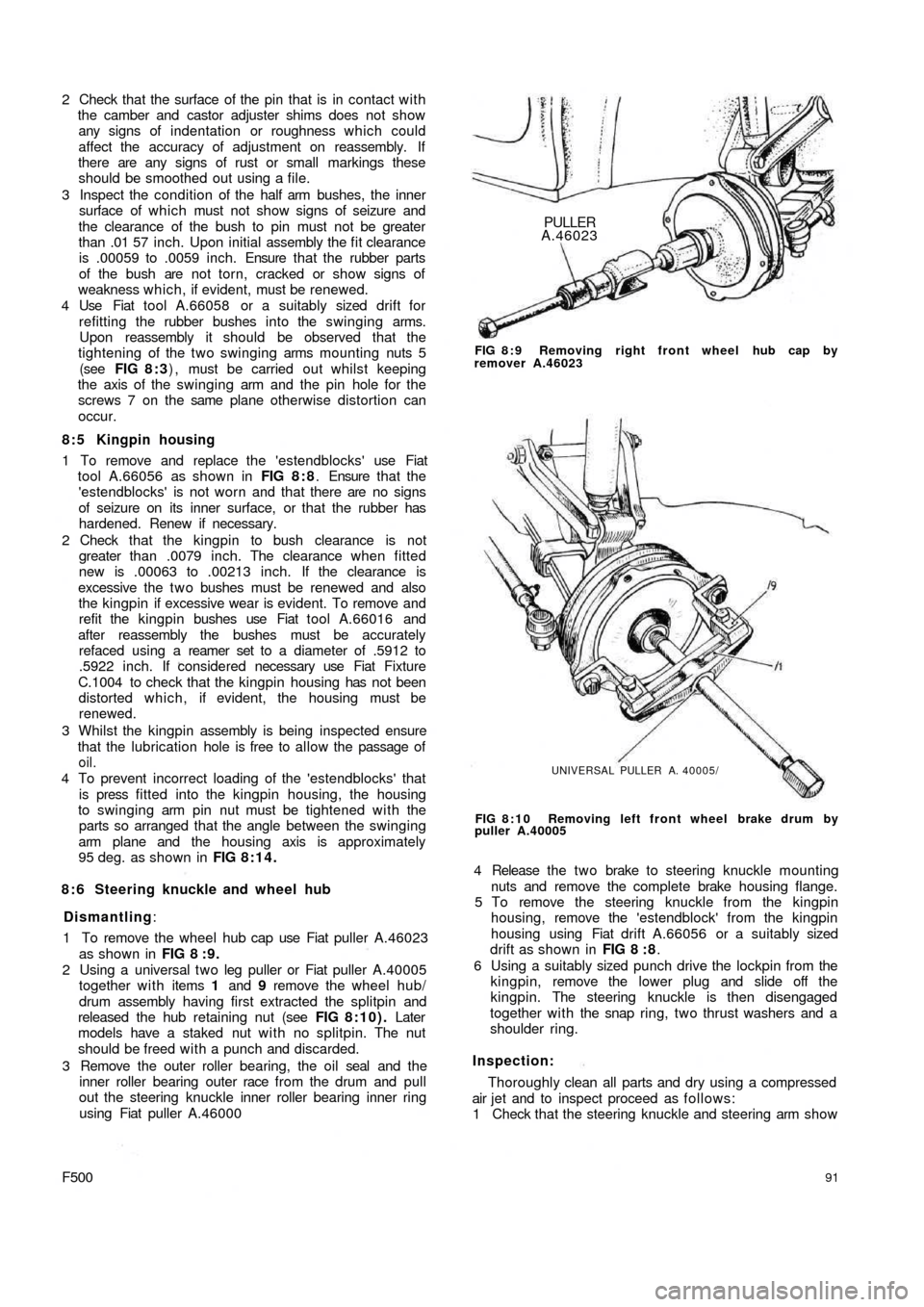
1 To remove the wheel hub cap use Fiat puller A.46023
as shown in FIG 8 : 9 .
2 Using a universal t w o leg puller or Fiat puller A.40005
together with items 1 and 9 remove the wheel hub/
drum assembly having first extracted the splitpin and
released the hub retaining nut (see FIG 8:10). Later
models have a staked nut w i t h no splitpin. The nut
should be freed with a punch and discarded.
3 Remove the outer roller bearing, the oil seal and the
inner roller bearing outer race from the drum and pull
out the steering knuckle inner roller bearing inner ring
using Fiat puller A.46000
F500PULLER
A.46023
FIG 8 : 9 Removing right front wheel hub cap by
remover A.46023
UNIVERSAL PULLER A. 40005/
FIG 8:10 Removing left front wheel brake drum by
puller A.40005
4 Release the t w o brake to steering knuckle mounting
nuts and remove the complete brake housing flange.
5 To remove the steering knuckle from the kingpin
housing, remove the 'estendblock' from the kingpin
housing using Fiat drift A.66056 or a suitably sized
drift as shown in FIG 8 : 8.
6 Using a suitably sized punch drive the lockpin from the
kingpin, remove the lower plug and slide off the
kingpin. The steering knuckle is then disengaged
together with the snap ring, two thrust washers and a
shoulder ring.
Inspection:
Thoroughly clean all parts and dry using a compressed
air jet and to inspect proceed as follows:
1 Check that the steering knuckle and steering arm show
91
Page 104 of 128
CHAPTER 11
THE ELECTRICAL EQUIPMENT
11:1 Description
11:2 Battery
11:3 The generator
11:4 The starter
11:5 The control box
1 1 : 6 Fuses
1 1 : 7 Flasher unit
11:1 Description
All models covered by this manual have 12 volts
electrical systems in which the negative battery terminal
is earthed. There are three units in the regulator box to
control the charging circuit; a cut-out, a current regulator
and a voltage regulator. These are adjustable but it must
be stressed that accurate moving coil meters are required
when checking or altering the settings. Cheap and
unreliable instruments will make accurate adjustments
impossible.
There are wiring diagrams in Technical Data at the end
of this manual to enable those with electrical experience
to trace and correct wiring faults.
For t h e U.K. Market the headlamps are of the double
filament dipping renewable bulb type with adjustments
for individual beam settings.
The battery is located in the front compartment
forward of the petrol tank and the fuses to the rear o f the
petrol tank.
Detailed instructions for servicing the electrical equip-
ment will be found in this chapter, but it must be pointed
out that it is not sensible to try to repair that which is
seriously defective, electrically or mechanically. Such
equipment should be replaced by new units which can
be obtained on an exchange basis.
F500111
11 :8 Windscreen wipers
1 1 : 9 The lighting system
11:10 Panel and warning lights
11:11 The horn
11:12 Lighting and flasher switch
1 1 : 1 3 Fault diagnosis
11.2 The battery
This of the 12-volt lead/acid type and has to meet
heavy demands for current particularly in the winter. To
maintain the performance of the battery at its maximum
it is essential to carry out the following operations.
Keep the top of the battery and surrounding parts dry
and clean, as dampness can cause leakage between the
securing clamps and the battery terminals. Clean off any
corrosion from the metal parts of the battery mounting
with diluted ammonia and paint them with an anti-
sulphuric paint. If the terminal posts are corroded,
remove the cables and clean w i t h diluted ammonia.
Smear the posts w i t h petroleum jelly before remaking the
connections and fit the terminals securely. High electrical
resistance due to corrosion at the terminal posts is often
responsible for lack of sufficient current to operate the
starter motor.
Ensure t h a t the filler plugs are in good condition and
show no signs of cracks. This may cause leakage of
electrolyte and consequent corrosion. Test the condition
of the cells after topping-up the electrolyte level with
distilled water to just above the tops of the separators as
shown in FIG 11 :2 . Never add neat acid. If it is
necessary to make a new electrolyte due to loss by
spillage add sulphuric acid to the
distilled water.
It is highly dangerous to add water to acid.
Page 106 of 128
indicates a break in the cable from the generator to
regulator. Repeat the test on terminal 67. Finally,
remove the temporary link from the generator. If the
readings are correct, test the regulator as described in
Section 11:5.
Removing generator:
1 Disconnect the leads from the generator.
2 Remove the drive belt as previously described.
3 Release t h e rear mounting bracket at the side of the
power unit.
4 Remove the air cooling ducting from around the fan
and generator area and lift away the unit.
5 Release the blower from the end of the armature shaft
and finally, the mounting bolts from the air ducting.
Dismantling generator:
1 Release the pulley self-locking nut and slide the pulley
off the armature shaft.
2 Remove the t w o Woodruff keys on armature shaft.
3 Unscrew the t w o through bolt nuts and pull out the
bolts.
4 Partially remove the commutator end head to the point
where the brushes are. s t i l l seating on the commutator.
Using a piece of hooked wire relieve the load of the
springs on the brushes by arranging the spring ends
on the brush sides. The brushes will be locked in their
holders and cannot be chipped by striking against the
armature shaft during the commutator end head
removal.
5 Gently ease the commutator and fan end heads apart
and, slide out the armature.
Servicing brushes:
Lift the brushes up in the boxes and hold them in that
position by letting each brush spring bear on the side of
its brush. Fit the commutator end bracket over the
commutator end of the armature shaft and release the
brushes by hooking up the springs using a thin screw
driver. Hold back each spring in turn and move the brush
by pulling gently on the flexible connector. If the brush
moves sluggishly remove it and polish the sides using a
smooth file. Before this operation is actually carried out it
is suggested that the brush is marked before removal so
that it is replaced in its original working position.
inch,The minimum permissible length of a brush is
so renew any t h a t are less than this figure. Test the brush
springs using a spring tension scale. New springs should
have a tension of 1.3 to 1.6 Ib. In service this value could
fall slightly before performance is affected. Always bed in
new brushes by wrapping fine sandpaper round the
commutator, pressing down on the brush and rotating
the commutator under it, or draw the paper t o o and f r o .
If new brushes are fitted always fit genuine Fiat replace-
ments.
Servicing the commutator:
A commutator in good condition should be smooth and
free from pitting or signs of the segments burning. Clean
with a rag moistened in petrol. If necessary, polish using
a fine glasspaper whilst rotating the armature. Never use
emerycloth.
If the commutator is badly worn it may be skimmed
using a centre lathe. Use a high rotational speed and take
F500113
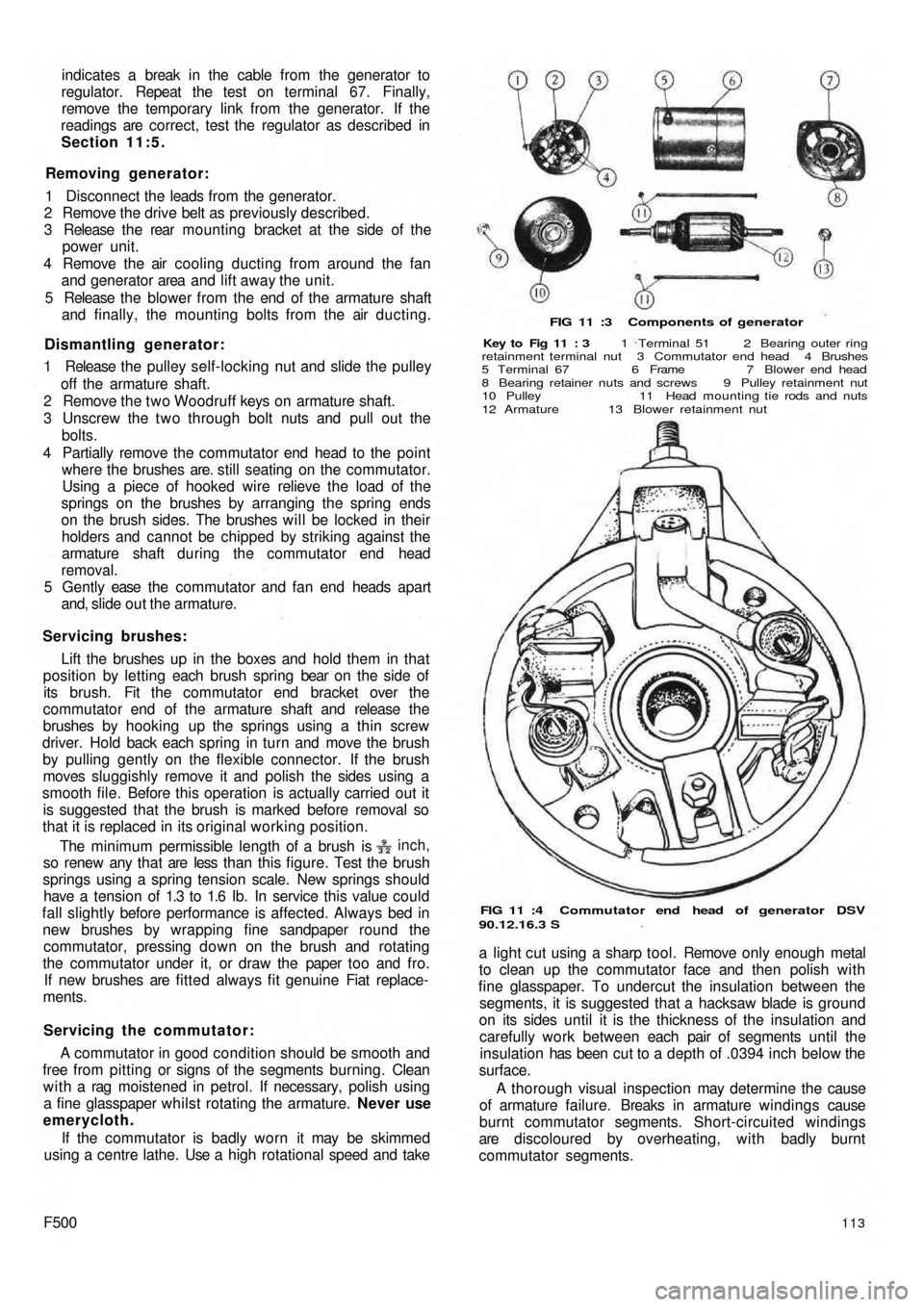
FIG 11 :3 Components of generator
Key to Fig 11 : 3 1 Terminal 51 2 Bearing outer ring
retainment terminal nut 3 Commutator end head 4 Brushes
5 Terminal 67 6 Frame 7 Blower end head
8 Bearing retainer nuts and screws 9 Pulley retainment nut
10 Pulley 11 Head mounting tie rods and nuts
12 Armature 13 Blower retainment nut
FIG 11 :4 Commutator end head of generator DSV
90.12.16.3 S
a light cut using a sharp tool. Remove only enough metal
to clean up the commutator face and then polish with
fine glasspaper. To undercut the insulation between the
segments, it is suggested that a hacksaw blade is ground
on its sides until it is the thickness of the insulation and
carefully work between each pair of segments until the
insulation has been cut to a depth of .0394 inch below the
surface.
A thorough visual inspection may determine the cause
of armature failure. Breaks in armature windings cause
burnt commutator segments. Short-circuited windings
are discoloured by overheating, with badly burnt
commutator segments.
Page 108 of 128
switch contacts. The starter motor rotates driving the
engine through the pinion and ring gear. As soon as the
engine fires the starter hand lever must be released which
will open the starter switch contacts so stopping the
starter motor and the pinion will return under the action
of a spring to a neutral position.
Tests for a starter which does not operate:
Check the condition of the battery and particularly
the connections to the terminals and to earth. If the
battery is charged, switch on the lights and operate the
starter hand lever control. If the lights go dim but the
starter does not operate it shows that current is reaching
the starter motor. The probability is that the pinion of the
starter shaft is jammed in mesh due to dirty pinion splines
or a broken spring. To release the pinion engage a low
gear with the ignition switched off and rock the vehicle
backwards and forwards which should allow the pinion
to be disengaged from the flywheel ring gear. If it proves
impossible to free a jammed pinion the starter motor must
be removed for examination and repair.
If the lamps do not go dim, check the starter switch and
also check the connection between the battery and the
starter switch to ensure that they are tight and making
good electrical connection. If the starter motor still does
not work it should be removed from the power unit for
inspection.
Removing the starter:
To remove the starter motor from the power unit
proceed as follows:
1 Disconnect the positive terminal from the
battery post.
2 Release the hand lever control cable from the starter
motor engagement lever.
3 Disconnect the battery cable terminal from the starter
motor switch.
4 Remove the retaining nuts and washers holding the
starter motor to body to the transmission bellhousing
and gently ease backwards and lift away the starter
motor.
Examining the commutator and brush gear :
Refer to FIG 11:5 and remove the coverband 5. Hold
back each spring in turn and pull gently on the flexible
connection to the brush. If the brush does not move
freely remove it from its holder and polish the sides using
a fine file. Mark the brushes so that they will be replaced
in their original positions. If the brushes are so worn that
they no longer bear onto the commutator, or the brush
connector has become exposed on the running face, the
brushes must be renewed.
If the commutator is blackened it should be cleaned by
turning it against a petrol-moistened cloth. With the
brushes and commutator overhauled hold the body of the
starter motor in a vice and connect it with thick cables to a
12 volt battery. One cable should go to the starter
switch terminal and the other to the body of the starter.
The starter should run at high speed. If it does not, it
must be dismantled for further examination and testing.
F500115 Dismantling the starter:
To dismantle the starter proceed as follows:
1 Remove the coverband 5 (see FIG 11:5) and hold
back the brush springs and take out the brushes.
2 Remove the starter switch by releasing the t w o
mounting screws and lift away the switch.
3 Remove the commutator end head 16, slide off the
armature assembly from the drive unit and from the
pole shoes.
4 Release the engagement lever pin 6 and spring 7 from
the lever operating bracket on the drive end head. Lift
away the lever and withdraw the pinion assembly
complete which is shown in FIG 11:5.
Servicing the brushes
Test the brush springs with a balance, the correct
tension is 2.5 to 2.9 Ib. according to the wear of the
brushes. Fit a new spring if the tension is low.
The life of the brushes depends on the type of service
in which the vehicle is being used. In normal circum-
stances even when the starter is being used frequently,
the brushes should last more than 18,000 miles. If the
wear is found to be abnormal it will probably be found
that the commutator is either damaged or excessively
w o r n . Only Fiat replacement brushes must be used.
Testing the field coils:
Use a 12 volt bulb in one lead of a 12 volt battery.
Connect one lead to the brush connection joint to the coil
field and the other to the field coil current supply lead.
If the bulb does not light there is a break in the f i e l d coil
windings. This is not a complete test as it is still possible
for a coil to be earthed. Check this by moving the lead
from the brush connection and holding it on a clean
metal
surface on the yoke or body. If the bulb lights it shows
that the field coils are earthed.
The only sure way of curing faulty field coils is to take
the starter motor to a service station.
Examining the armature:
The armature shaft may be bent due to the starter
being operated whilst the engine is operating. Do not try
to straighten a bent shaft or machine the armature core to
obtain the correct clearance.
If the commutator is damaged or any wires or segments
have lifted from it, the assembly will have to be renewed.
Starter bearings:
Bearing bushes are of the porous bronzed type and
must not be reamed after fitting. Worn bearings should
be withdrawn by screwing a tap into them and pulling
on the tap. New bushes must be immersed in engine oil
for approximately twenty four hours before fitting. Press
them into place using a suitably sized drift which has a
spigot the length of the bearing and the diameter of the
starter shaft. When this is withdrawn after fitting, the
bore of the bush should be correct to size.
The pinion drive:
This unit is shown in FIG 11:5. The chief sources of
trouble are a dirty unit or a broken starting engagement
Page 116 of 128
Lamp brilliance varies w i t h the speed of t h e car:
Check the condition of the battery. Examine the battery
connections. Make sure they are tight and renew faulty
cables.
11:10 Panel and warning lights:
All the gauges are clustered in a single instrument
mounted on the dashboard above the steering column.
Incorporated in this cluster is the parking light pilot light,
generator charge indicator, fuel reserve supply indicator,
low oil pressure indicator, and the speedometer w i t h
mileage recorder.
The parking lamp indicator glows green when the
ignition lock switch key is in either position 1 or 2 once
the toggle switch on the instrument panel has been
operated.
The generator charge indicator shows red only when
the ignition is turned on. It should be extinguished when
the generator output is sufficient for battery charge
(12.6 ± 0.2 volts) with the engine running at a speed
of 1100 rev/min and the headlights switched off.
The fuel reserve supply indicator shows red only when
the ignition is turned on and the amount of fuel in the
petrol tank has dropped to approximately .8 to 1.1
Imp. gallons.
The low oil pressure indicator shows red only when the
ignition is turned on and should be extinguished when
the oil pressure reaches 7.1 to 21.3 Ib/sq in, and opens
the sending unit contacts. Once the engine is at normal
operating temperature but at a speed below 1000 rev/
min the indicator might light up even the pressure is under
control and with normal operation.
All the bulbs fitted to the above described units are of
the tubular 2.5W type and to renew a bulb extract the
bulb holder from the rear of t h e instrument cluster and
release the bulb which is attached by a normal bayonet
coupling.
Fuel reserve supply indicator sender u n i t:
The fuel reserve supply indicator should be checked for
correct indication by allowing the fuel tank to empty and
then inserting .8 to 1.1 Imp. gallons at which stage the
light should extinguish. Any failure to do so should be
checked as follows:
1 Ensure that the indicator bulb operates correctly.
2 Check for complete circuit between the sender unit and
the indicator bulb.
3 If the sender unit float bracket is distorted the bulb
will
indicate a reserve supply of fuel greater or smaller than
specified. The bracket should be adjusted to give
correct indication of fuel level.
4 The sender unit could have been inadvertantly
damaged in which case the unit must be renewed.
11 :11 The horn
The horn circuit comprises the horn, push button at the
centre of the steering wheel and normal earth return
electrical circuit through the car body. One terminal is
connected to the battery whilst the other to the push
button on the steering wheel which when the button is
depressed the circuit will be closed so causing the horn
to operate.
F500
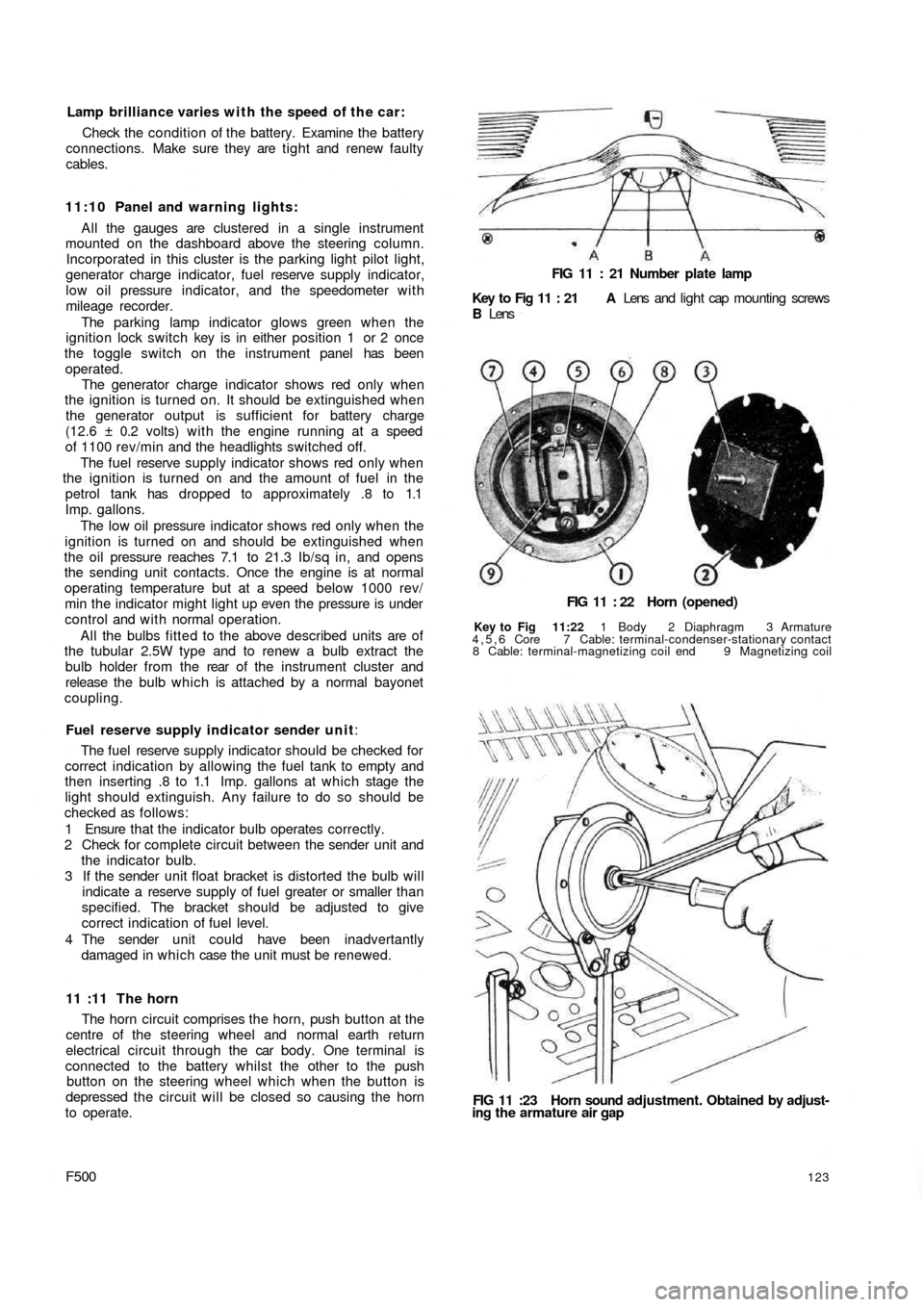
FIG 11 : 21 Number plate lamp
Key to Fig 11 : 21 A Lens and light cap mounting screws
B Lens
FIG 11 : 22 Horn (opened)
Key to Fig 11:22 1 Body 2 Diaphragm 3 Armature
4,5,6 Core 7 Cable: terminal-condenser-stationary contact
8 Cable: terminal-magnetizing coil end 9 Magnetizing coil
FIG 11 :23 Horn sound adjustment. Obtained by adjust-
ing the armature air gap
123
Page 128 of 128
cushion and back rest. A number of rubber straps are
hooked across the frame under the cushion and in a
sheath covering on the seat back.
The bottom of the front seat frame ends are provided
with sliding guides which run in guide rails attached to
the floor. The sliding guides are pivoted on the frame
tubes to allow for forward tilting of the seats giving better
access to the rear compartment. Two rubber pads
provide cushioning of the seat frame on the guide rails
as shown in FIG 12:11. The control lever for seat
adjustment is fitted in the frame righthand tube to permit
unlocking of the seats so that they may be adjusted to
individual drivers requirements.
Rear seats (Sedan):
The rear seat comprises of a foam rubber cushion and
back. The seat back is cemented to the rear floor and
body shell bulkhead. The rear seat lining is of fabric and
imitation leather. The seat lining is held in place by four
self-tapping screws, t w o of which secure the floor below
the back window and two the lining at the base of t h e
back rest. Included with the seat assembly is a masonite
floor which is fitted below the rear window.
Rear Seat (Station Wagon):
The rear seat back rest is pivoted at the base of its
frame so that it can be folded down to form a load plat-
form surface. In the upright position it is retained in place
by t w o brackets mounted on either side of the body below
the side
windows.
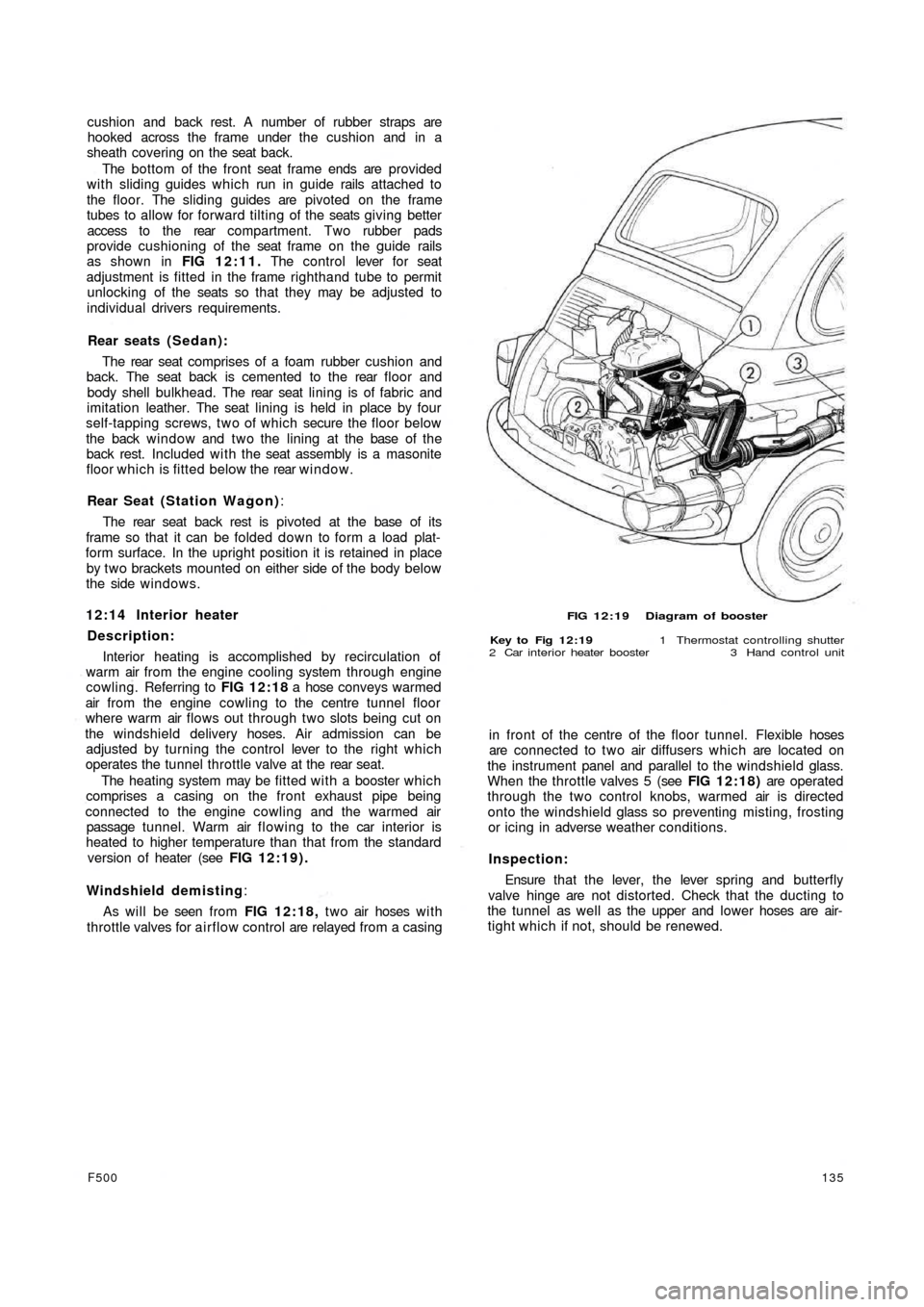
12:14 Interior heater
Description:
Interior heating is accomplished by recirculation of
warm air from the engine cooling system through engine
cowling. Referring to FIG 12:18 a hose conveys warmed
air from the engine cowling to the centre tunnel floor
where warm air flows out through two slots being cut on
the windshield delivery hoses. Air admission can be
adjusted by turning the control lever to the right which
operates the tunnel throttle valve at the rear seat.
The heating system may be fitted with a booster which
comprises a casing on the front exhaust pipe being
connected to the engine cowling and the warmed air
passage tunnel. Warm air flowing to the car interior is
heated to higher temperature than that from the standard
version of heater (see FIG 12:19).
Windshield demisting:
As will be seen from FIG 12:18, t w o air hoses w i t h
throttle valves for airflow control are relayed from a casing
F500135
FIG 12:19 Diagram of booster
Key to Fig 12:19 1 Thermostat controlling shutter
2 Car interior heater booster 3 Hand control unit
in front of the centre of the floor tunnel. Flexible hoses
are connected to two air diffusers which are located on
the instrument panel and parallel to the windshield glass.
When the throttle valves 5 (see FIG 12:18) are operated
through the two control knobs, warmed air is directed
onto the windshield glass so preventing misting, frosting
or icing in adverse weather conditions.
Inspection:
Ensure that t h e lever, the lever spring and butterfly
valve hinge are not distorted. Check that the ducting to
the tunnel as well as the upper and lower hoses are air-
tight which if not, should be renewed.