drive FIAT 500 1967 1.G Service Manual
[x] Cancel search | Manufacturer: FIAT, Model Year: 1967, Model line: 500, Model: FIAT 500 1967 1.GPages: 128, PDF Size: 9.01 MB
Page 67 of 128
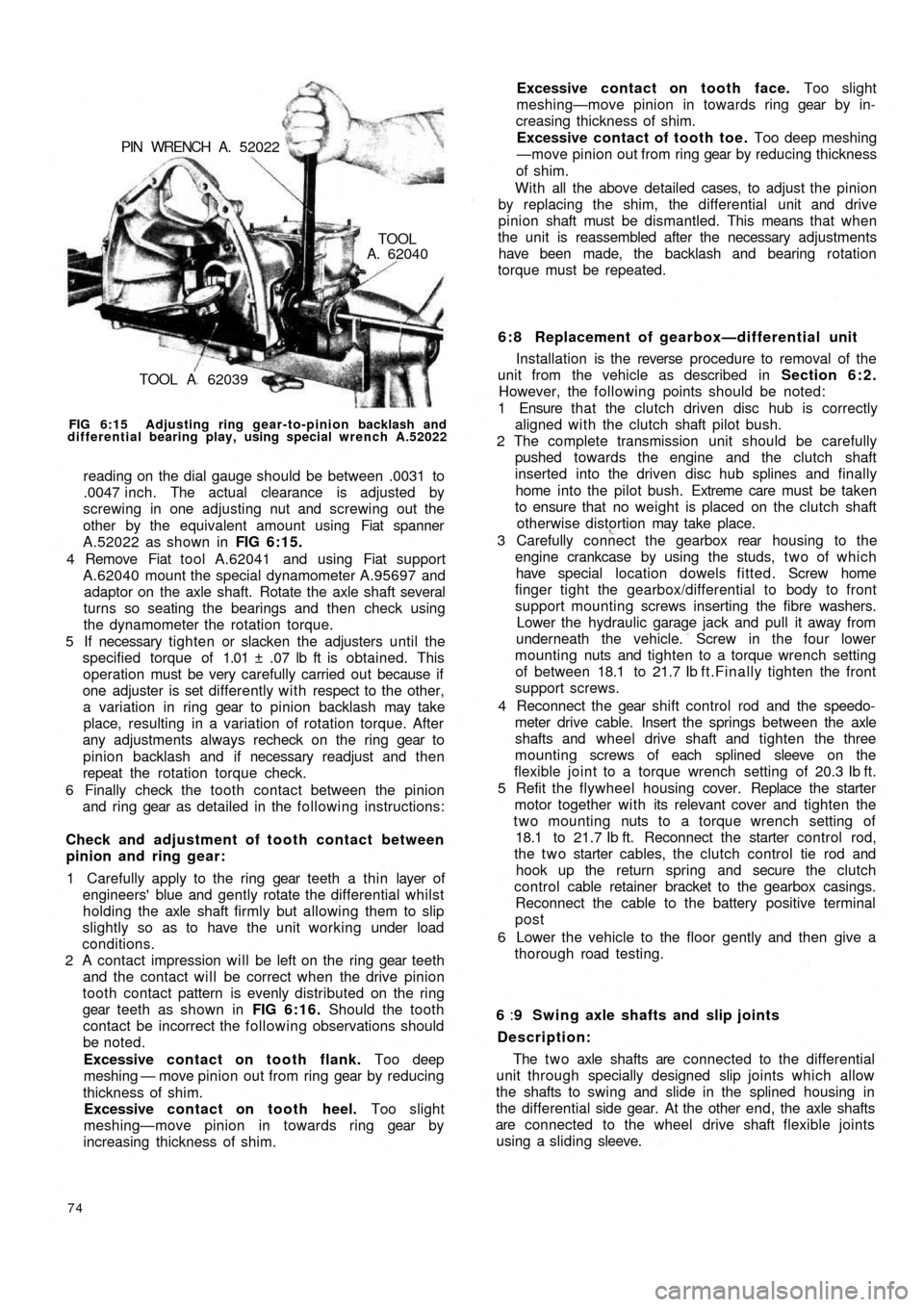
TOOL A 62039
TOOLA. 62040 PIN WRENCH A. 52022
FIG 6:15 Adjusting ring gear-to-pinion backlash and
differential bearing play, using special wrench A.52022
reading on the dial gauge should be between .0031 to
.0047 inch. The actual clearance is adjusted by
screwing in one adjusting nut and screwing out the
other by the equivalent amount using Fiat spanner
A.52022 as shown in FIG 6:15.
4 Remove Fiat tool A.62041 and using Fiat support
A.62040 mount the special dynamometer A.95697 and
adaptor on the axle shaft. Rotate the axle shaft several
turns so seating the bearings and then check using
the dynamometer the rotation torque.
5 If necessary tighten or slacken the adjusters until the
specified torque of 1.01 ± .07 lb ft is obtained. This
operation must be very carefully carried out because if
one adjuster is set differently with respect to the other,
a variation in ring gear to pinion backlash may take
place, resulting in a variation of rotation torque. After
any adjustments always recheck on the ring gear to
pinion backlash and if necessary readjust and then
repeat the rotation torque check.
6 Finally check the tooth contact between the pinion
and ring gear as detailed in the following instructions:
Check and adjustment of tooth contact between
pinion and ring gear:
1 Carefully apply to the ring gear teeth a thin layer of
engineers' blue and gently rotate the differential whilst
holding the axle shaft firmly but allowing them to slip
slightly so as to have the unit working under load
conditions.
2 A contact impression will be left on the ring gear teeth
and the contact will be correct when the drive pinion
tooth contact pattern is evenly distributed on the ring
gear teeth as shown in FIG 6:16. Should the tooth
contact be incorrect the following observations should
be noted.
Excessive contact on tooth flank. Too deep
meshing — move pinion out from ring gear by reducing
thickness of shim.
Excessive contact on tooth heel. Too slight
meshing—move pinion in towards ring gear by
increasing thickness of shim.
74
6 : 8 Replacement of gearbox—differential unit
Installation is the reverse procedure to removal of the
unit from the vehicle as described in Section 6:2.
However, the following points should be noted:
1 Ensure that the clutch driven disc hub is correctly
aligned with the clutch shaft pilot bush.
2 The complete transmission unit should be carefully
pushed towards the engine and the clutch shaft
inserted into the driven disc hub splines and finally
home into the pilot bush. Extreme care must be taken
to ensure that no weight is placed on the clutch shaft
otherwise distortion may take place.
3 Carefully connect the gearbox rear housing to the
engine crankcase by using the studs, t w o of which
have special location dowels fitted. Screw home
finger tight the gearbox/differential to body to front
support mounting screws inserting the fibre washers.
Lower the hydraulic garage jack and pull it away from
underneath the vehicle. Screw in the four lower
mounting nuts and tighten to a torque wrench setting
of between 18.1 to 21.7 Ib f t.Finally tighten the front
support screws.
4 Reconnect the gear shift control rod and the speedo-
meter drive cable. Insert the springs between the axle
shafts and wheel drive shaft and tighten the
three
mounting screws of each splined sleeve on the
flexible joint to a torque wrench setting of 20.3 Ib ft.
5 Refit the flywheel housing cover. Replace the starter
motor together with its relevant cover and tighten the
two mounting nuts to a torque wrench setting of
18.1 to 21.7 Ib ft. Reconnect the starter control rod,
the t w o starter cables, the clutch control tie rod and
hook up the return spring and secure the clutch
control cable retainer bracket to the gearbox casings.
Reconnect the cable to the battery positive terminal
post
6 Lower the vehicle to the floor gently and then give a
thorough road testing.
6 :9 Swing axle shafts and slip joints
Description:
The t w o axle shafts are connected to the differential
unit through specially designed slip joints which allow
the shafts to swing and slide in the splined housing in
the differential side gear. At the other end, the axle shafts
are connected to the wheel drive shaft flexible joints
using a sliding sleeve. Excessive contact on tooth face. Too slight
meshing—move pinion in towards ring gear by in-
creasing thickness of shim.
Excessive contact of tooth toe. Too deep meshing
—move pinion out from ring gear by reducing thickness
of shim.
With all the above detailed cases, to adjust the pinion
by replacing the shim, the differential unit and drive
pinion shaft must be dismantled. This means that when
the unit is reassembled after the necessary adjustments
have been made, the backlash and bearing rotation
torque must be repeated.
Page 70 of 128
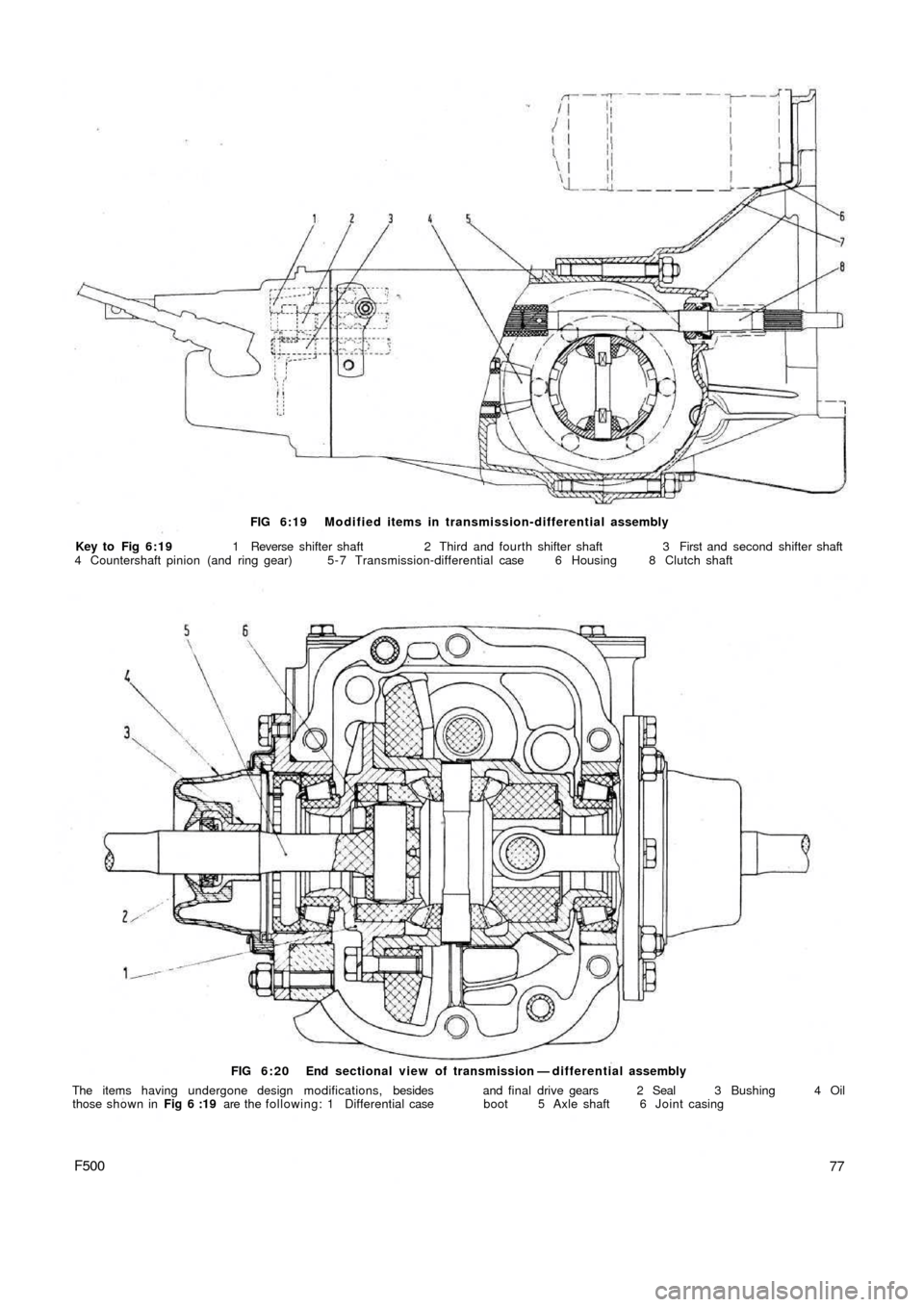
FIG 6:19 Modified items in transmission-differential assembly
Key to Fig 6:19 1 Reverse shifter shaft 2 Third and fourth shifter shaft 3 First and second shifter shaft
4 Countershaft pinion (and ring gear) 5 - 7 Transmission-differential case 6 Housing 8 Clutch shaft
FIG 6:20 End sectional view of transmission — differential assembly
The items having undergone design modifications, besides and final drive gears 2 Seal 3 Bushing 4 Oil
those shown in Fig 6 :19 are the following: 1 Differential case boot 5 Axle shaft 6 Joint casing
77F500
Page 72 of 128
CHAPTER 7
REAR SUSPENSION AND WHEELS
7:1
7:2
7:3
7:4Description
Removal of rear suspension assembly
Servicing swinging arms
Coil springs
7:1 Description
The rear wheels are independently sprung by means of
coil springs and V-shaped swinging arms acting on coil
springs and telescopic double acting hydraulic shock
absorbers. The swinging arms are m o u n t e d at their inner
ends on 'estendblocks', the coil spring is fitted at the outer
end of the swinging arm. At the wheel end of the suspen-
sion arm is attached a steel pressing to which the brake
backplate and wheel bearing housing are bolted so
forming a swinging unit to which is attached the road
wheel.
The inner pivots are so located vertical wheel move-
ments do not influence the drive shaft length which
means that there is no need to fit a splined joint at the
wheel end. Two taper roller bearings which are separated
by a specially designed collapsible spacer are located in
the rear wheel bearing housing and this carries the axle
shaft. The outer end of the axle shaft is flanged and it
is to this flange that the brake drum is bolted. The splined
inner end carries a rubber cushioned coupling to which
the drive shaft flange is attached.
7 : 2 Removal of rear suspension assembly
1 Jack-up the vehicle and place on firmly based stands.
Remove the road wheel on the side from which the
suspension unit is to be removed.
F50079 7:5
7:6
7:7
7:8Installation of rear suspension assembly
Checking and adjusting rear wheel toe-in
Modifications
Fault diagnosis
2 Using a garage hydraulic jack support the swinging
arm to facilitate the removal of the upper shock
absorber mounting nut which is located inside the
vehicle on the floor. To gain access to the nut remove
the rear wheel housing linings.
3 Unhook the parking brake shoe control lever return
spring.
4 Remove the three screws securing the drive shaft
flange to the flexible coupling. Pull back the sleeve and
remove the inner spring.
5 Remove the brake fluid reservoir cap, remove the filter
and plug the delivery hole in the brake f l u i d reservoir
and disconnect the flexible brake pipe from the
bracket on the body floor.
6 Disconnect the parking brake control tie rod by first
removing the cotter pin and removing the cable eye
from the pin on the shoe control lever. Release the
cable adjustment nuts and free the cable from the
fairlead on the swinging arm.
7 Using the hydraulic jack carefully lower the swinging
arm, fully retract the shock absorber by pushing in the
outer cylinder and carefully pull out the coil spring
together with its mounting rubber rings.
8 Remove the self-locking nut securing the swinging
arm to the internal support welded on the floor.
Extract the mounting pin and note the number and
arrangement of shims between the bushings and the
bracket. This will facilitate reassembly.
Page 84 of 128
2 Check that the surface of the pin that is in contact with
the camber and castor adjuster shims does not show
any signs of indentation or roughness which could
affect the accuracy of adjustment on reassembly. If
there are any signs of rust or small markings these
should be smoothed out using a file.
3 Inspect the condition of the half arm bushes, the inner
surface of which must not show signs of seizure and
the clearance of the bush to pin must not be greater
than .01 57 inch. Upon initial assembly the fit clearance
is .00059 to .0059 inch. Ensure t h a t the rubber parts
of the bush are not torn, cracked or show signs of
weakness which, if evident, must be renewed.
4 Use Fiat tool A.66058 or a suitably sized drift for
refitting the rubber bushes into the swinging arms.
Upon reassembly it should be observed that the
tightening of the two swinging arms m o u n t i n g nuts 5
(see FIG 8 : 3) , must be carried out whilst keeping
the axis of the swinging arm and the pin hole for the
screws 7 on the same plane otherwise distortion can
occur.
8 : 5 Kingpin housing
1 To remove and replace the 'estendblocks' use Fiat
tool A.66056 as shown in FIG 8 : 8. Ensure t h a t the
'estendblocks' is not worn and that there are no signs
of seizure on its inner surface, or that the rubber has
hardened. Renew if necessary.
2 Check that the kingpin to bush clearance is not
greater than .0079 inch. The clearance when fitted
new is .00063 to .00213 inch. If the clearance is
excessive the t w o bushes must be renewed and also
the kingpin if excessive wear is evident. To remove and
refit the kingpin bushes use Fiat tool A.66016 and
after reassembly the bushes must be accurately
refaced using a reamer set to a diameter of .5912 to
.5922 inch. If considered necessary use Fiat Fixture
C.1004 to check that the kingpin housing has not been
distorted which, if evident, the housing must be
renewed.
3 Whilst the kingpin assembly is being inspected ensure
that the lubrication hole is free to allow the passage of
oil.
4 To prevent incorrect loading of the 'estendblocks' that
is press fitted into the kingpin housing, the housing
to swinging arm pin nut must be tightened with the
parts so arranged that the angle between the swinging
arm plane and the housing axis is approximately
95 deg. as shown in FIG 8:14.
8:6 Steering knuckle and wheel hub
Dismantling:
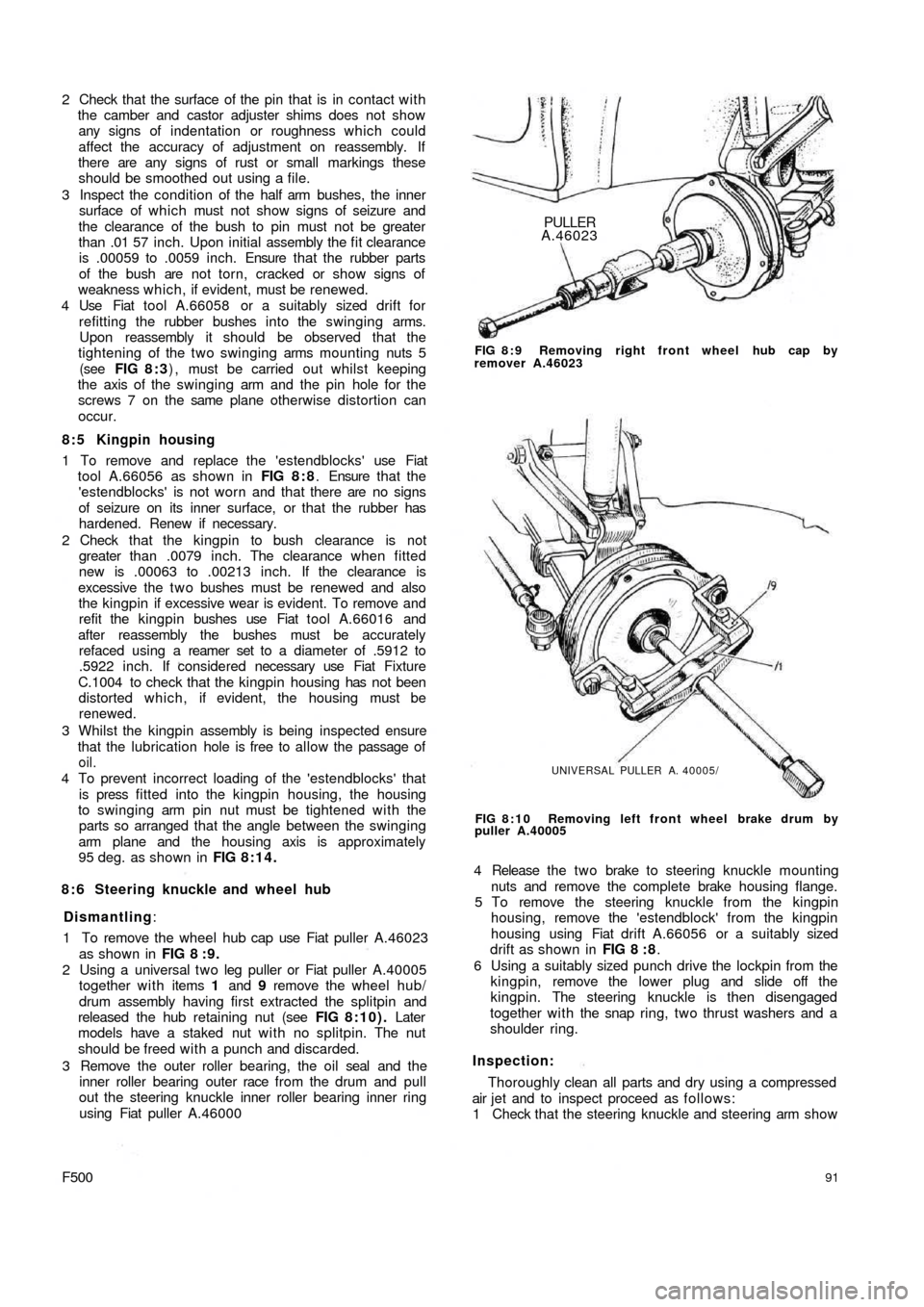
1 To remove the wheel hub cap use Fiat puller A.46023
as shown in FIG 8 : 9 .
2 Using a universal t w o leg puller or Fiat puller A.40005
together with items 1 and 9 remove the wheel hub/
drum assembly having first extracted the splitpin and
released the hub retaining nut (see FIG 8:10). Later
models have a staked nut w i t h no splitpin. The nut
should be freed with a punch and discarded.
3 Remove the outer roller bearing, the oil seal and the
inner roller bearing outer race from the drum and pull
out the steering knuckle inner roller bearing inner ring
using Fiat puller A.46000
F500PULLER
A.46023
FIG 8 : 9 Removing right front wheel hub cap by
remover A.46023
UNIVERSAL PULLER A. 40005/
FIG 8:10 Removing left front wheel brake drum by
puller A.40005
4 Release the t w o brake to steering knuckle mounting
nuts and remove the complete brake housing flange.
5 To remove the steering knuckle from the kingpin
housing, remove the 'estendblock' from the kingpin
housing using Fiat drift A.66056 or a suitably sized
drift as shown in FIG 8 : 8.
6 Using a suitably sized punch drive the lockpin from the
kingpin, remove the lower plug and slide off the
kingpin. The steering knuckle is then disengaged
together with the snap ring, two thrust washers and a
shoulder ring.
Inspection:
Thoroughly clean all parts and dry using a compressed
air jet and to inspect proceed as follows:
1 Check that the steering knuckle and steering arm show
91
Page 86 of 128
8 : 7 Hydraulic damper:
Description:
The front and rear shock absorbers are of the telescopic
double acting type. Their dampening action takes place
directly on the suspension without the use of any
intermediate linkage. The shock absorber comprises a
cylindrical body formed by to coaxial tubes 14 and 15
(see FIG 8:11), the inner tube acting as the working
cylinder and the outer one as a casing. The fluid reservoir
being located between the two sections. A third outer
cylinder 13 shields the rod 2 from any road dirt.
On the top the cylinder body is enclosed by a bush 1 1 ,
oil seals 5 and 9 and a housing 4. The rod 2 slides through
the seals 5, the upper end is fixed into the vehicle body
floor and its lower end carries the piston 22 on which
rebound 26 and inlet valves 21 are arranged.
The bottom of the shock absorber is closed by a plug
35 with a threaded shank 36 for the shock absorber to be
mounted onto the suspension unit. The cylinder 15 and
carrier plug 32 is mounted with a compensation valve
30 and a compression valve 33. The piston is provided
with two rows of orifices. The internal row is blanked
underneath by the rebound valve which operates
downwards. The external row is blanked by the inlet
valve which opens upwards. Hydraulic shock absorbers
fitted since March 1959 are provided w i t h a vapour
pocket bleeder from the cylinder exterior. The bleeder
device comprises a capillary
hole 12 interconnecting the
inner cylinder 15 with the upper chamber 10 and also a
passage tube 16 from the upper chamber to the fluid
reservoir. Any vapour pockets in the pressure cylinder
are excluded past the capillary hole 12 into the chamber
10 from which they flow downwards during shock
absorber operation through the passage 16 in a light
fluid stream and up to the top of the reservoir with the
reservoir fluid.
Dismantling and inspection:
Normally during service if a shock absorber becomes
weak in operation then a new unit should be fitted.
Should however, it be necessary for the original unit to
be overhauled proceed as follows:
1 Thoroughly clean the outer casing in petrol and blow
dry using a compressed air jet.
2 Firmly clamp the lower shank of the shock absorber
in a vice and telescope upwards the outer casing and
using Fiat wrench A.56024 unscrew the upper
threaded ring 3 (see FIG 8:11).
3 Remove the shock absorber from the vice and carefully
remove the inner cylinder 15 using a screwdriver
inserted in the cylinder bottom chamfer and remove
the lower plug 32 which carries the compression and
compensation valves.
4 Push the rod i n t o the cylinder 15 and clamp the upper
shank in a vice. Unscrew the plug 29, and carefully
remove the piston 22 together with the inlet and
rebound valves. Withdraw the rod 2 from the cylinder
15 and remove the seal gasket, the housing, and
threaded ring. Thoroughly wash all parts in petrol and
carefully blow dry using a c
ompressed air jet. The
following parts should be inspected as follows.
Check that the inlet, rebound and compensation valve
discs are not deformed or show signs of cracking.
F50093 Inspect the surfaces of the piston, the seal ring and the
compression valve to ensure that they are smooth and
hydraulic fluid tight. Check that the rebound and
compression valve springs and upper seal gasket
springs are not broken or weak. Carefully inspect the
t w o seal gaskets for damage or wear and it is recom-
mended that they are renewed upon reassembly.
Check that the rod and the cylinders show no sign of
deformation and that the air pocket evacuating
passage is not blocked. Also check that the capillary
hole 12 is not blocked. Any parts which show signs
of wear or damage must be renewed.
Reassembly:
Reassembly of the shock absorber is the reverse
procedure to dismantling. Special care must be taken
when refilling the shock absorber w i t h Fiat SA1 oil
otherwise its operating characteristics will be altered.
The hydraulic fluid capacity for the front shock
absorbers is .112 imperial quarts.
The hydraulic capacity for the rear shock absorbers is
.088 imperial quarts. Only Fiat—SA1 oil must be
used.
To insert the components into the shock absorber
body proceed as follows:
1 Mount the piston on the rod, and insert the piston and
rod assembly into the cylinder 15 (see FIG 8:11).
2 Push the piston against the bush 11 and then very
carefully pour the correct amount of hydraulic fluid
up to about j inch from the edge.
3 Press f i t t h e plug 32 and pour the remaining fluid into
the casing 14.
4 Insert the cylinder 15 into the casing 14 and tighten
the upper threaded ring 3.
8 :8 Front suspension assembly and installation
1 Attach Fiat fixture A.66061 to the springs as shown
in FIG 8:12 and load it using the centre screw on the
fixture until the index 'Nuova 500' appears below
the crossbeam lower edge. It is in this position the
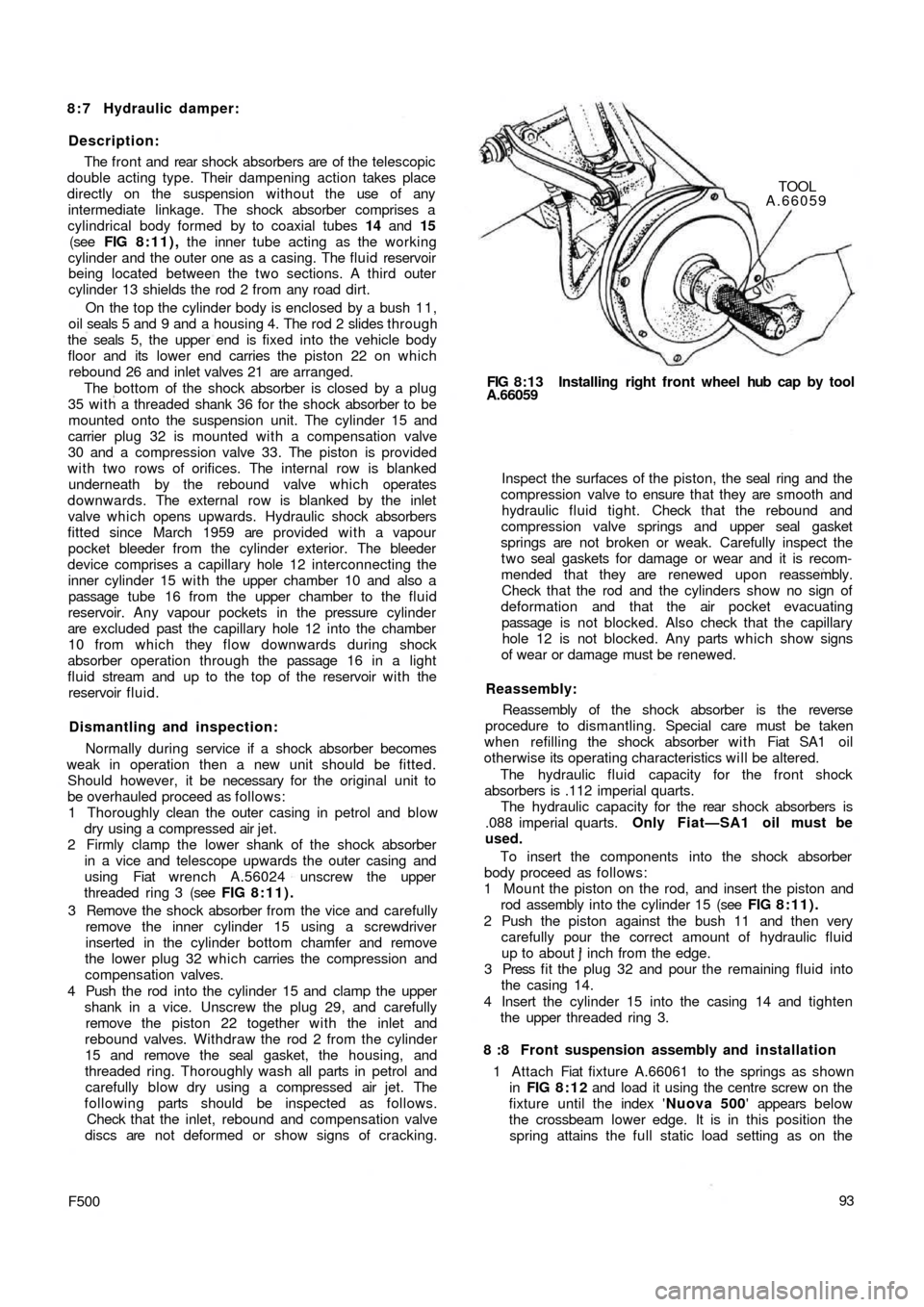
spring attains the full static load setting as on the FIG 8:13 Installing right front wheel hub cap by tool
A.66059TOOL
A.66059
Page 105 of 128
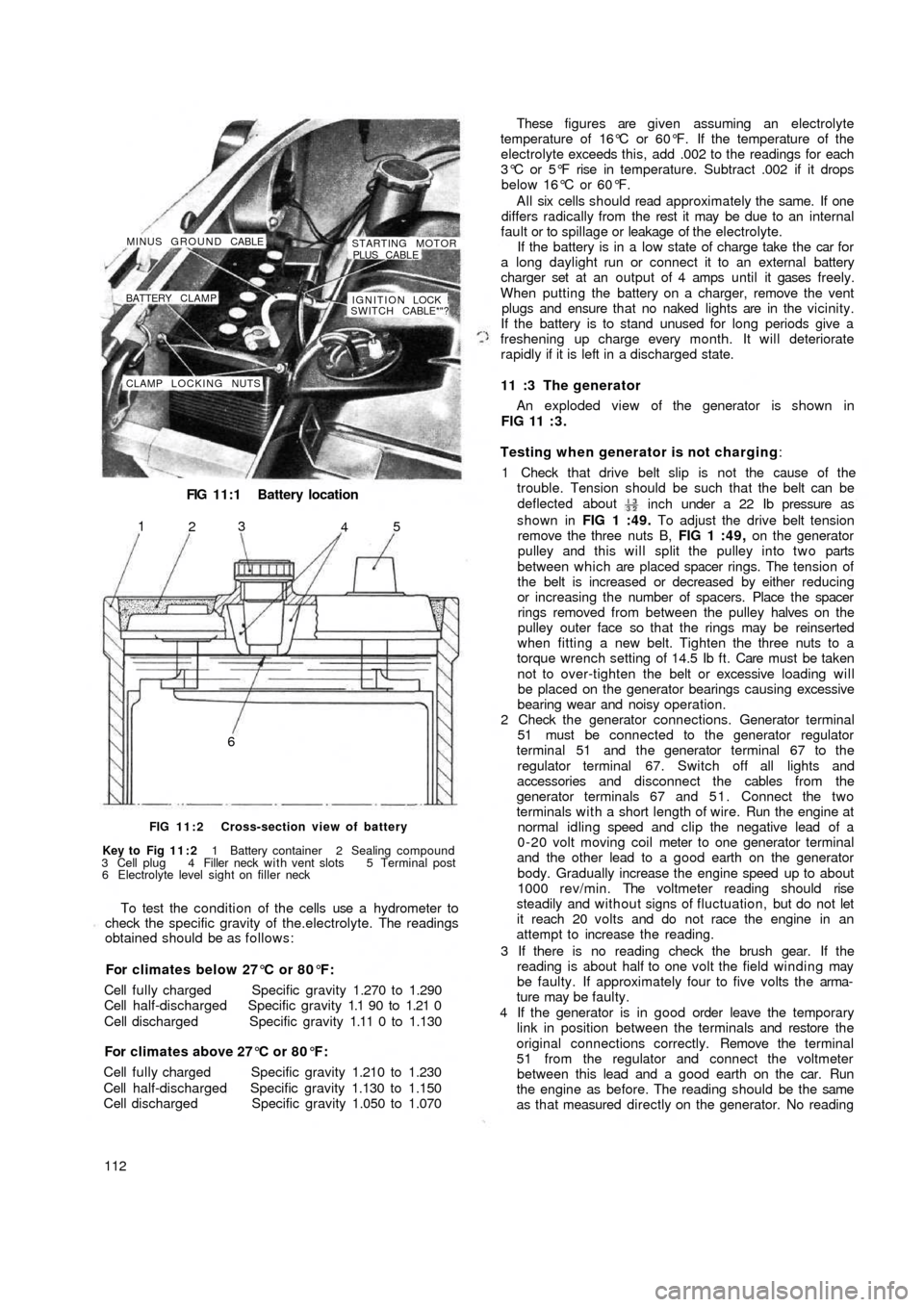
FIG 11:1 Battery location
CLAMP LOCKING NUTSIGNITION LOCK !
SWITCH CABLE*"? BATTERY CLAMP MINUS GROUND CABLE
STARTING MOTOR
PLUS CABLE
65
4 3
2 1
FIG 11:2 Cross-section view of battery
Key to Fig 11:2 1 Battery container 2 Sealing compound
3 Cell plug 4 Filler neck with vent slots 5 Terminal post
6 Electrolyte level sight on filler neck
To test the condition of the cells use a hydrometer to
check the specific gravity of the.electrolyte. The readings
obtained should be as follows:
For climates below 27°C or 80°F:
Cell fully charged Specific gravity 1.270 to 1.290
Cell half-discharged Specific gravity 1.1 90 to 1.21 0
Cell discharged Specific gravity 1.11 0 to 1.130
For climates above 27°C or 80°F:
Cell fully charged Specific gravity 1.210 to 1.230
Cell half-discharged Specific gravity 1.130 to 1.150
Cell discharged Specific gravity 1.050 to 1.070
112These figures are given assuming an electrolyte
temperature of 16°C or 60°F. If the temperature of the
electrolyte exceeds this, add .002 to the readings for each
3°C or 5°F rise in temperature. Subtract .002 if it drops
below 16°C or 60°F.
All six cells should read approximately the same. If one
differs radically from the rest it may be due to an internal
fault or to spillage or leakage of the electrolyte.
If the battery is in a low state of charge take the car for
a long daylight run or connect it to an external battery
charger set at an output of 4 amps until it gases freely.
When putting the battery on a charger, remove the vent
plugs and ensure that no naked lights are in the vicinity.
If the battery is to stand unused for long periods give a
freshening up charge every month. It will deteriorate
rapidly if it is left in a discharged state.
11 :3 The generator
An exploded view of the generator is shown in
FIG 11 : 3 .
Testing when generator is not charging:
1 Check that drive belt slip is not the cause of the
trouble. Tension should be such that the belt can be
deflected about
inch under a 22 Ib pressure as
shown in FIG 1 :49. To adjust the drive belt tension
remove the three nuts B, FIG 1 :49, on the generator
pulley and this will split the pulley into two parts
between which are placed spacer rings. The tension of
the belt is increased or decreased by either reducing
or increasing the number of spacers. Place the spacer
rings removed from between the pulley halves on the
pulley outer face so that the rings may be reinserted
when fitting a new belt. Tighten the three nuts to a
torque wrench setting of 14.5 Ib ft. Care must be taken
not to over-tighten the belt or excessive loading will
be placed on the generator bearings causing excessive
bearing wear and noisy operation.
2 Check the generator connections. Generator terminal
51 must be connected to the generator regulator
terminal 51 and the generator terminal 67 to the
regulator terminal 67. Switch off all lights and
accessories and disconnect the cables from the
generator terminals 67 and 5 1 . Connect the two
terminals with a short length of wire. Run the engine at
normal idling speed and clip the negative lead of a
0-20 volt moving coil meter to one generator terminal
and the other lead to a good earth on the generator
body. Gradually increase the
engine speed up to about
1000 rev/min. The voltmeter reading should rise
steadily and without signs of fluctuation, but do not let
it reach 20 volts and do not race the engine in an
attempt to increase the reading.
3 If there is no reading check the brush gear. If the
reading is about half to one volt the field winding may
be faulty. If approximately four to five volts the arma-
ture may be faulty.
4 If the generator is in good order leave the temporary
link in position between the terminals and restore the
original connections correctly. Remove the terminal
51 from the regulator and connect the voltmeter
between this lead and a good earth on the car. Run
the engine as before. The reading should be the same
as that measured directly on the generator. No reading
Page 106 of 128
indicates a break in the cable from the generator to
regulator. Repeat the test on terminal 67. Finally,
remove the temporary link from the generator. If the
readings are correct, test the regulator as described in
Section 11:5.
Removing generator:
1 Disconnect the leads from the generator.
2 Remove the drive belt as previously described.
3 Release t h e rear mounting bracket at the side of the
power unit.
4 Remove the air cooling ducting from around the fan
and generator area and lift away the unit.
5 Release the blower from the end of the armature shaft
and finally, the mounting bolts from the air ducting.
Dismantling generator:
1 Release the pulley self-locking nut and slide the pulley
off the armature shaft.
2 Remove the t w o Woodruff keys on armature shaft.
3 Unscrew the t w o through bolt nuts and pull out the
bolts.
4 Partially remove the commutator end head to the point
where the brushes are. s t i l l seating on the commutator.
Using a piece of hooked wire relieve the load of the
springs on the brushes by arranging the spring ends
on the brush sides. The brushes will be locked in their
holders and cannot be chipped by striking against the
armature shaft during the commutator end head
removal.
5 Gently ease the commutator and fan end heads apart
and, slide out the armature.
Servicing brushes:
Lift the brushes up in the boxes and hold them in that
position by letting each brush spring bear on the side of
its brush. Fit the commutator end bracket over the
commutator end of the armature shaft and release the
brushes by hooking up the springs using a thin screw
driver. Hold back each spring in turn and move the brush
by pulling gently on the flexible connector. If the brush
moves sluggishly remove it and polish the sides using a
smooth file. Before this operation is actually carried out it
is suggested that the brush is marked before removal so
that it is replaced in its original working position.
inch,The minimum permissible length of a brush is
so renew any t h a t are less than this figure. Test the brush
springs using a spring tension scale. New springs should
have a tension of 1.3 to 1.6 Ib. In service this value could
fall slightly before performance is affected. Always bed in
new brushes by wrapping fine sandpaper round the
commutator, pressing down on the brush and rotating
the commutator under it, or draw the paper t o o and f r o .
If new brushes are fitted always fit genuine Fiat replace-
ments.
Servicing the commutator:
A commutator in good condition should be smooth and
free from pitting or signs of the segments burning. Clean
with a rag moistened in petrol. If necessary, polish using
a fine glasspaper whilst rotating the armature. Never use
emerycloth.
If the commutator is badly worn it may be skimmed
using a centre lathe. Use a high rotational speed and take
F500113
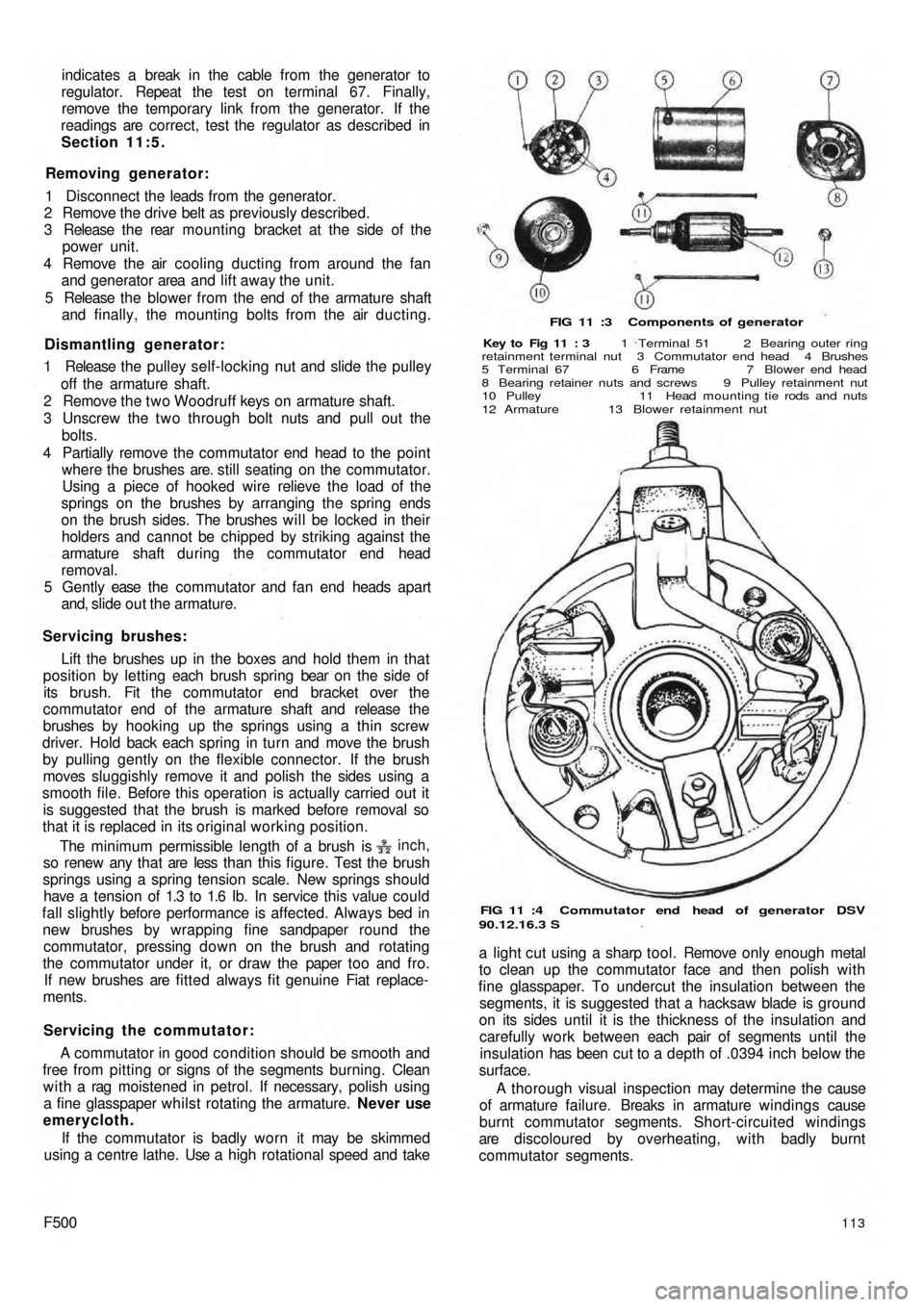
FIG 11 :3 Components of generator
Key to Fig 11 : 3 1 Terminal 51 2 Bearing outer ring
retainment terminal nut 3 Commutator end head 4 Brushes
5 Terminal 67 6 Frame 7 Blower end head
8 Bearing retainer nuts and screws 9 Pulley retainment nut
10 Pulley 11 Head mounting tie rods and nuts
12 Armature 13 Blower retainment nut
FIG 11 :4 Commutator end head of generator DSV
90.12.16.3 S
a light cut using a sharp tool. Remove only enough metal
to clean up the commutator face and then polish with
fine glasspaper. To undercut the insulation between the
segments, it is suggested that a hacksaw blade is ground
on its sides until it is the thickness of the insulation and
carefully work between each pair of segments until the
insulation has been cut to a depth of .0394 inch below the
surface.
A thorough visual inspection may determine the cause
of armature failure. Breaks in armature windings cause
burnt commutator segments. Short-circuited windings
are discoloured by overheating, with badly burnt
commutator segments.
Page 107 of 128
1
791011 8 234
11
10
16,15
14 13
1265
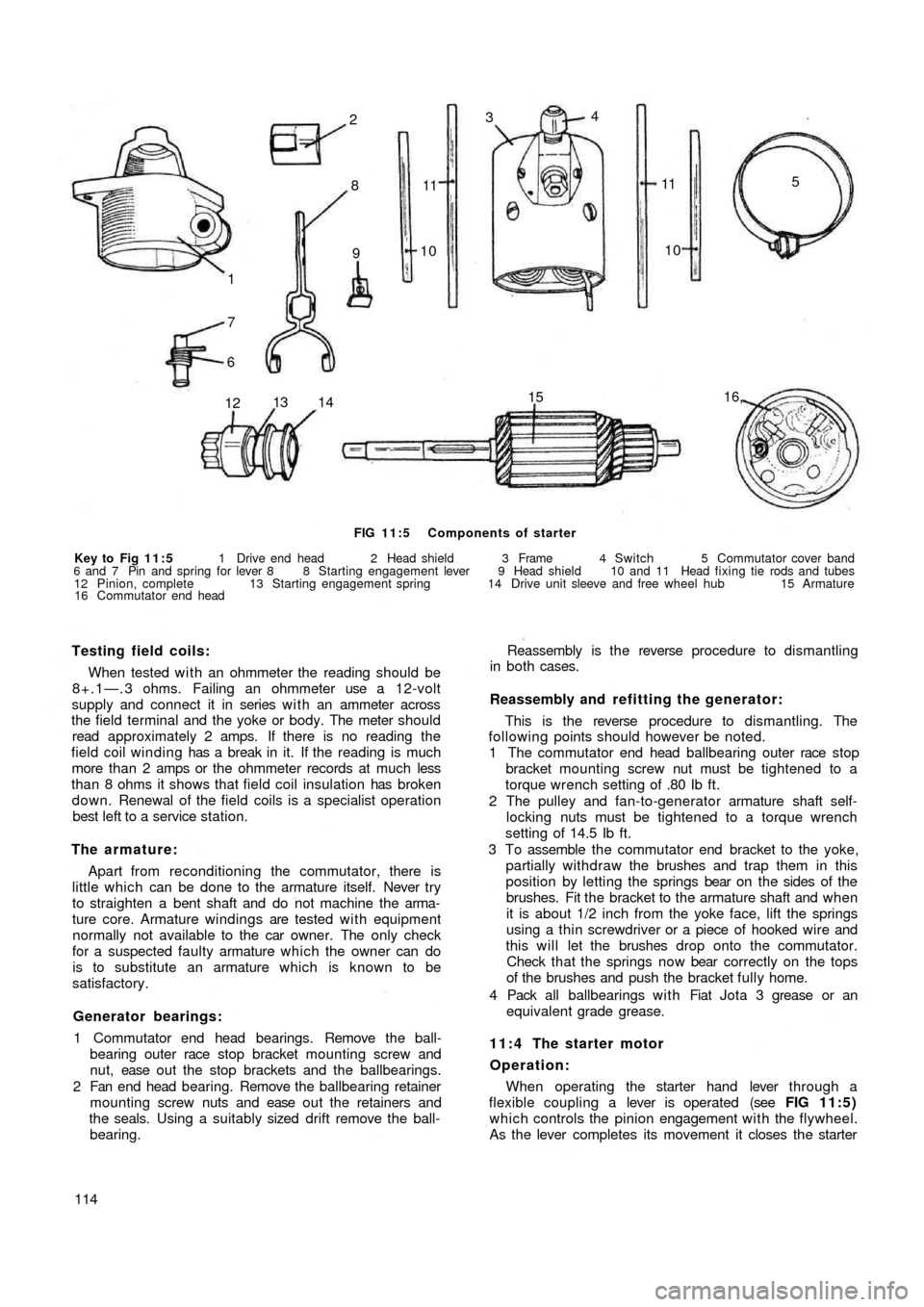
FIG 11:5 Components of starter
Key to Fig 11:5 1 Drive end head 2 Head shield 3 Frame 4 Switch 5 Commutator cover band
6 and 7 Pin and spring for lever 8 8 Starting engagement lever 9 Head shield 10 and 11 Head fixing tie rods and tubes
12 Pinion, complete 13 Starting engagement spring 14 Drive unit sleeve and free wheel hub 15 Armature
16 Commutator end head
Testing field coils:
When tested w i t h an ohmmeter the reading should be
8+.1—.3 ohms. Failing an ohmmeter use a 12-volt
supply and connect it in series w i t h an ammeter across
the field terminal and the yoke or body. The meter should
read approximately 2 amps. If there is no reading the
field coil winding has a break in it. If the reading is much
more than 2 amps or the ohmmeter records at much less
than 8 ohms it shows that field coil insulation has broken
down. Renewal of the field coils is a specialist operation
best left to a service station.
The armature:
Apart from reconditioning the commutator, there is
little which can be done to the armature itself. Never try
to straighten a bent shaft and do not machine the arma-
ture core. Armature windings are tested w i t h equipment
normally not available to the car owner. The only check
for a suspected faulty armature which the owner can do
is to substitute an armature which is known to be
satisfactory.
Generator bearings:
1 Commutator end head bearings. Remove the ball-
bearing outer race stop bracket mounting screw and
nut, ease o u t t h e stop brackets and the ballbearings.
2 Fan end head bearing. Remove the ballbearing retainer
mounting screw nuts and ease o u t t h e retainers and
the seals. Using a suitably sized drift remove the ball-
bearing.
114Reassembly is the reverse procedure to dismantling
in both cases.
Reassembly and refitting the generator:
This is the reverse procedure to dismantling. The
following points should however be noted.
1 The commutator end head ballbearing outer race stop
bracket mounting screw nut must be tightened to a
torque wrench setting of .80 Ib ft.
2 The pulley and fan-to-generator armature shaft self-
locking nuts must be tightened to a torque wrench
setting of 14.5 Ib ft.
3 To assemble the commutator end bracket to the yoke,
partially withdraw the brushes and trap them in this
position by letting the springs bear on the sides of the
brushes. Fit the bracket to the armature shaft and when
it is about 1/2 inch from the yoke face, lift the springs
using a thin screwdriver or a piece of hooked wire and
this will let the brushes drop onto the commutator.
Check that the springs now bear correctly on the tops
of the brushes and push the bracket fully home.
4 Pack all ballbearings with Fiat Jota 3 grease or an
equivalent grade grease.
11:4 The starter motor
Operation:
When operating the starter hand lever through a
flexible coupling a lever is operated (see FIG 11:5)
which controls the pinion engagement with the flywheel.
As the lever completes its movement it closes the starter
Page 108 of 128
switch contacts. The starter motor rotates driving the
engine through the pinion and ring gear. As soon as the
engine fires the starter hand lever must be released which
will open the starter switch contacts so stopping the
starter motor and the pinion will return under the action
of a spring to a neutral position.
Tests for a starter which does not operate:
Check the condition of the battery and particularly
the connections to the terminals and to earth. If the
battery is charged, switch on the lights and operate the
starter hand lever control. If the lights go dim but the
starter does not operate it shows that current is reaching
the starter motor. The probability is that the pinion of the
starter shaft is jammed in mesh due to dirty pinion splines
or a broken spring. To release the pinion engage a low
gear with the ignition switched off and rock the vehicle
backwards and forwards which should allow the pinion
to be disengaged from the flywheel ring gear. If it proves
impossible to free a jammed pinion the starter motor must
be removed for examination and repair.
If the lamps do not go dim, check the starter switch and
also check the connection between the battery and the
starter switch to ensure that they are tight and making
good electrical connection. If the starter motor still does
not work it should be removed from the power unit for
inspection.
Removing the starter:
To remove the starter motor from the power unit
proceed as follows:
1 Disconnect the positive terminal from the
battery post.
2 Release the hand lever control cable from the starter
motor engagement lever.
3 Disconnect the battery cable terminal from the starter
motor switch.
4 Remove the retaining nuts and washers holding the
starter motor to body to the transmission bellhousing
and gently ease backwards and lift away the starter
motor.
Examining the commutator and brush gear :
Refer to FIG 11:5 and remove the coverband 5. Hold
back each spring in turn and pull gently on the flexible
connection to the brush. If the brush does not move
freely remove it from its holder and polish the sides using
a fine file. Mark the brushes so that they will be replaced
in their original positions. If the brushes are so worn that
they no longer bear onto the commutator, or the brush
connector has become exposed on the running face, the
brushes must be renewed.
If the commutator is blackened it should be cleaned by
turning it against a petrol-moistened cloth. With the
brushes and commutator overhauled hold the body of the
starter motor in a vice and connect it with thick cables to a
12 volt battery. One cable should go to the starter
switch terminal and the other to the body of the starter.
The starter should run at high speed. If it does not, it
must be dismantled for further examination and testing.
F500115 Dismantling the starter:
To dismantle the starter proceed as follows:
1 Remove the coverband 5 (see FIG 11:5) and hold
back the brush springs and take out the brushes.
2 Remove the starter switch by releasing the t w o
mounting screws and lift away the switch.
3 Remove the commutator end head 16, slide off the
armature assembly from the drive unit and from the
pole shoes.
4 Release the engagement lever pin 6 and spring 7 from
the lever operating bracket on the drive end head. Lift
away the lever and withdraw the pinion assembly
complete which is shown in FIG 11:5.
Servicing the brushes
Test the brush springs with a balance, the correct
tension is 2.5 to 2.9 Ib. according to the wear of the
brushes. Fit a new spring if the tension is low.
The life of the brushes depends on the type of service
in which the vehicle is being used. In normal circum-
stances even when the starter is being used frequently,
the brushes should last more than 18,000 miles. If the
wear is found to be abnormal it will probably be found
that the commutator is either damaged or excessively
w o r n . Only Fiat replacement brushes must be used.
Testing the field coils:
Use a 12 volt bulb in one lead of a 12 volt battery.
Connect one lead to the brush connection joint to the coil
field and the other to the field coil current supply lead.
If the bulb does not light there is a break in the f i e l d coil
windings. This is not a complete test as it is still possible
for a coil to be earthed. Check this by moving the lead
from the brush connection and holding it on a clean
metal
surface on the yoke or body. If the bulb lights it shows
that the field coils are earthed.
The only sure way of curing faulty field coils is to take
the starter motor to a service station.
Examining the armature:
The armature shaft may be bent due to the starter
being operated whilst the engine is operating. Do not try
to straighten a bent shaft or machine the armature core to
obtain the correct clearance.
If the commutator is damaged or any wires or segments
have lifted from it, the assembly will have to be renewed.
Starter bearings:
Bearing bushes are of the porous bronzed type and
must not be reamed after fitting. Worn bearings should
be withdrawn by screwing a tap into them and pulling
on the tap. New bushes must be immersed in engine oil
for approximately twenty four hours before fitting. Press
them into place using a suitably sized drift which has a
spigot the length of the bearing and the diameter of the
starter shaft. When this is withdrawn after fitting, the
bore of the bush should be correct to size.
The pinion drive:
This unit is shown in FIG 11:5. The chief sources of
trouble are a dirty unit or a broken starting engagement
Page 109 of 128
4
53 2 1
7
6
FIG 11 :6 Regulator assembly GN 1.12.16
Key to Fig 11:6 1 Voltage regulator adjusting spring
2 Current regulator adjusting spring 3 Cutout adjusting
spring 4 Voltage regulator adjustment arm 5 Current
regulator adjustment arm 6 Cutout adjustment blade spring
7 Soldering of cutout shunt and series winding
FIG 11:7 Wiring diagram for checking the cutout
closing voltage
Key to Fig 1 1 : 7 GR Regulator GN 1.12.16 G Generator
FIAT DSV 90.12.1 6.3 S V Voltmeter, 20 V scale (0.5%
accuracy) L 12 V, 3 to 5 W bulb
FIG 11:8 Wiring diagram for checking the reverse
current of cutout
Key to Fig 11:8 GR Regulator GN 1.1 2.1 6 G Generator
FIAT DSV 90.1 2.1 6.3 S B Battery, 50 Ah, fully charged
A Ammeter, asymmetrical scale 10-0-15 A V Voltmeter,
20 V scale (0.5% accuracy)
116spring 13. Should any defect be found then the pinion
assembly must be renewed as one complete unit. After
examining to ensure that there are no defects thoroughly
clean using petrol.
Reassembling and refitting the starter:
In both cases this is a simple reversal of the dismantling
procedure. Grease t h e drive splines and the engagement
lever groove in the sleeve.
11:5 The control box:
Description:
The generator regulator fitted to the new 500 model
consists of three separate
units; voltage regulator,
current regulator, cut-out relay (see FIG 11 :6).
The voltage regulator and current regulator relays
comprise a U-shaped body one of whose arms is bent
to form a flange, whilst the other adjustment arm pro-
vides a stop for the hinge spring. The U-shaped body is
secured to the frame by the core threaded shank and
carries, on the flanged end, an armature supported by a
hinge spring which comprises a steel leaf and bi-metal
leaf overimposed in the current regulator and bi-metal
leaf in the voltage regulator. The armature carries the
movable contact.
Fixed contacts of both voltage and current regulators
are mounted on t w o blade springs which are secured to a
single bracket rivetted to the U-shaped adjustment arm.
The design of the t w o fixed contacts carrier blade springs
is such as to permit the adjustment of the contact
position by suitably bending the blade springs. The cut-
out is similar in design to the other two relays as shown
in FIG 11:6. Again the hinge spring is bi-metallic as in
the voltage regulator.
All the armatures are provided w i t h blade springs, so
that the tension may be adjusted to the required setting
value. This adjustment is obtained by bending the
adjustment arms.
The voltage regulator coil comprises a fine wire wind-
ing w i t h a great number of turns, shunt connected to the
generator.
The cut-out coil comprises a fine wire winding with a
great number of turns shunt connected to the generator,
and of a winding comprising a few turns of heavy gauge
wire, which is connected in series w i t h the generator
charge circuit (cut-out series winding).
The current regulator coil comprises a few turns of
heavy gauge wire which is series connected with the
generator charge circuit.
The generator regulator base has three terminals to
which the various cables are connected.
No. 51 — connection to generator positive terminal.
No. 67 — connection to generator field winding.
No. 30 — connection to electrical accessories.
The regulator cover is secured to the base w i t h a
rubber gasket placed in between which seals the unit
against the ingress of moisture or dust.
A regulation resistor is fitted under the base and is
secured to the voltage regulator and current regulator
relay core threaded shanks.