mount FIAT 500 1971 1.G Manual PDF
[x] Cancel search | Manufacturer: FIAT, Model Year: 1971, Model line: 500, Model: FIAT 500 1971 1.GPages: 128, PDF Size: 9.01 MB
Page 113 of 128
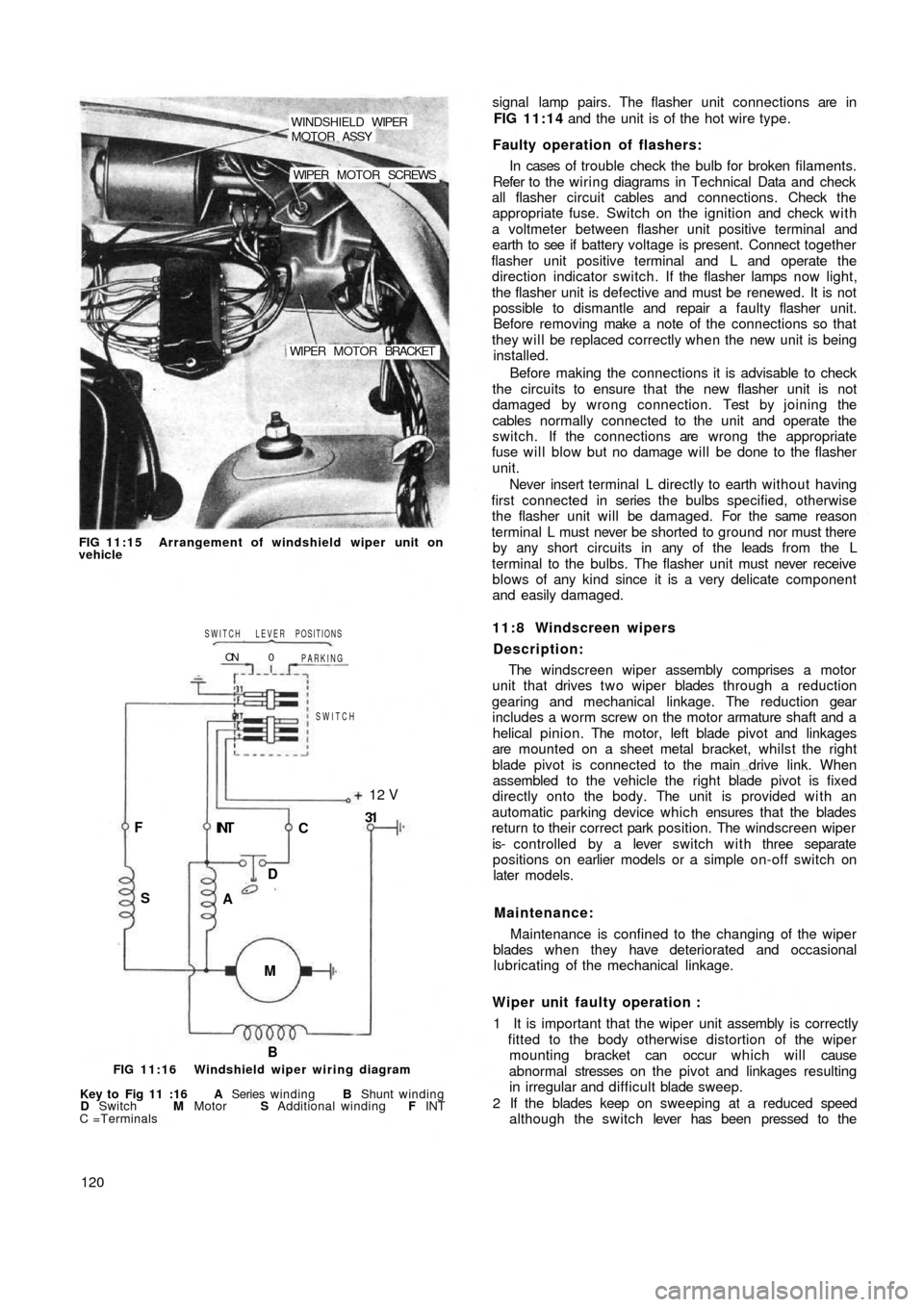
WINDSHIELD WIPER
MOTOR ASSY
WIPER MOTOR SCREWS
WIPER MOTOR BRACKET
FIG 11:15 Arrangement of windshield wiper unit on
vehicle
B M INT F
SC12 V
31
D
A
SWITCH PARKING
0 ON
SWITCH LEVER POSITIONS
FIG 11:16 Windshield wiper wiring diagram
Key to Fig 11 :16 A Series winding B Shunt winding
D Switch M Motor S Additional winding F INT
C =Terminals
120signal lamp pairs. The flasher unit connections are in
FIG 11:14 and the unit is of the hot wire type.
Faulty operation of flashers:
In cases of trouble check the bulb for broken filaments.
Refer to the wiring diagrams in Technical Data and check
all flasher circuit cables and connections. Check the
appropriate fuse. Switch on the ignition and check w i t h
a voltmeter between flasher unit positive terminal and
earth to see if battery voltage is present. Connect together
flasher unit positive terminal and L and operate the
direction indicator switch. If the flasher lamps now light,
the flasher unit is defective and must be renewed. It is not
possible to dismantle and repair a faulty flasher unit.
Before removing make a note of the connections so that
they will be replaced correctly when the new unit is being
installed.
Before making the connections it is advisable to check
the circuits to ensure that the new flasher unit is not
damaged by wrong connection. Test by joining the
cables normally connected to the unit and operate the
switch. If the connections are wrong the appropriate
fuse will blow but no damage will be done to the flasher
unit.
Never insert terminal L directly to earth without having
first connected in series the bulbs specified, otherwise
the flasher unit will be damaged. For the same reason
terminal L must never be shorted to ground nor must there
by any short circuits in any of the leads from the L
terminal to the bulbs. The flasher unit must never receive
blows of any kind since it is a very delicate component
and easily damaged.
11:8 Windscreen wipers
Description:
The windscreen wiper assembly comprises a motor
unit that drives t w o wiper blades through a reduction
gearing and mechanical linkage. The reduction gear
includes a worm screw on the motor armature shaft and a
helical pinion. The motor, left blade pivot and linkages
are mounted on a sheet metal bracket, whilst the right
blade pivot is connected to the main drive link. When
assembled to the vehicle the right blade pivot is fixed
directly onto the body. The unit is provided w i t h an
automatic parking device which ensures that the blades
return to their correct park position. The w
indscreen wiper
is- controlled by a lever switch with three separate
positions on earlier models or a simple on-off switch on
later models.
Maintenance:
Maintenance is confined to the changing of the wiper
blades when they have deteriorated and occasional
lubricating of the mechanical linkage.
Wiper unit faulty operation :
1 It is important that the wiper unit assembly is correctly
fitted to the body otherwise distortion of the wiper
mounting bracket can occur which will cause
abnormal stresses on the pivot and linkages resulting
in irregular and difficult blade sweep.
2 If the blades keep on sweeping at a reduced speed
although the switch lever has been pressed to the
Page 114 of 128
parking position the trouble will be found in the sliding
sector which fails to open the switch D (see FIG
11 :16) . Check by removing the four motor cover
mounting screws and uncover the sliding sector. If
possible suitably bend the sector to bring it against
into contact with the rod tip of switch D.
3 If the automatic parking of the blades does not occur
when the switch lever is fully depressed to the parking
position but the motor stops when the switch is
operated the cause of the trouble is that the switch D
is not closing and consequently no current is flowing
between the terminals C and INT. This will probably
be due to dirt lodged between the movable contact
and the fixed contacts of switch D. Thoroughly wash
the components with petrol and if necessary reface
the contacts using a very fine file.
4 Should the motor unit be noisy in operation although
still operating reliably the noise is probably due to the
reduction gear operation, whereby the pinion and
worm are excessively worn or a tooth chipped. The
motor unit must be renewed as motor unit parts are
not available in service.
5 If the switch lever is pushed upwards to the 'on'
position or depressed downwards to the Parking
position and the wiper is still inoperative thoroughly
check all terminal connections for tightness and
cables for damage which if all appear to be correct the
failure of the wiper to operate indicates an internal
fault of the motor unit which
should be repaired or
renewed as necessary.
Removal and refitting the motor:
Remove the wiper arms and the electrical connections
to the motor. Dismantling is a straightforward operation
providing that as all items are removed so they are
inspected and a note made of their locations. However,
reassembly requires more care and the following
procedure should be adopted.
1 Mount the wiper unit onto the body by fully tightening
the nuts fixing the pivots onto which the arms are
fitted. Ensure t h a t the rubber sealing bushes between
the pivots and body are correctly assembled to prevent
water ingress. Slightly lubricate with glycerine.
2 Secure the mounting bracket lower edge to the body
by means of the special square bracket. It is important
not to distort the mounting bracket and ease of
assembly is ensured by elongated holes in the square
bracket. By suitable adjustment the linkages will not
be subjected to distortion or abnormal stresses during
operation.
3 Fit the motor unit to the mounting bracket tightening
the screws and reassemble the main link to the pivot
lever. Ensure t h a t the l o c k i n g of the fastener on the
pivot lever is secure so that it does not become loose
during operation.
4 Remake all the electrical connections and run the
motor for a short time whilst checking all the switch
positions including the automatic parking. It is at this
position that the wiper blades and arms are assembled
to the wiper mechanism.
5 Onto the pivots, install the shims, snap ring, wiper arm,
plain washer and lockwasher. Fully tighten the nuts
with the wiper arms in the parked position.
F500
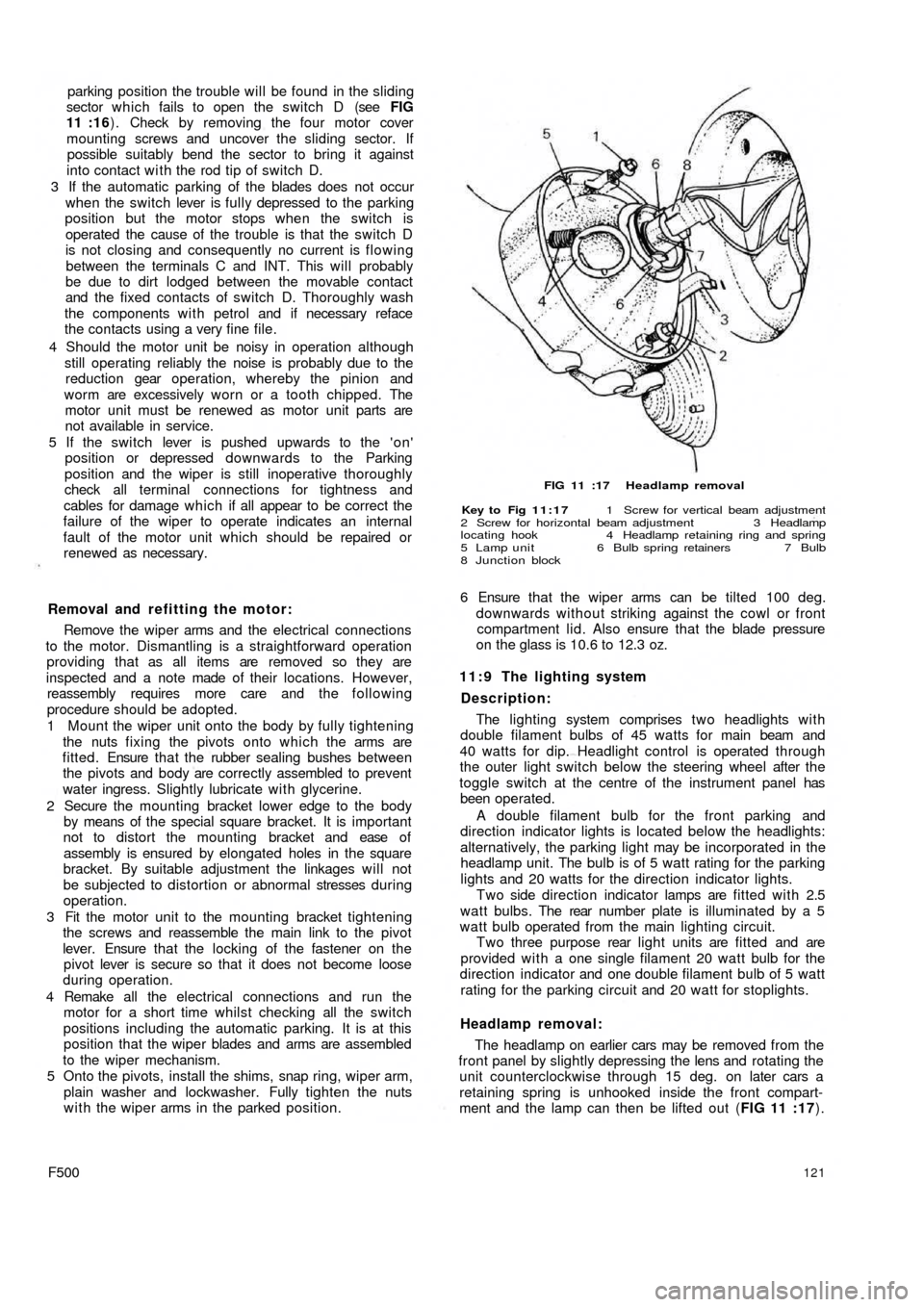
FIG 11 :17 Headlamp removal
Key to Fig 11:17 1 Screw for vertical beam adjustment
2 Screw for horizontal beam adjustment 3 Headlamp
locating hook 4 Headlamp retaining ring and spring
5 Lamp unit 6 Bulb spring retainers 7 Bulb
8 Junction block
6 Ensure that the wiper arms can be tilted 100 deg.
downwards without striking against the cowl or front
compartment lid. Also ensure that the blade pressure
on the glass is 10.6 to 12.3 oz.
1 1 : 9 The lighting system
Description:
The lighting system comprises t w o headlights with
double filament bulbs of 45 watts for main beam and
40 watts for dip. Headlight control is operated through
the outer light switch below the steering wheel after the
toggle switch at the centre of the instrument panel has
been operated.
A double filament bulb for the front parking and
direction indicator lights is located below the headlights:
alternatively, the parking light may be incorporated in the
headlamp unit. The bulb is of 5 watt rating for the parking
lights and 20 watts for the direction indicator lights.
Two side direction indicator lamps are fitted with 2.5
w a t t b u l b s . The rear number plate is illuminated by a 5
watt bulb operated from the main lighting circuit.
Two three purpose rear light units are fitted and are
provided with a one single filament 20 watt bulb for the
direction indicator and one double filament bulb of 5 watt
rating for the parking circuit and 20 watt for stoplights.
Headlamp removal:
The headlamp on earlier cars may be removed from the
front panel by slightly depressing the lens and rotating the
unit counterclockwise through 15 deg. on later cars a
retaining spring is unhooked inside the front compart-
ment and the lamp can then be lifted out (FIG 11 :17).
121
Page 115 of 128
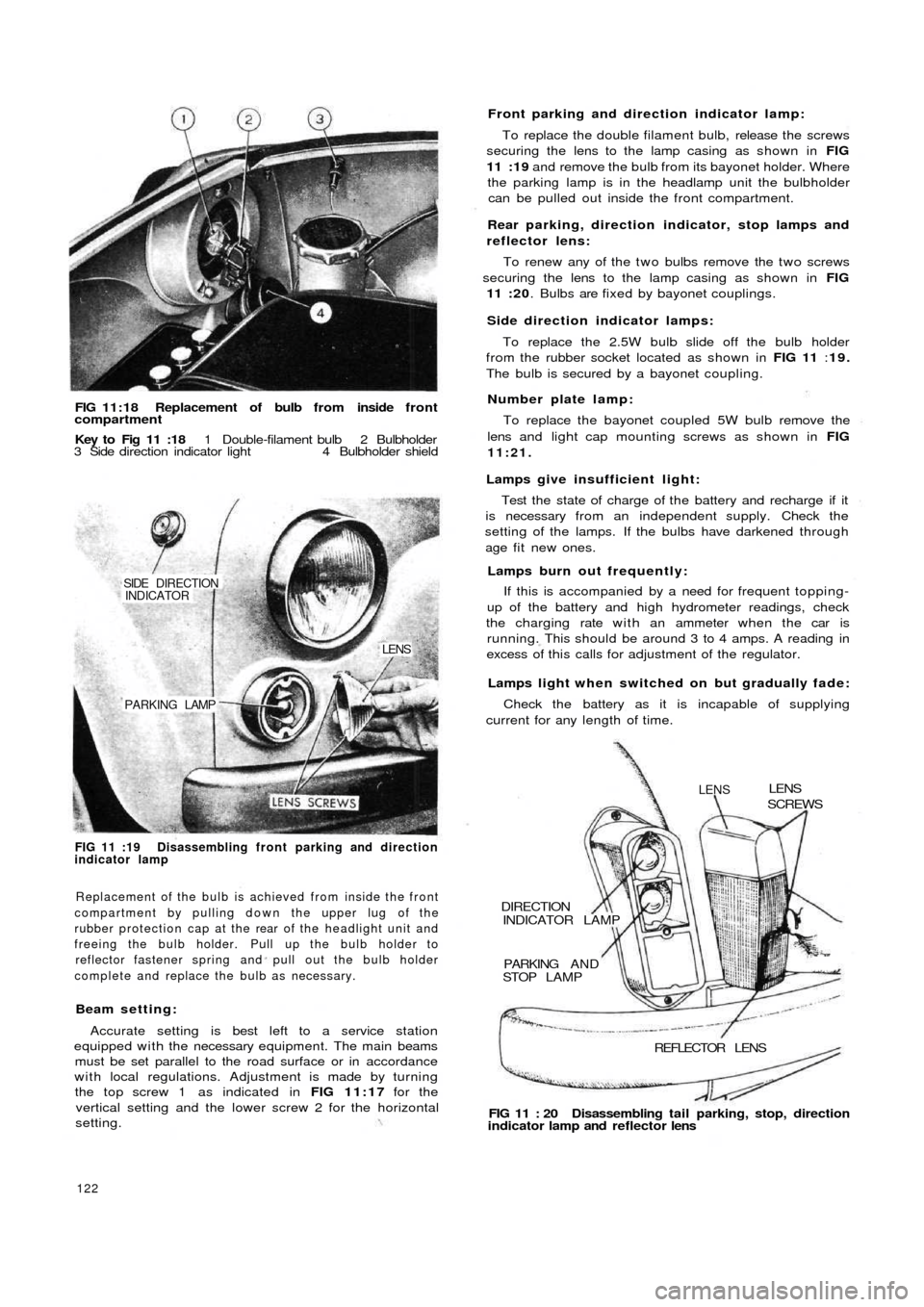
FIG 11:18 Replacement of bulb from inside f r o n tcompartment
Key to Fig 11 :18 1 Double-filament bulb 2 Bulbholder
3 Side direction indicator light 4 Bulbholder shield
PARKING LAMP
LENS
SIDE DIRECTIONINDICATOR
FIG 11 :19 Disassembling front parking and direction
indicator lamp
Replacement of the bulb is achieved from inside the front
compartment by pulling down the upper lug of the
rubber protection cap at the rear of t h e headlight unit and
freeing the bulb holder. Pull up the bulb holder to
reflector fastener spring and pull out the bulb holder
complete and replace the bulb as necessary.
Beam setting:
Accurate setting is best left to a service station
equipped with the necessary equipment. The main beams
must be set parallel to the road surface or in accordance
with local regulations. Adjustment is made by turning
the top screw 1 as indicated in FIG 11:17 for the
vertical setting and the lower screw 2 for the horizontal
setting.
122
FIG 11 : 20 Disassembling tail parking, stop, direction
indicator lamp and reflector lens REFLECTOR LENS PARKING A N D
STOP LAMP INDICATOR LAMP
DIRECTION
LENSLENS
SCREWS
Lamps light when switched on but gradually fade:
Check the battery as it is incapable of supplying
current for any length of time. Front parking and direction indicator lamp:
To replace the double filament bulb, release the screws
securing the lens to the lamp casing as shown in FIG
11 :19 and remove the bulb from its bayonet holder. Where
the parking lamp is in the headlamp unit the bulbholder
can be pulled out inside the front compartment.
Rear parking, direction indicator, stop lamps and
reflector lens:
To renew any of the t w o bulbs remove the t w o screws
securing the lens to the lamp casing as shown in FIG
11 : 2 0. Bulbs are fixed by bayonet couplings.
Side direction indicator lamps:
To replace the 2.5W bulb slide off the bulb holder
from the rubber socket located as shown in FIG 11 :19.
The bulb is secured by a bayonet coupling.
Number plate lamp:
To replace the bayonet coupled 5W bulb remove the
lens and light cap mounting screws as shown in FIG
11:21.
Lamps give insufficient light:
Test the state of charge of the battery and recharge if it
is necessary from an independent supply. Check the
setting of the lamps. If the bulbs have darkened through
age fit new ones.
Lamps burn out frequently:
If this is accompanied by a need for frequent topping-
up of the battery and high hydrometer readings, check
the charging rate with an ammeter when the car is
running. This should be around 3 to 4 amps. A reading in
excess of this calls for adjustment of the regulator.
Page 116 of 128
Lamp brilliance varies w i t h the speed of t h e car:
Check the condition of the battery. Examine the battery
connections. Make sure they are tight and renew faulty
cables.
11:10 Panel and warning lights:
All the gauges are clustered in a single instrument
mounted on the dashboard above the steering column.
Incorporated in this cluster is the parking light pilot light,
generator charge indicator, fuel reserve supply indicator,
low oil pressure indicator, and the speedometer w i t h
mileage recorder.
The parking lamp indicator glows green when the
ignition lock switch key is in either position 1 or 2 once
the toggle switch on the instrument panel has been
operated.
The generator charge indicator shows red only when
the ignition is turned on. It should be extinguished when
the generator output is sufficient for battery charge
(12.6 ± 0.2 volts) with the engine running at a speed
of 1100 rev/min and the headlights switched off.
The fuel reserve supply indicator shows red only when
the ignition is turned on and the amount of fuel in the
petrol tank has dropped to approximately .8 to 1.1
Imp. gallons.
The low oil pressure indicator shows red only when the
ignition is turned on and should be extinguished when
the oil pressure reaches 7.1 to 21.3 Ib/sq in, and opens
the sending unit contacts. Once the engine is at normal
operating temperature but at a speed below 1000 rev/
min the indicator might light up even the pressure is under
control and with normal operation.
All the bulbs fitted to the above described units are of
the tubular 2.5W type and to renew a bulb extract the
bulb holder from the rear of t h e instrument cluster and
release the bulb which is attached by a normal bayonet
coupling.
Fuel reserve supply indicator sender u n i t:
The fuel reserve supply indicator should be checked for
correct indication by allowing the fuel tank to empty and
then inserting .8 to 1.1 Imp. gallons at which stage the
light should extinguish. Any failure to do so should be
checked as follows:
1 Ensure that the indicator bulb operates correctly.
2 Check for complete circuit between the sender unit and
the indicator bulb.
3 If the sender unit float bracket is distorted the bulb
will
indicate a reserve supply of fuel greater or smaller than
specified. The bracket should be adjusted to give
correct indication of fuel level.
4 The sender unit could have been inadvertantly
damaged in which case the unit must be renewed.
11 :11 The horn
The horn circuit comprises the horn, push button at the
centre of the steering wheel and normal earth return
electrical circuit through the car body. One terminal is
connected to the battery whilst the other to the push
button on the steering wheel which when the button is
depressed the circuit will be closed so causing the horn
to operate.
F500
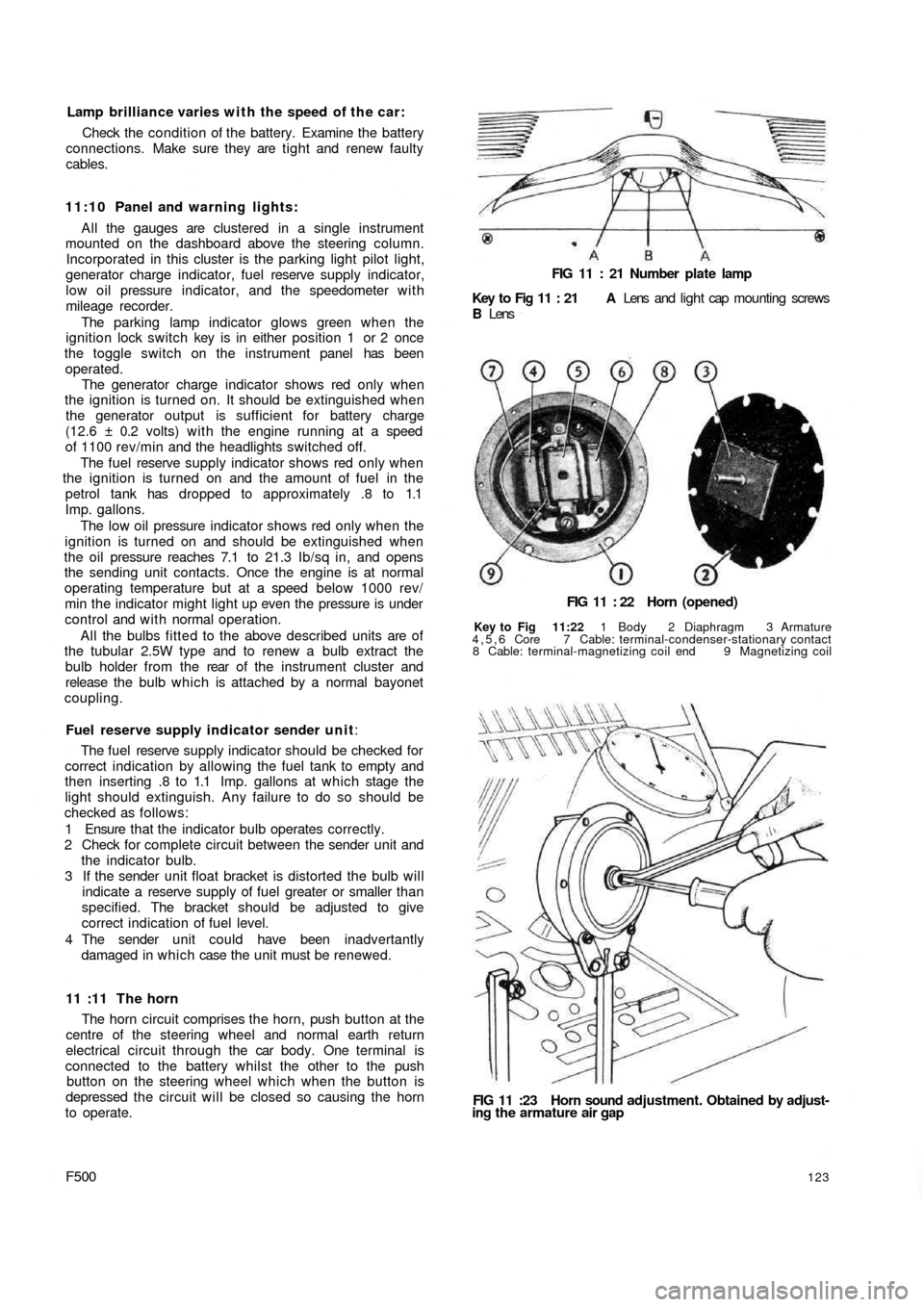
FIG 11 : 21 Number plate lamp
Key to Fig 11 : 21 A Lens and light cap mounting screws
B Lens
FIG 11 : 22 Horn (opened)
Key to Fig 11:22 1 Body 2 Diaphragm 3 Armature
4,5,6 Core 7 Cable: terminal-condenser-stationary contact
8 Cable: terminal-magnetizing coil end 9 Magnetizing coil
FIG 11 :23 Horn sound adjustment. Obtained by adjust-
ing the armature air gap
123
Page 117 of 128
Before removing an apparently faulty horn check the
wiring and connections. Check that the mounting bolts
are tight and that the horn does not foul any adjacent part.
Removal and installation:
This is a straightforward operation and the only
precaution to be taken is to ensure that the rubber gasket
bonded to the horn body does not become detached. If
the horn is renewed, before installing the new horn bond
the rubber gasket to the new unit with adhesive in
the same position as was on the original horn unit fitted.
Should the horn fail to operate the following points
should be noted.
1 Damaged horn.
2 Broken connection between battery and horn.
3 Broken connection between horn and push button on
steering wheel
4 Damaged push button mechanism.
5 Directional signal and outer lighting changeover
switch blade contact failing to make contact with the
steering wheel hub ring contact.
6 Current lead displaced from the horn blade contact on
the directional signal and outer lighting switch.
7 Distorted or broken diaphragm in horn.
8 Connections or inner windings
broken or burnt.
9 Electro-magnet contact points dirty or excessively
worn.The contacts may be adjusted by the adjusting screw
after the points have been cleaned and refaced.
To adjust the tone of the horn use a ring spanner and
screwdriver as shown in FIG 11 :23.
It is recommended that if the horn unit operation is
unreliable a new unit should be fitted rather than the
original one repaired.
11:12 Lighting and flasher switch
Description:
The two switches provide a directional signal switch
which automatically returns to the rest position once a
turn has been negotiated and the steering wheel is
brought back to the straight-ahead position. The change
over switch controls the outer lights and the headlights
flasher. The complete unit is located under the steering
wheel on the steering column.
Switch unit removal:
1 Carefully pry off the horn push button at the steering
wheel centre using a fine blade screwdriver.
2 Disconnect the positive terminal of the battery.
3 Disconnect the plug in contact in the steering wheel
hub.
4 Unscrew the steering wheel retaining nut from the
inner column and remove the steering wheel from the
shaft.
5 Slacken the bolts securing the steering column support
to the body
6 Remove the plug in contacts from the switch unit
ensuring that their correct location is noted for re-
assembly.7 Remove the switch unit from the steering column.
124
Switch unit installation:
This is the reverse procedure to dismantling. It is
advisable after installation to check that the steering
wheel when in the straight-ahead position and the
directional signal switch lever in neutral, the reference
index on the outer face of the directional signal switch
drum is in line with the index on the steering wheel hub.
This will ensure correct sequence of operation.
11:13 Fault diagnosis
(a) Battery discharged
1 Lighting circuit shorted
2 Terminals loose or dirty
3 Generator not charging
4 Regulator or cut-out units not working properly
5 Battery internally defective
(b) Insufficient charging current
1 Loose or corroded battery terminals
2 Generator driving belt slipping
(c) Battery will not hold a charge
1 Low electrolyte level
2 Battery plates sulphated
3 Electrolyte leakage from cracked casing or top sealing
compound
4 Plate separators ineffective
(d) Battery overcharged
1 Voltage regulator needs adjusting
(e) Generator output low or nil
1 Belt broken or slipping
2 Regulator unit out of adjustment
3 Worn bearings, loose pole pieces
4 Commutator worn, burned or shorted
5 Armature shaft bent or worn
6 Insulation proud between commutator segments
7 Brushes sticking, springs weak or broken
8 Field coil wires shorted, broken or burned
( f ) Starter motor lacks power or will not operate
1 Battery discharged, loose cable connections
2 Starter pinion jammed in mesh with flywheel gear
3 Starter switch faulty
4 Brushes worn or sticking, heads detached or shorting
5 Commutator dirty or worn
6 Starter shaft bent
7 Engine abnormally stiff
(g) Starter motor inoperative
1 Check 1 in (f)
2 Armature or field coils faulty
Page 118 of 128
(h) Starter motor rough or noisy
1 Mounting bolts loose
2 Damaged pinion or flywheel gear teeth
( i ) Lamps inoperative or erratic
1 Battery low, bulbs burned out
2 Faulty earthing of lamps or battery
3 Lighting switch faulty, loose or broken wiring
connections
F500
125
(j) Wiper motor sluggish, taking high current
1 Faulty armature
2 Bearings out of alignment
3 Commutator dirty or short-circuited
(k) Wiper motor operates but does not drive
arms
1 Gearbox components worn
Page 120 of 128
CHAPTER 12
THE BODYWORK
12:1
12:2
12:3
12:4
12:5
12:6
12:7Bodywork finish
Interior and chrome cleaning
Door trim and accessories
Door handles and locks
Removing regulator and door glass
Removing windshield glass
Removing rear side windows12:8
12:9
12:10
12:11
12:12
12:13
12:14Removing rear window glass
Front compartment lid
Engine compartment lid
Folding top
Sun roof
Seats
Interior heater
12:1 Bodywork finish
Large scale repairs to body panels are best left to
expert panel beaters. Even small dents can be tricky, as too
much hammering will stretch the metal and make things
worse instead of better. Filling minor dents and scratches
is probably the best method of restoring the surface. The
touching up of paintwork is well within the powers of
most car owners, particularly as self-spraying cans of
paint in the correct colours are now readily available. It
must be remembered, however, that paint changes colour
w i t h age and it is better to spray a whole wing rather than
try to touch up a small area.
Before spraying it is essential to remove all traces of
wax polish with white spirit. More drastic treatment is
required if silicone polishes have been applied. Use a
primer surfacer or paste stopper according to the amount
of filling required, and when it is dry, rub it down with
400 grade Wet or Dry paper until the surface is smooth
and flush with the surrounding area. Spend time on
getting the best finish as this will control the final effect.
Apply the retouching paint, keeping it wet in the centre
and light and dry round the edges. After a few hours of
drying, use a cutting compound to remove the dry spray
and finish with liquid polish.
F500127
12:2 Interior and chrome cleaning
The cloth upholstery of the seating and the rear
compartment lining must be regularly cleaned to ensure
long life and preserve its attractive appearance. Any dust
or dirt that is blown into the car will settle on the uphol-
stery and will tend to wear the cloth causing an unsightly
appearance. It is recommended that the dust is wiped off
using either a vacuum cleaner or a stiff brush. To remove
ordinary soiling of the upholstery cloth proceed as
follows:
1 Using luke warm water and a neutral soap and a piece
of clean cloth wipe over the upholstery in the direction
of the nap.
2 Repeat the operation using a clean damp cloth and
warm water but no soap.
3 Allow the upholstery cloth to dry, use a stiff brush
against the direction of the upholstery nap to restore
its original fluffy look.
To obtain best results, any stains must be removed as
soon as possible otherwise as time passes they will
become more difficult, if not impossible to remove.
Certain stains require specific solvents and the instruc-
tions must be strictly adhered to.
Page 121 of 128
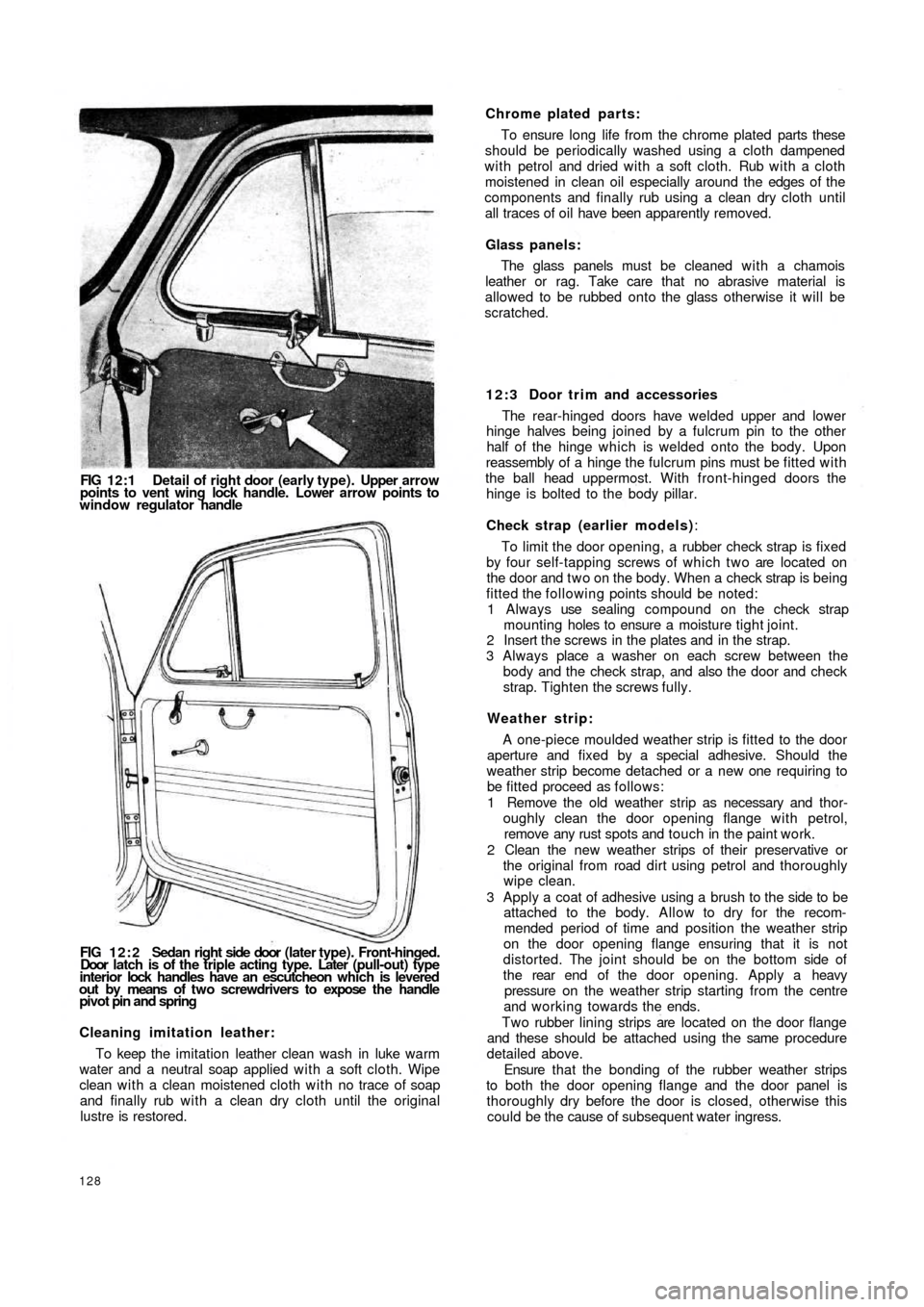
FIG 12:1 Detail of right door (early type). Upper arrow
points to vent wing lock handle. Lower arrow points to
window regulator handle
FIG 1 2 : 2 Sedan right side door (later type). Front-hinged.
Door latch is of the triple acting type. Later (pull-out) type
interior lock handles have an escutcheon which is levered
out by means of t w o screwdrivers to expose the handle
pivot pin and spring
Cleaning imitation leather:
To keep the imitation leather clean wash in luke warm
water and a neutral soap applied with a soft cloth. Wipe
clean with a clean moistened cloth with no trace of soap
and finally rub with a clean dry cloth until the original
lustre is restored.
128
Chrome plated parts:
To ensure long life from the chrome plated parts these
should be periodically washed using a cloth dampened
with petrol and dried with a soft cloth. Rub with a cloth
moistened in clean oil especially around the edges of the
components and finally rub using a clean dry cloth until
all traces of oil have been apparently removed.
Glass panels:
The glass panels must be cleaned w i t h a chamois
leather or rag. Take care that no abrasive material is
allowed to be rubbed onto the glass otherwise it will be
scratched.
12:3 Door trim and accessories
The rear-hinged doors have welded upper and lower
hinge halves being joined by a fulcrum pin to the other
half of the hinge which is welded onto the body. Upon
reassembly of a hinge the fulcrum pins must be fitted with
the ball head uppermost. With front-hinged doors the
hinge is bolted to the body pillar.
Check strap (earlier models):
To limit the door opening, a rubber check strap is fixed
by four self-tapping screws of which two are located on
the door and t w o on the body. When a check strap is being
fitted the following points should be noted:
1 Always use sealing compound on the check strap
mounting holes to ensure a moisture t i g h t j o i n t .
2 Insert the screws in the plates and in the strap.
3 Always place a washer on each screw between the
body and the check strap, and also the door and check
strap. Tighten the screws fully.
Weather strip:
A one-piece moulded weather strip is fitted to the door
aperture and fixed by a special adhesive. Should the
weather strip become detached or a new one requiring to
be fitted proceed as follows:
1 Remove the old weather strip as necessary and thor-
oughly clean the door opening flange with petrol,
remove any rust spots and touch in the paint work.
2 Clean the new weather strips of their preservative or
the original from road dirt using petrol and thoroughly
wipe
clean.
3 Apply a coat of adhesive using a brush to the side to be
attached to the body. Allow to dry for the recom-
mended period of time and position the weather strip
on the door opening flange ensuring that it is not
distorted. The joint should be on the bottom side of
the rear end of the door opening. Apply a heavy
pressure on the weather strip starting from the centre
and working towards the ends.
Two rubber lining strips are located on the door flange
and these should be attached using the same procedure
detailed above.
Ensure that the bonding of the rubber weather strips
to both the door opening flange and the door panel is
thoroughly dry before the door is closed, otherwise this
could be the cause of subsequent water ingress.
Page 122 of 128
Inner panels:
Imitation leather-lined masonite trim panels are fitted
to all versions of the new 500' models. The panels are
secured in the housing below the door window by means
of four stiff clips located at the top and seven spring clips
located at the bottom equally spaced around the panel
border. The fasteners are located in holes in the door
framework inner flange. The door framework has a plate
which should be bent downwards onto the trim panel
once it has been installed. This will ensure correct seating
of the trim panel in the door housing.
When the door trim panel is being reassembled ensure
that the tarred felt pad is cemented correctly on the door
inner flange so that any water that may seep in through to
the door interior from the window rubber weather strips
may be kept away from the trim panel which would
otherwise cause distortion and rapid deterioration.
12:4 Door handles and locks
The doors are provided with locks which are operated
by handles either from inside or outside the vehicle.
Removal of the lock is a straightforward operation but
upon reassembly the following procedure should be
followed:
1 Mount the handle assembly from the outside and
insert the washer onto the stud. Screw in the nut several
turns to allow correct handle-to-lock mating on final
fitting.
2 Arrange the locking handle dog so that it is horizontally
positioned and tighten the mounting nut.
3 Mount the lock to the door panel and secure w i t h three
screws and washers.
4 Fit the plate w i t h the t w o rubber guide blocks fastening
by the t w o screws.
Striker plates are fitted with shim adjustment to the
door pillars and are secured by three screws.
12:5 Removing window regulator and door glass
Window regulator:
Description:
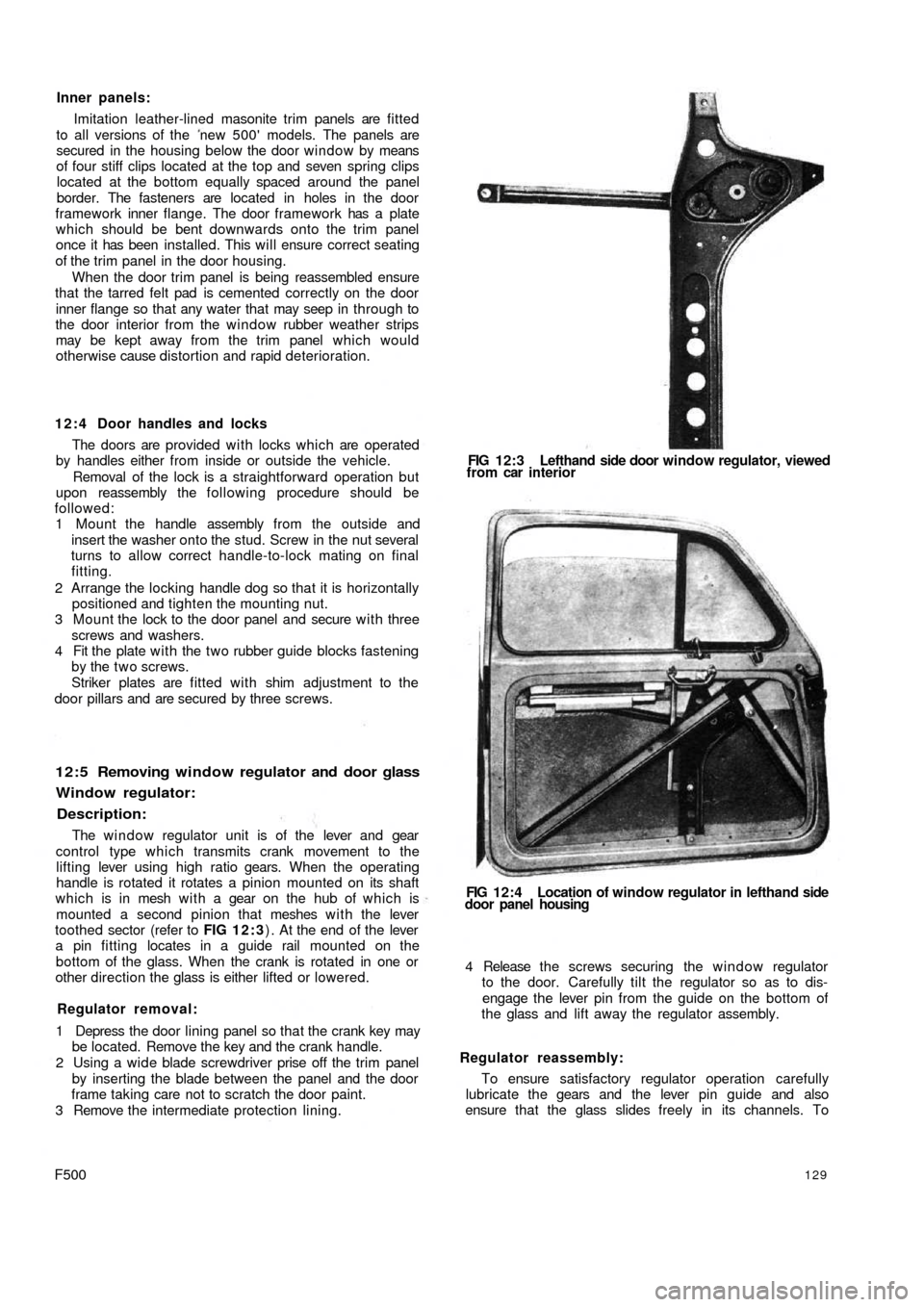
The window regulator unit is of the lever and gear
control type which transmits crank movement to the
lifting lever using high ratio gears. When the operating
handle is rotated it rotates a pinion mounted on its shaft
which is in mesh w i t h a gear on the hub of which is
mounted a second pinion that meshes with the lever
toothed sector (refer to FIG 1 2 : 3) . At the end of the lever
a pin fitting locates in a guide rail mounted on the
bottom of the glass. When the crank is rotated in one or
other direction the glass is either lifted or lowered.
Regulator removal:
1 Depress the door lining panel so that the crank key may
be located. Remove the key and the crank handle.
2 Using a wide blade screwdriver prise off the trim panel
by inserting the blade between the panel and the door
frame taking care not to scratch the door paint.
3 Remove the intermediate protection lining.
F500129
FIG 12:3 Lefthand side door window regulator, viewed
from car interior
FIG 12:4 Location of window regulator in lefthand side
door panel housing
4 Release the screws securing the window regulator
to the door. Carefully tilt the regulator so as to dis-
engage the lever pin from the guide on the bottom of
the glass and lift away the regulator assembly.
Regulator reassembly:
To ensure satisfactory regulator operation carefully
lubricate the gears and the lever pin guide and also
ensure that the glass slides freely in its channels. To
Page 126 of 128
12:11 Folding top
The f ol di n g top assembly comprises the following
items:
1 Imitation leather top w i t h vinylite back window.
2 Front end frame complete with two handles and
catches. A movable bow which slides on the frame
guide rails.
3 Three stiffening bows fixed by chrome plated buttons
and tipped with rubber blocks.
4 Front mouldings for t o p mounting on frame.
5 Rear moulding on top mounting engine cooling air
intake body panel.
6 Retaining strap for the roller stop.
The removal of the folding top is straightforward but
care should be taken on reassembly to the vehicle and the
following points should be noted:
1 The t o p rear moulding is secured by ten screws
consisting of six self-tapping screws and four standard
screws which are located as follows:
(a) One long self-tapping screw at each end.
(b) Two standard screws at centre.
(c) Two standard screws next to the long screws.
(d) Four self-tapping screws, two on each side
between the standard screws.
These screws also secure the upper end of the engine
air intake panel to body.
2 Having fixed the rear moulding spread the top across
t h e o p e n i n g . Ensure t h e pivoting bow is located
between the second and third stiffening bows. Using
special screws fix the frame rails to the upper inner
ends of the body side panels.
12:12 Sunroof
The 'new 500' sunroof model differs from the con-
vertible model in the arrangement of the top. The sunroof
comprises a rear metal panel and a front imitation leather
covering which acts as a collapsible top.
The weather strip surrounded back window is
located
on t h e rear metal panel and the following items are
cemented in place; plastic lining, foam rubber strip at
upper front end, and two rubber welts located on the
sides to prevent water ingress.
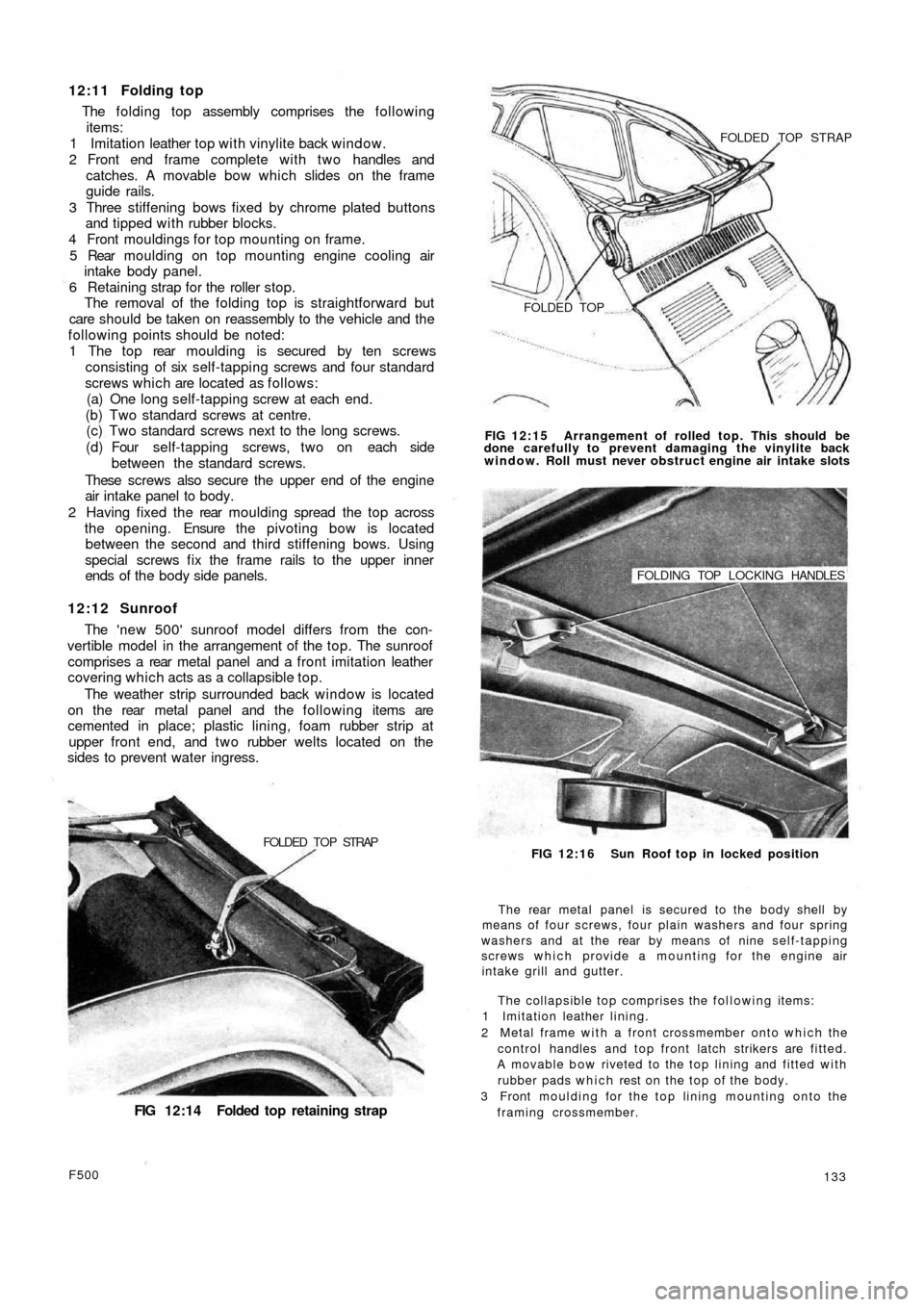
FIG 12:14 Folded top retaining strap
F500
133 FOLDED TOP STRAP
FOLDED TOP
FIG 12:15 Arrangement of rolled top. This should be
done carefully to prevent damaging the vinylite back
window. Roll must never obstruct engine air intake slots
FOLDING TOP LOCKING HANDLES
FIG 12:16 Sun Roof top in locked position
The rear metal panel is secured to the body shell by
means of four screws, four plain washers and four spring
washers and at the rear by means of nine self-tapping
screws which provide a mounting for the engine air
intake grill and gutter.
The collapsible top comprises the following items:
1 Imitation leather lining.
2 Metal frame with a front crossmember onto which the
control handles and top front latch strikers are fitted.
A movable bow riveted to the top lining and fitted with
rubber pads which rest on t h e t o p of t h e body.
3 Front moulding for the top lining mounting onto the
framing crossmember. FOLDED TOP STRAP