Rear seat FIAT 500 1972 1.G Owner's Manual
[x] Cancel search | Manufacturer: FIAT, Model Year: 1972, Model line: 500, Model: FIAT 500 1972 1.GPages: 128, PDF Size: 9.01 MB
Page 120 of 128
CHAPTER 12
THE BODYWORK
12:1
12:2
12:3
12:4
12:5
12:6
12:7Bodywork finish
Interior and chrome cleaning
Door trim and accessories
Door handles and locks
Removing regulator and door glass
Removing windshield glass
Removing rear side windows12:8
12:9
12:10
12:11
12:12
12:13
12:14Removing rear window glass
Front compartment lid
Engine compartment lid
Folding top
Sun roof
Seats
Interior heater
12:1 Bodywork finish
Large scale repairs to body panels are best left to
expert panel beaters. Even small dents can be tricky, as too
much hammering will stretch the metal and make things
worse instead of better. Filling minor dents and scratches
is probably the best method of restoring the surface. The
touching up of paintwork is well within the powers of
most car owners, particularly as self-spraying cans of
paint in the correct colours are now readily available. It
must be remembered, however, that paint changes colour
w i t h age and it is better to spray a whole wing rather than
try to touch up a small area.
Before spraying it is essential to remove all traces of
wax polish with white spirit. More drastic treatment is
required if silicone polishes have been applied. Use a
primer surfacer or paste stopper according to the amount
of filling required, and when it is dry, rub it down with
400 grade Wet or Dry paper until the surface is smooth
and flush with the surrounding area. Spend time on
getting the best finish as this will control the final effect.
Apply the retouching paint, keeping it wet in the centre
and light and dry round the edges. After a few hours of
drying, use a cutting compound to remove the dry spray
and finish with liquid polish.
F500127
12:2 Interior and chrome cleaning
The cloth upholstery of the seating and the rear
compartment lining must be regularly cleaned to ensure
long life and preserve its attractive appearance. Any dust
or dirt that is blown into the car will settle on the uphol-
stery and will tend to wear the cloth causing an unsightly
appearance. It is recommended that the dust is wiped off
using either a vacuum cleaner or a stiff brush. To remove
ordinary soiling of the upholstery cloth proceed as
follows:
1 Using luke warm water and a neutral soap and a piece
of clean cloth wipe over the upholstery in the direction
of the nap.
2 Repeat the operation using a clean damp cloth and
warm water but no soap.
3 Allow the upholstery cloth to dry, use a stiff brush
against the direction of the upholstery nap to restore
its original fluffy look.
To obtain best results, any stains must be removed as
soon as possible otherwise as time passes they will
become more difficult, if not impossible to remove.
Certain stains require specific solvents and the instruc-
tions must be strictly adhered to.
Page 124 of 128
8 Refit the intermediate protection lining ensuring that
it is properly located and well glued. Refit the door
lining panel, key and crank handle.
Door ventilator:
The door ventilator comprises the glass, weather strip
placed between the glass and chromium plated frame,
the chromium plated frame together with pin and bracket
for upper and lower hinging, frame control handle and
lining.
To remove the ventilator glass first drill the upper pivot
pin using a portable electric drill and release the nut and
locknut from the lower pivot bracket. Carefully lift away
the glass.
Reassembly:
To reassemble the ventilator glass proceed as follows:
1 Coat the outer edge of the glass on which the chrome
plated frame must be installed with a 50% solution of
petrol and oil to ensure that the glass can be easily
inserted into the frame.
2 Install the lock handle which is secured to the frame
by means of a screw sunk into the handle body and
t w o corrugated spring washers placed between the
frame and the handle.
3 Before installing the ventilator pane on the door panel
ensure that the metal channels in the front post flanges
at the pane base are firmly located in place and f i t the
rubber weather strip arranging it carefully in its
seating. The weather strip is secured by clips located
on the metal channels.
4 Refit the handle striker plate and secure it to the door
channel by means of t w o self-tapping screws.
5 Insert the lower ventilator swivel on the door panel to
welded bracket. Fit the spring and secure ventilator
assembly through the nut, locknut and plain washer so
that it can, be freely adjusted to any position without
undue effort (see FIG 12:5).
6 Fit the chrome cover on the lower ventilator swivel.
Refit the upper ventilator swivel in the door panel
brackets and clench it using a hammer and a suitably
sized drift against a firm metal block. This will ensure
correct ventilator movement.
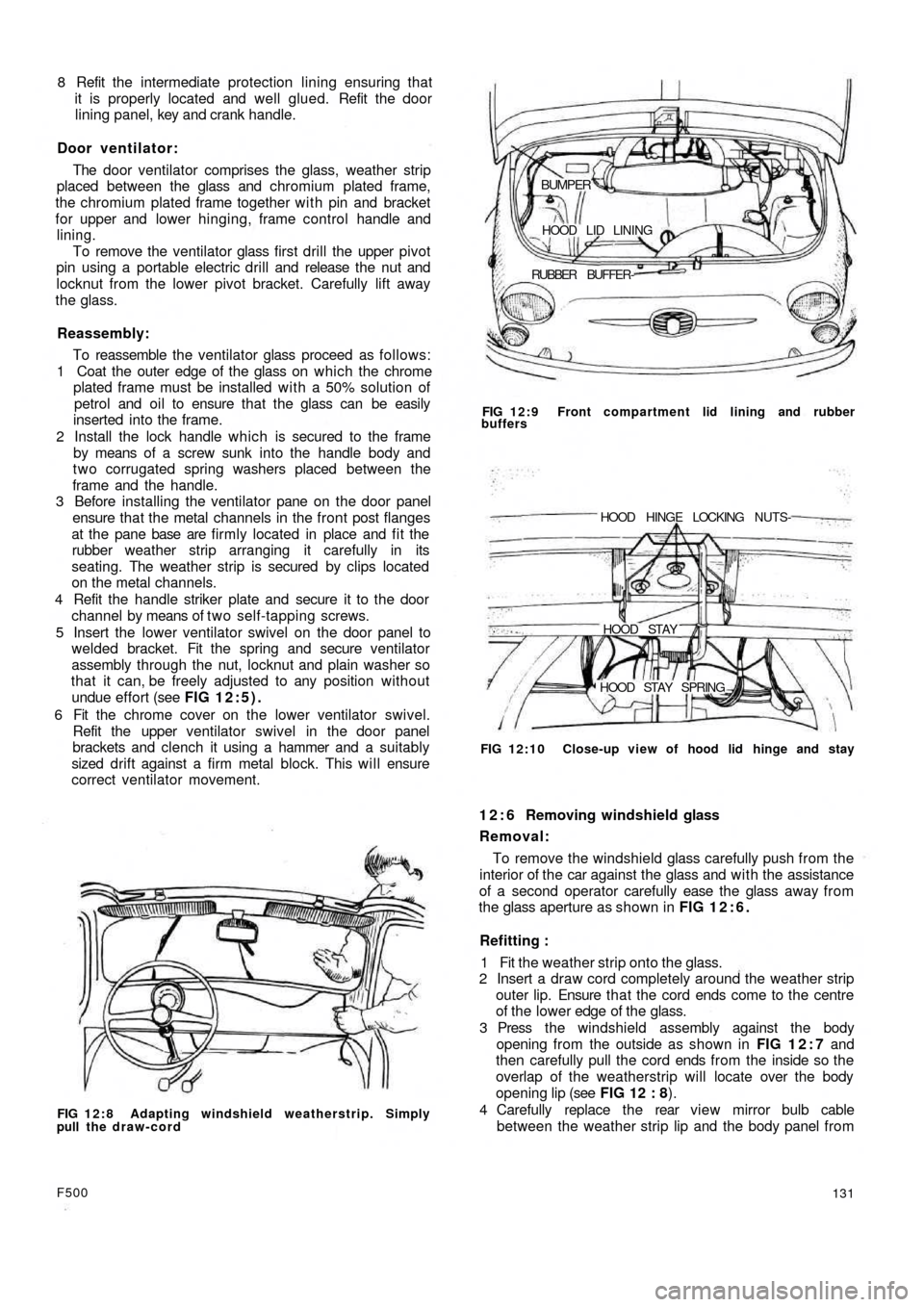
FIG 12:8 Adapting windshield weatherstrip. Simply
pull the draw-cord
F500
131 RUBBER BUFFER-HOOD LID LINING
BUMPER
FIG 12:9 Front compartment lid lining and rubber
buffers
HOOD STAY SPRING HOOD STAY HOOD HINGE LOCKING NUTS-
FIG 12:10 Close-up view of hood lid hinge and stay
1 2 : 6 Removing windshield glass
Removal:
To remove the windshield glass carefully push from the
interior of the car against the glass and with the assistance
of a second operator carefully ease the glass away f r o m
the glass aperture as shown in FIG 12:6.
Refitting :
1 Fit the weather strip onto the glass.
2 Insert a draw cord completely around the weather strip
outer lip. Ensure t h a t the cord ends come to the centre
of the lower edge of the glass.
3 Press t h e windshield assembly against the body
opening from the outside as shown in FIG 1 2 : 7 and
then carefully pull the cord ends from the inside so the
overlap of the weatherstrip will locate over the body
opening lip (see FIG 12 : 8).
4 Carefully replace the rear view mirror bulb cable
between the weather strip lip and the body panel from
Page 125 of 128
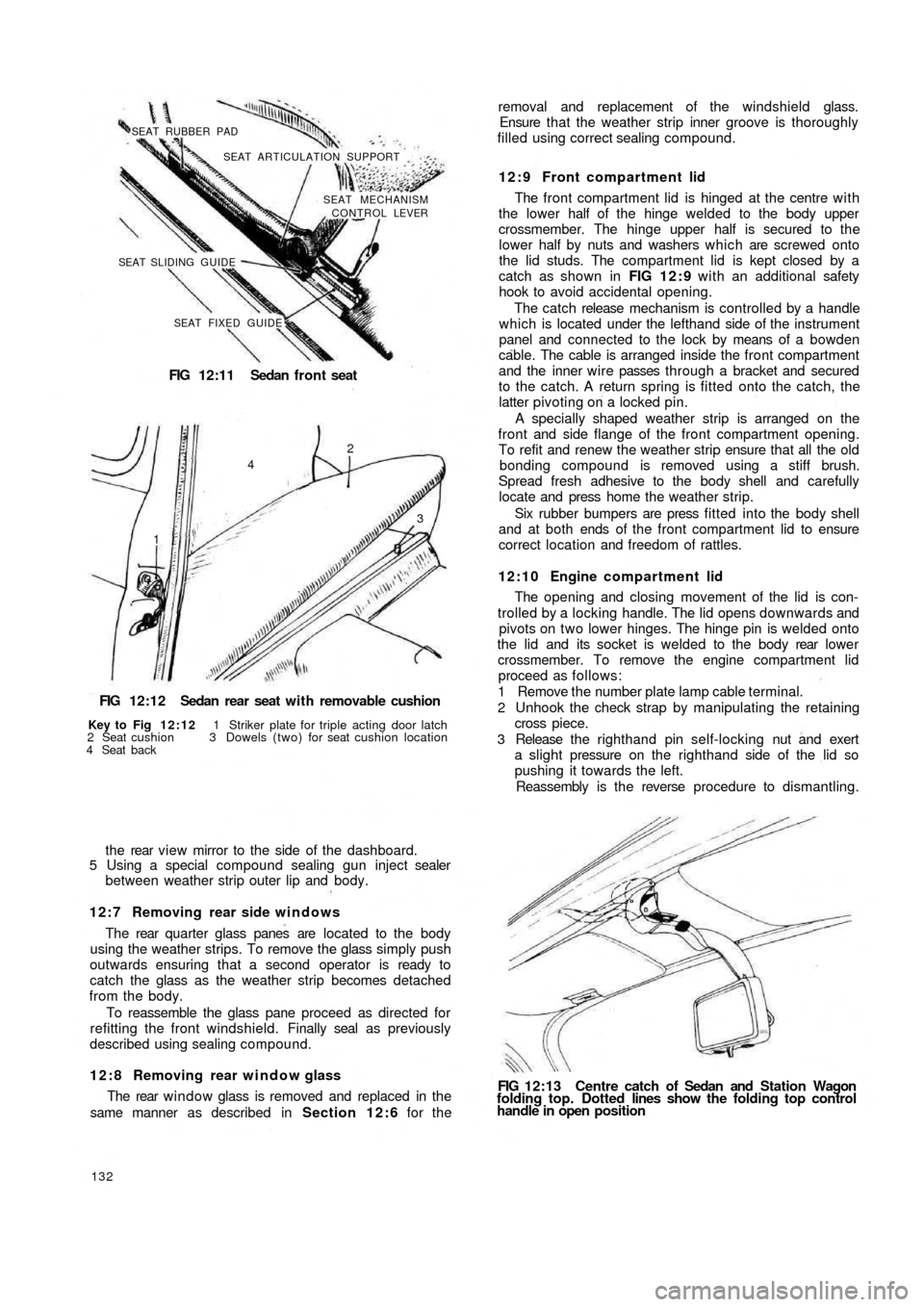
SEAT RUBBER PAD
SEAT ARTICULATION SUPPORT
SEAT MECHANISM
CONTROL LEVER
SEAT SLIDING GUIDE
SEAT FIXED GUIDE
FIG 12:11 Sedan front seat
42
3
1
FIG 12:12 Sedan rear seat w i t h removable cushion
Key to Fig 12:12 1 Striker plate for triple acting door latch
2 Seat cushion 3 Dowels (two) for seat cushion location
4 Seat back
t h e rear v i e w mirror to the side of the dashboard.
5 Using a special compound sealing gun inject sealer
between weather strip outer lip and body.
12:7 Removing rear side windows
The rear quarter glass panes are located to the body
using the weather strips. To remove the glass simply push
outwards ensuring that a second operator is ready to
catch the glass as the weather strip becomes detached
from the body.
To reassemble the glass pane proceed as directed for
refitting the front windshield. Finally seal as previously
described using sealing compound.
12:8 Removing rear window glass
The rear window glass is removed and replaced in the
same manner as described in Section 12:6 for the
132
FIG 12:13 Centre catch of Sedan and Station Wagon
folding top. Dotted lines show the folding top control
handle in open position removal and replacement of the windshield glass.
Ensure t h a t the weather strip inner groove is thoroughly
filled using correct sealing compound.
1 2 : 9 Front compartment lid
The front compartment lid is hinged at the centre w i t h
the lower half of the hinge welded to the body upper
crossmember. The hinge upper half is secured to the
lower half by nuts and washers which are screwed onto
the lid studs. The compartment lid is kept closed by a
catch as shown in FIG 1 2 : 9 with an additional safety
hook to avoid accidental opening.
The catch release mechanism is controlled by a handle
which is located under the lefthand side of the instrument
panel and connected to the lock by means of a bowden
cable. The cable is arranged inside the front compartment
and the inner wire passes through a bracket and secured
to the catch. A return spring is fitted onto the catch, the
latter pivoting on a locked pin.
A specially shaped weather strip is arranged on the
front and side flange of the front compartment opening.
To refit and renew the weather strip ensure that all the old
bonding compound is removed using a stiff brush.
Spread fresh adhesive to the body shell and carefully
locate and press home the weather strip.
Six rubber bumpers are press fitted into the body shell
and at both ends of the front compartment lid to ensure
correct location and freedom of rattles.
12:10 Engine compartment lid
The opening and closing movement of the lid is con-
trolled by a locking handle. The lid opens downwards and
pivots on two lower hinges. The hinge pin is welded onto
the lid and its socket is welded to the body rear lower
crossmember. To remove the engine compartment lid
proceed as follows:
1 Remove the number plate lamp cable terminal.
2 Unhook the check strap by manipulating the retaining
cross piece.
3 Release the righthand pin self-locking nut and exert
a slight pressure on the righthand side of the lid so
pushing it towards the left.
Reassembly is the reverse procedure to dismantling.
Page 127 of 128
BOW
FIG 12:17 Sun Roof top in unlatched position
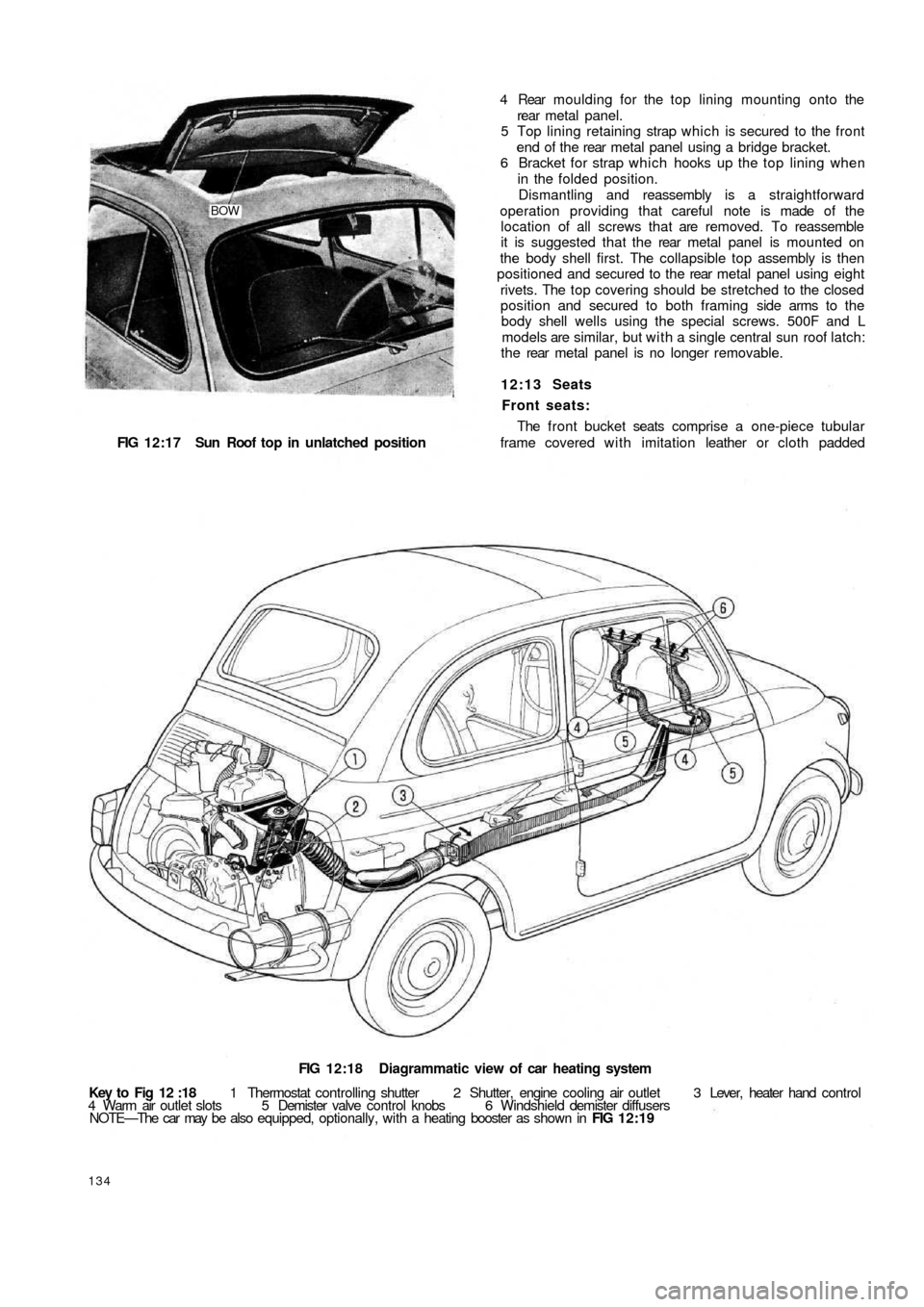
FIG 12:18 Diagrammatic view of car heating system
Key to Fig 12 :18 1 Thermostat controlling shutter 2 Shutter, engine cooling air outlet 3 Lever, heater hand control
4 Warm air outlet slots 5 Demister valve control knobs 6 Windshield demister diffusers
NOTE—The car may be also equipped, optionally, with a heating booster as shown in FIG 12:19
134
4 Rear moulding for the top lining mounting onto the
rear metal panel.
5 Top lining retaining strap which is secured to the front
end of t h e rear metal panel using a bridge bracket.
6 Bracket for strap which hooks up the top lining when
in the folded position.
Dismantling and reassembly is a straightforward
operation providing that careful note is made of the
location of all screws that are removed. To reassemble
it is suggested that the rear metal panel is mounted on
the body shell first. The collapsible top assembly is then
positioned and secured to the rear metal panel using eight
rivets. The top covering should be stretched to the closed
position and secured to both framing side arms to t h e
body shell wells using the special screws. 500F and L
models are similar, but with a single central sun roof latch:
t h e rear metal panel is no longer removable.
12:13 Seats
Front seats:
The front bucket seats comprise a one-piece tubular
frame covered with imitation leather or cloth padded
Page 128 of 128
cushion and back rest. A number of rubber straps are
hooked across the frame under the cushion and in a
sheath covering on the seat back.
The bottom of the front seat frame ends are provided
with sliding guides which run in guide rails attached to
the floor. The sliding guides are pivoted on the frame
tubes to allow for forward tilting of the seats giving better
access to the rear compartment. Two rubber pads
provide cushioning of the seat frame on the guide rails
as shown in FIG 12:11. The control lever for seat
adjustment is fitted in the frame righthand tube to permit
unlocking of the seats so that they may be adjusted to
individual drivers requirements.
Rear seats (Sedan):
The rear seat comprises of a foam rubber cushion and
back. The seat back is cemented to the rear floor and
body shell bulkhead. The rear seat lining is of fabric and
imitation leather. The seat lining is held in place by four
self-tapping screws, t w o of which secure the floor below
the back window and two the lining at the base of t h e
back rest. Included with the seat assembly is a masonite
floor which is fitted below the rear window.
Rear Seat (Station Wagon):
The rear seat back rest is pivoted at the base of its
frame so that it can be folded down to form a load plat-
form surface. In the upright position it is retained in place
by t w o brackets mounted on either side of the body below
the side
windows.
12:14 Interior heater
Description:
Interior heating is accomplished by recirculation of
warm air from the engine cooling system through engine
cowling. Referring to FIG 12:18 a hose conveys warmed
air from the engine cowling to the centre tunnel floor
where warm air flows out through two slots being cut on
the windshield delivery hoses. Air admission can be
adjusted by turning the control lever to the right which
operates the tunnel throttle valve at the rear seat.
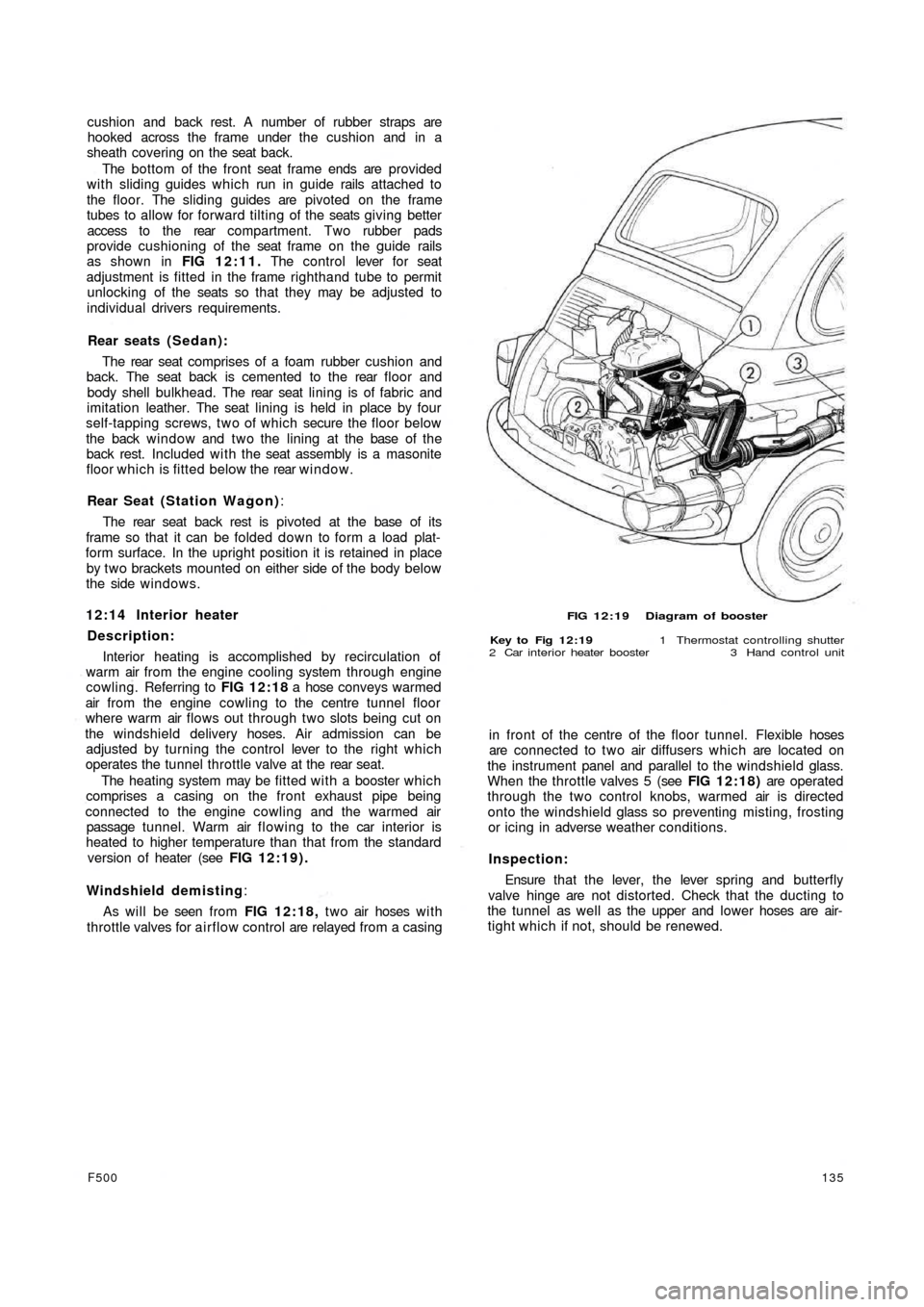
The heating system may be fitted with a booster which
comprises a casing on the front exhaust pipe being
connected to the engine cowling and the warmed air
passage tunnel. Warm air flowing to the car interior is
heated to higher temperature than that from the standard
version of heater (see FIG 12:19).
Windshield demisting:
As will be seen from FIG 12:18, t w o air hoses w i t h
throttle valves for airflow control are relayed from a casing
F500135
FIG 12:19 Diagram of booster
Key to Fig 12:19 1 Thermostat controlling shutter
2 Car interior heater booster 3 Hand control unit
in front of the centre of the floor tunnel. Flexible hoses
are connected to two air diffusers which are located on
the instrument panel and parallel to the windshield glass.
When the throttle valves 5 (see FIG 12:18) are operated
through the two control knobs, warmed air is directed
onto the windshield glass so preventing misting, frosting
or icing in adverse weather conditions.
Inspection:
Ensure that t h e lever, the lever spring and butterfly
valve hinge are not distorted. Check that the ducting to
the tunnel as well as the upper and lower hoses are air-
tight which if not, should be renewed.