engine FIAT 500 2013 2.G Manual PDF
[x] Cancel search | Manufacturer: FIAT, Model Year: 2013, Model line: 500, Model: FIAT 500 2013 2.GPages: 423, PDF Size: 9.86 MB
Page 325 of 423
3. Connect the negative end(-)of the jumper cable to the
negative(-)post of the booster battery.
4. Connect the opposite end of the negative(-)jumper
cable to a good engine ground (exposed metal part of
the discharged vehicle’s engine) away from the battery
and the fuel injection system.
WARNING!
Do not connect the cable to the negative post (-) of the
discharged battery. The resulting electrical spark
could cause the battery to explode and could result in
personal injury.
5. Start the engine in the vehicle that has the booster
battery, let the engine idle a few minutes, and then
start the engine in the vehicle with the discharged
battery. Once the engine is started, remove the jumper
cables in the reverse sequence:
6. Disconnect the negative(-)jumper cable from the
engine ground(-)of the vehicle with the discharged
battery.
7. Disconnect the negative end(-)of the jumper cable
from the negative(-)post of the booster battery.
8. Disconnect the opposite end of the positive(+)jumper
cable from the positive(+)post of the booster battery.
9. Disconnect the positive(+)end of the jumper cable
from the positive(+)post of the discharged vehicle.
If frequent jump-starting is required to start your vehicle,
you should have the battery and charging system in-
spected at your authorized studio.
6
WHAT TO DO IN EMERGENCIES 323
Page 326 of 423
CAUTION!
Accessories plugged into the vehicle power outlets
draw power from the vehicle’s battery, even when not
in use (i.e., cellular phones, etc.). Eventually, if
plugged in long enough without engine operation,
the vehicle’s battery will discharge sufficiently to
degrade battery life and/or prevent the engine from
starting.
FREEING A STUCK VEHICLE
If your vehicle becomes stuck in mud, sand or snow, it can
often be moved using a rocking motion. Turn the steering
wheel right and left to clear the area around the front
wheels. Then shift back and forth between DRIVE and
REVERSE (with automatic transmission) or 2nd gear and
REVERSE (with manual transmission), while gently press-
ing the accelerator. Use the least amount of accelerator pedal
pressure that will maintain the rocking motion, without
spinning the wheels, or racing the engine.
CAUTION!
Racing the engine or spinning the wheels may lead to
transmission overheating and failure. Allow the en-
gine to idle with the transmission in NEUTRAL for at
least one minute after every five rocking-motion
cycles. This will minimize overheating and reduce
the risk of transmission failure during prolonged
efforts to free a stuck vehicle.
NOTE:Press the#ESC Off#switch, to place the Electronic
Stability Control (ESC) system in#Partial Off#mode,
before rocking the vehicle. Refer to “Electronic Brake
Control” in “Starting And Operating” for further infor-
mation. Once the vehicle has been freed, press the#ESC
Off#switch again to restore#ESC On#mode.
324 WHAT TO DO IN EMERGENCIES
Page 327 of 423
CAUTION!
•When “rocking” a stuck vehicle by shifting be-
tween DRIVE/2nd gear and REVERSE, do not spin
the wheels faster than 15 mph (24 km/h), or drive-
train damage may result.
•Revving the engine or spinning the wheels too fast
may lead to transmission overheating and failure.
It can also damage the tires. Do not spin the wheels
above 30 mph (48 km/h) while in gear (no trans-
mission shifting occurring).
WARNING!
Fast spinning tires can be dangerous. Forces gener-
ated by excessive wheel speeds may cause damage,
or even failure, of the axle and tires. A tire could
(Continued)
WARNING!(Continued)
explode and injure someone. Do not spin your vehi-
cle’s wheels faster than 30 mph (48 km/h) or for
longer than 30 seconds continuously without stop-
ping when you are stuck and do not let anyone near
a spinning wheel, no matter what the speed.
SHIFT LEVER OVERRIDE
If a malfunction occurs and the shift lever cannot be
moved out of the PARK position, you can use the
following procedure to temporarily move the shift lever:
1. Turn the engine OFF.
2. Firmly apply the parking brake.
6
WHAT TO DO IN EMERGENCIES 325
Page 331 of 423
CAUTION!(Continued)
•Towing this vehicle in violation of the above re-
quirements can cause severe transmission damage.
Damage from improper towing is not covered un-
der the New Vehicle Limited Warranty.
Manual Transmission
•Vehicle can be flat towed (all four wheels on the
ground) with the transmission in NEUTRAL.
•Vehicle can be towed with the front wheels elevated.
•Vehicle can be towed on a flatbed truck (all wheels off
the ground).
CAUTION!
Towing this vehicle in violation of the above require-
ments can cause severe transmission damage. Dam-
age from improper towing is not covered under the
New Vehicle Limited Warranty.
ENHANCED ACCIDENT RESPONSE SYSTEM
In the event of an impact causing airbag deployment, if
the communication network remains intact, and the
power remains intact, depending on the nature of the
event the ORC will determine whether to have the
Enhanced Accident Response System perform the follow-
ing functions:
•Cut off fuel to the engine.
•Flash hazard lights as long as the battery has power or
until the ignition key is turned off.
6
WHAT TO DO IN EMERGENCIES 329
Page 332 of 423
•Turn on the interior lights, which remain on as long as
the battery has power or until the ignition key is
removed.
•Unlock the doors automatically.
After the event occurs, when the system is active, the
message#Fuel Cutoff See Handbook#is displayed.
Carefully check the vehicle for fuel leaks in the engine
compartment and on the ground near the engine com-
partment and fuel tank before resetting the system and
starting the engine.
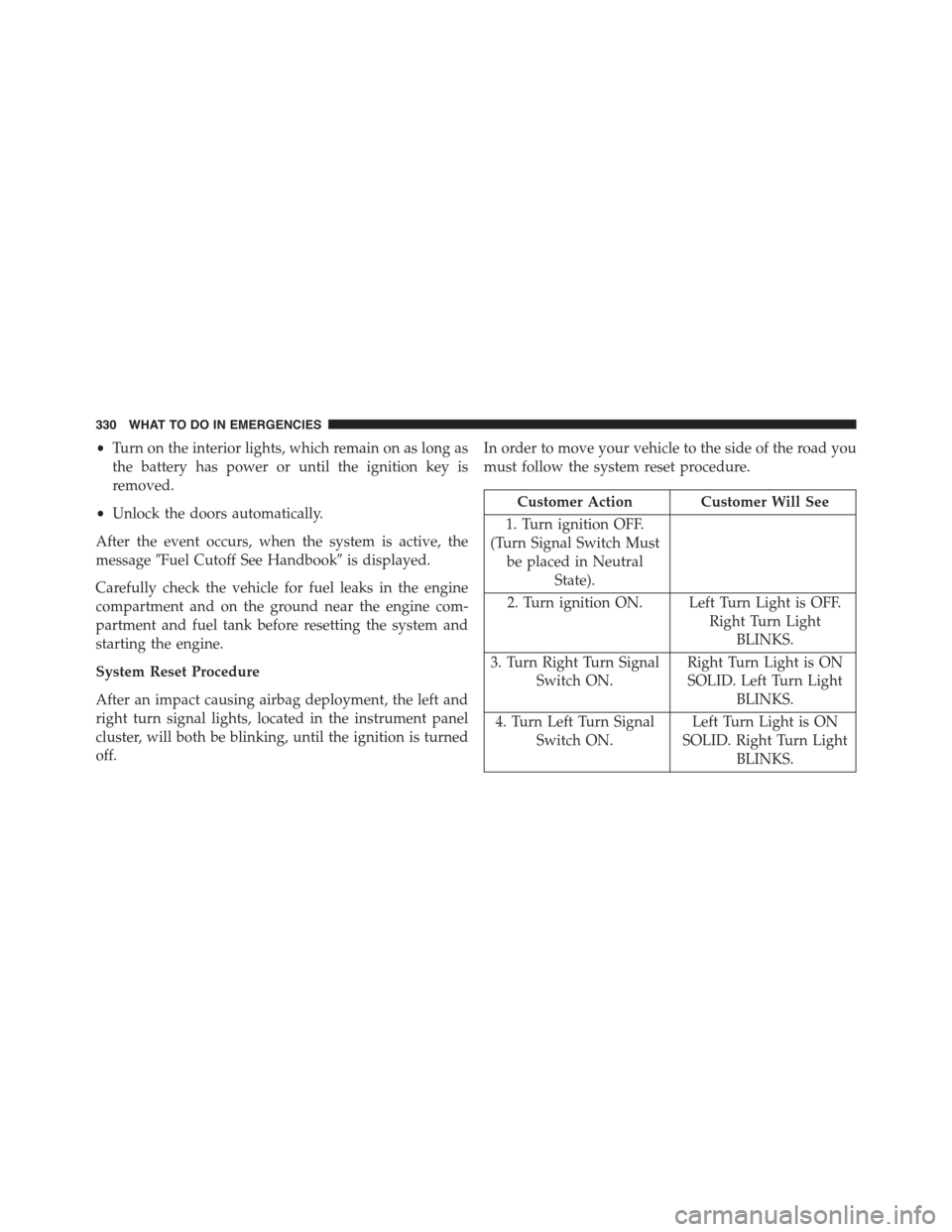
System Reset Procedure
After an impact causing airbag deployment, the left and
right turn signal lights, located in the instrument panel
cluster, will both be blinking, until the ignition is turned
off.
In order to move your vehicle to the side of the road you
must follow the system reset procedure.
Customer Action Customer Will See
1. Turn ignition OFF.
(Turn Signal Switch Must
be placed in Neutral
State).
2. Turn ignition ON. Left Turn Light is OFF.
Right Turn Light
BLINKS.
3. Turn Right Turn Signal
Switch ON.
Right Turn Light is ON
SOLID. Left Turn Light
BLINKS.
4. Turn Left Turn Signal
Switch ON.
Left Turn Light is ON
SOLID. Right Turn Light
BLINKS.
330 WHAT TO DO IN EMERGENCIES
Page 333 of 423
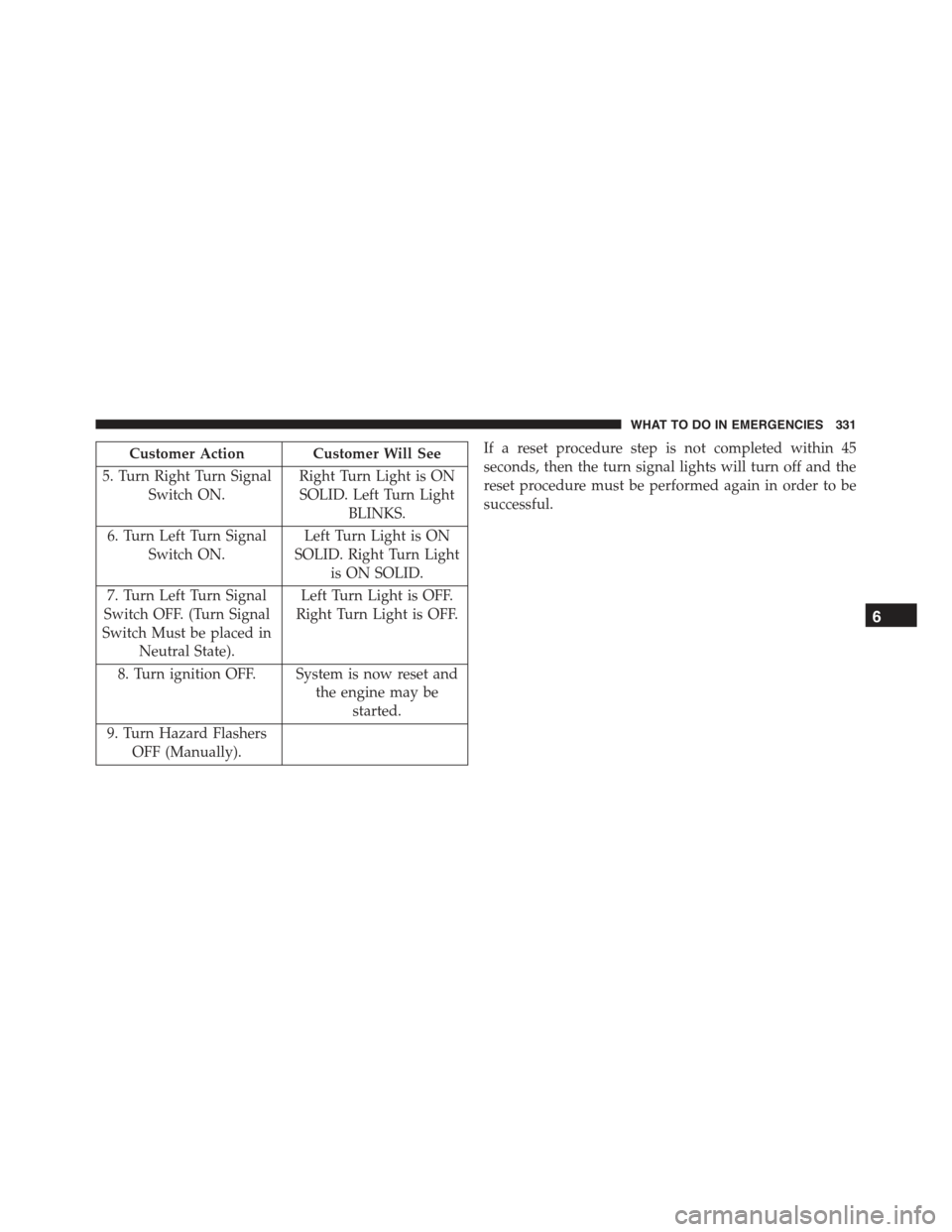
Customer Action Customer Will See
5. Turn Right Turn Signal
Switch ON.
Right Turn Light is ON
SOLID. Left Turn Light
BLINKS.
6. Turn Left Turn Signal
Switch ON.
Left Turn Light is ON
SOLID. Right Turn Light
is ON SOLID.
7. Turn Left Turn Signal
Switch OFF. (Turn Signal
Switch Must be placed in
Neutral State).
Left Turn Light is OFF.
Right Turn Light is OFF.
8. Turn ignition OFF. System is now reset and
the engine may be
started.
9. Turn Hazard Flashers
OFF (Manually).
If a reset procedure step is not completed within 45
seconds, then the turn signal lights will turn off and the
reset procedure must be performed again in order to be
successful.
6
WHAT TO DO IN EMERGENCIES 331
Page 335 of 423
MAINTAINING YOUR VEHICLE
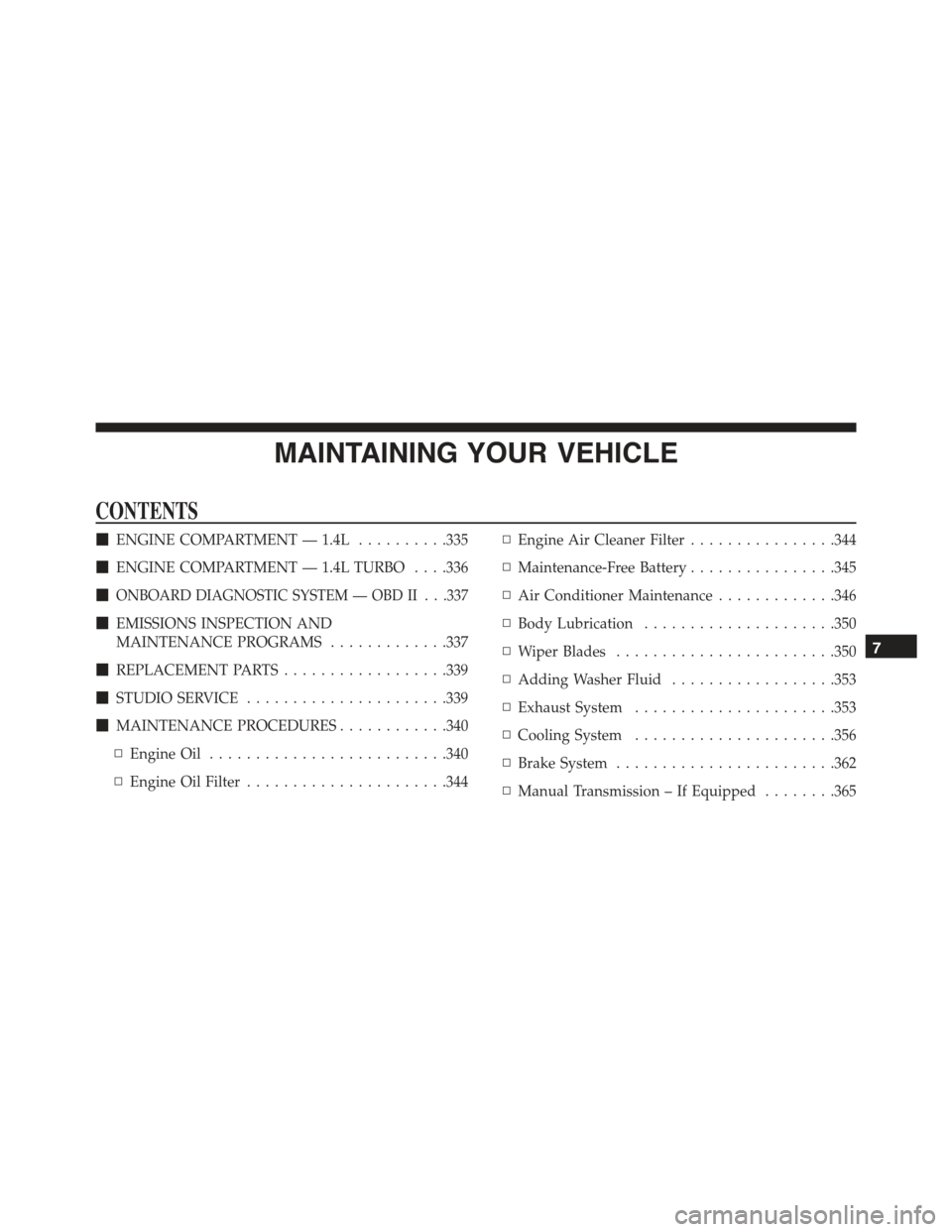
CONTENTS
!ENGINE COMPARTMENT — 1.4L..........335
!ENGINE COMPARTMENT — 1.4L TURBO . . . .336
!ONBOARD DIAGNOSTIC SYSTEM — OBD II . . .337
!EMISSIONS INSPECTION AND
MAINTENANCE PROGRAMS.............337
!REPLACEMENT PARTS..................339
!STUDIO SERVICE......................339
!MAINTENANCE PROCEDURES............340
▫Engine Oil..........................340
▫Engine Oil Filter......................344
▫Engine Air Cleaner Filter................344
▫Maintenance-Free Battery................345
▫Air Conditioner Maintenance.............346
▫Body Lubrication.....................350
▫Wiper Blades........................350
▫Adding Washer Fluid..................353
▫Exhaust System......................353
▫Cooling System......................356
▫Brake System........................362
▫Manual Transmission – If Equipped........365
7
Page 336 of 423
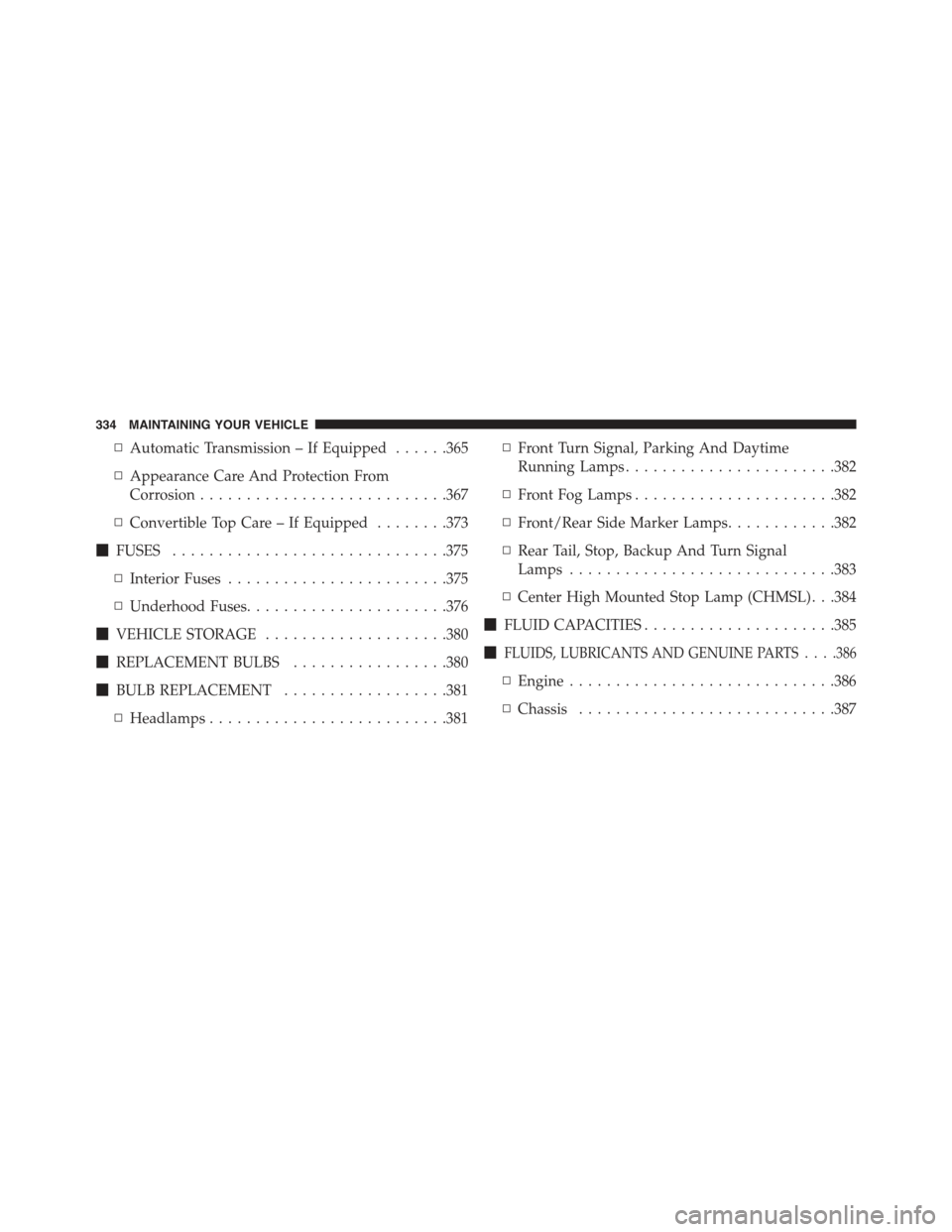
▫Automatic Transmission – If Equipped......365
▫Appearance Care And Protection From
Corrosion...........................367
▫Convertible Top Care – If Equipped........373
!FUSES..............................375
▫Interior Fuses........................375
▫Underhood Fuses......................376
!VEHICLE STORAGE....................380
!REPLACEMENT BULBS.................380
!BULB REPLACEMENT..................381
▫Headlamps..........................381
▫Front Turn Signal, Parking And Daytime
Running Lamps.......................382
▫Front Fog Lamps......................382
▫Front/Rear Side Marker Lamps............382
▫Rear Tail, Stop, Backup And Turn Signal
Lamps.............................383
▫Center High Mounted Stop Lamp (CHMSL) . . .384
!FLUID CAPACITIES.....................385
!FLUIDS, LUBRICANTS AND GENUINE PARTS . . . .386
▫Engine.............................386
▫Chassis............................387
334 MAINTAINING YOUR VEHICLE
Page 337 of 423
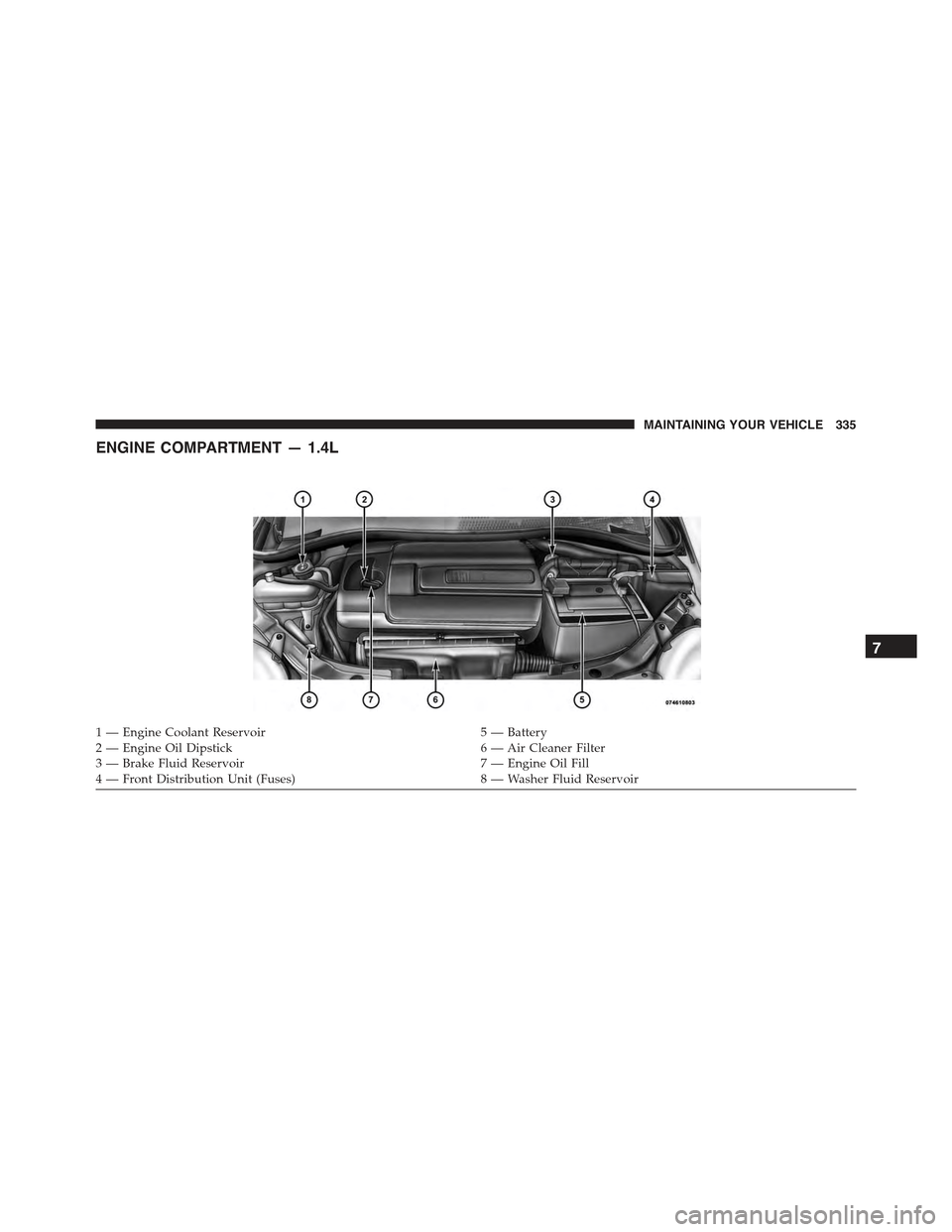
ENGINE COMPARTMENT — 1.4L
1 — Engine Coolant Reservoir5 — Battery2 — Engine Oil Dipstick6 — Air Cleaner Filter3 — Brake Fluid Reservoir7 — Engine Oil Fill4 — Front Distribution Unit (Fuses)8 — Washer Fluid Reservoir
7
MAINTAINING YOUR VEHICLE 335
Page 338 of 423
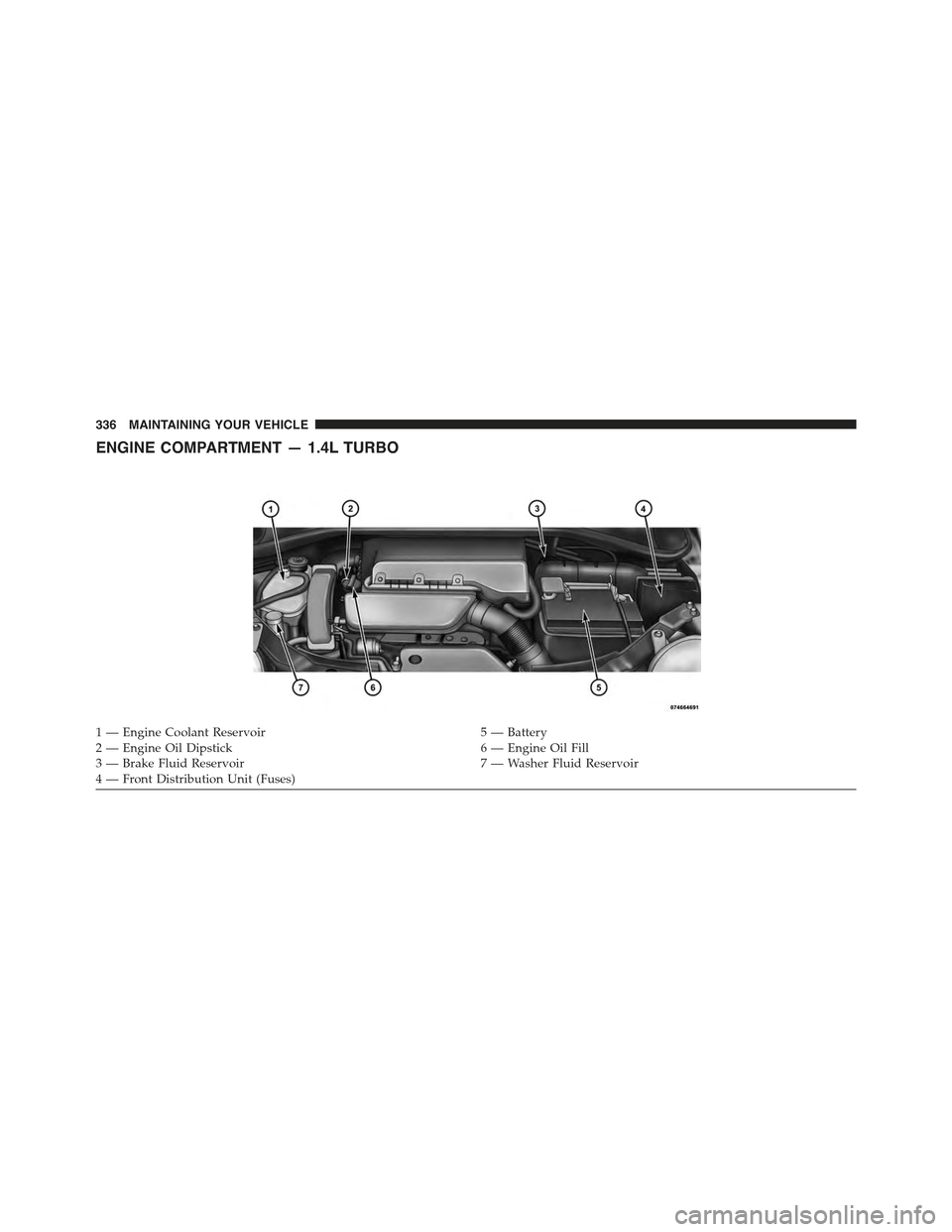
ENGINE COMPARTMENT — 1.4L TURBO
1 — Engine Coolant Reservoir5 — Battery2—EngineOilDipstick6—EngineOilFill3 — Brake Fluid Reservoir7 — Washer Fluid Reservoir4—FrontDistributionUnit(Fuses)
336 MAINTAINING YOUR VEHICLE