child lock FIAT 500 2013 2.G Owners Manual
[x] Cancel search | Manufacturer: FIAT, Model Year: 2013, Model line: 500, Model: FIAT 500 2013 2.GPages: 423, PDF Size: 9.86 MB
Page 12 of 423
▫Power Window Switches.................26
!LIFTGATE............................28
!OCCUPANT RESTRAINTS................29
▫Lap/Shoulder Belts....................32
▫Lap/Shoulder Belt Untwisting Procedure.....37
▫Seat Belts In Passenger Seating Positions......37
▫Automatic Locking Retractor Mode (ALR) —
If Equipped..........................38
▫Energy Management Feature..............39
▫Seat Belt Pretensioners..................40
▫Enhanced Seat Belt Use Reminder System
(BeltAlert®)..........................40
▫Seat Belt Extender.....................41
▫Seat Belts And Pregnant Women...........42
▫Supplemental Restraint System (SRS) — Air Bags . . .42
▫Advanced Front Air Bag Features...........44
▫Air Bag Deployment Sensors And Controls....48
▫Event Data Recorder (EDR)...............58
▫Child Restraints.......................59
▫Transporting Pets......................78
!ENGINE BREAK-IN RECOMMENDATIONS....78
!SAFETY TIPS..........................79
▫Transporting Passengers..................79
▫Exhaust Gas.........................80
▫Safety Checks You Should Make Inside The
Vehicle.............................81
▫Periodic Safety Checks You Should Make
Outside The Vehicle....................83
10 THINGS TO KNOW BEFORE STARTING YOUR VEHICLE
Page 14 of 423
WARNING!
•Before exiting a vehicle, always apply the parking
brake, shift the transmission into PARK, and push
ignition button to place ignition in OFF position.
When leaving the vehicle, always lock your ve-
hicle.
•Never leave children alone in a vehicle, or with
access to an unlocked vehicle.
•Allowing children to be in a vehicle unattended is
dangerous for a number of reasons. A child or
others could be seriously or fatally injured. Chil-
dren should be warned not to touch the parking
brake, brake pedal or the shift lever.
•Do not leave the Key Fob in or near the vehicle, or
in a location accessible to children. A child could
operate power windows, other controls, or move
the vehicle.
(Continued)
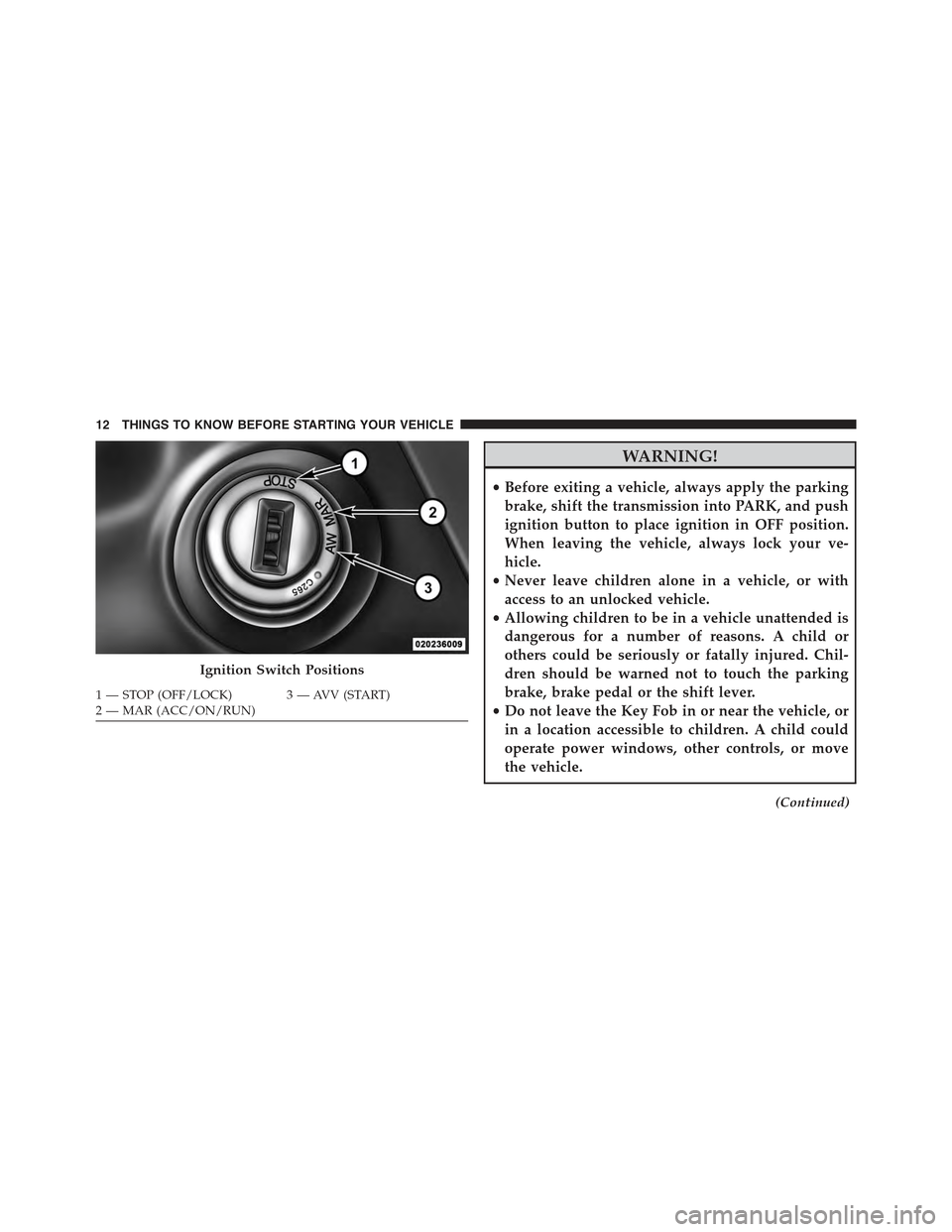
Ignition Switch Positions
1—STOP(OFF/LOCK) 3—AVV(START)2—MAR(ACC/ON/RUN)
12 THINGS TO KNOW BEFORE STARTING YOUR VEHICLE
Page 15 of 423
WARNING!(Continued)
•Do not leave children or animals inside parked
vehicles in hot weather. Interior heat build-up may
cause serious injury or death.
CAUTION!
An unlocked car is an invitation to thieves. Always
remove the key from the ignition and lock all the
doors when leaving the vehicle unattended.
Locking Doors With A Key
You can insert the key with either side up. To lock the
door, turn the key to the left. To unlock the door, turn the
key to the right. Refer to “Body Lubrication” in “Main-
taining Your Vehicle” for maintenance procedures.
Key-In-Ignition Reminder
Opening the driver’s door when the key is in the ignition
and the ignition switch position is OFF/LOCK, sounds a
signal to remove the key.
SENTRY KEY®
The Sentry Key® Immobilizer System prevents unau-
thorized vehicle operation by disabling the engine. The
system does not need to be armed or activated. Operation
is automatic, regardless of whether the vehicle is locked
or unlocked.
The system uses ignition keys which have an embedded
electronic chip (transponder) to prevent unauthorized
vehicle operation. Therefore, only keys that are pro-
grammed to the vehicle can be used to start and operate
the vehicle.
2
THINGS TO KNOW BEFORE STARTING YOUR VEHICLE 13
Page 26 of 423
WARNING!
•Do not leave children or animals inside parked
vehicles in hot weather. Interior heat build-up may
cause serious injury or death.
•For personal security and safety in the event of an
collision, lock the vehicle doors as you drive as
well as when you park and leave the vehicle.
•Before exiting a vehicle, always apply the parking
brake, shift the transmission into PARK, and re-
move the Key Fob from the ignition. When leaving
the vehicle, always lock your vehicle.
•Never leave children alone in a vehicle, or with
access to an unlocked vehicle.
(Continued)
WARNING!(Continued)
•Allowing children to be in a vehicle unattended is
dangerous for a number of reasons. A child or
others could be seriously or fatally injured. Chil-
dren should be warned not to touch the parking
brake, brake pedal or the shift lever.
•Do not leave the Key Fob in or near the vehicle, or
in a location accessible to children, and do not
leave a vehicle equipped with Keyless Enter-N-Go
in the ACC or ON/RUN mode. A child could
operate power windows, other controls, or move
the vehicle.
CAUTION!
An unlocked vehicle is an invitation to thieves.
Always remove the key from the ignition and lock all
of the doors when leaving the vehicle unattended.
24 THINGS TO KNOW BEFORE STARTING YOUR VEHICLE
Page 28 of 423
Autoclose — If Equipped
When enabled, the door locks will lock automatically
when the vehicle’s speed exceeds 15 mph (24 km/h).
To change the setting proceed as follows:
1. Briefly press theSET ESCbutton “On” or “Off” will
flash on the display (according to the previous set-
ting).
2. Press the UPor DOWNbutton for setting.
3. Briefly press theSET ESCbutton to go back to the
menu screen, or press and hold theSET ESCbutton
(approximately one second) to go back to the main
screen without storing the settings.
NOTE:Use the Automatic Door Locks feature in accor-
dance with local laws.
Refer to “Electronic Vehicle Information Center (EVIC)”
in “Understanding Your Vehicle” for further information.
POWER WINDOWS
Power Window Switches
There are single window controls located on the shifter
bezel, below the climate controls, which operate the
driver and passenger door windows. The window con-
trols will operate when the ignition switch is in the
ON/RUN position.
WARNING!
Never leave children in a vehicle with the key in the
ignition switch. Occupants, particularly unattended
children, can become entrapped by the windows
while operating the power window switches. Such
entrapment may result in serious injury or death.
26 THINGS TO KNOW BEFORE STARTING YOUR VEHICLE
Page 32 of 423
•All seat belt systems (except the driver’s) include
Automatic Locking Retractors (ALRs), which lock the
seat belt webbing into position by extending the belt
all the way out and then adjusting the belt to the
desired length to restrain a child seat or secure a large
item in a seat — if equipped
Please pay close attention to the information in this section.
It tells you how to use your restraint system properly, to
keep you and your passengers as safe as possible.
If you will be carrying children too small for adult-sized
seat belts, the seat belts or the Lower Anchors and Tether
for Children (LATCH) feature also can be used to hold
infant and child restraint systems. For more information
on LATCH, refer to “LATCH — Child Seat Anchorage
System (Lower Anchors and Tether for Children).”
Here are some simple steps you can take to minimize the
risk of harm from a deploying air bag:
1. Children 12 years old and under should always ride
buckled up in a rear seat.
WARNING!
Infants in rear facing child restraints should never
ride in the front seat of a vehicle with a passenger
Advanced Front Air Bag. An air bag deployment can
cause severe injury or death to infants in that posi-
tion.
Children that are not big enough to wear the vehicle seat
belt properly (see section on Child Restraints) should be
secured in the rear seat in child restraints or belt-
positioning booster seats. Older children who do not use
child restraints or belt-positioning booster seats should
ride properly buckled up in the rear seat. Never allow
children to slide the shoulder belt behind them or under
their arm.
30 THINGS TO KNOW BEFORE STARTING YOUR VEHICLE
Page 39 of 423
6. To release the belt, push the red button on the buckle.
The belt will automatically retract to its stowed posi-
tion. If necessary, slide the latch plate down the
webbing to allow the belt to retract fully.
WARNING!
A frayed or torn belt could rip apart in a collision and
leave you with no protection. Inspect the belt system
periodically, checking for cuts, frays, or loose parts.
Damaged parts must be replaced immediately. Do
not disassemble or modify the system. Seat belt
assemblies must be replaced after a collision if they
have been damaged (bent retractor, torn webbing,
etc.).
Lap/Shoulder Belt Untwisting Procedure
Use the following procedure to untwist a twisted lap/
shoulder belt.
1. Position the latch plate as close as possible to the
anchor point.
2. At about 6 to 12 in (15 to 30 cm) above the latch plate,
grasp and twist the belt webbing 180 degrees to create
a fold that begins immediately above the latch plate.
3. Slide the latch plate upward over the folded webbing.
The folded webbing must enter the slot at the top of
the latch plate.
4. Continue to slide the latch plate up until it clears the
folded webbing.
Seat Belts In Passenger Seating Positions
The seat belts in the passenger seating positions are
equipped with Automatic Locking Retractors (ALR)
which are used to secure a child restraint system. For
additional information, refer to “Installing Child Re-
straints Using The Vehicle Seat Belt” under the “Child
2
THINGS TO KNOW BEFORE STARTING YOUR VEHICLE 37
Page 40 of 423
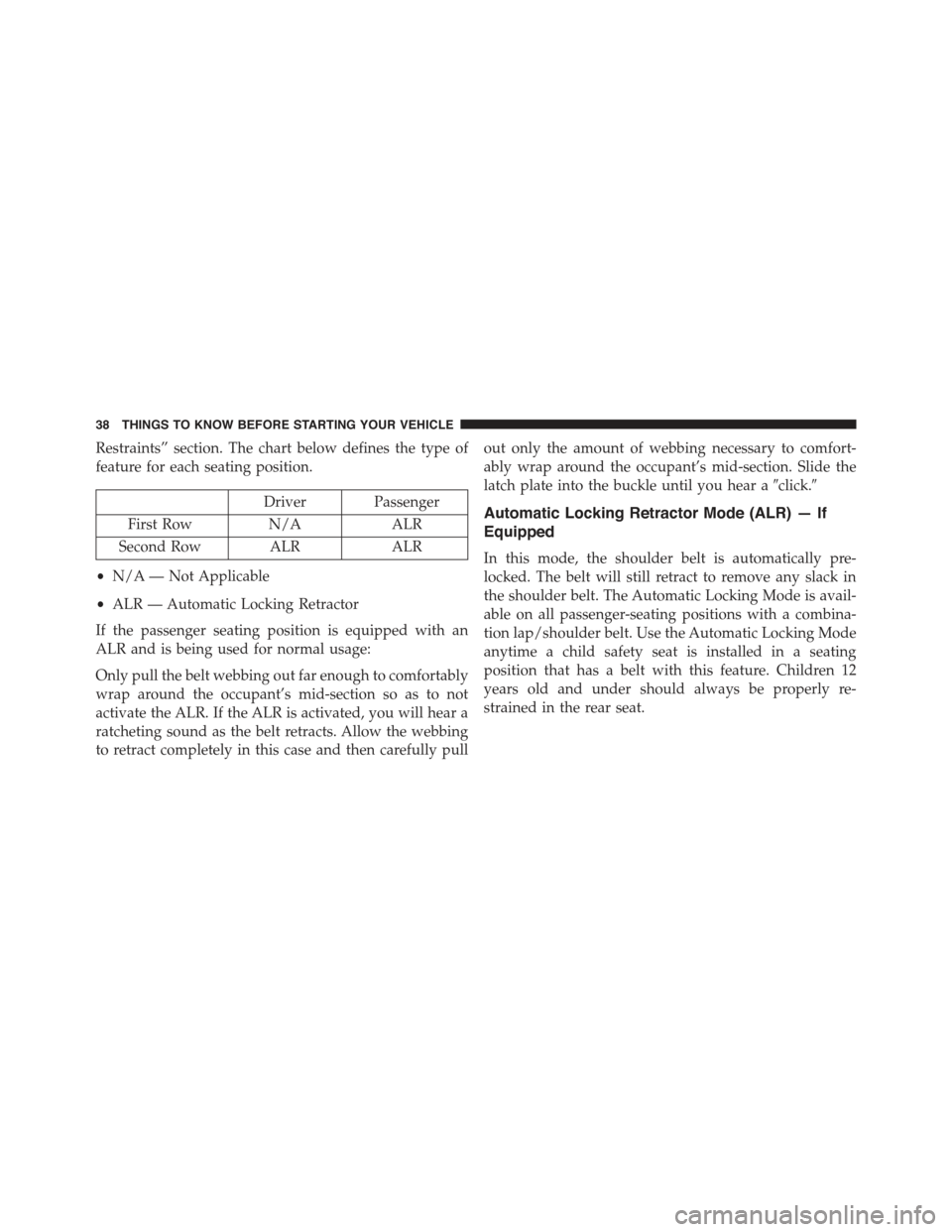
Restraints” section. The chart below defines the type of
feature for each seating position.
Driver Passenger
First RowN/AALR
Second Row ALRALR
•N/A — Not Applicable
•ALR — Automatic Locking Retractor
If the passenger seating position is equipped with an
ALR and is being used for normal usage:
Only pull the belt webbing out far enough to comfortably
wrap around the occupant’s mid-section so as to not
activate the ALR. If the ALR is activated, you will hear a
ratcheting sound as the belt retracts. Allow the webbing
to retract completely in this case and then carefully pull
out only the amount of webbing necessary to comfort-
ably wrap around the occupant’s mid-section. Slide the
latch plate into the buckle until you hear a#click.#
Automatic Locking Retractor Mode (ALR) — If
Equipped
In this mode, the shoulder belt is automatically pre-
locked. The belt will still retract to remove any slack in
the shoulder belt. The Automatic Locking Mode is avail-
able on all passenger-seating positions with a combina-
tion lap/shoulder belt. Use the Automatic Locking Mode
anytime a child safety seat is installed in a seating
position that has a belt with this feature. Children 12
years old and under should always be properly re-
strained in the rear seat.
38 THINGS TO KNOW BEFORE STARTING YOUR VEHICLE
Page 49 of 423
The system includes side impact sensors that are cali-
brated to deploy the Seat-Mounted Side Air Bags (SAB)
and SABIC during impacts that require air bag occupant
protection.
SAB and SABIC air bags are a supplement to the seat belt
restraint system. Occupants, including children who are
up against or very close to SAB or SABIC air bags can be
seriously injured or killed. Occupants, especially chil-
dren, should not lean on or sleep against the door, side
windows, or area where the SAB or SABIC air bags
inflate, even if they are in an infant or child restraint.
Always sit upright as possible with your back against the
seat back, use the seat belts properly, and use the
appropriate sized child restraint, infant restraint or
booster seat recommended for the size and weight of the
child.
WARNING!
•Your vehicle is equipped with left and right
Supplemental Side Air Bag Inflatable Curtain
(SABIC), do not stack luggage or other cargo up
high enough to block the location of the SABIC.
The area where the SABIC is located should remain
free from any obstructions.
•Do not use accessory seat covers or place objects
between you and the side air bags; the performance
could be adversely affected and/or objects could be
pushed into you, causing serious injury.
(Continued)
2
THINGS TO KNOW BEFORE STARTING YOUR VEHICLE 47
Page 72 of 423
Locating The LATCH Anchorages
In addition, there are tether strap anchorages
behind each rear seating position located on
the back of the seat.
LATCH-compatible child restraint systems will be
equipped with a rigid bar or a flexible strap on each side.
Each will have a hook or connector to attach to the lower
anchorage and a way to tighten the connection to the
anchorage. Forward-facing child restraints and some
rear-facing infant restraints will also be equipped with a
tether strap. The tether strap will have a hook at the end
to attach to the top tether anchorage and a way to tighten
the strap after it is attached to the anchorage.
Center Seat LATCH
WARNING!
This vehicle does not have a center seating position.
Do not use the center lower LATCH anchorages to
install a child seat in the center of the back seat.
Always follow the directions of the child restraint manu-
facturer when installing your child restraint. Not all child
restraint systems will be installed as described here.
To Install A LATCH-compatible Child Restraint
1. If the selected seating position has a Switchable Auto-
matic Locking Retractor (ALR) seat belt, stow the seat
belt, following the instructions below. See the section
“Installing Child Restraints Using the Vehicle Seat
Belt” to check what type of seat belt each seating
position has.
70 THINGS TO KNOW BEFORE STARTING YOUR VEHICLE