cooling FIAT 500 2014 2.G User Guide
[x] Cancel search | Manufacturer: FIAT, Model Year: 2014, Model line: 500, Model: FIAT 500 2014 2.GPages: 440, PDF Size: 2.89 MB
Page 372 of 440
Refer to the “Maintenance Schedule” for the proper
maintenance intervals.
NOTE:Some vehicles require special tools to add coolant
properly. Failure to fill these systems properly could lead
to severe internal engine damage. If any coolant is
needed to be added to the system please contact your
local authorized dealer.
Selection Of Coolant
Refer to “Fluids, Lubricants, and Genuine Parts” in
“Maintaining Your Vehicle” for further information.
CAUTION!
• Mixing of engine coolant (antifreeze) other than
specified Organic Additive Technology (OAT) en-
gine coolant (antifreeze), may result in engine
damage and may decrease corrosion protection.
Organic Additive Technology (OAT) engine cool-
ant is different and should not be mixed with
Hybrid Organic Additive Technology (HOAT) en-
gine coolant (antifreeze) or any “globally compat-
ible” coolant (antifreeze). If a non-OAT engine
coolant (antifreeze) is introduced into the cooling
system in an emergency, the cooling system will
need to be drained, flushed, and refilled with fresh
OAT coolant (conforming to MS-12106), by an
authorized dealer as soon as possible.
(Continued)
370 MAINTAINING YOUR VEHICLE
Page 374 of 440
(antifreeze) solution. The use of lower quality water
will reduce the amount of corrosion protection in the
engine cooling system.
Please note that it is the owner’s responsibility to main-
tain the proper level of protection against freezing ac-
cording to the temperatures occurring in the area where
the vehicle is operated.
NOTE:
• Some vehicles require special tools to add coolant
properly. Failure to fill these systems properly could
lead to severe internal engine damage. If any coolant is
needed to be added to the system please contact your
local authorized dealer. •
Mixing engine coolant (antifreeze) types is not recom-
mended and can result in cooling system damage. If
HOAT and OAT coolant are mixed in an emergency,
have a authorized dealer drain, flush, and refill with
OAT coolant (conforming to MS-12106) as soon as
possible.
Cooling System Pressure Cap
The cap must be fully tightened to prevent loss of engine
coolant (antifreeze) and to ensure that engine coolant
(antifreeze) will return to the radiator from the coolant
recovery tank.
The cap should be inspected and cleaned if there is any
accumulation of foreign material on the sealing surfaces.
372 MAINTAINING YOUR VEHICLE
Page 375 of 440
WARNING!
•The warning words “DO NOT OPEN HOT” on the
cooling system pressure cap are a safety precaution.
Never add engine coolant (antifreeze) when the
engine is overheated. Do not loosen or remove the
cap to cool an overheated engine. Heat causes
pressure to build up in the cooling system. To
prevent scalding or injury, do not remove the
pressure cap while the system is hot or under
pressure.
• Do not use a pressure cap other than the one
specified for your vehicle. Personal injury or en-
gine damage may result.
Disposal Of Used Engine Coolant
Used ethylene glycol-based engine coolant (antifreeze) is
a regulated substance requiring proper disposal. Check
with your local authorities to determine the disposal rules for your community. To prevent ingestion by ani-
mals or children, do not store ethylene glycol-based
engine coolant in open containers or allow it to remain in
puddles on the ground. If ingested by a child or pet, seek
emergency assistance immediately. Clean up any ground
spills immediately.
Coolant Level
The coolant expansion bottle provides a quick visual
method for determining that the coolant level is ad-
equate. With the engine off and cold, the level of the
engine coolant (antifreeze) in the bottle should be be-
tween the bottom and top lines marked “COLD FILL
RANGE”.
As long as the engine operating temperature is satisfac-
tory, the coolant bottle need only be checked once a
month.
7
MAINTAINING YOUR VEHICLE 373
Page 376 of 440
When additional engine coolant (antifreeze) is needed to
maintain the proper level, it should be added to the
coolant bottle. Do not overfill.
Points To Remember
NOTE:When the vehicle is stopped after a few miles/
kilometers of operation, you may observe vapor coming
from the front of the engine compartment. This is nor-
mally a result of moisture from rain, snow, or high
humidity accumulating on the radiator and being vapor-
ized when the thermostat opens, allowing hot engine
coolant (antifreeze) to enter the radiator.
If an examination of your engine compartment shows no
evidence of radiator or hose leaks, the vehicle may be
safely driven. The vapor will soon dissipate.
• Do not overfill the coolant expansion bottle. •
Check the coolant freeze point in the radiator and in
the coolant expansion bottle. If engine coolant (anti-
freeze) needs to be added, the contents of the coolant
expansion bottle must also be protected against freez-
ing.
• If frequent engine coolant (antifreeze) additions are
required, the cooling system should be pressure tested
for leaks.
• Maintain engine coolant (antifreeze) concentration at a
minimum of 50% OAT coolant (conforming to MS-
12106) and distilled water for proper corrosion protec-
tion of your engine which contains aluminum compo-
nents.
• Make sure that the coolant expansion bottle overflow
hoses are not kinked or obstructed.
• Keep the front of the radiator clean. If your vehicle is
equipped with air conditioning, keep the front of the
condenser clean.
374 MAINTAINING YOUR VEHICLE
Page 396 of 440
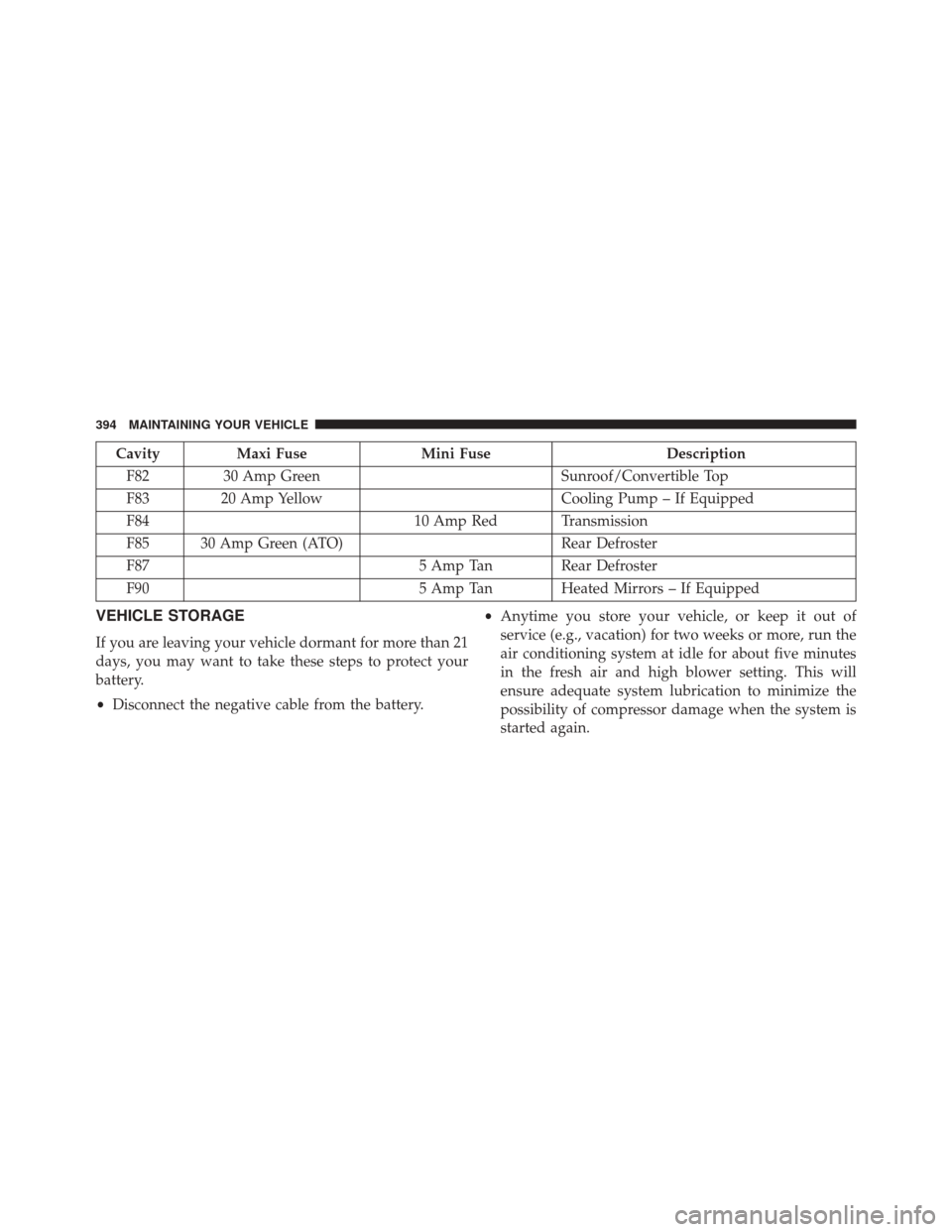
CavityMaxi Fuse Mini Fuse Description
F82 30 Amp Green Sunroof/Convertible Top
F83 20 Amp Yellow Cooling Pump – If Equipped
F84 10 Amp Red Transmission
F85 30 Amp Green (ATO) Rear Defroster
F87 5 Amp Tan Rear Defroster
F90 5 Amp Tan Heated Mirrors – If Equipped
VEHICLE STORAGE
If you are leaving your vehicle dormant for more than 21
days, you may want to take these steps to protect your
battery.
•Disconnect the negative cable from the battery. •
Anytime you store your vehicle, or keep it out of
service (e.g., vacation) for two weeks or more, run the
air conditioning system at idle for about five minutes
in the fresh air and high blower setting. This will
ensure adequate system lubrication to minimize the
possibility of compressor damage when the system is
started again.
394 MAINTAINING YOUR VEHICLE
Page 401 of 440
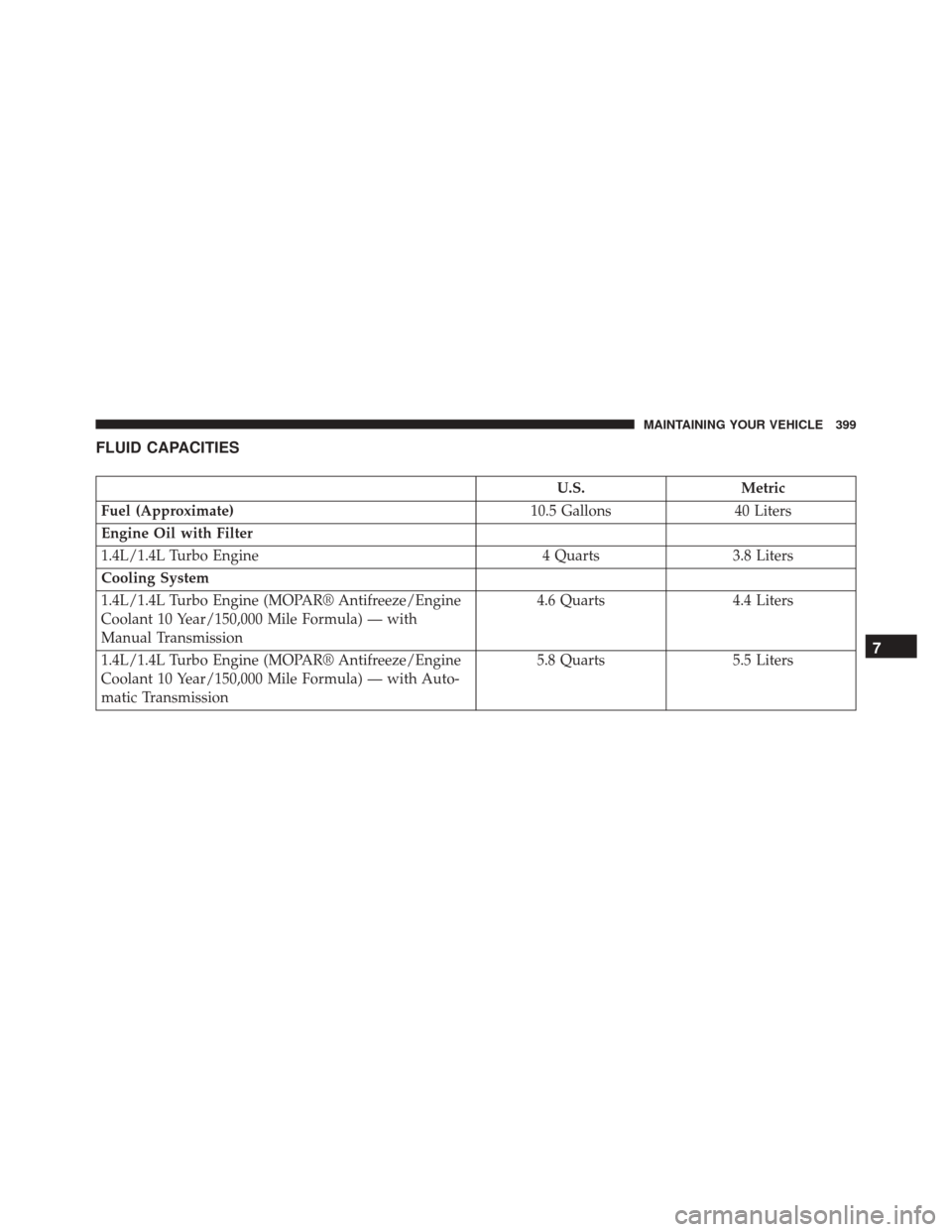
FLUID CAPACITIES
U.S.Metric
Fuel (Approximate) 10.5 Gallons40 Liters
Engine Oil with Filter
1.4L/1.4L Turbo Engine 4 Quarts3.8 Liters
Cooling System
1.4L/1.4L Turbo Engine (MOPAR® Antifreeze/Engine
Coolant 10 Year/150,000 Mile Formula) — with
Manual Transmission 4.6 Quarts
4.4 Liters
1.4L/1.4L Turbo Engine (MOPAR® Antifreeze/Engine
Coolant 10 Year/150,000 Mile Formula) — with Auto-
matic Transmission 5.8 Quarts
5.5 Liters
7
MAINTAINING YOUR VEHICLE 399
Page 407 of 440
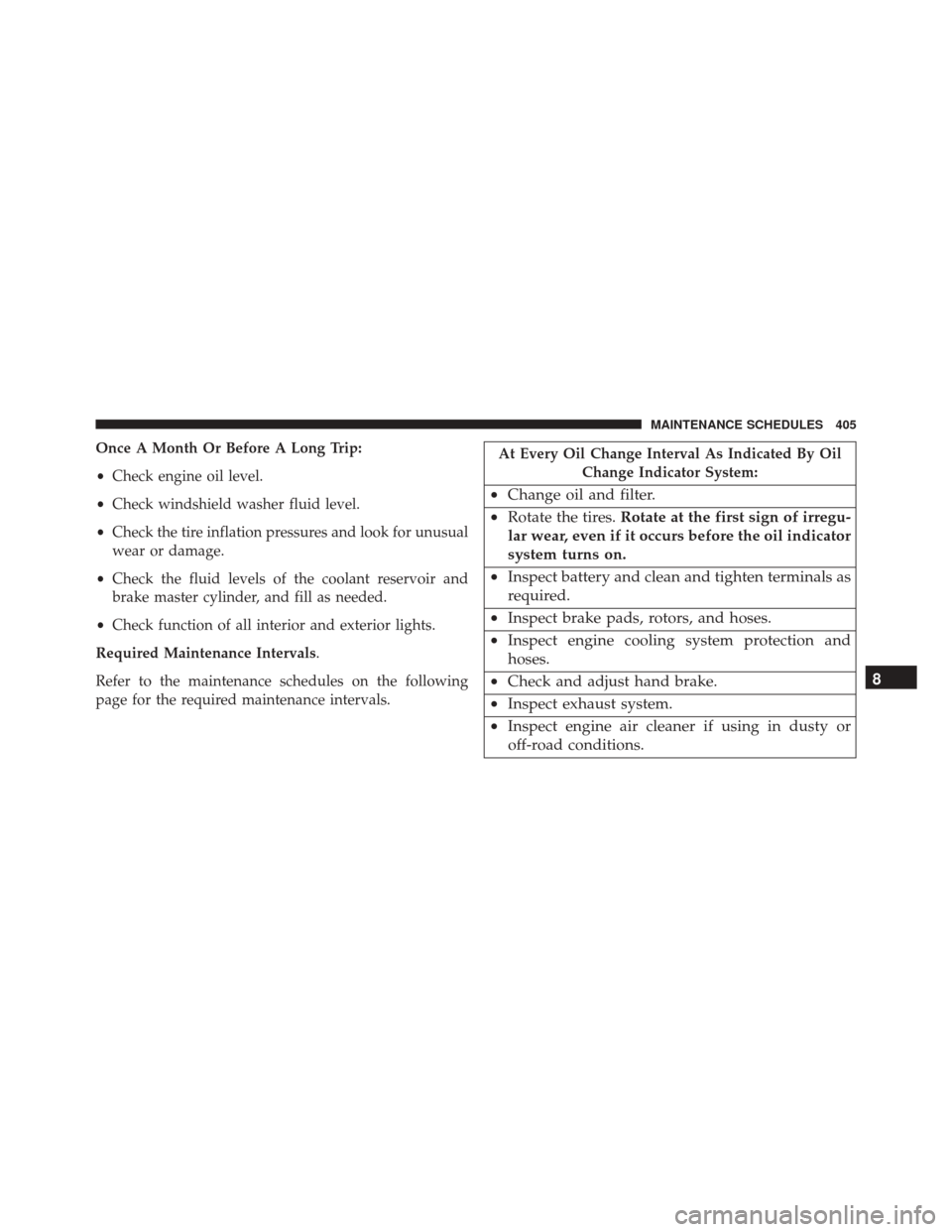
Once A Month Or Before A Long Trip:
•Check engine oil level.
• Check windshield washer fluid level.
• Check the tire inflation pressures and look for unusual
wear or damage.
• Check the fluid levels of the coolant reservoir and
brake master cylinder, and fill as needed.
• Check function of all interior and exterior lights.
Required Maintenance Intervals.
Refer to the maintenance schedules on the following
page for the required maintenance intervals.At Every Oil Change Interval As Indicated By Oil Change Indicator System:
•Change oil and filter.
• Rotate the tires. Rotate at the first sign of irregu-
lar wear, even if it occurs before the oil indicator
system turns on.
• Inspect battery and clean and tighten terminals as
required.
• Inspect brake pads, rotors, and hoses.
• Inspect engine cooling system protection and
hoses.
• Check and adjust hand brake.
• Inspect exhaust system.
• Inspect engine air cleaner if using in dusty or
off-road conditions. 8
MAINTENANCE SCHEDULES 405
Page 426 of 440
Child Restraint............................56
Child Restraints Child Seat Installation .....................73
Install A LATCH-compatible Child Restraint .....68
Installing Child Restraints Using The Vehicle Seat
Belt ..................................71
Lower Anchors And Tethers For Children .......64
Clean Air Gasoline ....................... .294
Cleaning Wheels .............................. .382
Windshield Wiper Blades ..................363
Climate Control ......................... .206
Clutch ................................ .375
Clutch Fluid ............................ .375
Compact Disc (CD) Maintenance ..............205
Compact Spare Tire ....................... .275
Connector UCI................................ .203
Universal Consumer Interface (UCI) ..........203Contract, Service
......................... .414
Convertible Top Maintenance .................386
Coolant (Antifreeze) ...................... .399
Cooling System .......................... .369
Adding Coolant (Antifreeze) ...............371
Coolant Level ......................... .369
Disposal of Used Coolant .................373
Drain, Flush, and Refill ...................369
Inspection ........................... .373
Points to Remember .....................372
Pressure Cap ......................... .372
Selection of Coolant (Antifreeze) .............370
Corrosion Protection ...................... .380
Cruise Light ............................ .148
Cupholders ............................ .136
Customer Assistance ...................... .412
Data Recorder, Event .......................55
Daytime Running Lights ....................112
424 INDEX
Page 427 of 440
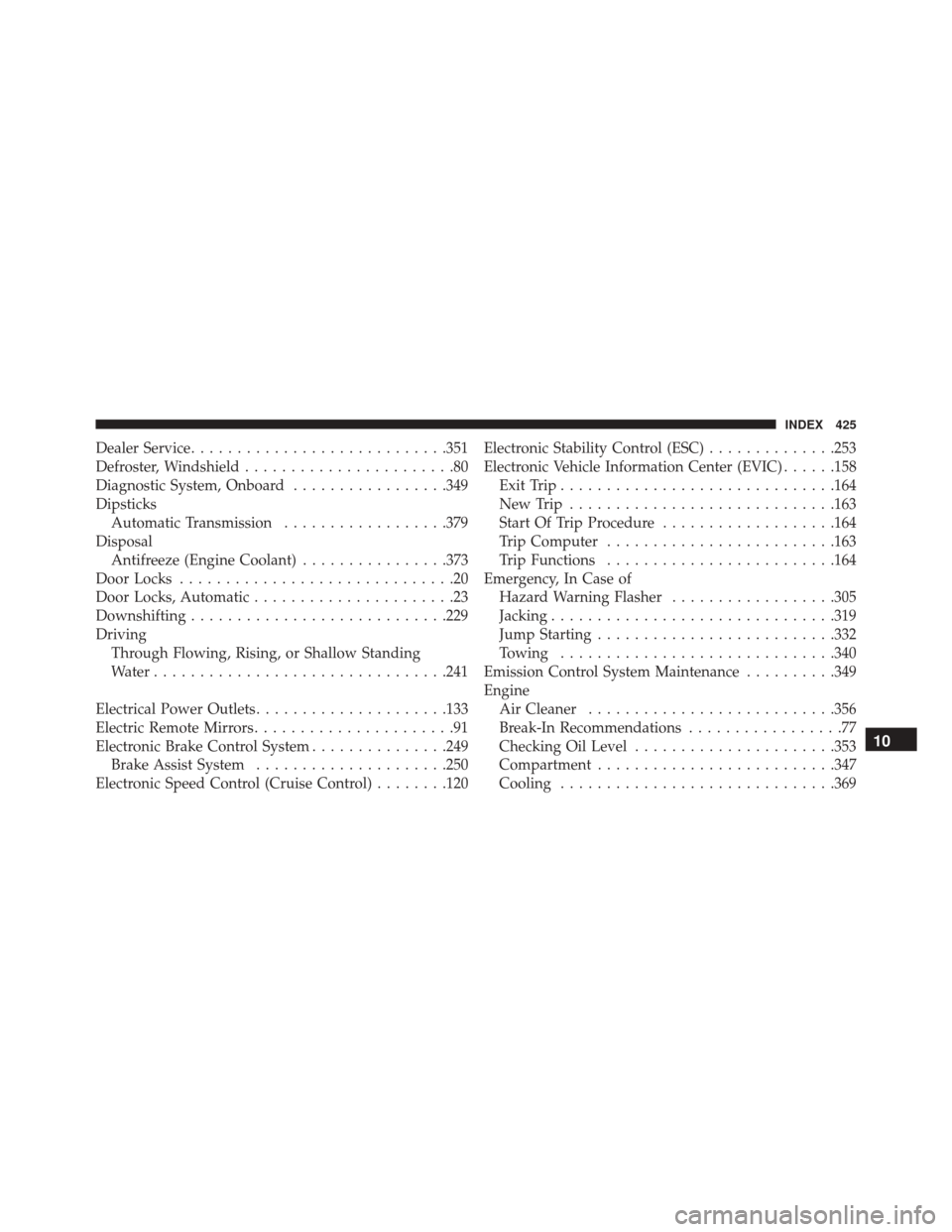
Dealer Service........................... .351
Defroster, Windshield .......................80
Diagnostic System, Onboard .................349
Dipsticks Automatic Transmission ..................379
Disposal Antifreeze (Engine Coolant) ................373
Door Locks ..............................20
Door Locks, Automatic ......................23
Downshifting ........................... .229
Driving Through Flowing, Rising, or Shallow Standing
Water ............................... .241
Electrical Power Outlets .....................133
Electric Remote Mirrors ......................91
Electronic Brake Control System ...............249
Brake Assist System .....................250
Electronic Speed Control (Cruise Control) ........120Electronic Stability Control (ESC)
..............253
Electronic Vehicle Information Center (EVIC) ......158
Exit Trip ............................. .164
NewTrip ............................ .163
Start Of Trip Procedure ...................164
Trip Computer ........................ .163
Trip Functions ........................ .164
Emergency, In Case of Hazard Warning Flasher ..................305
Jacking .............................. .319
Jump Starting ......................... .332
Towing ............................. .340
Emission Control System Maintenance ..........349
Engine Air Cleaner .......................... .356
Break-In Recommendations .................77
Checking Oil Level ..................... .353
Compartment ......................... .347
Cooling ............................. .369
10
INDEX 425