drive FIAT 500 2017 2.G Owners Manual
[x] Cancel search | Manufacturer: FIAT, Model Year: 2017, Model line: 500, Model: FIAT 500 2017 2.GPages: 350, PDF Size: 3.01 MB
Page 307 of 350
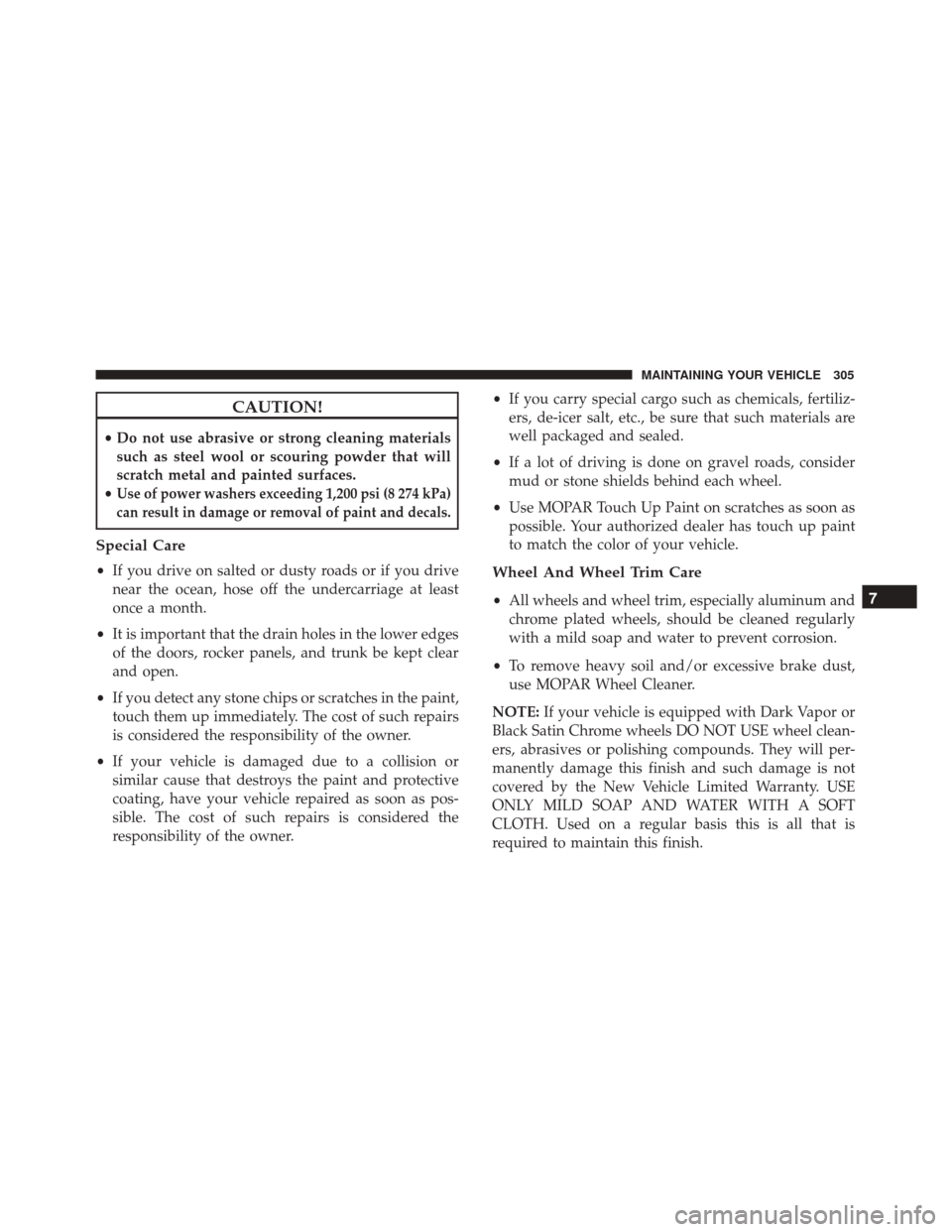
CAUTION!
•Do not use abrasive or strong cleaning materials
such as steel wool or scouring powder that will
scratch metal and painted surfaces.
•
Use of power washers exceeding 1,200 psi (8 274 kPa)
can result in damage or removal of paint and decals.
Special Care
• If you drive on salted or dusty roads or if you drive
near the ocean, hose off the undercarriage at least
once a month.
• It is important that the drain holes in the lower edges
of the doors, rocker panels, and trunk be kept clear
and open.
• If you detect any stone chips or scratches in the paint,
touch them up immediately. The cost of such repairs
is considered the responsibility of the owner.
• If your vehicle is damaged due to a collision or
similar cause that destroys the paint and protective
coating, have your vehicle repaired as soon as pos-
sible. The cost of such repairs is considered the
responsibility of the owner. •
If you carry special cargo such as chemicals, fertiliz-
ers, de-icer salt, etc., be sure that such materials are
well packaged and sealed.
• If a lot of driving is done on gravel roads, consider
mud or stone shields behind each wheel.
• Use MOPAR Touch Up Paint on scratches as soon as
possible. Your authorized dealer has touch up paint
to match the color of your vehicle.Wheel And Wheel Trim Care
• All wheels and wheel trim, especially aluminum and
chrome plated wheels, should be cleaned regularly
with a mild soap and water to prevent corrosion.
• To remove heavy soil and/or excessive brake dust,
use MOPAR Wheel Cleaner.
NOTE: If your vehicle is equipped with Dark Vapor or
Black Satin Chrome wheels DO NOT USE wheel clean-
ers, abrasives or polishing compounds. They will per-
manently damage this finish and such damage is not
covered by the New Vehicle Limited Warranty. USE
ONLY MILD SOAP AND WATER WITH A SOFT
CLOTH. Used on a regular basis this is all that is
required to maintain this finish.7
MAINTAINING YOUR VEHICLE 305
Page 313 of 350
WARNING!(Continued)
•If the replaced fuse blows again, contact an au-
thorized dealer.
• If a general protection fuse for safety systems (air
bag system, braking system), power unit systems
(engine system, gearbox system) or steering sys-
tem blows, contact an authorized dealer.
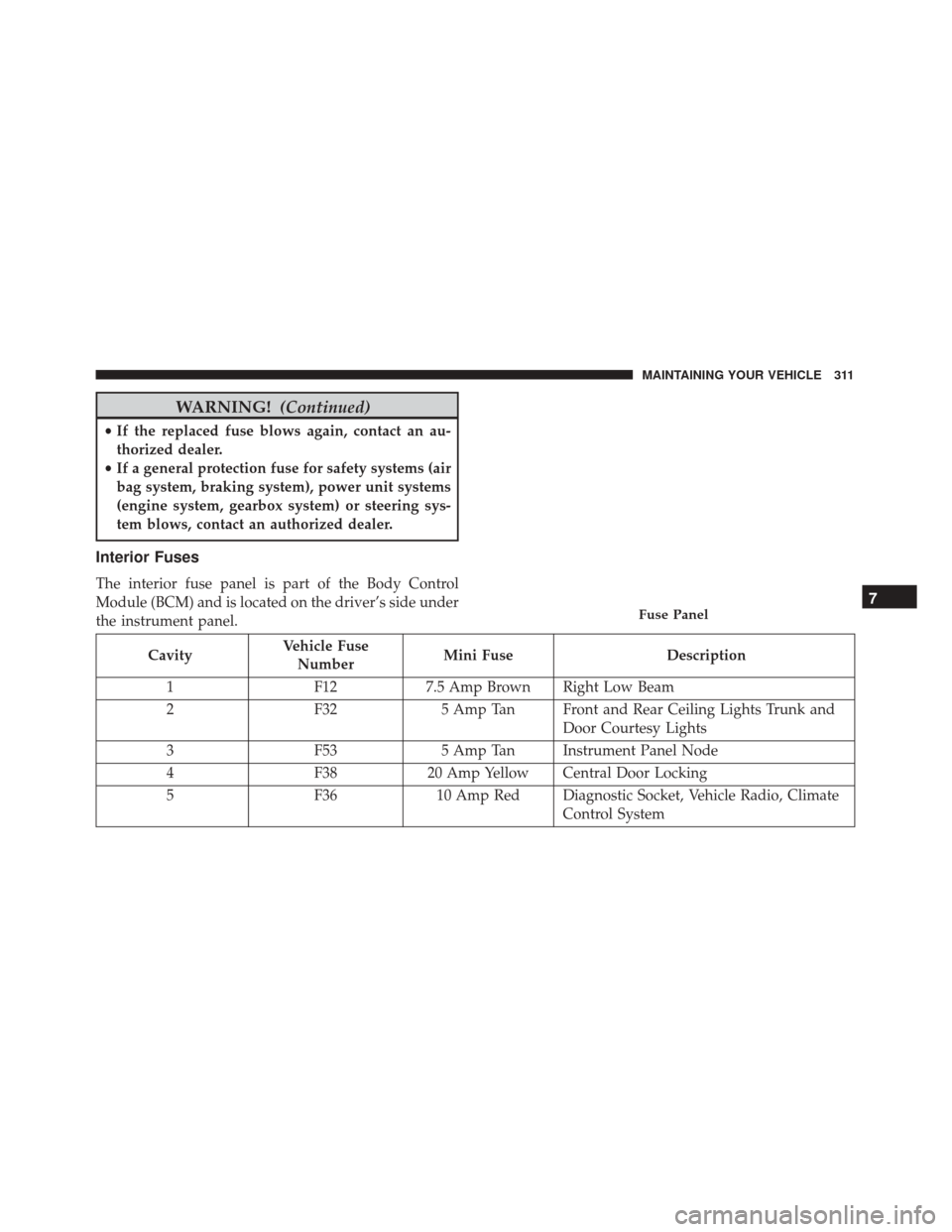
Interior Fuses
The interior fuse panel is part of the Body Control
Module (BCM) and is located on the driver’s side under
the instrument panel.
Cavity Vehicle Fuse
Number Mini Fuse
Description
1 F127.5 Amp Brown Right Low Beam
2 F325 Amp Tan Front and Rear Ceiling Lights Trunk and
Door Courtesy Lights
3 F535 Amp Tan Instrument Panel Node
4 F3820 Amp Yellow Central Door Locking
5 F3610 Amp Red Diagnostic Socket, Vehicle Radio, Climate
Control System
Fuse Panel7
MAINTAINING YOUR VEHICLE 311
Page 314 of 350
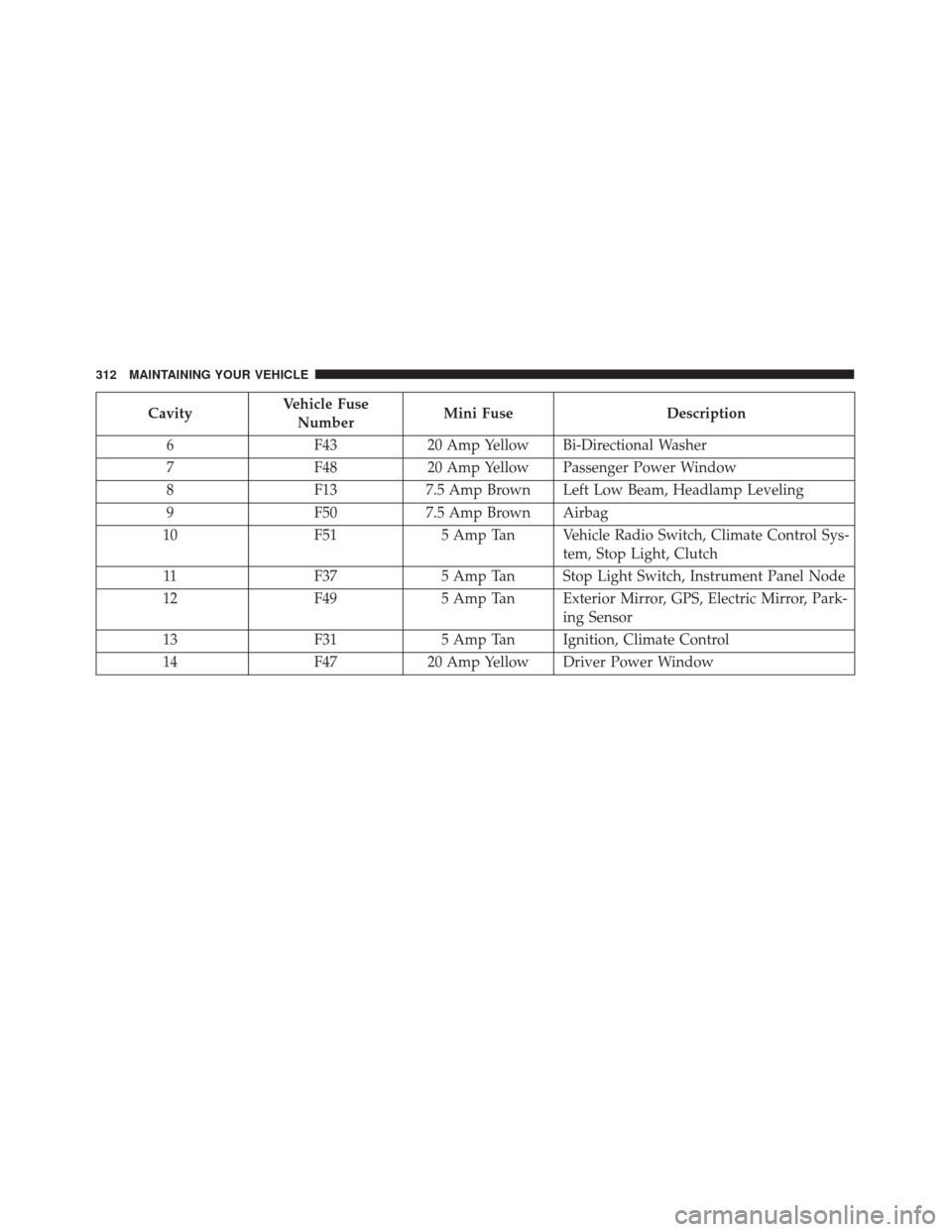
CavityVehicle Fuse
Number Mini Fuse
Description
6 F4320 Amp Yellow Bi-Directional Washer
7 F4820 Amp Yellow Passenger Power Window
8 F137.5 Amp Brown Left Low Beam, Headlamp Leveling
9 F507.5 Amp Brown Airbag
10 F515 Amp Tan Vehicle Radio Switch, Climate Control Sys-
tem, Stop Light, Clutch
11 F375 Amp Tan Stop Light Switch, Instrument Panel Node
12 F495 Amp Tan Exterior Mirror, GPS, Electric Mirror, Park-
ing Sensor
13 F315 Amp Tan Ignition, Climate Control
14 F4720 Amp Yellow Driver Power Window
312 MAINTAINING YOUR VEHICLE
Page 317 of 350
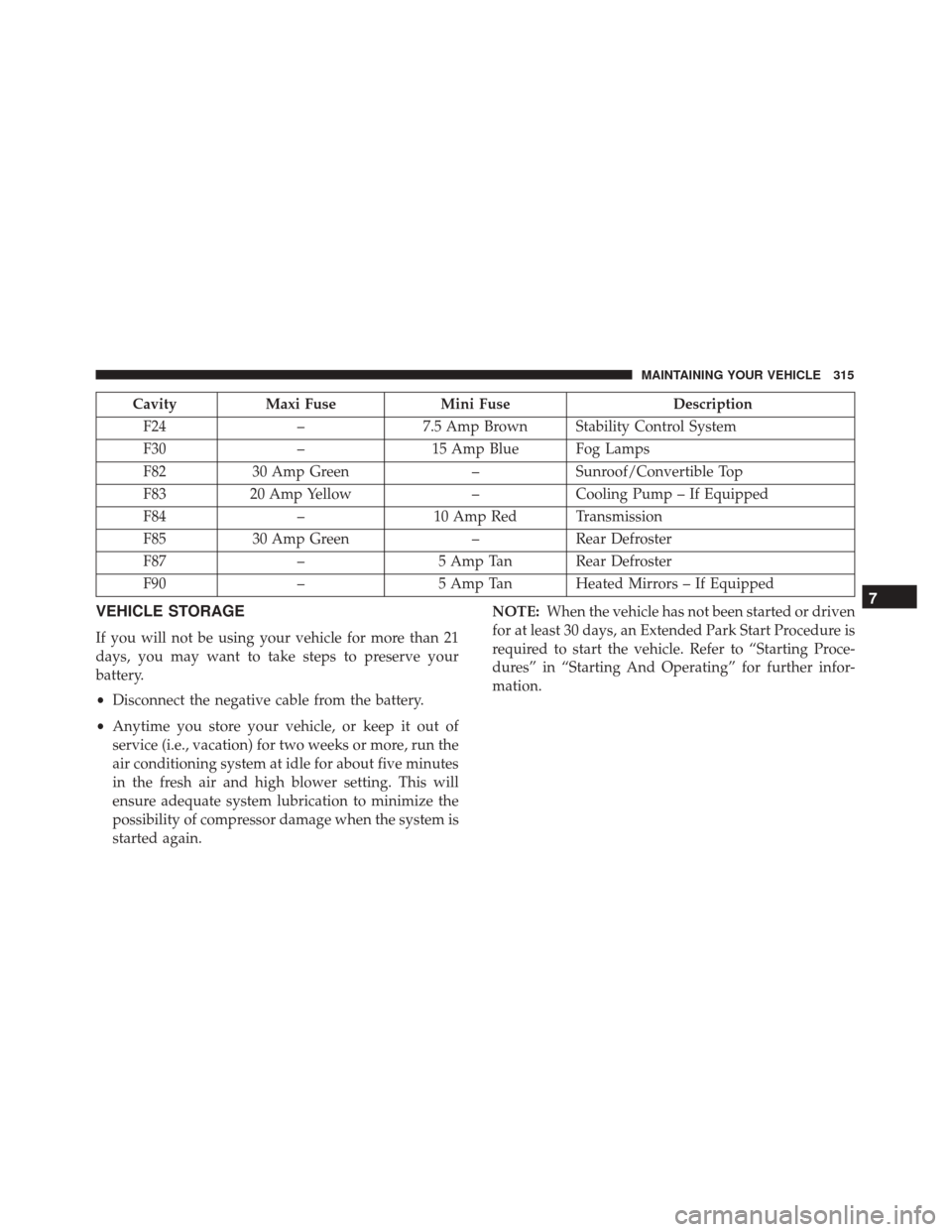
CavityMaxi Fuse Mini Fuse Description
F24 –7.5 Amp Brown Stability Control System
F30 –15 Amp Blue Fog Lamps
F82 30 Amp Green –Sunroof/Convertible Top
F83 20 Amp Yellow –Cooling Pump – If Equipped
F84 –10 Amp Red Transmission
F85 30 Amp Green –Rear Defroster
F87 –5 Amp Tan Rear Defroster
F90 –5 Amp Tan Heated Mirrors – If Equipped
VEHICLE STORAGE
If you will not be using your vehicle for more than 21
days, you may want to take steps to preserve your
battery.
•Disconnect the negative cable from the battery.
• Anytime you store your vehicle, or keep it out of
service (i.e., vacation) for two weeks or more, run the
air conditioning system at idle for about five minutes
in the fresh air and high blower setting. This will
ensure adequate system lubrication to minimize the
possibility of compressor damage when the system is
started again. NOTE:
When the vehicle has not been started or driven
for at least 30 days, an Extended Park Start Procedure is
required to start the vehicle. Refer to “Starting Proce-
dures” in “Starting And Operating” for further infor-
mation.
7
MAINTAINING YOUR VEHICLE 315
Page 329 of 350
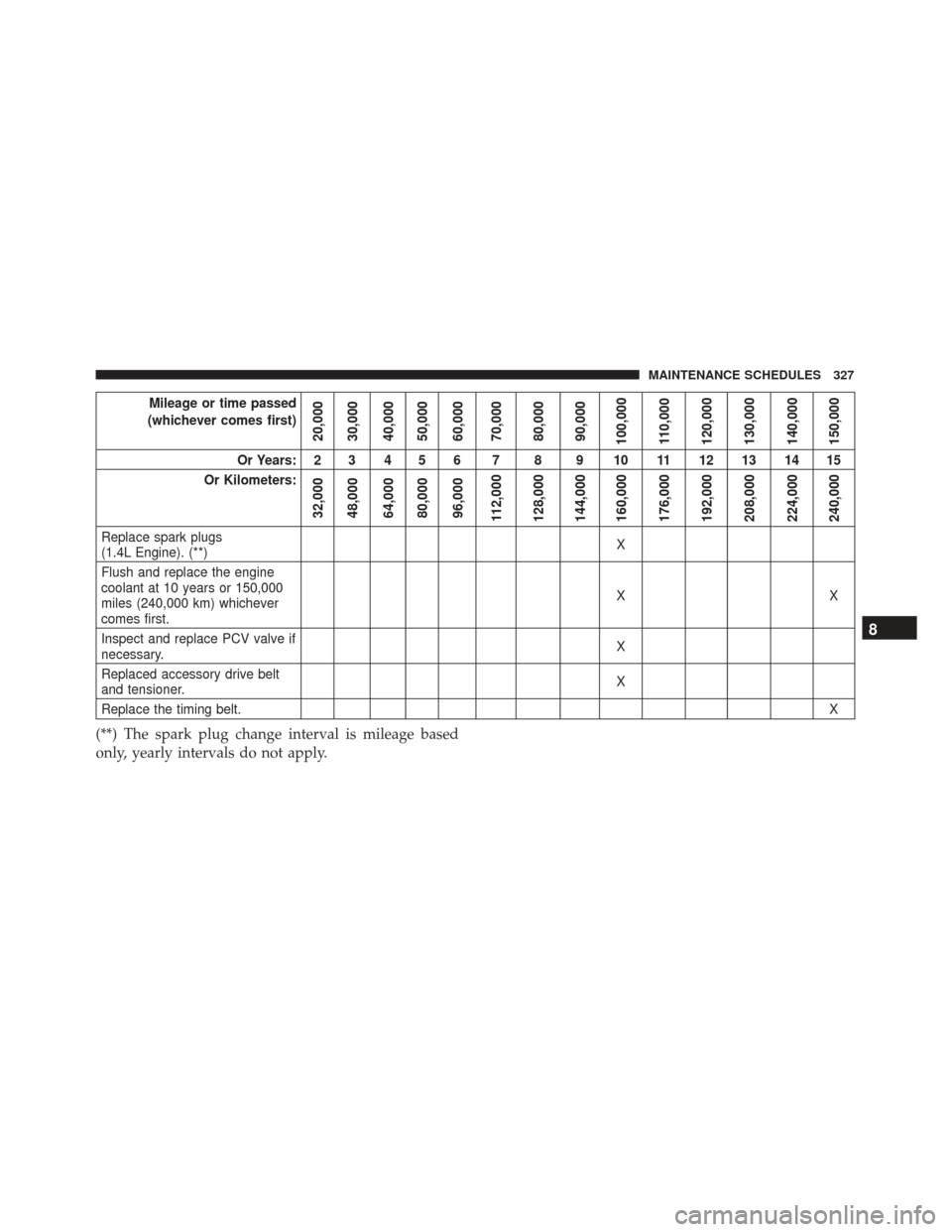
Mileage or time passed
(whichever comes first)
20,000
30,000
40,000
50,000
60,000
70,000
80,000
90,000
100,000
110,000
120,000
130,000
140,000
150,000
Or Years: 2 3 4 5 6 7 8 9 10 11 12 13 14 15
Or Kilometers:
32,000
48,000
64,000
80,000
96,000
112,000
128,000
144,000
160,000
176,000
192,000
208,000
224,000
240,000
Replace spark plugs
(1.4L Engine). (**) X
Flush and replace the engine
coolant at 10 years or 150,000
miles (240,000 km) whichever
comes first. XX
Inspect and replace PCV valve if
necessary. X
Replaced accessory drive belt
and tensioner. X
Replace the timing belt. X
(**) The spark plug change interval is mileage based
only, yearly intervals do not apply.
8
MAINTENANCE SCHEDULES 327
Page 338 of 350
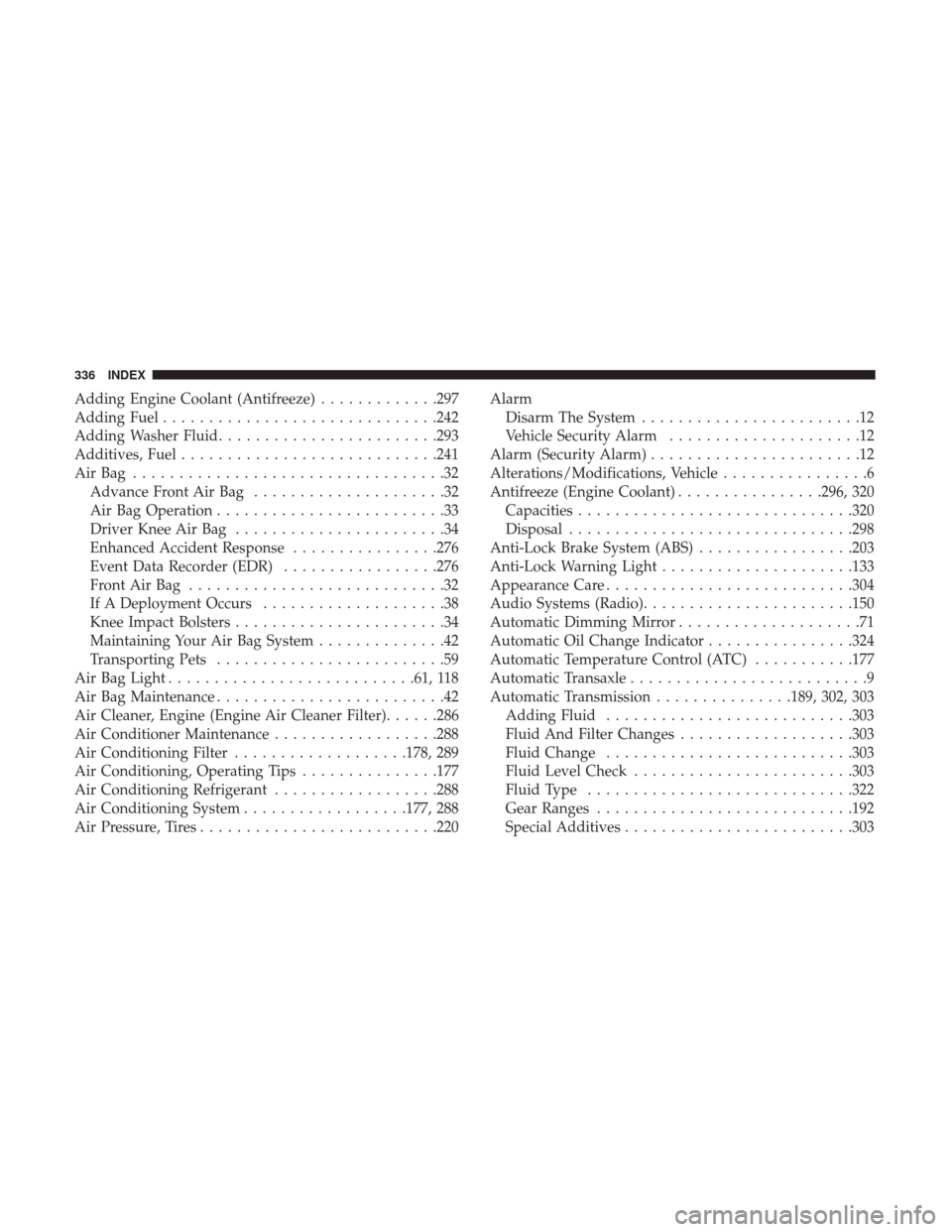
Adding Engine Coolant (Antifreeze).............297
Adding Fuel ............................. .242
Adding Washer Fluid ....................... .293
Additives, Fuel ........................... .241
AirBag ..................................32 Advance Front Air Bag .....................32
Air Bag Operation .........................33
Driver Knee Air Bag .......................34
Enhanced Accident Response ................276
Event Data Recorder (EDR) .................276
FrontAirBag ............................32
If A Deployment Occurs ....................38
Knee Impact Bolsters .......................34
Maintaining Your Air Bag System ..............42
Transporting Pets .........................59
Air Bag Light .......................... .61, 118
Air Bag Maintenance .........................42
Air Cleaner, Engine (Engine Air Cleaner Filter) ......286
Air Conditioner Maintenance ..................288
Air Conditioning Filter ...................178, 289
Air Conditioning, Operating Tips ...............177
Air Conditioning Refrigerant ..................288
Air Conditioning System ..................177, 288
Air Pressure, Tires ......................... .220Alarm
Disarm The System ........................12
Vehicle Security Alarm .....................12
Alarm (Security Alarm) .......................12
Alterations/Modifications, Vehicle ................6
Antifreeze (Engine Coolant) ................296, 320
Capacities ............................. .320
Disposal .............................. .298
Anti-Lock Brake System (ABS) .................203
Anti-Lock Warning Light .....................133
Appearance Care .......................... .304
Audio Systems (Radio) ...................... .150
Automatic Dimming Mirror ....................71
Automatic Oil Change Indicator ................324
Automatic Temperature Control (ATC) ...........177
Automatic Transaxle ..........................9
Automatic Transmission ...............189, 302, 303
Adding
Fluid .......................... .303
Fluid And Filter Changes ...................303
Fluid Change .......................... .303
Fluid Level Check ....................... .303
Fluid Type ............................ .322
Gear Ranges ........................... .192
Special Additives ........................ .303
336 INDEX
Page 349 of 350

VEHICLES SOLD IN CANADA
With respect to any Vehicles Sold in Canada, the name FCA
US LLC shall be deemed to be deleted and the name FCA
Canada Inc. used in substitution therefore.
DRIVING AND ALCOHOL
Drunken driving is one of the most frequent causes of
accidents.
Your driving ability can be seriously impaired with blood
alcohol levels far below the legal minimum. If you are
drinking, don’t drive. Ride with a designated non-
drinking driver, call a cab, a friend, or use public trans-
portation.
WARNING!
Driving after drinking can lead to an accident.
Your perceptions are less sharp, your reflexes are
slower, and your judgment is impaired when you
have been drinking. Never drink and then drive.
This manual illustrates and describes the operation of
features and equipment that are either standard or op-
tional on this vehicle. This manual may also include a
description of features and equipment that are no longer
available or were not ordered on this vehicle. Please
disregard any features and equipment described in this
manual that are not on this vehicle.
FCA US LLC reserves the right to make changes in design
and specifications, and/or make additions to or improve-
ments to its products without imposing any obligation
upon itself to install them on products previously manu-
factured.
Copyright © 2016 FCA US LLC
INSTALLATION OF RADIO TRANSMITTING
EQUIPMENT
Special design considerations are incorporated into this
vehicle’s electronic system to provide immunity to radio
frequency signals. Mobile two-way radios and telephone
equipment must be installed properly by trained person-
nel. The following must be observed during installation.
The positive power connection should be made directly
to the battery and fused as close to the battery as possible.
The negative power connection should be made to body
sheet metal adjacent to the negative battery connection.
This connection should not be fused.
Antennas for two-way radios should be mounted on the
roof or the rear area of the vehicle. Care should be used
in mounting antennas with magnet bases. Magnets may
affect the accuracy or operation of the compass on
vehicles so equipped.The antenna cable should be as short as practical and
routed away from the vehicle wiring when possible. Use
only fully shielded coaxial cable.
Carefully match the antenna and cable to the radio to
ensure a low Standing Wave Ratio (SWR).
Mobile radio equipment with output power greater than
normal may require special precautions.
All installations should be checked for possible interfer-
ence between the communications equipment and the
vehicle’s electronic systems.