brake light FIAT 500 2017 2.G User Guide
[x] Cancel search | Manufacturer: FIAT, Model Year: 2017, Model line: 500, Model: FIAT 500 2017 2.GPages: 350, PDF Size: 3.01 MB
Page 205 of 350
BRAKE SYSTEM
Your vehicle is equipped with dual hydraulic brake
systems. If either of the two hydraulic systems loses
normal capability, the remaining system will still func-
tion. However, there will be some loss of overall brak-
ing effectiveness. You may notice increased pedal travel
during application, greater pedal force required to slow
or stop, and potential activation of the “Brake System
Warning Light”.
In the event power assist is lost for any reason (i.e.,
repeated brake applications with the engine off), the
brakes will still function. However, the effort required
to brake the vehicle will be much greater than that
required with the power system operating.
ELECTRONIC BRAKE CONTROL SYSTEM
Your vehicle is equipped with a advanced electronic
brake control system that includes the Anti-Lock Brake
System (ABS), Brake Assist System (BAS), Traction
Control System (TCS), Hill Start Assist (HSA), and
Electronic Stability Control (ESC). All systems work
together to enhance vehicle stability and control in
various driving conditions and are commonly referred
to as ESC.
Four-Wheel Anti-Lock Brake System (ABS)
The Four-Wheel ABS is designed to aid the driver in
maintaining vehicle control under adverse braking con-
ditions. The system operates with a separate computer
to modulate hydraulic pressure, to prevent wheel
lock-up and to help avoid skidding on slippery sur-
faces.
The system’s pump motor runs during an ABS stop to
provide regulated hydraulic pressure. The pump motor
makes a low humming noise during operation, which is
normal.
The ABS includes an amber ABS Warning Light. When
the light is illuminated, the ABS is not functioning. The
system reverts to standard non-anti-lock brakes. Turn-
ing the ignition Off and On again may reset the ABS if
the fault detected was only momentary.
5
STARTING AND OPERATING 203
Page 208 of 350
•Gear selection matches vehicle uphill direction (i.e.,
vehicle in NEUTRAL (manual transmission), vehicle
facing uphill is in forward gear; vehicle backing
uphill is in REVERSE gear).
WARNING!
There may be situations on minor hills with a
loaded vehicle, or while pulling a trailer, when the
system will not activate and slight rolling may
occur. This could cause a collision with another
vehicle or object. Always remember the driver is
responsible for braking the vehicle.
Disabling/Enabling HSA
If you wish to turn the HSA system on or off, it can be
done using the Customer Programmable Features in the
Uconnect Settings. Refer to “Uconnect Settings” in for
further information.
Electronic Stability Control (ESC)
The Electronic Stability Control (ESC) system enhances
directional control and stability of the vehicle under
various driving conditions. ESC corrects for oversteer-
ing or understeering of the vehicle by applying the
brake of the appropriate wheel to assist in counteracting the oversteering or understeering condition. Engine
power may also be reduced to help the vehicle maintain
the desired path. ESC uses sensors in the vehicle to
determine the vehicle path intended by the driver and
compares it to the actual path of the vehicle. When the
actual path does not match the intended path, ESC
applies the brake of the appropriate wheel to assist in
counteracting the oversteer or understeer condition.
•
Oversteer - when the vehicle is turning more than
appropriate for the steering wheel position.
• Understeer - when the vehicle is turning less than
appropriate for the steering wheel position.
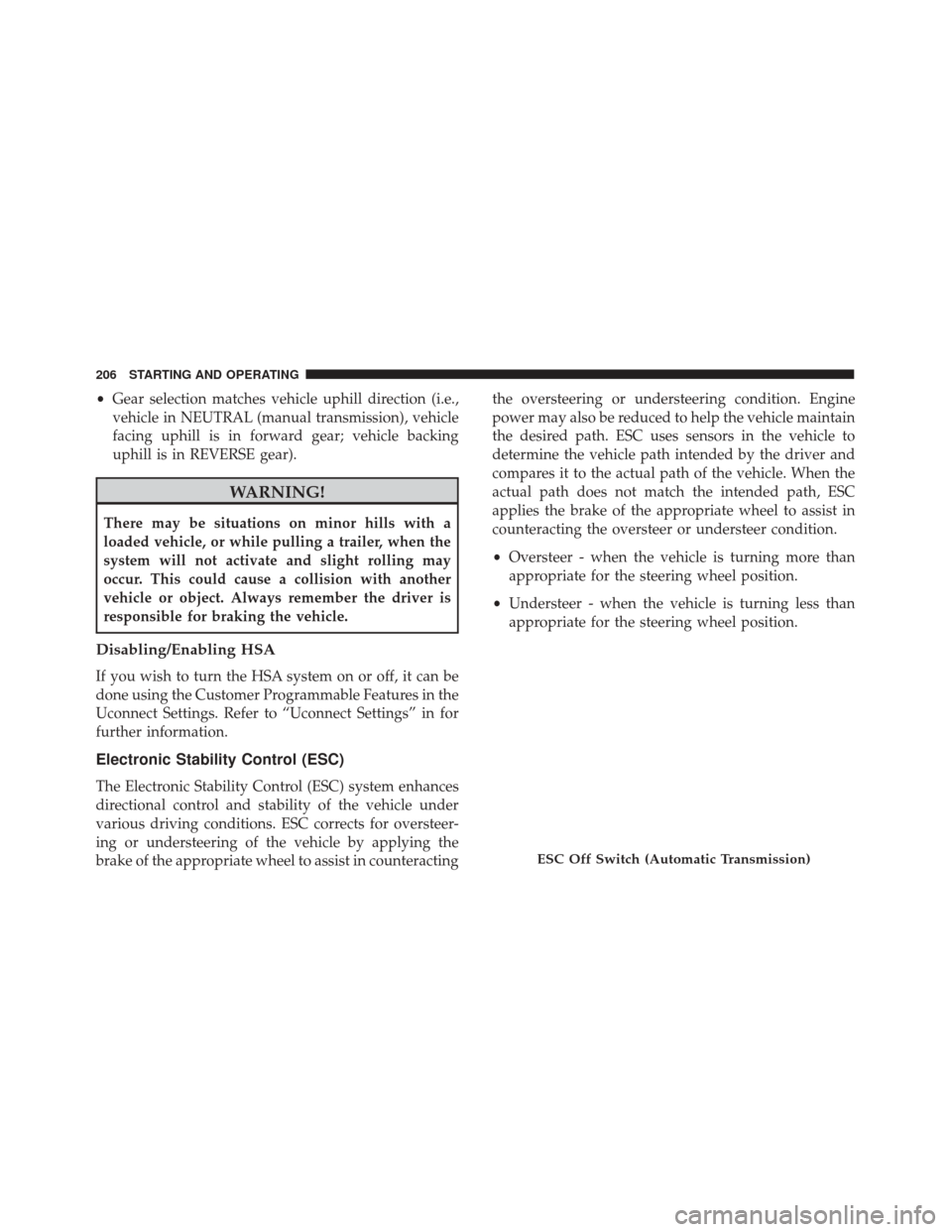
ESC Off Switch (Automatic Transmission)
206 STARTING AND OPERATING
Page 271 of 350
Preparations For Jump-Start
The battery in your vehicle is located between the left
front headlight assembly and the left front wheel splash
shield.
WARNING!
•Take care to avoid the radiator cooling fan when-
ever the hood is raised. It can start anytime the
ignition switch is ON. You can be injured by
moving fan blades.
• Remove any metal jewelry such as rings, watch
bands and bracelets that could make an inadver-
tent electrical contact. You could be seriously
injured.
• Batteries contain sulfuric acid that can burn your
skin or eyes and generate hydrogen gas which is
flammable and explosive. Keep open flames or
sparks away from the battery.
1. Set the parking brake, shift the automatic transmis- sion into PARK and turn the ignition to LOCK.
2. Turn off the heater, radio, and all unnecessary elec- trical accessories.
3. Remove the protective cover over the positive (+)
battery post. To remove the cover, push the locking
tab and pull upward on the cover.
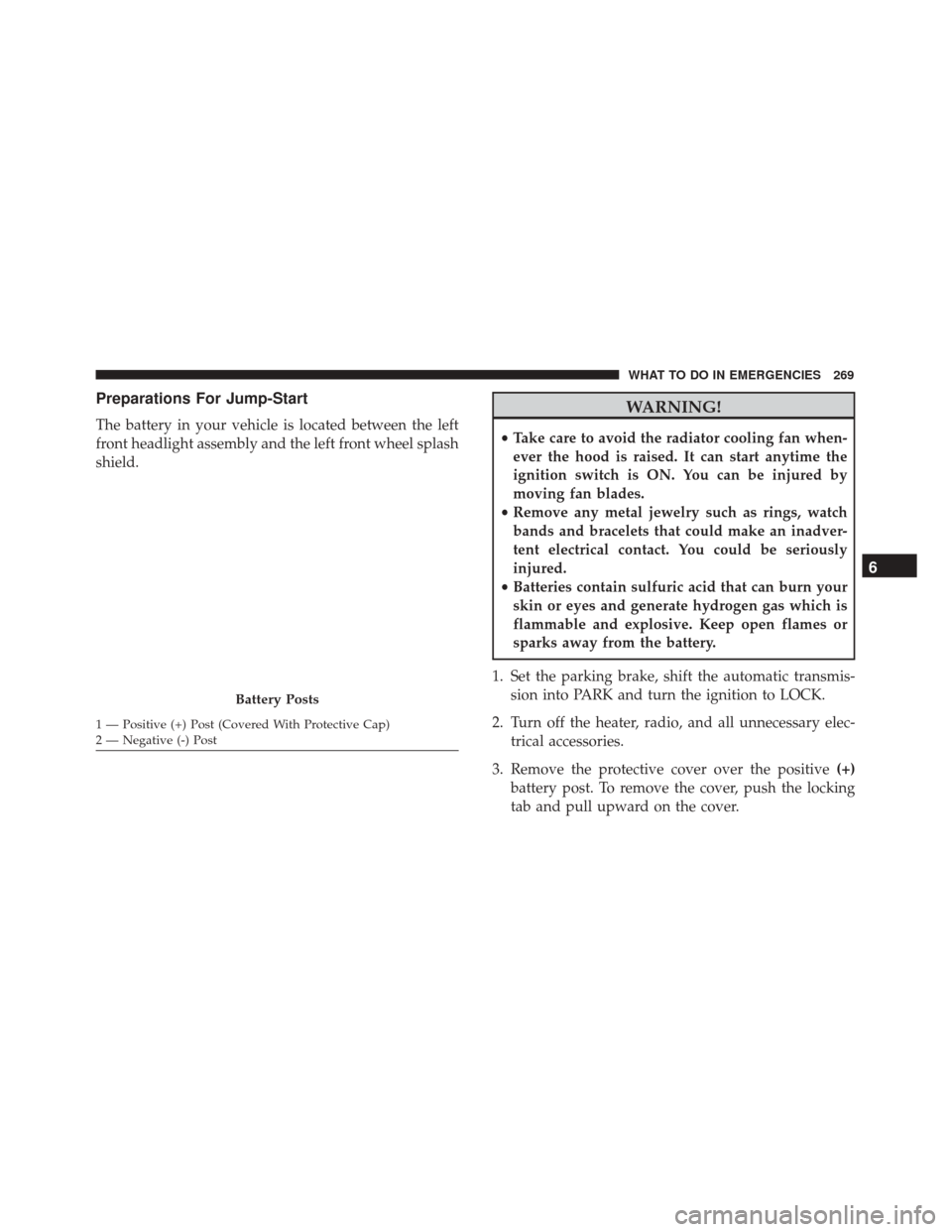
Battery Posts
1 — Positive (+) Post (Covered With Protective Cap)
2 — Negative (-) Post
6
WHAT TO DO IN EMERGENCIES 269
Page 302 of 350
•Maintain engine coolant (antifreeze) concentration at
a minimum of 50% OAT coolant (conforming to
MS.90032) and distilled water for proper corrosion
protection of your engine which contains aluminum
components.
• Make sure that the coolant expansion bottle overflow
hoses are not kinked or obstructed.
• Keep the front of the radiator clean. If your vehicle is
equipped with air conditioning, keep the front of the
condenser clean.
• Do not change the thermostat for Summer or Winter
operation. If replacement is ever necessary, install
ONLY the correct type thermostat. Other designs
may result in unsatisfactory engine coolant (anti-
freeze) performance, poor gas mileage, and increased
emissions.
Brake System
In order to assure brake system performance, all brake
system components should be inspected periodically.
Refer to the “Maintenance Schedule” for the proper
maintenance intervals.
WARNING!
Riding the brakes can lead to brake failure and
possibly a collision. Driving with your foot resting
or riding on the brake pedal can result in abnor-
mally high brake temperatures, excessive lining
wear, and possible brake damage. Riding the
brakes may also reduce braking capacity in an
emergency.
Brake Master Cylinder
The fluid level in the master cylinder should be checked
when performing under hood services, or immediately
if the “Brake Warning Light” is on.
Be sure to clean the top of the master cylinder area
before removing the cap. If necessary, add fluid to bring
the fluid level up to the requirements described on the
brake fluid reservoir. Fluid level can be expected to fall
as the brake pads wear. The brake fluid level should be
checked when the pads are replaced. However, low
fluid level may be caused by a leak and a checkup may
be needed.
300 MAINTAINING YOUR VEHICLE
Page 316 of 350
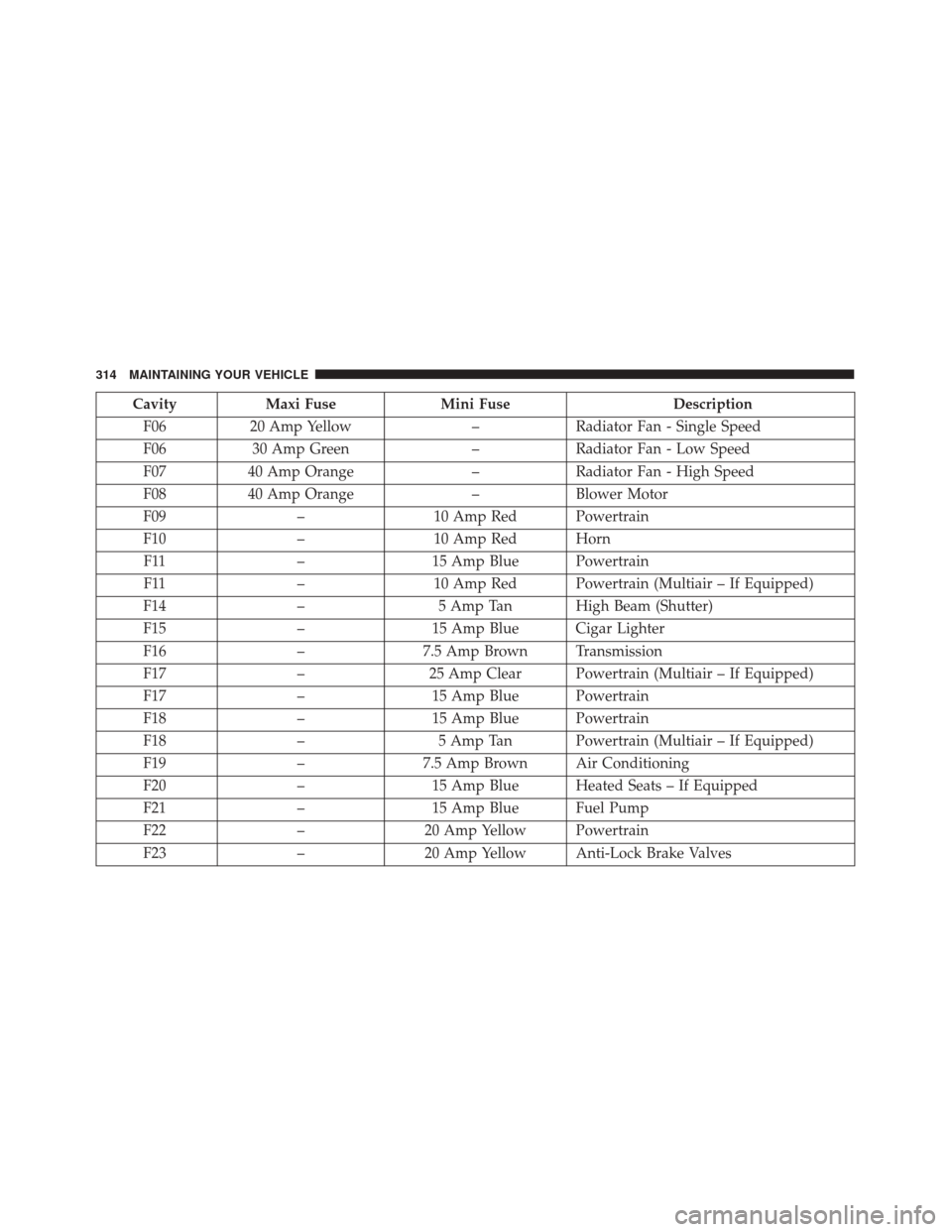
CavityMaxi Fuse Mini Fuse Description
F06 20 Amp Yellow –Radiator Fan - Single Speed
F06 30 Amp Green –Radiator Fan - Low Speed
F07 40 Amp Orange –Radiator Fan - High Speed
F08 40 Amp Orange –Blower Motor
F09 –10 Amp Red Powertrain
F10 –10 Amp Red Horn
F11 –15 Amp Blue Powertrain
F11 –10 Amp Red Powertrain (Multiair – If Equipped)
F14 –5 Amp Tan High Beam (Shutter)
F15 –15 Amp Blue Cigar Lighter
F16 –7.5 Amp Brown Transmission
F17 –25 Amp Clear Powertrain (Multiair – If Equipped)
F17 –15 Amp Blue Powertrain
F18 –15 Amp Blue Powertrain
F18 –5 Amp Tan Powertrain (Multiair – If Equipped)
F19 –7.5 Amp Brown Air Conditioning
F20 –15 Amp Blue Heated Seats – If Equipped
F21 –15 Amp Blue Fuel Pump
F22 –20 Amp Yellow Powertrain
F23 –20 Amp Yellow Anti-Lock Brake Valves
314 MAINTAINING YOUR VEHICLE
Page 326 of 350
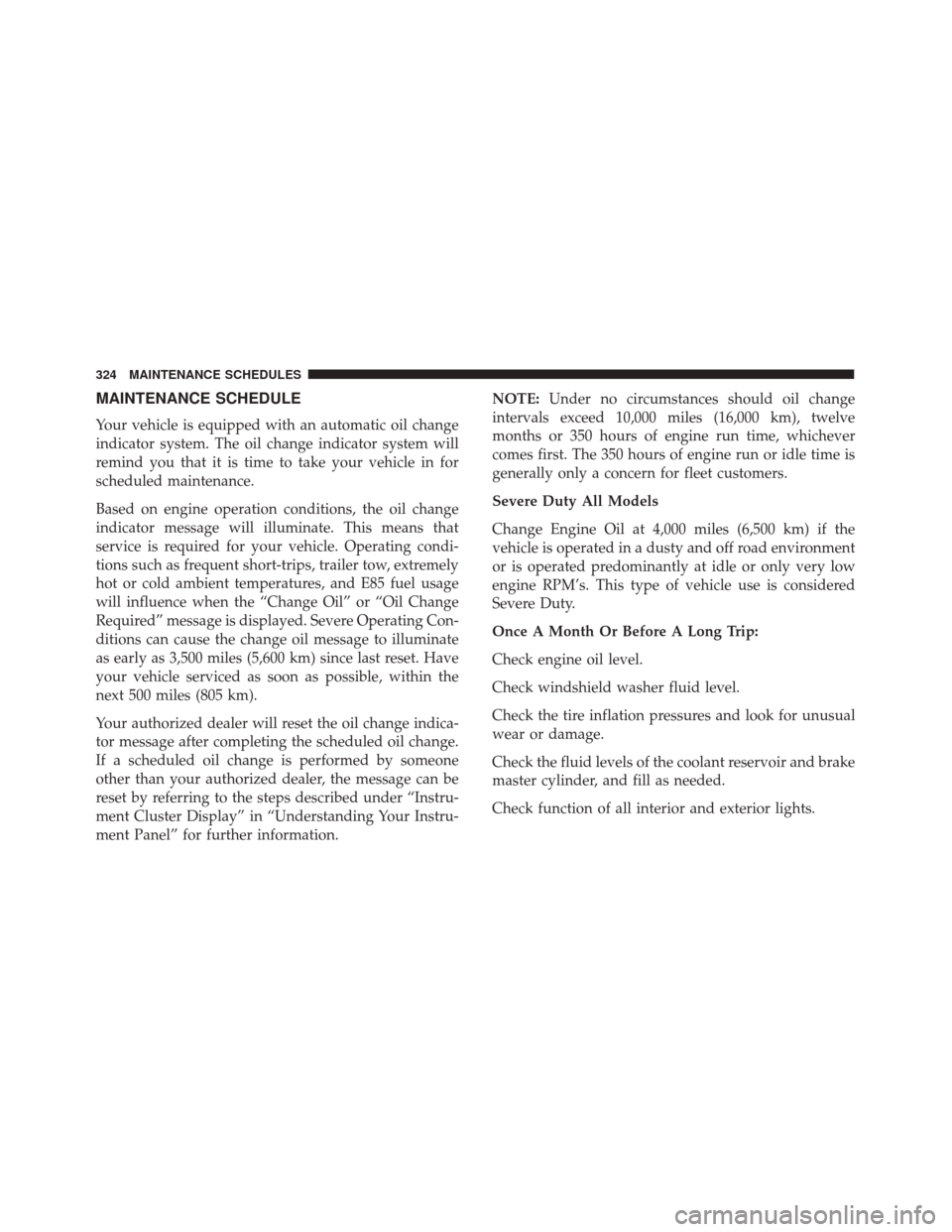
MAINTENANCE SCHEDULE
Your vehicle is equipped with an automatic oil change
indicator system. The oil change indicator system will
remind you that it is time to take your vehicle in for
scheduled maintenance.
Based on engine operation conditions, the oil change
indicator message will illuminate. This means that
service is required for your vehicle. Operating condi-
tions such as frequent short-trips, trailer tow, extremely
hot or cold ambient temperatures, and E85 fuel usage
will influence when the “Change Oil” or “Oil Change
Required” message is displayed. Severe Operating Con-
ditions can cause the change oil message to illuminate
as early as 3,500 miles (5,600 km) since last reset. Have
your vehicle serviced as soon as possible, within the
next 500 miles (805 km).
Your authorized dealer will reset the oil change indica-
tor message after completing the scheduled oil change.
If a scheduled oil change is performed by someone
other than your authorized dealer, the message can be
reset by referring to the steps described under “Instru-
ment Cluster Display” in “Understanding Your Instru-
ment Panel” for further information.NOTE:
Under no circumstances should oil change
intervals exceed 10,000 miles (16,000 km), twelve
months or 350 hours of engine run time, whichever
comes first. The 350 hours of engine run or idle time is
generally only a concern for fleet customers.
Severe Duty All Models
Change Engine Oil at 4,000 miles (6,500 km) if the
vehicle is operated in a dusty and off road environment
or is operated predominantly at idle or only very low
engine RPM’s. This type of vehicle use is considered
Severe Duty.
Once A Month Or Before A Long Trip:
Check engine oil level.
Check windshield washer fluid level.
Check the tire inflation pressures and look for unusual
wear or damage.
Check the fluid levels of the coolant reservoir and brake
master cylinder, and fill as needed.
Check function of all interior and exterior lights.
324 MAINTENANCE SCHEDULES
Page 338 of 350
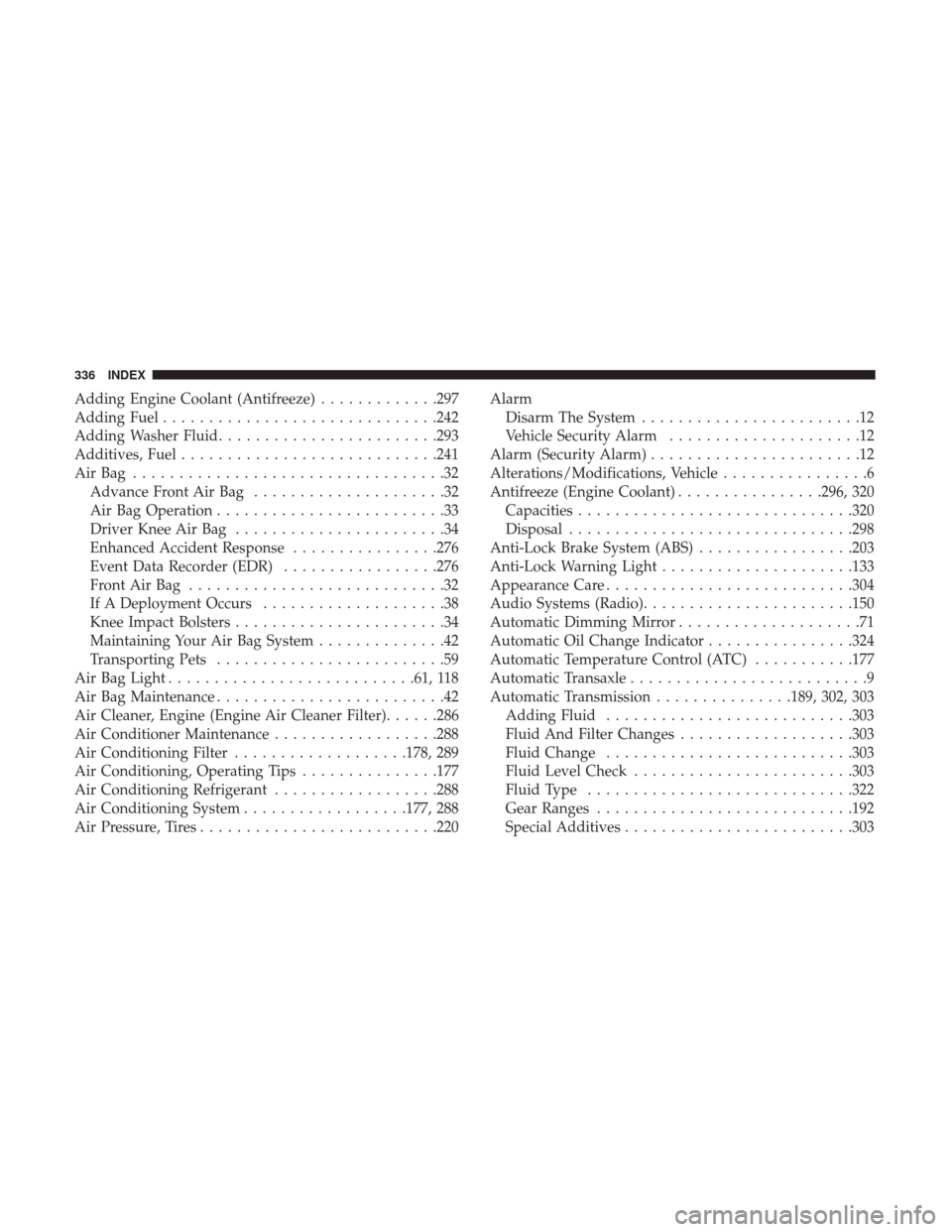
Adding Engine Coolant (Antifreeze).............297
Adding Fuel ............................. .242
Adding Washer Fluid ....................... .293
Additives, Fuel ........................... .241
AirBag ..................................32 Advance Front Air Bag .....................32
Air Bag Operation .........................33
Driver Knee Air Bag .......................34
Enhanced Accident Response ................276
Event Data Recorder (EDR) .................276
FrontAirBag ............................32
If A Deployment Occurs ....................38
Knee Impact Bolsters .......................34
Maintaining Your Air Bag System ..............42
Transporting Pets .........................59
Air Bag Light .......................... .61, 118
Air Bag Maintenance .........................42
Air Cleaner, Engine (Engine Air Cleaner Filter) ......286
Air Conditioner Maintenance ..................288
Air Conditioning Filter ...................178, 289
Air Conditioning, Operating Tips ...............177
Air Conditioning Refrigerant ..................288
Air Conditioning System ..................177, 288
Air Pressure, Tires ......................... .220Alarm
Disarm The System ........................12
Vehicle Security Alarm .....................12
Alarm (Security Alarm) .......................12
Alterations/Modifications, Vehicle ................6
Antifreeze (Engine Coolant) ................296, 320
Capacities ............................. .320
Disposal .............................. .298
Anti-Lock Brake System (ABS) .................203
Anti-Lock Warning Light .....................133
Appearance Care .......................... .304
Audio Systems (Radio) ...................... .150
Automatic Dimming Mirror ....................71
Automatic Oil Change Indicator ................324
Automatic Temperature Control (ATC) ...........177
Automatic Transaxle ..........................9
Automatic Transmission ...............189, 302, 303
Adding
Fluid .......................... .303
Fluid And Filter Changes ...................303
Fluid Change .......................... .303
Fluid Level Check ....................... .303
Fluid Type ............................ .322
Gear Ranges ........................... .192
Special Additives ........................ .303
336 INDEX
Page 339 of 350
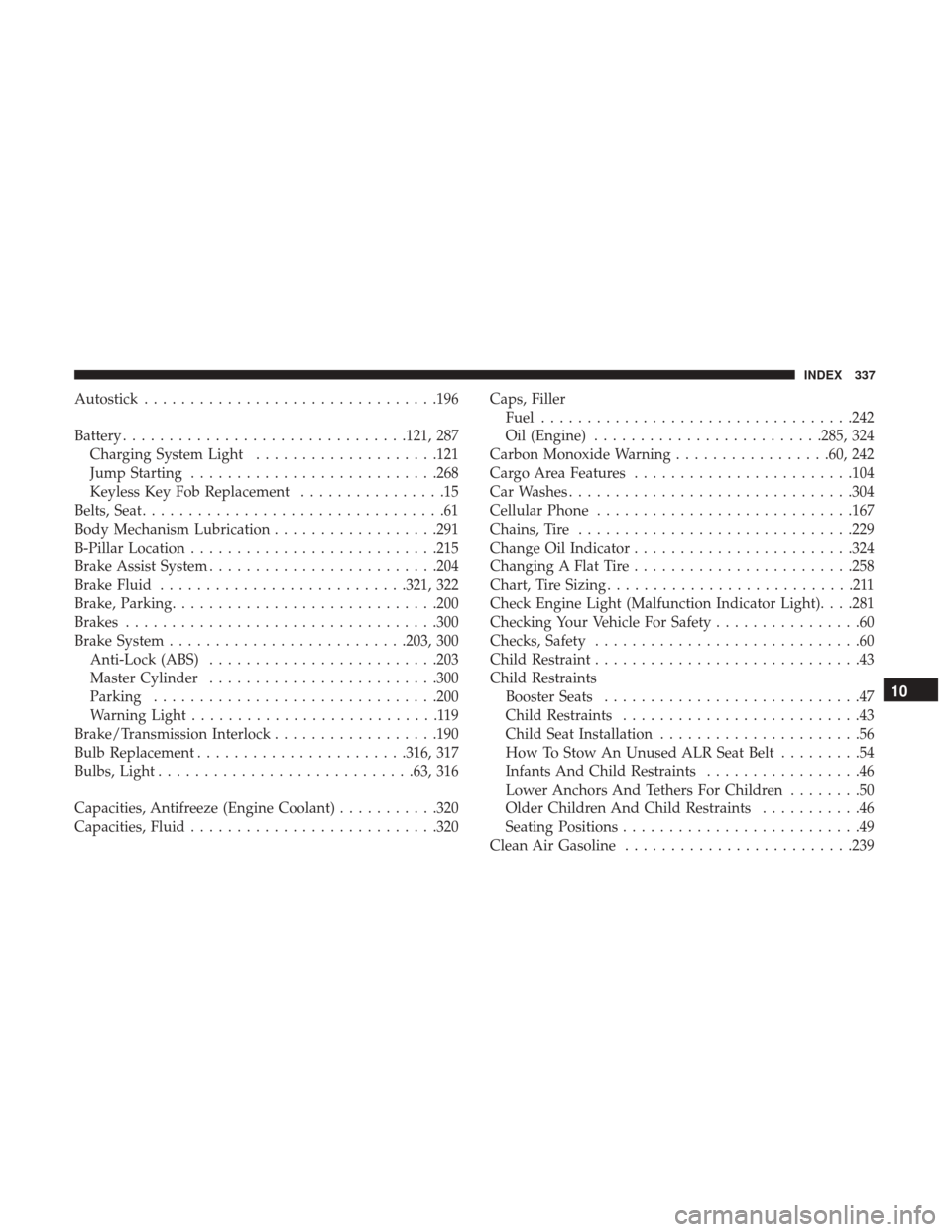
Autostick............................... .196
Battery .............................. .121, 287
Charging System Light ....................121
Jump Starting .......................... .268
Keyless Key Fob Replacement ................15
Belts, Seat .................................61
Body Mechanism Lubrication ..................291
B-Pillar Location .......................... .215
Brake Assist System ........................ .204
Brake Fluid .......................... .321, 322
Brake, Parking ............................ .200
Brakes ................................. .300
Brake System ......................... .203, 300
Anti-Lock (ABS) ........................ .203
Master Cylinder ........................ .300
Parking .............................. .200
Warning Light ...........................119
Brake/Transmission Interlock ..................190
Bulb Replacement ...................... .316, 317
Bulbs, Light ........................... .63, 316
Capacities, Antifreeze (Engine Coolant) ...........320
Capacities, Fluid .......................... .320Caps, Filler
Fuel ................................. .242
Oil (Engine) ........................ .285, 324
Carbon Monoxide Warning .................60, 242
Cargo Area Features ....................... .104
Car Washes .............................. .304
Cellular Phone ........................... .167
Chains, Tire ............................. .229
Change Oil Indicator ....................... .324
Changing A Flat Tire ....................... .258
Chart, Tire Sizing ...........................211
Check Engine Light (Malfunction Indicator Light). . . .281
Checking Your Vehicle For Safety ................60
Checks, Safety .............................60
Child Restraint .............................43
Child Restraints Booster
Seats............................47
Child Restraints ..........................43
Child Seat Installation ......................56
How To Stow An Unused ALR Seat Belt .........54
Infants And Child Restraints .................46
Lower Anchors And Tethers For Children ........50
Older Children And Child Restraints ...........46
Seating Positions ..........................49
Clean Air Gasoline ........................ .23910
INDEX 337
Page 341 of 350
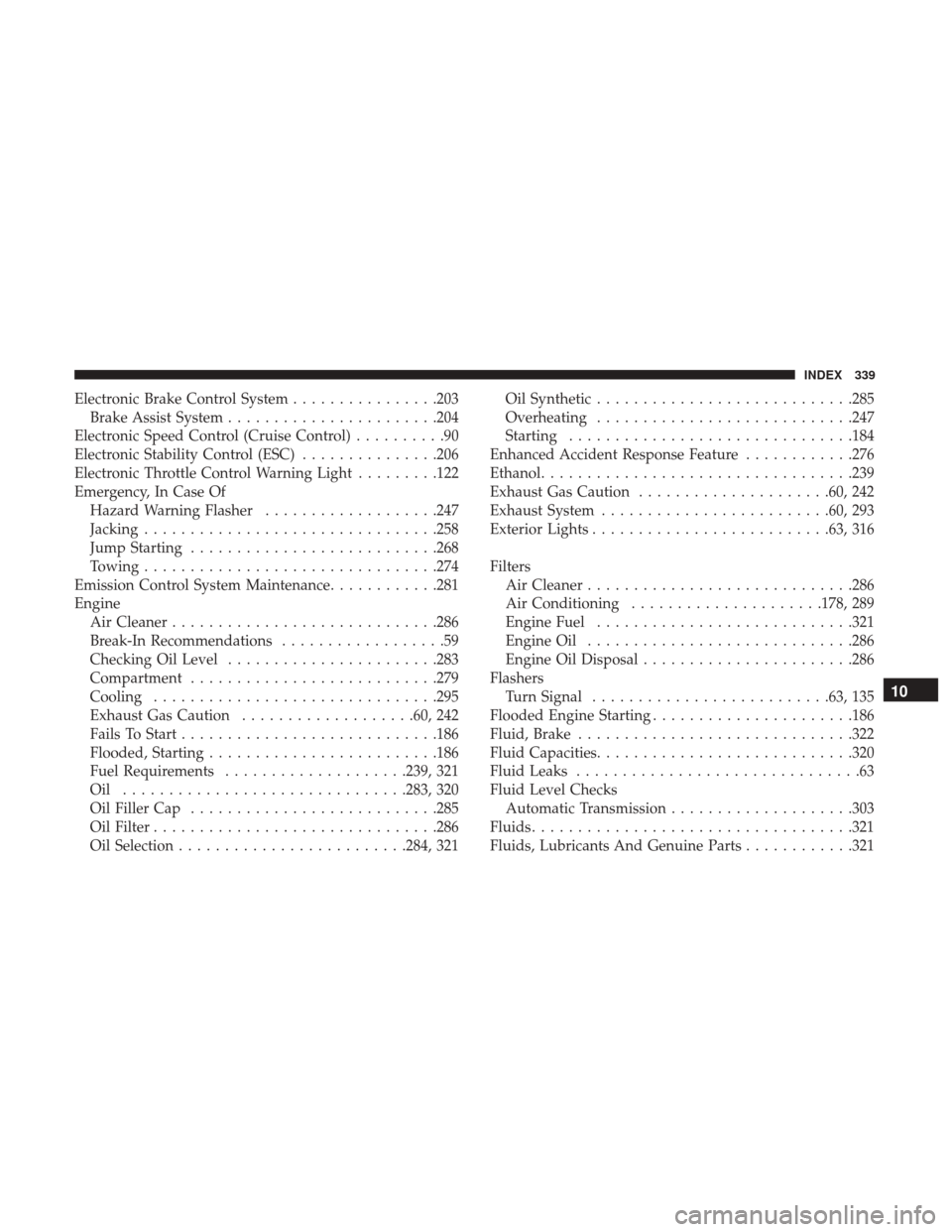
Electronic Brake Control System................203
Brake Assist System ...................... .204
Electronic Speed Control (Cruise Control) ..........90
Electronic Stability Control (ESC) ...............206
Electronic Throttle Control Warning Light .........122
Emergency, In Case Of Hazard Warning Flasher ...................247
Jacking ............................... .258
Jump Starting .......................... .268
Towing ............................... .274
Emission Control System Maintenance ............281
Engine Air Cleaner ............................ .286
Break-In Recommendations ..................59
Checking Oil Level ...................... .283
Compartment .......................... .279
Cooling .............................. .295
Exhaust Gas Caution ...................60, 242
Fails To Start ........................... .186
Flooded, Starting ........................ .186
Fuel Requirements ....................239, 321
Oil .............................. .283, 320
Oil Filler Cap .......................... .285
Oil Filter .............................. .286
Oil Selection ........................ .284, 321Oil Synthetic
........................... .285
Overheating ........................... .247
Starting .............................. .184
Enhanced Accident Response Feature ............276
Ethanol ................................. .239
Exhaust Gas Caution .....................60, 242
Exhaust System ........................ .60, 293
Exterior Lights ......................... .63, 316
Filters Air Cleaner ............................ .286
Air Conditioning .....................178, 289
Engine Fuel ........................... .321
Engine
Oil ............................ .286
Engine Oil Disposal ...................... .286
Flashers Turn Signal ......................... .63, 135
Flooded Engine Starting ..................... .186
Fluid, Brake ............................. .322
Fluid Capacities ........................... .320
Fluid Leaks ...............................63
Fluid Level Checks Automatic Transmission ....................303
Fluids .................................. .321
Fluids, Lubricants And Genuine Parts ............321
10
INDEX 339
Page 343 of 350
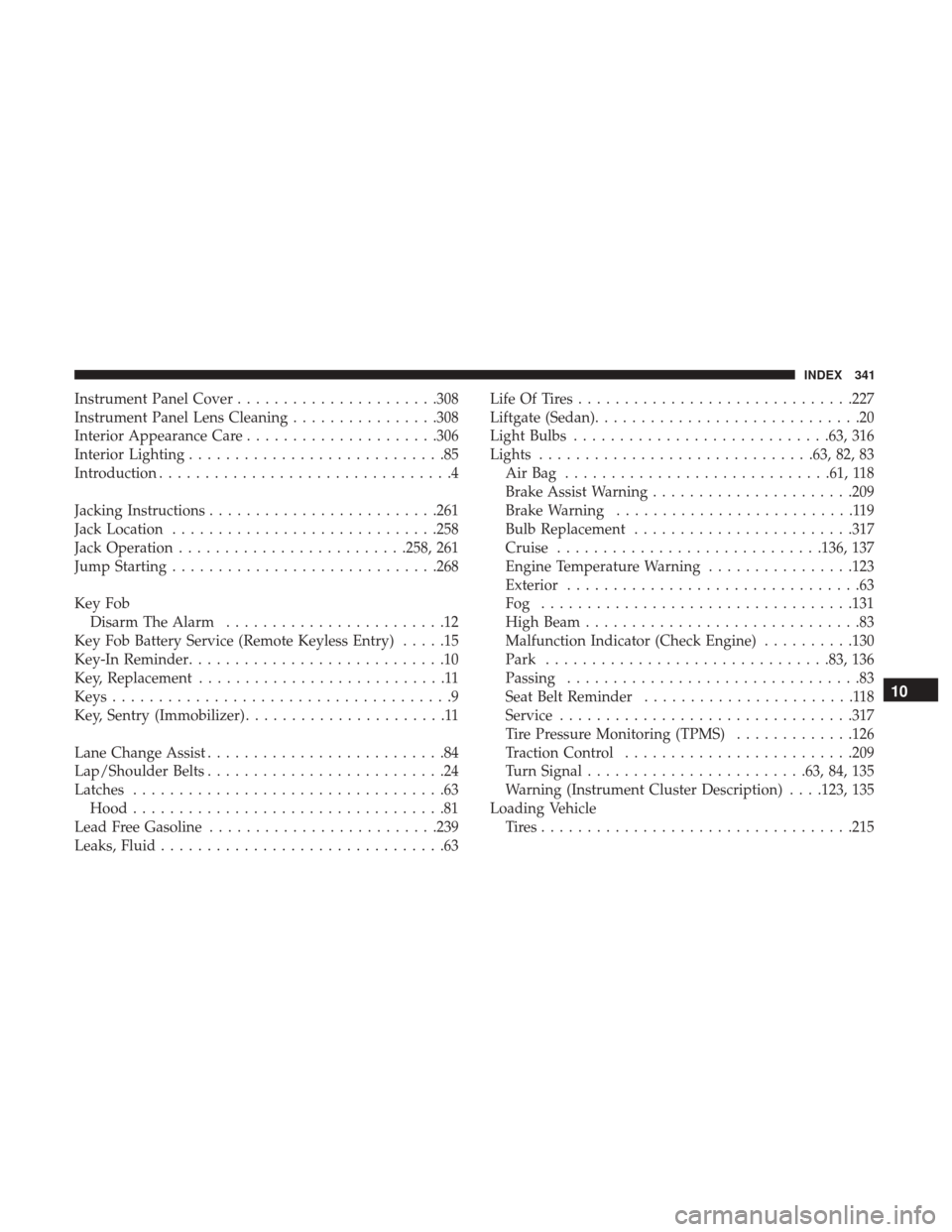
Instrument Panel Cover..................... .308
Instrument Panel Lens Cleaning ................308
Interior Appearance Care .....................306
Interior Lighting ............................85
Introduction ................................4
Jacking Instructions ........................ .261
Jack Location ............................ .258
Jack Operation ........................ .258, 261
Jump Starting ............................ .268
Key Fob Disarm The Alarm ........................12
Key Fob Battery Service (Remote Keyless Entry) .....15
Key-In Reminder ............................10
Key, Replacement ...........................11
Keys .....................................9
Key, Sentry (Immobilizer) ......................11
Lane Change Assist ..........................84
Lap/Shoulder Belts ..........................24
Latches ..................................63
Hood ..................................81
Lead Free Gasoline ........................ .239
Leaks, Fluid ...............................63 Life Of Tires
............................. .227
Liftgate (Sedan) .............................20
Light Bulbs ........................... .63, 316
Lights ............................. .63, 82, 83
AirBag ............................ .61, 118
Brake Assist Warning ..................... .209
Brake Warning ..........................119
Bulb Replacement ....................... .317
Cruise ............................ .136, 137
Engine Temperature Warning ................123
Exterior ................................63
Fog ................................. .131
High Beam ..............................83
Malfunction Indicator (Check Engine) ..........130
Park .............................. .83, 136
Passing ................................83
Seat Belt Reminder .......................118
Service ............................... .317
Tire Pressure Monitoring (TPMS) .............126
Traction Control ........................ .209
T
urn Signal ....................... .63, 84, 135
Warning (Instrument Cluster Description) . . . .123, 135
Loading Vehicle Tires................................. .215
10
INDEX 341