engine overheat FIAT 500 2017 2.G User Guide
[x] Cancel search | Manufacturer: FIAT, Model Year: 2017, Model line: 500, Model: FIAT 500 2017 2.GPages: 350, PDF Size: 3.01 MB
Page 296 of 350
Open seams or loose connections could permit exhaust
fumes to seep into the passenger compartment. In
addition, have the exhaust system inspected each time
the vehicle is raised for lubrication or oil change.
Replace as required.
WARNING!
•Exhaust gases can injure or kill. They contain
carbon monoxide (CO), which is colorless and
odorless. Breathing it can make you unconscious
and can eventually poison you. To avoid breath-
ing CO, refer to “Safety Tips/Exhaust Gas” in
“Things To Know Before Starting Your Vehicle”
for further information.
• A hot exhaust system can start a fire if you park
over materials that can burn. Such materials
might be grass or leaves coming into contact with
your exhaust system. Do not park or operate your
vehicle in areas where your exhaust system can
contact anything that can burn.
CAUTION!
• The catalytic converter requires the use of un-
leaded fuel only. Leaded gasoline will destroy the
effectiveness of the catalyst as an emissions con-
trol device and may seriously reduce engine per-
formance and cause serious damage to the engine.
• Damage to the catalytic converter can result if
your vehicle is not kept in proper operating
condition. In the event of engine malfunction,
particularly involving engine misfire or other
apparent loss of performance, have your vehicle
serviced promptly. Continued operation of your
vehicle with a severe malfunction could cause the
converter to overheat, resulting in possible dam-
age to the converter and vehicle.
Under normal operating conditions, the catalytic con-
verter will not require maintenance. However, it is
important to keep the engine properly tuned to assure
proper catalyst operation and prevent possible catalyst
damage.
NOTE: Intentional tampering with emissions control
systems can result in civil penalties being assessed
against you.
294 MAINTAINING YOUR VEHICLE
Page 297 of 350
In unusual situations involving grossly malfunctioning
engine operation, a scorching odor may suggest severe
and abnormal catalyst overheating. If this occurs, stop
the vehicle, turn off the engine and allow it to cool.
Service, including a tune-up to manufacturer’s specifi-
cations, should be obtained immediately.
To minimize the possibility of catalytic converter dam-
age:
•Do not shut off the engine or interrupt the ignition,
when the transmission is in gear and the vehicle is in
motion.
• Do not try to start the engine by pushing or towing
the vehicle.
• Do not idle the engine with any spark plug wires
disconnected or removed, such as when diagnostic
testing, or for prolonged periods during very rough
idle or malfunctioning operating conditions.Cooling System
WARNING!
• Turn vehicle off and disconnect the fan motor
lead before working near the radiator cooling fan.
• You or others can be badly burned by hot engine
coolant (antifreeze) or steam from your radiator. If
you see or hear steam coming from under the
hood, do not open the hood until the radiator has
had time to cool. Never open a cooling system
pressure cap when the radiator or coolant bottle is
hot.
• Keep hands, tools, clothing, and jewelry away
from the radiator cooling fan when the hood is
raised. The fan starts automatically and may start
at any time, whether the engine is running or not.
• When working near the radiator cooling fan,
disconnect the fan motor lead or turn the ignition
switch to the OFF position. The fan is temperature
controlled and can start at any time the ignition
switch is in the ON position.
• You or others can be badly burned by hot engine
coolant (antifreeze) or steam from your radiator.
(Continued)
7
MAINTAINING YOUR VEHICLE 295
Page 300 of 350
NOTE:
•It is the owner’s responsibility to maintain the proper
level of protection against freezing according to the
temperatures occurring in the area where the vehicle
is operated.
• Some vehicles require special tools to add coolant
properly. Failure to fill these systems properly could
lead to severe internal engine damage. If any coolant
is needed to be added to the system, please contact
your local authorized dealer.
• Mixing engine coolant (antifreeze) types is not rec-
ommended and can result in cooling system damage.
If HOAT and OAT coolant are mixed in an emer-
gency, have a authorized dealer drain, flush, and
refill with OAT coolant (conforming to MS.90032) as
soon as possible.
Cooling System Pressure Cap
The cap must be fully tightened to prevent loss of
engine coolant (antifreeze) and to ensure that engine
coolant (antifreeze) will return to the radiator from the
coolant recovery tank. The cap should be inspected and cleaned if there is any
accumulation of foreign material on the sealing sur-
faces.
WARNING!
•
Do not open hot engine cooling system. Never
add engine coolant (antifreeze) when the engine
is overheated. Do not loosen or remove the cap to
cool an overheated engine. Heat causes pressure
to build up in the cooling system. To prevent
scalding or injury, do not remove the pressure cap
while the system is hot or under pressure.
• Do not use a pressure cap other than the one
specified for your vehicle. Personal injury or
engine damage may result.
Disposal Of Used Engine Coolant
Used ethylene glycol-based engine coolant (antifreeze)
is a regulated substance requiring proper disposal.
Check with your local authorities to determine the
disposal rules for your community. To prevent ingestion
by animals or children, do not store ethylene glycol-
based engine coolant in open containers or allow it to
298 MAINTAINING YOUR VEHICLE
Page 341 of 350
Electronic Brake Control System................203
Brake Assist System ...................... .204
Electronic Speed Control (Cruise Control) ..........90
Electronic Stability Control (ESC) ...............206
Electronic Throttle Control Warning Light .........122
Emergency, In Case Of Hazard Warning Flasher ...................247
Jacking ............................... .258
Jump Starting .......................... .268
Towing ............................... .274
Emission Control System Maintenance ............281
Engine Air Cleaner ............................ .286
Break-In Recommendations ..................59
Checking Oil Level ...................... .283
Compartment .......................... .279
Cooling .............................. .295
Exhaust Gas Caution ...................60, 242
Fails To Start ........................... .186
Flooded, Starting ........................ .186
Fuel Requirements ....................239, 321
Oil .............................. .283, 320
Oil Filler Cap .......................... .285
Oil Filter .............................. .286
Oil Selection ........................ .284, 321Oil Synthetic
........................... .285
Overheating ........................... .247
Starting .............................. .184
Enhanced Accident Response Feature ............276
Ethanol ................................. .239
Exhaust Gas Caution .....................60, 242
Exhaust System ........................ .60, 293
Exterior Lights ......................... .63, 316
Filters Air Cleaner ............................ .286
Air Conditioning .....................178, 289
Engine Fuel ........................... .321
Engine
Oil ............................ .286
Engine Oil Disposal ...................... .286
Flashers Turn Signal ......................... .63, 135
Flooded Engine Starting ..................... .186
Fluid, Brake ............................. .322
Fluid Capacities ........................... .320
Fluid Leaks ...............................63
Fluid Level Checks Automatic Transmission ....................303
Fluids .................................. .321
Fluids, Lubricants And Genuine Parts ............321
10
INDEX 339
Page 345 of 350
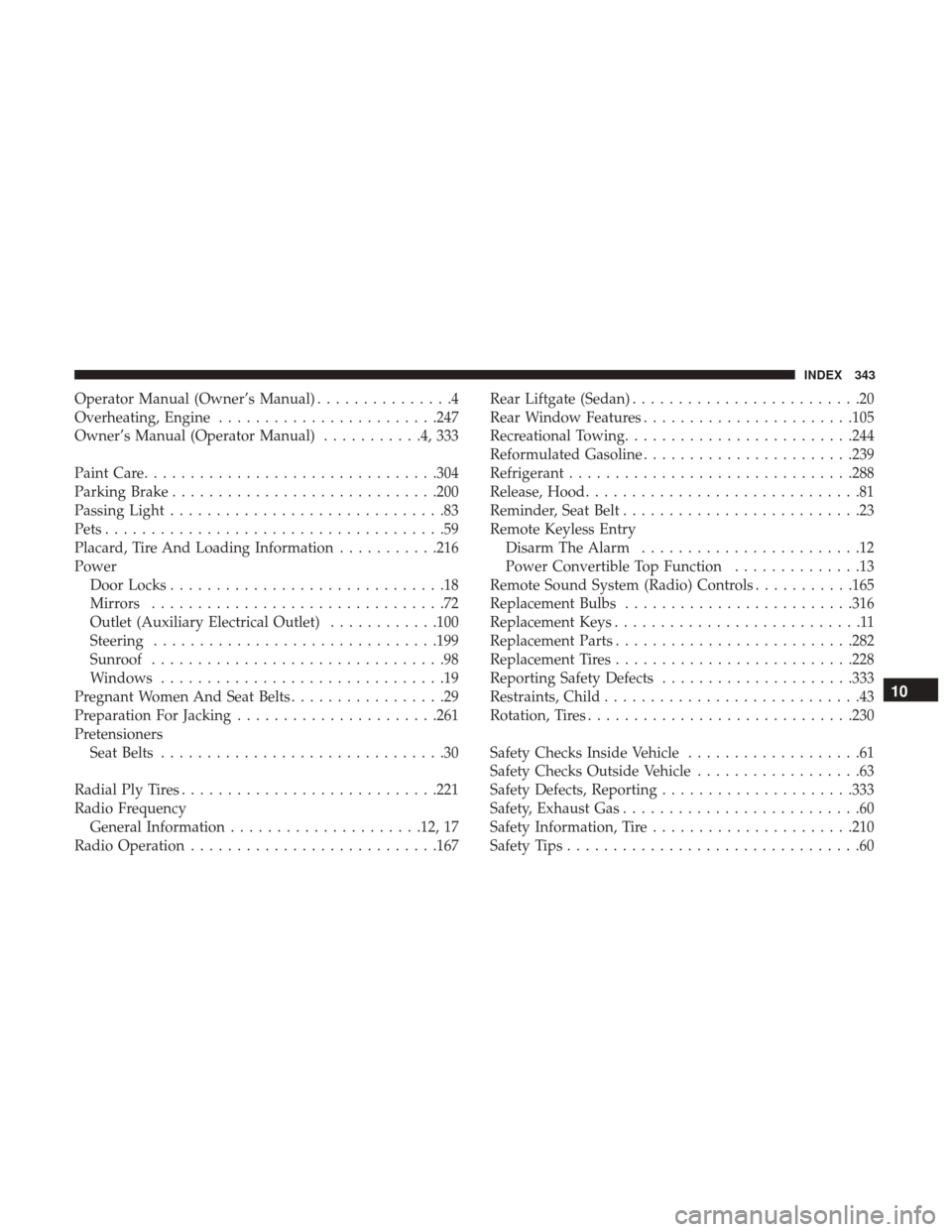
Operator Manual (Owner’s Manual)...............4
Overheating, Engine ....................... .247
Owner’s Manual (Operator Manual) ...........4,333
Paint Care ............................... .304
Parking Brake ............................ .200
Passing Light ..............................83
Pets .....................................59
Placard, Tire And Loading Information ...........216
Power Door Locks ..............................18
Mirrors ................................72
Outlet (Auxiliary Electrical Outlet) ............100
Steering .............................. .199
Sunroof ................................98
Windows ...............................19
Pregnant Women And Seat Belts .................29
Preparation For Jacking ..................... .261
Pretensioners Seat Belts ...............................30
Radial Ply Tires ........................... .221
Radio Frequency General Information .....................12, 17
Radio Operation .......................... .167Rear Liftgate (Sedan)
.........................20
Rear Window Features ...................... .105
Recreational Towing ........................ .244
Reformulated Gasoline ...................... .239
Refrigerant .............................. .288
Release, Hood ..............................81
Reminder, Seat Belt ..........................23
Remote Keyless Entry Disarm The Alarm ........................12
Power Convertible Top Function ..............13
Remote Sound System (Radio) Controls ...........165
Replacement Bulbs ........................ .316
Replacement Keys ...........................11
Replacement Parts ......................... .282
Replacement Tires ......................... .228
Reporting Safety Defects .....................333
Restraints, Child ............................43
Rotation, Tires ............................ .230
Safety Checks Inside Vehicle ...................61
Safety Checks Outside Vehicle ..................63
Safety
Defects, Reporting .....................333
Safety, Exhaust Gas ..........................60
Safety Information, Tire ..................... .210
Safety Tips ................................60
10
INDEX 343