Oil FIAT 500 2017 2.G Owner's Guide
[x] Cancel search | Manufacturer: FIAT, Model Year: 2017, Model line: 500, Model: FIAT 500 2017 2.GPages: 350, PDF Size: 3.01 MB
Page 296 of 350
Open seams or loose connections could permit exhaust
fumes to seep into the passenger compartment. In
addition, have the exhaust system inspected each time
the vehicle is raised for lubrication or oil change.
Replace as required.
WARNING!
•Exhaust gases can injure or kill. They contain
carbon monoxide (CO), which is colorless and
odorless. Breathing it can make you unconscious
and can eventually poison you. To avoid breath-
ing CO, refer to “Safety Tips/Exhaust Gas” in
“Things To Know Before Starting Your Vehicle”
for further information.
• A hot exhaust system can start a fire if you park
over materials that can burn. Such materials
might be grass or leaves coming into contact with
your exhaust system. Do not park or operate your
vehicle in areas where your exhaust system can
contact anything that can burn.
CAUTION!
• The catalytic converter requires the use of un-
leaded fuel only. Leaded gasoline will destroy the
effectiveness of the catalyst as an emissions con-
trol device and may seriously reduce engine per-
formance and cause serious damage to the engine.
• Damage to the catalytic converter can result if
your vehicle is not kept in proper operating
condition. In the event of engine malfunction,
particularly involving engine misfire or other
apparent loss of performance, have your vehicle
serviced promptly. Continued operation of your
vehicle with a severe malfunction could cause the
converter to overheat, resulting in possible dam-
age to the converter and vehicle.
Under normal operating conditions, the catalytic con-
verter will not require maintenance. However, it is
important to keep the engine properly tuned to assure
proper catalyst operation and prevent possible catalyst
damage.
NOTE: Intentional tampering with emissions control
systems can result in civil penalties being assessed
against you.
294 MAINTAINING YOUR VEHICLE
Page 303 of 350
NOTE:If your vehicle is equipped with a manual
transmission, the brake fluid reservoir supplies fluid to
both the brake system and the clutch release system.
The two systems are separated in the reservoir, and a
leak in one system will not affect the other system. The
manual transmission clutch release system should not
require fluid replacement during the life of the vehicle.
If the brake fluid reservoir is low and the brake system
does not indicate any leaks or other problems, it may be
a result of a leak in the hydraulic clutch release system.
See your local authorized dealer for service.
Use only manufacturer’s recommended brake fluid.
Refer to “Fluids, Lubricants, And Genuine Parts” in
“Maintaining Your Vehicle” for further information.
WARNING!
• Use only manufacturer’s recommended brake
fluid. Refer to “Fluids, Lubricants, And Genuine
Parts” in “Maintaining Your Vehicle” for further
information. Using the wrong type of brake fluid
can severely damage your brake system and/or
impair its performance. The proper type of brake
fluid for your vehicle is also identified on the
(Continued)
WARNING! (Continued)
original factory installed hydraulic master cylin-
der reservoir.
• To avoid contamination from foreign matter or
moisture, use only new brake fluid or fluid that
has been in a tightly closed container. Keep the
master cylinder reservoir cap secured at all times.
Brake fluid in a open container absorbs moisture
from the air resulting in a lower boiling point.
This may cause it to boil unexpectedly during
hard or prolonged braking, resulting in sudden
brake failure. This could result in a collision.
• Overfilling the brake fluid reservoir can result in
spilling brake fluid on hot engine parts, causing
the brake fluid to catch fire. Brake fluid can also
damage painted and vinyl surfaces, care should
be taken to avoid its contact with these surfaces.
• Do not allow petroleum-based fluid to contami-
nate the brake fluid. Brake seal components could
be damaged, causing partial or complete brake
failure. This could result in a collision.
7
MAINTAINING YOUR VEHICLE 301
Page 307 of 350
CAUTION!
•Do not use abrasive or strong cleaning materials
such as steel wool or scouring powder that will
scratch metal and painted surfaces.
•
Use of power washers exceeding 1,200 psi (8 274 kPa)
can result in damage or removal of paint and decals.
Special Care
• If you drive on salted or dusty roads or if you drive
near the ocean, hose off the undercarriage at least
once a month.
• It is important that the drain holes in the lower edges
of the doors, rocker panels, and trunk be kept clear
and open.
• If you detect any stone chips or scratches in the paint,
touch them up immediately. The cost of such repairs
is considered the responsibility of the owner.
• If your vehicle is damaged due to a collision or
similar cause that destroys the paint and protective
coating, have your vehicle repaired as soon as pos-
sible. The cost of such repairs is considered the
responsibility of the owner. •
If you carry special cargo such as chemicals, fertiliz-
ers, de-icer salt, etc., be sure that such materials are
well packaged and sealed.
• If a lot of driving is done on gravel roads, consider
mud or stone shields behind each wheel.
• Use MOPAR Touch Up Paint on scratches as soon as
possible. Your authorized dealer has touch up paint
to match the color of your vehicle.Wheel And Wheel Trim Care
• All wheels and wheel trim, especially aluminum and
chrome plated wheels, should be cleaned regularly
with a mild soap and water to prevent corrosion.
• To remove heavy soil and/or excessive brake dust,
use MOPAR Wheel Cleaner.
NOTE: If your vehicle is equipped with Dark Vapor or
Black Satin Chrome wheels DO NOT USE wheel clean-
ers, abrasives or polishing compounds. They will per-
manently damage this finish and such damage is not
covered by the New Vehicle Limited Warranty. USE
ONLY MILD SOAP AND WATER WITH A SOFT
CLOTH. Used on a regular basis this is all that is
required to maintain this finish.7
MAINTAINING YOUR VEHICLE 305
Page 308 of 350

CAUTION!
Do not use scouring pads, steel wool, a bristle
brush, or metal polishes. Do not use oven cleaner.
These products may damage the wheel’s protective
finish. Avoid automatic car washes that use acidic
solutions or harsh brushes that may damage the
wheel’s protective finish. Only MOPAR Wheel
Cleaner or equivalent is recommended.
Stain Repel Fabric Cleaning Procedure — If
Equipped
Stain Repel seats may be cleaned in the following
manner:
•Remove as much of the stain as possible by blotting
with a clean, dry towel.
• Blot any remaining stain with a clean, damp towel.
• For tough stains, apply MOPAR Total Clean, or a
mild soap solution to a clean, damp cloth and remove
stain. Use a fresh, damp towel to remove soap
residue. •
For grease stains, apply MOPAR Multi-Purpose
Cleaner to a clean, damp cloth and remove stain. Use
a fresh, damp towel to remove soap residue.
• Do not use any harsh solvents or any other form of
protectants on Stain Repel products.
Interior Care
Use MOPAR Total Clean to clean fabric upholstery and
carpeting.
Use MOPAR Total Clean to clean vinyl upholstery.
MOPAR Total Clean is specifically recommended for
leather upholstery.
Your leather upholstery can be best preserved by regular
cleaning with a damp soft cloth. Small particles of dirt can
act as an abrasive and damage the leather upholstery and
should be removed promptly with a damp cloth. Stub-
born soils can be removed easily with a soft cloth and
MOPAR Total Clean. Care should be taken to avoid
soaking your leather upholstery with any liquid. Please
do not use polishes, oils, cleaning fluids, solvents, deter-
gents, or ammonia-based cleaners to clean your leather
upholstery. Application of a leather conditioner is not
required to maintain the original condition.
306 MAINTAINING YOUR VEHICLE
Page 310 of 350
When cleaning the rear view mirror, spray cleaner on
the towel or cloth that you are using. Do not spray
cleaner directly on the mirror.
Instrument Panel Cover
The instrument panel cover has a low glare surface
which minimizes reflections on the windshield. Do not
use protectants or other products which may cause
undesirable reflections. Use soap and warm water to
restore the low glare surface.
Instrument Panel Bezels
CAUTION!
When installing hanging air fresheners in your
vehicle, read the installation instructions carefully.
Some air fresheners will damage the finish of
painted or decorated parts if allowed to directly
contact any surface.
Cleaning Plastic Instrument Cluster Lenses
The lenses in front of the instruments in this vehicle are
molded in clear plastic. When cleaning the lenses, care
must be taken to avoid scratching the plastic.
1. Clean with a wet soft cloth. A mild soap solutionmay be used, but do not use high alcohol content or
abrasive cleaners. If soap is used, wipe clean with a
clean damp cloth.
2. Dry with a soft cloth.
Seat Belt Maintenance
Do not bleach, dye or clean the belts with chemical
solvents or abrasive cleaners. This will weaken the
fabric. Sun damage can also weaken the fabric.
If the belts need cleaning, use a mild soap solution or
lukewarm water. Do not remove the belts from the
vehicle to wash them. Dry with a soft cloth.
Replace the belts if they appear frayed or worn or if the
buckles do not work properly.
NOTE: If the belts retract slowly, inspect the upper
turning loop for soiling. If soiling is present, clean with
a wet soft cloth until all residue is removed.
308 MAINTAINING YOUR VEHICLE
Page 322 of 350
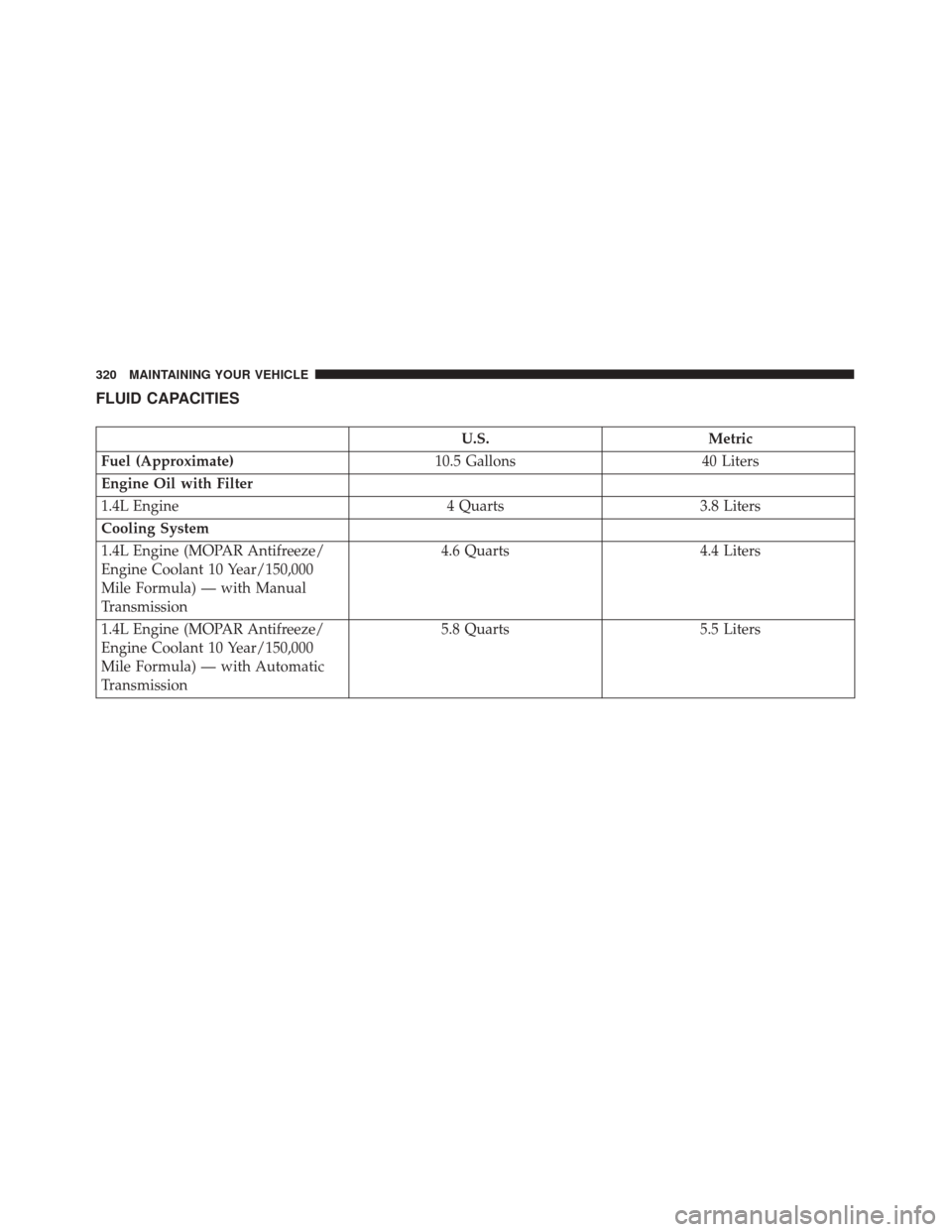
FLUID CAPACITIES
U.S.Metric
Fuel (Approximate) 10.5 Gallons40 Liters
Engine Oil with Filter
1.4L Engine 4 Quarts3.8 Liters
Cooling System
1.4L Engine (MOPAR Antifreeze/
Engine Coolant 10 Year/150,000
Mile Formula) — with Manual
Transmission 4.6 Quarts
4.4 Liters
1.4L Engine (MOPAR Antifreeze/
Engine Coolant 10 Year/150,000
Mile Formula) — with Automatic
Transmission 5.8 Quarts
5.5 Liters
320 MAINTAINING YOUR VEHICLE
Page 323 of 350
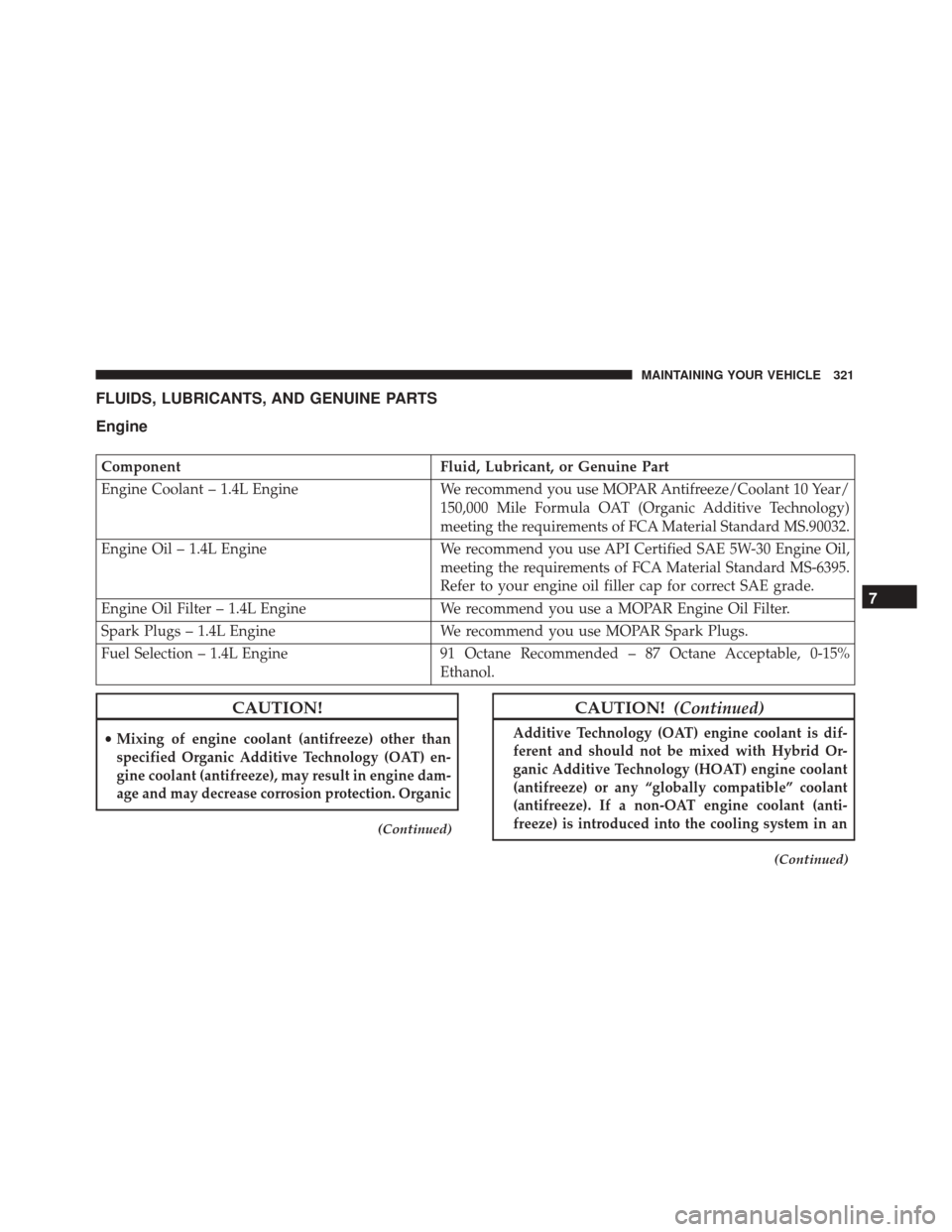
FLUIDS, LUBRICANTS, AND GENUINE PARTS
Engine
ComponentFluid, Lubricant, or Genuine Part
Engine Coolant – 1.4L Engine We recommend you use MOPAR Antifreeze/Coolant 10 Year/
150,000 Mile Formula OAT (Organic Additive Technology)
meeting the requirements of FCA Material Standard MS.90032.
Engine Oil – 1.4L Engine We recommend you use API Certified SAE 5W-30 Engine Oil,
meeting the requirements of FCA Material Standard MS-6395.
Refer to your engine oil filler cap for correct SAE grade.
Engine Oil Filter – 1.4L Engine We recommend you use a MOPAR Engine Oil Filter.
Spark Plugs – 1.4L Engine We recommend you use MOPAR Spark Plugs.
Fuel Selection – 1.4L Engine 91 Octane Recommended – 87 Octane Acceptable, 0-15%
Ethanol.
CAUTION!
•Mixing of engine coolant (antifreeze) other than
specified Organic Additive Technology (OAT) en-
gine coolant (antifreeze), may result in engine dam-
age and may decrease corrosion protection. Organic
(Continued)
CAUTION! (Continued)
Additive Technology (OAT) engine coolant is dif-
ferent and should not be mixed with Hybrid Or-
ganic Additive Technology (HOAT) engine coolant
(antifreeze) or any “globally compatible” coolant
(antifreeze). If a non-OAT engine coolant (anti-
freeze) is introduced into the cooling system in an
(Continued)
7
MAINTAINING YOUR VEHICLE 321
Page 326 of 350
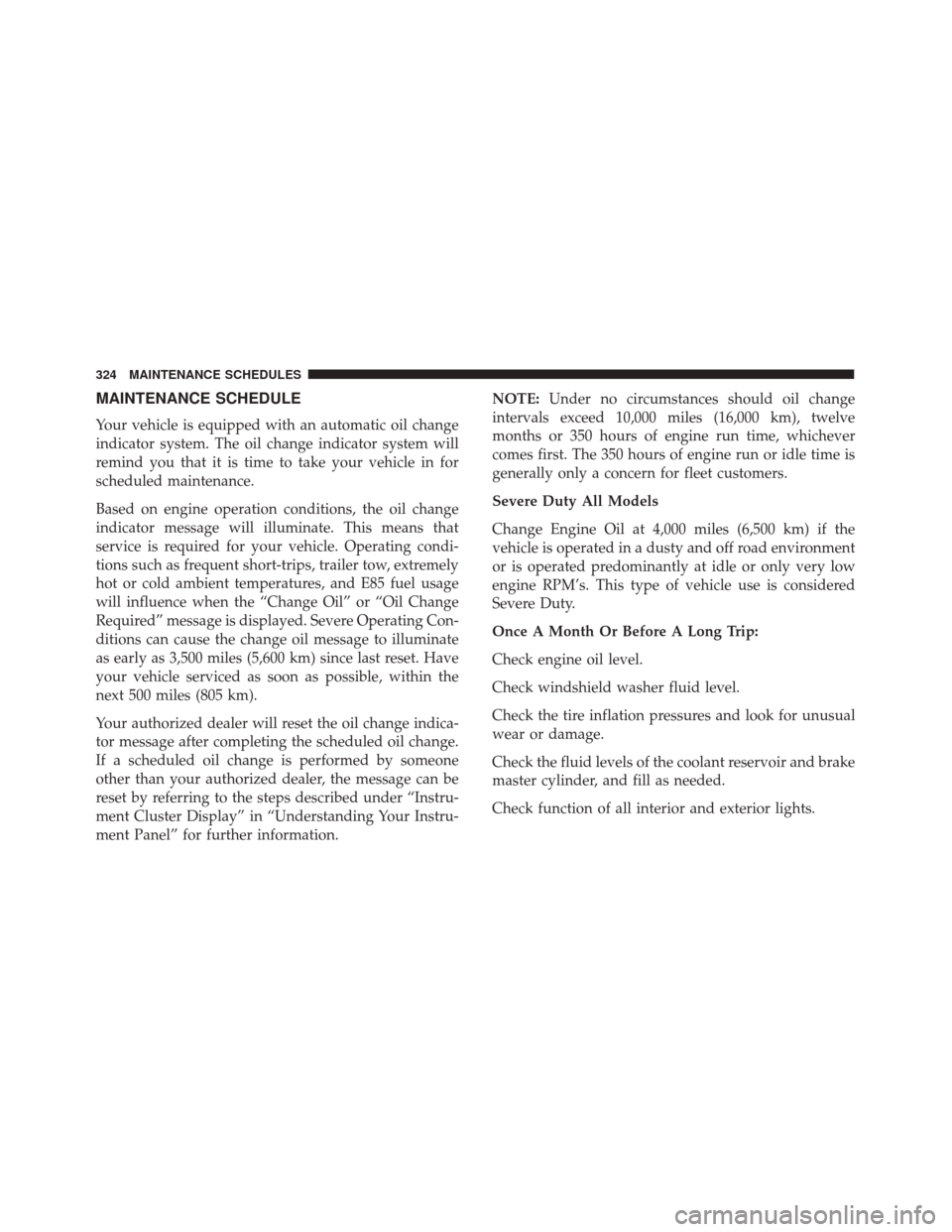
MAINTENANCE SCHEDULE
Your vehicle is equipped with an automatic oil change
indicator system. The oil change indicator system will
remind you that it is time to take your vehicle in for
scheduled maintenance.
Based on engine operation conditions, the oil change
indicator message will illuminate. This means that
service is required for your vehicle. Operating condi-
tions such as frequent short-trips, trailer tow, extremely
hot or cold ambient temperatures, and E85 fuel usage
will influence when the “Change Oil” or “Oil Change
Required” message is displayed. Severe Operating Con-
ditions can cause the change oil message to illuminate
as early as 3,500 miles (5,600 km) since last reset. Have
your vehicle serviced as soon as possible, within the
next 500 miles (805 km).
Your authorized dealer will reset the oil change indica-
tor message after completing the scheduled oil change.
If a scheduled oil change is performed by someone
other than your authorized dealer, the message can be
reset by referring to the steps described under “Instru-
ment Cluster Display” in “Understanding Your Instru-
ment Panel” for further information.NOTE:
Under no circumstances should oil change
intervals exceed 10,000 miles (16,000 km), twelve
months or 350 hours of engine run time, whichever
comes first. The 350 hours of engine run or idle time is
generally only a concern for fleet customers.
Severe Duty All Models
Change Engine Oil at 4,000 miles (6,500 km) if the
vehicle is operated in a dusty and off road environment
or is operated predominantly at idle or only very low
engine RPM’s. This type of vehicle use is considered
Severe Duty.
Once A Month Or Before A Long Trip:
Check engine oil level.
Check windshield washer fluid level.
Check the tire inflation pressures and look for unusual
wear or damage.
Check the fluid levels of the coolant reservoir and brake
master cylinder, and fill as needed.
Check function of all interior and exterior lights.
324 MAINTENANCE SCHEDULES
Page 327 of 350
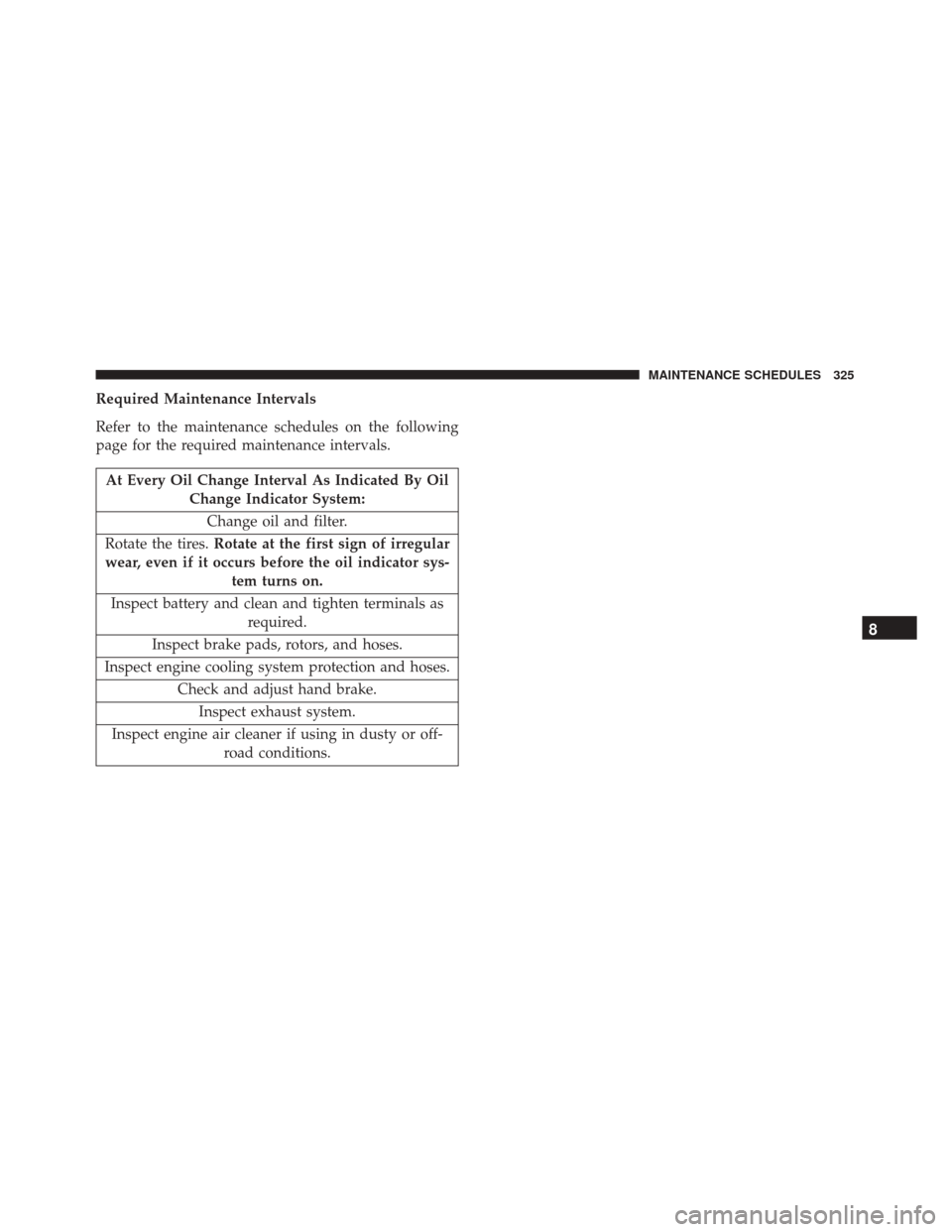
Required Maintenance Intervals
Refer to the maintenance schedules on the following
page for the required maintenance intervals.
At Every Oil Change Interval As Indicated By OilChange Indicator System:
Change oil and filter.
Rotate the tires. Rotate at the first sign of irregular
wear, even if it occurs before the oil indicator sys- tem turns on.
Inspect battery and clean and tighten terminals as required.
Inspect brake pads, rotors, and hoses.
Inspect engine cooling system protection and hoses. Check and adjust hand brake.Inspect exhaust system.
Inspect engine air cleaner if using in dusty or off- road conditions.
8
MAINTENANCE SCHEDULES 325
Page 338 of 350
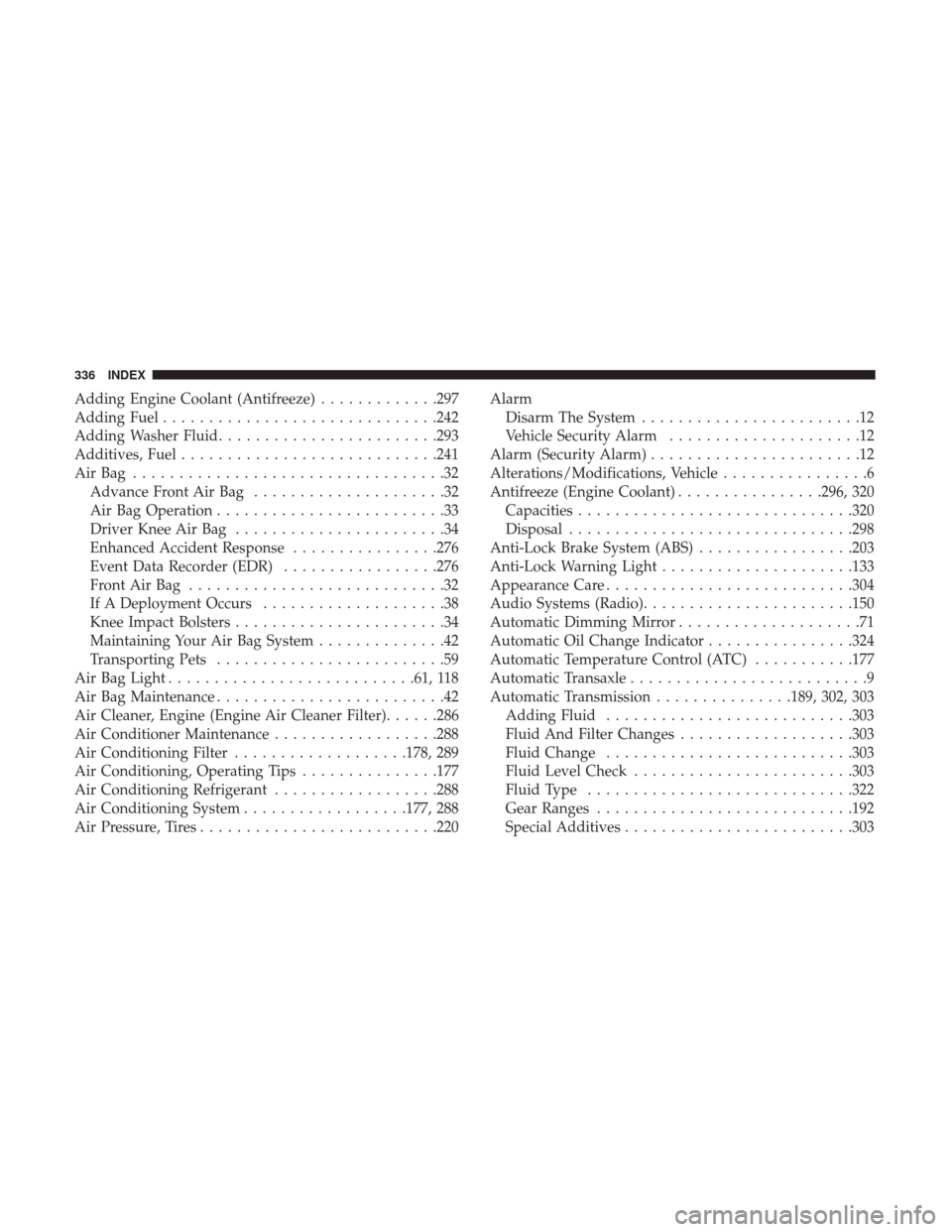
Adding Engine Coolant (Antifreeze).............297
Adding Fuel ............................. .242
Adding Washer Fluid ....................... .293
Additives, Fuel ........................... .241
AirBag ..................................32 Advance Front Air Bag .....................32
Air Bag Operation .........................33
Driver Knee Air Bag .......................34
Enhanced Accident Response ................276
Event Data Recorder (EDR) .................276
FrontAirBag ............................32
If A Deployment Occurs ....................38
Knee Impact Bolsters .......................34
Maintaining Your Air Bag System ..............42
Transporting Pets .........................59
Air Bag Light .......................... .61, 118
Air Bag Maintenance .........................42
Air Cleaner, Engine (Engine Air Cleaner Filter) ......286
Air Conditioner Maintenance ..................288
Air Conditioning Filter ...................178, 289
Air Conditioning, Operating Tips ...............177
Air Conditioning Refrigerant ..................288
Air Conditioning System ..................177, 288
Air Pressure, Tires ......................... .220Alarm
Disarm The System ........................12
Vehicle Security Alarm .....................12
Alarm (Security Alarm) .......................12
Alterations/Modifications, Vehicle ................6
Antifreeze (Engine Coolant) ................296, 320
Capacities ............................. .320
Disposal .............................. .298
Anti-Lock Brake System (ABS) .................203
Anti-Lock Warning Light .....................133
Appearance Care .......................... .304
Audio Systems (Radio) ...................... .150
Automatic Dimming Mirror ....................71
Automatic Oil Change Indicator ................324
Automatic Temperature Control (ATC) ...........177
Automatic Transaxle ..........................9
Automatic Transmission ...............189, 302, 303
Adding
Fluid .......................... .303
Fluid And Filter Changes ...................303
Fluid Change .......................... .303
Fluid Level Check ....................... .303
Fluid Type ............................ .322
Gear Ranges ........................... .192
Special Additives ........................ .303
336 INDEX