brake FIAT 500 2019 Owner handbook (in English)
[x] Cancel search | Manufacturer: FIAT, Model Year: 2019, Model line: 500, Model: FIAT 500 2019Pages: 228, PDF Size: 6.01 MB
Page 71 of 228
58) 59) 60) 61) 62) 63)
HH (Hill Holder) SYSTEM
This is an integral part of the ESC
system and facilitates starting on
slopes, activating automatically in the
following cases:
uphill: car stationary on a road with
a gradient higher than 5%, engine
running, brake pressed and gearbox in
neutral or gear (other than reverse)
engaged;
downhill: car stationary on a road
with a gradient higher than 5%, engine
running, brake pressed and reverse
gear engaged.
When setting off, the ESC system
control unit maintains the braking
pressure on the wheels until the engine
torque necessary for starting is
reached, or in any case for a maximum
of 2 seconds, allowing your right foot
to be moved easily from the brake
pedal to the accelerator.
When the 2 seconds have elapsed,
without starting, the system is
automatically deactivated, gradually
releasing the braking pressure.
During this release stage, the typical
mechanical brake release noise can be
heard, indicating that the car is about
to move.Moving the car on sloping roads
For optimal starting on very steep
gradients, as follows:
Press the brake pedal to activate the
Hill Holder;
completely press the clutch pedal;
engage the gear;
remove your foot from the brake
pedal;
completely press the accelerator
pedal.
In this manner, the engine goes to the
optimal rpm for taking off uphill. The Hill
Holder remains engaged (car braked)
until the clutch is gradually released
(holding the accelerator pedal pressed):
at this point, the system switches off
and the car starts moving. The Hill
Holder function switches off
automatically if the cars does not
take-off within 2 seconds.
The manoeuvre makes it possible to
avoid pressing the accelerator (because
it must remain fully pressed during the
manoeuvre) and to operate only the
clutch, by gradually releasing it.
Operating the handbrake is not
necessary.
On less steep gradients, the system is
active also with the accelerator pedal
not completely pressed.
64) 65)
ASR (AntiSlip
Regulation) SYSTEM
This is an integral part of the ESC
system and automatically operates in
the event of one or both drive wheels
slipping, loss of grip on wet roads
(aquaplaning) and acceleration
on slippery, snowy or icy roads, etc.
Depending on the slipping conditions,
two different control systems are
activated:
if the slipping involves both drive
wheels, the ASR system intervenes,
reducing the power transmitted by the
engine;
if the slipping only involves one of
the drive wheels, it also intervenes
automatically, braking the wheel that is
slipping.
System intervention
This is indicated by the flashing of the
warning light on the instrument panel,
to inform the driver that the car is in
critical stability and grip conditions.
69
Page 72 of 228
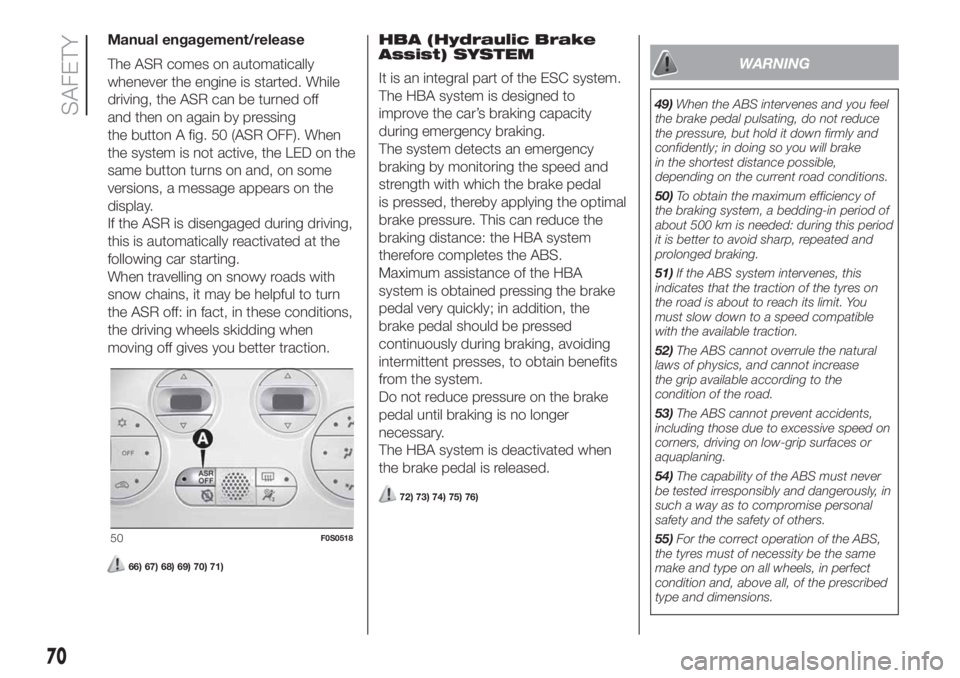
Manual engagement/release
The ASR comes on automatically
whenever the engine is started. While
driving, the ASR can be turned off
and then on again by pressing
the button A fig. 50 (ASR OFF). When
the system is not active, the LED on the
same button turns on and, on some
versions, a message appears on the
display.
If the ASR is disengaged during driving,
this is automatically reactivated at the
following car starting.
When travelling on snowy roads with
snow chains, it may be helpful to turn
the ASR off: in fact, in these conditions,
the driving wheels skidding when
moving off gives you better traction.
66) 67) 68) 69) 70) 71)
HBA (Hydraulic Brake
Assist) SYSTEM
It is an integral part of the ESC system.
The HBA system is designed to
improve the car’s braking capacity
during emergency braking.
The system detects an emergency
braking by monitoring the speed and
strength with which the brake pedal
is pressed, thereby applying the optimal
brake pressure. This can reduce the
braking distance: the HBA system
therefore completes the ABS.
Maximum assistance of the HBA
system is obtained pressing the brake
pedal very quickly; in addition, the
brake pedal should be pressed
continuously during braking, avoiding
intermittent presses, to obtain benefits
from the system.
Do not reduce pressure on the brake
pedal until braking is no longer
necessary.
The HBA system is deactivated when
the brake pedal is released.
72) 73) 74) 75) 76)
WARNING
49)When the ABS intervenes and you feel
the brake pedal pulsating, do not reduce
the pressure, but hold it down firmly and
confidently; in doing so you will brake
in the shortest distance possible,
depending on the current road conditions.
50)To obtain the maximum efficiency of
the braking system, a bedding-in period of
about 500 km is needed: during this period
it is better to avoid sharp, repeated and
prolonged braking.
51)If the ABS system intervenes, this
indicates that the traction of the tyres on
the road is about to reach its limit. You
must slow down to a speed compatible
with the available traction.
52)The ABS cannot overrule the natural
laws of physics, and cannot increase
the grip available according to the
condition of the road.
53)The ABS cannot prevent accidents,
including those due to excessive speed on
corners, driving on low-grip surfaces or
aquaplaning.
54)The capability of the ABS must never
be tested irresponsibly and dangerously, in
such a way as to compromise personal
safety and the safety of others.
55)For the correct operation of the ABS,
the tyres must of necessity be the same
make and type on all wheels, in perfect
condition and, above all, of the prescribed
type and dimensions.
50F0S0518
70
SAFETY
Page 73 of 228
56)If the space-saver wheel (where
provided) is used, the ABS system keeps
operating. Always remember that the
space-saver wheel, being smaller than the
original wheel, provides less grip.
57)The ABS gets the most from the
available grip, but it cannot improve it; you
should therefore take every care when
driving on slippery surfaces and not take
unnecessary risks.
58)For the correct operation of the ESC
system, the tyres must necessarily be
of the same make and type on all wheels,
in perfect condition and, above all, of
the prescribed type and size.
59)The ESC functions even when the
space-saver wheel is being used. Always
remember that the space-saver wheel,
being smaller than the original wheel,
provides less grip.
60)ESC performance features must not
induce the driver to take unnecessary
or unfounded risks. Your driving style must
always be suited to the road conditions,
visibility and traffic. The driver is always
responsible for road safety.
61)The ESC system cannot alter the
natural laws of physics, and cannot
increase grip, which depends on the
condition of the road.
62)The ESC system cannot prevent
accidents, including those due to excessive
speed on corners, driving on low-grip
surfaces or aquaplaning.
63)The capability of the ESC system must
never be tested irresponsibly and
dangerously, in such a way as to
compromise personal safety and the safety
of others.64)The HH system is not a parking brake,
therefore do not leave the vehicle without
activating the handbrake, switching off
the engine, and engaging first gear, with
the vehicle parked in safe conditions.
65)There may be situations on small
gradients (less than 8%), with car laden or
a trailer attached to it (where provided),
in which the HH system may not activate,
causing a slight reversing motion and
increasing the risk of collision with another
vehicle or object. The driver is, in any
case, responsible for safe driving.
66)For the correct operation of the ASR
system, it is essential that the tyres are
of the same make and type on all wheels,
in perfect condition and, above all, of
the specified type and dimensions.
67)If the space-saver wheel (where
provided) is used, the ASR system keeps
operating. Always remember that the
space-saver wheel, being smaller than the
original wheel, provides less grip.
68)The ASR cannot overrule the natural
laws of physics, and cannot increase
the grip available according to the
condition of the road.
69)The ASR system cannot prevent
accidents, including those due to excessive
speed on corners, driving on low-grip
surfaces or aquaplaning.
70)The capability of the ASR must never
be tested irresponsibly and dangerously, in
such a way as to compromise personal
safety and the safety of others.71)Do not take unnecessary risks, even if
your vehicle is fitted with an ASR system.
Your driving style must always be suited to
the road conditions, visibility and traffic.
The driver is always responsible for road
safety.
72)The HBA system cannot increase tyre
grip on the road over the limits imposed by
laws of physics: always drive carefully
according to the conditions of the road
surface.
73)The HBA system cannot prevent
accidents, including those due to excessive
speed on bends, travelling on low-grip
surfaces or aquaplaning.
74)The HBA system is an aid for the driver,
who must always pay full attention while
driving. The responsibility always rests with
the driver.
75)The capability of the HBA system must
never be tested irresponsibly and
dangerously in such a way as to
compromise the safety of the driver,
occupants or other road users.
76)When the HBA system intervenes,
noises may be heard from the system. This
is normal. In any case, while braking keep
the brake pedal firmly depressed.
71
Page 99 of 228
STARTING THE
ENGINE
121) 122)
36) 37) 39) 40)
Before starting the engine, adjust the
seat, the interior rear view mirrors,
the door mirrors and fasten the seat
belt correctly.
Never press the accelerator pedal for
starting the engine.
The Start&Stop, ECO and AUTO
functions are activated automatically
whenever the engine is started.
PETROL VERSIONS
Starting the engine
Proceed as follows:
engage the handbrake and put the
gear lever in neutral;
fully depress the clutch pedal
without touching the accelerator;
turn the ignition key to AVV and
release it as soon as the engine starts.
If the engine does not start at the
first attempt, return the ignition key to
STOP before repeating the starting
procedure.If, when the ignition key is at MAR, the
instrument panel warning light or the
symbol
remains lit together with
warning light
turn the key to STOP
and then back to MAR. If the warning
light remains on, try with the other keys
provided with the car.
Contact a Fiat Dealership if you still
cannot start the engine.
VERSIONS WITH
DUALOGIC
TRANSMISSION
123)
The system allows the engine to be
started both with a gear engaged and
with the transmission in neutral (N).
However, the brake pedal must always
be pressed first if neutral is not
engaged. It is therefore advisable to
position the gear lever at N before
starting the engine.
LPG VERSIONS
The engine always starts up on petrol
independently of the previously
selected mode.
38)
WARNING
121)It is dangerous to run the engine in
enclosed areas. The engine consumes
oxygen and engine exhaust contains
carbon dioxide, carbon monoxide and
other toxic gasses.
122)Remember that the brake servo and
electrical power steering system are not
operational until the engine is started,
therefore a greater effort will be required to
press the brake pedal or turn the steering
wheel.
123)If the engine fails to start with a gear
engaged, the potentially dangerous
situation due to the fact that the gearbox is
automatically placed in neutral will be
signalled by an acoustic signal.
WARNING
36)It is advisable not to demand maximum
performance from your car (e.g. excessive
acceleration, long distances at maximum
rpm, excessively intense braking, etc.)
when it is first used.
37)When the engine is switched off never
leave the key turned to MAR to prevent
useless current absorption from draining
the battery.
38)There must therefore always be
enough petrol in the tank to protect the
petrol pump and to guarantee temporary
switching from LPG to petrol operation.
97
Page 100 of 228
39)Never, under any circumstances, jump
start the engine by pushing, towing or
coasting downhill. This could cause fuel to
flow into the catalytic converter and
damage it beyond repair.
40)A quick burst on the accelerator before
stopping the engine serves no practical
purpose; it wastes fuel and is especially
damaging to turbocharged engines.PARKING THE
VEHICLE
When parking and leaving the car,
proceed as follows:
engage a gear (1stgear if facing
uphill or reverse if facing downhill) and
leave the wheels turned;
stop the engine and engage the
handbrake;
always remove the ignition key.
Block the wheels with a wedge or a
stone if the car is parked on a steep
slope.
Do not leave the ignition key on MAR to
avoid draining the battery. Always
remove the key when you leave the car.
Versions with Dualogic
transmission
To park safely it is essential to engage
1
stgear or reverse (R), with your foot on
the brake pedal and, if there is a
gradient, to operate the handbrake.
Before releasing the brake pedal, wait
until P appears on the display.
IMPORTANT NEVER leave the car with
the gearbox in neutral (or, on versions
equipped with automatic transmission,
before placing the gear lever at P).HANDBRAKE
124) 125) 126)
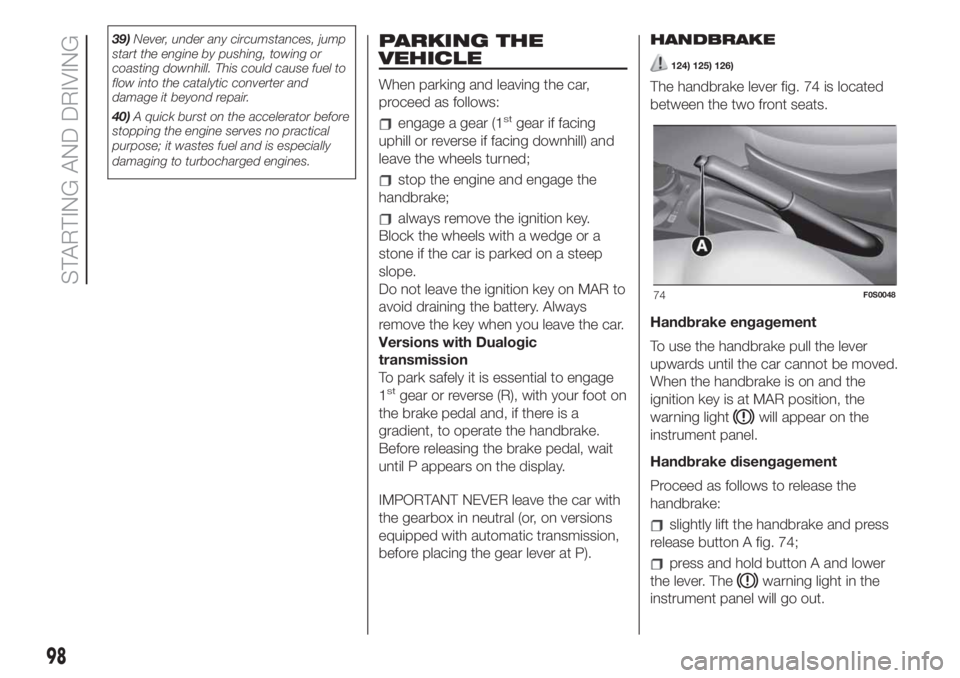
The handbrake lever fig. 74 is located
between the two front seats.
Handbrake engagement
To use the handbrake pull the lever
upwards until the car cannot be moved.
When the handbrake is on and the
ignition key is at MAR position, the
warning light
will appear on the
instrument panel.
Handbrake disengagement
Proceed as follows to release the
handbrake:
slightly lift the handbrake and press
release button A fig. 74;
press and hold button A and lower
the lever. The
warning light in the
instrument panel will go out.
74F0S0048
98
STARTING AND DRIVING
Page 101 of 228
Press the brake pedal when carrying
out this operation to prevent the car
from moving accidentally.
WARNING
124)The car should be braked after a few
clicks of the lever, if it is not, contact a
Fiat Dealership to have it adjusted.
125)Never leave children in the
unattended car. Always remove the ignition
key when leaving the car and take it out
with you.
126)In the case of parking manoeuvres on
roads on a gradient, the front wheels
must be steered towards the pavement
(when parking downhill), or in the opposite
direction if the vehicle is parked uphill.
Block the wheels with a wedge or a stone if
the car is parked on a steep slope.
MANUAL
TRANSMISSION
(for versions/markets, where provided)
127)
41)
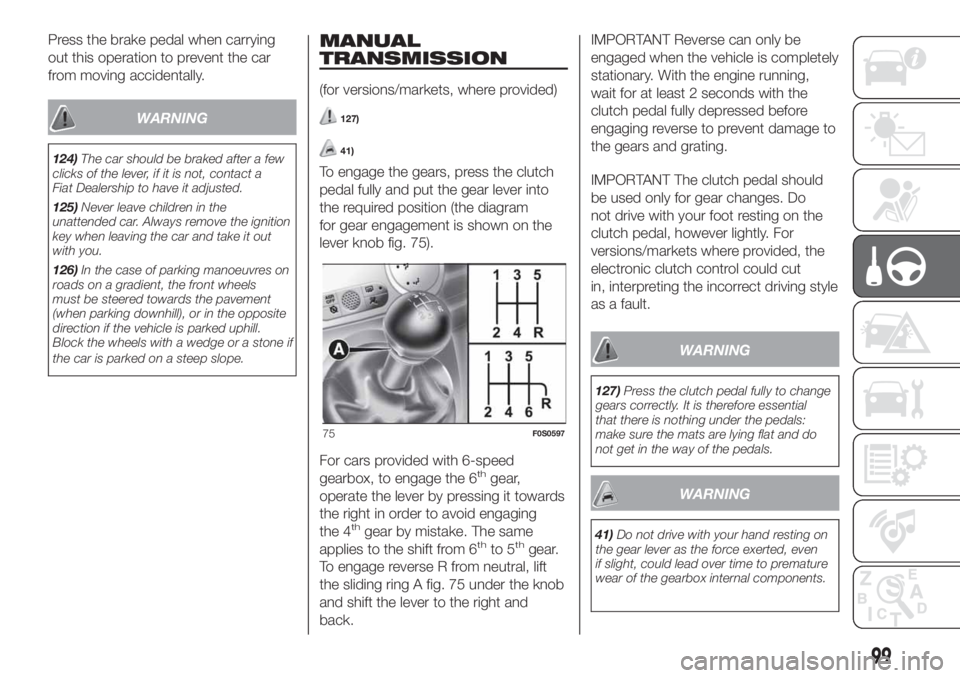
To engage the gears, press the clutch
pedal fully and put the gear lever into
the required position (the diagram
for gear engagement is shown on the
lever knob fig. 75).
For cars provided with 6-speed
gearbox, to engage the 6
thgear,
operate the lever by pressing it towards
the right in order to avoid engaging
the 4
thgear by mistake. The same
applies to the shift from 6thto 5thgear.
To engage reverse R from neutral, lift
the sliding ring A fig. 75 under the knob
and shift the lever to the right and
back.IMPORTANT Reverse can only be
engaged when the vehicle is completely
stationary. With the engine running,
wait for at least 2 seconds with the
clutch pedal fully depressed before
engaging reverse to prevent damage to
the gears and grating.
IMPORTANT The clutch pedal should
be used only for gear changes. Do
not drive with your foot resting on the
clutch pedal, however lightly. For
versions/markets where provided, the
electronic clutch control could cut
in, interpreting the incorrect driving style
as a fault.
WARNING
127)Press the clutch pedal fully to change
gears correctly. It is therefore essential
that there is nothing under the pedals:
make sure the mats are lying flat and do
not get in the way of the pedals.
WARNING
41)Do not drive with your hand resting on
the gear lever as the force exerted, even
if slight, could lead over time to premature
wear of the gearbox internal components.
75F0S0597
99
Page 102 of 228
DUALOGIC
TRANSMISSION
(for versions/markets, where provided)
42) 44)
OPERATING MODE
MANUAL MODE
In this mode, the driver decides when
to shift gear;
Proceed as follows:
press the brake pedal;
start the engine;
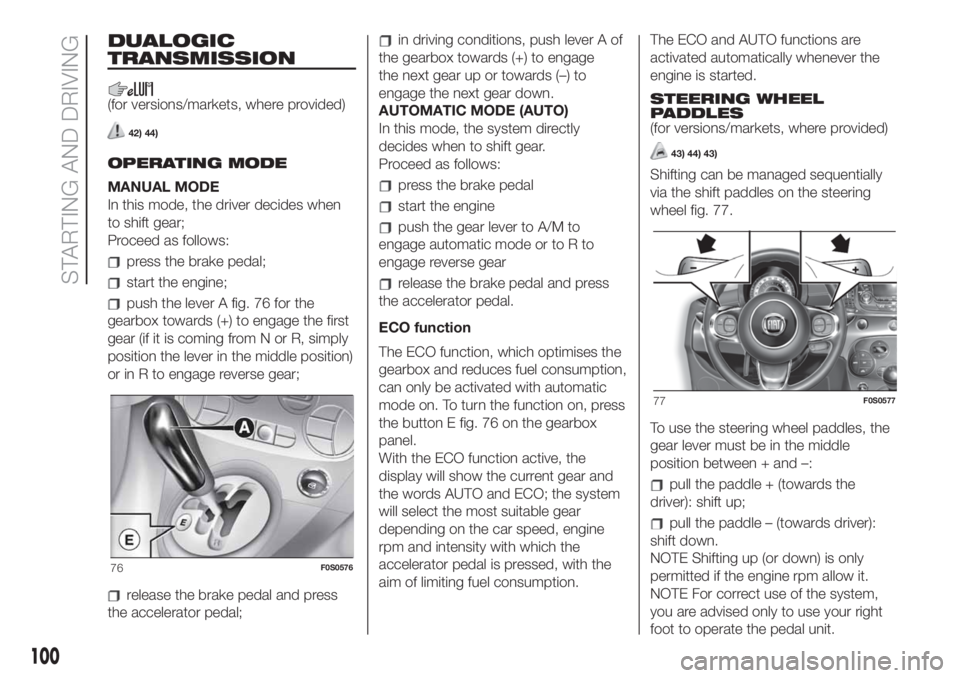
push the lever A fig. 76 for the
gearbox towards (+) to engage the first
gear (if it is coming from N or R, simply
position the lever in the middle position)
or in R to engage reverse gear;
release the brake pedal and press
the accelerator pedal;
in driving conditions, push lever A of
the gearbox towards (+) to engage
the next gear up or towards (–) to
engage the next gear down.
AUTOMATIC MODE (AUTO)
In this mode, the system directly
decides when to shift gear.
Proceed as follows:
press the brake pedal
start the engine
push the gear lever to A/M to
engage automatic mode or to R to
engage reverse gear
release the brake pedal and press
the accelerator pedal.
ECO function
The ECO function, which optimises the
gearbox and reduces fuel consumption,
can only be activated with automatic
mode on. To turn the function on, press
the button E fig. 76 on the gearbox
panel.
With the ECO function active, the
display will show the current gear and
the words AUTO and ECO; the system
will select the most suitable gear
depending on the car speed, engine
rpm and intensity with which the
accelerator pedal is pressed, with the
aim of limiting fuel consumption.The ECO and AUTO functions are
activated automatically whenever the
engine is started.
STEERING WHEEL
PADDLES
(for versions/markets, where provided)
43) 44) 43)
Shifting can be managed sequentially
via the shift paddles on the steering
wheel fig. 77.
To use the steering wheel paddles, the
gear lever must be in the middle
position between + and –:
pull the paddle + (towards the
driver): shift up;
pull the paddle – (towards driver):
shift down.
NOTE Shifting up (or down) is only
permitted if the engine rpm allow it.
NOTE For correct use of the system,
you are advised only to use your right
foot to operate the pedal unit.
76F0S0576
77F0S0577
100
STARTING AND DRIVING
Page 104 of 228
129)Before starting any servicing
operation, stop the engine and remove the
key from the ignition switch to operate
the steering lock, particularly when the
wheels do not touch the ground. If this is
not possible (for example if the key needs
to be turned to MAR or the engine must be
running), remove the main fuse that
protects the electric power steering.START&STOP
SYSTEM
130) 131) 132) 133)
46)
(for versions/markets, where provided)
The Start&Stop system automatically
stops the engine each time the car
is stationary and starts it again when
the driver wants to move off.
In this way, the vehicle efficiency is
increased, by reducing consumption,
dangerous gas emissions and sound
pollution.
OPERATING MODE
Stopping the engine
With manual transmission: with the car
stationary, the engine stops with the
transmission in neutral and the clutch
pedal released.
With Dualogic gearbox: the engine
stops if the car is at a standstill and the
brake pedal is pressed. This condition
can be maintained even if the brake
pedal is not depressed, if the gear lever
is in position N (Neutral).NOTE The engine can only be stopped
automatically over about 10 km/h, to
prevent the engine from being
repeatedly stopped when driving at
walking pace.
Stopping of the engine is indicated by
the warning light or the symbol
on
the instrument panel switching on
(on some versions, together with a
message on the display).
Restarting the engine
With manual transmission: press the
clutch pedal.
With Dualogic gearbox: if the gear lever
is in position N (Neutral), place it in
any other gear, otherwise release the
brake pedal or move the gear lever
to+,–or R (Reverse).
MANUAL SYSTEM
ACTIVATION/
DEACTIVATION
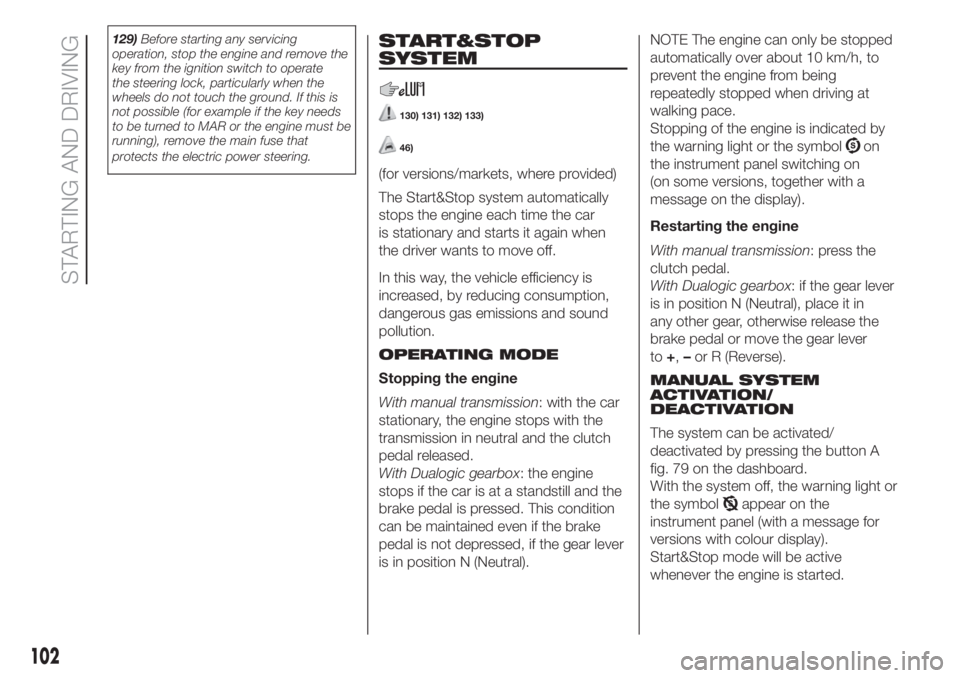
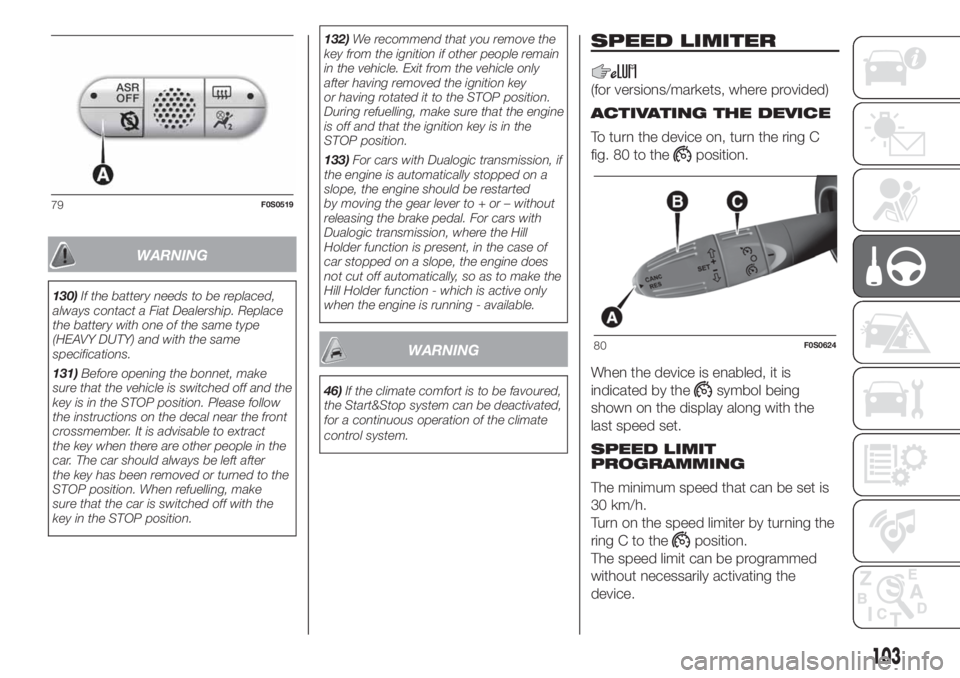
The system can be activated/
deactivated by pressing the button A
fig. 79 on the dashboard.
With the system off, the warning light or
the symbol
appear on the
instrument panel (with a message for
versions with colour display).
Start&Stop mode will be active
whenever the engine is started.
102
STARTING AND DRIVING
Page 105 of 228
WARNING
130)If the battery needs to be replaced,
always contact a Fiat Dealership. Replace
the battery with one of the same type
(HEAVY DUTY) and with the same
specifications.
131)Before opening the bonnet, make
sure that the vehicle is switched off and the
key is in the STOP position. Please follow
the instructions on the decal near the front
crossmember. It is advisable to extract
the key when there are other people in the
car. The car should always be left after
the key has been removed or turned to the
STOP position. When refuelling, make
sure that the car is switched off with the
key in the STOP position.132)We recommend that you remove the
key from the ignition if other people remain
in the vehicle. Exit from the vehicle only
after having removed the ignition key
or having rotated it to the STOP position.
During refuelling, make sure that the engine
is off and that the ignition key is in the
STOP position.
133)For cars with Dualogic transmission, if
the engine is automatically stopped on a
slope, the engine should be restarted
by moving the gear lever to + or – without
releasing the brake pedal. For cars with
Dualogic transmission, where the Hill
Holder function is present, in the case of
car stopped on a slope, the engine does
not cut off automatically, so as to make the
Hill Holder function - which is active only
when the engine is running - available.
WARNING
46)If the climate comfort is to be favoured,
the Start&Stop system can be deactivated,
for a continuous operation of the climate
control system.
SPEED LIMITER
(for versions/markets, where provided)
ACTIVATING THE DEVICE
To turn the device on, turn the ring C
fig. 80 to the
position.
When the device is enabled, it is
indicated by the
symbol being
shown on the display along with the
last speed set.
SPEED LIMIT
PROGRAMMING
The minimum speed that can be set is
30 km/h.
Turn on the speed limiter by turning the
ring C to the
position.
The speed limit can be programmed
without necessarily activating the
device.
79F0S0519
80F0S0624
103
Page 107 of 228
ELECTRONIC
CRUISE CONTROL
(for versions/markets, where provided)
This device can be used at speeds
higher than 30 km/h
ACTIVATING THE DEVICE
134) 135) 136)
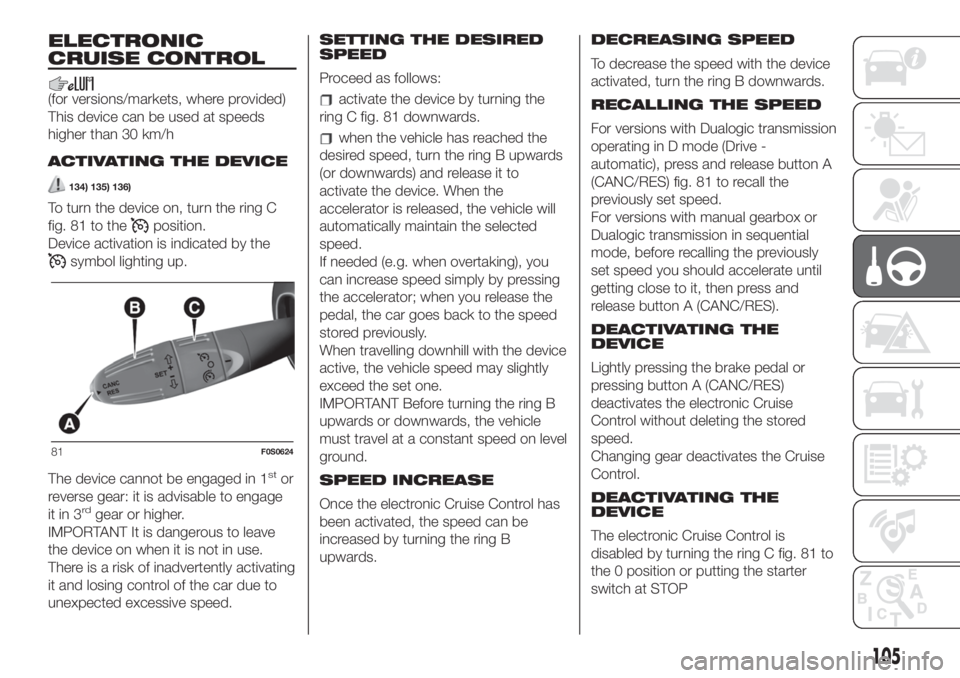
To turn the device on, turn the ring C
fig. 81 to the
position.
Device activation is indicated by the
symbol lighting up.
The device cannot be engaged in 1
stor
reverse gear: it is advisable to engage
it in 3
rdgear or higher.
IMPORTANT It is dangerous to leave
the device on when it is not in use.
There is a risk of inadvertently activating
it and losing control of the car due to
unexpected excessive speed.SETTING THE DESIRED
SPEED
Proceed as follows:
activate the device by turning the
ring C fig. 81 downwards.
when the vehicle has reached the
desired speed, turn the ring B upwards
(or downwards) and release it to
activate the device. When the
accelerator is released, the vehicle will
automatically maintain the selected
speed.
If needed (e.g. when overtaking), you
can increase speed simply by pressing
the accelerator; when you release the
pedal, the car goes back to the speed
stored previously.
When travelling downhill with the device
active, the vehicle speed may slightly
exceed the set one.
IMPORTANT Before turning the ring B
upwards or downwards, the vehicle
must travel at a constant speed on level
ground.
SPEED INCREASE
Once the electronic Cruise Control has
been activated, the speed can be
increased by turning the ring B
upwards.DECREASING SPEED
To decrease the speed with the device
activated, turn the ring B downwards.
RECALLING THE SPEED
For versions with Dualogic transmission
operating in D mode (Drive -
automatic), press and release button A
(CANC/RES) fig. 81 to recall the
previously set speed.
For versions with manual gearbox or
Dualogic transmission in sequential
mode, before recalling the previously
set speed you should accelerate until
getting close to it, then press and
release button A (CANC/RES).
DEACTIVATING THE
DEVICE
Lightly pressing the brake pedal or
pressing button A (CANC/RES)
deactivates the electronic Cruise
Control without deleting the stored
speed.
Changing gear deactivates the Cruise
Control.
DEACTIVATING THE
DEVICE
The electronic Cruise Control is
disabled by turning the ring C fig. 81 to
the 0 position or putting the starter
switch at STOP
81F0S0624
105